



Abstract
We report additional fossil evidence for pygoscelid penguins breeding on King George (25 de Mayo) Island, South Shetland Islands, in the Holocene beginning at ~7000 cal. yr BP. This evidence comes from a raised marine beach deposit formerly studied and described as Pingfo I at Stranger Point, Potter Peninsula. We relocated and exposed deposits at this site and recovered additional samples of penguin bones from five stratigraphic beds that are redescribed here. Most of these bones are from juvenile penguins and exhibit little or no wear indicating minimal transport to the beach deposits. Some of the bones are developed enough to be identifiable to Adélie (Pygoscelis adeliae), Gentoo (Pygoscelis papua), and Chinstrap (Pygoscelis antarctica) penguins, indicating that all three species were breeding at Stranger Point from ~7320 to 4865 cal. yr BP. This breeding occupation corresponds with the first warming and deglaciation that occurred in the northern Antarctic Peninsula by this time and ends with the onset of reglaciation of the Peninsula. At least 31 abandoned penguin mounds and ornithogenic soils also were located and sampled at Stranger Point and indicate that the current occupation of this area by all three pygoscelid penguins dates no older than ~535 cal. yr BP. The absence of ornithogenic soils from earlier Holocene breeding was probably due to glacial activity and soil solifluction during periods of warming in the mid to late Holocene.
Keywords
Introduction
Three pygoscelid penguin species (Adélie, Gentoo, and Chinstrap penguins) are widely distributed at breeding colonies throughout the northern Antarctic Peninsula. Despite this presence, radiocarbon dates on penguin tissues from ornithogenic soils at active and abandoned colonies so far indicate a relatively young age for these sites at ~1100 BP for Gentoo penguins (Pygoscelis papua), and only 500–600 BP for Adélie (Pygoscelis adeliae) and Chinstrap (Pygoscelis antarctica) penguins (Emslie et al., 2011, 2018). However, older beach and lake deposits have produced pygoscelid penguin bones dating to the early to middle Holocene on Ardley and King George Islands, South Shetland Islands. The absence of ornithogenic soils in the northern Antarctic Peninsula that provide direct evidence of former breeding colonies earlier than the late Holocene, though, remain absent. In the Ross Sea and East Antarctica, however, ornithogenic soils have been identified as old as 27,000 BP (Baroni and Orombelli, 1994; Emslie et al., 2007). This mismatch in age of ornithogenic soils and the penguin fossil record in the northern Antarctic Peninsula does not occur in other regions of Antarctica and has been referred to as the ‘northern enigma’ (Emslie et al., 2018).
Here, we investigated the Holocene record of pygoscelid penguins at Stranger Point, King George (25 de Mayo) Island, in austral summer 2017–2018. Currently, Stranger Point is occupied by a modest colony of Adélie and Gentoo penguins (3700 and 4990 breeding pairs, respectively, Juáres et al., 2016) as well as a small cluster of Chinstrap penguins (only five nests in 2017–2018). Abandoned penguin mounds were first identified at Stranger Point by Tatur and Myrcha (1989). One radiocarbon age of guano near an abandoned nesting site on an elevated cliff and a lichenometric age suggested abandonment on the highest cliffs by 500 years ago (Tatur et al., 1997). A preliminary ground survey of this area in 2017–2018 indicated at least 20 abandoned pebble mounds were present on two beach terraces immediately above the active Adélie penguin colony. Additional mounds were later found on a terrace above the beach at an elevation of 47–50 m a.s.l.. We surveyed and sampled these abandoned mounds, as well as two of the active Adélie penguin colonies, to recover penguin bones and egg membrane to determine their age and to reconstruct the occupation history of penguins currently breeding at Stranger Point.
In addition, a middle-Holocene marine beach deposit (Pingfo I) described by Del Valle et al. (2002) on the southwest side of Stranger Point was relocated and resampled in 2017–2018. The sampling by Del Valle et al. (2002) produced numerous bones of penguins and marine mammals, as well as well-preserved remains of seaweed. The penguin bones also were well-preserved indicating minimal transport to the site of deposition (little to no erosion due to reworking; Montalti et al., 2009). The spongy and porous nature of the penguin bones at time of death are characteristic of juvenile penguins and thus evidence for a nearby colony where they died before fledging. Bones of both Adélie and Gentoo penguin were identified in this collection, but no additional radiocarbon dating was completed (Montalti et al., 2009). Our objective was to resample and redescribe the fossil-bearing beds at this site and obtain additional bones for identification and radiocarbon dating for this earlier occupation of Stranger Point.
Materials and methods
Ground surveys for abandoned penguin colonies and ornithogenic soils were conducted at Stranger Point in January/February 2018 (Figure 1). Abandoned pebble mounds formed from penguin nests were located and mapped with a handheld Garmin GPSmap 78s. All points were uploaded to Google Earth Pro (Figure 2).

Map of the Antarctic Peninsula (left) showing locations of islands discussed in the text and detail of King George (25 de Mayo) Island (right) showing locations of sites.

Google Earth image of Stranger Point, Potter Peninsula, King George (25 de Mayo) Island, showing the location of abandoned penguin mounds (M1–M31) recorded in January 2018 as well as the location of current breeding sites for Adélie Penguins that were sampled (B3 and I9) and the Pingfo I fossil site. Map data: Google, DigitalGlobe 2017.
Two pebble mounds, one on the lower beach and one on the upper terrace, were excavated at Stranger Point to recover penguin remains for analysis. Excavations were completed following the methods of Emslie et al. (2018). A 1 × 1 or 0.5 × 0.5 m test pit was placed on each mound and excavated in arbitrary 5 cm levels until reaching the bottom of the ornithogenic deposits, or until permafrost prevented further excavation. All excavated soils were screened onto a large plastic tarp in the field through stacked 0.64 and 0.32 cm2 mesh screens to remove large rocks, pebbles, and other debris. Sediments from the top screen were sorted to recover organic remains in the field. Sediments from the lower screen were placed into bags for screen washing in the lab and then sorted to recover all organic remains. In this manner, bone, feather, eggshell and egg membrane, and any prey remains (fish bones, otoliths, and squid beaks) could be recovered from each level. Excavations ended when reaching the bottom of the ornithogenic soils, recognized by a change in soil color and texture, or when permafrost prevented further excavation.
Two active Adélie penguin colonies at Stranger Point also were sampled by excavating a small pit into the fresh ornithogenic soil to expose a profile of the deposits, after which penguin tissues were recovered from the bottom most level where the soil contacts natural beach deposits. The two colonies were located within the current penguin monitoring grid system on the southwest (B3) and southeast (I9) sides of Stranger Point (Figure 2). Recovered penguin tissues were radiocarbon dated to determine a minimum age of these currently active colonies.
Radiocarbon dating of penguin bone, feather, and egg membrane was completed at Woods Hole National Ocean Sciences Accelerator Mass Spectrometry (NOSAMS) facility and are designated by OS numbers. All uncorrected dates in radiocarbon years before present (14C yr BP) were corrected for the marine carbon reservoir effect using a ΔR of 700 ± 50 years (see Emslie, 2001) and calibrated using Calib 7.0.4 software (Stuiver and Reimer, 1993) and the Marine13 calibration curve to provide a 2σ range for each date in calendar years before present (cal. yr BP).
Results
Abandoned pebble mounds (penguin nest sites)
A total of 31 pebble mounds were located on the beach terrace and upper terrace at Stranger Point (Figure 2). All mounds are assumed to be former breeding sites for Adélie penguins due to their proximity to current breeding sites of this species. Of these, two were excavated by 5 cm levels to recover bones, eggshell, and other tissues for radiocarbon dating. One large mound (M4) was selected for excavation on the beach due to its size and apparent depth, plus presence of lichens on surface pebbles suggesting an older age for this mound compared with others. After removing surface pebbles from a 1 × 1 m test pit placed on the top center of the mound, excavations proceeded for 17 levels (85 cm depth) before reaching permafrost near the bottom of the ornithogenic soils.
M20 on the upper terrace was excavated next, but with a 0.5 × 0.5 m test pit placed on top of the mound. After removing surface pebbles, excavations proceeded for eight levels (55 cm depth) before reaching the bottom of the ornithogenic soils. For both M4 and M20, the test pits were backfilled at the conclusion of the excavations and surface pebbles replaced.
One other mound (M10) was tested by excavating a small pit into the side of the mound to recover datable organic remains. This probe failed to produce any datable material and was backfilled. The two active Adélie penguin mounds, I9 and B3, also were sampled by exposing a profile of the ornithogenic soil, then sampling bone or egg membrane from the lowest level where ornithogenic soils interface with natural beach sediments.
A total of 23 radiocarbon dates were completed on penguin bone, feather, and egg membrane (Table 1). Radiocarbon dates on egg membrane, feather, and bone from M4 and M20, as well as from ornithogenic soils in two of the active Adélie penguin colonies (I9 and B3), indicate that the most recent occupation of Stranger Point began ~765 years ago based on the midpoint of the calibrated 2σ range of the oldest date from M4 Level 9 (Table 1). It appears that M4 was occupied until ~390 cal. yr BP, while M20 on the upper terrace above Stranger Point was occupied by ~550 cal. yr BP and abandoned within the past 100 years. The currently active colony at B3 also began at ~535 cal. yr BP, with I9 occupied slightly later at ~380 cal. yr BP. All 17 radiocarbon dates on these abandoned and active penguin mounds indicate a relatively recent occupation of Stranger Point by the currently breeding Adélie penguins.
Radiocarbon dates from Pygoscelis sp. tissues from ornithogenic soils and beach deposits at Stranger Point, King George (25 de Mayo) Island, Antarctic Peninsula.
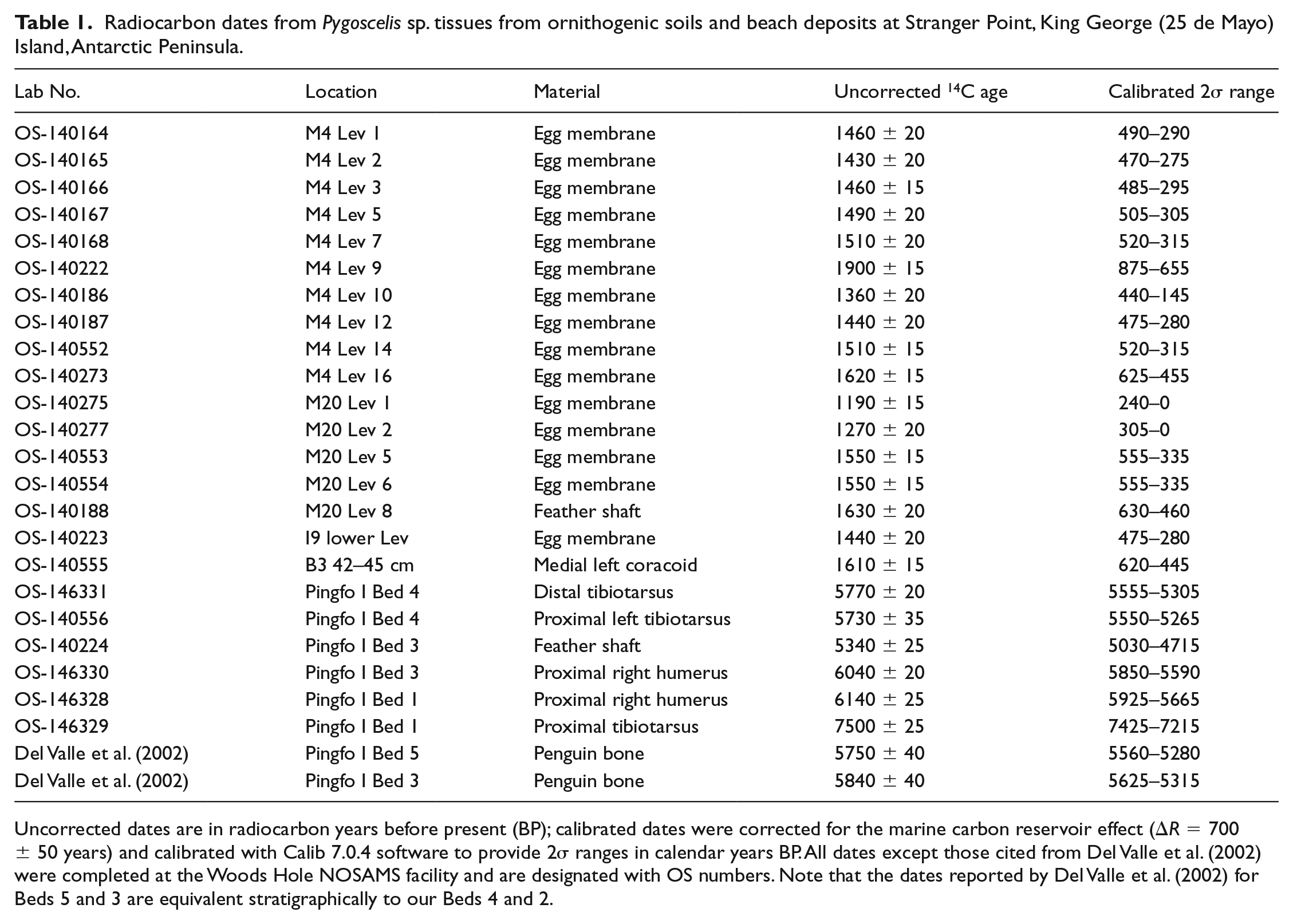
Uncorrected dates are in radiocarbon years before present (BP); calibrated dates were corrected for the marine carbon reservoir effect (ΔR = 700 ± 50 years) and calibrated with Calib 7.0.4 software to provide 2σ ranges in calendar years BP. All dates except those cited from Del Valle et al. (2002) were completed at the Woods Hole NOSAMS facility and are designated with OS numbers. Note that the dates reported by Del Valle et al. (2002) for Beds 5 and 3 are equivalent stratigraphically to our Beds 4 and 2.
Pingfo I (raised marine beach deposit)
This marine beach deposit was relocated in 2018 for additional sampling and mapping. Del Valle et al. (2002) identified six beds and two facies of marine sediments numbered sequentially from the lowest unit near present sea level to the uppermost unit at 2.8 m a.s.l. These six beds alternate from sand and pebbles (Beds 1, 3, and 5) to gravel and rock layers (Beds 2, 4, and 6). The sand and pebble layers contain penguin bones and seaweed. Later, Montalti et al. (2009) completed an analysis of the bones and determined that they came from a nearby breeding colony. The Pingfo I deposits were re-exposed here with shovels and trowels for mapping and description. Numerous penguin bones were recovered from the same beds as identified by Del Valle et al. (2002).
The Pingfo I profile exposed in 2018 (S62°15′26, 41″W58°37′8, 41″; 17,739 m a.s.l.; Figure 3) is located at the southeast margin of Potter Peninsula, within the Antarctic Specially Protected Area No. 132. It coincides with the top of a terrace of possible structural origin. At this point, a sedimentary profile was exposed and measured with a Trimble GPS; thickness of the stratigraphic beds was determined using a tape measure. A total thickness of all stratigraphic units was 2.46 m compared with 2.8 m of Del Valle et al. (2002). Because of the compaction and block concentrations, the profile was exposed in steps downward to the beach (Figure 4). Although Del Valle et al. (2002) identified six beds in these deposits, we recognized only five beds described as follows, from the top of the profile (youngest unit, Bed 5) to the bottom (oldest, Bed 1; Figures 3 and 4):
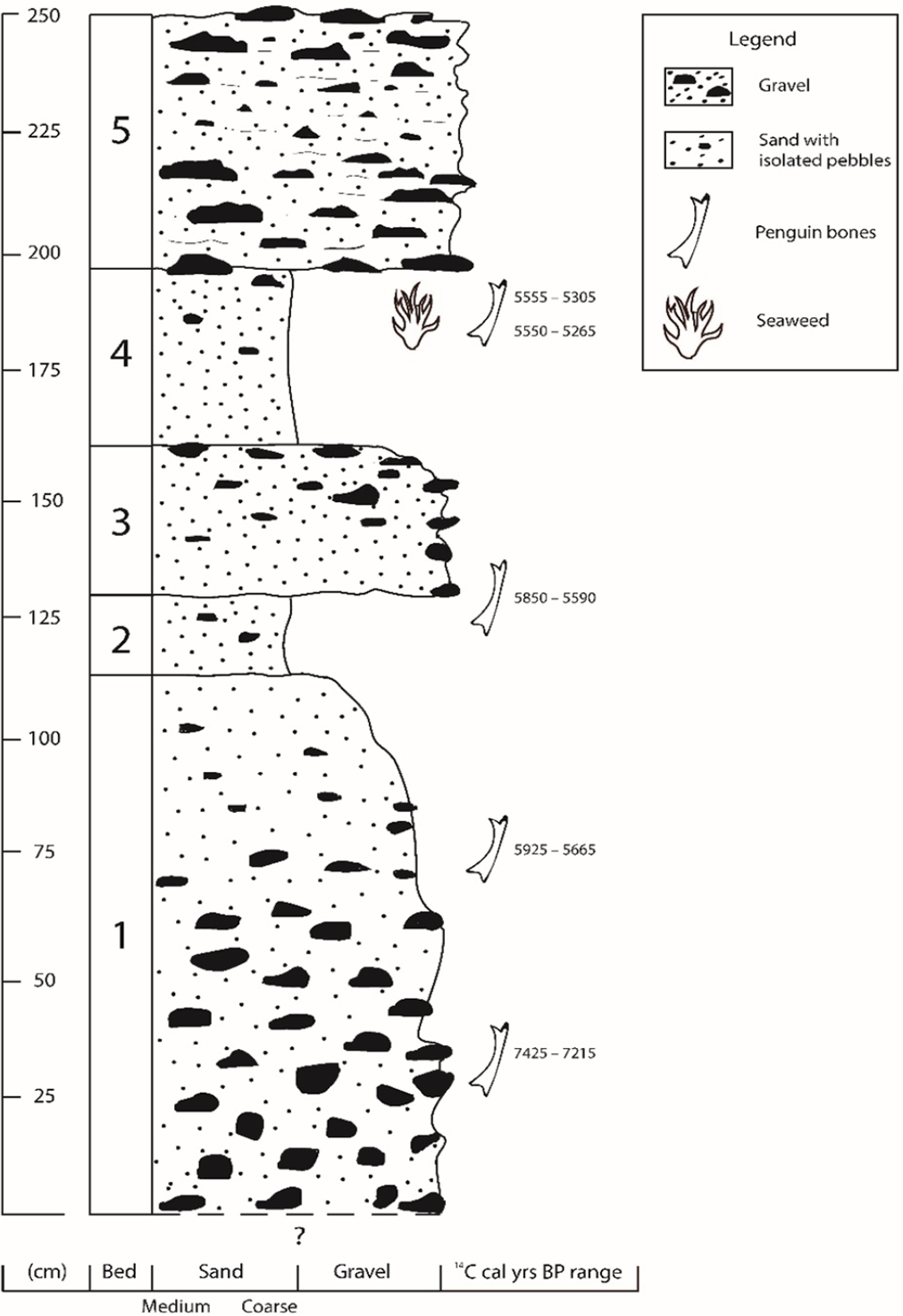
Stratigraphic profile of Pingfo I Beds 1–5 as mapped and described in 2018.
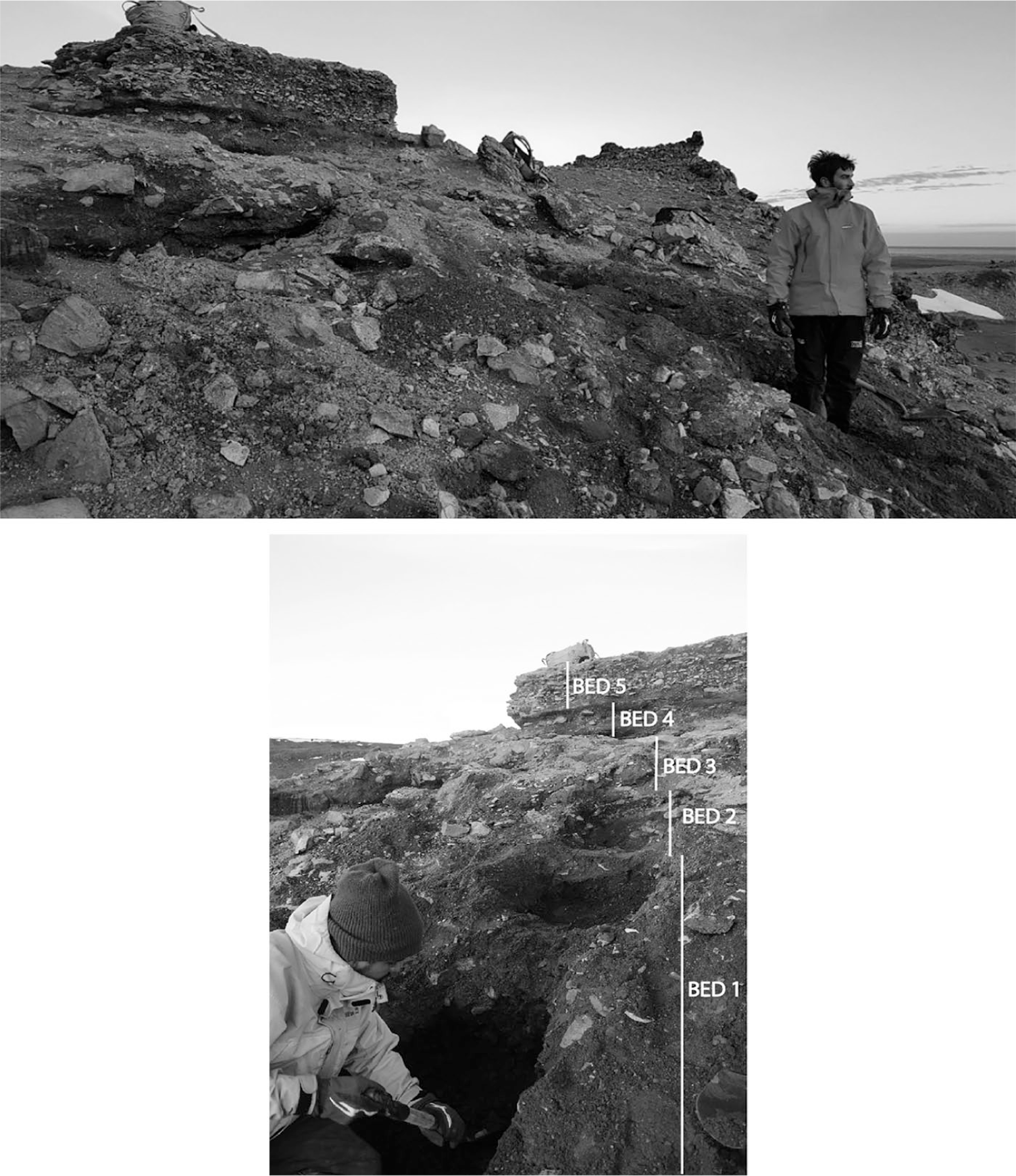
Top: view of the Pingfo I locality at Stranger Point with M. Romero standing in exposure; bottom: stratigraphic exposure showing Beds 1–5 with M. Argota excavating Bed 1.
Bed 1
The lowest bed at Pingfo I is the thickest at 112 cm with angular cobbles in a coarse sand matrix. At the bottom, the cobble size and sphericity increase. Penguin bones were recovered from 35 to 77 cm from the top of this bed (Figure 5). Equivalent to Beds 2 and 1 in Del Valle et al. (2002) as we found no sedimentological differences within this bed to separate it into two beds.

A juvenile Pygoscelis penguin femur in situ in Bed 1, Pingfo I.
Bed 2
This thin bed, 15 cm thick, is composed of medium-sized sand with isolated angular cobbles. No sedimentary structures were observed. Penguin bones were sampled from this bed. Equivalent to Bed 3 in Del Valle et al. (2002).
Bed 3
This bed is 31 cm thick and consists of angular cobbles within a coarse sand matrix. At the bottom, the ratio of cobbles/sand decreases and penguin feathers and bones become abundant. Equivalent to Bed 4 in Del Valle et al. (2002).
Bed 4
This bed is 36 cm thick and comprises medium-sized sand with incipient low angle cross laminae and isolated subangular cobbles of volcanic composition. Penguin bones, feathers, and seaweed fragments were found at the bottom of this bed. Equivalent to Bed 5 in Del Valle et al. (2002).
Bed 5
The upper bed of the Pingfo I sequence comprises a 52 cm thick matrix of coarse to very coarse sand, with sub-horizontal partially imbricated gravelly (pebble to cobble) fabric.
Angular cobbles and pebbles also occur in the sandy matrix. The clast size ranges from 2 to 20 cm in diameter. Most of the angular cobbles are found with major axes parallel to the bedding plane. These angular clasts exhibit little or no reworking. The composition of the clasts is volcanic, and it is assumed that they are derived from the tertiary volcanic outcrops nearby. Evidence of biologic activity in this upper most bed is considerable. Equivalent to Bed 6 in Del Valle et al. (2002).
Penguin bone identification and description
Most of the bones recovered from Pingfo Beds 1–5 are from juvenile pygoscelid penguins and cannot be positively identified to species as they are too undeveloped to exhibit identifiable features (see Emslie, 1995). Only a few specimens were from older chicks with more developed bone that had sufficient osteological characters for reliable identification. Identifications were based on comparison with adult (bones fully ossified) and juvenile (bone porous and undeveloped) skeletons of Adélie (N = 3 adult, 7 juvenile), Chinstrap (N = 3 adult, 1 juvenile), and Gentoo (N = 1 adult, 2 juvenile) penguins housed at the UNCW Ornithology Collections. Elements and characters used to distinguish these species include:
Proximal mandible: this can be distinguished to species based on relative size and shape of the articular and articular process. In dorsal view, the proximal edge of the articular process angles gradually to the internal distal direction in P. adeliae, but angles slightly more steeply in P. antarctica and strongly in P. papua. One proximal left mandible from Bed 1 is identified as P. papua, and one proximal right mandible from Bed 3 is identified as P. antarctica, based on these features.
Dentary: this portion of the mandible is distinctly deeper dorso-ventrally where it articulates with the angular in P. adeliae compared with P. antarctica or P. papua. One dentary from Bed 1 is identifiable as P. adeliae based on this character.
Tarsometatarus: this is relatively longer in P. adeliae and P. papua compared with P. antarctica, and more robust in P. papua (see measurements in Emslie, 1995). One complete juvenile tarsometatarsus from Bed 3 is referred to P. papua based on these differences. Another complete juvenile tarsometatarsus from M4 Level 5 is referred to P. adeliae.
Six radiocarbon dates were completed on bone and feather from Beds 4, 3 and 1 and indicate the earliest occupation of Stranger Point by breeding Pygoscelis penguins began at ~7320 cal. yr BP and extended to ~4865 cal. yr BP (Table 1). The dates previously published by Del Valle et al. (2002) also fall within this period.
Discussion
The radiocarbon dates at M4 and M20 indicate an historic occupation of Stranger Point by breeding Adélie penguins at no earlier than ~765 cal. yr BP. Moreover, while it might be expected that the abandoned sites on the higher terrace above the beach where M20 is located would be older, they are actually contemporaneous and even younger than those on the lower beach. However, Montalti et al. (2009) indicated that slump on the slope below this upper terrace produced bones dating as old at ~2000 yr BP, but did not provide more information on whether this was a uncorrected 14C date or one corrected and calibrated for the marine carbon reservoir effect. If uncorrected, the calibrated age would be ~700–800 cal. yr BP and in alignment with dates completed here.
A much older occupation of Stranger Point by all three Pygoscelis penguins is evident from the marine beach deposits at Pingfo I. While most of the juvenile penguin bones from ornithogenic soils at M4 and M20 are likely from P. adeliae, the bones from Pingfo Beds 1–5 represent all three pygoscelid penguins. Since this deposit is secondary and in an area where all three species occur today, this mixture of bones is not unexpected. Gentoo and Adélie penguins are common nesting birds at Stranger Point today, while the Chinstrap penguin is restricted to one small colony on a rocky promontory at the end of the point. A large colony of Chinstrap penguins is currently located across Potter Cove at Barton Peninsula (Figure 1). However, numbers have declined for two of these species at Stranger Point since the 1980s. Jablonski (1984) completed nest counts in austral summer 1980–1981 and reported 18,412, 2584, and 495 nests for Adélie, Gentoo, and Chinstrap penguins, respectively. These counts were corrected by Trivelpiece et al. (1987) to account for early nest losses to 20,253, 3152, and 574 nests, respectively. Except for Gentoo penguins, which have increased by approximately 25% today compared with 1980–1981, there has been a substantial drop in the populations of the other two species (Juáres et al., 2015).
Given this historic distribution, it is feasible that all three pygoscelid species were breeding on Stranger Point at the time of the Pingfo I beach deposition. In addition, as found by Montalti et al. (2009), all the juvenile bones from the Pingfo I Beds are well-preserved and exhibit no damage or wear from wave action or stream transport. It appears that all these bones were deposited a short distance from the colonies where the chicks hatched (Montalti et al., 2009), though no ornithogenic soils that would represent this older, mid-Holocene nesting have been found on the Stranger Point coast. Despite this absence, these bones are all from pre-fledged chicks and thus provide bone fide evidence of breeding by all three pygoscelid penguins on King George Island during the middle Holocene. It should also be noted that the well-rounded pebble-sized clasts on the raised marine beaches where Pingfo I and most abandoned pebble mounds are located were formed on a marine beach in the early to mid Holocene (Fretwell et al., 2010).
New radiocarbon dates on penguin bones and feathers recovered from Beds 4, 3, and 1 at Pingfo I completed here confirm the age of these deposits at middle Holocene as first reported by Del Valle et al. (2002, 2007). The two original radiocarbon dates from Beds 3 and 5 (equivalent to our Beds 4 and 2) reported by Del Valle et al. (2002) were recalibrated here using the same method as our new dates and fall within the total 2σ range of these new dates of 7425–5265 cal. yr BP (Table 1). These dates confirm breeding by pygoscelid penguins on Stranger Point beginning at about ~7000 cal. yr BP and ending by ~5000 cal. yr BP. Other deposits with penguin bones have been reported on King George Island that also fall within this range of dates. Roberts et al. (2017) reported the recovery of juvenile Gentoo penguin bones from Ardley Lake, Ardley Island, dating to ~7400–7200 cal. yr BP, though no ornithogenic soils have been found near this lake or on Ardley Island that also date to this period (Emslie et al., 2018). Tatur (1989) also reported ~2 m of alluvial deposits of sands and gravels that included at the base a ~40 cm thick phosphatic mud containing abundant juvenile Adélie and Chinstrap penguin bones from Penguin Ridge, Thomas Point, King George Island. These deposits were pre-dated by Holocene deglaciation (9000–8000 yr BP) and post-dated at 4950 ± 140 14C yr BP from peat samples (Birkenmajer, 1981) and are similar to those at Pingfo I, but at a higher elevation (45 m a.s.l.), and is so far the only known possible ornithogenic phosphatic soil that has been preserved for thousands of years in a terrestrial environment in the Antarctic Peninsula. Thus, there is now clear evidence that all three pygoscelid penguins were breeding either at Ardley Island in Maxwell Bay, Stranger Point in Potter Cove, or at Thomas Point in Admiralty Bay (Figure 1) by the early to middle Holocene.
The initial penguin occupation at ~7000 cal. yr BP corresponds to Holocene warming and deglaciation at that time, both in the Antarctic Peninsula and East Antarctica (Ingólfsson et al., 1998; Masson et al., 2000). More specific to King George Island, Roberts et al. (2017) discuss the geologic evidence for an early Holocene optimum (EHO), or warming period from 10,100 to 8200 cal. yr BP when the ice cap on Fildes Peninsula (Figure 1) began melting. The EHO was followed by the first Holocene occupation of Ardley Island by breeding penguins from 7400 to 5800 cal. yr BP, corresponding with the occupation at Stranger Point as evinced by the Pingfo I deposits reported here. Roberts et al. (2017) also identify five phases of penguin occupation at Ardley Island based on the guano record in Ardley Lake sediments. These occupations, or guano phases (GPs) are numbered 1-5 with the first occupation (GP-1) at 7360–5820 cal. yr BP. Thus, our oldest radiocarbon date from Bed 1 at Pingfo I correlates with GP-1. Most of our remaining dates from Beds 1-5 correspond with GP-2 (6020-5180 cal. yr BP) except for one date from Bed 3 that is slightly younger in age (5030-4715 cal. yr BP). We have no other penguin remains that date within GP-3, 4a, 4a, and 5 (4640-4090, 4230-3270, 3580-2880, and 2830-1160 cal. yr BP, respectively) as defined by Roberts et al. (2017). In addition, the middle-Holocene penguin occupation at Stranger Point appears to have ended by ~5000 cal. yr BP, which corresponds to increased cooling and glacial readvance at that time. The penguin occupation here, then, is likely controlled by warming and cooling events that provided ice-free terrain and open-water access to beaches during the former periods, though at Ardley Island Roberts et al. (2017) hypothesize that volcanic activity interrupted the penguin occupations since GP-2. We found no evidence for the influence of volcanic activity affecting penguin occupation at Stranger Point where the most recent occupation began by ~765 cal. yr BP and also corresponds with climate warming (‘Medieval Warm Period’, ~AD 1300) following the ‘Little Ice Age’ (Bertler et al., 2011).
Despite the clear evidence for breeding by pygoscelid penguins at Stranger Point and elsewhere on King George Island in the early to middle Holocene, there remains no deposits of ornithogenic soils of that age here or elsewhere in the northern Antarctic Peninsula. The oldest ornithogenic soils that have been located in this region were of Gentoo penguins at Byers Peninsula, Livingston Island, and dated at ~1100 cal. yr BP (Emslie et al., 2011; Figure 1). Although there was only minimal movement of juvenile penguin bones from breeding sites on the terrace near the Pingfo I beach deposits, ornithogenic soils from these former colonies are absent, adding to the mismatch with depositional records for penguin breeding (including those in lake sediments, beach deposits, and glacial moraines) that has been termed the ‘northern enigma’ (Emslie et al., 2018). Only one active breeding colony of Adélie penguins at the Danger Islands, Weddell Sea (Figure 1), has produced an older age of ornithogenic soils at ~2800 cal. yr BP in the northern peninsula (M Polito, personal communication). At Stranger Point, the relatively narrow beach terraces and their slumped profiles have probably been a factor in solifluction of soils over time, especially during warmer periods in the mid to late Holocene that could explain absence of ornithogenic soils from earlier occupations there.
Footnotes
Acknowledgements
The authors would like to thank the Direccion Nacional del Antartico, Instituto Antártico Argentino (IAA) Program and personnel at Carlini Station for their help and support in completing this research. They also thank Lic. Jorge Strelin from IAA for all his guidance and support.
Funding
The author(s) disclosed receipt of the following financial support for the research, authorship, and/or publication of this article: This work was funded by NSF Grant ANT-1443585.
