



Abstract
In this study, we assess how representative a single charcoal record from a peat profile in small bogs (1.5–2 ha in area) is for the reconstruction of Holocene fire history. We use high-resolution macrocharcoal (>250 μm) analysis of continuous series of 2 cm3 samples from two small bogs in southern Sweden. We compare (1) duplicate charcoal records from the same core, (2) duplicate charcoal records from profiles in the same site (10 m apart), and (3) charcoal records from two sites within the same region (15 km apart). Comparisons are made for charcoal counts and area expressed as accumulation rates. The results suggest that (a) charcoal counts and area are highly correlated in all records; (b) duplicate charcoal records within the same core are very similar, although some charcoal peaks are found in only one of the two records; (c) although long-term trends in fire regimes are similar between duplicate charcoal records from nearby profiles within the same site and between charcoal records from sites within the same region, some individual charcoal peaks/fire events are asynchronous between records. The known historical fires of the town of Växjö (1570 and 1612 CE) are recorded at the two study sites, which indicates a macrocharcoal source area of minimum 15 km in diameter. The 2 cm3 peat samples contained relatively low amounts of macrocharcoal; we therefore recommend to analyse larger samples from small peat bogs with comparable peat accumulation rates. This will improve the reliability of the macrocharcoal record and its interpretation.
Introduction
Fire history inferred from charcoal remains in peat or lake sediment profiles has been widely used as an indicator of climate change and/or human impact (e.g. Marlon et al., 2013; Molinari et al., 2013, 2018; Mooney et al., 2001; Mooney and Maltby, 2006; Power et al., 2008; Vannière et al., 2011, 2013). Fire is also one of the many factors that have shaped biodiversity at the landscape-, habitat- and species-level scales (e.g. Colombaroli and Tinner, 2013; Lindbladh et al., 2003, 2008; Ohlson et al., 2011). Studies on fire history rely on the analysis of charcoal remains in peat deposits, lake sediments, soils and other deposits. The interpretation of charcoal analyses in terms of fire dynamics/regimes/frequencies often uses a single charcoal record from a single core/profile from a selected site. The present study investigates the representation of micro- and macrocharcoal in peat deposits of small bogs in the hemiboreal vegetation zone (sensu Ahti et al., 1968) of southern Sweden (province of Småland). Several earlier studies on fire history in that region have shown that fire was an important environmental factor behind past forest dynamics and biodiversity changes (e.g. Bradshaw et al., 2010; Hannon et al., 2012; Lindbladh et al., 2003, 2008; Lindbladh and Foster, 2010; Niklasson et al., 2002). In our study area, at the site of Storasjö, Olsson et al. (2010) found a close relationship between fire regimes and climate change in the early and mid Holocene, and human impact in the late Holocene. Moreover, Olsson and Lemdahl (2009, 2010) documented the close relationship between fire and beetle diversity over the Holocene at the sites of Stavsåkra and Storasjö, and Cui et al. (2015) demonstrated the importance of vegetation, geological, and geomorphological characteristics in the Holocene fire history of these two sites.
Changes in fire regime have been inferred from single records of microcharcoal (fragments <160 μm) and/or macrocharcoal (fragments >250 μm), sometimes associated with complementary records of charred plant macroremains, fire-damaged pollen grains (e.g. Greisman and Gaillard, 2009) and/or identification of the plant taxa burned using microscopic wood anatomy (e.g. Olsson et al., 2010). Patterson et al. (1987) published a review on microcharcoal as a fossil indicator of fire. At that time, the most common method was to count individual microcharcoal fragments occurring in samples prepared for pollen analysis and grouped into a number of size classes, which was very tedious and time consuming. Thanks to the development of relatively simple and much faster techniques to obtain continuous records of macrocharcoal (e.g. Black and Mooney, 2006; Black et al., 2007; Mooney and Maltby, 2006) as well as diagnostic and analytical tools for charcoal analysis (i.e. Charster, Gavin, 2006; CharAnalysis, Higuera et al., 2008), charcoal records can be obtained more efficiently from multiple sites and interpreted on the basis of a larger number of charcoal parameters.
There are only few studies of charcoal records from the same site in Europe (e.g. Hörnberg et al., 2011; Ohlson et al., 2006, 2011; Pitkänen et al. 2001, 2002; Segerström et al., 2008) and from duplicate peat profiles (analyses of two profiles with a very short distance between them) (e.g. Innes et al., 2004). Charcoal records from the same site have rarely been compared systematically. Such comparison might be problematic due to the correlation of profiles based on 14C chronologies. In contrast, when samples of parallel charcoal records are collected from the same depths within the same core(s), they should be of the same age. There are many published parallel charcoal records from the same core(s)/profiles, but these are mostly analyses of different charcoal-size fractions. To our knowledge, duplication of exactly the same charcoal analysis in the same peat or lake sediment core(s) has not been published earlier.
In this paper, we assess how representative single charcoal records from small peat bogs are in terms of number, size (in both count and area of charcoal fragments accumulated per year) and frequency of recorded charcoal peaks. We use peat sequences from two small bogs, Stavsåkra and Notteryd, located in the hemiboreal zone of southern Sweden (Figure 1). We compare (1) two parallel charcoal records from the same core (duplicate of the same analysis) at Notteryd, (2) two parallel charcoal records from two profiles at Stavsåkra (ca. 10 m apart), and (3) charcoal records from the two sites Stavsåkra and Notteryd located in the same region (ca. 15 km apart).
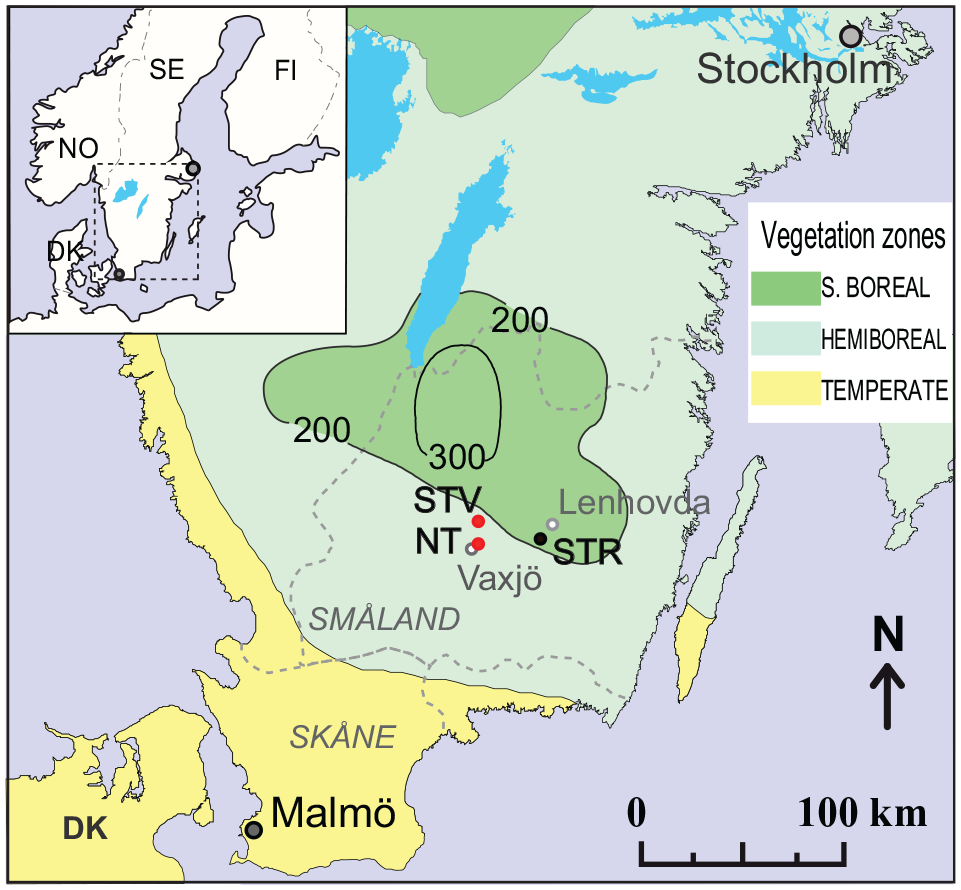
Study area in southern Sweden, province of Småland, with location of the two study sites Notteryd (NT) and Stavsåkra (STV). The site of Storasjö (STR) (Olsson et al., 2010) is shown for comparison of results in the discussion.
Study area and site description
The study area is situated in the province of Småland, southern Sweden (Figure 1). The mean January, July, and annual temperatures are −3°C, 16°C, and 6°C respectively, and the mean January, July, and annual precipitation are 52 mm, 75 mm, and 651 mm respectively (Statistical yearbook of Sweden, 2004). The bedrock consists of Småland granite and the Quaternary deposits are characterized by silty-sandy till (Daniel, 2001). The two study sites, Stavsåkra (N 57° 01′ 27″, E 14° 48′ 47″, 187 m a.s.l., 2 ha in area) and Notteryd (N 56° 54′ 47″, E 14° 53′ 8″, 186 m a.s.l., 1.5 ha in area), are small bogs located between the southern edge of the Småland uplands and the town of Växjö (Figure 1). The modern vegetation is characterized by deciduous trees (dominated by Betula (birch) with Corylus (hazel), Tilia (linden), Quercus (oak) and Fagus (beech)) mixed with Pinus (pine) and Picea (spruce), the latter often planted. Today the bogs are overgrown by trees (mainly pine and birch), and Ericaceae (heather family) are dominant in the under-storey.
Materials and methods
Henceforth, “microcharcoal” refers to charcoal fragments between10 μm and 160 μm in diameter counted simultaneously with pollen grains and spores (Greisman and Gaillard, 2009), “macrocharcoal” to charcoal fragments >250 μm in diameter analyzed following the method developed by Black and Mooney (2006), Mooney and Maltby (2006), and Black et al. (2007), and “macrocharcoal estimate” to broad count fractions (1–10, 11–100, 101–1000, >1000) of macrocharcoal fragments >250 μm in diameter as estimated during plant macrofossil analysis (Greisman and Gaillard, 2009).
Field work and sampling strategy
In this paper, the term “core” refers to a ca. one-meter long half cylinder of peat/sediment (10 cm in diameter) extracted with a Russian corer, while the term “profile” refers to a series of overlapping cores covering the entire Holocene peat stratigraphy. The overlapping cores are extracted from two separate holes ca. 50 cm apart and have an overlap in their drilling depth. This is done in order to get a complete, clean peat stratigraphy.
Two peat profiles were sampled ca. 10 m apart at Stavsåkra, the first one in 2005 (hereafter STV05; Greisman and Gaillard, 2009; Olsson and Lemdahl, 2009) and the second one in 2009 (hereafter STV09; this paper). STV05 was analyzed for pollen, microcharcoal, plant macrofossils, macrocharcoal fragments and insect remains (for more details, see Greisman and Gaillard, 2009). STV09 was sampled with the aim to perform a macrocharcoal analysis following the new standard method of Black and Mooney (2006) and compare the results with the charcoal analysis from STV05. In 2009, two parallel 3.4 m long profiles ca. 50 cm apart were extracted with a 10 cm-diameter Russian corer. One of the profiles (STV09-1) was sampled for 14C dating and the other one (STV09-2) was sampled at 1 cm interval for macrocharcoal analysis (2 cm3 consecutive samples) and pollen analysis (1 cm3 samples) at 35 selected levels for pollen-stratigraphical correlation with STV05 and age-depth modeling (see chronological control below and Figure 2).

Lithostratigraphy, sedimentation rates and age-depth models of the peat profiles from (a) Notteryd (NT), (b) Stavsåkra 2009 (STV09-1), and (c) Stavsåkra 2005 (STV05) established using the 14C dates presented in Table 2 and the software Bacon (Blaauw and Christen, 2011). Both the standard deviation errors for 14C dates (blue) and the distributions of the correlated ages (green) are shown. The gray shadows indicate likely calendar ages at 90% confidence ranges, and the red line is the mean likely calendar age.
A 2.8 m-long profile was sampled at Notteryd (NT) in December 2010 with a Russian core. The NT profile (NTA and NTB in the case of sample duplicates) was sampled for pollen analysis (1 cm3 large samples) at 5 cm depth intervals, plant macrofossil analysis (consecutive samples, 0–5, 5–10, 10–15 cm, etc. corresponding to ca. 300 cm3), and macrocharcoal analysis (consecutive 2-cm3 samples) at 1 cm depth intervals (0–1, 1–2, 2–3 cm, etc.). Moreover, a second parallel series (duplicate NTB) of consecutive samples for macrocharcoal analysis were taken between 0.3 and 1.9 m.
Pollen and microcharcoal analysis
Samples for pollen analysis of STV05, STV09-2 and NT were washed through a 160 μm sieve before preparation following Berglund and Ralska-Jasiewiczowa (1986). At least 500 terrestrial pollen grains per sample were counted and identified under a microscope with magnifications of 400x or 1000x. Microcharcoal fragments were counted simultaneously with pollen and divided into two fractions (10–25 μm and 25–160 μm), following Berglund (1991). The pollen and microcharcoal records of STV05 are published in Greisman and Gaillard (2009).
Macrocharcoal analysis and fire reconstruction
Macrocharcoal analysis of STV05 (Greisman and Gaillard, 2009) was performed along with the plant macrofossil analysis. Samples were soaked in 10% NaOH for 24 h, and washed through two sieves with mesh sizes of 500 μm and 250 μm. Macroscopic plant remains and macrocharcoal fragments were sorted out from the residue under a stereo microscope (at a 12× magnification), divided into two fractions (250–500 μm and >500 μm) and counted. Note that the charcoal fraction between 160 μm and 250 μm was not analyzed in this study (see microcharcoal analysis above).
High-resolution macrocharcoal records from STV09-2 and NT (and the duplicates NTA and NTB) were obtained following the method developed by Black and Mooney (2006), Mooney and Maltby (2006) and Black et al. (2007). All 2-cm3 samples were dispersed in 30 ml of a 5% NaClO solution for at least 24 h to remove the pigments from the organic matter. After the bleaching process, samples were washed through a sieve with a 250 μm mesh, and charcoal fragments were sorted out under a stereo microscope and put into a petri dish. Each petri dish was photographed on a light board (Gepe slimlight 2003) using a camera Nikon D80s. The count and area of charcoal fragments in each sample were recorded using the image analysis software Scion Image for Windows (version 4.0.3.2). Macrocharcoal fragments retained in a sieve may be smaller than the size of the sieve mesh (250 μm in diameter) if the fragment shape is elongated. Therefore, most fragments are >250 μm, but smaller ones may represent a part of the total amount. To explore the charcoal representation within a core, charcoal concentration (count and area of charcoal fragments per cm3) from two parallel records at Notteryd (NTA and NTB) were compared using correlation analysis of four fragment size classes, that is, >1000 μm, 500 –1000 μm, 250–500 μm, and <250 μm in diameter.
In order to compare charcoal representation between STV09-2 and NT in terms of charcoal peaks, charcoal accumulation rates (count and area of charcoal fragments cm−2 year−1) were calculated using the computer program Charster version 0.8.3 (Gavin, 2006). The duplicate charcoal records NTA and NTB (depths 0.3 m to 1.9 m) were combined into one NT record by calculating the average counts and area for each level/sample analyzed. The accumulation rate was then calculated using the mean of the sample resolution for this core, that is, 40 years/sample (Table 1). Beside charcoal produced by local fires around the coring site, charcoal fragments recorded in lake sediments or peat deposits include charcoal coming from biomass burning within a larger region, as well as charcoal from sediment mixing and secondary charcoal transport, that is, the “background charcoal” (e.g. Clark and Patterson, 1997; Clark et al., 1998). Background charcoal was estimated by applying a LOcally WEighted regression Scatterplot Smoother (LOWESS) to the charcoal record over 1000 years. By subtracting the background charcoal from the interpolated record, a residual charcoal accumulation rate (CHAR) was obtained. “Residual CHAR” is composed of random variability (noise) and local fire events (signal). In Charster, any residual CHAR value greater than the threshold (set to ‘0’ in this study) was considered a ‘peak’, that is, a potential local fire event (Whitlock and Larsen, 2001).
Summary information of the charcoal analyses performed in this study.
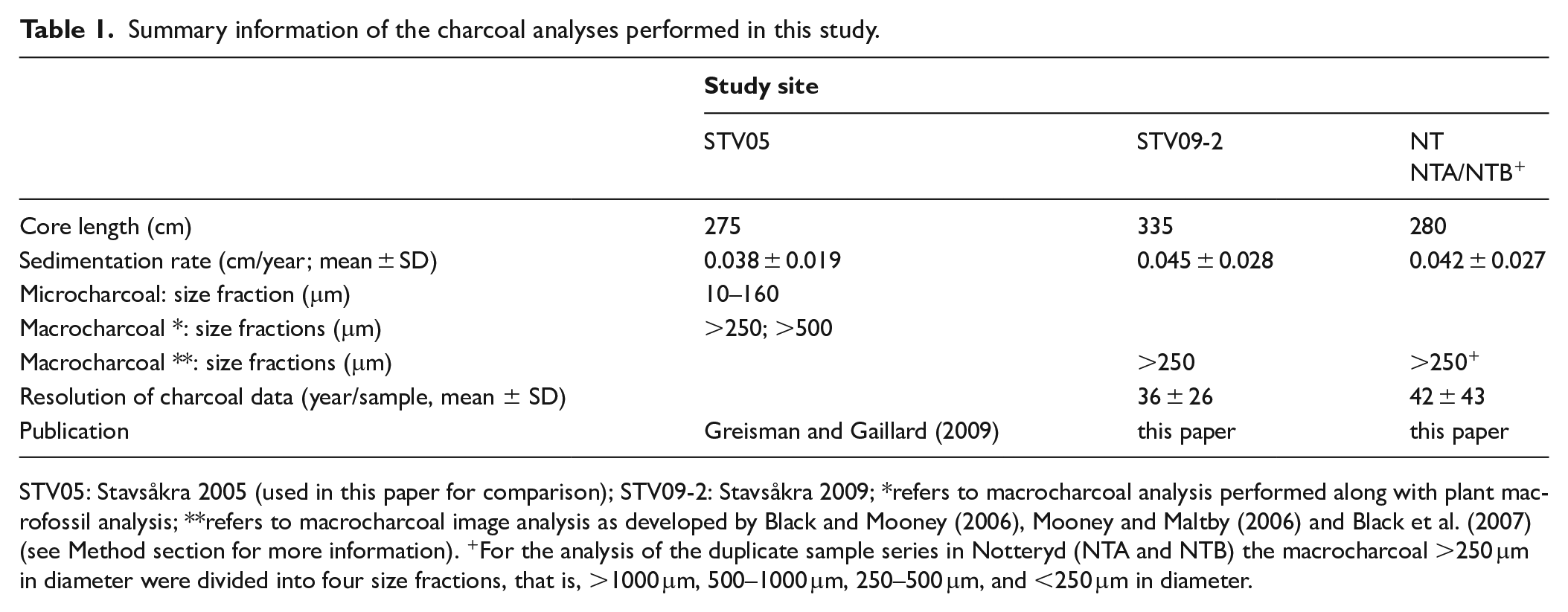
STV05: Stavsåkra 2005 (used in this paper for comparison); STV09-2: Stavsåkra 2009; *refers to macrocharcoal analysis performed along with plant macrofossil analysis; **refers to macrocharcoal image analysis as developed by Black and Mooney (2006), Mooney and Maltby (2006) and Black et al. (2007) (see Method section for more information). +For the analysis of the duplicate sample series in Notteryd (NTA and NTB) the macrocharcoal >250 μm in diameter were divided into four size fractions, that is, >1000 μm, 500–1000 μm, 250–500 μm, and <250 μm in diameter.
CHAR and sediment/peat accumulation rates for STV09-2 and NT were produced with the R package rbacon (version 2.4.1), a flexible Bayesian age-depth modeling tool with Monte Carlo–based uncertainty estimates (Blaauw and Christen, 2011) that considers chronological uncertainties.
Chronological control
The plant material used for 14C dating was selected from the plant macrofossil samples. Whenever possible, Sphagnum leaves were chosen for dating. Otherwise, macroremains from terrestrial plants (i.e. birch leaves, birch fruits and seeds) were preferred. If those remains were not in sufficient number, we used large charcoal fragments. The choice of the levels to be dated in STV09-1 and NT was based on (i) the lithological boundaries that were clear enough to be correlated between parallel profiles, (ii) the availability of a sufficient amount of terrestrial plant material to date, and (iii) the length of time intervals between lithological boundaries. A first series of samples from levels below and above each lithological boundary was analyzed for terrestrial remains appropriate for dating. Once the 14C dates were obtained, a second series of samples from complementary levels was collected to obtain a reasonable distribution of dates over the Holocene. Dating was performed at the Ångström Laboratory at Uppsala University. The chronologies used to compare and correlate the macrocharcoal records from NT and STV09-2 were established with the R package rbacon (version 2.4.1; Blaauw and Christen, 2011).
The age-depth model for NT is based on 14 14C dates (Table 2). We assumed that the surface of the profile is contemporaneous with the year of coring (2005 ± 5 CE) and that the lithostratigraphical boundary between light-gray clay and gyttja (at a depth of 2.77 m) corresponds to the start of the Holocene dated by Björck et al. (1996) in southern Sweden to 11450–11390 ± 80 year BP. For simplification, we ascribed to our lithostratigraphical boundary the age of 11500 ± 100 cal year BP (Figure 2a). The age-depth model for STV09-1 (Figure 2b) is based on 16 14C dates and 2 ages inferred from the age-depth model of STV05 by lithostratigraphical correlation of STV09-1 with STV05 (Table 2, Supplementary Material, Figure 3a). The surface of STV09-1 is set to 2000 ± 5 CE and the lithostratigraphical boundary between clayey gyttja and gyttja clay (at a depth of 3.27 m) is ascribed to the start of the Holocene and set to 11500 ± 100 cal year BP (as for NT, see above). We also applied the ‘Bacon’ model on the published 16 14C dates from STV05 (Greisman and Gaillard, 2009) to establish a new consistent chronology for between-site comparisons. The obtained chronology does not differ significantly from the one published in Olsson and Lemdahl (2009) and Olsson et al. (2010). The “accumulation rate prior” are the same for the three cores. The two parameters of the accumulation rate prior (a gamma distribution) in the ‘Bacon’ software, that is, the mean accumulation rate and the accumulation shape, were set for the three sites to 50 year/cm and 1.5, respectively. For the section thickness and variability of accumulation rate we used the default settings (5 cm intervals; memory strength = 4; memory mean = 0.7).
Radiocarbon dates and calibrated ages from Notteryd (NT) and Stavsåkra (STV09-1). Calibration of radiocarbon dates was carried out using OxCal version 3.10 (Bronk Ramsey, 2005).
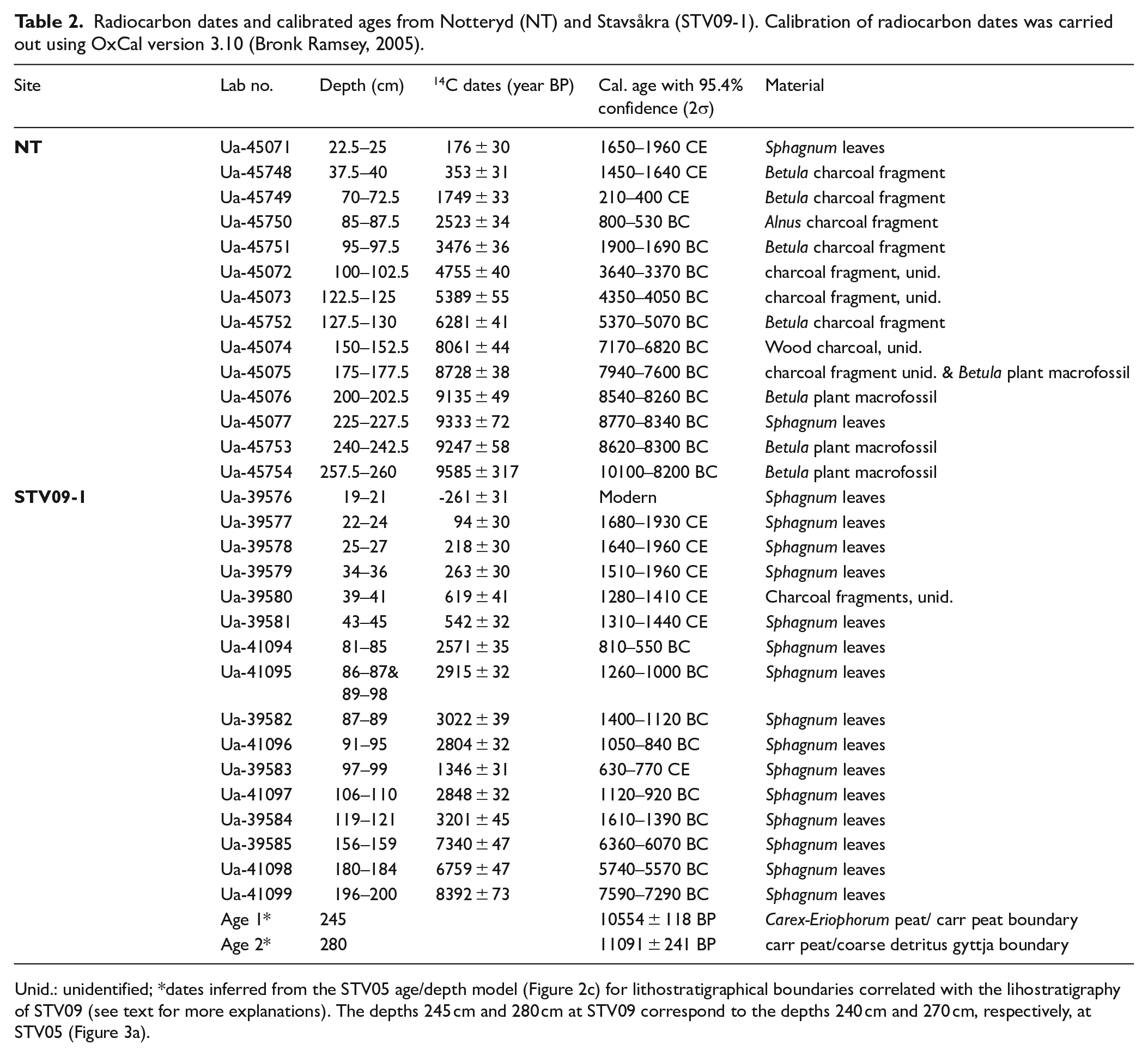
Unid.: unidentified; *dates inferred from the STV05 age/depth model (Figure 2c) for lithostratigraphical boundaries correlated with the lihostratigraphy of STV09 (see text for more explanations). The depths 245 cm and 280 cm at STV09 correspond to the depths 240 cm and 270 cm, respectively, at STV05 (Figure 3a).
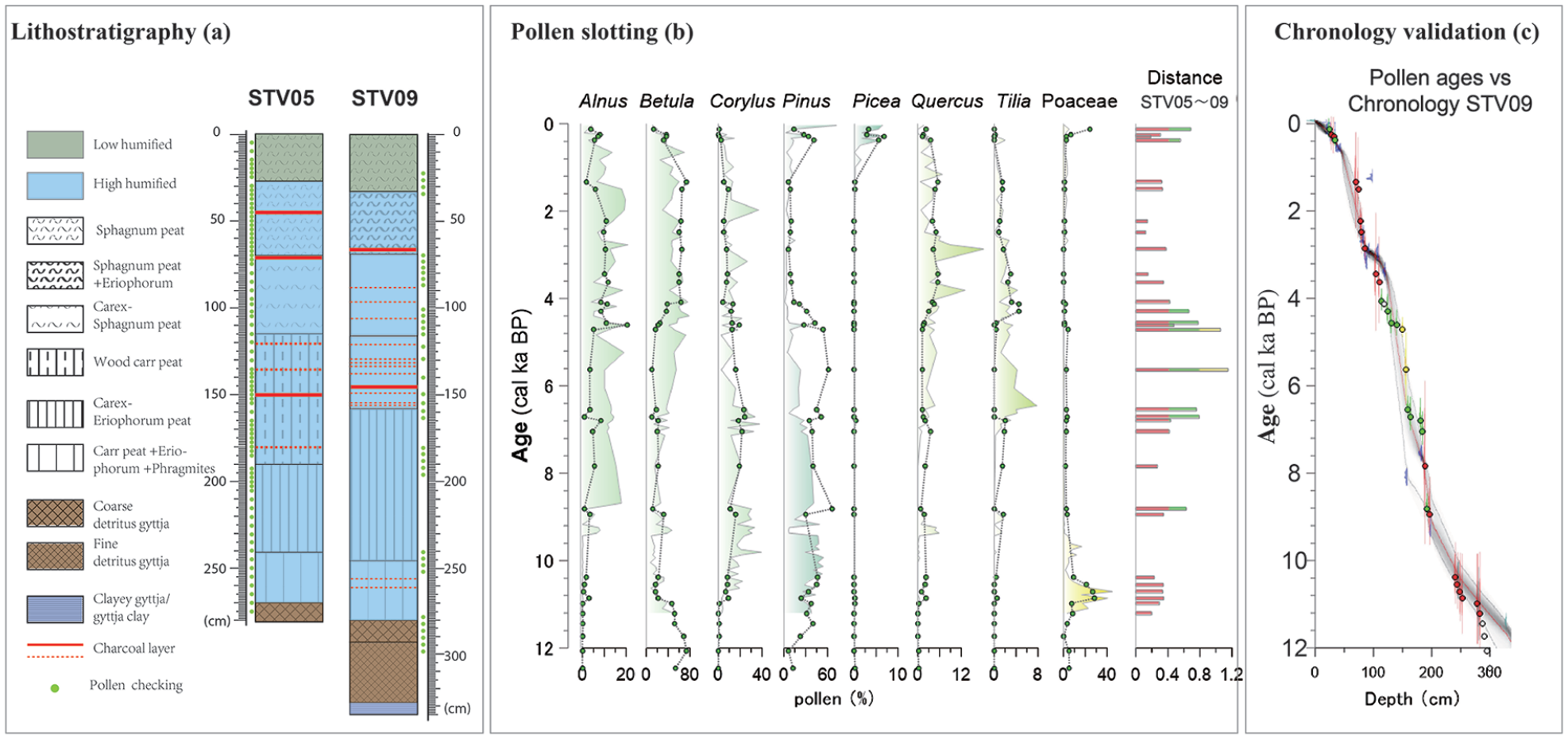
(a) Lithostratigraphical correlation between the two profiles from Stavsåkra STV05 and STV09-2. (b) pollen-stratigraphical correlation between STV09-2 (green dots) and STV05 (color shaded curves) using the sequence slotting method and the Manhattan distance at each pollen alignment; the shorter the distance the higher the confidence; distance 0–0.4 in red, 0.4–0.8 in green, and >0.8 in yellow. (c) pollen alignment ages of STV09-2 (colored dots with error bars) compared with the Bacon age-depth model of STV09-1 (gray age-depth model; see Figure 2b). See text for more details.
The chronology of STV09-2 was established by pollen-stratigraphical correlation with STV05 (Figure 3b). The obtained chronology was then cross-checked with the chronology established for STV09-1 (Figure 3c). Pollen-stratigraphical correlation between STV09 and STV05 was achieved by sequence slotting (Birks and Gordon, 1985; Gordon, 1982; Gordon and Birks, 1974; Thompson and Clark, 1989) using eight major pollen taxa, that is, Alnus, Betula, Corylus, Pinus, Picea, Quercus, Tilia, and Poaceae, and the “Manhatten distance” (Gordon and Birks, 1974; Figure 3b). Moreover, the lithostratigraphies of STV05 and STV09-2 were correlated by using the R package distantia (Version 1.0.2; Benito and Birks, 2020) (see Supplementary material for details).
Results
Chronologies and sediment/peat accumulation rates
Henceforth, all ages are given in calibrated 14C kilo years (ka) BP, abbreviated ‘ka BP’.
The best correspondence between the pollen stratigraphies of STV05 and STV09-2 is found during the early and late Holocene (Manhatten distance <0.4), while the correspondence is less good during the mid Holocene (Manhatten distance >0.4) (Figure 3b). However, comparison of the chronology of STV09-2 with that of STV09-1 (based on 14C dates) shows that the ages inferred by pollen-stratigraphical correlation in core STV09-2 lie within the range of the chronology established for STV09-1, except for the period of ca. 3–4 ka BP (Figure 3c). The latter discrepancy between the two chronologies is partly explained by the 14C dates inversions between 81 and 121 cm, that is, 3.022, 2.804, 1.346, 2.848, and 3.201 ka BP. All dates were obtained from small quantities of Sphagnum leaves, and it is not possible to decide which of these dates are most reliable. Moreover, any selection of dates excluding inversions does not change significantly the age-depth model. The peat deposits from Stavsåkra obviously exhibit changes in accumulation rates over time that are not necessarily synchronous and may be much localized over the bog surface, depending on the plants growing at the site of coring.
The age-depth models for NT, STV09-1 and STV05 show similar trends. Accumulation rates (AR) are high in the early Holocene until ca. 10 ka BP (>0.04 cm year–1, up to ca. 0.06–0.08 cm year–1), which is related to lacustrine sediment deposition (clayey gyttja, detritus gyttja and gyttja) and in-filling deposits (peat from telmatophytes such as Phragmites and various Carex species). A decrease in AR occurs ca. 10–9 ka BP. Lower, more or less constant ARs ca. 9–2 ka BP (<0.04 cm year–1, down to 0.01–0.02 cm year–1) correspond to relatively high humified carr peat. ARs then increase from ca. 2 ka BP with particularly high values (>0.04 cm year–1, up to 0.06–0.09 cm year–1) from ca. 1 ka BP related to the deposition of more or less humified Sphagnum peat (Figure 2). There are several increases in AR over mid Holocene at Stavsåkra, the largest and longest ca. 4.8–4 ka BP at STV05 (0.05 cm year–1) and ca. 4–3 ka BP at STV09-1 (0.1–012 cm year–1).
Comparison between parallel charcoal records from the same cores
The Spearman correlation analysis performed on the duplicate records (NTA and NTB) of charcoal concentration (count and area of charcoal fragments per unit volume of sediment/peat) indicates a strong correlation between charcoal counts and area in each individual record (ρ = 0.968 in NTA and ρ = 0.934 in NTB) (Figure 4). In contrast, the correlation between the two duplicate charcoal records is not statistically significant (ρ = 0.372 for charcoal counts and ρ = 0.349 for charcoal area).
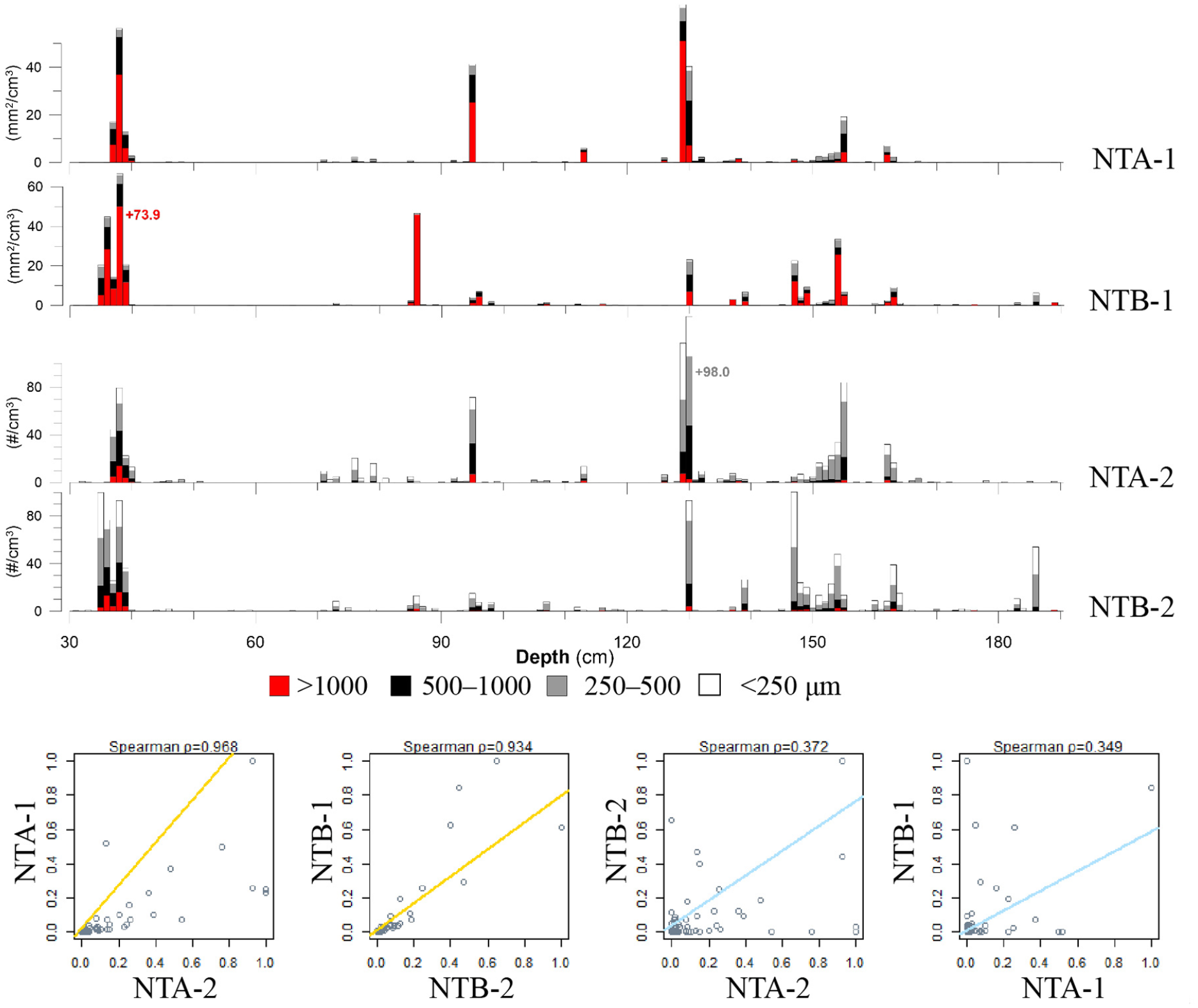
Upper panel: Macrocharcoal concentrations (fragments’ counts and areas) from the duplicate records (NTA and NTB) of the same core from Notteryd. Concentrations are presented in four fragment size classes (see color code below the diagrams) in both area (NTA-1, NTB-1) and count (NTA-2, NTB-2) of charcoal fragments. Lower panel: Spearman’s rank correlations of paired records.
The differences between the two records in terms of charcoal area are particularly clear for fragments >1000 μm in diameter, while the difference in terms of charcoal counts are obviously due to small fragments <500 μm. The major information found in the total charcoal area is represented in the fraction of charcoal fragments ⩾500 μm, while the major information found in the total charcoal count is represented in the fraction of charcoal fragments ⩽500 μm.
Comparison between charcoal records from two nearby profiles at Stavsåkra, STV05 and STV09-2
The record of macrocharcoal accumulation rates (CHAR) from STV09-2 includes 17 synchronous fire peaks identified in both charcoal counts and charcoal area, of a total of 47 peaks in charcoal counts and 36 peaks in charcoal area (Figure 5a, upper panel, blue and red dots). The results indicate high fire frequency during the early Holocene (until ca. 9.4 ka BP), mid Holocene (ca. 5–4 ka BP), and late Holocene (ca. 3.5–3 ka BP and from ca. 0.7 ka BP). Low fire activity is recorded between ca. 9.2 ka and ca. 5.5 ka BP. The record of microcharcoal from STV05 (Figure 5b) exhibits 20 peaks and high fire frequency during the early Holocene (ca. 11–10.7 ka BP and ca. 9.4 ka BP), mid Holocene (ca. 7–6 ka BP), and late Holocene (from ca. 3 ka BP, especially ca. 2.6 ka BP, and from ca. 0.5 ka BP). Low fire activity is recorded ca. 8.6–7.2 ka BP and ca. 6–3 ka BP. The macroscopic CHAR estimates from STV05 (Figure 5c) show two major periods of fire activity, ca. 9–6.8 ka BP and ca. 4–0.4 ka BP. Low fire activity characterizes the mid Holocene ca. 6.5–4.5 ka BP.
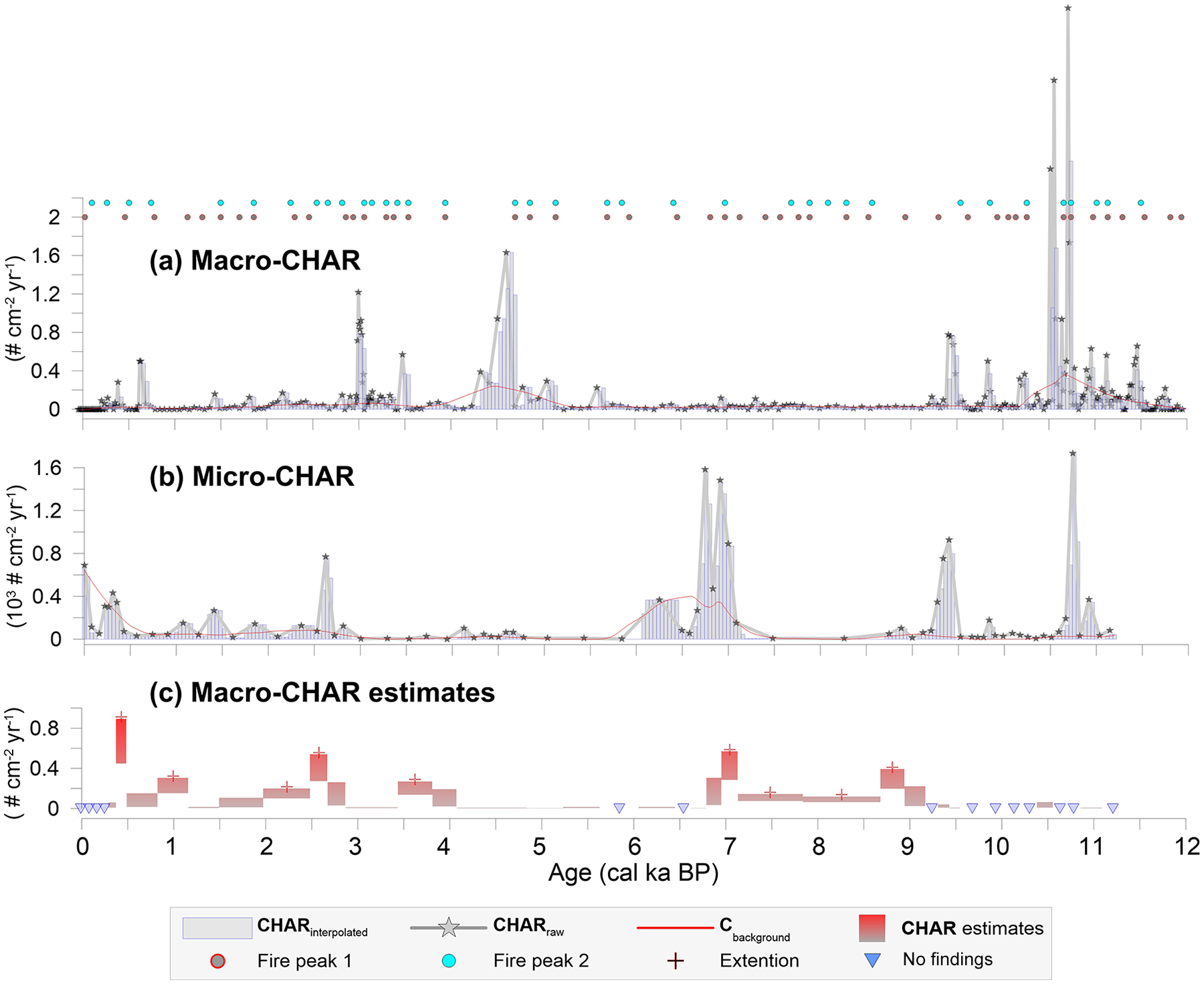
Charcoal accumulation rate (CHAR) from two nearby profiles from Stavsåkra: (a) high-resolution macroscopic CHAR with background (red line) from STV09-2, (b) microscopic CHAR with background (red line) from STV05 (counts of charcoal fragments on pollen slides; see Methods for details), and (c) macroscopic CHAR estimates from STV05 (estimated number of charcoal fragments in samples used for plant macrofossil analysis, see Methods for details). The data presentation for STV05 (b, c) is modified from Greisman and Gaillard (2009). In (a) and (b) CHAR raw (the raw record) was interpolated at 40 years resolution (i.e. CHAR interpolated) and a 1000 years LOWESS smoother was applied to estimate low-frequency CHAR (C background); while in (c) the residues of CHAR interpolated and C background indicate the fire peaks; in (a) red circles (fire peak 1): based on charcoal counts; blue circles (fire peak 2): based on charcoal area).
There are two major discrepancies between STV05 and STV09-2. STV05 exhibits high peaks of microcharcoal ca. 7–6 ka BP and of macrocharcoal around 7 ka BP, while STV09-2 is characterized by high peaks of macrocharcoal ca. 5–4.3 ka BP, and by small peaks of microcharcoal ca. 4.7–4.2 ka BP. The uncertainties embedded in the chronologies may imply between-core differences of ca. ± 250 years in the ages of synchronous layers. Therefore, we may assume that the peaks of charcoal in STV05 at ca. 0.4 ka BP, ca. 2.6 ka BP, ca. 9.4 ka BP, and ca. 10.7 ka BP, and in STV09-2 at ca. 0.4 (or 0.7) ka BP, ca. 3 ka BP, ca. 9.5 ka BP, and ca. 10.7 ka BP, are synchronous.
Comparison between charcoal records from two sites in the same geographical region, Notteryd (NT) and Stavsåkra (STV09-2)
The sediment accumulation rates at the two sites are broadly comparable except for a sharp increase in peat accumulation rate around 3 ka BP occurring at Stavsåkra (STV09-1) (Figure 6). Different short-term fire histories are recorded at the two sites in terms of timing and frequency of fire events, although the number of charcoal peaks over the Holocene is almost the same (35 at Notteryd and 47 at Stavsåkra; Figure 6). However, the two sites show similar long-term trends with frequent fires in the early Holocene with particularly high peaks around or before 9 ka BP (although not contemporaneous between the sites), a long period with low fire frequency at both sites from ca. 9 ka BP (STV09-2) and ca. 7 ka BP (NT) until ca. 4 ka BP, and more frequent fires from ca. 2 ka BP, with a distinct historical fire dated to ca. 1600 CE.
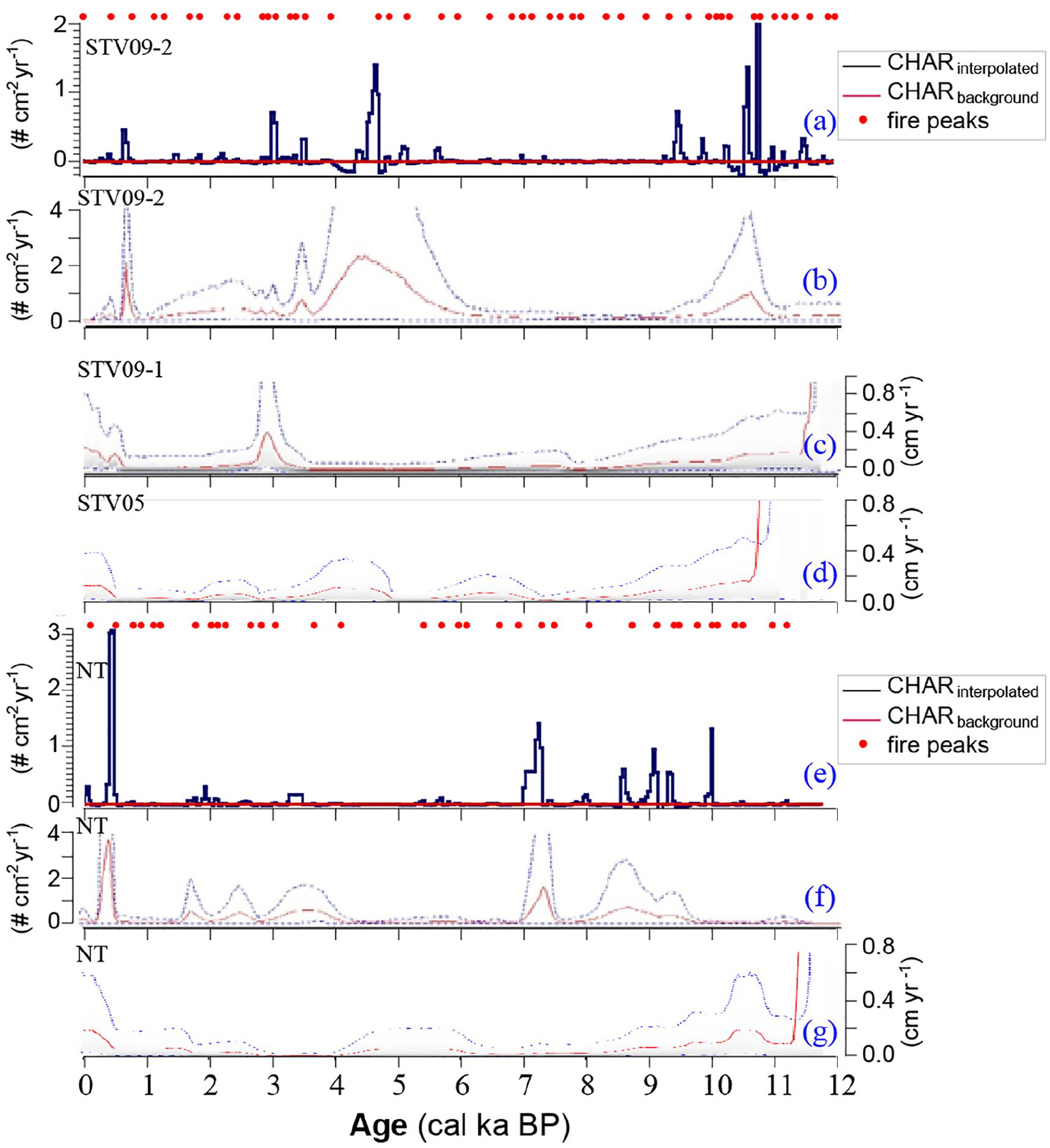
Inferred fire history from Stavsåkra (STV) and Notteryd (NT) using Charster (Gavin, 2006) with their sedimentation rates and modeled charcoal accumulation rates (CHAR) using Bacon (Blaauw and Christen, 2011). Macroscopic CHAR with identified fire peaks for (a) STV09-2 and (e) NT; modeled CHAR with mean probability (red curve) and 90% probability range (blue curves) for (b) STV09-2 and (f) NT; sediment/peat accumulation rates for (c) STV09-1, (d) STV05 and (g) NT, with probability mean and range as in (b).
Discussion
Methodological issues
The most common recommendations found in the literature on charcoal-based reconstructions of fire history are to use in preference (a) charcoal fragments >0.5 μm (Clark and Patterson, 1997), (b) charcoal counts and/or charcoal area (or weight/mass), and (c) charcoal accumulation rates (CHAR) rather than percentages of charcoal fragments (e.g. Whitlock and Larsen, 2001). Most studies on charcoal dispersal and deposition suggest that large and heavy charcoal fragments are deposited close to the fire edge and represent local fire, while small and light fragments are transported over long distances and indicate regional fire (e.g. Adolf et al., 2018; Carcaillet et al., 2001; Clark et al., 1998; Gardner and Whitlock, 2001; Ohlson and Tryterud, 2000; Tinner et al., 1998). Blackford (2000) found that fragments <20 μm are most reliable as indicators of regional background charcoal, while fragments >125 μm are representative of local fires. Millspaugh and Whitlock (1995), Clark et al. (1998), and Froyd (2006) suggested that fragments >120–125 μm are the most useful proxy to reconstruct fire events, and Tinner et al. (1998) and Duffin et al. (2008) recommended using charcoal >50 μm to reconstruct local fire history. These studies reveal the difficulty of providing precise recommendations on the size fraction(s) to use in order to separate local from regional fires. Moreover, the spatial scale (in quantitative terms) of a local versus regional fire event is seldom clearly defined. Black and Mooney (2006) developed an efficient method to reconstruct local fire using macrocharcoal particles >250 μm. The selected minimum size of the charcoal fragments is based on the assumption that charcoal of this size and larger will represent primarily local or site-catchment fire events (Whitlock and Millspaugh, 1996).
The use of CHAR implies that a detailed and reliable chronology is available, which is usually standardized in palaeoecological studies today. Nevertheless, the degree of accuracy of the chronology will influence the reliability of the CHAR values and the interpretation of the charcoal record. Chronologies are based on age-depth models and their accuracy will depend largely on the number of dates available per unit time. The reliability of chronologies often varies along a record, and accumulation rates might be over- or underestimated over parts of a record, which will bias the reconstruction of the fire history. In this study, the charcoal record from Stavsåkra STV09-2 has the least certain chronology of this study, and the uncertainty is highest for the mid Holocene, where some of the high or very low accumulation rates are most likely a consequence of C14 date inversions affecting the behavior of the age-depth model. It is also in this record that we suspect that the peak of charcoal at ca. 4.5 ka BP might be wrongly dated and may represent instead an event dated to ca. 7 ka BP in STV05 (see discussion below).
The use of charcoal area is considered optimal because a large number of small fragments does not necessarily represent a major fire event, and a small number of very large charcoal fragments may represent a major local fire event. Nevertheless, based on our results, we suggest that the combined assessment of charcoal area and count for several size classes is the most powerful method to interpret a charcoal record (see Notteryd, Figure 4). Using area alone may lead to misinterpretation, as the area of a certain size fraction does not inform on the size of individual fragments within the fraction. Knowing the number of fragments informs on the mean size of each fragment within the size fraction, that is, whether the fragments are very small or relatively large. For instance, a peak value of area may represent a single large piece of charcoal rather than a large number of fragments. Such information may be useful for the interpretation of the record.
The effect of the basin size and type (bog or lake) on the size of the charcoal source area is still not fully understood. Peters and Higuera (2007) developed a “fragment dispersal model” to calculate the potential charcoal source area (PCSA) for several size classes of fires. They found that the variability in airborne charcoal deposition in a lake can be explained largely by the relationship between the size of the PCSAs and the size of fires. The simulations show that if a large fire occurs within a small PCSA, the produced charcoal is deposited over the entire PCSA, resulting in charcoal peaks in sites located within the PCSA and absence of charcoal in sites located outside the PCSA. Furthermore, a large PCSA with a larger number of fires of varying sizes than a small PCSA will lead to a larger variability in charcoal deposition through time in a site located in a large PCSA than in a site located in a small PCSA. The theoretical results of Peters and Higuera (2007) also show that macrocharcoal is biased toward short distances, but may also be transported over many kilometers, which agrees with dispersal data from uncontrolled fires (e.g. Hallett et al., 2003; Pisaric, 2002; Tinner et al., 2006; Whitlock and Millspaugh, 1996).
Our results indicate that almost all charcoal peaks in the small size classes (250–500 μm and <250 μm) have an equivalent peak in the large size class (>500 μm) (Figure 4). This would suggest that the peaks of small and large charcoal fragments represent the same fires. It is also noteworthy that the large fires that almost entirely destroyed the town of Växjö and devastated the farms of the area in 1570 CE and 1612 CE are recorded by higher charcoal values at Notteryd (4 km from Växjö; Figure 6e) than at Stavsåkra (16 km from Växjö; Figure 6a) and Storasjö (Olsson et al., 2009; 30 km from Växjö). It indicates that the distance between the site and the fire plays a significant role, and that small bogs have a relatively large charcoal source area.
Although the size and intensity of a fire/fires, and the distance between the fire(s) and the sampled site play a major role in the representation of fires in a charcoal record, other factors may also be of importance. Wind strength and direction, the plant/wood species that burned, and taphonomic processes during the transport, deposition and preservation of the charcoal fragments are other factors that may play a more or less significant role. The charcoal record obtained from a peat sequence at a particular point of a bog is the result from the sum of all these factors.
Is a single charcoal record representative of the site’s fire history?
The two parallel series of charcoal samples from the same cores (Notteryd, NTA and NTB, Figure 4) and the two charcoal records from nearby parallel profiles (Stavsåkra, STV05 and ST09-2, Figure 5) indicate that a single record is broadly representative of the fire history of the site. Although some charcoal peaks (all fractions; counts and areas) occur only in one of the two records, most peaks are found in both records. It is however striking that the Spearman analysis does not show a significant correlation between the duplicate charcoal records NTA and NTB, although several peaks are recorded in both records and trends are very similar (Figure 4). The major differences are: (a) the high values of both count and area at 186 cm, 147 cm, and 35–36 cm, and of area at 86 cm in record B are not found in record A, and (b) the high values of count and area at 93 cm in record A are not found in record B. These differences may be due to the small sample size and random differences in the size of the charcoal fragments. Such dissimilarities might become smaller when larger samples are analyzed, that is, larger numbers of charcoal fragments are counted and measured.
At Stavsåkra (Figure 5) the comparison between the records STV05 and STV09-2 is problematic because of the differences in methods used. The macroscopic record from STV05 has a lower time resolution than that of STV09-2, and the volume of sediment/peat analyzed in STV05 is larger. Moreover, the number of large fragments is greater in STV05 than in STV09-2. In contrast, small fragments might be missed when bleaching is not used, which is the case of STV05. The number of macroscopic fragments was estimated in large fractions (1–10, 11–100, 101–1000, >1000), which also implies approximate accumulation rates for STV05 (Figure 5c). Nevertheless, despite these methodological issues and uncertainties in the time correlation of the two records, main trends in charcoal accumulation rates, and in the number of peaks and their average frequencies are comparable. The peaks in numbers of macrocharcoal (STV09-2) and microcharcoal (STV05) fragments at ca. 10.7 ka BP and 9.4 ka BP may correspond to the same fire events/periods at the site. Moreover, the five peaks of values between ca. 3 ka BP and 0.7 ka BP (macrocharcoal in STV09-2) and between ca. 2.6 ka BP and 0.3 ka BP (microcharcoal in STV05) might also represent the same fire events/periods at the site, although with an age discrepancy of ca. 400 years. Such a discrepancy in age between the two cores is probably a result of the uncertainties related to age-depth modeling.
There are, however, other major discrepancies in charcoal curves between the two records that need to be addressed, that is, the fire events/periods at ca. 7 ka BP in STV05 and ca. 4.6 ka BP in STV09-2. The two possible explanations are either uncertain chronologies or local differences in the type and amount of vegetation that burned at each site. The chronology of STV09-2 might be inaccurate in the mid Holocene due to a gap in 14C dates between ca. 8 ka and 4 ka BP, and erroneous pollen-stratigraphical correlation over that period. A closer examination of the sequence slotting result (Figure 3b) suggests that the pollen-stratigraphical section boundary B/C set to 60 cm in STV05 and 80 cm in STV09-2 might be erroneous (see Supplementary Material, Table 2). The pollen-stratigraphical change (i.e. increase in Alnus, Betula, Quercus, and Tilia, and decrease in Corylus and Pinus) dated to ca. 4.6 ka BP in STV09-2 by correlation with STV05, might instead be synchronous with a similar pollen-stratigraphical change in STV05 dated to ca. 7 ka BP (Figure 3b). This would imply that the charcoal peaks at 4.6 ka BP (STV09-2) and at 7 ka BP (STV05) might correspond to the same fire event/period. The correct dating for this event would thus be ca. 7 ka BP. The latter interpretation is supported by two other charcoal records from the region, NT (this paper) and Storasjö (Olsson et al., 2009) ca. 30 km from STV and NT. These two records both exhibit a charcoal peak at ca. 7–7.5 ka BP. This highlight the importance of a careful evaluation of sequence slotting based on the correlation of pollen-stratigraphical changes when alternative correlations might have been dismissed.
The results suggest that a single charcoal record may be only partly representative of a site’s fire history given that not all charcoal peaks are recorded in duplicate records, either they are from the same core (NTA and NTB) or from parallel profiles 10 m apart (STV05 and STV09-2). Sample duplicates from the same core may help to separate the charcoal peaks that are due to continuous deposit of charcoal particles over the surface of the site from “random peaks” that result from other processes within the peat/sediment profile. Duplicates from a parallel profile are more problematic to use because of the correlation issues, for example, the difficulty to establish chronologies with the needed precision for correlation of high-resolution charcoal records.
Are the charcoal records from Notteryd and Stavsåkra representative of the region’s fire history?
The major fire events of the early Holocene are not synchronous between sites, which indicates that fire was relatively frequent in the region from the start of the Holocene until ca. 9–8.5 ka BP, but none or few of the fire events did occur at the same time in the entire area. Most of the major fire events occur before 10 ka BP in STV, and between 10 ka and 8.5 ka BP in NT. In contrast, the very distinct fire event at ca. 7 ka BP (NT and STV05), the fire events/period between ca. 4 ka and 1.5 ka BP (NT and STV05/STV09-2), and the fire event ca. 0.5–0.6 ka BP (NT and STV09-2) may represent the same major events in the area. The charcoal record from Storasjö (Olsson et al., 2009) exhibits major fire events/periods at ca. 0.6 ka and 1.5 ka BP, and between 7.5 ka and 4 ka BP with the most pronounced event at ca. 7.5 ka BP. It suggests that the fire events/periods ca. 7–7.5 ka, 4 ka, 1.5 ka, and 0.5–0.6 ka BP represent the same fire periods in the region (within an area of minimum ca. 30 km in diameter). The 7–7.5 ka fire period is probably climate-induced (low precipitations), while the major fire periods in the late Holocene are related to human activities (forest clearances for agriculture, in particular from Late Iron Age, Olsson et al., 2009). The most recent, pronounced charcoal peak in all three sites at ca. 0.5 ka BP is most probably related to the large fires that occurred in the town of Växjö and its surroundings during the severe wars between Sweden and Denmark 1570 CE (Larsson, 1967) and 1612 CE (Larsson, 1962).
Conclusions
Our results suggest that almost all the information used in the reconstruction of Holocene fire history at the two selected bogs Stavsåkra and Notteryd is captured by the area of charcoal fragments >500 μm. Nonetheless, the addition of charcoal count provides useful information about the mean size of the fragments, either in the total record or in different size classes. We thus recommend calculating the total charcoal accumulation rates of both area and count of fragments.
The macrocharcoal records from Stavsåkra (STV09-2) and Notteryd (NT) analyzed with the methods of Black and Mooney (2006) exhibit very low charcoal values of both area and count, which hampers the separation of fire-related from non-fire-related variability in the peak component (Higuera et al., 2008). Therefore, we recommend to analyse samples >2 cm3 in the case of small peat bogs with similar peat accumulation rates as the two study sites discussed in this paper. The charcoal records from Stavsåkra and Notteryd do not provide information on whether the charcoal peaks represent local (e.g. 10 m to a few km around the coring site; Clark, 1988), or regional (e.g. >10 km around the coring sites; Clark, 1988) fire events. The large fires that destroyed the town of Växjö in 1570 CE and 1612 CE are recorded with higher charcoal values at Notteryd (ca. 4 km from the town) than at Stavsåkra (ca. 16 km from the town). Moreover, they are represented at both sites by large areas and counts of charcoal fragments of all size classes, but in particular of the size class >1000 μm. Therefore, both large and small charcoal fragments may represent the same fire event(s). Local fires may produce charcoal fragments of all sizes, and large fragments (i.e. >1000 μm in the case of this study) do not necessarily imply local fires (i.e. fires within a distance <10 km).
Parallel charcoal records from the same core (Notteryd, NTA and NTB) or very close parallel profiles (Stavsåkra, STV05 and STV09-2) are very similar although some fire events may not be registered over the entire core diameter (10 cm) (NTA and NTB) or bog surface. The charcoal records from parallel profiles at Stavsåkra show large differences in the record of individual charcoal peaks, which may in part results from the uncertainties in 14C chronologies and correlation of the profiles. Nonetheless, major fire events are registered in both records and the long-term fire history is consistent in terms of periods with either frequent fires (early and late Holocene) or few fires (mid Holocene).
Our results confirm the observation of Ohlson et al. (2006) that fire events are not necessarily represented by continuous layers of charcoal over an entire bog surface. However, in that study, only the bottom part of each peat bog was dated and the chronology of the individual layers was estimated. It was thus impossible to assess whether some of the charcoal layers were synchronous between the peat bogs. In our study, we show that a number of charcoal layers are synchronous between the two profiles of Stavsåkra (STV05 and STV09-2), as well as between the profiles from Notteryd (NT) and Stavsåkra. This study also confirms the assumptions discussed in Olsson et al. (2010) and Cui et al. (2013) that the region of Stavsåkra-Notteryd is characterized by a long-term Holocene fire history partly different from the one reconstructed at Storasjö, a peat bog located 30 km East of Stavsåkra (Figure 1).
Supplemental Material
Supplementary_Material_Cui_et_al__The_Holocene_HOL_941069 – Supplemental material for Evaluating fossil charcoal representation in small peat bogs: Detailed Holocene fire records from southern Sweden
Supplemental material, Supplementary_Material_Cui_et_al__The_Holocene_HOL_941069 for Evaluating fossil charcoal representation in small peat bogs: Detailed Holocene fire records from southern Sweden by Qiao-Yu Cui, Marie-José Gaillard, Boris Vannière, Daniele Colombaroli, Geoffrey Lemdahl, Fredrik Olsson, Blas Benito and Yan Zhao in The Holocene
Footnotes
Acknowledgements
We acknowledge the financial support of the Linné Academy’s scholarships for Q.-Y. Cui’s visits at the University of Bern. We thank Willy Tinner and two anonymous reviewers for their constructive comments and useful suggestions.
Funding
The author(s) disclosed receipt of the following financial support for the research, authorship, and/or publication of this article: This research was financially supported by the Faculty of Health and Life Sciences of the Linnaeus University (Sweden) and the National Natural Science Foundation of China (41401228).

Supplemental material
Supplemental material for this article is available online.
References
Supplementary Material
Please find the following supplemental material available below.
For Open Access articles published under a Creative Commons License, all supplemental material carries the same license as the article it is associated with.
For non-Open Access articles published, all supplemental material carries a non-exclusive license, and permission requests for re-use of supplemental material or any part of supplemental material shall be sent directly to the copyright owner as specified in the copyright notice associated with the article.
