



Abstract
The emergence and intensification of transcontinental exchange during both the Late Neolithic and Bronze Age profoundly influenced the social history of Eurasia. While scholars have intensively discussed east-west long-distance communication along the proto-Silk Road, the north-south transport networks that connected China to South and Southeast Asia during the Late Neolithic and Bronze Age have attracted much less attention in the scholarly literature based on archeological science data. In this paper, we find new radiocarbon dates from 11 Neolithic and Bronze Age sites in northwestern and central Yunnan in Southwest China, a key entrance into South and Southeast Asia from China. Combined with previously published archeological records and radiocarbon dates, we attempt to disentangle and understand the timing and routes of the networks linking China to South and Southeast Asia during the Late Neolithic and Bronze Age. We propose three north-south land routes that played essential roles in the cultural exchanges in addition to the proto-Silk Road and maritime routes. This includes the trans-Himalayan routes, trans-Hengduan Mountain routes, and the trans-Yunnan–Guizhou Plateau routes. The north-south exchange between China and South and Southeast Asia probably emerged in the fifth millennium BP (before the present) mainly through a low-frequency trans-Yunnan–Guizhou Plateau and trans-Himalayan routes. The exchange frequency significantly increased after the fourth millennium BP, with the synchronous development of the three primary north-south passageways. Trans-Hengduan routes might have been the most crucial artery connecting China and South and Southeast Asia during 3000–2200 BP, but more archeological records are needed to understand the detailed evolution of these transport networks.
Keywords
Introduction
The Late Neolithic and Bronze Age corresponded to the rise of trans-Eurasia exchange (Chen et al., 2022; Frachetti et al., 2017; Liu et al., 2019), which profoundly influenced the trajectory of social evolution and human-environment interactions in different corners of the Old World (Chen et al., 2015; Dong et al., 2020; Huang et al., 2017; Miller and Makarewicz, 2019; Zhang et al., 2021). The convergence of crops that were domesticated in Southwest and East Asia occurred during the middle fifth millennium BP (Spengler et al., 2014; Zhou et al., 2020), while transcontinental exchange along the proto-silk Road emerged some hundreds of years later (Li, 2021; Wang et al., 2019). Compared to the west-east transport networks along the Proto-Silk Road, the north-south transport networks during the Late Neolithic and Bronze Ages are not well understood (Higham et al., 2011).
As crucial parts of the Silk Road, the “Shu-Shendu Road蜀身毒道,” “Annan Tong Tianzhu Road 安南通天竺道,” and “Tang-Tibet Ancient Road 唐蕃古道” (Figure 1) recorded in historical documents acted as the primary north-south passageways linking China to South and Southeast Asia during the historical period (Fang, 1987; Guo, 1990; Lin, 1981; Lu and Yu, 2017). The transport networks primarily composed of“Shu-Shendu Road” and“Annan Tong Tianzhu Road” were formed in the Han and Jin dynasties (202 BCE–420 CE) and remained relatively stable for the past 2000 years, as shown by historical documents, field survey data, and geographic data (Huo and Ren, 2022). The transport network within and passing through Yunnan exhibits a diversified change during the prehistoric period. By contrast, the “Tang-Tibet Ancient Road” flourished during the Tubo period (633–842 CE) and integrated into the transport networks during the Yuan Dynasty (Huo, 2017). However, the archeological evidence suggests that interregional exchange started during the Late Neolithic period through different passageways (e.g. Gao et al., 2020; Hung et al., 2007; Lü, 2016).
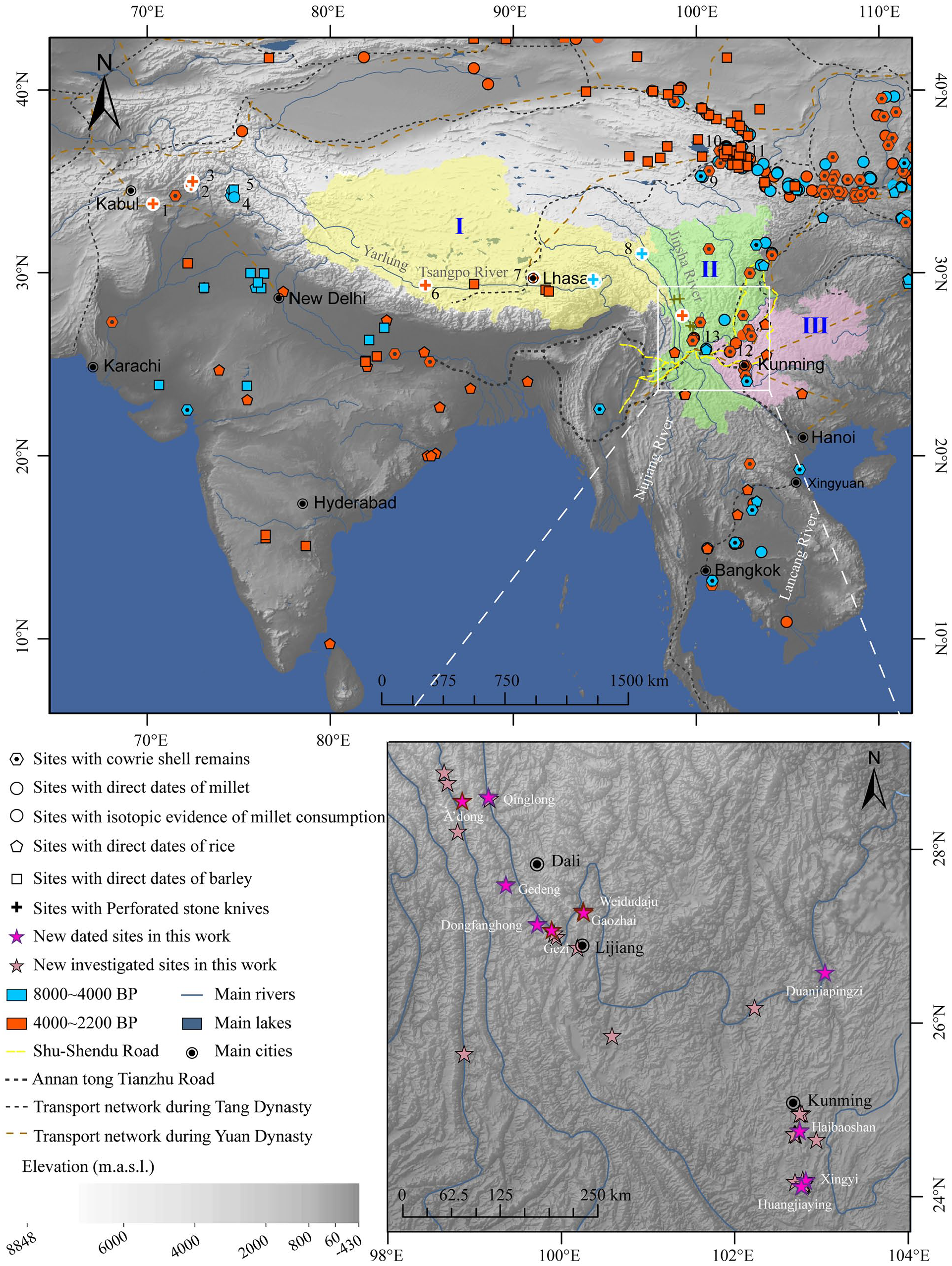
Location of the sites mentioned in the text. (1) Bir-kot-ghundai site, (2) Loebanr site, (3) Kalalo-deray site, (4) Gufkral site, (5) Bruzahom site, (6) Changguogou site, (7) Qugong site, (8) Karuo site, (9) Zongri site, (10) Shannashuzha, (11) Liuwan site, (12) Dadunzi site, (13) Baiyangcun site. Zone I, II, and III represent Tibet Plateau, Hengduan Mountain areas, and Yunnan-Guizhou Plateau, respectively. Three historical trade roads in these three regions connect China to South and Southeast Asia. Historically, roads between North China and South and Southeast Asia are based on Guo (1990) and Wu et al. (2015).
Cultural exchange between China and South and Southeast Asia during the Late Neolithic and Bronze Age was facilitated by massive diffusion of farming groups, for example, the southward expansion of millet farmers from the Yellow River valleys in North China, which has been discussed in detail by archeologists, geneticists and linguists (e.g. Gao et al., 2020; Ma et al., 2022; Wang et al., 2018; Zhang et al., 2019). However, given that the results of these studies are conflicting, the timing and routes for the spread of millet farming to Southwest China and South and Southeast Asia remain unclear. Besides the evidence based on archeological sciences, the cultural exchange between northern China and South and Southeast Asia has been primarily discussed in terms of typology and other traditional archeological data (e.g. Chen, 2012; Han, 2013a, 2013b; Yang, 2004; Yao, 2010; Yao et al., 2020). For instance, the similarities between ceramics and painted pottery found in northern China and South Asia show an interaction rout through the eastern margin of the Tibet Plateau and Himalayan mountains to South Asia. A cluster of archeological materials from the Liangshan region suggests routes and types of interregional interaction and motivations (e.g. Hein, 2014a; Hein et al., 2015a; Hein, 2014b, 2015b, 2015c, 2016a, 2016b, 2017a, 2017b). Nevertheless, the history of the development of these networks is still unclear as few radiocarbon dates exist in critical areas of the ancient passageways during the Neolithic and Bronze Ages, such as in the northwestern and central Yunnan Province of southwestern China.
In this study, we investigated Neolithic and Bronze sites in northwestern and central Yunnan Province, which were the crossroads of the “Shu-Shendu Road” and “Annan Tong Tianzhu Road” (Figure 1) recorded in historical documents. We obtained new radiocarbon dates from 11 sites in these areas and reviewed and analyzed published radiocarbon dates and archeological data from Neolithic and Bronze sites in North China, South Asia, and mainland Southeast Asia to explore the preliminary spatial-temporal patterns of the interaction networks linking these areas during ~5000–2200 BP. New radiocarbon dates of investigated sites in this study are essential supplements to the dataset to detect spatiotemporal patterns of human settlement during the Late Neolithic and Bronze Age in northwestern and central Yunnan, which are vital components of the trans-Hengduan and trans-YGP routes (Figure 1).
Materials and methods
Study region and sampling
We focus on the inland dispersal routes across the Hengduan Mountains and Yunnan–Guizhou Plateau and the Tibetan Plateau from North China to South Asia and mainland Southeast Asia (Figure 1) in this study. Although routes from northwestern China to South Asia via the proto-Silk Road and Inner Asian Mountain corridor, coastal routes from Fujian and Taiwan to islands Southeast Asia, and maritime routes from China to South and Southeast Asia are also passageways connecting China to South and Southeast Asia (Stevens et al., 2016). Historically, there were primarily three transport roads between North China and South and Southeast Asia (Guo, 1990; Wu et al., 2015; Figure 1). Cultural exchanges between North China and South and Southeast Asia during the Late Neolithic and Bronze Age may also follow routes similar to these three historic trading roads. The Hengduan Mountains correspond to a transitional region between the Tibetan Plateau and Yunnan–Guizhou Plateau (Zhang et al., 1997). The western routes, with the highest altitudes, cut across the Tibetan and Himalayan Mountains (Figure 1, Zone I). The central routes, also with high altitudes, are across the Hengduan Mountains along the eastern margin of the Tibetan Plateau, including the west Sichuan highland, northwest Yunnan, and southeast Tibet (Zhang et al., 1997) (Figure 1, Zone II). The eastern routes with the lower-altitude cross the Yunnan–Guizhou Plateau, including most of the regions in Yunnan and Guizhou (Figure 1, Zone III).
We investigated 33 Neolithic and Bronze Age sites in northwestern and central Yunnan during the second Tibetan Plateau scientific expedition with the support of various archeological institutes in April 2021 and sampled human bones, animal bones, pottery, and plant remain from these sites (Figure 1 and Supplemental Table S3). Eighteen sites in northwest Yunnan (Figures 1 and 2) are located in the Hengduan mountain region. This region features vertical zonation, with high mountains and deep gorges at the reaches of rivers, such as the Jinsha, Lancang, and Nujiang Rivers. The higher river basins used for pastoralism today are primarily in the northern region 28–30°N, whereas the lower basins used for modern agriculture are in the southern region below 28°N (Yang and Zheng, 1989; Zhang et al., 1997; Zhao et al., 1992). The period from November to April is cold and dry, while from May to September, it is warm and wet (Zhang et al., 1997; Zhao et al., 1992). Fifteen sites are located in central Yunnan, characterized by lower altitudes and lake basins (Figures 1 and 2). According to the data from Kunming, the average annual precipitation is ~1000 mm, and the primary rainy season is from May to September.
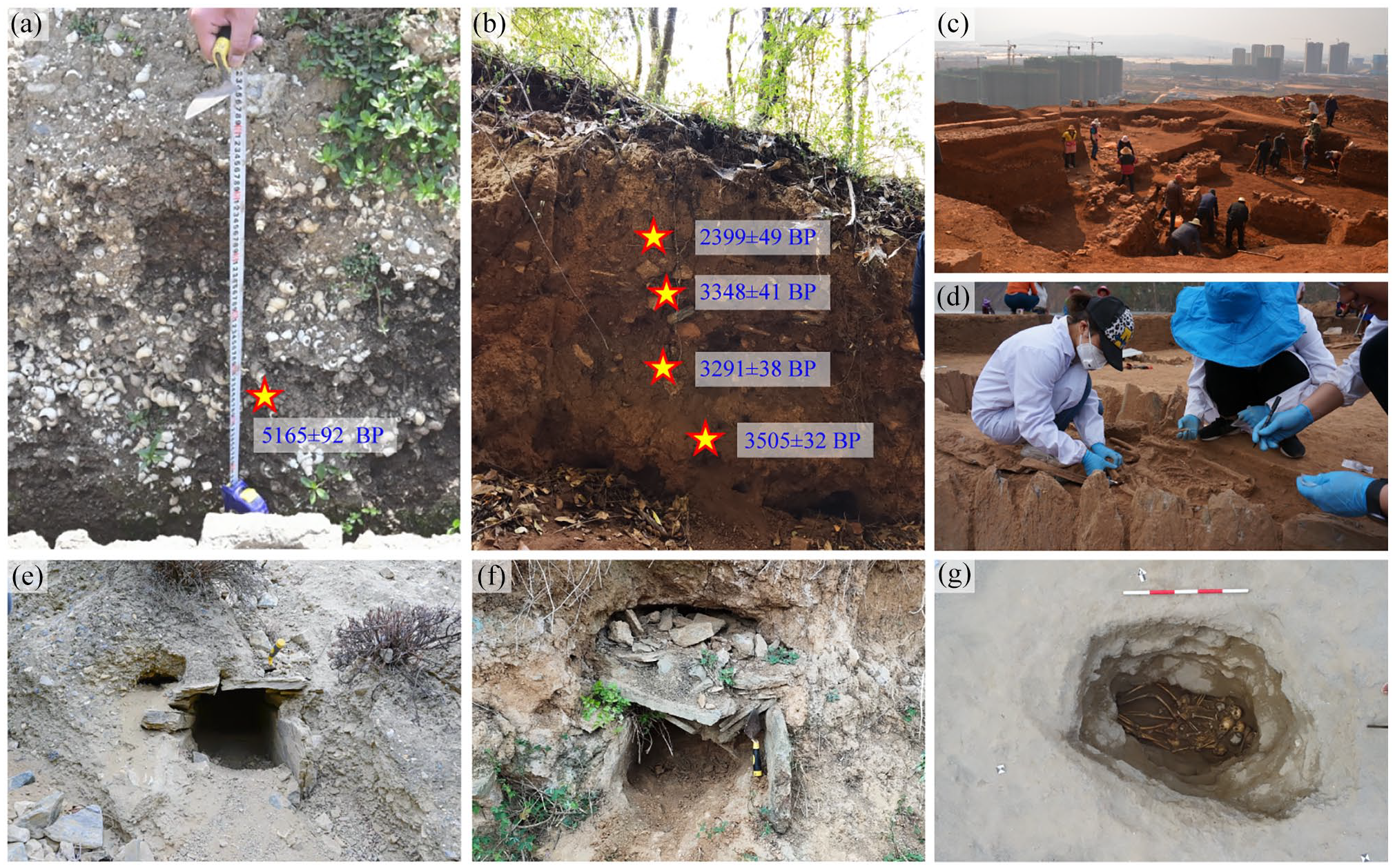
Photographs of Neolithic and Bronze sites used in this study. (a) Huangjiaying; (b) Gedeng; (c) Haibaoshan; (d) Duanjiapingzi; (e) Qinglong; (f) Gezi; (g) Weidudaju. The pentagram represents the location of the material dated unearthed from the profile.
Based on evidence from material culture (Li, 2019), most Neolithic sites in Yunnan date to the middle-late Neolithic period. Integrating radiocarbon dates from the various contexts of Neolithic sites in Yunnan Province, the Neolithic period is roughly divided into two phases: the early phase (5000–3800 BP) and the late phase (3800–3000 BP) (Yao, 2010). The early phase dates are constricted to northwestern Yunnan and central Yunnan. The earliest radiocarbon date of Neolithic culture in Yunnan is from the Baiyangcun site, starting around 4600 BP. While most Neolithic sites in Yunnan date to the late phase (3800–3000 BP). There are mainly four ceramic complexes identified in Yunnan. First, a double-handle jar tradition is primarily found in the highland regions of the upper reaches of the Jinsha River. Second, an incised or impressed ware tradition and ground lithics were distributed in the middle Jinsha and Lancang Rivers. Third, a gray amphora ware tradition is found in the Lower Jinsha. And fourth, a cord-impressed ware tradition and flake or shouldered axes are found in the Qilu Lake Basin, the Red River, and the lower Nu River (Yao, 2010). In the subsequent Bronze Age, the sites of Heposuo and Shangxihe in the Dian Lake Basin provided the earliest evidence of bronze manufacturing in Yunnan at around 3100 BP (Yao et al., 2020). In northwestern Yunnan, the earliest evidence of bronze manufacturing is in the early third millennium BP (Yao, 2010). The Gedeng and Baiyangcun types represent a Neolithic culture in northwestern Yunnan (Li, 2019), including the middle-lower reaches of the Lancang and Jinsha Rivers. By contrast, the Haidong type and Shizhaishan culture are the most critical Neolithic and Bronze Age culture in central Yunnan, respectively, following the complex polity “Dian.”
While we investigated 33 sites in Yunnan, only 11 sites where samples of human, animal, and plant remains were collected were well-preserved enough to be suitable for radiocarbon dating. We collected all available samples from these sites. A total of 26 human, animal, and plant remains samples were collected from the 11 sites for radiocarbon dating, including eight sites in northwestern Yunnan and three sites in central Yunnan. The other radiocarbon dates of crop remains, charcoal, and archeological data were collected from published materials in China, South Asia, and mainland Southeast Asia (Supplemental Table S2 and Figures S1–S4). We reviewed and analyzed direct radiocarbon dates of millets (Panicum miliaceum and Setaria italica), rice (Oryza sativa), barley (Hordeum vulgare), charcoal, and collagen from some key sites and regions. In addition to the direct radiocarbon dates, we collected some indirect dates for crops, millet consumption, cowrie shell, and perforated stone knives from sites with valuable relics to trace the history of cultural exchange between China and South and Southeast Asia. The data summarized in this study are primarily derived from reviews of radiocarbon, crop, isotopic, and archeological evidence from different regions in China, South Asia, and Southeast Asia (Dong et al., 2020; Liu et al., 2019; Long et al., 2022; Wang et al., 2014).
Cultural exchanges between China, South Asia, and Southeast Asia strengthened during the Late Neolithic and Bronze Age, which can be detected in the distribution of prehistoric archeological materials in these regions. Given broomcorn and foxtail millet were first domesticated in northern China at ~10,000 BP (Zhao, 2011) and spread southward to Sichuan and Yunnan via the northeastern margin of the Tibetan Plateau after 5500 BP (Chen et al., 2015; Huan et al., 2022), the distribution of Neolithic sites with direct dates of millet remains or isotopic evidence for millet consumption can shed light on the history of the development of the north-south passageways connecting North China and South and Southeast Asia during the Neolithic period. Rice, first domesticated in the middle-lower reaches of the Yangzi River at around 10,000 BP (Zhao, 2011), can also be used to track the interaction exchange between China and South and Southeast Asia. Additionally, perforated stone knives were specific tools for farming unearthed from early-mid Neolithic sites in North China (Li, 2011; Zhao, 2011; Zuo et al., 2017). Perforated stone knives were consistently associated with millet remains and sedimentary houses in North China during the Neolithic period (Lü, 2015). By contrast, barley, which was first domesticated in Southwest Asia, appeared much earlier in South Asia than in China, indicating that barley may have been introduced into China through the Himalayas from South Asia (Bellwood, 2005; Liu et al., 2019). In comparison, cowrie shells in China are thought to be transported from the Indian Ocean (Higham et al., 2020; Yang, 2019). The earliest remains of cowrie shells were found at some sites in northwestern China during 5000–4000 BP and then widely unearthed from the Late Neolithic and Bronze sites in northwestern and southwestern China during the fourth millennium BP (Yao, 2010). These cowrie shells are rare in inland regions and ostensibly acted as ancient currency by the Shang, Zhou, and Sanxingdui polities (Yao, 2010). In addition, the rise of metallurgy in Southeast Asia is particularly pertinent to the north-south routes of communication between China and mainland Southeast Asia across Southwest China (e.g. Higham et al., 2011; Pryce et al., 2022). Therefore, we can outline the interaction between China, South Asia, and Southeast Asia through the distribution of these elements in China, South, and Southeast Asia.
Radiocarbon dating
The pretreatment of bone samples was conducted at the Key Laboratory of Western China’s Environmental System (MOE) of Lanzhou University. Collagen samples were extracted from bone and teeth following the process described in Richards and Hedges (1999) and an added ultrafiltration step. After acid-base-acid treatment, liquid samples were filtered with a 9 ml Ezee Filter separator and ultrafiltrated with Amicon Ultra-4 Millipore 30 kDa filter centrifuge tubes to retain the >30 kDa fractions. Finally, samples were freeze-dried to extract collagen for radiocarbon dating. The pretreatment of plant remains, and the charcoal samples followed pretreatment protocols (Brock et al., 2010). All samples were selected for accelerator mass spectrometry radiocarbon dating at the AMS radiocarbon dating laboratory of MOE at Lanzhou University. OxCal v.4.4.4 with an IntCal 20 calibration curve (Reimer, 2020) was used for calibration. All reported ages are relative to AD 1950 (referred to as “BP”).
Results
Twenty-six new 14C dates from the 11 investigated sites in Yunnan were obtained in this study (Table 1). Eight sites in northwest Yunnan and three sites in central Yunnan were dated to ~3900–2400 BP and ~5200–2800 BP (Figure 2 and Table 1), respectively.
Radiocarbon dates of samples and sampling context in this study.
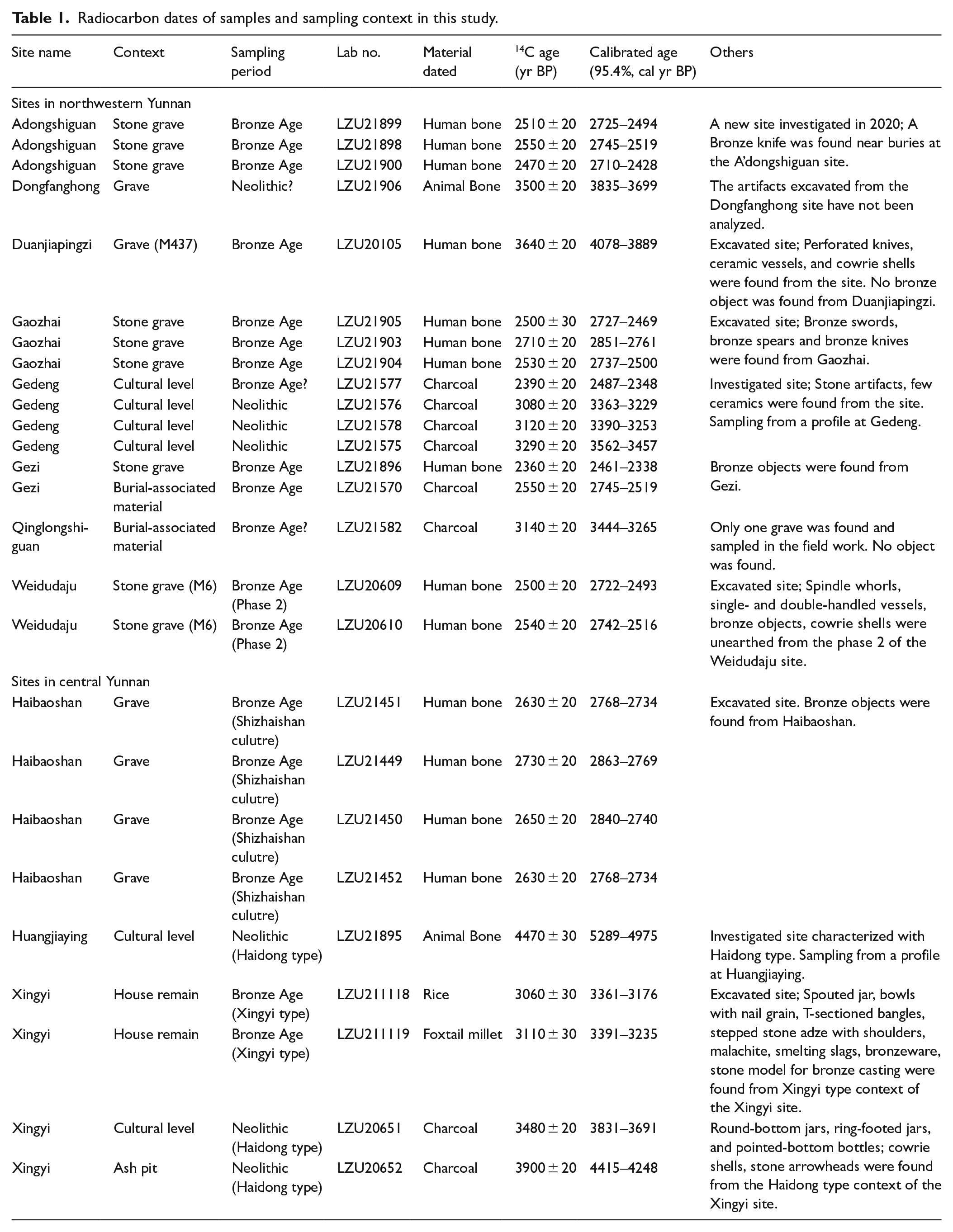
Three sites were investigated in central Yunnan (Figures 1 and 2, Supplemental Table S3). The earliest date of this region is from the Huangjiaying site, which dates to ~5200 BP based on one bone sample. The Xingyi site is a shell midden site and was excavated in 2015 and 2016 across three cultural phases: Haidong type, Xingyi type, and Dian culture. Pottery, cowrie shells, stone arrowheads, houses, road remains, tombs, malachite, smelting slags, bronzeware, and stone models for bronze casting were unearthed at the Xingyi site. Four plant and charcoal samples were dated to 4400–3300 BP. Several cowrie shells were buried in tomb eight and dated to ~4300 BP (Li, 2019). The Haibaoshan site was excavated in 2021, including more than 100 tombs. Four collagen samples of Haibaoshan were dated to ~2800 BP.
Eight sites were studied in northwestern Yunnan (Table S3, Figures 1 and 2). More than 600 sarcophagus tombs were excavated from the Duanjiapingzi site in 2019. Pottery, stone knives, and 160 cowrie shells were unearthed from tombs. Only one human bone sample was extracted successfully and dated to ~3900 BP. One bone sample from Dongfanghong site was dated to ~3800 BP. A sarcophagus was found in Qinglong, and one charcoal sample from this site was dated to 3400 BP. A stone knife was found from the sarcophagus of the A’dong site and dated to 2700–2600 BP based on collagen samples. Two profiles were found at the Gedeng site, and charcoal, bones, and pottery were collected. Four charcoal samples were dated to ~3500–2400 BP. Two bone samples of the Gaozhai site were dated to ~2800–2600 BP. A significant number of tombs, which housed cowrie shells and bronzewares were unearthed from the Weidudaju site. At the Weidudaju site two human bone samples were dated to ~2600 BP. A bronze bracelet was unearthed from the Gezi site, which is radiocarbon dated to ~2700–2400 BP based on human bones and charcoal.
Discussion
According to archeological records, the interaction networks by land linking South Asia, mainland Southeast Asia, and Northwest China changed throughout the Late Neolithic and Bronze Age, which can be roughly divided into three routes and three phases, as shown in Figures 1 and 3.
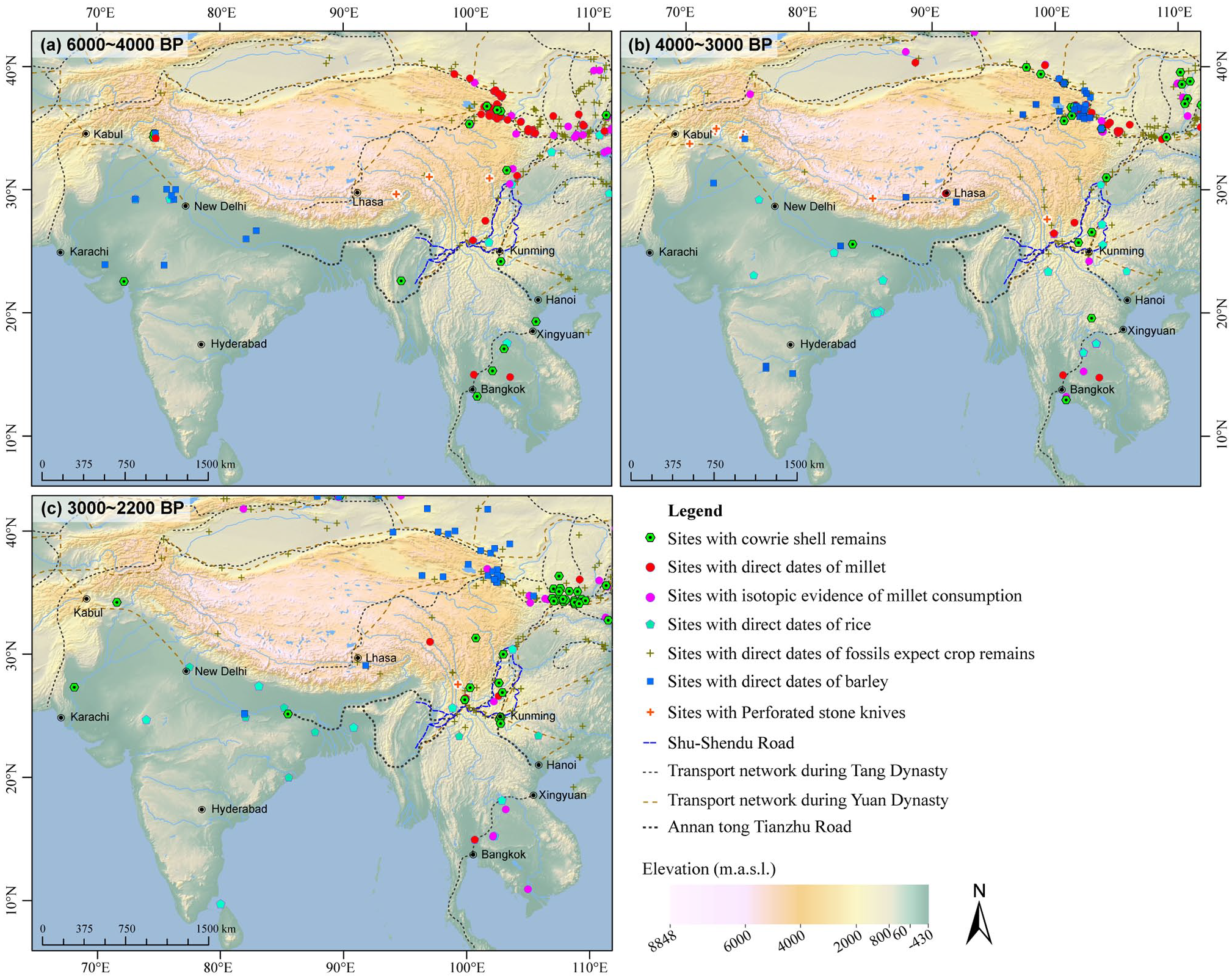
The distribution of Neolithic and Bronze sites unearthing millets, rice, barley, cowrie shells, and perforated stone knives in China, South Asia, and Southeast Asia (a, b, and c) Represent the distribution of different elements during 6000–4000 BP, 4000–3000 BP, and 3000–2200 BP (Detailed information is listed in Supplemental Table S1).
Western routes with the highest altitude across the Tibetan and Himalayan Mountains
The trans-Himalayan routes between northwestern China and South Asia cut across the Tibetan and Himalayan mountains (Figure 1, Zone I) and are considered to have originated in the fifth millennium BP. This cultural exchange for the late Neolithic period can be inferred from the discovery of objects in East Asian style from the excavation of Neolithic sites in South Asia, such as semisubterranean dwellings, perforated stone knives, and bone swim bladders from Neolithic sites in the Kashmir areas of northwestern India during 4800–4500 BP (Allchin, 1968; Han, 2018). Some relics of Mehrgarh Neolithic styles in South Asia, including cowrie shells and triangular polyline ornamentation on pottery, were unearthed from the Karuo site on the southeastern Tibetan Plateau (CPAM, Tibet Autonomous Region et al., 1980). Cowrie shells were also found from the Zongri, Liuwan, and Shangsunjiazhai sites dated to ~5000–4000 BP on the northeastern Tibetan Plateau (Wang, 2018, Figure 3a), further demonstrating significant cultural exchange between northwestern China and the Indian subcontinent during the late Neolithic (Yu and Li, 2018). However, there may be multiple dispersal routes of cowrie shells into northwestern China.
Although archeological evidence demonstrates a minimal onset of cultural exchange between China and South Asia during the late Neolithic period, the exact timing and routes are not revealed. Huo (1990) proposed that Neolithic cultural elements from northern China (such as semisubterranean dwellings and perforated stone knives) were introduced from the Bangong Lake region into the Kashmir areas via the valleys of the Lancang and Yarlung Tsangpo Rivers. In addition to artifacts, millet remains were unearthed from two Neolithic sites in the Kashmir Valley and dated to 4500–4000 BP (Spate et al., 2017; Yatoo et al., 2020; Figure 3a and Supplemental Table S1). This suggests a possible connection to trans-Himalayan routes via the Tibet Plateau and the Himalayan mountains or an introduction via the proto-Silk Road (Chen et al., 2022). This proposed trans-Himalayan exchange is supported by parallels seen in the material culture of the Kashmir Neolithic from excavations on the western and southern Tibetan Plateau (Han, 2013b; Lü, 2015). Although the absence of radiocarbon dates of the late Neolithic sites in the hinterland of the Tibetan Plateau, such as the valley of the Yarlung Tsangpo River, suggests this evidence will require further examination (Figure 1, Supplemental TableS1).
During 4000–3000 BP, although there were possibly multiple routes for millet dispersal from North China to South Asia, these perforated stone knives and crop remains found in South Asia suggest that the trans-Himalayan exchange may have been well developed during this period. Perforated stone knives were unearthed from a cultural context dated 4000–3000 BP at the Changguogou site, the Qugong site in the south Tibetan Plateau, and the Loebanr, Bir-kot-ghundai, Kalalo-deray, Bruzahom, and Gufkral sites at the Swat Valley and in Kashmir (Lü, 2016; Figure 3b). Millet and barley remains were identified and dated to 4000–3000 BP at the Changguogou site (Fu et al., 2000) and Qugong site (Gao et al., 2021) in the middle and lower reaches of the Yarlung Tsangpo River (Figure 3b). Millet remains were frequently found in late Harappan sites in South Asia, date to 4000–3000 BP (Pokharia et al., 2017; Saraswat, 1993; Spate et al., 2017; Weber, 2003; Figure 3b). Barley may have been introduced to the Indian subcontinent at approximately 8000–5000 BP (Liu et al., 2018; Petrie, 2015; Tengberg, 1999) and was widely utilized in South Asia during 6000–4000 BP (Figure 3a). This frost-tolerant crop was introduced to the northeastern Tibetan Plateau at approximately 4000 BP (Chen et al., 2015), slightly earlier than in the Yarlung Tsangpo River Valley (Figure 3b). While Liu et al. (2019) argue that barley was introduced into China via trans-Himalayan routes, supported by genetic evidence (Zeng et al., 2018), more archaeobotanical evidence – significantly earlier dates of barley remains in South Asia and the southern Tibetan Plateau – is needed to test this hypothesis further.
Although some new radiocarbon dates spanning 3000–2200 BP from Late Bronze Age sites along the Yarlung Tsangpo River (Wang et al., 2021) have been reported recently, the number of sites in this period is less than 4000–3000 BP (Figure 3c). This suggests there a decline in the significance of the trans-Himalayan routes or an absence of radiocarbon dating on these routes during the third millennium BP.
Central routes with high altitude across the Hengduan Mountains
The trans-Henguan mountain routes are along the eastern margin of the Tibetan Plateau, including the western Sichuan highland, northwestern Yunnan, and southeastern Tibet (Figure 1, Zone II). The trans-Henguan mountain exchange between China, South, and Southeast Asia was likely mainly along the “Shu-Shendu Road” (Luo, 1990) in prehistory and may start in the fifth millennium BP with a lower frequency exchange (Figure 3a). Rice remains were identified from a few Neolithic sites in South Asia and dated to 4500–4000 BP (Long et al., 2022; Sharma et al., 2020; Figure 3a), implying the appearance of rice cultivation in South Asia by the mid-fifth millennium BP. These rice remains might have been transmitted into South Asia following multiple dispersal routes similar to the historically documented “Shu-Shendu Road,” although no rice remains have been found in Myanmar (Figure 3a). The trans-Hengduan mountain routes might also act as essential passageways linking China and mainland Southeast Asia via north-south riverine valleys (Higham, 2002; Higham et al., 2020), although reported radiocarbon dates of 5000–4000 BP in northwestern Yunnan, which is at the hub of the “Shu-Shendu Road,” are limited (Supplemental Table S1). We investigated Neolithic sites found in recent years in the Hengduan mountain regions along the Lancang, Jinsha, and Nujiang Rivers (Figure 1), but no radiocarbon data was found to be dated earlier than 4000 BP (Table 1). Only three Neolithic sites (Baiyangcun, Dadunzi, and Xinguang sites) dated before 4000 BP in northwestern Yunnan have been reported in previous studies (Dal Martello, 2020), suggesting that the frequency of the trans-Hengduan exchange may have been low during the Late Neolithic period.
Millet crops were spread southward to northwestern Sichuan at ~5000 BP (Huan et al., 2022, Supplemental Table S1) and the Karuo site at ~4600 BP (D’Alpoim-Guedes et al., 2013b, Supplemental Table S1). The earliest data of millet remains in Yunnan Province are ~4600 BP from the Baiyangcun site in northwestern Yunnan (Dal Martello et al., 2018). This archaeobotanical and isotopic evidence indicates that millet crops were utilized on the southern boundary of China during the early fifth millennium BP, a little earlier than that in Thailand at ~4500 BP (D’Alpoim Guedes et al., 2020; Higham et al., 2020; Figure 3a and Supplemental Table S1). These data suggest the formation of north-south passageways, which connected North China and mainland Southeast Asia during the fifth millennium BP, although we cannot identify the exact routes. Low-frequency occurrences of millet remains in Southeast Asia except for Myanmar during this period may indicate a low-frequency exchange between China and Southeast Asia via Southwest China.
The frequency of cultural exchange between China and South and Southeast Asia via the trans-Hengduan routes increased during 4000–3000 BP, given that the number of Bronze Age sites dated to this period along the “Shu-Shendu Road” was found to be greater than in the late Neolithic (Figure 3a and b). In our investigation in the Hengduan Mountain region of northwestern Yunnan, the Qinglong stone grave, Duanjiapingzi, and Gedeng sites were dated to 4000–3000 BP (Figure 1, Table 1). Rice agriculture was fully developed in northwestern Yunnan (Dal Martello et al., 2018), South Asia, and mainland Southeast Asia during 4000–3000 BP (Liu et al., 2019) (Figure 3b). Hybridization between japonica and indica occurred in South Asia after 4000 BP, suggesting that japonica rice spread from China to South Asia by 4000–3000 BP (Fuller et al., 2010; Vaughan et al., 2008). Rice dispersal into South Asia may have followed multiple routes, including the trans-Hengduan mountain routes via Myanmar and coastal routes from South China to South Asia via Southeast Asia (Fuller, 2011). This idea is also supported by the unearthing of cowrie shell and ivory remains from the Sanxingdui site (Qiu, 2013) and Jinsha site (Zhu et al., 2002) in the Sichuan Basin, which is proposed to be introduced from India to Southwest China via the “Shu-Shendu Road” (Zhang, 2009; Figure 3b).
The trans-Hengduan Mountains exchange between China and South and Southeast Asia was significantly enhanced during 3000–2200 BP. There are significantly more sites along the “Shu-Shendu Road” in the Hengguan Mountain region during 3000–2200 BP than for 4000–3000 BP (Figure 3b and c). This difference suggests that the importance of the trans-Hengduan routes in the cultural exchange between China and South and Southeast Asia was significantly frequented during 3000–2200 BP, and is supported by historical documents such as “Shi Ji, Da Wan Zhuan” (Li, 2011). The Gezi, Weidudaju, and A’dong tombs and the Gedeng and Gaozhai sites investigated in the Hengduan Mountains of this study are also dated to 3000–2200 BP (Figure 1, Table 1), further supporting a thriving trans-Hengduan exchange during the late Bronze Age.
Eastern routes with lower-altitude across the Yunnan–Guizhou Plateau, including most regions of Yunnan and Guizhou
There are several Neolithic sites dated between 5000 and 4000 BP in Yunnan Province along the “Annan Tong Tianzhu Road” (Figures 1 and 3a), which laid a foundation of human activities for the trans-Yunnan–Guizhou Plateau (YGP) exchange. The interaction via the trans-YGP routes began in the fifth millennium BP. Our dating of investigated sites in central Yunnan Province reveals that humans colonized the Qilu Lake basin in Tonghai in the fifth millennium BP, including the Xingyi and Huangjiaying sites (Table 1), which were the crossroads of the “Annan Tong Tianzhu Road” during the historical period (Zhou, 1994). The cowrie shell found in Xingyi (burial 8) was dated to ~4300 BP (Li, 2019). Several sites with cowrie shells and evidence of millet or millet consumption dated to ~4500–4000 BP were distributed between Bangkok and Kunming (Figure 3a), further hinting at the opening of these trans-YGP routes during the late fifth Millennium BP, although more reliable evidence is needed, especially between Tonghai and Hanoi. In addition to the above routes across Yunnan to connect North China and mainland Southeast Asia, some scholars have highlighted coastal routes from the middle-lower Yangtze to Guangdong and Guangxi, then westward and southward to Vietnam, and finally reached mainland Southeast Asia at approximately 4000 BP (Fuller, 2011; Rispoli, 2007). However, there is no evidence of millet remains or millet consumption along coastal across Guangxi and Guangdong before 4000 BP (Gao et al., 2020).
The trans-YGP exchange was strengthened during 4000–3000 BP. The distribution of sites along the eastern route of the “Annan Tong Tianzhu Road” and the routes between Xingyuan and Bangkok during 4000 and 3000 BP (Figure 3b) is more concentrated than those during 6000–4000 BP (Figure 3a), including the new dates from Xingyi found in this study (Figure 1, Supplemental Table S1). Millet and rice remains were identified from numerous sites dated to 4000 to 3000 BP in mainland Southeast Asia (D’Alpoim Guedes et al., 2020; Hedges et al., 1991; White and Hamilton, 2009; Figure 3b), suggesting that long-distance exchange via trans-YGP routes may have been frequented during this period. The cultural exchange between China and mainland Southeast Asia during the fourth millennium BP can also be supported by the additional jade artifacts (Hung et al., 2007), although this exchange might have been via maritime routes (Hung et al., 2007; Stevens et al., 2016). In addition, the same incised and impressed pottery style was found at many sites from Yunnan to mainland Southeast Asia (Higham, 2002, 2004), suggesting some cultural contact between the two regions. Most sites dated to 4000–3000 BP in central Yunnan and mainland Southeast Asia are distributed along the ancient land passage (Figure 3b), including two remains of rice and millet from the Xingyi site in central Yunnan. This suggests that the trans-YGP routes played an essential role in the cultural exchanges between China and mainland Southeast Asia during this period.
New radiocarbon dates spanning 3000–2200 BP in the Late Bronze Age sites along the eastern route of the “Annan Tong Tianzhu Road” (Archaeological Team of Guangxi Zhuang Autonomous Region and Napo Museum, 2003) have been reported, including four dates of the Haibaoshan site near Dian Lake in this study (Figure 1 and Table 1). However, the number of sites in this period is less than 4000–3000 BP (Figure 3). This may not reflect a decline in the significance of the trans-YGP routes in cultural exchanges between China and Southeast Asia as it may reflect the limited radiocarbon dating in these areas.
The rise of metallurgy in Southeast Asia is particularly pertinent to the north-south communication routes across Southwest China. This topic has been debated for over 100 years, and the debate has most recently focused on two competing theoretical models. Proponents of the early arrival of metallurgy argue that bronze metallurgy was a result of long-distance communication among the well-known Seima-Tubino culture on the Eurasian steppe, Southeast Asia, and various intermediate groups of people in the Hexi Corridor, the Sichuan Basin, and the Yunnan Plateau (White and Hamilton, 2009, 2021). This places the development of metallurgy in the fifth millennium BP, which is much earlier than that in the Central Plains of China. However, this has been widely criticized by those who believe that the arrival of metallurgy occurred later (Higham et al., 2011) because the fragments of metallurgy at Ban Chiang lack proper archeological context or secured dating. More importantly, there is little evidence suggesting any broader social impact brought by metallurgy to the local communities. Instead, placing metallurgy at the end of the fourth to early third Millennium BP seems much more plausible, as it fits the trends in the overall spread of metallurgy in Eurasia, particularly in China (Higham et al., 2011, 2020). The late arrival also suggests a north-south movement of metallurgy. This theory proposes the Central Plains of China as the point of departure for the movement of metallurgy, followed by the mid-lower Yangtze River Valley, Sichuan, Yunnan, and Southeast Asia. This picture, illustrated by the late arrival school of thought, agrees well with the dynastic expansion of early Shang (ca. 3500–3400 BP) and the overall development of the Chinese Bronze Age that highlighted a dual system of leaded bronze metallurgy and ritual vessel production underpinned by a vast and efficient network of communication (Liu et al., 2019; Pollard et al., 2017). A series of AMS also support these dates from Bronze Age sites in the Lake Dian basin (Yao et al., 2020). The rich ore deposits in Yunnan and Southeast Asia, particularly those with tin, were attractive to other groups, as demonstrated in historical texts from the Western Han (202 BCE–8 CE). Yunnan was also once believed to be a source of the highly radiogenic lead in the metal produced along the Yellow and Yangtze Rivers (Jin et al., 2017). Although the source of radiogenic lead needs more in-depth research, its distribution reveals another potential route for north-south communication from the Central Plains (the Shang dynasty) and the Wei River Valley (the Zhou dynasty) to Hanzhong, Sichuan (the Sanxingdui culture), and Yunnan (Liu et al., 2021). Meanwhile, lead isotopic analysis, together with the widespread use of bronze drums with vivid and unique decorations in Yunnan, Guangxi, Guizhou, and Southeast Asia, points to close contact—in terms of material culture and raw metal resources – for these regions (Pryce and Bellina, 2018; Pryce et al., 2022) despite not yet having identified the exact routes.
Although we highlight the north-south exchange routes between North China and South and Southeast Asia in late prehistory, many west-east exchanges were linking these through riverine valleys in the eastern Tibetan Plateau. Millet crops diffused westward to the western Sichuan Plateau at approximately 5000 BP and then eastward to the Sichuan Basin at ~4700 BP (D’Alpoim Guedes and Wan, 2015; Gao et al., 2020). Rice is also thought to have spread westward to the Sichuan Basin via the Yangtze River valley at ~4600 BP (D’Alpoim Guedes et al., 2013a; Gao et al., 2020). Then, both crops diffused southward to Yunnan slightly later (Dal Martello et al., 2018). After 4000 BP, the west-east exchange may have been more common, as shown by the numerous sites distributed along the riverine pathways, such as the upper reaches of the Yangtze, Jinshan, Lancang, and Yagong Rivers (Figure 3). Perforated stone knives appeared at the Qugong site at approximately 3600 BP and then were probably later disseminated westward to the Changguogou site along the Yarlung Tsangpo River valley (Supplemental Table S1). This indicates that some exchanges occurred between higher-altitude and lower-altitude routes in this period, which may have increased north-south exchanges of culture and goods.
Conclusions
We integrated new radiocarbon dates from 11 sites and published radiocarbon dates and archeological data from Neolithic and Bronze sites in North China, South Asia, and mainland Southeast Asia to explore the preliminary spatial-temporal patterns of the interaction networks linking these areas during ~5000–2200 BP. We conclude the following:
(1) Three primary land passageways, including the trans-Himalayan, trans-Hengduan, and trans-YGP routes, significantly contributed to cultural exchange between China and South and Southeast Asia during the Late Neolithic and Bronze Ages.
(2) The initial interaction networks linking China, South Asia, and Southeast Asia emerged no later than in the fifth millennium BP, while the frequency of cultural exchange between China and South and Southeast Asia was likely low. The trans-YGP and trans-Himalayan routes played important roles between China and South and Southeast Asia.
(3) Cultural exchanges between China and South and Southeast Asia significantly strengthened along these three primary land passageways during the fourth millennium BP. In contrast, the trans-Hengduan routes may have been the dominant north-south passageway linking China and South and Southeast Asia during 3000–2200 BP.
(4) The primary passageways for cultural exchange between China and South and Southeast Asia during late prehistory might have changed during different periods. The trans-Himalayan, trans-Hengduan, and trans-YGP routes may have interconnected during the late Neolithic and Bronze Ages and did not develop independently.
The detailed history of the development of the transport networks connecting China, South Asia, and Southeast Asia is complicated. More archeological research in areas with archeological data along these three primary land passageways would be valuable to develop a more thorough understanding of the trajectory of the evolution of these transport networks linking different East, South, and Southeast Asia areas during the Late Neolithic and Bronze Age.
Supplemental Material
sj-pdf-1-hol-10.1177_09596836221131698 – Supplemental material for Understanding the transport networks complex between South Asia, Southeast Asia and China during the late Neolithic and Bronze Age
Supplemental material, sj-pdf-1-hol-10.1177_09596836221131698 for Understanding the transport networks complex between South Asia, Southeast Asia and China during the late Neolithic and Bronze Age by Minmin Ma, Yongxiu Lu, Guanghui Dong, Lele Ren, Rui Min, Lihong Kang, Zhonghua Zhu, Xiaorui Li, Bo Li, Zhijian Yang, Nongbu Cili, Ruiliang Liu, Yu Gao and Fahu Chen in The Holocene
Footnotes
Funding
The author(s) disclosed receipt of the following financial support for the research, authorship, and/or publication of this article: Second Tibetan Plateau Scientific Expedition and Research Program (STEP), (Grant No. 2019QZKK0601), Priority Research Program of the Chinese Academy of Sciences, Pan-Third Pole Environment Study for a Green Silk Road (Pan-TPE) (Grant No. XDA2004010101). We also thank Jiajia Dong and Minxia Lu for the experiment of the radiocarbon dates from Duanjiapingzi, Weidudaju and Haibaoshan sites.

Supplemental material
Supplemental material for this article is available online.
References
Supplementary Material
Please find the following supplemental material available below.
For Open Access articles published under a Creative Commons License, all supplemental material carries the same license as the article it is associated with.
For non-Open Access articles published, all supplemental material carries a non-exclusive license, and permission requests for re-use of supplemental material or any part of supplemental material shall be sent directly to the copyright owner as specified in the copyright notice associated with the article.
