



Abstract
We successfully measured four radiocarbon dates on two specimens of a black geometric rock painting with a fragment in jeopardy of naturally spalling off in the wall of a rock shelter in the Ẓufār region, in the south of the Sultanate of Oman. Extraction of carbon dioxide (CO2) for radiocarbon dating of the binder in the black pigment of the rock painting specimen was conducted in the plasma oxidation laboratory at the Office of Archeological Studies in Santa Fe, NM. The radiocarbon content was measured on the Swiss ETH-Zürich accelerator mass spectrometer MICADAS. The dates obtained agreed with one another within the statistical uncertainty and the average date of the four samples was 1500 ± 35 radiocarbon years BP. The calendric equivalents of the average date results in calendric calibration date ranges that span the mid-fifth through mid-seventh centuries (440–453 CE, 478–496 CE, and 534–646 CE). This research demonstrates that it is possible to date the black paintings of the Jebel al-Qara’ area of Oman; this is the first pictogram that was dated using radiocarbon dating in the region.
Introduction
The first reports of rock art in Oman were made by the English diplomat Bertram Thomas in the late 1920s and concern engraved inscriptions and camels in the wadis Andhaur, Dhikur and Dhaghaub, north of Jebel al-Qara’, in Ẓufār (Thomas, 1929: 209–210; Thomas, 1932: 126–129). The same author later reported engraved sites very close to the border with the Emirates (Thomas, 1931: 198). However, it was not until the 1960s that Omani rock images really began to attract scholarly attention, thanks to the research of two pioneering women in regional archeology: the Danish Karen Frifelt (1968) and her English colleague Beatrice De Cardi (1969), and systematic research was initiated by Christopher Clarke and Rudolf Jäckli in the following decade (Clarke, 1975a, 1975b; Jäckli, 1980; Preston, 1976). In the 2000s, Angelo Fossati undertook a detailed study of the rock engravings of Jebel Akhdar (Fossati, 2015a, 2015b, 2017, 2019), and a few thematic syntheses have emerged, for example, on ibex hunting, ostrich or camel figurations (ElMahi, 2000, 2001, 2010). To date, the vast majority of published sites are located in the northern or central parts of the country (Al-Jahwari and ElMahi, 2014; Degli Esposti et al., 2020; Insall, 1999; Yule, 2013; Zerboni et al., 2021), but there are also some in the south (Yule, 2001). In the south-west, from the early 1990s, Ali Aḥmed Maḥāsh al-Shaḥrī undertook a systematic exploration of Ẓufār, in order to record the decorated caves. His research has led to several publications, either by this author alone with regard to the rock paintings (Al-Shaḥrī, 1991, 2000), or in collaboration with Geraldine Margaret Harmsworth King with regard to the alphabetic inscriptions (Al-Shaḥrī and King, 1991; King, 1991).
As part of the NeoArabia Project/ Archeology of the Arabian Seashores program, which aims to study the evolution of the Omani seashores since the late Pleistocene, we were led to expand our research area in order to contextualize the settlement history of the region. We carried out surveys in the mountains of the Ẓufār region, in the south of the Sultanate of Oman, during six missions between 2015 and 2019 (Le Quellec et al., 2018). We focused on the inventory of rock paintings in the sub-rock shelters of this region. A recurrent problem in rock art studies is having to work with undated documents, or documents whose chronological position is far too imprecise. One of the aims of our research was therefore to contribute to the dating of this art.
Rock art in Ẓufār
Al-Shaḥri’s remarkable work, accomplished with the means of the time, remained unfinished, and it is difficult to get an idea of the field context from these publications as they are illustrated only by unlocated surveys grouped by theme. Al-Shaḥrī (2000) is illustrated by 66 plates of surveys but contains only four photos of rock paintings. The main purpose of our missions was therefore to examine the state of conservation of the sites, to establish the degree of legibility of the original images, to estimate the accuracy and reliability of the already published surveys, to inventory new sites and to radiocarbon date one of the pictograms. The use of high-resolution photographs and image processing methods allowed us to improve the quality of the surveys, to correct old observations, and to discover new inscriptions (Le Quellec et al., 2018). The surveys were mainly conducted in the central area of the Jebel al-Qara’, where the rock images and inscriptions are found in rock shelters of very variable dimensions, which can range from a few meters wide to about a 100. These shelters are locally called xádɛ́r in Jibbali, a modern South Arabian language (Rubin, 2014). These shelters can be located in the lower part of the valleys, or on the contrary very high up.
Five main types of figures have been noted: anthropomorphs and hands, zoomorphs (only quadrupeds), plants, abstract motifs (notably zigzag lines and groups of dots), and undeciphered South Arabian inscriptions. Almost all of these elements are painted, mostly in black, sometimes in red, rarely in white. The coloring of certain pectiniform quadrupeds currently in white could result from the alteration of the pigments. Indeed, a figure of this type shows the passage from a grayish black to an off-white. Multi-colored compositions are rare and are painted in red and black.
Camels are the most abundant quadrupeds, represented alone, accompanied by humans, or mounted. Horses and riders seem to be less frequent. Certain details could allow a first chrono-cultural approach: saddles with cantle, hand weapons, small round shields. The other quadrupeds are bovines (either isolated or combining a cow and its calf) and canines (domestic dogs and probably foxes). The hands, which are very numerous, are never negative, but true positive hands stencils seem rare. Most of them are actually paintings of hands. It is possible that some of them were made as extensions of palm prints, but this remains to be verified. When our inventories are sufficiently complete, we plan to carry out a typology, and to examine the distribution of the different types, but there is no guarantee that this would lead to a chrono-cultural seriation. The paintings are often executed without any link between them other than proximity – at least apparently. The real scenes are rare, and we note in particular the representation of a fight between meharists (camel cavalry) and horsemen, and a scene of hunting ibex. The degree of preservation – and therefore of visibility – of the paintings is very variable. Some appear to be quite fresh, others are barely visible at present, and these two occurrences can be observed both for the animal figurations (mostly camels) and for the alphabetical inscriptions, but it would certainly be premature to draw any conclusions from the point of view of chronology. The age of the inscriptions has been estimated to be around 2000 BP on the basis of comparisons with a variety of other pre-Islamic inscriptions which have been found in the Arabian Peninsular, but without clear evidence for this (King, 1991: 4).
Establishing a chronological framework would make it possible to situate this rock art in relation to other archeological data, in order to better define the culture of the societies that have occupied these places over the last millennia. The rock graphics are certainly material vestiges, which enlighten us. Their main contribution is to the characterization of the societies of the illustrators and comes from their immaterial specificity: devoid of utilitarian function, they translate ideas, ways of being in the world, and their iconographic study contributes to better a understanding of these ideal aspects, even if their deep meaning will always remain inaccessible to us. The establishment of a chronological framework also allows for the perception of a possible evolution of these past cultures, at a time of great environmental but also social changes (e.g. Charpentier et al., 2014; Cremaschi et al., 2015). With a better regional understanding of the figurative corpus, as much by its content as by its chronology, the construction of a more complete qualitative and quantitative documentation of these rock graphics and their dating would undoubtedly be a great help to epigraphists to finally decipher these still mysterious alphabets.
The analyzed pictogram fragment
During our 2019 mission, we were asked to visit a place where paintings and inscriptions had been seen by Ali Aḥmed al-Kathiri in three rock shelters located in a place called Miṯbōn at the head of the wādī Enjar, which is a tributary of the wādī Derbat (Figure 1). In the largest rock shelter on the south bank of the wādī, Ali Aḥmed al-Kathiri had noticed that on a geometric black painting, a small piece of painted rock was about to fall down and he suggested taking it off for analysis (Figure 2). After having carefully examined the site, we agreed that a fragment of painting was at risk of falling off, and that it was better to sample it in order to carry out analyses. The sampled fragment belongs to a black geometric figure, formed by an approximately circular line and digitations. Its hue and patina are not visually different from those of other black paintings and inscriptions in the same locality.
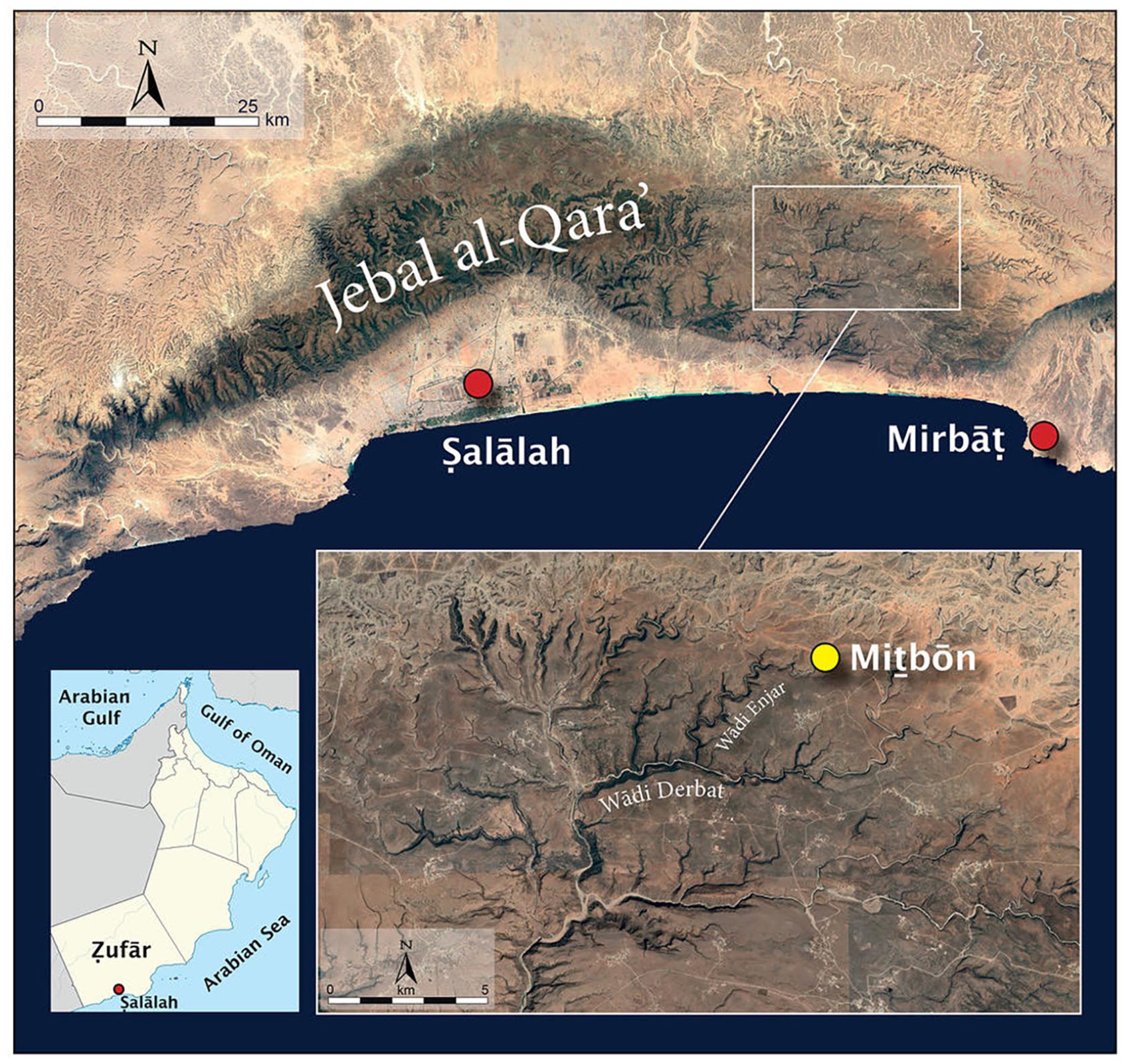
Location of the site where the specimen was collected, and localities cited in the text.
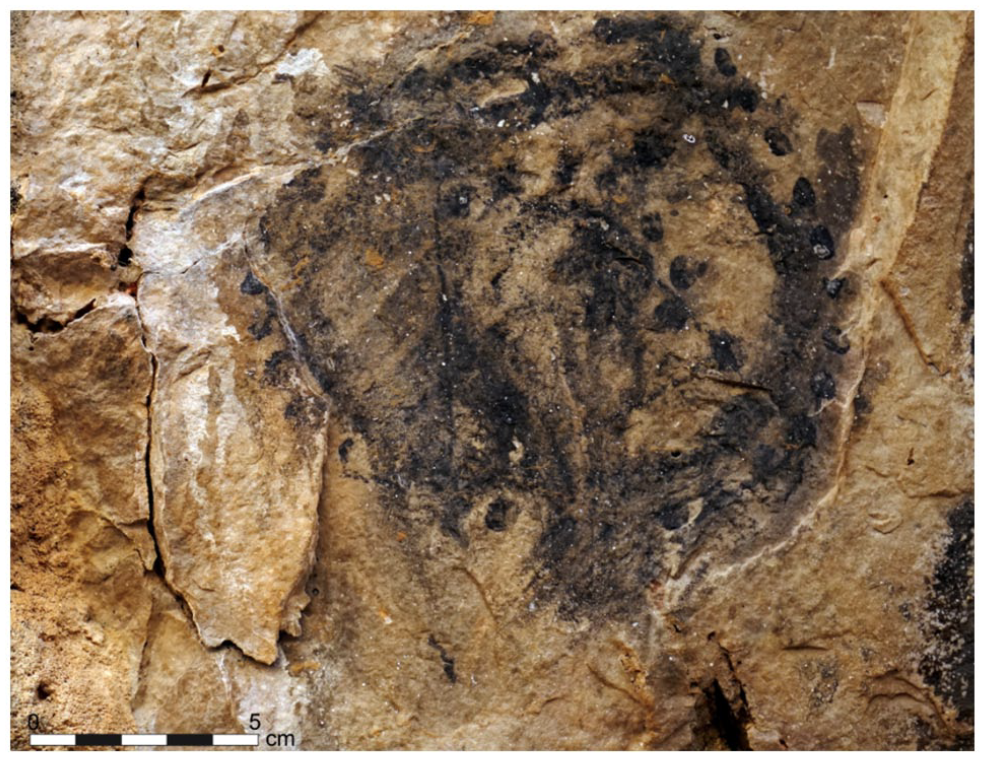
View of the black geometric painting analyzed from the Miṯbōn rock shelters. The figure is roughly 15 cm in diameter. The removed specimen (with four black dots) is on the left side of the pictogram, above the scale in the photo.
Other geometric paintings with digitations are known from Jebel al-Qara’ (Al-Shaḥrī, 1994: 236, 240, 242), but our figure does not correspond to any recurrent type. Although it is a relatively easy pictogram to make, its relative complexity makes its function as a waṣm – tribal sign or property mark – highly unlikely (Khan, 2000). The shelter in which it is found is adorned with pictograms that are often difficult to read and are currently being inventoried. They include digital tracings (digitations and series of sticks), at least 13 anthropomorphs, an indeterminate quadruped, at least five camels, a pectiniform figure that may represent a mounted horse and about 10 alphabetic inscriptions. As very generally in Ẓufār, these inscriptions are not attributable with certainty to any language, and the value of their letters remains uncertain (King, 1999: 247; Yule, 2013: 401).
Radiocarbon dating via oxidation plasma
The extraction of carbon dioxide (CO2) for radiocarbon (14C) dating of black pigment of the rock painting sample from Oman (Figures 2 and 3) was carried out in the Low Energy Plasma Radiocarbon Sampling (LEPRS) Laboratory at the Office of Archeological Studies (OAS) in Santa Fe, NM. The LEPRS Laboratory utilizes a plasma oxidation approach for extracting CO2 from a specimen. This method differs from traditional radiocarbon dating in specimen preparation prior to accelerator mass spectrometry (AMS) dating of the carbon sample. The technique is perhaps the most commonly used approach so far for dating the organic binders in pictograms. It has the advantage of extracting minute quantities of carbon from the target pigment separately from carbonate and oxalate contamination because the plasma energy can be maintained below the energies (radiofrequency and temperatures) where those inorganic molecules dissociate. For examples of the experimental procedures used, see the recent publications from the three currently operating plasma oxidation laboratories (Armitage et al., 2020; Baker and Armitage, 2013; Loendorf et al., 2017; McDonald et al., 2014; Rowe et al., 2016, 2021; Russ et al., 2017; Steelman et al., 2019, 2021).
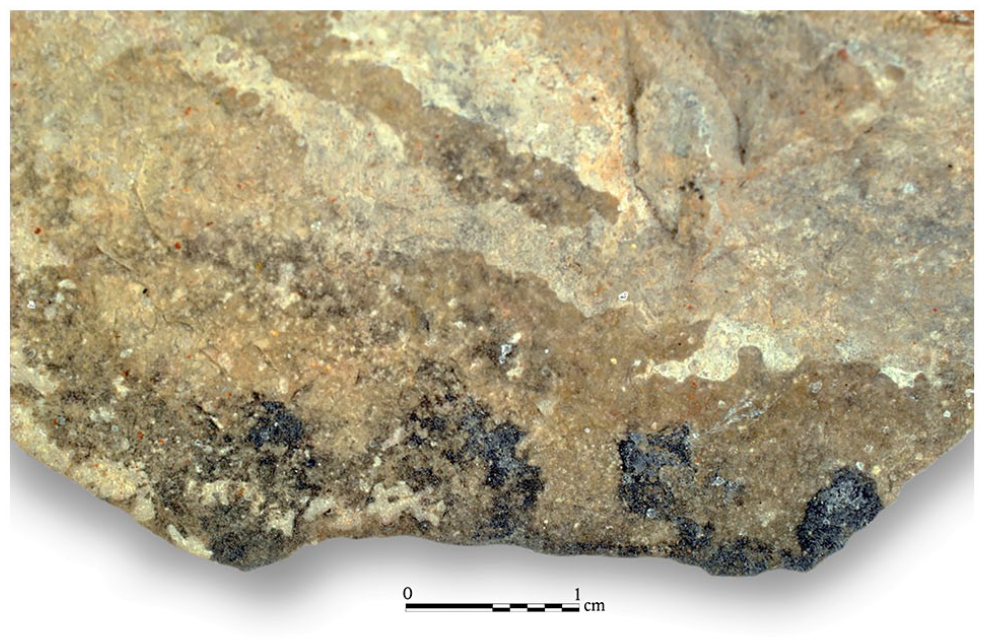
Rock painting sample from Oman with black pigment utilized for radiocarbon dating.
The plasma oxidation laboratory at OAS utilizes a three-stage set of plasma treatments to ensure the oxidative sampling of carbon for AMS measurement of 14C is free of contaminating carbon sources. Step 1: The process begins with serial oxygen plasmas runs (133 Pa) on empty reaction chambers to assure that no carbon contamination exists in the chamber. Multiple oxygen plasmas are run until a negligible amount of CO2 is produced (<0.5 µg carbon), at which time the chamber is considered to be clean of organic contaminants. Step 2: The chambers are then removed from the plasma system, the specimens to be dated are inserted, and the chambers are reattached to the manifold of the vacuum system. The chambers holding the specimens are heated with heat lamps (roughly 110°C) to dehydrate the sample and release some adsorbed CO2 prior to the initiation chemically inert argon-plasmas (133 Pa). Runs of argon-plasmas are conducted serially until insignificant amounts of CO2 collected. This step is designed to efficiently mechanically “knock off” adsorbed CO2 from the artifacts and chamber surfaces. Step 3: At this point the artifacts are considered ready for carbon extraction via plasma oxidation in preparation of a radiocarbon sample to be analyzed by AMS. These sampling oxidation plasmas are generally conducted at 133 Pa pressure and low temperatures, often near human body temperature of ~37°C and almost always below 70°C. The oxidized CO2 gas (carbon sourced from the pictogram specimen), is collected within a liquid nitrogen (LN2) cooled 4 mm diameter glass tube that is flame sealed and separated from the vacuum system apparatus for shipment to the Laboratory of Ion Beam Physics, ETH Zürich, for AMS dating. The LEPRS Laboratory staff routinely collect at least two, and usually more, CO2 samples (glass ampules) from each specimen, in case further studies are desired. For more detailed information regarding the process of plasma oxidation refer to Rowe et al. (2016, 2017).
The Laboratory of Ion Beam Physics (ETH-Zürich, Switzerland) is capable of direct AMS dating CO2 gas samples of 20–100 µg carbon from rock painting specimens (Welte et al., 2018).
Preparation of specimens for radiocarbon dating
Two specimens, Oman-P and Oman-A, were prepared for dating in the LEPRS laboratory by mechanically scraping off the pigment layer. This process exposed and removed the thin pigment layer in addition to unavoidable inclusions of calcium carbonates and oxalates, which are not considered to be contamination since the plasma oxidation extraction methodology is conducted at low radiofrequency (RF) powers, well below the dissociation energies (temperatures) of carbonates and oxalates. To confirm that there was no contamination from these inorganic molecules, the scraped material from specimen Oman-P was treated with 1M phosphoric acid to dissolve the carbonates away, ensuring that plasma oxidations were conducted on a carbonate-free specimen.
To guarantee the scrapped specimens were contained during pre-plasma documentation and installation into the sample chambers, the material were loaded into clean porcelain supports or “boats” (which were previously washed and heated for >4 hours in air to 750°C, to combust any potential contaminating carbon). Due to potential adsorbed and absorbed water resulting from the phosphoric acid pre-treatment, the porcelain boats supporting the scraped specimens were placed into their own individual plasma chambers and exposed to gentle supplemental warming (from reptile heat lamps) to increase the rate of off-gassing while under a high vacuum (~1 ×10⁻⁴ Pa).
The two studied specimens were small; Oman-P was <1 mg, almost pure pigment, while Oman-A-4a was 20 mg because it contained a relatively large amount of carbonate and oxalate. During plasma oxidation and carbon extraction, specimen Oman-P was completely exhausted. Plasma treatments of specimen Oman-A-4a completely oxidized the carbon of the pigment, leaving a matrix of calcium oxalate and subtly changing the appearance of the specimen.
A unique quality of the plasma oxidation approach is the possibility of sequential oxidation of samples; this was employed on specimen Oman-A-4a with the collection of three ampules of carbon dioxide gas from six plasma oxidation exposures at low plasma energies targeting only the organic carbon (⩽40 W). The glass ampule of one run broke and two of six runs did not yield enough carbon to collect (<20 µg), indicating the exhaustion of the organic carbon of the pigment. Four radiocarbon dates reported by the AMS lab are presented in Table 1.
Radiocarbon dating information for ampules from the Zufār, Oman rock painting.

The agreement between all four ages derived from the two specimens is reassuring, thus all four dates are averaged together. The average 14C date on the organic (pigment) component of the Omani rock painting is 1500 ± 35 14C years before present (years BP). The calendric equivalent of the average date is presented in Figure 4. The calibrated age ranges span the mid-fifth through mid-seventh centuries (440–453 CE, 478–496 CE, and 534–646 CE).
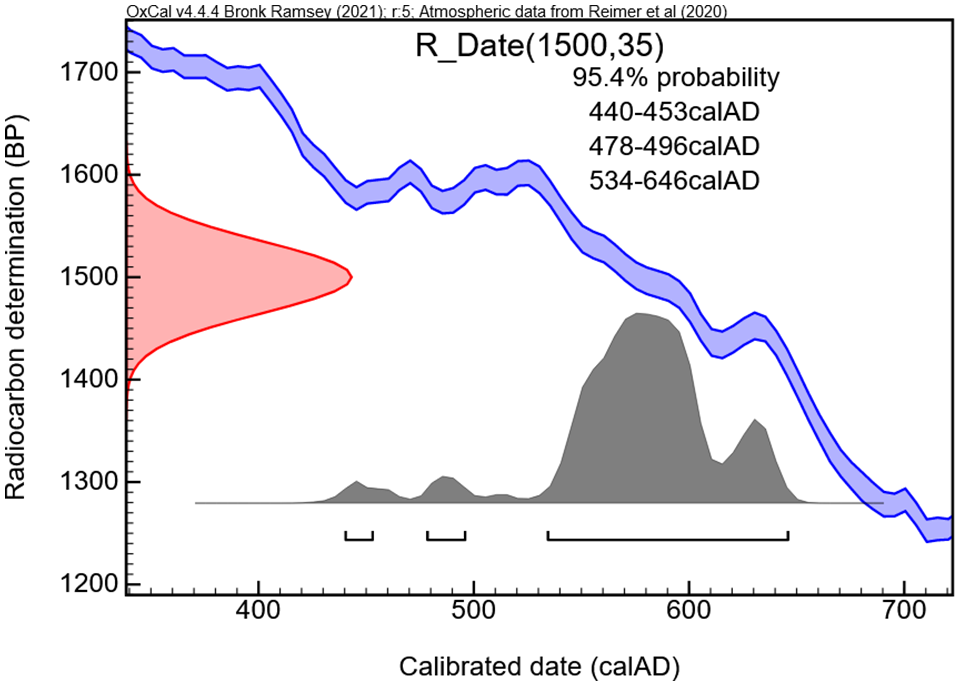
The simple calendrical calibration of the average date of the Zufār pictogram, prepared using OxCal v4.40.2 (Bronk Ramsey, 2020; Reimer et al., 2020). The calibrated calendrical date ranges at 95.4% probability are 440–453 CE, 478–496 CE, and 534–646 CE. With a composite age range of mid-fifth century to mid-seventh century. The red curve along the y-axis represents the radiocarbon concentration and its measurement uncertainty (±1σ), expressed as 14C y BP. The blue undulating line across the graph is the measured variation in atmospheric 14C as reflected in repeated AMS dating of carbon isotopes in annual tree-ring samples. The gray curve along the x-axis depicts the normalized distribution of the likelihood of different possible ages the AMS measured radiocarbon concentration could be based on the variation in atmospheric 14C concentrations. The Bayesian modeled calendric age of the measured AMS sample is most likely to fall within the ages bounded by area(s) of the gray curve. Calibrated calendrical age ranges are reported at 95.4% probability (±2σ) as the bracketed age along the x-axis.
Discussion and conclusion
The average radiocarbon date (1500 ± 35 years BP) was obtained from four ampules of CO2 produced from organic matter of the rock painting specimen via plasma oxidation. The calibrated age range dates the Oman rock painting to sometime during the mid-fifth century to mid-seventh centuries. This date indicates the period in which some of the black geometric paintings at Jebel al-Qara’ were made. Our research shows that it is possible to date the black paintings of the Jebel al-Qara’ area, and it is now hoped that future research will date the alphabetic inscriptions themselves. This would make it possible to finally give a chronological framework to these inscriptions, still undeciphered to this day, and to thus help to locate them not only in relation to the rock paintings, but also in relation to either Old South Arabian languages or Modern south Arabian ones. This could then constitute a contribution to epigraphists in the deciphering of these alphabets.
Footnotes
Acknowledgements
All the explorations were made with the invaluable help of the Ministry of Heritage and Tourism. We also wish to thank the Ministry of Heritage and Tourism of Oman, especially Eng. Ibrahim al-Kharusi – Undersecretary of Heritage, Dr. Sultan Al-Bakri – General Director of Archeology, and Ali Al-Marhoqi– Director of the Department of Excavations and Archeological Studies.
CRediT authorship contribution statement
Data availability statement

Funding
The author(s) disclosed receipt of the following financial support for the research, authorship, and/or publication of this article: In France, we would like to thank the Consultative Commission for Excavations Abroad of the Ministry of Foreign Affairs, for granting the expedition, the National Research Agency and the NeoArabia Project (CNRS, Inrap, MHNH). In the United States, the Office of Archeological Studies LEPRS Laboratory is funded in part by the Dr. Donald E. Pierce Endowment for Archaeology and Conservation, administered by the Museum of New Mexico Foundation.