



Abstract
This study investigates Neolithic subsistence on Jeju Island in Korea during the Early Holocene. Gosanri, our main site, provides evidence of the Early Holocene peopling to the Island by 10,000 cal. BP with pottery making tradition, while the Neolithic sites appeared in the Korean peninsula only 2000 years later. Gosanri and most of the Early Holocene sites, collectively called the Incipient Neolithic (10,000–8000 cal. BP), are located along the coastal lines of Jeju, and thus Incipient Neolithic people were assumed to conduct marine-based subsistence activities. This assumption has not been tested partly as most sites did not preserve any organic remains that can reflect diet. We examine this unanswered question by providing direct evidence on diet through the compound specific isotope analysis on pottery and by examining the stone tool compositions for procuring food. Our analyses suggest that Early Holocene islanders relied on terrestrial resource substantially. The proximity to the coast is not a self-sufficient evidence for the assumption of marine-oriented diet. Instead, the seasonality of food resources, the seasonal climate fluctuation, and the locational merit to a quarry, all equally affected Jeju islanders’ diet preference and subsistence practice. Overall Gosanri provides another convincing case of the broad-spectrum resource use to the transition to the Early Holocene.
Keywords
Introduction
The transition to the Holocene has been intensely studied worldwide, in terms of how people adapted to changing environments. One way to reflect the adaptation is through expanding diet breadth, called the broad-spectrum resource revolution (Flannery, 1969; Zeder, 2012), and a long-lasting niche construction of subsistence with domesticated plants and animals (Laland and O’Brien, 2010; Smith, 2016). An absence of the Early Holocene sites in Korean left a gap to test this adaptational strategy of broad-spectrum use. Fortunately, a discovery of the Early Holocene sites on Jeju Island provided us to place Jeju in line with a global trend of building niches of diverse seasonal resources at the onset of the Holocene. With the discovery of pottery and its early dates (Jeju National University Museum, 1998), Gosanri, our main site, is regarded as the evidence for the Early Holocene presence, predating the Initial Neolithic culture in other regions of Korea. Moreover, our study on Neolithic Jeju adds one more dimension on the Early Holocene study—an island setting.
The Early Holocene sites have been spotted only on Jeju Island, marking the beginning of the Neolithic period (Incipient phase, 10,000–8000 cal. BP). Jeju pottery preceded at least 2000 years than anywhere else in Korea, which consists of the peninsula (a.k.a. “mainland”) and over 3300 islands. Pottery was first discovered at the Gosanri site along the west coast, revealing one of the few examples of the Early Holocene pottery tradition worldwide (Figure 1a) (Park, 2021). All 17 Early Holocene sites are located along the current coastal line on Jeju (Jeju National University Museum, 2003). Due to a high acidity of soils, organic remains are not generally preserved in Korea, but the Neolithic case is saved from this limitation, as a majority of sites are shellmiddens (Ha, 2010). The Neolithic period of Korea (ca. 10,000–3500 cal. BP), often called as “Chulmum,” is named after its type marker pottery with incised geographical decorations. Throughout the Neolithic period, people occupied islands and coastal regions, accumulating numerous shellmiddens. Since studies on subsistence mainly relied on data from shellmiddens where faunal remains are preserved well, Neolithic subsistence has been pictured as the “maritime hunting-(shell)-fishing” entity, compared to the subsequent Mumun or Bronze period (3500–2400 cal. BP) when farming eventually became a dominant mode of subsistence (See the discussion in Choy et al., 2012; Lee, 2011). In contrast, none of the Early Holocene sites on Jeju are shellmiddens and thus no faunal remains were preserved. The assumption on subsistence dominated by marine fishery, however, remains the same on Jeju, based on its proximity to the ocean. We aim to test this common hypothesis in empirical ways.

Map of the sites mentioned (Jeju pointed with an arrow in the inset map). (a) Incipient Neolithic sites on Jeju. (1) Gosanri, (2) Gangjeongdong, (3) Samhwa, (4) Gimnyeongri, (5), Gimnyeong park, (6) Jocheon Road Zone 2, (7) Yeraedong, (8) Samyang park, (9) Dodudong, (10) Oedodong, (11) Odeungdong, (12) Sagaeri Road, (13) Handeul rockshelter, (14) Ongpocheon, (15) Yongdamdong, (16) Jocheon Road Zone 11, (17) Seongeupri 1. Purple circles for main sites with features and artifact concentrations, including large grinding slabs; black filled circles for sites with diverse artifacts without any features; black empty circles for sites only with arrowheads. (b) A topographic map near the Gosanri site.
A recent study on Gosanri demonstrates the Incipient Neolithic islanders utilized coastal regions as a habitual space or a home base, setting the tradition of “residential mobility” (in sensu Binford, 1980, 2001) throughout the Neolithic period over 8000 years (Lee et al., 2023). Our investigation starts based on this recent finding: Jeju islanders visited Gosanri frequently over the long term for quarrying raw materials and making stone tools (Park, 2021), and this residential mobility pattern was already established from the beginning of the Incipient period (Lee et al., 2023). Our main question is then how Early Holocene islanders sustained at Gosanri while engaging with these specific tasks. As they dwelled near the shoreline, did they seek after mainly marine resources? To answer this question despite the absence of organic remains, we examined the most abundant materials at the site, stone tools, and pottery, with two questions in mind: (1) what types of stone tools were commonly made and used, particularly related to food procuring activities? and (2) what types of food were cooked in pots? Then we tested whether the subsistence activities reflected in stone tools match food types preserved in pottery. Fish and marine mammals have not been the only option for those who live by the coast in Korea historically (Go, 2018; Park, 2010) and prehistorically (e.g. Kwak et al., 2022). Keeping these earlier studies in mind, we hypothesize that other factors than the proximity to the ocean impacted subsistence strategies on Jeju, including the complexity of the landscapes, biodiversity, and cultural preference. Accordingly, our research approaches the question on Jeju islanders’ subsistence without an assumption on marine-focused diet based on the circumstance that Jeju is an island.
Our study on subsistence and diet strategy may contribute to understanding traditional ecological knowledge and niche construction that sustained islanders amid the changing Early Holocene environment. Traditional ecological knowledge is a complex of understanding, practice, and belief about the relationships of people with their environment that is transmitted over generations (Turner et al., 2011). Niche construction can be characterized as the process whereby organisms, through their metabolism, their activities, and their choices modify their own and/or each other’s niches (Odling-Smee et al., 2003). That is, Niche construction is an interactive process in which people deliberately modify their surroundings and pass this modified environment over generations as ecological heritage. In archeology, niche construction theory has been mostly applied to agricultural spread and domestication (e.g., Barber and Higham, 2021; Boivin et al., 2016; Kwak et al., 2022; O’Brien and Laland, 2012; Quintus and Cochrane, 2018; Smith, 2016; Zeder, 2016). A few are dedicated to non-farmers to reconstruct how ecological knowledge had passed down and developed subsistence strategies (e.g. Moss and Wellman, 2017). Our study can further expand the attention to island food tradition long before the agricultural emergence.
Archeological and environmental background
Jeju, the largest and most habitable island of Korea (1848 km2), lies on the Korea Strait, 142 km off from the southwest of the Korean peninsula. Jeju was emerged by volcanic eruptions during the Cenozoic era, shaping a volcanic mountain called the Hallasan in its center. Numerous eruptions as late as the 11th century raised over 360 pyroclastic cones, locally called Oreum. Before 15,000 BP the sea level surrounding Jeju is estimated to be at least 100 m lower than the current level, connecting Jeju to the Chinese continent, but by the onset of Holocene Jeju became an island (Kim, 2019a). Its volcanic origins, climate, and vegetation have provided the environmental settings of Jeju distinctive from the rest of Korea.
Today Jeju belongs to the subtropical climate zone with an average annual temperature of 15.5°C and it rarely falls below the freezing temperature. During the Preboreal (10,250–9450 cal. BP), a colder, drier climate changed to a warmer, wetter one, with an increasing precipitation. This change resulted in an increase of marine diversity and terrestrial vegetation. Forests became denser with an increase of the temperate forest taxa since 10,300 cal. BP, including nut-bearing arboreal taxa such as oak (Quercus sp.) and Itajii chinkapin (Castnopsis sieboldii) (Korea Institute of Geological Environments, 2018; Park et al., 2014). This climate change was concurrent with the emergence of the Neolithic culture there.
Jeju is known to have seasonal, strong winds, and the average wind velocity at the Gosanri district, where the Gosanri site is found, is from 5 to 10 m/s (Korea Meteorological Administration open MET data portal, 2022), which is much higher than the rest of Jeju. The Jagunae stream and wetlands compensate a lower annual precipitation (1904.77 mm), facilitating rice farming in the district, in contrast to other areas on Jeju. Moreover, with the presence of wetland and groundwater, the district is known to have a clay source for pottery production (Jeju Archaeological Institute, 2018).
Jeju documents distinctive cultural history (Park, 2021). The critical difference in archeological records is the presence of the Early Holocene sites, about 2000 years prior to the appearance of the Neolithic culture in mainland Korea. This early Holocene culture, collectively known as the Incipient Neolithic (10,000–8000 cal. BP), is first identified at the Gosanri site on the southwestern coastal region (Figure 1b). Gosanri lies on the gently undulating flat on the summit of the stiff cliff (9–30 m a.s.l.), 150 m away from the current seashore to the east bound. The Gosanri district is surrounded by volcanic cones, including Dangsanbong (148 m a.s.l.) 800 m in its north and Suwolbong (77 m a.s.l) 1.2 km in its southwest. Suwolbong peak is a tuff formed by underwater magma eruption and subsequent pyroclastic surges around 14,000 cal. BP (Sohn and Park, 2005). Initially discovered by a local farmer in 1987, Gosanri was investigated several times up until 2016 (Jeju Cultural Heritage Institute, 2017). Initial surveys and excavations from 1994 to 1998 spotted artifacts widely across the area (Jeju National University Museum, 1998). To protect cultural heritage by preventing tourism development in the area, the Gosanri district (98,465 m2) is registered as Historical Site No. 412 by the Cultural Heritage Administration of Korea.
Gosanri is an open-air site with no evidence of a shellmidden (Figure 2a), and thus organic remains were not preserved. The site revealed numerous potsherds, stone tools, and their byproducts (Park, 2021). Gosanri was used by 10,000 cal. BP, based on 14C dates. Two dates on encrustation on Gosanri type pottery are 12,420–11,400 cal. BP (AA-38105, 10,180 ± 65 uncal. BP; all dates represent 2σ ranges) and 9460–9130 cal. BP (KGM-OPy140001, 8310 ± 50 uncal. BP) (Jeju Cultural Heritage Institute, 2014; Kang, 2006). Several dates on charcoal associated with the Incipient Gosanri pottery range from 10,370 to 9915 cal. BP (CA-10, 9040 ± 60 uncal. BP) to 9460–9130 cal. BP (CAL-4, 8310 ± 50 uncal. BP) (Lee et al., 2023). Depending on the area within the Gosanri site, artifacts of certain Neolithic subphases were found, and some areas show artifacts of multiple subphases. Overall, the Incipient Neolithic assemblage is dominant over later-phase artifacts, dating to the Initial (8000–6500 cal. BP), Early (6500–5000 cal. BP), Late (5000–4000 cal. BP), and Final (4000–3000 cal. BP). Most Incipient, Initial, and Early sites were situated along the coastal line below 30 m a.s.l., while a few were located on hillslopes above 200 m a.s.l. In contrast, the Late and Final sites were evenly distributed along the coast and inland (Park, 2021).
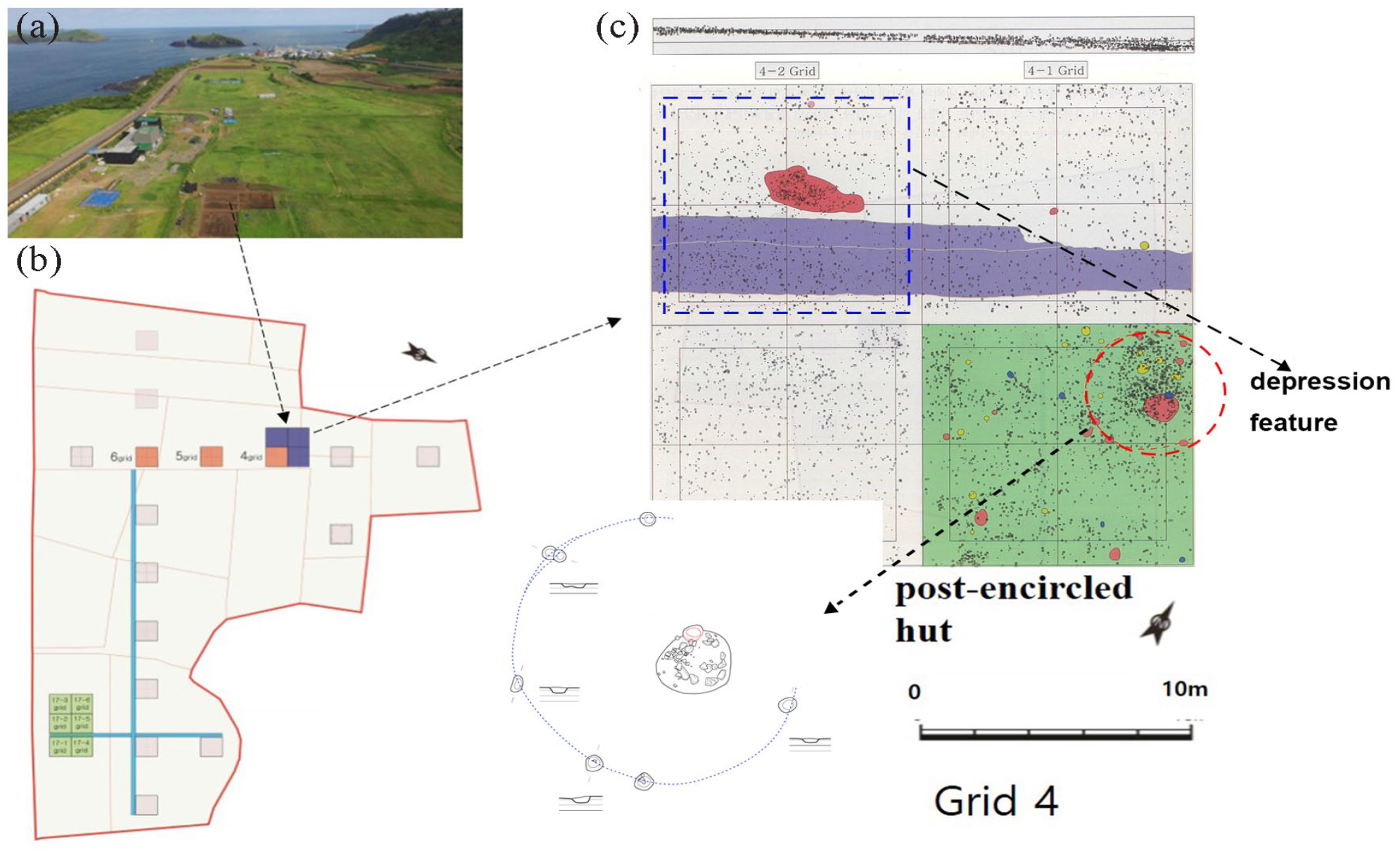
The area excavated at Gosanri District during the 2015–2016 fieldseason: (a) aerial view of the Gosanri district, (b) Gosanri site Zone 2, and (c) Gosanri Zone 2 Grid 4, showing a post-encircled feature and a depression feature filled with stone tools and byproducts.
Mainland influence to Jeju was reflected mostly in pottery types from the Initial Neolithic period onward. Influx from the mainland, however, came to a halt during the mainland Middle Neolithic period (5500–4500 cal. BP). Foxtail and broomcorn millets were first introduced along the east and south coasts of the mainland by the Early Neolithic period (6500–5500 cal. BP) (Lee et al., 2019), and widely spread by the Middle Neolithic (5500–4500 cal. BP) (Crawford and Lee, 2003; Lee, 2011, 2017). Increases in numbers and sizes of settlements began during the Early Neolithic, and picked during the Middle (Kim et al., 2021). Contrary to this boom, Jeju showed a decrease in site numbers during that time (Park, 2021). The absence of typical mainland’s Middle Neolithic material culture on Jeju reflected a lack of interactions with the mainland. The environmental instability due to resuming volcanic activities may have cause this downturn.
Another contrasting trait from the mainland is that well-defined residential structures, such as subterranean houses, did not appear on Jeju throughout the Neolithic period (Park, 2021). Instead, the Gosanri and a few Neolithic sites revealed hut-like structures outlined by postholes, outdoor hearths, and workshop-like features (Lee et al., 2023) (Figure 2c). This selective adoption of cultural elements indicate that the shape of interactions were likely acculturation and interaction not by replacement (Lee et al., 2023). Most subsequent Neolithic sites were located at the same locations as the Incipient sites, indicating a similarity in locational preference and resources that landscapes could have offered. Secondly, some material cultural tradition sustained to the later Neolithic phases. This continuity indicates that Jeju islanders used a certain landscape as a focal point as part of a living niche for over several 1000 years, despite new technological and cultural influence from the mainland. Earlier study shows that traditional ecological knowledge on landscape choice and residential mobility of Early Holocene islanders were transcended to the descendants, who also interacted with and accepted migrants from the mainland. In that regard, understanding the beginning of traditional ecological knowledge formation and cultural niche construction is key to understand Island Neolithic culture on Jeju. For that goal, our study will investigate traditional ecological knowledge on food strategies.
Materials and methods
Stone artifacts analysis
We analyzed a total of 1654 stone artifacts from Zone 2 at Gosanri that were retrieved from the 2012 to 2016 field seasons (Jeju Archaeological Institute, 2018; Figure 2b). This study classified lithics from Jeju into six categories that reflect their functions, based on their morphological variations, raw materials used, and previous experimental studies on stone tools from Neolithic sites in Korea (Park, 2021) and Jomon sites in Japan (Mitsunosuke, 1981; Sato, 2008): (1) hunting tools, including stemmed arrowheads, arrowheads, willow-leaf shaped arrowheads, and arrowhead flakes; (2) tools for both hunting and fishing such as stemmed points; (3) food processing tools, including grinding slabs and pestles; (4) multi-functional tools, including end scrapers, blades, plows, and grooved stones; (5) manufacturing tools, including anvils, grinding stones, and pounders; and (6) byproducts and debris (e.g. cores, microblade cores, debris) (Figure 3). Data from this study were recovered from the Gosanri and other Early Holocene sites on Jeju where the Gosanri type pottery was present, including Odeungdong, Gimnyeongri, Gangjeongdong, and Samhwa District.
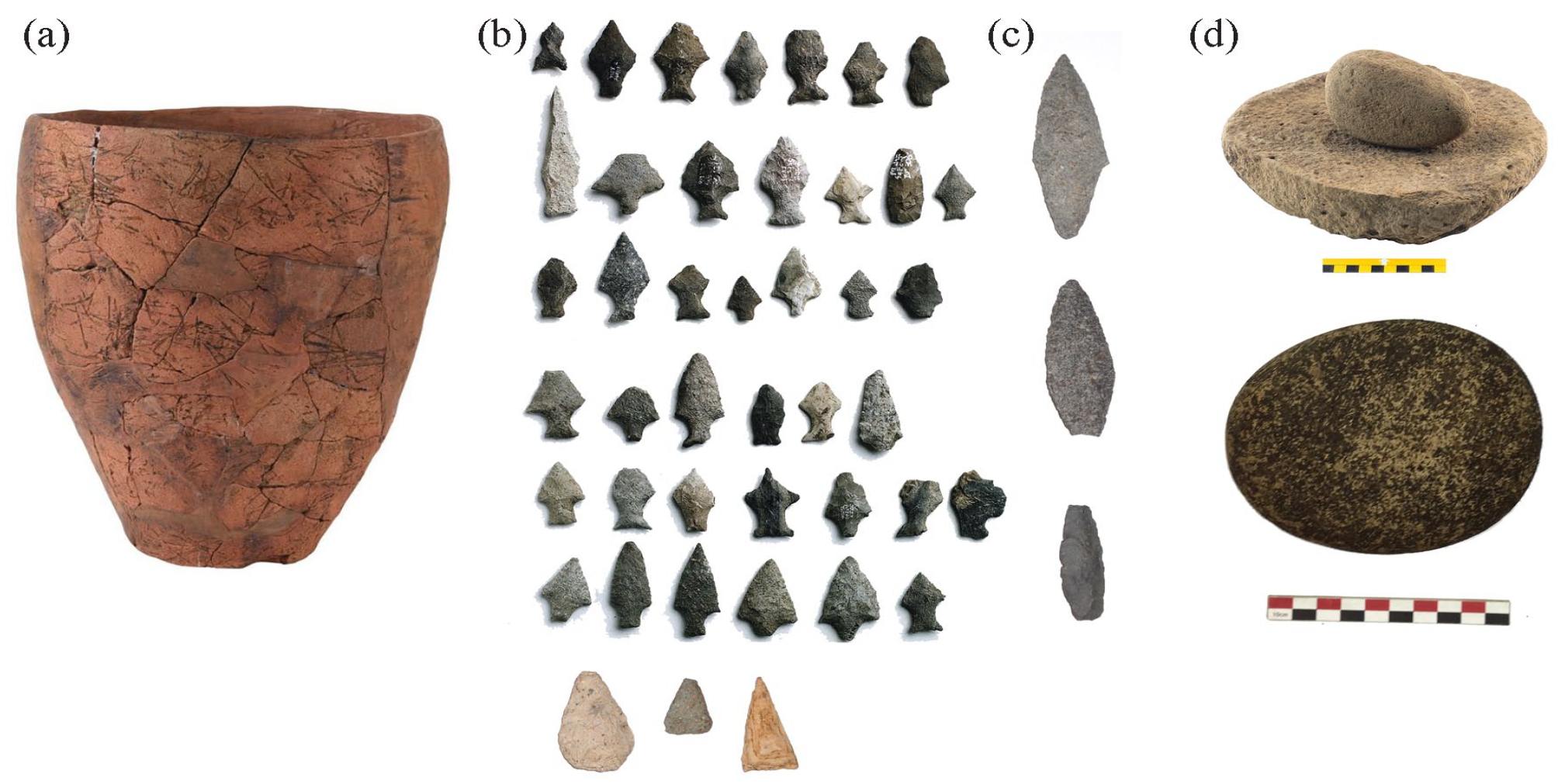
Stone tools and Neolithic pottery found at the Gosanri site (not in the same scale): (a) Incipient Neolithic pottery, (b) arrowheads, (c) stemmed points, and (d) grinding slabs and pestles.
Stable isotope analysis
Stable isotope analysis has become a useful method for tracing diet patterns as the isotopic composition of living organism depends upon the food they eat (Malainey, 2011). In Korean archeology, the application of isotope analysis has been challenged by the acidity of sediments that does not guarantee long-term preservation of organic remains. Among approximately a 1000 of Neolithic sites in Korea, only 10, including five shellmidden sites, yielded human remains (Kim, 2019). Only 25 out of 81 human remains (MNI) found there were subject to isotope analysis along with animal bones (e.g. Choy and Richards, 2010; Choy et al., 2012; Lee, 2011a, 2011b; Shin et al., 2013). Human remains reveal mostly marine subsistence signatures (cf. Kwak et al., 2022). The results of systematic DNA analysis are yet to be published. On Jeju, one partial Neolithic human remain was reported at the Samhwa district, but the bone was mostly burnt, and no further analysis was conducted (Kim, 2019).
Pottery may preserve traces of past cooking episodes within their matrix. These absorbed residues are called as lipids, a mixture of naturally occurred compounds such as fatty acids, waxes or sterols. Using gas chromatography-combustion-isotope ratio mass spectrometry (hereafter, GC/C-IRMS), stable carbon isotope ratio values of C16:0 and C18:0 fatty acids (hereafter δ13C) have been measured for understanding ancient human diets as they are the most ubiquitous in cooking vessels (Evershed, 2008a; Evershed et al., 1999; Evershed, 2008b; Reber and Evershed, 2004).
This study also measured δ13C values extracted from Gosanri pottery that was collected during the 2015 and 2016 fieldseasons (Jeju Archaeological Institute, 2018; Table 1). The experimental analysis of Evershed (2008a) demonstrates that organic residues are most likely concentrated on rims and bodysherds from cooking. Therefore, we collected 27 rims or upper bodysherds to extract absorbed residues through the established protocol outlined by Correa-Ascencio and Evershed (2014). Approximately 5 g of each potsherd was sampled and the surface was cleaned using a drill (Dremel 3000) to remove any external contaminations. The cleaned sample was ground to fine powder in a glass mortar and pestle, and weighed. Then 5 mL of a H2SO4 (sulfuric acid):MeOH (methanol) was added followed by heating (2% v/v, 70°C, 1 h, vortex mixing every 5 min) to form fatty acid methyl esters (hereafter FAMEs).
List of pottery samples analyzed for isotope analysis. Each hair of the scale = 1 mm.

Before initiating isotope analysis, we examined lipid samples extracted from potsherds with Gas Chromatography–Mass Spectrometry (hereafter GC-MS) to separate and to identify specific organic compounds within the mixture. The prepared FAMEs were analyzed by a 6890N Network GC system with a 5979 Mass selective Detector from Agilent Technologies. Helium was the carrier gas. The peaks were identified based on their mass spectral characteristics and GC retention times, and by comparison with the NIST mass spectral library.
Isotope analysis was performed using a Thermo GC/C-IRMS system composed of a Trace GC Ultra gas chromatograph (Thermo Electron Corp., Milan, Italy) coupled to a Delta V Advantage Isotope Ratio Mass Spectrometer (IRMS) through a GC/C-III interface (Thermo Electron Corp., Bremen, Germany). Each sample was measured 10 times. The precision of measured δ13C values were determined and corrected using external standards composed of several FAMEs calibrated against NIST standard reference materials (cf. Colonese et al., 2015).
Results
Stone artifact compositions
This study focuses on stone artifacts recovered from Gosanri Zone 2 during the fieldseasons from 2012 to 2016 (Table 2). Raw materials (cores, microblade cores) and byproducts (debris) are the most abundant at Gosanri, counting 1654, that is, 86% of all remains analyzed. Except for debris, the most common artifacts are arrowheads (112), contributing to the dominance of hunting tools (50%) (Figure 3). The second common tool type was food processing tools such as grinding slabs and pestle, consisting of 24%. From these grinding slabs, starch of various plants was extracted, including grass family (Poaceae), millet subfamily (Paniocid), wheat tribe (Triticeae), and tubers of possibly either family Cucurbitaceae or Dioscoreaceae (Lee and Lee, 2018). Despite to its location right on the coastal line, Gosanri revealed a smaller amount of fishing tools. Stemmed points are the only items that could have been used for fishing but also for hunting, counting less than 1% among identified items.
Counts of stone tool types recovered from the Gosanri site.
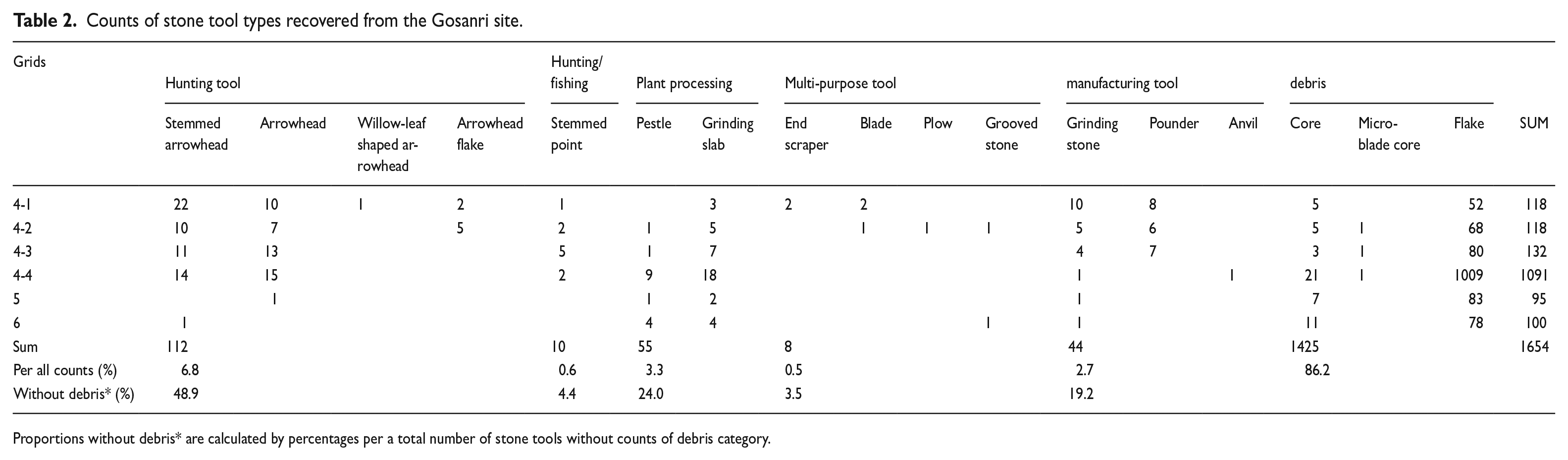
Proportions without debris* are calculated by percentages per a total number of stone tools without counts of debris category.
The combination of types and quantities of lithics hint the main activities that islanders conducted during their stay at Gosanri. The diversity of tool types and the abundance of raw materials and debris all suggest that stone tools were locally manufactured and cured at Gosanri. An abundance of manufacturing tools, 19% of which functions can be identified, also points to the same conclusion (Figure 3). The proximity to a quarry at Chaguido Islet also reflects the function of the Gosanri site. All this indicates that the main attraction and function of Gosanri was to procure rocks and to make stone tools.
The relative abundance of lithics of known functions reflect how people sustained themselves while they were quarrying raw materials and engaging in stone tool production. The proportions of stone tools reflect that the main subsistence activities were likely hunting and gathering rather than fishing. Abundance of grinding slabs and pestles and starch remains also support that harvesting edible grains and tubers were one of key subsistence strategies at Gosanri (Lee and Lee, 2018).
It is noticeable that hunting tools were commonly found in other Early Holocene sites (Table 3). For example, they are even more dominant at Gimnyeongri on the north shore and at Odeungdong on the central hilly region (Table 3). At these two locations, plant food processing tools are absent. In contrast, two inland sites at Gangjeongdong and Samhwa district, hunting tools are less abundant than the other three sites. Instead, grinding slabs and pestles are dominant at Samhwa and Gangjeongdong. Since all five sites are contemporaneous to Gosanri, the difference in tool compositions need an explanation. What made a different emphasis on tool types among these contemporaneous Neolithic communities? As tools represent different functions related to subsistence strategies, the follow-up question will be why Early Holocene islanders relied on hunting at some sites more than in others despite sharing the same cultural tradition and environments. We will examine this question in relation to environmental and ecological conditions on Jeju.
Counts and percentages (%) of stone tool types recovered from the Incipient Neolithic sites on Jeju.

Isotope signature from pottery
We were able to extract identifiable residues from 12 out of 27 samples, while the remaining ones were excluded from further analysis due to their low concentrations of lipid (Table 1). We were not able to observe any kinds of noticeable organic compounds from these samples. In our GC-MS results, each of the peaks in chromatogram with a different retention time (along the horizontal axis) indicates a different compound (cf. Figure 4a). These compounds may indicate faunal or floral remains absorbed in the pottery matrix. Generally, the most frequently observed compounds in archeological lipid residues are palmitic (C16:0) and stearic (C18:0) fatty acids (Evershed, 2008b). In addition to that, a high concentration of C18:0 fatty acid normally indicates an animal source (Copley et al., 2005a; Enser, 1991; Evershed et al., 2002). For example, the ratio of C16:0 and C18:0 fatty acid observed in modern animal fats typically falls within the range of 1.0–2.0, while the observed ratios of these two in modern vegetable oils is greater than 3.0 (Copley et al., 2005b; Gregg and Slater, 2010). With the results of GC-MS analysis, we were able to identify both major short- and long-chain saturated fatty acids (Figure 4a). Among them, the most abundant compounds were C16:0 and C18:0, indicating most lipid residues in this study may have been originated from animal fats. Some compounds observed in the chromatogram only exist in certain types of foods and are known as biomarkers. These biomarkers can help us to narrow down the identification of items processed. Phytanic acid (3,7,11,15-tetramethylhexadecanoic acid), pristanic acid (2,6,10,14-tetramethylpentadecanoic acid), and 4,8,12-TMTD (4,8,12-trimethyltridecanoic acid) are found in particularly high concentrations in marine animals (Copley et al., 2004; Craig et al., 2011; Evershed et al., 2008; Hansel et al., 2004; Solazzo and Erhardt, 2007; Vetter and Schröder, 2011). Together with thermally produced long-chain ω-(o-alkylphenyl) alkanoic acids, these compounds are indicators of aquatic/marine resources (Craig et al., 2011; Evershed et al., 2008). Two samples (GS007, GS026) at Gosanri showed the presence of phytanic acid. As phytanic acid is also present in ruminants (Heron and Craig, 2015), however, it does not necessarily mean that these samples were originated from aquatic/marine resource. Besides phytanic acid, no other aquatic/marine biomarkers were identified.
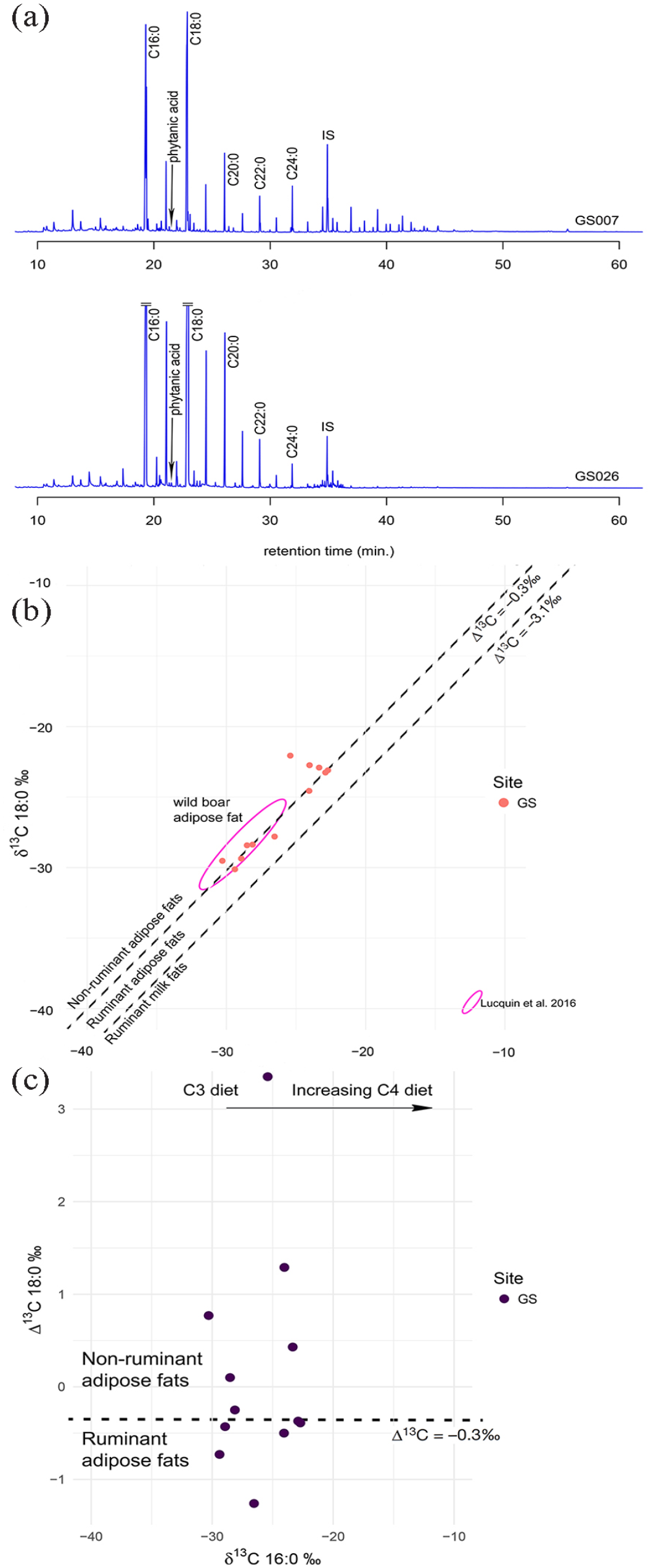
(a) Chromatograms results from the GC-MS analysis. 5-a Cholestane was added as an internal standard (1232 ng). IS: internal standard. (b) Results of isotope analysis of Gosanri (GS) samples, using the method described in Salque et al. (2013). Δ13C = δ13C18:0–δ13C16:0. (c) The distribution of δ13C18:0 and δ13C16:0 values of Gosanri (GS) samples.
As for the interpretation of the isotope data, we followed the method from Salque et al. (2013). This approach uses the Δ13C (δ13C18:0–δ13C16:0) proxy which removes the exogenous factors related to the local environment and allows us focus on the metabolic and biosynthetic characteristics of the animal fat source (Copley et al., 2003; Dunne et al., 2012). This approach can distinguish non-ruminant fats, ruminant fats, and ruminant milk fats. The results of the isotope analysis on C16:0 and C18:0 fatty acids from our samples reveal key characteristics in Gosanri people’s diet (Figure 4b and c). Six samples (GS004, GS007, GS012, GS013, GS016, GS026) indicate the presence of ruminant fat, whereas the remaining six (GS001, GS003, GS009, GS015, GS018, GS027) showed the presence of non-ruminant fats. None of our samples were originated from milk fats. Although no Incipient Neolithic sites yielded faunal remains, we suspect most of the ruminant adipose fats presented in our samples likely originated from deer, considering the following factors. In general, coastal shellmiddens in Korea, sika deer (Cervus Nippon) and wild boar (Sus scrofa) were the main terrestrial animals for consumption (Lee, 2011a, 2011b; Shin et al., 2013). Several Early or Late/Final Neolithic shellmiddens on Jeju also yielded a substantial number of sika (Cervus nippon), Siberian roedeer (Capreolus pygargus) or wild boar bones (Yang, 2014). As hunting stone tools had not changed much on Jeju throughout the Neolithic period (Park, 2021), we suspect that games in the Incipient phase would be similar to the later phases.
To see if there is any possibility that the non-ruminant fats in our samples are from wild boar, we compared our samples with the reference ellipse of wild boar adipose fat from both prehistoric and modern Japanese specimens (Lucquin et al., 2016; Shoda et al., 2017). Although the geographic proximity is the main reason that we employed the reference ellipse from Japan, we are aware that the δ13C values of the available samples from Japan might not be directly comparable with those of the archeological ones from Korea. The result shows that three samples (GS015, GS018, GS027) were likely to be originated from wild boar (Figure 4b). Wild boar is the second most common mammals among the Neolithic sites in Korea, including Jeju Island (Yang, 2014). Generally, an increase in δ13C value of C16:0 fatty acid is considered to correspond to an increase in either C4 plants or marine resource consumption (Salque et al., 2013). In our study, three samples (GS001, GS003, GS009) with non-ruminant fat range showed relatively high δ13C (C16:0) values. Since indigenous C4 plants in Korea are extremely rare and there is no evidence of domesticated millet at Gosanri (Lee and Lee, 2018), the origins of these residues are likely marine animals.
Discussion and conclusion
Residential mobility and resource seasonality
To explain the results from both the isotope and lithic compositions, we first examined the settlement patterns and environmental conditions at Gosanri, particularly the seasonality of food resources. About half of 80 Neolithic sites on Jeju revealed human-built features, mostly dating to the Late or Final Neolithic phases, including caves, rock shelters, pits, stone-laid features, outdoor hearts, ditch-like features, or postholes (Park, 2021). Seven out of 17 Incipient sites exhibit some types of human-built structures, including outdoor hearths and stone-laid features. As these features were not defined as clearly as Neolithic structures in the mainland, however, the debate continues whether these features simply represent areas formed by post-depositional accumulations of artifacts. A hut-like residential feature and a pit-like feature found at Gosanri answer this question. In the floor area encircled by postholes, a stone-lined pit filled with charcoal is centered and numerous stone tools and byproducts were concentrated on the floor (Figure 2c) (Jeju Archaeological Institute, 2017). This feature suggests a domestic dwelling structure, resembling a hut with a canopy (Figure 2). Furthermore, a recent study on soil micromorphology identified a pit-like sunken feature filled with stone artifacts as a space for making stone tools (Lee et al., 2023). This feature represents an emerging form of repeated task space rather than a layer where artifacts, byproducts, and wastes were accumulated because of postdepositional disturbance. These two features at Gosanri may reflect the emergence of a residential base in the Incipient Neolithic period (Lee et al., 2023). The density and diversity of stone tools at Gosanri exceed all other contemporaneous sites. Beyond Gosanri, a few other Incipient sites are known to be residential bases, including Samhwa, Gangjeongdong, Odeungdong, and Gimnyeongri (Figure 1a) (Park, 2021). Overall, Jeju Neolithic settlement patterns fit the model of residential mobility (in sensu Binford, 1980, 2001). People moved between the residential bases and certain task localities to conduct various subsistence activities through a seasonal cycle without building robust posts. In contrast, “logistical mobility” requires more robust habitation structures (Binford, 1980, 2001), and only later Neolithic sites in the Korean peninsula reflect such type. The residential mobility pattern of the Incipient Neolithic has persisted over several 1000 years to the Final Neolithic period on Jeju, in contrast to the emergence of logistical mobility in the mainland by the Middle Neolithic period.
Neolithic islanders on Jeju probably kept a mostly mobile way of life. Gosanri was visited almost for 7000 years (Lee et al., 2023). Then what made this long-term habitual use of Gosanri possible? Given the scarce precipitation and higher wind velocities, Gosanri would not have been an ideal location for living. Despite this drawback, its proximity to the quarry source at Chaguido Islet was probably a main attraction to the Neolithic islanders. Chaguido, 1.7 km off westward from the Gosanri shore, is a single source of dacite welded tuff, rhyolitic tuff, and rhyolitic welded tuff on Jeju. These rocks were preferred for stone tools as they are harder than basalt, a dominant rock type on Jeju (Jeju Archaeological Institute, 2018). It is likely that Gosanri could have served as a task camp and a residential base where raw materials were brought back for tool manufacture.
Diverse ecological patches near the Gosanri site, including flatlands, wetlands, and peaks, may have been suitable for foraging various wild resources. Our isotope analysis and earlier study on starch remains indicate a variety of terrestrial resources were consumed at Gosanri (Lee and Lee, 2018). Starch remains from grinding slabs indicate that tubers and grains from wetlands and forest edges were harvested for food (Lee and Lee, 2018). All this outcome indicates that it is not justified to assume the marine importance simply based on the current proximity to the coast.
Faunal remains are not preserved in an open-air condition at Gosanri, but a few later Neolithic shellmidden sites on Jeju revealed faunal remains, including Hamori, Bukchonri, Gimnyeongri, and Handong (Figure 1a) (Yang, 2014). Similar to the sites in other parts of Korea, the most frequently found mammal taxa are sika deer or Siberian roedeer, and wild boar is often the second. At least six taxa of fish were identified from shellmiddens on Jeju (Yang, 2014), all inhabiting the inner bay environment (Han et al., 2016). Approximately 15 fish taxa inhabit near the shores or the inner bays on Jeju, and have been the main sources for fishery to date (Kim, 2005). Fish taxa found on later period shellmiddens on Jeju can be caught mostly in summer or winter, including convict grouper (Epinephelus septemfasciatus), red seabream (Pagrus major), blackhead seabream (Acanthopagrus schlegelii), Asian sheepshead wrasse (Semicossyphus reticulatus), striped beakfish (Oplegnathus fasciatus), and northern whiting (Sillago sihama) (Han et al., 2016). Considering the seasonality of fish remains, shellmidden sites were probably visited in summer and/or winter along the south and northeast coast on Jeju. Gosanri district is notorious for strong summer and winter winds. For example, the instantaneous wind velocity at Gosanri district can be as high as 26 m/s (4.9 m/s in average) and 34 m/s (9.4 m/s in average) in summer and winter respectively. The record for the fastest instantaneous wind velocity was 60 m/s which was formed by the typhoon called “Maemi” in summer 2003 (Korea Meteorological Administration open MET data portal, 2022). If wind patterns are the same during the Early Holocene, Gosanri could not have been an ideal location for year-round dwelling without substantial structures. Instead, Gosanri people built a hut-like base that were seasonally used when winds were calmer, probably in spring and fall. Along the west coast, fish taxa that can be caught without a seafaring boat are available only in high wind seasons (summer, winter). All things considered, Gosanri likely played a pulling post for Neolithic people in spring and fall when winds were calmer. In these habitable seasons, however, fish was scarce near the shore, and this condition probably impacted the islanders’ subsistence strategy focusing on terrestrial resources.
We do not claim that our results provide an overarching explanatory model for Neolithic subsistence across Korea. Jeju is distinctive in terms of the presence of the Early Holocene sites where no contemporaneous sites were found in the rest of Korea. Gosanri and other Incipient Neolithic sites on Jeju may represent a rare preservation of the Early Holocene sites, while all others might have been submerged with a rising sea level after the Last Glacial Maximum. Our findings on heavy reliance of terrestrial animals at Gosanri, however, can be compared with the subsistence of later Neolithic sites in other parts of Korea. In many Neolithic coastal shellmiddens, marine fauna was found more abundantly (Lee, 2002), and isotope signature of most human remains indicates marine diet (Shin et al., 2013). Isotope signatures extracted from pottery along the southeastern coastal regions in the mainland, however, shows more or less balanced proportions between terrestrial and marine resources (Kwak et al., 2022). In that regard, heavy reliance on terrestrial protein at Gosanri on Jeju stands out, and can be explained by its proximity to a tuff quarry, strong seasonal winds, and the seasonality of marine resources.
Island niche construction
Along the shores of Korea over 800 shellmiddens were found, laying a strong assumption on the dominance of marine resource in the Neolithic period. Recent studies, however, showed that prehistoric subsistence is not always straightforward and simple (Kwak et al., 2022; Lee et al., 2019). In addition to that, growing number of evidence indicate the importance of terrestrial resources even in the coastal regions worldwide. For example, studies from the Balearic Islands of Ibiza and Formentera in Spain revealed that prehistoric communities did not systematically use marine or freshwater food items and their diet was mainly based on terrestrial resources (Nehlich et al., 2012; Van Strydonck et al., 2005).
The Gosanri site is situated in the southwestern part of the Jeju Island, right next to the current shoreline (Figure 1b). Interestingly, our isotope analysis on the potsherds showed that major part of Gosanri peoples’ diet was terrestrial animals, probably deer and wild boar. The isotopic signal was not far off from that of the Bronze (or Mumun) period Songgukri site in the southwestern peninsula, dating to 2900–2400 cal. BP (Kwak et al., 2017). This comparison indicates that Gosanri people consumed terrestrial animals to the similar degree of inland dwellers in the mainland who came over several thousand years later. Only a quarter of our samples reflect the presence of marine fats. It is also noticeable that the most common stone tool type at Gosanri is a stemmed arrowhead (Figure 3). Both archeological and isotopic evidence showed that Gosanri people were active hunters. Marine products were the main foodstuffs in some part of southern coastal areas of mainland Korea (Kwak et al., 2022; Shoda et al., 2017). Our study at Gosanri, however, suggests that the proximity to the coast does not necessarily support the assumption of marine-oriented diet. Gosanri shows other factors, including the seasonal climate fluctuations, the resource seasonality, and the proximity to other key resources, a quarry in this case, need to be considered in examining the main diet and subsistence.
Although the coastline was probably further away from the Gosanri site than the current shoreline, we do not think the distance between the site and shoreline kept Gosanri people from seeking marine resource. Prehistoric hunter-gatherers easily travel several kilometers for their foraging activities (Lovis et al., 2005) and Gosanri people probably had no major geographical hindrance to accessing marine resources. Then, what was the main reason for islanders to focus on terrestrial resources? The answer can be found in the seasonality of marine resources, environmental challenges, seasonal strong winds in this case, and technological constraints that kept from seafaring and building wind-proof shelters. The coastline was always accessible, but fish in inner bay areas were not available in spring and fall when winds were calmer. Islanders therefore had to establish other reliable food resources. Hunting wild terrestrial mammals and harvesting edible wild plants were probably the most practical choice for the Early Holocene islanders. This ecological knowledge of hunting and gathering sustained through the Final Neolithic phase on Jeju.
Concluding remarks
When it comes to the prehistoric island subsistence, the importance of marine resources is considered foremost. In Korean archeology, a marine-oriented economy is interpreted as typical coastal lifeway (Kim, 2010). This interpretation, however, overlooks key factors that that aquatic resources are not always consistently available due to their seasonality as well as the cultural and technological limitations. Our analysis on stone artifacts and isotope signatures from pottery residues from Gosanri indicated that these coastal islanders were also effective hunters and they consumed wild terrestrial animals on regular bases. Heavy reliance on terrestrial protein at Gosanri on Jeju stands out. In spite of the strong wind that severely limits habitability of Gosanri area without a solid shelter, its proximity to a high-quality tuff quarry acted as an pulling factor. Islanders repeatedly visited Gosanri to mine the most desirable raw materials (tuff) for their tools during the strong-wind free seasons (spring, fall) when they could live by without substantial shelters. In spring and fall, however, Gosanri people would have face a lack of inner bay fish, while seafaring fishery was not their option. To overcome the seasonal deficiency of marine resources and secure sustainable provision, Neolithic islanders chose terrestrial resources as their key diet and built a long-lasting niche of seasonal use of the Gosanri landscape and resources.
Footnotes
Acknowledgements
This work was supported by the Korean Studies Promotion Service/Academy of Korean Studies (Laboratory Program for Korean Studies, AKS-2015-Lab-2250001). We appreciate the Jeju Archeology Institute and Jeju Cultural Heritage Institute for their cooperation during the fieldwork, including Dr. Changhwa Kang, Dr. Jaewon Ko, and Hana Lee. Our gratitude is to Dr. Rory Walsh (University of Michigan), Dr. Habeom Kim (University of Oregon), and Hyunsoo Lee (University of Oregon) for their participation in the Gosanri fieldwork. Our gratitude is to three anonymous reviewers who helped us improving this paper.
Funding
The author(s) disclosed receipt of the following financial support for the research, authorship, and/or publication of this article: This work was supported by the Laboratory Program for Korean Studies through the Ministry of Education of Republic of Korea and Korean Studies Promotion Service of the Academy of Korean Studies under the grant no. AKS-2015-Lab-2250001.
