



Abstract
Temperate lake sediments store a substantial amount of organic carbon (OC) over millennia. Despite the importance of quantifying terrestrial carbon budgets for Nature-based Solutions, the long-term accumulation of OC in European temperate lakes is poorly constrained. In this study, we analyzed 30 lake sediment records to generate a preliminary first-order estimate of Holocene OC accumulation rate (OCAR) and OC storage in UK lakes. We also examined the environmental variables that influence OCAR and produced synthesized Holocene records of %OC and z-scores of log-transformed OCAR and sediment accumulation rate (SAR) at 500-year resolution. Based on our estimation, we report an average Holocene OCAR of 7.4 ± 5.5 g C m−2 yr−1 and a Holocene total OC storage of 0.24 ± 0.18 Pg C in UK lakes. Apart from latitude, no relationship was found between the average Holocene OCAR and the various environmental variables (i.e. temperature, precipitation, surface area, catchment area, depth, altitude, and geology type). During the Holocene, OCAR closely resembles variations in SAR, whereas the increase in %OC is likely explained by the warming climate. Early Holocene variations in OCAR were primarily climate-driven. In contrast, the anthropogenic impact on the landscape exerted a predominant influence on OC burial during the middle-late Holocene. Our results improve the current understanding of terrestrial carbon budgets in the UK and demonstrate the under-appreciated importance of lakes as long-term OC stores.
Keywords
Introduction
In the context of anthropogenic climate change, there is an unparalleled need to achieve carbon neutrality by this century. Nature-based Solutions (NbS) comprise a crucial component of climate change mitigation due to the large amount of carbon stored in natural and managed ecosystems. NbS has the potential to mitigate CO2 emission at a rate of 10 Gt CO2 yr−1 and, in the long-term, reduce peak warming by 0.1–0.3°C depending on the different warming scenarios (Girardin et al., 2021). Quantifying terrestrial carbon budgets is conducive to implementing NbS and could help guide more targeted and informed land management decisions (Cole et al., 2007; Gregg et al., 2021; Keith et al., 2021).
Despite only constituting 3.7% of the Earth’s non-glaciated land surface area (Verpoorter et al., 2014), lakes are highly spatially variable and play a critical role in the global carbon cycle (Buffam et al., 2011; Einsele, 2001; Prairie, 2008; Radbourne et al., 2017; Tranvik et al., 2009). Lake ecosystems are sites where active processing of carbon (e.g. carbon production, transformation, burial, and evasion) takes place (Cole et al., 2007; Prairie, 2008; Tranvik et al., 2009). Allochthonous input of organic matter from catchments contributes to lake’s dissolved organic carbon (OC) or dissolved organic matter pool, which can be assimilated by heterotrophs as an energy source (Hanson et al., 2015; Prairie, 2008). Dissolved inorganic carbon, mainly in the form of CO2, is consumed during photosynthetic assimilation by heterotrophs and oxidized into organic carbon in both dissolved and particulate forms (McGowan et al., 2016). OC may be reduced back into CO2 and CH4 through respiration. Particulate carbon suspended in the water column may sink to the lake bottom and contribute to OC burial in lake sediments (Alin and Johnson, 2007).
Although lakes mostly behave as net carbon sources and are super-saturated in CO2 in the surface waters (Cole et al., 1994; Tranvik et al., 2009), lake sediments can store a large amount of OC in the long-term due to their high OC burial efficiency, rapid sediment accumulation rates and high aquatic productivity (Cole et al., 2007; Sobek et al., 2009). Some of the deeper and larger lakes of tectonic origin could persist in the landscape for millions of years, and lake sediments in glaciated terrains could accumulate for more than 10,000 years (Alin and Johnson, 2007; Cole, 2013). In contrast, many smaller lakes are short-lived or artificially constructed (i.e. reservoirs). Globally, inland waters (including lakes, rivers, streams, and reservoirs) receive carbon at the magnitude estimated at 2.9 Pg C yr−1, amongst which 1.4 Pg C yr−1 are evaded into the atmosphere, 0.9 Pg C yr−1 are transported to the sea, and the remaining 0.6 Pg C yr−1 are buried to sediments (Tranvik et al., 2009). The total amount of carbon storage in lake sediments during the Holocene is estimated at 400–800 Pg C (Cole et al., 2007), and the long-term OC accumulation rate (OCAR) ranges between 4.5 and 14 g C m−2 yr−1 (Cole et al., 2007; Dean and Gorham, 1998; Stallard, 1998). Recently, OCAR in lake sediments has increased due to cultural eutrophication (Anderson et al., 2014, 2020). Carbon burial is expected to continue to increase, driven by climate change, increased runoff and eutrophication (Tranvik et al., 2009).
Lake sediments document spatially and temporally integrated information. Hence, paleolimnological approaches are well-suited for quantifying OC accumulation and storage in lakes and may offer critical insights for understanding future changes in the terrestrial carbon cycle (McGowan et al., 2016). One widely adopted method uses loss-on-ignition 550°C (%LOI550) data to estimate %OC in lake sediments (Anderson et al., 2014; Pajunen, 2000) or directly makes use of downcore total organic carbon (TOC) data measured using an elemental analyzer (McGowan et al., 2016). To date, many studies have adopted a paleolimnological approach for quantifying the amount of OC storage and OCAR in lakes at different spatial and temporal scales (e.g. Anderson et al., 2020; Dean and Gorham, 1998; Kastowski et al., 2011). However, there is a bias toward Holocene scale estimates on boreal and arctic lakes within Europe (e.g. Anderson et al., 2009; Chmiel et al., 2015; Kortelainen et al., 2004), whereas temperate lakes, which are large organic matter stores, receive less attention (Scott, 2014). Temperate lakes cover ~25% of the European lake surface area but contribute to ~35% of European lakes’ total carbon accumulation rate (Scott, 2014).
The UK is home to 43,738 water bodies covering 213,911 ha in Great Britain (Hughes et al., 2004) and 1,668 water bodies covering 62,600 ha in Northern Ireland (Gibson et al., 1994), altogether constituting around 1% of the total UK surface area. There are few systematic inventories of OCAR in the UK. Scott (2014) examined the OCAR of two lakes in the Shropshire–Cheshire meres region, and Anderson et al. (2014) included a number of UK lakes in their OCAR estimation for European lakes. Both studies focused on the last 100–150 years. Only a few UK lakes were included in the estimation of Holocene OCAR in European lakes (Kastowski et al., 2011). Thus, there is no clear overview of Holocene OCAR and OC storage estimates in the UK. There are extensive lake sediment records in the UK covering part or the complete sequence of the Holocene (e.g. Bennett et al., 1992; Fossitt, 1996; Watkins et al., 2007), offering an excellent opportunity to conduct a Holocene OC inventory.
Here, we present a first-order preliminary estimate for OCAR and OC storage in UK lakes across the Holocene by adopting a paleolimnological approach. In addition, we investigate the temporal variations in OCAR, sediment accumulation rate (SAR) and %OC during the Holocene and examine the environmental variables influencing OCAR in UK lakes (i.e. temperature, precipitation, surface area, catchment area, depth, altitude, latitude, and geology type). By comparing the OCAR in UK lakes to estimates from lakes in different regions and various habitat types in the UK, we evaluate the relative importance of lake sediments as an OC store in the UK.
Methods
Study sites and data collection
The selection of lake sediment cores was based on four main criteria: (1) the sediment record covers at least 3 kyr during the Holocene; (2) a %LOI550, TOC, or organic matter (OM) record exists; (3) a minimum of three radiocarbon dates to ensure a relatively reliable age control and (4) extant lakes.
A wide range of search terms was employed to identify relevant studies. These include “lake,” “loch,” “llyn,” “lough,” “Holocene,” “Britain,” “England,” “Scotland,” “Wales,” “Northern Ireland,” “organic matter,” “LOI,” “TOC,” “vegetation,” and “pollen.” We are aware that this search was not exhaustive, and additional sediment records must exist in earlier publications or remain unpublished. However, in contrast to other Holocene estimates for lakes (e.g. Anderson et al., 2009, n = 11; Chmiel et al., 2015, n = 7), fjords (e.g. Smeaton et al., 2017, n = 5), and peatlands (e.g. Ratcliffe et al., 2018, n = 12), the number of lakes included is sufficient for a preliminary first-order estimate.
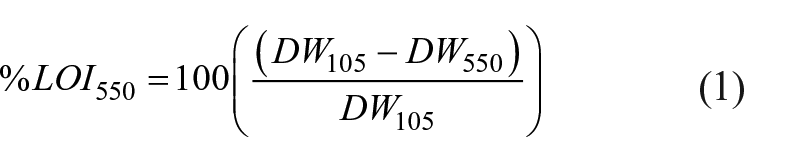
A total of 30 lake sediment records across the UK were selected (Figure 1). This includes three new lake sediment records (Loweswater, Loch na Claise, and Loch an Aigeil) that were analyzed for %LOI550 following Heiri et al. (2001), which entails burning at 550°C for 4 hours and calculating where DW105 refers to the dry weight of sediments after drying at 105°C. %LOI550 data for the 27 published records were generated using a temperature range between 450°C and 550°C and furnace times between 1 and 12 hours (references are in the Supplementary Information, available online). Scottish lakes (n = 19) comprise most of the selected records, followed by lakes in England (n = 6), Wales (n = 3), and Northern Ireland (n = 2). The proportional representation of lakes from each country is roughly consistent with the spatial distribution of lakes in the UK, dominated by lakes in Scotland (57%) and England (36%) in terms of absolute numbers (Gibson et al., 1994; Hughes et al., 2004).

Overview map showing the 30 study sites. Green triangles (n = 11) represent lake sediment records with reported dry bulk density data (required to calculate organic carbon accumulation rate); red circles (n = 19) represent lake sediment records lacking dry bulk density data. List of lake names, published reference sources, and further information associated with each lake are given in the Supplementary Information, available online.
Chronology
To obtain Holocene temporal trends in OCAR, SAR, and %OC, radiocarbon dates for all 30 lake records were (re)calibrated with the IntCal20 curve (Reimer et al., 2020) using Bayesian age-depth modeling in the rbacon package (version 2.5.8) (Blaauw and Christen, 2011) in R (see Supplemental Figures S1–S30, available online for the new age models and Supplemental Tables S1–S3, available online for radiocarbon ages from the three new records). The 95% confidence interval from the Bacon age-depth models were used as conservative age uncertainties. The maximum age uncertainties across all interpolated depth layers ranged from 289 (Lochan Uaine) to 1,705 years (Loch na Claise), with 77% of the lake records having maximum age uncertainties below 1,000 years.
Calculation of average Holocene OCAR and OC storage
%LOI550 was multiplied by a factor of 0.469 to convert it into %OC based on previous comparisons of %LOI550 and %OC data (Dean, 1974). Most of the published literature (n = 19) did not report data on dry bulk density (DBD) (Figure 1), but DBD and SAR are required to calculate dry mass accumulation rate (DMAR), which is essential in the calculation of OCAR (see below). Following Dean and Gorham (1998), an empirical relationship between %LOI550 and DBD was established using data from the 11 lakes with DBD reported (Figure 1) (equation (2)), which has r2 = 0.6 and p < 2.2 × 10⁻¹⁶. This %LOI550-DBD relationship is highly similar to existing empirical relationships (Dean and Gorham, 1998; Moyle et al., 2021) (see Supplemental Figure S31, available online).

This relationship was applied to the estimation of DBD for the 19 lakes. OCAR (g C m−2 yr−1) was determined by multiplying DMAR (g cm−2 yr−1) by %OC and a conversion factor of 10,000 (Anderson et al., 2014).
To account for the higher-than-average SAR occurring at the deepest part of the lake (Anderson et al., 2014; Engstrom and Rose, 2013), a sediment focusing factor based on the ratio of sediment 210Pb flux to regional atmospheric 210Pb flux was applied. Due to the paucity of sediment 210Pb flux data for most study sites, we employ a regional average focusing factor of 1.78 based on data from 90 UK lakes since 1850 CE (Handong Yang, unpublished data). Sediment focusing varies over time as the pattern of deposition evolves and lake morphometry or size changes (Engstrom and Rose, 2013). However, we assume that the focusing factor remains constant over the Holocene for ease of estimation. The focusing-corrected average Holocene OCAR in each lake sediment record was then averaged to estimate the average focusing-corrected Holocene OCAR in UK lakes. The total Holocene OC storage in UK lakes was calculated by multiplying the average focusing-corrected Holocene OCAR by 11,650 years and a total UK lake area of 276,511 ha (Gibson et al., 1994; Hughes et al., 2004). Standard deviations were calculated for the OCAR in each sediment record and propagated to obtain uncertainty of the average Holocene OCAR in UK lakes. We recognize that there are compounding error sources associated with each step of the estimation, but the reported error values represent a conservative estimate of the uncertainty, which means that the true value lies within the range provided.
Examining controlling factors on OCAR
Pearson’s product-moment correlation was performed to determine the relationship between the average Holocene OCAR from each sediment record and various modern environmental variables at each site, assuming that OCAR and these variables have remained constant over time. Data for surface area, catchment area, altitude, mean depth, maximum depth, geology type (categorized into low, moderate and high alkalinity groups) and latitude were obtained from the UK Lakes Portal (UK Centre for Hydrology and Ecology, 2016) and the original publications; the maximum annual temperature and mean annual precipitation between 1961 and 2020 at the nearest weather station for each site were obtained from the Met Office (2022). Spearman’s rank correlation coefficient was performed to analyze the relationship between OCAR and the three geology types.
Average UK Holocene temporal trends
The OCAR, SAR and %OC data for each lake were linearly interpolated between neighboring data points to the nearest 500-year since the sampling resolution of all sediment cores lies below 500-year. The OCAR and SAR data were log-transformed for normality (hereafter referred to as OCARlog and SARlog). For each sediment record, z-scores of OCARlog and SARlog were calculated by subtracting the mean and dividing by the standard deviation. Synthesized OCARlog and SARlog z-scores were produced by taking the average z-scores for all lakes at each resampled age (i.e. one average value every 500 years). Pearson’s product-moment correlation was performed to assess the relationship between the synthesized OCARlog z-score and the synthesized SARlog z-score and %OC.
Results
Average Holocene OCAR and OC storage estimates
The average focusing-corrected Holocene OCAR in UK lakes is 7.4 ± 5.5 g C m−2 yr−1 (uncorrected OCAR: 13.2 ± 9.9 g C m−2 yr−1), with values ranging from 2.5 ± 0.9 g C m−2 yr−1 for Loch Buailaval Beag to 20.3 ± 8.9 g C m−2 yr−1 for Lough Catherine (Figure 2). The area-weighted OCAR is 21 ± 15 Gg C yr−1 (rounded to two significant figures). During the Holocene, the total OC storage in UK lakes is approximately 0.24 ± 0.18 Pg C with areal OC storage of 86.5 ± 64.6 kg C m−2.

Focusing-corrected average Holocene organic carbon accumulation rate (OCAR) (g C m−2 yr−1) in each lake sediment record.
Relationship between OCAR and environmental variables
The only variable that significantly correlates with the average Holocene OCAR from each sediment record is latitude (r = −0.5, p = 3.2 × 10⁻³). No significant correlations were found between OCAR and any other of the variables tested (see Supplemental Information, available online).
Average UK Holocene temporal trends
Since 12 cal kyr BP, %OC has increased rapidly from ca. 6.8% to 17.3%, stabilizing after 8 cal kyr BP around 16–17% with a gradual increase (Figure 3a) to present-day values of 18.1%. The OCARlog z-score remains stable between 12 and 10 cal kyr BP and subsequently declines between 10 and 8 cal kyr BP (Figure 3b and 3d). In contrast, the SARlog z-score displays a more extended decline between 12 and 8 cal kyr BP (Figure 3c). Both records show a long-term increase from 8 cal kyr BP to the present, interrupted by a temporary decline between 6 and 5 cal kyr BP. After 3 cal kyr BP, OCARlog z-score lies predominantly above the average (i.e. when z-score = 0), which is greater than the early and middle Holocene.
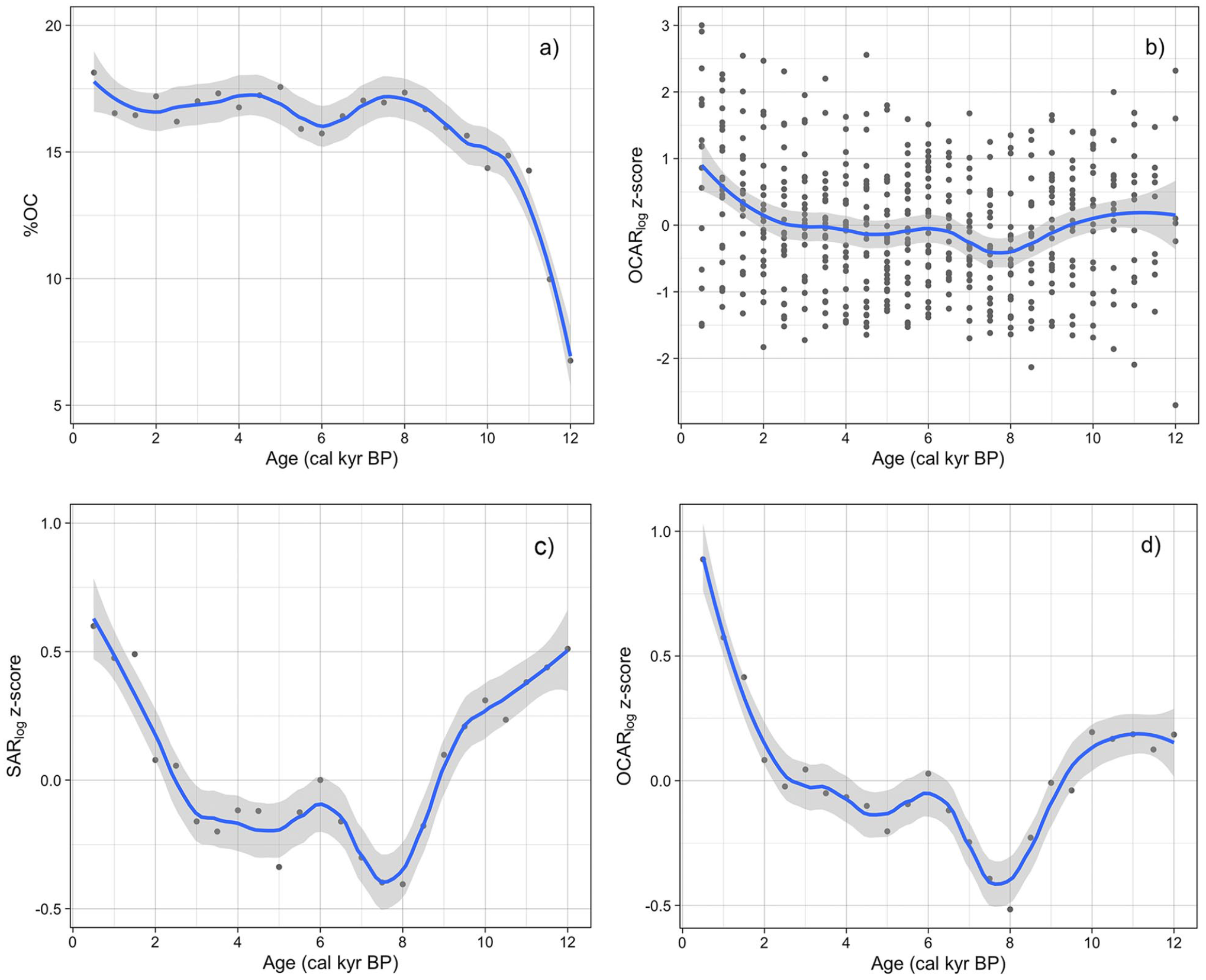
Average Holocene temporal trends for 30 UK lakes with LOESS smoothing (95% confidence interval, span = 0.4) at 500-year resolution: (a) percentage organic carbon (%OC); (b) raw log-transformed organic carbon accumulation rate (OCARlog) z-score showing data points from all sediment records; (c) synthesized log-transformed sediment accumulation rate (SARlog) z-score; (d) synthesized OCARlog z-score.
A very strong correlation exists between the OCARlog and SARlog z-scores (r = 0.9, p = 1.8 × 10⁻⁸). An r2 of 0.8 suggests that SARlog can explain up to 80% of the variation in OCARlog. On the contrary, %OC displays no relationship with the OCARlog z-score (r = −0.2, p = 0.5).
Discussion
Average Holocene OCAR and OC storage estimates
The total Holocene OC storage for UK lakes is estimated to be 0.24 ± 0.18 Pg C (areal OC storage: 86.5 ± 64.6 kg C m−2), equivalent to 0.88 ± 0.66 Pg CO2. The magnitude of the average Holocene OCAR of UK lakes at 7.4 ± 5.5 g C m−2 yr−1 is in good agreement with the global range for lakes between 4.5 and 14 g C m−2 yr−1 (Cole et al., 2007; Dean and Gorham, 1998; Stallard, 1998), and is higher than the average Holocene OCAR estimates for lakes in Europe (5.2 g C m−2 yr−1) (Kastowski et al., 2011), southwest Greenland (6 g C m−2 yr−1) (Anderson et al., 2009), Finland (1.6 g C m−2 yr−1) (Kortelainen et al., 2004), and Sweden (3.2 g C m−2 yr−1) (Chmiel et al., 2015). Variations in OCAR in Europe are likely due to region-specific lake characteristics. For example, lower temperatures in Finland may suppress primary production, thus leading to lower OCAR in boreal lakes (Kortelainen et al., 2004). In contrast, the higher OCAR in southwest Greenland may be explained by the selection of very small lakes in the study (range: 0.05–0.73 km2) (Anderson et al., 2009) compared to the selection of larger Finnish lakes (average area: 122 km2) (Kortelainen et al., 2004) because OCAR is often found to be inversely related with lake area (Mulholland and Elwood, 1982; Pajunen, 2000).
Within habitats of the UK, the Holocene OCAR of lakes (7.4 ± 5.5 g C m−2 yr−1) is higher than the modern estimates for broadleaf and mixed woodlands (4.2 g C m−2 yr−1, range: 0.7–12 g C m−2 yr−1), coniferous woodlands (4.9 g C m−2 yr−1, range: 0.8–11.7 g C m−2 yr−1) and grasslands (2.2 g C m−2 yr−1) (Downing et al., 2008), but lower than the Holocene estimates for fjords (8.3 ± 2.0 g C m−2 yr−1) (Smeaton et al., 2017), peatlands (17.8 ± 4.9 g C m−2 yr−1) (Ratcliffe et al., 2018), the modern estimate for ponds aged between 18 and 20 years (142 ± 19 g C m−2 yr−1) (Taylor et al., 2019) and millennial-scale estimates for seagrasses (138 ± 38 g C m−2 yr−1) and salt marshes (218 ± 24 g C m−2 yr−1) (Mcleod et al., 2011) (Figure 4a). The area-weighted OCAR for UK lakes (21 ± 15 Gg C yr−1) is lower than all UK habitats apart from seagrasses (Figure 4b) due to the small total surface area of lakes in the UK compared with other habitats.

Comparison of (a) average Holocene organic carbon accumulation rate (OCAR) and (b) area-weighted Holocene OCAR in a range of habitats in the UK. Sources of OCAR data include Mcleod et al. (2011) for seagrasses and salt marshes, Smeaton et al. (2017) for fjords, Taylor et al. (2019) for ponds, Downing et al. (2008) for woodlands and grasslands and Ratcliffe et al. (2018) for peatlands. Data for habitat area used for calculating area-weighted Holocene OCAR was obtained from Gibson et al. (1994) and Hughes et al. (2004) for lakes, Taylor et al. (2019) for ponds, Carey et al. (2008) for woodlands, grasslands and peatlands, Smeaton et al. (2017) for fjords, Phelan et al. (2011) for salt marshes and Green et al. (2021) for seagrasses.
In comparison to most terrestrial habitats, vegetated coastal habitats exhibit very high OCARs owing to their high efficiency in trapping sediments from both riverine and oceanic sources, facilitated by their complex ecosystem structure (Mcleod et al., 2011). Peatlands and ponds also exhibit higher OCARs than lakes. Peatlands are highly efficient OC sinks due to active plant growth (Loisel et al., 2014). Ponds are generally very productive and are effective in trapping and preserving carbon in sediments (Cole et al., 2007; Downing et al., 2006). The higher OCAR in lakes compared to woodlands and grasslands is due to the higher OC preservation rate of lakes (Cole et al., 2007).
The OC turnover rates in ponds or forest biomass last for decades to centuries (Cole, 2013). The long-term storage of OC can only occur in soils once forests reach maturity, and yet, the long-term OC burial in soil is much limited compared to its instantaneous carbon assimilation rate due to periodic burning and/or high decay rates (Prairie, 2008). Moreover, despite having very high OCAR, ponds are ephemeral features of the landscape that is more susceptible to in-filling and desiccation compared to lakes. In contrast, lake sediments, peatlands and coastal habitats can store OC for millennia (Cole et al., 2007; Mcleod et al., 2011; Prairie, 2008; Ratcliffe et al., 2018; Taylor et al., 2019). Consequently, although the average Holocene OCAR of lakes is modest in contrast to various habitat types in the UK, the capacity of lakes to act as long-term carbon stores cannot be overlooked.
The estimation of Holocene OC storage and accumulation rate in UK lakes provides an important constraint on the regional terrestrial carbon budget. Using the past as an analog, our results are highly relevant for understanding how carbon budgets in lakes will change in the future (Hanson et al., 2015; McGowan et al., 2016). Moreover, despite the promising potential of NbS for climate change mitigation, there is currently a bias toward carbon flows (e.g. sequestration) and an underappreciation of carbon storage in carbon accounting (Keith et al., 2021). While both processes are essential for the ecosystem service of climate regulation, the overlooking of carbon storage hampers current NbS efforts by providing incomprehensive information about the mitigation benefits, which may result in perverse outcomes in NbS implementation (Keith et al., 2021). Hence, by quantifying the long-term carbon storage in lake sediments in the UK, we provide critical information that may contribute to a more comprehensive carbon accounting of terrestrial aquatic systems beneficial for facilitating better informed NbS practices and associated land management decisions. Despite the long-term mitigation benefits NbS may offer, we stress that these benefits are limited compared to decarbonization efforts (Girardin et al., 2021). Therefore, NbS should not act as a distraction from emission reduction activities in the near term.
Controlling factors on OCAR
Previous studies have identified a wide range of environmental variables controlling OC burial in lakes. The main variables include depth (Anderson et al., 2014), surface area (Downing et al., 2008; Mulholland and Elwood, 1982; Pajunen, 2000), lake morphometry (Ferland et al., 2014), precipitation (Tranvik et al., 2009), temperature (Gudasz et al., 2015; Rantala et al., 2016), nutrients (Anderson et al., 2020), oxygen exposure time, and mineralization (Sobek et al., 2009). Here, we found a moderate relationship between OCAR and latitude, which may suggest an indirect influence of cooling as latitude increases (Kastowski et al., 2011). The absence of a relationship between OCAR and the environmental variables we tested may suggest the relationships found in previous studies may not apply universally. Moreover, none of the variables alone shape variations in OCAR between lakes, but rather, a combination of many site-specific factors. However, it is beyond the scope of this study to explain variations between lakes. Besides, with over 67% of the studied lakes ⩽10 ha, the absence of a relationship between OCAR and the surface area might be due to the bias toward very small lakes with variable OCAR yet narrow environmental gradients (Kastowski et al., 2011).
Average UK Holocene temporal trends
The strong positive correlation between the synthesized OCARlog and SARlog z-scores indicates that variations in OCARlog are largely driven by SARlog, and %OC of the sediment has not changed markedly during the Holocene. The increase in %OC during the early Holocene (12–8 cal kyr BP) likely resulted from the increasing annual temperature in Europe (Figure 5a and 5b) (Davis et al., 2003; Lang et al., 2010), which facilitated the switch from late glacial minerogenic sediment to organic gyttja as catchment soil developed (Bennett et al., 1990; Edwards and Whittington, 1998; Snowball and Thompson, 2008). The decrease in the synthesized OCARlog and SARlog z-scores prior to 8 cal kyr BP can be explained by the progressive establishment of woodlands fostered by the increasingly warm climate, which stabilizes the soils and reduces runoff and erosion (Figure 5a, 5f, and 5g) (Bennett et al., 1992; Fossitt, 1996; Watkins et al., 2007).

Dominant drivers of Holocene organic carbon accumulation rate (OCAR) and sediment accumulation rate (SAR) variations in 30 UK lakes (see Figure 1). (a) Pollen-reconstructed annual temperature record for Europe (Davis et al., 2003); (b) percentage organic carbon (%OC) at 500-year resolution; (c) radiocarbon (14C) date probability density functions from archeological sites between 9 and 3.4 cal kyr BP (Woodbridge et al., 2014); (d) pollen-inferred deciduous woodland change since 9 cal kyr BP (Woodbridge et al., 2014); (e) C:N ratios from three study sites (blue: Lochnagar; green: Loch nan Corr; red: Loch na Claise) with LOESS-smoothing (span = 0.2) (Dalton et al., 2005; Mackie et al., 2007; Matthews, 2022); (f and g) synthesized log-transformed SAR (SARlog) and OCAR (OCARlog) z-scores at 500-year resolution. The yellow bar above (g) represents the time range for the elm decline between 6,347 and 5,281 cal kyr BP based on statistical analyses of radiocarbon dates (Parker et al., 2002). The period-based chronology for pre-historic Britain was obtained from Pollard (2008). The green shading separates out intervals where climate exerts more influence on OCAR and SAR variations from periods where anthropogenic impact on the landscape dominates (see text for details).
Since 8 cal kyr BP, the long-term increase in the synthesized OCARlog and SARlog z-scores suggests increasing anthropogenic disturbance on the landscape (Figure 5f and 5g). The initial population increase in Britain started from ca. 7.6 cal kyr BP during the Late Mesolithic, followed by a long-term population growth trend, indicated by the increase in 14C date densities from archeological evidence and the sustained decline in deciduous woodlands (Figure 5c and 5d) (Woodbridge et al., 2014). On the contrary, %OC has remained relatively stable since 8 cal kyr BP, resembling the stabilized trend in temperature (Figure 5a and 5b).
The local maxima in the synthesized OCARlog and SARlog z-scores between 6.5 and 5.5 cal kyr BP coincides with the widely documented elm decline on the British Isles (6,347–5,281 cal yr BP) (Figure 5f and 5g) for which human activity is one of the hypothesized causes (Parker et al., 2002). The elevated sedimentation and OC burial may have been driven by the transition from Mesolithic hunter-gatherers to Neolithic agriculture in the British Isles between 6.4 and 6 cal kyr BP (Woodbridge et al., 2014) and the substantial population growth in Britain between 6.1 and 5.4 cal kyr BP (Collard et al., 2010) (Figure 5c), both increasing anthropogenic pressure on the landscape. The increase in the synthesized z-scores is interrupted by a decline toward lower values in both records between 5.5 and 4.5 cal kyr BP. This interval coincides with reduced 14C date density between 5.3 and 4.4 cal kyr, indicating reduced Neolithic impact on the landscape, which leads to the re-establishment of woodlands (Figure 5c, 5d, 5f, and 5g) (Woodbridge et al., 2014).
Since 5–4 cal kyr BP, the continued increase in the synthesized OCARlog and SARlog z-scores suggests enhanced soil erosion, which might be attributed to anthropogenic activities (Edwards and Whittington, 2001; Van Vliet-Lanoë et al., 1992). The gradual increase in both z-scores between 4 and 3 cal kyr BP coincides with the British Bronze Age (2,200–800 BC or 4,150–2,750 BP), whilst the accelerated increase since ca. 3–2.5 cal kyr BP coincides with the British Iron Age (800 BC–43 CE/500 CE or 2,750–1,907/1,450 BP) (Pollard, 2008). Changes in OCAR and SAR are consistent with the long-term increase in C:N at Loch na Claise, Loch nan Corr, and Lochnagar, with an accelerated increase over the last 2 kyr (Figure 5e) (Dalton et al., 2005; Mackie et al., 2007; Matthews, 2022). These suggest an increase in allochthonous sediment input linked to human activities. However, there are limited records of C:N from the studied lakes to help further discriminate between allochthonous and autochthonous sources of OC. Compared to natural conditions, anthropogenic sediment delivery can be 5–10 times higher (Dearing and Jones, 2003). Increased land-use pressure, including deforestation, agriculture, and grazing, have all exacerbated soil erosion and increased allochthonous carbon input to lakes (Beales, 1980; Bennett et al., 1992; Edwards and Whittington, 1998; Jones et al., 1985; Mulder, 1999). Soil erosion would also elevate nutrient supply into lakes, increasing autochthonous OC accumulation due to increased aquatic productivity.
Conclusion
This study represents a preliminary first-order estimate of Holocene OCAR and OC storage in UK lakes. We acknowledge a number of limitations, namely, the assumption of a non-varying %LOI550-DBD relationship, spatial and temporal extrapolations of OCAR, uncertainties of radiocarbon chronologies and issues of linear interpolation, which could be improved with analyses of new dated sediment cores. Although the OCAR of lakes is modest compared to various coastal and terrestrial habitats in the UK, our results demonstrate the importance of lakes as long-term OC stores. While more lake sediment records could be incorporated into the estimation for better spatiotemporal representation of UK lakes, our estimates based on available data improve the current understanding of terrestrial carbon storage in the UK and OC accumulation in European temperate lakes. Our results may contribute important information for understanding how lake carbon budgets would change in the future, as well as for implementing a more comprehensive carbon accounting for better-informed NbS and land management practices.
Moreover, our results indicate that the first-order response of lake OCAR was to climate amelioration during the early Holocene, initiating organic matter production in terrestrial landscapes and its burial in lake sediments. The second major driver of OCAR since the middle Holocene has been the anthropogenic impact on the landscape, which has resulted in enhanced transport and erosion of OC from the deforested landscapes into lakes and also increased aquatic productivity due to a greater nutrient supply. Further work using geochemical analyses is required to distinguish the type or source of OC that reaches lakes during the middle-late Holocene.
Supplemental Material
sj-pdf-2-hol-10.1177_09596836231157062 – Supplemental material for How much organic carbon have UK lakes stored in the Holocene? A preliminary estimate
Supplemental material, sj-pdf-2-hol-10.1177_09596836231157062 for How much organic carbon have UK lakes stored in the Holocene? A preliminary estimate by Mengyao Du, Vivienne J Jones, Maarten van Hardenbroek, Louisa Matthews and Kejia Ji in The Holocene
Supplemental Material
sj-xlsx-1-hol-10.1177_09596836231157062 – Supplemental material for How much organic carbon have UK lakes stored in the Holocene? A preliminary estimate
Supplemental material, sj-xlsx-1-hol-10.1177_09596836231157062 for How much organic carbon have UK lakes stored in the Holocene? A preliminary estimate by Mengyao Du, Vivienne J Jones, Maarten van Hardenbroek, Louisa Matthews and Kejia Ji in The Holocene
Footnotes
Acknowledgements
We would like to sincerely thank Neil Rose and the two anonymous reviewers for their helpful comments and suggestions. We are also grateful to Handong Yang for providing unpublished 210Pb data for calculating the average sediment focusing factor.
Correction (May 2023):
Figures 2 and 4a have been updated to correct the y-axis labels.
Correction (January 2024):
Figure 5 has been updated to correct the x-axis label.
Funding
The author(s) disclosed receipt of the following financial support for the research, authorship, and/or publication of this article: Radiocarbon chronologies for three new sediment records analyzed in this study were provided by NEIF (NF/2019/1/11 and NEIF 2364.0321), and the PhD studentship for Louisa Matthews was provided by NERC-UKRI (IAP-17-91).
Data availability
The OCAR dataset is available in supplementary materials.

Supplemental material
Supplemental material for this article is available online.
References
Supplementary Material
Please find the following supplemental material available below.
For Open Access articles published under a Creative Commons License, all supplemental material carries the same license as the article it is associated with.
For non-Open Access articles published, all supplemental material carries a non-exclusive license, and permission requests for re-use of supplemental material or any part of supplemental material shall be sent directly to the copyright owner as specified in the copyright notice associated with the article.
