



Abstract
Today, the South Atlantic Convergence Zone (SACZ), a convective band that extends across central Brazil to the western South Atlantic Ocean, modulates Southern Hemisphere summer rainfall in Southeastern Brazil. During the Holocene, however, the role of the SACZ over the rainfall regime in this part of South America is still under debate. This study aims to provide new insights into the SACZ Late-Holocene variability through analysis of the geochemical (XRF-based bulk sediment Metal/Metal ratios) and sedimentological (grain size and end-member modeling) variations along four cores retrieved in a coastal area (24–49 m water depth) located in the core of modern SACZ. Our records show an increase in Ti/Ca ratios, suggesting increased rainfall and that the terrigenous input to the Brazilian southeastern inner shelf changed in the Late-Holocene (last 4200 years). These changes are also followed by a decrease in the K/Ti ratio, indicative of an increase in chemical weathering in the sediment source, and an increase in the Mn/Ti, suggesting an increase in oxidation. Additionally, decadal-scale variability with periodicities of 25 and 55 years obtained by a time-series (Redfit) analysis highlights a potential role of the Pacific Decadal Oscillation and the Atlantic Multidecadal Oscillation, respectively, as drivers of the SACZ variability over the last 4200 years.
Introduction
The late Quaternary climate of South America is determined by a complex set of factors, which promoted changes at seasonal to orbital (i.e. multi-millennial) timescales in the precipitation regimes associated with the Intertropical Convergence Zone (ITCZ) and the South American Monsoon System (SAMS) (Bernal et al., 2016; Deininger et al., 2019; Novello et al., 2017); and, to a lesser extent, the South Atlantic Cyclones (SAC) and the Southern Hemisphere Wind System (SHWW) (Baker and Fritz, 2015). On the millenium timescale, oceanographic oscillations from the Pacific (such as the El Niño Southern Oscillation, ENSO), and sea surface temperature (SST) and ocean-atmosphere interactions in the tropical Atlantic overlap with changes in insolation, promoting significant variation in precipitation in South America (Baker and Fritz, 2015; Deininger et al., 2019). Relatively recent works (Bahr et al., 2021; Campos et al., 2019) have attributed changes in the large-scale oceanic circulation (i.e. the Atlantic Meridional Circulation – AMOC) as the main driver of the Late-Holocene climate variability, particularly for the tropical regions of South America.
The SAMS is the dominant hydroclimatic feature in South America; it dictates the amount and spatial distribution of rainfall across significant continent areas (Marengo, 2004; Vera et al., 2006). During the SASM, significant easterly winds bring rainfall to the central monsoon region, which covers a large part of the Amazon Basin (Figure 1a). When these winds encounter the Andes, they are deflected to the south, causing a southeastward moisture movement from the Amazon to the mid-latitudes. This extensive southeastward moisture transportation creates the South Atlantic Convergence Zone (SACZ), a convective band extending across central Brazil to the western South Atlantic Ocean in the Southern Hemisphere summer as part of the SASM system (Gorenstein et al., 2022; Figure 1a). While, south of the SACZ position, substantial precipitation derives from the South American Low-Level Jet (SALLJ), which transports moisture from the Amazon Basin along the eastern slope of the Andes to southeastern South America (i.e. mainly the La Plata Basin and southern Brazil; Vera et al., 2006).

(a) Map showing mean summer precipitation (1891–2019 December, January, and February mean) over South America from the Global Precipitation Climatology Center (GPCC) in mm/day and the main atmospheric features (red – South American Summer Monsoon (SASM), Intertropical and South Atlantic Convergence Zones (ITCZ and SACZ, respectively)) and ocean circulation (black – Brazil Current (BC), Malvinas Current (MC), North Brazil Current (NBC). South Atlantic Current (SAC), South Equatorial Under Current (SEUC), South Equatorial Countercurrent (SECC), South Equatorial Current (SEC), and Subantarctic Front (SAF)) (Gorenstein et al., 2022). (b) Location map of the cores analyzed in this study.
The role of the SACZ in modulating the rainfall regime in part of South America during the Holocene is still under debate. Wong et al. (2021) observed a flat trend in a δ18O speleothem record from central Brazil along the Mid-to-Late-Holocene, inferring that the SACZ kept its latitudinal position and intensity along the period. On the other hand, Novello et al. (2018), using a much larger dataset, inferred significant variations in the position of the SACZ over the last two millennia. Recent model simulations, however, have shown that the SACZ had no latitudinal displacement between the Mid-Holocene and the pre-industrial period (Wong et al., 2023). This simulation highlights latitudinal differences in the precipitation response of the continental and oceanic components of the SACZ, depicting the north-south anti-phase precipitation anomalies previously reported. Additionally, Wong et al. (2023) model simulation suggests that precipitation in the SACZ core has remained relatively constant since the Mid-Holocene.
Most clastic shelves are characterized by elongated muddy deposits (mud depocenters), extending along the different sectors of the shelf with their three-dimensional geometries and characteristic sedimentary processes (Hanebuth et al., 2015). Inner shelf mud depocenters provide high-resolution paleoceanographic and paleoclimatic variations of the adjacent continent records (Avnaim-Katav et al., 2019; Bastos et al., 2010; Hanebuth et al., 2021; Humphries et al., 2020; Kajita et al., 2018). In some cases, in depocenters with moderate to high sedimentation rates (higher than 50 cm/kyr), it is possible to recognize climatic and oceanographic variations of decadal or secular scales (Perez et al., 2016, 2021b), with the possibility of recognizing natural and anthropogenic contributions (Celis-Hernandez et al., 2018; Kajita et al., 2018; Perez et al., 2021a; Timoszczuk et al., 2021).
The inner continental shelf of Southeast Brazil is a favorable zone for the development of areas with high rates of muddy Holocene sedimentation (Alves et al., 2020; Vieira et al., 2018) due to the existence of an irregular coastline and a set of islands that attenuate the wave action over the area (Dias de Araujo et al., 2021; Takase et al., 2021). Holocene sedimentation rates vary from 30 to 70 cm/kyr (Mahiques et al., 2011). From the hydroclimatic point of view, this sector of the Brazilian shelf is presently under the core domain of the SACZ (Bahr et al., 2021). Therefore, the southeastern Brazilian coast is favorable for recognizing oceanographic and climate variability during the Late-Holocene in South America.
In this study, we analyze the characteristics of the sediments deposited during the Late-Holocene in the inner SE Brazilian continental shelf, an area presently subject to high rainfall rates (>2500 mm/year, Dos Santos Pereira et al., 2022) within the SACZ core zone. We applied terrigenous input geochemical (i.e. bulk-sediment Metal/Ti ratios) and sedimentological (i.e. grain size end-member analysis) proxies to assess and evaluate precipitation changes over SE Brazil. This area has limited high-resolution information on the Late-Holocene precipitation variability but is strategically located to record SACZ past variability (Figure 1).
Study Area
The study area corresponds to a sector of the inner shelf of southeastern Brazil, between latitudes 23.50°S and 24.00°S and longitudes 044.90°W and 045.00°W (Figure 1). In its coastal limit, the area is bordered by the Serra do Mar Mountain range, characterized by high rainfall and great potential for the occurrence of landslides and the export of heterogeneous sedimentary material toward the coastline (Alcântara et al., 2023; Boulomytis et al., 2017; Seluchi et al., 2011; Vieira and Gramani, 2015). For example, in the region of São Sebastião (southeast of the study area), a total rainfall of 683 mm fell in 24 h, between 18 and 19 February 2023, with 64 life losses and millions of US dollars in financial loss.
The primary source of sediments in the area corresponds to a series of small rivers that drain the Serra do Mar. Once reaching the ocean, the sediments are redistributed by wind-driven currents and deposited, forming mudbelts (Vieira et al., 2018). The lithology of the Serra do Mar is mainly composed of high-rank metamorphic rocks, such as highly fractured Neoproterozoic gneisses and migmatites, and granites (Gomes et al., 2022) cut by Cretaceous diabase dykes. The combination of lithology, structures, and climate favors the occurrence of intense debris flows (Cerri et al., 2017, 2018). Most of the coarse fractions (gravel and coarse sand) of these debris flows remain at the foot of the Serra do Mar, while the fine fractions have the potential of being exported to the coast and adjacent inner shelf, as personally observed several times over the last decades (Vieira et al., 2018; Vieira and Gramani, 2015).
Semi-enclosed inlets mark the coast, each receiving the discharge of several small drainage systems (de Mahiques et al., 1998). The adjacent shelf exhibits a complex morphology, with curved isobaths and small islands that attenuate the wave dynamics.
Three water masses mark the hydrography, the Tropical Water (TW), the South Atlantic Central Water (SACW), and the Coastal Water (CW) (Castro Filho et al., 1987), showing a conspicuous seasonal pattern. The TW (T ~ 24.0°C, S ~ 37.0) is frequent during the winter, both in the bottom and surface. The SACW (T ~ 13.0°C, S ~ 35.4) is a water mass whose core is located on the upper slope, and that penetrates the shelf during the spring and summer seasons when E-NE winds favor the occurrence of a seasonal upwelling (Campos et al., 1994, 1995). Finally, the CW (T ~ 24.0°C, S ~ 34.9) corresponds to a mixture of oceanic waters with freshwater from several drainage systems.
Methods
This study is based on data from four sediment cores collected onboard R/V Alpha Delphini using a gravity corer (Figure 1 and Table 1).
Results of the radiocarbon ages obtained for cores 776, 339, 340, and 341.

Cores chronology
Due to the lack of well-preserved carbonate shells (mollusks or foraminifera), the organic fraction of sediment samples was separated for radiocarbon analyses at Beta Laboratory (Miami, USA) through the use of a solution of 10% of HCl to remove calcium carbonate. Calibrated ages were calculated using the software Calib (Stuiver et al., 2021) and the Southern Hemisphere (SH20) database (Hogg et al., 2020) without any reservoir correction. Depth-age curves were built using a Bayesian model proposed by Blaauw and Christen (2011). For this study, we only considered the time interval starting at 4200 cal BP, which is recognized as the beginning of the Late-Holocene (Walker et al., 2012).
XRF core scanning
Each core was cut longitudinally and analyzed for metals using an Olympus Delta Professional XRF handheld analyzer equipped with a 4 W excitation source consisting of an Au and Ta anode X-ray tube. The measurements were done continuously at intervals of 0.5 cm, with a counting time of 1 min per sample. Due to their semiquantitative characteristics, elemental ratios (Metal/Ti) have been used instead of direct counts (Govin et al., 2012).
In this study, we focus on three Metal/Ti rations aiming to assess terrigenous input (Ca/Ti), chemical weathering intensity (K/Ti and Rb/Ti), grain size mineral fractionation (Zr/Ti), and sedimentary redox conditions (Mn/Ti) changes. Ti/Ca (or Ca/Ti) is recognized as a trustworthy indicator of terrigenous input (Arz et al., 1999; Govin et al., 2012) and has been previously applied as such in modern and paleoceanographic studies in the SE Brazilian shelf (e.g. de Mahiques et al., 2017; Nagai et al., 2009 amongst others). While K and Rb have similar chemical properties and are often found in high concentrations in clay deposits, with K relatively more soluble in water than Rb, Ti is noted as minimally affected by weathering (Clift et al., 2014). Therefore, K/Ti is commonly applied as a chemical weathering intensity proxy (Yang et al. (2015).
The Zr/Ti ratio indicates higher heavy mineral concentrations responding to bottom currents (de Castro et al., 2021). Still, it has recently been used to indicate weathering under wetter climatic conditions (Fonsêca et al., 2024). Finally, given Mn’s peculiar geochemical behavior, Mn/Ti enrichment has been suggested to indicate Mn deposition under oxidizing conditions and, therefore, Mn/Ti values are commonly used as a proxy for changes in oxic conditions along the Quaternary (Kim et al., 2023; Ponomarenko, 2023).
Grain size and bulk organic parameters
Grain size and bulk organic parameters were also determined in samples from core 776 since it provided the best time resolution from all of the cores.
The grain size was determined in a Microtrac S3500 laser granulometer after removing the carbonate fraction with a solution of HCl 10% and organic matter with H2O2 30%. We determined the quantity of sediment (in %) of each fraction at one-eighth φ intervals.
Total organic carbon (TOC) and Total Nitrogen (TN) were determined in decarbonated and non-decarbonated samples, respectively, in a COSTECH CN Analyzer. The standard used to quantify total organic carbon and total nitrogen content was LECO 502-309 from LECO Corporation. The carbon isotopic ratio (δ13Corg) was determined in a Finnigan Delta V Plus in decarbonated samples, using the certified standards USGS-40 and IAEA-600 for calibration. The precision values were 0.1% for TOC, 0.1‰ for δ13C, and 0.01% for TN.
Statistical analysis and rainfall data
Univariate (Pearson Correlation) and Multivariate (Principal Component Analyses – PCA) statistics and time-series (Redfit) analyses were performed with the software PAST, version 4.15 (Hammer et al., 2001). End-member analysis was used to recognize the existence of distinct grain-size populations and their variability along the core 776; the analysis was performed with the BASEMMA macro for Excel (Zhang et al., 2020). Historical (1946–2023) rainfall data was extracted from the Department of Water and Electrical Energy of the State of São Paulo (DAEE), available at http://www.hidrologia.daee.sp.gov.br (last accessed on 15 January 2024).
Results
Results are presented as Supplemental Materials: metals (1 to 4), grain size (5), and organic matter (6).
Geochronology
The radiocarbon results are presented in Table 1, and Depth versus Age plots are presented in Figure 2. No age inversions in any cores were considered suitable for analysis and interpretation. Calculated sedimentation rates were 23.6 cm/kyr for core 340, 24.4 cm/kyr for core 339, 72.7 cm/kyr for core 341, and 79.2 cm/kyr for core 776, yielding temporal resolutions between 12 and 42 years per sample, for cores 776 and 340, respectively.

Age-depth models for cores 339, 340, 341, and 776.
XRF analysis
Metal (Ca, K, Mn, Fe, Rb, V, Cr, S, Zr, Cl)/Ti ratios, grain size, and bulk organic matter results are presented as Supplemental Materials of this paper. Two Metal/Ti ratios (Ca/Ti and Mn/Ti) presented similar statistically significant trends along the Late-Holocene in all cores (Table 2 and Figure 3). K/Ti ratios also presented a similar significant trend but only for cores 341 and 776. Despite Cl/Ti presenting statistically significant trends in all the cores, it shows an inverted trend in core 340; therefore, it is not graphically presented in this work. The other Metal/Ti ratios did not show any trend along the time intervals, but Rb/Ti and Zr/Ti are graphically presented since they were used in the time-series analysis.
Coefficient of correlation (Pearson R) of the Metal/Ti ratios analyzed in this study.

Bold and underlined entries correspond to values statistically significant at a 0.05 level.

Variations of Ca/Ti, K/Ti, Mn/Ti, Rb/Ti, and Zr/Ti along cores 339 (gray), 340 (green), 341 (red), and 776 (blue) analyzed in this study.
Ca/Ti and K/Ti presented a trend of decreasing values toward the coretop (0.009% to 0.020% per 1000 years for Ca/Ti and 0.001% per 1000 years for K/Ti), while Mn/Ti presented an opposite trend (0.001% per 1000 years).
Figures 4–7 show the PCAs’ results for each core, the trend of the two main components, and the Component Loadings. The interpretation (terrigenous, weathering, etc.) was based on the ratios that affect more deeply the component factors.

Plot of the main components along time in core 339 and indication of the main Component Loadings for Components 1 and 2. (a) Vertical variations of Principal Component 1. (b) Vertical variations of Principal Component 2. (c) Factor loadings of Principal Component 1. (d) Factor loadings of Principal Component 2.

Plot of the main components along time in core 340 and indication of the main Component Loadings for Components 1 and 2. (a) Vertical variations of Principal Component 1. (b) Vertical variations of Principal Component 2. (c) Factor loadings of Principal Component 1. (d) Factor loadings of Principal Component 2.

Plot of the main components along time in core 341 and indication of the main Component Loadings for Components 1 and 2. (a) Vertical variations of Principal Component 1. (b) Vertical variations of Principal Component 2. (c) Factor loadings of Principal Component 1. (d) Factor loadings of Principal Component 2.

Plot of the main components along time in core 776 and indication of the main Component Loadings for Components 1 and 2. (a) Vertical variations of Principal Component 1. (b) Vertical variations of Principal Component 2. (c) Factor loadings of Principal Component 1. (d) Factor loadings of Principal Component 2.
There is a trend of decreasing values of the first component of core 339 (Figure 4a), corresponding to the decrease of Ca/Ti, K/Ti, and Rb/Ti (Figure 4c), and an increase of Mn/Ti. On the other hand, component 2 (Figure 4b) presents a trend on increasing values toward the core top, marked by positive values of Fe/Ti, Rb/Ti, and Mn/Ti (Figure 4d).
Concerning core 340 (Figure 5), the first component also shows a trend of decreasing values toward the top (Figure 5a). This component is characterized by positive values of Ca/Ti, K/Ti, and Rb/Ti, and negative values of Mn/Ti (Figure 5c). Component 2 does not show any characteristic trend along the core (Figure 5b); the positive values are related to the Fe/Ti, V/Ti, and Mn/Ti ratios (Figure 5d).
The first component of core 341 (Figure 6a) presents a decreasing trend from the core base to approximately 1500 cal BP, followed by a peak at ca. 1300 cal BP and another decreasing trend toward the top. This component is marked by positive values of Fe/Ti and Rb/Ti; the negative values are dependent on the quantities of Ca/Ti and K/Ti (Figure 6c). Component 2 exhibits a general trend of decreasing values toward the top (Figure 6b), which is representative by a decrease in Ca/Ti, K/Ti, and Zr/Ti and an increase in Cr/Ti.
The first component of the PCA of core 776 (Figure 7b) shows a trend of increasing values toward the top, being characterized by the decrease of Ca/Ti and K/Ti ratios and increase of Mn/Ti (Figure 7b). The second component (Figure 7b) does not show any trend and it was not possible to identify a specific ratio that could influence the behavior of the variability (Figure 7d).
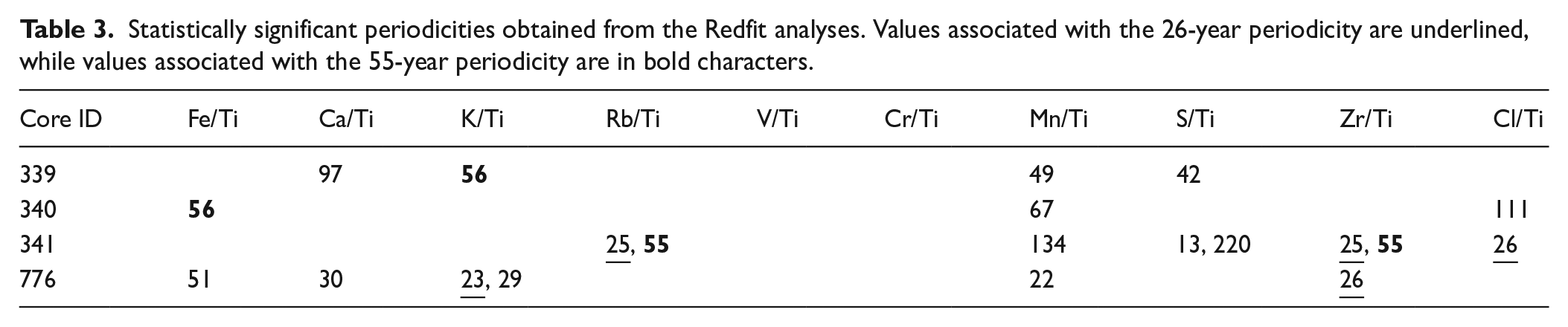
Concerning the Redfit time-series analysis (Figure 8), we only considered the values that exceeded the critical false alarm arising from the Chi2 approximation (Hammer et al., 2001), with results in Table 3. Only V/Ti and Cr/Ti did not present any statistically significant cycle in the cores. It is worth noting that there is a persistence of values around 26 and 55 years.

(a) Redfit time-series output for historical rainfall data from the Ubatuba region. (b) Redfit time-series output for Rb/Ti variations along core 341. (c) Redfit time-series output for Zr/Ti variations along core 776. The 55-year variability crosses the 95% Chi2 line but not the Chi2 critical line.
Statistically significant periodicities obtained from the Redfit analyses. Values associated with the 26-year periodicity are underlined, while values associated with the 55-year periodicity are in bold characters.
Grain size
Core 776 mainly comprises fine sands to coarse silts (Figure 9d). From the core base to ca. 2700 cal BP, it is possible to observe a coarsening upward trend, with grain size medians varying from 4.3 φ to 3.2 φ. This interval is followed by a section exhibiting progressive fining up to 1700 cal BP when the medians reach values lower than 5.1 φ. The top core section exhibits a coarsening upward trend, and median values reach 3.5 φ. The visual analysis of the Coefficient of Determination (R2) behavior versus the grain size classes and samples (Figure 9a and b) allowed us to determine that four end-members adequately represent the grain-size populations in core 776 (Figure 9c and d).

(a) Coefficient of determination (R2) of the end-members (EM) versus grain-size classes. (b) Coefficient of determination (R2) of the end-members versus samples. (c) Distribution curves of the end-members of core 776. (d) Vertical variations of the end-members along core 776.
End-member 1 is a positively skewed trimodal population, with modes in −0.74, 0.26, and 3.13 φ (Figure 9c); this end-member presents a minimal contribution to grain-size, with higher values limited to the interval between 3000 and 2300 cal BP (Figure 9d). End-member 2 corresponds to a symmetrical, unimodal distribution, with a mode centered in 3.50 φ (Figure 9c); its vertical distribution varies greatly, with maxima values between the core base and 2300 cal BP and minima between 2300 and 1700 cal BP (Figure 9d).
End-member 3 reflects a positively skewed, bimodal population (Figure 9c); the main mode is centered at 4.1 Φ and the secondary one at 2.4 φ. It also shows a heterogeneous vertical distribution, with high values before 2300 cal BP; from that age to the coretop, it alternates high and low values with end-member 4. End-member 4 is a negatively skewed, bimodal distribution; the primary mode is centered at 6.00 φ and the secondary at 4.00 φ. Its vertical distribution shows three distinct behaviors. From the core base to 2300 cal BP, it shows a limited contribution; from that age to 1700 cal BP, it presents its maximum values, with a slight interruption between 1750 and 2000 cal BP. Finally, from 1700 cal BP to the coretop, it alternates high and low values with end-member 3 (Figure 9d).
The vertical distribution of the bulk organic parameters in core 776 is shown in Figure 10. Organic carbon presents a clear, statistically significant trend (0.1% per 1000 years) of increasing values toward the coretop. General trends for the C/N ratio and δ13C values are observed but are not statistically significant (α < 0.05).

Vertical variations of A – Corg, B – C/N ratio, and C – δ13C values along core 776.
Discussion
The Metal/Metal ratio determinations, organic matter composition, and grain size data of four southeastern Brazilian inner continental shelf revealed Late-Holocene fluctuations in terrigenous input. Also, grain size variations account for conspicuous changes in the depositional conditions along the Late-Holocene on the SE Brazilian shelf. The long-term trends observed in Metal/Metal ratios from all four cores are first explored to unravel terrigenous sediments’ input response to humidity conditions changes on the adjacent continent. We then compare our records data with available data from two distinct paleo-precipitation records retrieved outside the SACZ core to highlight millennial and decadal-scale fluctuations in this atmospheric feature activity over the last 4200 years.
At the inner continental shelf of the south Brazilian Margin, sedimentary Ca concentration depends on the production and dissolution of marine carbonates (Dias de Araujo et al., 2021; Padua et al., 2022). Therefore, the decreasing trend of Ca/Ti observed through the Late-Holocene in all records suggests increased terrigenous sediment input from the nearby continental rocks, comprised mainly of granites from the Serra do Mar Mountain chain.
Our records also presented a slight decreasing trend in K/Ti and Rb/Ti ratios, which may account for an intensification of the weathering processes over the last ca. 4000 years. According to Padua et al. (2022), the sediments within the São Sebastião Channel (adjacent to the study area) are mainly composed of felsic materials, closely related to fresh rock granodioritic/granitic compositions, indicating early stages of weathering. On the other hand, the modern-day surface sediments on the São Sebastião inner shelf exhibit a siliciclastic signature with lower mafic content and similar characteristics to the granitic and gneissic rocks found on the adjacent continent (de Mahiques et al., 2017). Goudeau et al. (2013) associate high K/Ti ratio values with the presence of illite; however, in our case, due to the limitations of the potential sediment sources, the low K/Ti values should be associated with a more intense chemical weathering and, thus, an increase in the rainfall. A similar interpretation was provided by Yang et al. (2015), who associated K/Ti values with the strength of the winter monsoon in the East China Sea.
Variations in Mn/Ti values are commonly used as a proxy for changes in oxic conditions along the Quaternary. Ponomarenko (2023) used Mn/Ti variations to evaluate paleoenvironmental changes in the Baltic Sea, with higher values associated with increased ventilation along the Holocene. Kim et al. (2023) used the same proxy to recognize changes in the redox conditions associated with glacial and interglacial times in Antarctica. In our cores, the increase of Mn/Ti values toward the top may be associated with a higher content in clay minerals belonging to end-member 4 (Reddy and Perkins, 1974) or changes in weathering since the behavior of Mn is similar to other terrigenous elements (Al, Fe, and K) in the source areas (Wei et al., 2004).
Interestingly, the organic matter proxies (6 > C/N ratio < 16 and −24.0‰ > δ13C < −19.0‰; Figure 10) do not reflect a clear signal of terrigenous organic matter input but a slight pelagic indication. For the SE Brazilian continental shelf, marine-derived organic matter C/N ratios and δ13C values fall between 4 and 10 and between −24.0 and −18.0‰, respectively (Dias de Araujo et al., 2024). This apparent contradiction may be caused by the increase in phyto- and zooplankton as a response to the input of nutrients during the rainy seasons (Aidar et al., 1993).
The relative increase in the contribution of the End-member 2 grain size population in the 776 record after 2000 cal BP further supports the increase in the input of terrigenous sediments to the inner shelf of SE Brazil. In the study area, modern sediments are mainly comprised of finer sediments, and the occurrence of coarser grains is related to a stronger continental influence over depositional processes (de Mahiques et al., 1998). Therefore, our records suggest an overall Late-Holocene increase in continental influence to the inner shelf of the SE Brazilian continental margin, with a particular shift around 2000 cal BP toward more humid conditions over the continent. Our records are located within the modern SACZ core, which makes them ideal for tracking Holocene changes in rainfall regime associated with this SAMS feature; we interpret these changes in rainfall to the SACZ activity.
Although recent model simulation (Wong et al., 2023) suggests no significant changes in precipitation in the SACZ core between the Mid-Holocene and pre-industrial period, all our records show that the terrigenous input to the Brazilian southeastern inner shelf changed in this interval (Figure 11).

Late-Holocene variations in (a) Insolation (Laskar et al., 2004); (b) variations of K/Ti in core MD125-67-4 (Bahr et al., 2021); (c and d) variations on K/Ti in core 776 and 339; (e and f) variations in Ca/Ti in core 776 and 339; (g) Variations in Sr/Ca in speleothems of Botuverá cave (southern Brazil) (Bernal et al., 2016). Note that although all records showed similar overall trends in Metal/Metal ratios, only cores 339 (24 m water depth) and 776 (49 m water depth) are represented.
The Mid-to-Late-Holocene spatial precipitation distribution within the SAMS influence area has been of interest over the last decade. Mid-Holocene paleo-hydroclimate proxy records along the eastern region of South America show contrasting precipitation signals across latitudes, with a clear north-south anti-phased pattern. Speleothem records along coastal northeastern Brazil indicate wetter Mid-Holocene conditions compared to the modern day (Chiessi et al., 2021; Cruz et al., 2009), while records from central to central-eastern Brazil point to similar modern-day moisture conditions in the Mid-Holocene, indicating no significant change in precipitation near the SACZ area (Strikis et al., 2011; Wong et al., 2021).
On the other hand, most hydroclimate records over Southeastern South America show drier Mid-Holocene conditions, possibly due to weaker moisture transport from the Amazon to the subtropics by the SALLJ (Wang et al., 2007). Some studies, however, argue that a southward migration of the SACZ during the Late-Holocene to its present position over southern Brazil explains the drier Mid-Holocene conditions compared to today (Bernal et al., 2016; Perez Filho et al., 2022; Wang et al., 2006). Nevertheless, according to Wong et al. (2023), the Mid-to-Late-Holocene latitudinal differences in the precipitation in South America result from the response of the continental and oceanic components of the SACZ to changes in insolation rather than its overall latitudinal migration. Although the long-term trend of increasing precipitation suggested in our records presents some agreement with the insolation change, they show clear decadal-scale fluctuations, which cannot be solely explained by insolation changes (Figure 11).
To better comprehend Late-Holocene SACZ dynamics, Bahr et al. (2021) compared two distinct paleo-precipitation records, the ln(K/Al) ratios from marine sediment core M125-67-4 (15°16.964′ S, 038°54.801′W, and 28 m water depth) and the speleothem Sr/Ca ratios from Botuverá Cave (27°13′S; 49°09′W, 230 m above sea level) (Bernal et al., 2016). These authors propose an antiphase (in-phase) relationship between the M125-67-4 record, retrieved in the northeastern boundary of the SACZ, and the Botuverá Cave record, located at the southwestern SACZ. The latter receives precipitation associated with the SACZ and the SALLJ and, therefore, would indicate a strong SACZ along with a weak SALLJ and vice-versa.
The comparison between two of our Ca/Ti and K/Ti ratios (terrigenous input and weathering conditions records, respectively) records (339 and 776) and these previous paleo-precipitation records highlights periods of antiphase on multi-millennial to centennial time scales between the records located in the core (this study) and the southern boundary of the SACZ (Sr/Ca ratios from Botuverá cave) and its northeastern counterpart (ln(K/Al) ratio from MD125-67-4) over the last 4000 years (Figure 11). A shift in humidity conditions in all records after 2000 cal BP suggests a stronger SACZ with wetter conditions in our core sites and southern Brazil, while eastern Brazil (core MD125-67-4 site) became dry. This scenario follows model simulations showing that rainfall decreased in southeastern South America between the Mid-Holocene and the pre-industrial period but increased near the equator (Wong et al., 2023). These authors argue that the reduced moisture from SALLJ and ITCZ weakened the SAMS and affected rainfall along the oceanic flanks of SACZ.
Modern SACZ is influenced by local or remote factors associated with other atmospheric and oceanic phenomena (Pezzi et al., 2022). Positive sea surface temperature (SST) anomalies in the Southwest Atlantic, for example, are associated with weakening the SACZ (Robertson and Mechoso, 2000). During the Late-Holocene, southwest Atlantic SST changes were modulated by a combination of wind patterns and the BC strength (Chiessi et al., 2014; Lessa et al., 2016; Nagai et al., 2009, 2020). These authors have linked changes in the BC strength to large-scale AMOC changes, highlighting an antiphase relationship between the BC and the AMOC. Particularly for our core sites, a stronger BC related to a weaker AMOC would favor negative SST anomalies and, therefore, stronger SACZ. AMOC strength changes during the Holocene have also been linked to explain the multi-centennial-scale changes in precipitation in central (Strikis et al., 2011), southeastern (Bernal et al., 2016), and eastern Brazil (Bahr et al., 2021).
The Redfit output of historical rainfall data (Figure 8a) indicates a primary cycle of 7 years, followed by a less pronounced 3-year cycle. These periodicities are associated with the El Niño Southern Oscillation (ENSO) variability (Chen et al., 2020; Ouyang et al., 2014). However, our records’ resolution is not high enough to recognize ENSO variability, but it led us to identify 25 and 55-year periodicity in Metal/Ti records. A cycle of around 25 years was reported by Bahr et al. (2021) for eastern Brazil, but the causes of this cycle were not explored. On the other hand, Reboita et al. (2021) observe that the 20–30 year is related to the Pacific Decadal Oscillation (PDO). The authors state anomalous wet periods are observed in the PDO warm phase in southeast Brazil.
The ~60-year periodicity is associated with the Atlantic Multidecadal Oscillation (AMO) (Bahr et al., 2021; Reboita et al., 2021). The AMO’s influence on South America’s climate is evident in the northern and northeastern areas of the continent (Reboita et al., 2021). However, the existing paleo-precipitation evidence in southeastern South America is insufficient to unravel how these climatic oscillations influenced the Late-Holocene precipitation changes, and further studies are necessary.
Conclusions
The analysis of cores collected in a coastal area located immediately under the influence of the SACZ indicates Late-Holocene variations in this atmospheric feature. Our results indicate an increasing trend in terrigenous sediment input (Ca/Ti) and weathering (K/Ti) in the adjacent continental sediment source, likely related to an intensification of the SACZ through the last 4200 years. Additionally, over the last 4000 years, opposite patterns between our records and other records from the northern and southern boundary of the SACZ highlight periods of rainfall antiphase on multi-millennial to centennial time scales. Additionally, the humidity conditions shift after 2000 cal BP, likely related to a weakening of the SAMS and decreasing rainfall along the oceanic flanks of the SACZ, which may be associated with AMOC multi-centennial-scale changes. Time-series (Redfit) Analysis allowed the recognition of periodicities of 25 and 55 years, which can be associated with the Pacific Decadal Oscillation and the Atlantic Multidecadal Oscillation, respectively.
Supplemental Material
sj-pdf-1-hol-10.1177_09596836241275021 – Supplemental material for Sedimentological and geochemical proxies reveal changes in the South Atlantic Convergence Zone in Southeast South America during the Late-Holocene
Supplemental material, sj-pdf-1-hol-10.1177_09596836241275021 for Sedimentological and geochemical proxies reveal changes in the South Atlantic Convergence Zone in Southeast South America during the Late-Holocene by Michel Michaelovitch de Mahiques, Renata Hanae Nagai, Irys Martins Rodrigues Ventura and Samara Cazzoli y Goya in The Holocene
Supplemental Material
sj-pdf-2-hol-10.1177_09596836241275021 – Supplemental material for Sedimentological and geochemical proxies reveal changes in the South Atlantic Convergence Zone in Southeast South America during the Late-Holocene
Supplemental material, sj-pdf-2-hol-10.1177_09596836241275021 for Sedimentological and geochemical proxies reveal changes in the South Atlantic Convergence Zone in Southeast South America during the Late-Holocene by Michel Michaelovitch de Mahiques, Renata Hanae Nagai, Irys Martins Rodrigues Ventura and Samara Cazzoli y Goya in The Holocene
Supplemental Material
sj-pdf-3-hol-10.1177_09596836241275021 – Supplemental material for Sedimentological and geochemical proxies reveal changes in the South Atlantic Convergence Zone in Southeast South America during the Late-Holocene
Supplemental material, sj-pdf-3-hol-10.1177_09596836241275021 for Sedimentological and geochemical proxies reveal changes in the South Atlantic Convergence Zone in Southeast South America during the Late-Holocene by Michel Michaelovitch de Mahiques, Renata Hanae Nagai, Irys Martins Rodrigues Ventura and Samara Cazzoli y Goya in The Holocene
Supplemental Material
sj-pdf-4-hol-10.1177_09596836241275021 – Supplemental material for Sedimentological and geochemical proxies reveal changes in the South Atlantic Convergence Zone in Southeast South America during the Late-Holocene
Supplemental material, sj-pdf-4-hol-10.1177_09596836241275021 for Sedimentological and geochemical proxies reveal changes in the South Atlantic Convergence Zone in Southeast South America during the Late-Holocene by Michel Michaelovitch de Mahiques, Renata Hanae Nagai, Irys Martins Rodrigues Ventura and Samara Cazzoli y Goya in The Holocene
Supplemental Material
sj-pdf-5-hol-10.1177_09596836241275021 – Supplemental material for Sedimentological and geochemical proxies reveal changes in the South Atlantic Convergence Zone in Southeast South America during the Late-Holocene
Supplemental material, sj-pdf-5-hol-10.1177_09596836241275021 for Sedimentological and geochemical proxies reveal changes in the South Atlantic Convergence Zone in Southeast South America during the Late-Holocene by Michel Michaelovitch de Mahiques, Renata Hanae Nagai, Irys Martins Rodrigues Ventura and Samara Cazzoli y Goya in The Holocene
Supplemental Material
sj-pdf-6-hol-10.1177_09596836241275021 – Supplemental material for Sedimentological and geochemical proxies reveal changes in the South Atlantic Convergence Zone in Southeast South America during the Late-Holocene
Supplemental material, sj-pdf-6-hol-10.1177_09596836241275021 for Sedimentological and geochemical proxies reveal changes in the South Atlantic Convergence Zone in Southeast South America during the Late-Holocene by Michel Michaelovitch de Mahiques, Renata Hanae Nagai, Irys Martins Rodrigues Ventura and Samara Cazzoli y Goya in The Holocene
Footnotes
Acknowledgements
The authors are grateful to the crew of RV Alpha Delphini for their help during the acquisition of the cores. Thanks are also due to MSc Rodolfo Jasão Soares Dias for his expertise in sediment sampling. Prof. Nathalie Fagel and an anonymous reviewer did a fantastic job revising the manuscript.
Author contributions
Funding
The author(s) disclosed receipt of the following financial support for the research, authorship, and/or publication of this article: This study was funded by the São Paulo Research Foundation (FAPESP) grant no. 2021/12789-4. M.M.de M. and R.H.N. acknowledge the Brazilian National Council of Scientific and Technological Development (CNPq) for the Research Grants n° 300962/2018-5 and 307106/2022-5

Supplemental material
Supplemental material for this article is available online.
References
Supplementary Material
Please find the following supplemental material available below.
For Open Access articles published under a Creative Commons License, all supplemental material carries the same license as the article it is associated with.
For non-Open Access articles published, all supplemental material carries a non-exclusive license, and permission requests for re-use of supplemental material or any part of supplemental material shall be sent directly to the copyright owner as specified in the copyright notice associated with the article.
