



Abstract
The study investigated, within the Southern African Customs Union region, the titles, roles, responsibilities, educational qualifications and skills of subject librarians. Semi-structured questionnaires were sent to 179 subject and other learning support librarians. The findings revealed that subject librarians performed many different tasks, emanating from the key responsibility areas of information literacy instruction, research support, faculty liaison, collection development and marketing. It found that changes had occurred in the profession over time, largely because of technological advances, and that these mainly affected the way tasks were performed, and resulted in subject librarians having to constantly update their skills in order to remain effective and relevant.
Keywords
Introduction
Academic libraries consist mainly of human, information and financial resources. An important element of their human resources is subject librarians, who are professionally trained staff, with vast experience, knowledge of, interest in and responsibility for, the literature of a designated subject or subjects (Avafia, 1983; Feetham, 2006). They have a number of responsibilities or functions, including collection development, materials selection, user education or library and information skills instruction, and they provide a subject-based information or reference service to library users (Reitz, 2013). They also liaise extensively with faculty members, and provide them with appropriate teaching, learning and research support.
Faced with technological developments, including the Internet and World Wide Web, subject librarianship has had to constantly re-evaluate and re-engineer itself, so as to remain relevant in the ever-changing technological and information environments. Unfortunately, in Africa, changes to the profession have not been carried out in a standard way. In the United States of America, there were no standard definitions of subject and learning support librarianship, and therefore no common terms or titles (Hay, 1990: 11). In southern Africa none existed either and, with the exception of those countries which had single universities, there were also no national models of subject librarianship and no standards that could be followed (Mbambo, 2006: 184), therefore titles, roles, responsibilities and related duties often varied from institution to institution.
The focus of this study was the Southern Africa Customs Union (SACU) region which consists of five countries, namely Namibia, Lesotho, Swaziland, Botswana and South Africa, whose markets share ‘a common customs area’ (McCarthy, 2013: 1). The study used the term subject librarian to include faculty, information and personal librarians, as well as information specialists and it had the following objectives:
to determine the models of subject librarianship in operation in SACU universities;
to determine the titles, roles, responsibilities, qualifications and skills of subject librarians;
to determine if, how and why these had changed;
to determine whether guidelines existed that could be used by university libraries in the region to assist them in the establishment of new subject and learning support services.
Literature review
Introductory period
Historically, subject and learning support services became a major part of higher education institutions as early as the beginning of the 20th century, and they remain at the core of academic libraries, despite having experienced a number of challenges over three distinct historical periods, especially in developed countries. The first subject librarians were seen in the United Kingdom (UK) in the 1920s, at libraries like the University College London Library, and more were introduced in the 1930s, starting at the University of Leeds Library (Feetham, 2006). In the United States of America (USA), although a few university libraries, like the one at Harvard University, employed subject bibliographers prior to 1940, others only really adopted the practice as a result of the Second World War, when it was recognised that knowledge about other countries and cultures was important (Hay, 1990). The main role of subject librarians during this introductory period was as intermediaries between the user and information, and they were expected to have the necessary skills to carry out various tasks attached to this role, including collection management, reference assistance, faculty liaison, cataloguing and classification and the compilation of bibliographies (Hay, 1990).
In Africa, subject specialisation/librarianship was first discussed in the mid-1960s, through various papers written by Loveday, and then by various other African LIS writers in the following years (Avafia, 1983). In 1967 it was in operation at the Rand Afrikaans University in South Africa (Qobose, 2001). Also in the 1960s, it was practised at the Dakar University Library, which employed subject specialists or ‘conservateurs’, to provide reference services, and to order and process books in designated subject areas (Avafia, 1983). At the University of Natal in Pietermaritzburg, subject librarianship began in 1977 (Prozesky and Cunningham, 1986), and at other university libraries in Botswana, South Africa and Nigeria it was introduced in the 1980s (Mbambo, 2006).
The way subject librarianship was practised was mostly guided by the library models in place within institutions. In the 1970s, subject work was organised according to four main library models, as proposed by Scrivener (1974: 114–115), that is: the functional model, whereby all the main library functions were performed centrally; the hybrid model, whereby senior library staff performed subject-based functions and additional centralised functions; the three-tier model, whereby graduate librarians performed subject-based functions, non-graduate professionally trained librarians performed duties like circulation which did not require subject knowledge, and junior assistants and clerical staff carried out routine tasks; and the subject divisional model, whereby subject teams consisting of graduate subject librarians and their junior assistants were located in and performed duties related to a subject/discipline collection.
Disintermediation period
Computers found their way into libraries in the 1950s but automation seriously began in the 1960s (Borgman, 1997). The World Wide Web was invented by Tim Berners-Lee in 1989 (World Wide Web Foundation, 2014) and introduced to libraries in the 1990s. These technological advances meant that a number of information and communication technologies (ICTs) appeared in academic libraries, and these impacted on the work of subject librarians, and changed user perceptions about information, its location, access, retrieval and the way it was used in teaching, learning and research (Wright, 1996). Information was now available from many different sources, including libraries, the Internet, media houses and publishing houses, and it came in many different formats, and was retrievable in a number of ways, such as personal computers, that the library did not necessarily control (American Library Association (ALA), 2006). As these information retrieval tools became cheaper to acquire and easier to use, some library patrons acquired them, and began conducting their own literature searches on the World Wide Web, thus fuelling the debate about the value of certain groupings of academic library staff, like subject librarians. An extreme consequence of this debate was seen at the University of Bangor in Wales, where some subject librarians lost their jobs because, as stated in the institution’s consultation paper, despite the teaching and research support they gave to academics and students, the cost of continuing to use them was hard to justify, since online resources made the search for information easier (Tysome, 2005).
This challenging period was referred to in the literature as the ‘disintermediation’ period, when intermediation between users and information, by subject librarians, was reduced. It caused the library to re-assess its work and value, to look at the responsibilities and skills of its staff with a fresh eye, and to encourage them to adopt new methods of carrying out their duties so as to remain relevant. Additionally, ICTs provided the impetus for libraries to change from repositories or storehouses that owned most of their information, to gateways that facilitated access to information; and to introduce technological innovations like online public access catalogues and electronic information databases (Angeley and Purdue, 2000). However, in southern Africa, computers in libraries did not become as prolific in as short a time as they did in developed countries in the late 1990s, and since many library users were new to computer use, they continued to need the assistance or mediation of subject librarians.
With regard to library models, according to Martin (1996), by the 1990s the dual library model had assumed greater importance in libraries, and he saw this shift as a way in which library management were able to rationalise their services, by allowing subject librarians to focus more on subject-specific duties, and by moving time-consuming functions like cataloguing and reference/information to their own departments. For some university libraries however, the increase in ICTs encouraged them to re-structure their operations by adopting newer, more technologically attuned library models, like the ‘convergence’ model. This type of structure was first seen in the USA in the 1980s, and in the UK in the late 1980s and early 1990s (Feetham, 2006), and it can still be found in some institutions to date. Convergence was where, mainly for administrative or management purposes, the library, computer services section, and sometimes other related university departments, were merged under a manager who had a ‘professional information background’ (Collier, 2006). Under this model, subject librarians, in their role as intermediaries, were still required to help users to navigate resources and/or to find subject-specific information which suited their needs (Feetham, 2006). They were also required to move away from their traditional thinking, acquire new skills and carry out duties which, though not really related to what they had learned at library school, allowed them to join the ranks of those new learning support professionals who better complemented the work of academic teaching staff (Biddiscombe, 2002). In Africa meanwhile, the subject-centred/subject-divisional model appeared to dominate university libraries during this period. In her discussion of subject librarianship in Africa, Mbambo (2006: 182), wrote that while in South Africa and Botswana university libraries ran mainly subject-based services, in Lesotho the university library ran a function-based service and in Zimbabwe university libraries adopted a mixture of ‘functionalist and subject-based structures’.
Re-intermediation period
ICTs, in some countries, posed a threat to the value of subject librarians, therefore, but an unforeseen consequence of ICTs was an information overload in the form of an over-abundance of information resources, which resulted in a challenging information environment marked by ‘information chaos’ (Rodwell, 2001). Consequently, users and university management realised that learning support professionals were still needed. This period was referred to as the re-intermediation period, whereby intermediation between the user and information by subject staff was re-introduced. This period also cemented subject librarians’ knowledge that their traditional library skills were no longer enough to deal with the new information environment with its new technologies (Biddiscombe, 2002); therefore many of them acted on the urgent need to acquire more or enhanced skills.
In relation to the subject librarian models in use, although the dual and subject divisional models continued to be found in university libraries (Martin, 1996), the re-invention of some academic library staff roles, plus the continued development of ICTs, resulted in predictions of an eventual move away from earlier models towards the ‘digital librarian’ or ‘cybrarian’ models (Feetham, 2006), whereby most information would be machine readable. However, these models in their pure format were not found in many libraries; instead a cross-breed-type structure was found, which Budd (1998: 182–184) described as a user-based, information delivery academic library, which promoted the concept of a ‘library transcending walls’, and which accepted the idea that information could come in any format, including print, electronic or digital. With this type of structure, many libraries combined the traditional and modern aspects, sources, formats, services, skills and technologies of libraries (Brophy, 2000).
In addition, due to the new technologies, some librarians became focused on teaching library users the strategies that would help them to optimally conduct research (Angeley and Purdue, 2000; Biddiscombe, 2002). This instructional element led to some academic libraries choosing to adopt the faculty-liaison model, which was characterized by partnership with faculty and direct involvement with teaching and research (Rodwell and Fairbairn, 2008). It was a resource-based teaching and learning model, which allowed the library to be central to the learning process (Qobose, 2000), and which promoted the university’s aim of producing information literate graduates (Dale, 2006), who would be able to locate, evaluate and critically use information, and who, in the process, would also choose to become lifelong learners (Angeley and Purdue, 2000; Biddiscombe, 2002; McKenzie and Wurzburg, 1997; Qobose, 2000). The ‘faculty library model’, or elements of it, can still be found in some university libraries.
Another model or facility that made its way into libraries in more recent times, and which was integrated into existing systems was the ‘commons model’. This type of service integrated the functions and space of the library, the IT department and other academic learning support services for the benefit of users (McMullen and Williams, 2008). The learning or knowledge commons mainly served the needs of undergraduate students, while the research commons catered to the needs of postgraduate students, academics and researchers, and both types were to be found in African university libraries. A research commons facility was in place at Makerere University Library in Uganda (Kinengyere and Tumuhairwe, 2009), while at universities like Rhodes, Stellenbosch, Cape Town, Kwazulu Natal, Pretoria and the Witwatersrand in South Africa, this facility was developed with support and funding from the Carnegie Corporation of New York (Daniels et al., 2010). Subject and learning support librarians played varying roles in this facility, mainly consisting of subject-specific support.
The ‘embedded librarian’ model also found its way into African academic libraries during this period. To embed meant to entrench, root, and implant oneself into something. Embedded librarianship therefore required librarians to steep themselves in the educational lives of the staff/students of a faculty or department or to become entrenched within a course (Dewey, 2004). It further required them to acquire a deep knowledge of the needs of a designated group and to use traditional library training and skills to anticipate and fulfil their needs, so as to help them to achieve their goals and to solve their problems (Shumaker and Tally, 2009: 9; Shumaker and Tyler, 2007). Some academic libraries, lacking the human resources to physically embed subject librarians within faculties, encouraged them to embed themselves in online courses.
During this period, the social networking movement also gained popularity and attracted librarians. Larsen (2007) urged libraries to get on to the Web, as that was where the users were. Some libraries began to adopt more technological models or elements of models like Library 2.0, which included the use of, not only ‘social networking sites, but also wikis, communication tools and folksonomies – that emphasise online collaboration and sharing among users’ (Pienaar and Smith, 2007). They also included the use of applications like blogs, RSS and syndication, tags, Flickr, YouTube, and podcasting (Larsen, 2007), and they tried to involve users in the design and application of library services, through online participation and feedback (Pienaar and Smith, 2007). A study of some African library websites showed that library 2.0 technologies were already being implemented, as a number of them had well developed weblogs, Facebook and Twitter pages.
Roles, responsibilities and skills
Technology forced subject librarians to rethink and update their roles, responsibilities, and skills, so as to remain relevant in the new information environment. However, the changes made by different institutions were not standard. Generally, however, in terms of the subject librarian role, it ‘evolved from subject-based collection development into subject-based user support’ (Gaston, 2001: 21). Subject librarians became ‘knowledge brokers’, who worked with faculty to support student learning (Dale, 2006). Therefore the collection and processing of materials to add to individual university libraries changed to ‘the locating, indexing of, and user education about, remotely held information’ (Gaston, 2001:21), reflecting the now accepted shift from ‘ownership’ of information to ‘access’ to information.
At last, a proper role for subject librarians! Real team member with valued skills in: finding learning resources; helping students acquire information skills; developing resources; evaluating resources; supporting online activity; and supervising research projects and other tasks traditionally the reserve of academic staff. (Shephard and Matthews, 2006: 98)
In terms of responsibilities, subject librarians carried out ‘multiple duties’ (Gray 2009), so amongst other things, they could be described as ‘teachers, designers, project managers, digital specialists, media specialists, records managers, knowledge managers, information specialists’ (Van Duinkerken et al., 2010: 166). They were required to liaise with different categories of users, select e-resources, market the library’s collections, carry out reference work, work with IT experts and to become involved in educational technology and various learning environments including online ones (Pinfield, 2001). They also had to provide users with access to an expanded range of materials, in many different formats, and from many different sources, including traditional ones (ALA, 2006).
Qualifications and skills
With regard to their credentials, in the past, subject specialists were expected to have subject qualifications, that is, subject-specific degrees. Writers like Herubel (2005) supported the idea of subject knowledge and wrote that subject librarians’ subject expertise was valuable, especially in the collection management area. However, they also noted that library and information science (LIS) qualifications were important, as the theoretical knowledge and principles of librarianship were still deemed to be useful. In Africa some universities employed ‘subject specialists’ and required them to possess a first degree in the relevant subject, backed up by a postgraduate LIS qualification, so that they would have adequate knowledge of the subjects taught in their faculties, and thus be better able to serve patrons (Mbambo, 2006). Other African universities employed ‘subject librarians’ instead, and these professionals were expected to have LIS degrees and to develop a wide knowledge of the literature in their designated subject areas. Overall, subject librarians were seen as professionals with information search and retrieval expertise, who could teach these and other learning support techniques, independent of subject specialisation, distinguishing them from subject specialists/lecturers, whose job was to pass on subject knowledge (Biddiscombe, 2002). With the ever-increasing technological advances, they were also required to improve their ICT skills, since not to upgrade them could spell their demise; therefore they had to become proactive in their own personal professional development, as well as in their work, by anticipating events and planning for them (Garrod, 1998). Unfortunately library schools were sometimes slow to respond to modern library needs, therefore subject librarians had to acquire pedagogic, ICT and other new skills ‘through reading, research, contact with colleagues in person and at conferences and dogged persistence at the school of hard knocks’ (DeCandido, 2000: 4).
Methodology
The study used the descriptive survey method to collect data. Since the study aimed to collect a large amount of data from a widely dispersed population found in the five countries of the SACU region (South Africa, Namibia, Botswana, Lesotho and Swaziland), the questionnaire was determined to be the best major data collection tool.
The target population consisted of 279 subject librarians within 27 universities in five SACU countries, whose email addresses were easily accessible, mainly from online sources. Semi-structured questionnaires (see Appendix I) were sent to these prospective respondents as email attachments. The questions were modelled around the study objectives, that is, they collected data about the titles, roles, responsibilities, skills, educational qualifications and the subject librarian models and standards/guidelines in operation in respondent libraries. They also asked about perceived changes in the profession and the reasons for these changes. The initial questionnaire was sent in the last week of May 2012 and then three reminders were sent, the first one 10 days after the initial email, the second one after an additional 10 days and the final one two months later.
A total of 121 usable questionnaires from 24 universities in four SACU countries were analysed, thus making the response rate 43.4%. Interviews were used to collect information from library managers in order to clarify certain issues, or to add to explanations of certain findings arising from questionnaire responses. Eight interviewees were selected from those universities from which few or no responses were received and the six managers who were available during the time frame allocated for interviews were interviewed by telephone. Data were analysed using SPSS®, the analytical tool most often used by survey researchers (Davies, 2007). MS-Excel and content analysis were also used where appropriate.
Major findings
Titles
This study found that there were no standard titles used for subject librarians in the region; instead titles varied. Of the 23 respondents (19.0%) were called librarian, senior librarian or assistant librarian; 21 (17.4%) subject librarian, 18 (14.9%) faculty librarian, 15 (12.4%) information specialist, 12 (9.9%) information librarian, 6 (5.0%) personal librarian, 5 (4.1%) branch librarian, 3 (2.5%) research librarian, 2 (1.6%) reference librarian and 1 (0.8%) was called a training librarian. The other 15 (12.4%) were known by various other titles such as manager. The title of ‘subject specialist’, which implied formal qualifications in a subject, was not used.
Models
In terms of the models in operation, 61 (50.4%) respondents worked under the dual model, whereby subject librarians specifically carried out subject-based duties, 50 (41.3%) worked under the hybrid model which required them to perform subject-specific duties, as well as duties in other units of the library, 5 (4.1%) worked under the subject-divisional model, which required them to team up with other library staff in order to perform library work on a subject basis, 5 (4.1%) worked under various other models or a combination of models. Interviewees also indicated that elements of newer models such as the operational convergence and digital ones were being adopted, in some of their libraries; for example, in those universities with faculty libraries, subject librarians were already embedded. Other subject staff partially embedded themselves by, for example, by timetabling certain days and hours within which they would be found in their departments, or by embedding themselves in various face-to-face and online courses.
Roles
Respondents’ roles were found to be closely related to their responsibilities, that is, their main roles were to teach information literacy (IL), provide reference/research support, liaise with faculty, participate in collection development and market the library and its services. Of the respondents 71 (58.7%) believed that their roles had changed, largely as a result of technological advances. Changes mentioned included the greater availability of electronic resources, electronic formats, electronic information delivery systems, Web 2.0 systems, social networks, mobile tools, subject portals and the virtual learning systems. However, 48 (39.7%) respondents felt that their roles had not changed, one (0.8%) was not sure and one (0.8%) did not respond to the question. One interviewee emphasised that in the future the subject librarian role would include actively participating in the research process, by conducting research and becoming knowledge creators and disseminators.
Responsibilities
As illustrated in the literature review, subject librarians had many responsibilities. Respondents in this study indicated that they were well-informed about the requirements and expectations of their jobs, as 119 (98.3%) of them had written job descriptions, and 112 (92.6%) found them easy to understand.
Figure 1 reveals that the most carried out function, by a small margin, was IL instruction, which was performed by 94.2% of the respondents. This was followed closely by reference and research support, which was performed by 93.4% of the respondents.

Key responsibility areas.
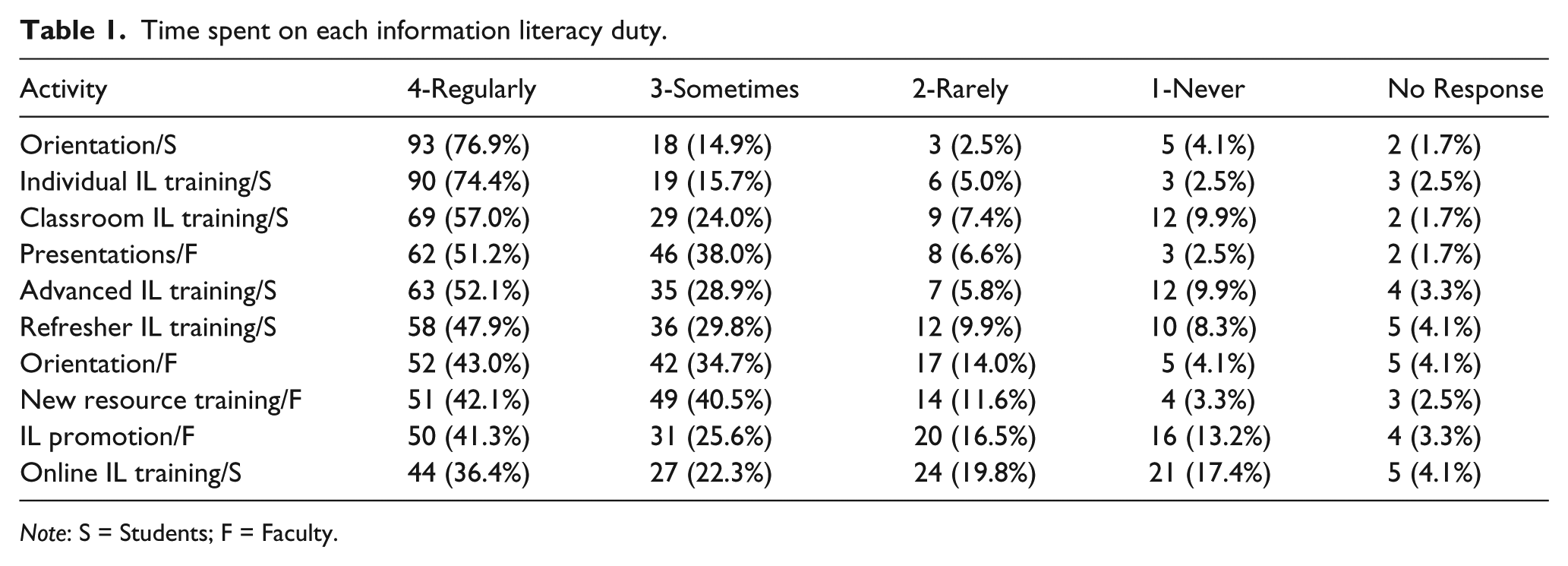
Column one in Table 1 shows those IL duties that were performed regularly by respondents. More than 50% of them regularly carried out individual and classroom-based IL training of students, at both general orientation and advanced level, plus the presentation of resources to lecturers. These duties came with a number of challenges, the main one being that they did not receive enough support from their clientele, both faculty and students. On the one hand, lecturers did not always support IL instruction, sometimes because they could not spare the time to send students for training, and on the other hand, when they did send them for training, some students did not show any interest or did not attend the sessions.
Time spent on each information literacy duty.
Note: S = Students; F = Faculty.
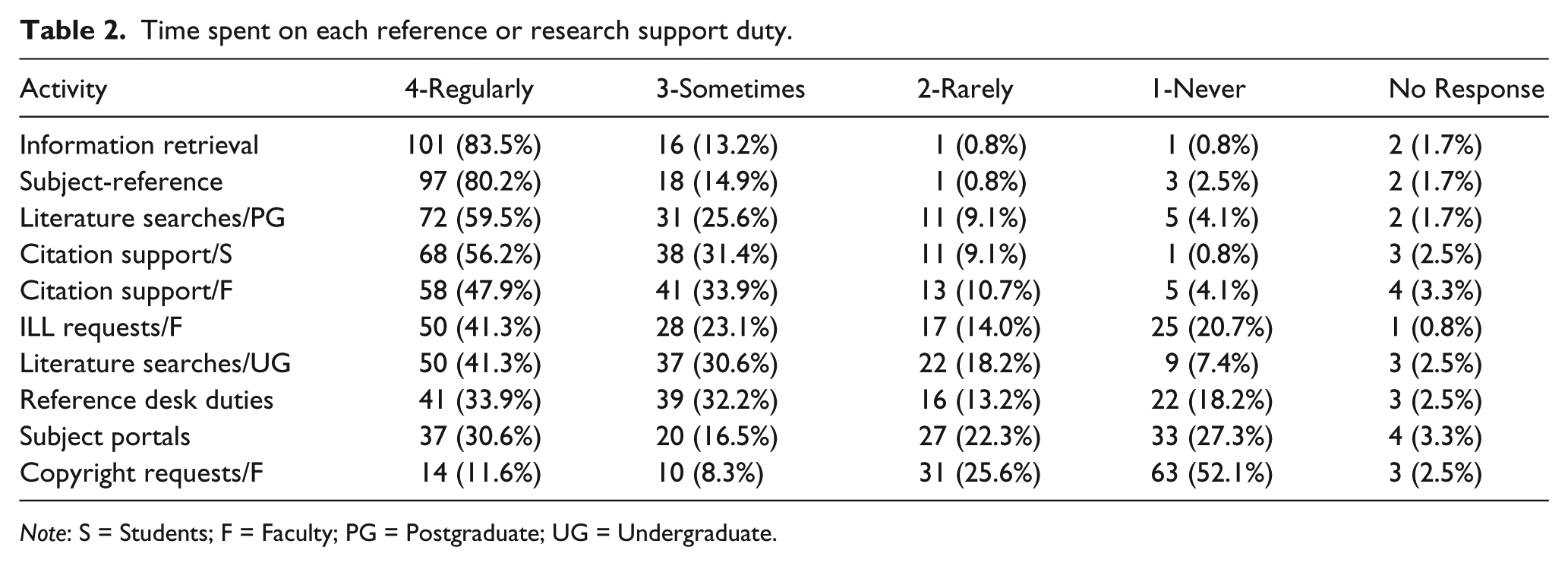
Reference and research support was ranked as the second most carried out function, just slightly behind IL instruction. The first column in Table 2 shows that the main reference/research duties performed regularly by more than 50% of the respondents were information retrieval, the provision of a subject-based service, literature searches and the provision of citation support to students. With regard to knowledge of on-going research in designated departments, 62.8% were aware of research being conducted by faculty and 58.6% of research being conducted by students in their departments. The main challenges experienced with this function related to the slow Internet and the lack of time to carry out research support effectively, due to a heavy workload, and lack of resources, including relevant databases for some subject areas.
Time spent on each reference or research support duty.
Note: S = Students; F = Faculty; PG = Postgraduate; UG = Undergraduate.
Faculty liaison was an important function in all universities, and in one library, according to an interviewee, it formed 60% of the work. The number of departments served by subject librarians varied, with 67 (55.4%) respondents serving up to five departments, 33 (27.3%) serving six to 10 departments, five (4.1%) serving 11 to 15 and five (4.1%) serving more. Eight (6.6%) respondents indicated that they served whole faculties, colleges or schools, while three (2.5%) did not answer the question. Not surprisingly, 55 (45.5%) respondents felt that they served too many departments. However, 56 (47.9%) felt that the number was neither too big nor too small, two (1.7%) that they were too few, while 6 (5.0%) did not respond to the question.
The study revealed that 79 (65.3%) respondents were either satisfied or very satisfied with their relationships with faculty, 30 (24.8%) were neither satisfied nor dissatisfied, 10 (8.2%) were not satisfied and two (1.7%) did not answer the question. In order for faculty liaison work to succeed, subject librarians had to use various methods to stay in touch with lecturers. The primary method used regularly by 106 (87.6%) respondents to communicate with faculty was electronic mail, while 70 (57.9%) participants used the telephone. Informal or chance meetings were regularly used by 58 (47.9%), while visits to faculty offices were routinely used by 49 (40.5%). However, only 30 (24.8%) of the respondents used departmental or Board of Studies (BOS) meetings and 22 (18.2%) used presentations to communicate with faculty. Social networking was not yet regularly used, that is only 16 (13.2%) respondents regularly used weblogs, Facebook and Twitter to communicate with faculty.
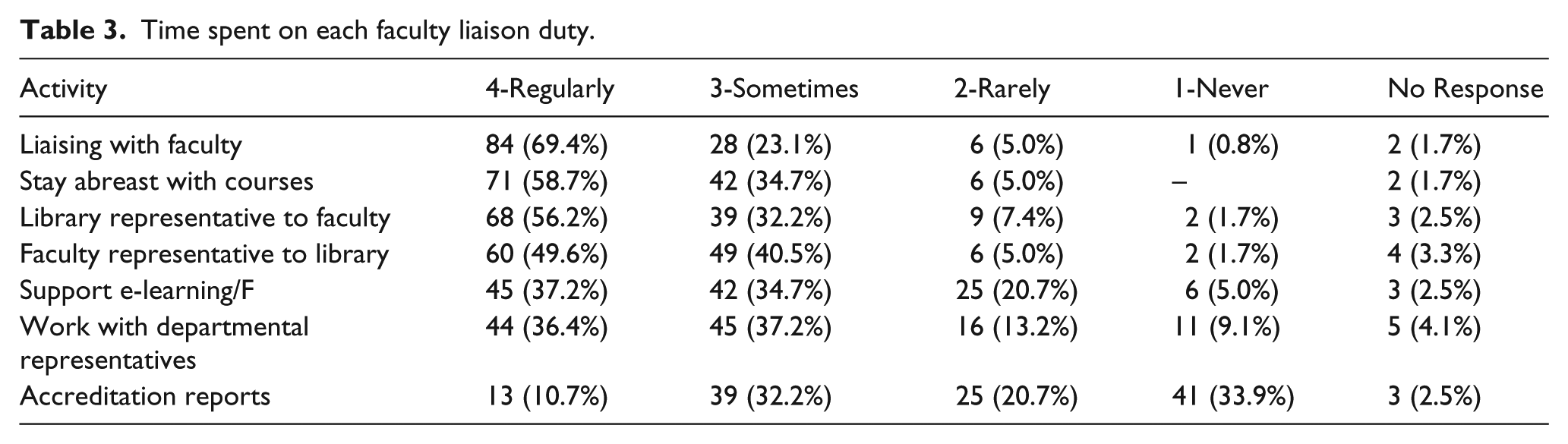
With regard to the faculty liaison duties regularly performed, Table 3 shows that the main ones involved liaising or building relationships with faculty, staying abreast of new courses, representing faculty interests to library management and library concerns to faculty. The main challenges experienced related, once again, to weak faculty support, with meetings and communication sometimes being limited because of high faculty workload, ergo lack of time.
Time spent on each faculty liaison duty.
Subject librarians are presumed to be aware of the strengths of the subject collections in these areas, and the needs of faculty in terms of teaching, learning and research. Therefore, traditionally, collection development is associated with them because of having specific subject areas designated to them. However, in this study, this function proved to be the fourth most frequently undertaken. Table 4 shows that the collection development duties carried out regularly by more than 50% of the respondents included subject-based selection, soliciting orders from faculty and circulating catalogues to them to help them with their selection. Meanwhile, duties like cataloguing and classification had declined in importance. The main challenge experienced by subject librarians in the performance of collection development duties was lack of lecturer support in indicating the texts they needed for teaching and learning purposes.
Time spent on each collection development duty.

Note: F = Faculty.
In terms of marketing and promotion, the study revealed that 85.1% of the respondents carried out this function, and that their main focus, as shown in Table 5, was marketing the library in general. The main marketing challenges experienced included a lack of interest in their marketing endeavours by faculty, the lack of funding and the lack of time to carry out this function more successfully.
Time spent on each marketing and promotion duty.

Note: SDI = Selective Dissemination of Information; CAS = Current Awareness Services.
As already mentioned, 41.3% of the respondents indicated that they worked in hybrid type libraries, whereby they were also expected to carry out various non-subject-based duties, and 73 (60.3%) respondents indicated this as their sixth function. Additionally, the management/administration function was identified as an extra function by a few respondents, and it included participating in the compilation of library strategic plans and policies, attending library management and other university meetings on behalf of the library, budget management, branch management, training colleagues and personal or professional development.
The number of duties associated with each major function indicated that subject librarians were very busy. Of the respondents 91 (75.2%) indicated that these duties had increased, 16 (13.2%) that they had neither increased nor decreased, eight (6.6%) that they had increased a little and six (5.0%) did not answer the question. It was therefore not really surprising that 79 (65.3%) respondents felt overworked. Only 36 (29.8%) felt neither over-worked nor under-worked, four (3.1%) felt underutilised and two (1.7%) did not respond to the question.
Experience, qualifications and skills
As a consequence of the nature of their jobs, subject librarians are required to have relevant working experience, appropriate qualifications and current skills. In terms of experience, interviewees indicated that three to four years’ experience in an academic or research library was the usual requirement, although experience in a special library could be considered if the applicant was being employed to work in the same subject area as that covered by the special library. Furthermore, in some circumstances, graduates without experience could be employed at ‘trainee’ level, and at a lower grade and salary, which would be raised once the incumbent gained the necessary experience.
Interviewees also revealed that the minimum requirements for employment as subject librarians were usually a four year LIS degree or an honours LIS degree. The study revealed that, in terms of LIS qualifications, two (1.7%) respondents held a PhD, 28 (23.1%) a Masters degree, 34 (28.1%) an Honours degree, 18 (14.9%) a postgraduate or higher diploma, 31 (25.6%) a degree and seven (5.8%) a diploma. Only one (0.8%) respondent did not have an LIS qualification. Some interviewees indicated that applicants with LIS degrees were also expected to develop an interest and skills in their designated subject area/s. Unfortunately obtaining official qualifications in the subject area they supported was difficult for some subject librarians, as some institutions only supported, in terms of funding and study leave, those librarians who wanted to obtain further LIS qualifications.
Some interviewees also revealed that they sometimes employed holders of non-LIS subject degrees as subject librarians, as long as they also held postgraduate LIS qualifications, or were prepared to acquire them. The study thus found that, besides their LIS qualifications, 65 (53.7%) respondents also held non-LIS subject degrees. Of these 65, one (0.8%) held a PhD, eight (6.6%) held Masters degrees, 16 (13.2%) held Honours degrees, 14 (11.6%) held postgraduate or higher diplomas, and 26 (21.5%) held degrees. Another 15 (12.4%) held non-degree level subject qualifications. Presumably the respondent without an LIS qualification was in the process of acquiring one, as this was a requirement.
The many tasks undertaken by subject librarians also indicated the need for a number of different skills, including management ones. More than 50% of the respondents indicated that the management skills essential to subject librarians were listening, communication, interpersonal, analytical or critical thinking, problem solving, decision making, team building, organisational, marketing and leadership skills. They also needed to know all their library policies and be able to be proactive. However only about a third felt budgeting and political skills were essential.
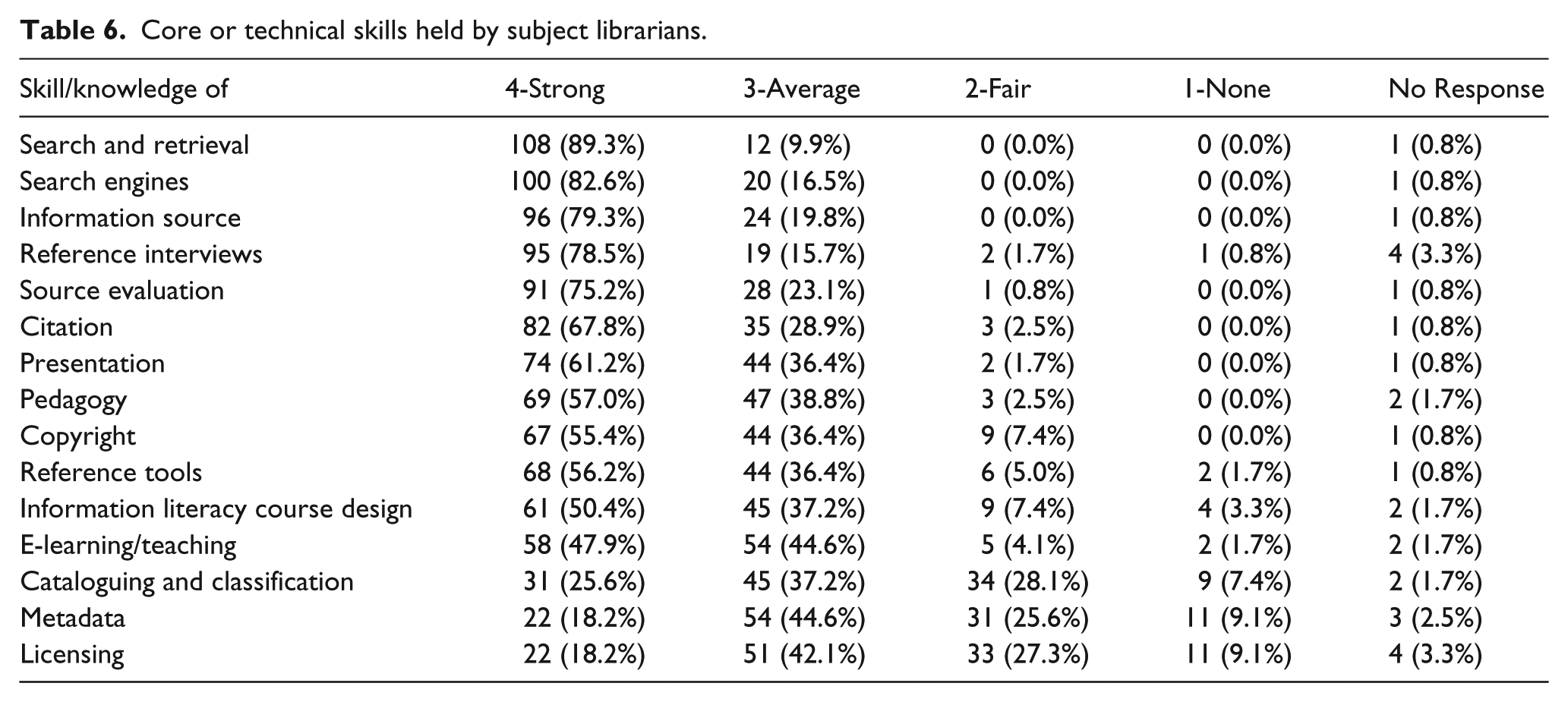
Core or technical skills were also important for subject librarians. As shown in Table 6, many respondents already possessed strong core skills. The strongest of these, held by over half of the respondents, included pedagogic, presentation, and IL course design skills; reference/research skills, including information search and retrieval skills; knowledge of the reference interview; knowledge of search engines, and various information sources, including the ability to evaluate information sources; and referencing/citation skills.
Core or technical skills held by subject librarians.
Subject librarians, by the nature of their work, also required skills in information and communication technologies. The researcher, in agreement with Hoskins (2005) that the International Computer Driver’s Licence (ICDL) included many of the ICT skills needed by subject staff, asked respondents if they possessed it. However, only 19 (15.7%) respondents had an ICDL, 83 (68.6%), did not, one (0.8%) was not sure what an ICDL was and 18 (14.9%) did not respond to the question. Despite this, the study discovered that more than 50% of the respondents had the most important ICT skills needed to effectively carry out their work. Table 7 reveals that they were skilled in electronic mailing, the use of MS-Word, MS-PowerPoint and their university’s library management system.
Technological (ICT) skills held by subject librarians.
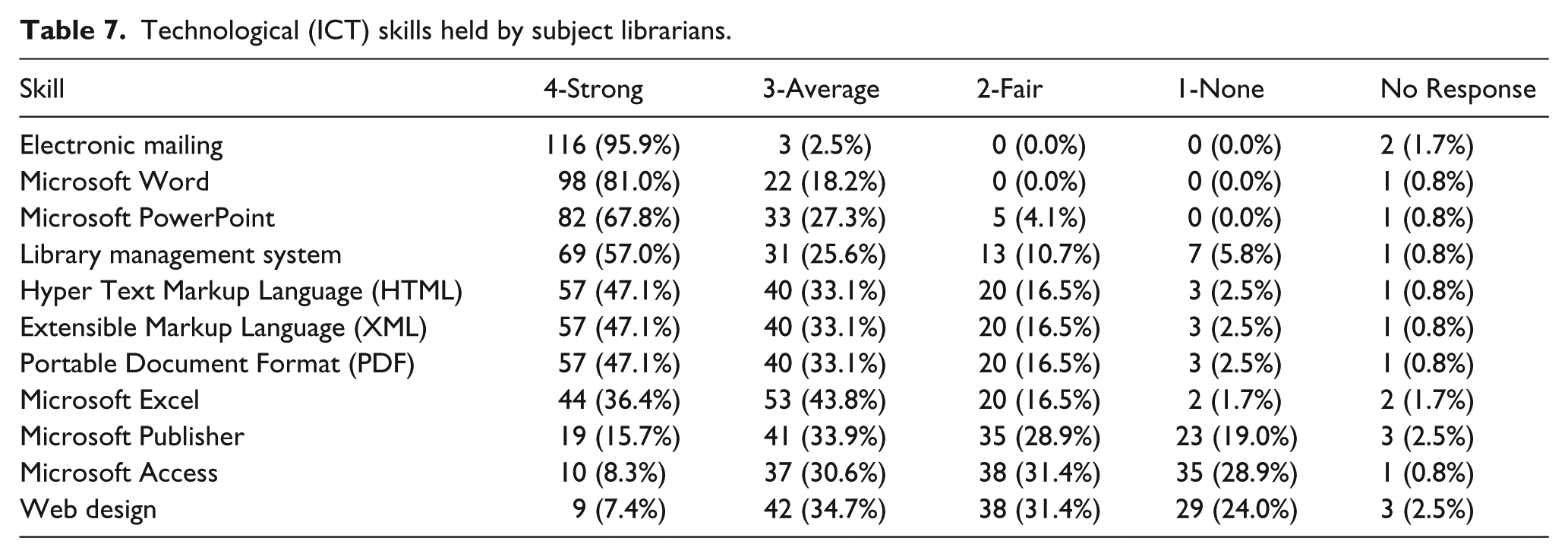
As a result of the ever-changing ICT environment, subject librarians needed to constantly update their skills. This study revealed that 91 (75.2%) respondents were well aware of this need; however, a surprising 28 (23.1%) said they did not need new skills, and two (1.7%) did not respond to the question. Over a third of those who believed that they needed new skills, indicated the need for ICT-related skills, including web design; online cataloguing and classification; knowledge of HTML, virtual referencing, and online chats; knowledge of the use of mobile technologies like cell-phones and tablets in education; knowledge of the construction of subject portals; and knowledge of the use of social media and Web 2.0/3.0 tools like wikis, blogs and other media in teaching, learning and research. A few indicated a need for teaching skills, including a need to know how to design curricula, create teaching objects, conduct curriculum integrated IL training and/or conduct online training using podcasts and programs like Camtasia, Moodle and/or Blackboard. Others mentioned the need for advanced search, research and academic writing skills, including how to make full use of electronic resources and search engines; referencing skills including the use of referencing software; management, organisation and leadership skills; data curation, metadata, digitisation, and archival skills to help with IR duties; publishing skills; presentation/public speaking skills; statistical software skills – including use of SPSS and Microsoft Excel; and marketing/promotion skills for use in marketing subject services and information resources.
Unfortunately, this study found that library schools were not perceived as fully preparing graduates for subject librarian posts. Only 33.8% of the study respondents felt that their preparation for the job was good, while 34.7% felt it was neither good nor bad, and the rest that it was poor. According to study respondents, technological, subject/reference and pedagogic skills were most lacking in LIS courses. Also neglected was the area of cataloguing and classification, which some felt was still important especially as it related to areas like metadata and data curation in institutional repositories and other archival collections. As shown in Table 8, because of the perceived short-comings of library programmes, more than 50% of the respondents acquired their skills informally, that is, they taught themselves, attended training workshops or received in-service training; while more than a third acquired their skills by observing colleagues.
Methods used to acquire ICT and core/technical skills.
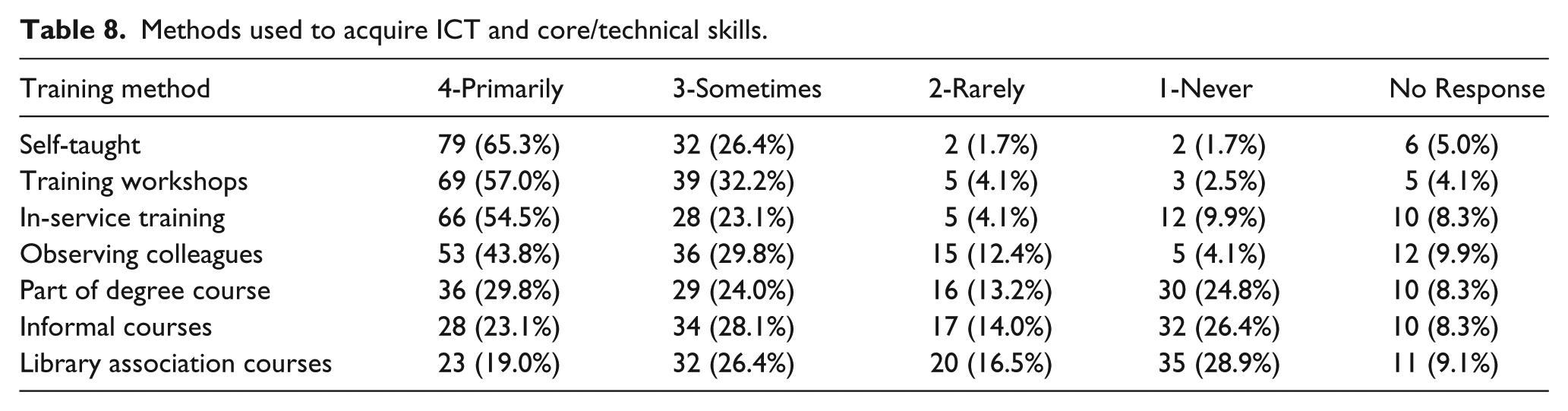
Continuing education was therefore viewed by 95.8% of respondents as being essential for subject librarians in order for them to stay relevant and useful. This upgrading process was supported by most managers, as 67.8% of the respondents indicated that they had been sent for further training courses, and 91.7% that they had been sent to attend workshops and/or conferences. Furthermore, management interviewees revealed that some of their libraries also had strong in-service training programmes for all staff, which they strongly supported. Furthermore, they were generally in favour of exchange programmes as a method of training, as long as the costs were borne equally by participating libraries.
The future
Despite the challenges experienced in the performance of their duties, 114 (94.2%) respondents indicated that they were generally happy working as subject librarians, six (5%) were neither happy nor unhappy and only one (0.8%) was unhappy. The main reasons for contentment were the dynamism of the profession, the satisfaction respondents got from interacting with and helping/empowering people, the appreciation they got from those assisted, and the opportunities they had to increase their knowledge. Some respondents also merely expressed a great love for the profession and pleasure at the opportunity to work independently and develop professionally.
In terms of their perceived future as subject librarians, 82 (67.8%) respondents were definite about this, 17 (14%) were neutral, 21 (17.4%) did not contemplate remaining as subject librarians and one (0.8%) did not respond to the question.
The profession would still be important by the year 2025, according to 97 (80.2%) respondents, the main reason being that, because information technologies, items, formats, sources and publishers/producers continued to grow, and because they were located in the developing world, there would always be users who would be disadvantaged, who would struggle to find relevant information, who would have difficulty in using certain information sources, technologies or databases, or who would just want librarians to conduct their searches for them. With the growing emphasis on the research output of university staff, subject librarians would also play an even more active role as research partners, so much so that they would need to start conducting their own research and creating knowledge. Finally, some respondents believed that subject librarians would remain indispensable to the modern university mainly because no other person – or ICT tool – could do what they do quite as well, and they would always be needed to empower users in order to turn them into independent researchers.
However, as already noted, some respondents were not so optimistic about their future as subject librarians, and nearly 20% were pessimistic about the future of the profession as a whole. They were discouraged by issues like having to deal with students who refused to be empowered by subject librarians in the search and retrieval process, but who preferred to be spoon-fed, while others just felt over-worked and unable to fully complete their duties. But the main reason for discouragement arose from what some respondents perceived as old and negative attitudes or perceptions about the library profession, which sometimes resulted in some faculty members and students not taking them seriously, or treating them like secretarial/administrative staff, or like people who spent their time shelving books. A few participants also foresaw subject librarians not being central to the library by the year 2025, the main reasons being their belief that they would be replaced by technology, that they would come to be perceived as being too costly to maintain, or that they would die out because the profession was not attracting younger librarians.
Guidelines for the profession
One of the main objectives of the study was to determine the existence or otherwise of guidelines for the profession, preferably tailored to the region. Since guidelines generally emanate from associations or professional groupings, respondents were asked if they were aware of any such associations for subject librarians in the region. Of the respondents 88 (72.7%) said ‘no’ and six (5%) did not answer the question. The remaining 27 (22.3%) respondents said that they knew of the existence of subject librarian associations and guidelines, but these turned out to be not specifically for subject librarians. When asked about the utility of standards or guidelines for the profession, 106 (87.6%) respondents said they did not know of any and two (1.7%) did not respond to the question. The remaining 13 (10.7%) respondents said they knew of standards/guidelines; however these were general and not specifically tailored to subject librarians.
Discussion
Titles
Job titles are as important to librarians as their continuing education (Biddiscombe, 2002). They often indicate to librarians and patrons respectively what can be expected in terms of services offered or services expected. Although the most widely used titles in use in SACU contained the word ‘librarian’, a few of the study respondents expressed their dislike for this word, believing that it was outdated, old-fashioned and misleading about their roles, and that it did not reflect the multiple tasks, like IL instruction, that they carried out. However, Siebert (as cited in Ojala, 2009), cautioned the profession against discarding the title ‘librarian’, noting that it conveyed the image of a person with knowledge of the type, format and location of available information, and the ability to search for, evaluate and retrieve information best suited to client needs.
Models
In his study of subject librarians in the UK, Martin (1996) discovered that there had been a shift to the dual model of subject librarianship and other related models. This study had similar findings, as it revealed that 61 (50.4%) respondents worked under the dual model, but it concluded that some respondents categorised their faculty library models as ‘dual’ because the definition used for ‘dual’ in the questionnaire fitted both models. Martin (1996) believed that the change to dual was head librarians’ attempt to rationalise subject work, so that subject librarians could focus on subject work, while other librarians focused on the rest of the library duties. However, the study also found that 41.3% of the respondents worked under a kind of crossbreed model, the hybrid model, which ‘grafted’ subject work onto a traditional library structure. This model did not always work well, according to Crossley (1974), as it required subject staff to divide their attention between different units, departments or sections, resulting in subject work suffering, and in some cases, with subject duties being backlogged or under-performed and some subject staff feeling over-burdened or over-worked. This view was confirmed by the study as 65.3% of the respondents reported feeling over-worked. Furthermore, some of them stated that they ended up feeling discouraged because they did not have enough time to satisfactorily complete their tasks, pay enough attention to their users, or do additional reading about developments in their field.
Roles
This study found that the roles of subject librarians still remained essentially the same as when this category of library staff was first introduced; however, the emphasis had changed. The roles of subject librarians were revealed to be mainly: to support, on a subject, discipline, departmental or faculty basis, the teaching, learning and research activities of students, faculty and staff from designated departments, by selecting, managing, providing or facilitating the creation and dissemination of subject-specific information; to train and empower users to become lifelong learners who are able to independently search for, retrieve and optimally use information for their decision making, problem solving and planning activities; and in the future their role would include actively participating in the research process, by conducting research and becoming knowledge creators and disseminators.
Responsibilities
In terms of their responsibilities, the study found that subject librarian tasks revolved (in order of most performed) around key functions like IL instruction, reference or research support, faculty liaison, collection development and marketing. Findings from other LIS researchers were similar, with differences mainly being in the priority given and the importance placed on some tasks as opposed to others. For example, respondents in a study by McAbee and Graham (2005) indicated that providing reference assistance at a reference desk was their highest ranking duty, followed by library instruction, reference consultations, subject-specific collection development then faculty liaison. Respondents in a study by Neerputh et al. (2006) identified their functions as the provision of reference services, instruction and teaching, management and organisation, communication, information technology, cataloguing and classification, professional development and continuous education, current awareness, and statistics and reports.
IL instruction was revealed to be the most practised function. In this technological age, with its ever-increasing technologies and information resources, IL training has become increasingly important, and this fact was acknowledged in Article 10B of the Southern African Development Community (SADC) Protocol for Education and Training, which recognised the importance of libraries, the abundance of information in print and electronic format, and the need for IL programmes ‘linked to classroom education, assignments and research’ (SADC, 1997). Therefore it was inevitable that IL training would be adopted in many SACU universities, and because of their information background, it was also predictable that academic libraries, through their subject librarians, would assume greater responsibility for IL instruction.
Reference work was ranked as the most important function by respondents in the study by Neerputh et al. (2006), but respondents from this study ranked reference/research support work second, slightly behind IL instruction. However, the fact that 93.4% practised it implied that universities emphasised research output, thus making research support by subject librarians more important. Added to this, libraries were adding support facilities like research commons, thus further enhancing the research experience of their clients. For their part, subject librarians were making great efforts to stay abreast of all research being conducted in their departments.
Faculty liaison was another very important subject-based function. In terms of the number of departments that each subject librarian dealt with, in the study at the University of Natal, Prozesky and Cunningham (1986: 99) found that subject librarians were in charge of five to eight subject areas. In this study most respondents also served a similar number, but some served many more which, in some cases, was unavoidable, as they were employed by university libraries that were very understaffed. In order for the services they offered to their departments to be successful, subject librarians had to find the most successful ways to communicate with them. A study by Arendt and Lotts (2012) found that the main methods used by their respondents to communicate with faculty were email, face-to-face communication and telephone calls. This study found that emails and telephone calls were the most used methods of communication, while face-to-face meetings were used by less than 50% of the respondents, probably because faculty were often out of their offices, conducting classes. Attendance at BOS meetings was rated low as a method of communication, and this could have been because the name used differed in different institutions, or because subject librarians were not invited to attend BOS meetings. However subject librarians ‘as a matter of right’, needed to sit in these meetings, so that they could have a say in the policies discussed and/or implemented, and they could give the library’s viewpoint on changes in curricula, student numbers and other issues (Holbrook 1972: 393). One interviewee felt strongly about this, adding that once included in these meetings, subject staff had to be proactive, asking to be added to the agenda whenever they had important information to impart, since once an issue was discussed at a meeting, and was included in the minutes, attendees tended to remember it.
According to Agyen-Gyasi (2008), collection development, was still the ‘heart’ of subject librarian work. However, in this study, collection development proved to be the fourth most carried out function, probably because some libraries had a dedicated acquisitions librarian, for whom collection development was the major function. But since subject staff were aware of the strengths of the subject collections in their designated disciplines/faculties, as well as the needs of faculty in terms of teaching, learning and research, they were still a valuable asset to collection developers.
Although marketing had always been considered to be important by academic libraries, it had become even more important in some libraries (Brewerton, 2011: 63). Without it being performed, the library could easily be overlooked and/or taken for granted and useful services like subject and research support could end up not reaching an adequate number of people. Librarians had to market themselves, and what they had to offer, proactively and aggressively, according to Love (2002). So marketing as a subject-based activity was now important in some university libraries.
In terms of management or administration, although it was classified as a minor responsibility, it was actually more widespread than the results revealed, as it permeated all duties. ‘Librarianship at every level involves management of something – people, budgets, collections, project, time, etc.; even … your boss!’ (Battin, 2001: 45). Management also included subject librarians developing themselves using various methods, for example, attending subject-based training and conferences (McAbee and Graham, 2005) and teaching themselves new skills as and when needed. Professional development and continuous education was also identified, as a minor function, by respondents in the study by Neerputh et al. (2006: 68).
Referring to workload, Pinfield (2001) wrote that, in addition to their traditional subject duties, subject librarians were being asked to perform even more tasks. In his study of subject librarians at the University of Botswana and at Rand University Library, Qobose (2001) found that 55% of his respondents felt overloaded, as they had to perform multiple tasks. This study found that subject librarians performed many tasks, thus they had their ‘fingers in many pies’. Unsurprisingly, 79 (65.3%) of the study respondents felt over-worked.
Qualifications
In terms of qualifications, although according to Avafia (1983), pure subject specialisation was not really practiced in Africa, mainly due to a lack of qualified staff, this study found that some university libraries did employ subject specialists, as long as they also held postgraduate LIS qualifications. This study thus revealed that many respondents held subject qualifications from degree level up, but that the title ‘subject specialist’, was not used in any SACU university; instead some respondents were known as ‘information specialists’, thus emphasising their expertise/knowledge of the information process, the information environment and information sources or literature in their designated subject.
Skills
Subject librarians, like other academic librarians, had seen many changes in the profession, and these were linked to technological advances and the changing information environment, so they constantly needed to update their skills. Battin (2001) urged librarians not to just make a couple of changes, but to continuously change, ‘without break or interruption’, in response to the continuously changing needs of the academic user community. This study found that respondents were well aware of what they needed to do in order to remain relevant. They indicated that they needed stronger core skills in teaching, advanced search and retrieval, marketing, management, leadership, data curation, metadata, digitisation, publishing and presentation or public speaking. They also indicated a great need for stronger ICT-related skills, like web design, how to use mobile technologies like cell-phones and tablets in education, how to use social media and Web 2.0/3.0 tools like wikis, blogs and other media, and how to use eLearning tools like Camtasia, Moodle and/or Blackboard, statistical tools like SPSS and MS Excel, open source referencing tools like Zotero, Mendeley and CiteULike, and commercial referencing tools like RefWorks, Reference Manager and EndNote.
Conclusion
Since most of the existing literature about the roles, responsibilities and skills of various categories of staff in academic libraries emanate from developed countries, this study was important in that it helped to shed light on subject librarianship in a southern African region. It also fulfilled its main objectives of determining the models of subject librarianship in operation; the roles, responsibilities and skills of subject librarians; and it confirmed the lack of regional guidelines for the profession.
In terms of the library models in operation, the study concluded that libraries chose the model that best suited their circumstances, with the dual (which included the faculty library model) and hybrid models being the most preferred. In some university libraries, especially the smaller ones, the hybrid model was the only feasible option. Shortage of staff meant that library managers had to distribute subject/faculty work in the best way possible, as they sometimes could not afford to appoint staff who performed subject duties exclusively; and in the case of branch libraries, some of these were run by one professional librarian who, with the possible exception of buying and/or processing items, which was usually done centrally, had to perform all professional library duties, including subject and learning support. However, some university libraries were also adopting elements of some newer models like the embedded and Library 2.0 models.
In terms of roles and titles, this study concluded that roles would always closely correspond to responsibilities, and that work titles, in the absence of an agreement about standardisation, would continue to vary from institution to institution.
In terms of subject librarian responsibilities, the main ones continued to be IL instruction, reference/research support, faculty liaison, collection development, marketing, and duties in other sections of the library; and the management function was additional as it permeated all the other functions, since subject librarians had to manage their classes, their activities, their time and their personal and professional development. The faculty liaison function also impacted on all the other functions since, for example, one could not provide subject-based reference/research support, solicit titles to add to the library collections, market the library and subject librarian services and arrange IL classes without liaising with faculty support.
With the number of duties attached to the six main subject librarian functions and to the additional management function, this study concluded that subject librarians worked extremely hard, and that their main personal challenge was finding the time to complete their tasks to their own satisfaction. It also concluded that, because of the dynamism of the profession, the job was extremely challenging, and best suited to proactive, active, inquisitive, and innovative information lovers, who were not prepared to just sit in their offices expecting users to visit them, but were prepared to go ‘out there’ and engage with their constituency, so as to become more visible and useful. It also required subject librarians to have various skills, including management skills, core/technical skills like pedagogic and search skills and ICT skills which had to constantly be updated. Although subject qualifications were often seen as an advantage, the study concluded that LIS qualifications were valued higher by institutions, and that it was considered preferable for subject librarians to be knowledgeable about the whole area of information, irrespective of subject area.
The overall conclusion of this study was that, despite their many tasks, and the challenges experienced in the performance of their many duties, including the sometimes weak faculty support, respondents were mainly satisfied and stimulated by their jobs, and many of them still saw a good future for the profession and believed that they would always be needed.
Footnotes
Appendix I
Acknowledgements
Thank you to all those who took time out of their very busy schedules to participate in this study.
Funding
This research received no specific grant from any funding agency in the public, commercial, or not-for-profit sectors.