




Abstract
The purpose of the study is to investigate the knowledge backgrounds of library directors from top universities in mainland China, Hong Kong, and Taiwan to provide support for director selection and training in Chinese university libraries. The study selected 19 library directors from top universities in mainland China, Hong Kong, and Taiwan. The data were collected mainly from official homepages of the selected university libraries or library organizations in combination with some supplementary information from individual departments of targeted university libraries. Most library directors from top universities in mainland China and Taiwan were educated at the universities in which they currently work and lack management experience. Such directors tend to be well-known scholars from fields other than library and information science. In contrast, library directors from top universities in Hong Kong have more diverse professional backgrounds, including significant experience working overseas in library and information science. The administrators and hiring committees of Chinese universities should focus on selecting library directors with diverse and advanced qualifications, as well as developing relevant laws and regulations to ensure that the selection of these directors remains competitive on the world stage.
Although some studies of academic library directors have already been conducted, few studies have focused on Chinese library directors. This paper revealed the different models of knowledge backgrounds between directors of top universities in mainland China, Hong Kong, and Taiwan.
Introduction
The creation, storage, and dissemination of knowledge are among the core goals of academic institutions, and while teaching and research have developed in many ways, libraries remain at the heart of universities. The 2002 version of the General Academic Library Regulation (Amendment) of the Ministry of Education of China (MOE) underscored the crucial role of university libraries as gatekeepers of the information, research, and services essential for teaching and learning. As such, university libraries should be central to the blueprints of universities (Ministry of Education, China, 2013). Given China’s ongoing economic and educational development, its university libraries have assumed an increasingly important role in international exchange and cooperation. Promoting the advancement of university libraries requires not only investment in infrastructure but also great care in the selection of directors and librarians (Wang and Zhu, 2005). This study investigates the issue of identifying suitable candidates to answer the following research questions:
RQ 1: What are the knowledge backgrounds of library directors from top universities in mainland China, Hong Kong, and Taiwan?
RQ 2: Are there significant differences between them?
RQ 3: Do the libraries of top Chinese universities share the same model with other countries in terms of the knowledge backgrounds of their directors?
Literature review
To investigate the role of the academic library director, Metz (1979) performed an empirical study in the 1970s by administering questionnaires to more than 200 American library directors. The results showed that a typical director of an academic library invests most of his or her energy in internal library affairs.
O’Connor (2014), library director of the Hong Kong Polytechnic University, established and conducted the NextGen Leadership program across Hong Kong, Singapore, and Shanghai. The program examined the changes and decisions facing librarians in Asia against the backdrop of disrupted international business models for libraries. The purpose of this work was to explore the leadership styles that will be required of special librarians in the future. The prominent Asian regional librarian Cheong (2011) believed that leaders in library and information science (LIS) need to be creative in the ways they shape strategic responses. According to Cheong, librarians should feel inspired to work at optimal levels with many different types of people, inside and outside their own libraries.
As an Australian expatriate who had assumed a senior library management post in the UK, McKnight (2007) found that cultural sensitivity, leadership, and good management are required to successfully transfer management knowledge. At the senior level, she argued, management and leadership are more important than expertise in librarianship.
In their study of library directors at academic institutions, Hernon et al. (2001) applied content analysis and interviewed panels selected from the Association of Research Libraries (ARL). They identified the attributes that current and future directors of academic libraries need to possess and generated a long list of such attributes. To refine the list, Hernon et al. (2002) conducted a follow-up study using the Delphi technique and obtained 105 attributes that are considered most important for the directors and assistant/associate/deputy directors of ARL academic libraries. The list is classified into seven categories in which management capability and leadership are the most important attributes. In another study, Hernon et al. (2004) recorded the work-related activities of 11 library directors from the Association of College and Research Libraries (ACRL) and the ARL for 12 days. They compared these activities with their list of 105 attributes to explore the relationship between what directors said was important and what they actually did on the job.
Matthews (2002) used the four-stage career movement cycle developed by Nicholson and West (1988) to analyze the career path for becoming the chief director of a college library. She found that the four stages (i.e. preparation, confrontation, adaptation, and stability) were relevant psychological and societal stages for library directors when they started in new occupational groups, regardless of the size of the organizations they worked for.
A minimum requirement for a director position at a university library in the United States is a Master’s degree in Library Science (MLS) from a college recognized by the American Library Association (ALA). Schirer-Suter (2008) examined job advertisements for academic library directors in the Chronicle of Higher Education and College & Research Libraries News between 2002 and 2003. Schirer-Suter found that the ALA-accredited MLS was the most requested qualification requirement, with knowledge of, or responsibility for, information technology ranking second. In addition, 70% of American university library directors go on to acquire a Doctorate in Library Science (Choi and Rasmussen, 2009). This model remains the educational baseline for the library profession in the United States.
Noh and Moran (2011) focused on the chief directors of public libraries in Korea. They analyzed the career paths followed in becoming a chief library director and the factors that contributed to attaining such a position. The results indicated that responsibility, leadership, active commitment, and communication skills were the most important credentials for chief library directors, with educational background being the least important.
Studies of the knowledge backgrounds of library directors are rare, and few studies have focused on Chinese library directors. There are, however, a few studies on the knowledge backgrounds of university presidents in China. Shang et al. (2011) studied presidents from 115 universities by examining the nature of the universities, the subjects’ overseas experiences as vice presidents of other universities, and their general social and work experiences. The authors found that most of the presidents came from within the university system, and their career experience was relatively uncomplicated.
Methodology
The research objects—namely, the top universities in the three regions—were defined as follows: for the top universities in mainland China, we used those of the C9 League (2013), an alliance of top Chinese universities known as the “Ivy League of China”. The League’s core mission is to develop world-class institutions. It is comprised of nine universities: Peking University, Fudan University, Harbin Institute of Technology, Nanjing University, Tsinghua University, Shanghai Jiaotong University, Xi’an Jiaotong University, Zhejiang University, and China University of Science and Technology. The top universities in Hong Kong and Taiwan were selected based on the Times Higher Education Supplement’s “Asia University Rankings 2012–2013”: The University of Hong Kong, Hong Kong University of Science and Technology, Chinese University of Hong Kong, City University of Hong Kong, Hong Kong Polytechnic University, National Taiwan University, National Tsing Hua University, National Chiao Tung University, National Cheng Kung University, and Hong Kong Baptist University. In total, 19 library directors were selected for the study.
Since this study concerns the knowledge backgrounds of library directors or deputy directors, it is necessary to define the term knowledge background. We think both educational background and professional background comprise the essence of knowledge background. Educational background mainly refers to basic academic qualifications, including degrees earned, institutions where he or she earned the degrees, and subject matter expertise (McLaughlin and Riesman, 1990). Professional background refers to a library director’s personal and vocational experiences prior to working at the university.
In this study, a library director who studied or worked outside of mainland China, Taiwan, and Hong Kong would be considered as having overseas experience. The overseas experience is relative to the institutions of mainland China, Taiwan, and Hong Kong, not the director himself/herself. For example, a director with his/her Master’s degree from London University would be considered as having overseas experience, no matter whether he/she is British or Chinese. Similarly, a library director who worked as a librarian or researcher in a LIS-related area would be considered as having work experience in LIS.
The relevant data for the above-mentioned 19 library directors were collected mainly from the official home pages of the respective university libraries or library organizations. Some supplementary information was obtained from the individual departments of the targeted university libraries. We acknowledge that it would be preferable to interview library directors and administrators of the universities about the rationale for their decision making with regard to the selection procedures for library directors. But in this study, we focus mostly on the knowledge backgrounds of the selected library directors and try to understand the criteria and trends of the selection procedure. We also consider studying the selection procedure of library directors using a questionnaire and interview survey in future work.
Content analysis
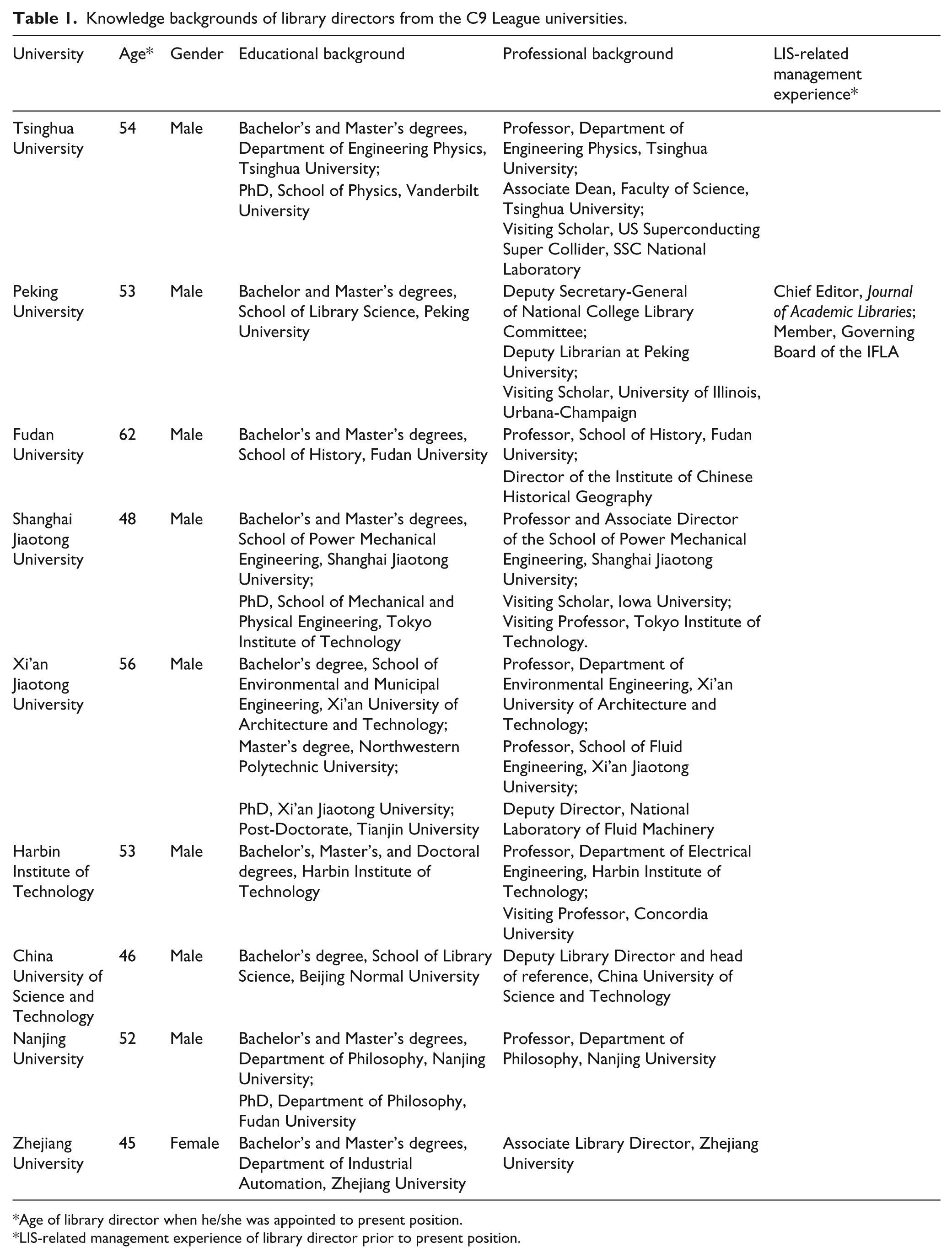
Knowledge backgrounds of library directors from C9 League universities
Column 2 in Table 1 shows the age information for the library directors. The average age of library directors when they were appointed to their current position was 52.1. The director of Zhejiang University’s library was the youngest at 45 (and also the only female in the group), while the library director of Fudan University was the oldest at 62.
Knowledge backgrounds of library directors from the C9 League universities.
Age of library director when he/she was appointed to present position.
LIS-related management experience of library director prior to present position.
Column 4 lists the directors’ educational backgrounds. Only two graduated with a degree in Library Science—the library directors of Peking University and China University of Science and Technology. The others mainly obtained degrees in Science and Engineering. Aside from the library directors of Zhejiang University, Peking University, and China University of Science and Technology, those from the C9 League were mostly renowned scholars with non-LIS academic backgrounds; these scholars had overseas Doctorate degrees and had experience of teaching and studying abroad (column 5).
In terms of professional background, most of the C9 League library directors worked at the same universities where they were educated. Only two received undergraduate degrees from universities other than those where they worked as directors. Another four were employed by the university from which they received their highest degree. None of the library directors had worked as a professor or administrative employee at any other Chinese university. This suggests that the C9 League universities strongly favor internal candidates when selecting library directors.
As C9 League institutions tend to be the preeminent universities in their respective cities or provinces, their library directors play key roles in local library organizations. For example, the library director of Shanghai Jiaotong University is also vice chairman of the Library Association of Shanghai. Clearly, a professional library director with rich library-related work experience would easily be elected to an international organization. The library director of Peking University, for example, sits on the governing board of the International Federation of Library Associations and Institutions (IFLA).
Knowledge backgrounds of library directors from top universities in Taiwan
Table 2 shows that the average age of library directors when appointed to their current positions at Taiwan’s top universities was 54.8. Half were female. Regarding professional education, all of the directors had overseas experience, lending their work an international perspective. Only one obtained a degree in Library Science while two received degrees in Social Science. The library director of National Cheng Kung University studied Science and Engineering. All of them easily obtained LIS-related academic positions, including the director of the Library Association of Taiwan.
Knowledge backgrounds of library directors from the top universities in Taiwan.
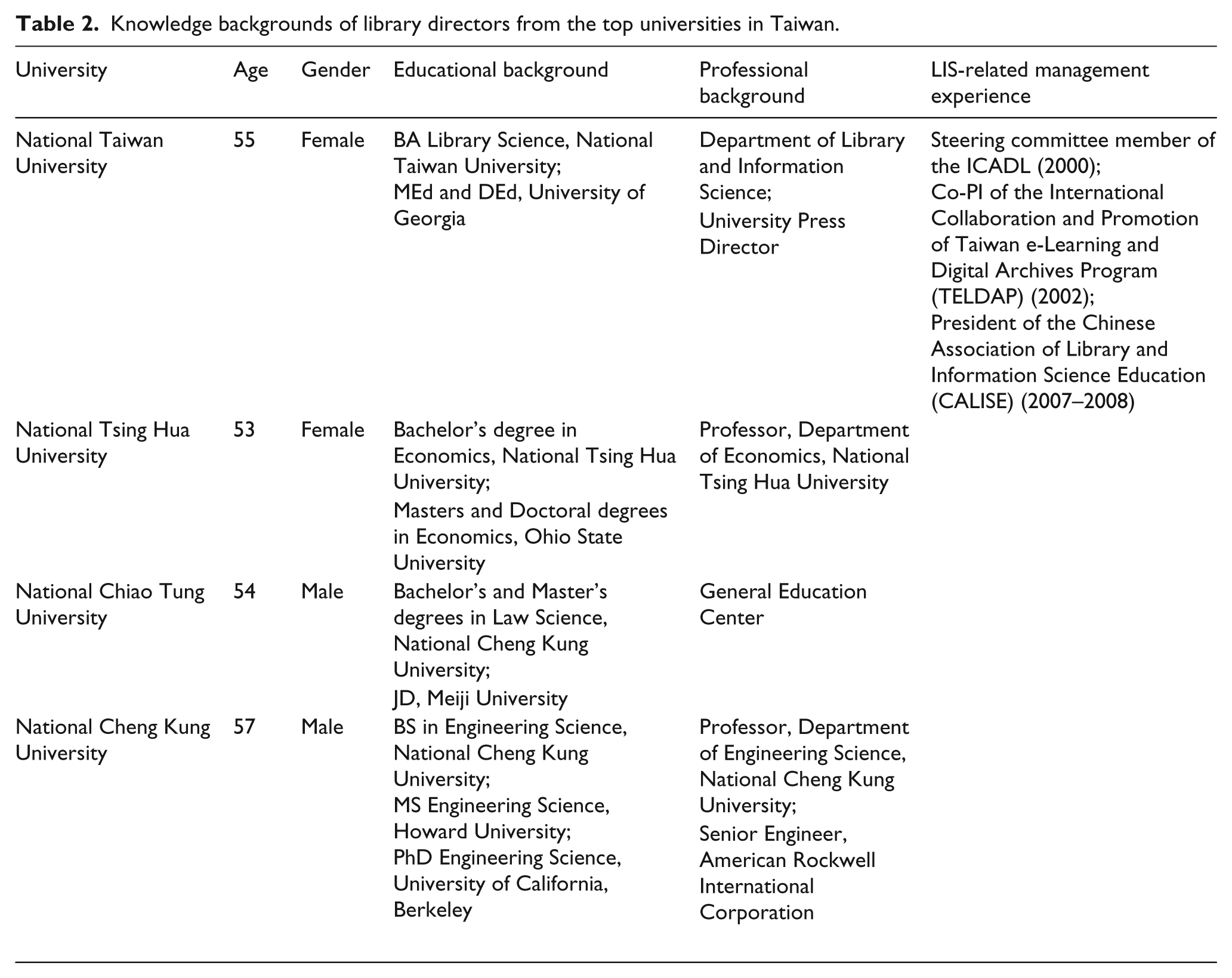
In terms of professional background, 75% of the library directors worked at a different university from where they received their undergraduate degree, while 100% worked at a different university from where they received their most recent degree. Of the directors, 75% did not have LIS experience.
Knowledge backgrounds of library directors from top universities in Hong Kong
As shown in Table 3, the average age of library directors when they were appointed to their current positions in top universities in Hong Kong was 52.8, and the library director from the City University of Hong Kong was the youngest at 44. Half of the library directors were female.
Knowledge backgrounds of library directors from top universities in Hong Kong.
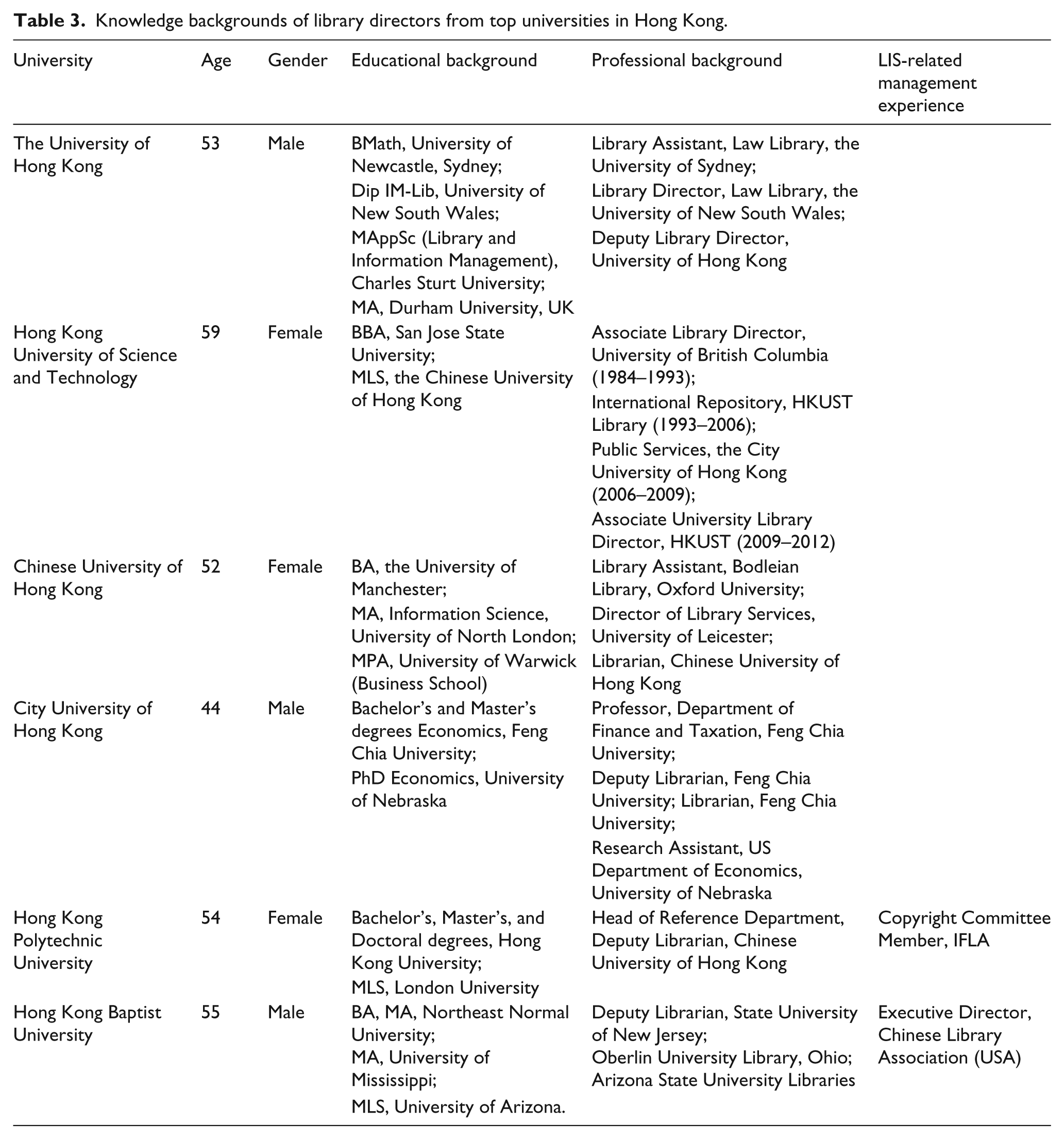
Four of the six directors graduated with degrees in Library Science, and all had overseas experience. As for LIS-related management experience before being appointed as director, one of the directors, from the Hong Kong Polytechnic University library, was a Copyright Committee Member of IFLA, and the director of Hong Kong Baptist University was Executive Director of the Chinese Library Association (USA).
Comparative analysis of the knowledge backgrounds of library directors from the top universities of the C9 League, Hong Kong, and Taiwan
Four of the candidates were below 50 when they were selected as library directors. Directors from Taiwan were older than those in mainland China and Hong Kong. The youngest library director (from the City University of Hong Kong) was hired at the age of 44 while the oldest (at Fudan University) was appointed at 62. See Figure 1 for ages of directors.
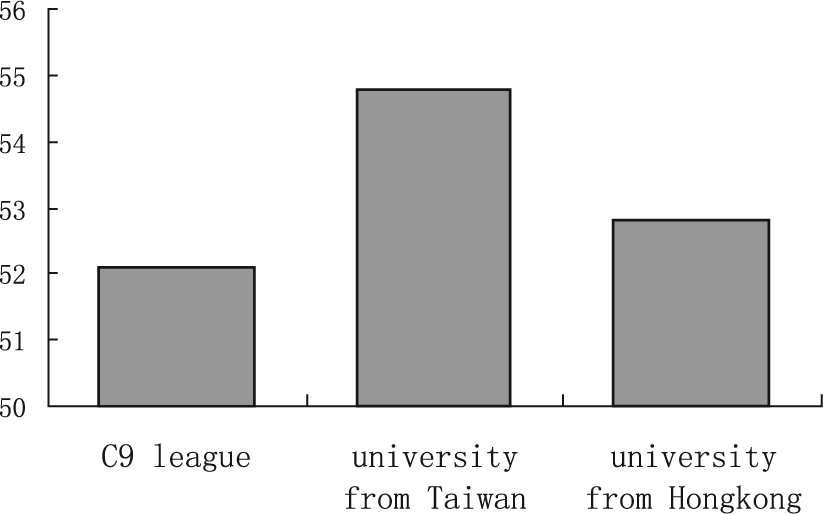
Age of library directors.
Figure 2 shows that the C9 League prefers male library directors, with only one female director. At the top universities of Taiwan and Hong Kong, however, half of the library directors were female.
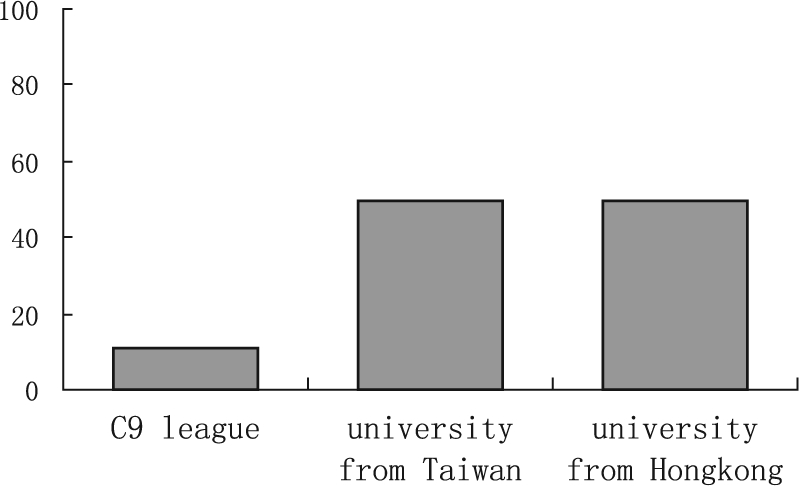
Percentage share of female library directors.
Figure 3 shows that all library directors from Taiwan and Hong Kong had overseas experience, with several years’ worth of education and research experience abroad. In contrast, less than 50% of library directors from the C9 league had overseas experience.

Overseas experience of library directors.
As shown in Figures 4 and 5, most library directors in Hong Kong had educational backgrounds in LIS with graduate degrees in the field. Only the library director of the City University of Hong Kong received a degree in a different field (Economics). Regardless, he had rich work experience in LIS and had been the library director of Feng Chia University in Taiwan for several years.
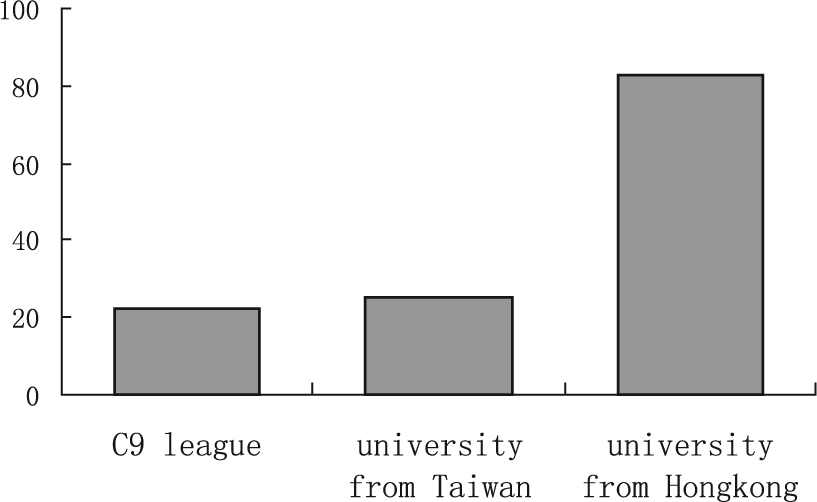
Education background of library directors in LIS.

Work experience in LIS of library directors.
These data reveal that top universities in Hong Kong set higher professional requirements for library directors. They select candidates from a worldwide pool and place more emphasis on LIS-related experience. Similar to the C9 League schools, top universities in Taiwan prefer to select library directors from their alumni, and they favor candidates with accumulated professional and academic experience at the same university.
There were no significant variations in average age across the three regions. Library directors from the top universities in Hong Kong had rich LIS-related academic and professional experience. The differences in the knowledge backgrounds of library directors from these top universities are likely to remain relevant to the selection criteria for library directors.
Conclusion
The C9 League universities and top universities in Taiwan appear to favor a “mixed mode” for selecting library directors, focusing on a candidate’s qualifications, degrees, and academic titles. Nonetheless, the rate of professional library directors at these universities is low, and most formerly worked as professors at the same university. The top Hong Kong universities, on the other hand, appear to follow the international mode of selection, favoring candidates from a worldwide pool. Candidates are expected to have obtained degrees in a wide range of fields, have considerable LIS-related academic and professional qualifications, and have experience working in other libraries.
While we found significant differences in the knowledge backgrounds of library directors in mainland China versus those in Taiwan and Hong Kong, the cause of this difference is unknown. Unlike in most westernized countries, there are few job advertisements for academic library directors in China. Most are selected according to the regulations and programs of the related institutions. Perhaps related is that the education system of Taiwan is very US focused, while the education system of HK is US as well as Canadian, British, and Australian focused. The system in mainland China is changing most rapidly of the three systems; which direction it will take and how this will impact on the libraries will be an interesting topic in the future.
Unlike their counterparts in many countries internationally, significantly fewer library directors in the C9 League specialize in Library Science. Naturally, the directors who are also well-known scholars in other fields can use their academic stature to secure funds and other resources for their libraries. Nevertheless, as mentioned earlier, previous research has found that management skills and leadership are considered the most important abilities for an academic library director. However, the lack of training and experience in Library Science may lead to difficulties in library management and development. Fortunately, some programs such as NEXTGEN which seeks to bring aspiring leaders from HK, Singapore and Shanghai to share their experiences should be helpful to middle management where hopefully the next generation of directors will come from.
Although there is no requirement for a Master’s or Bachelor’s degree in Library Science for the position of librarian in the universities of mainland China even when they have a school or department of LIS, there is usually a strong connection between the library and the LIS school or department. The university library can get help from the LIS school or department, such as librarian training, strategic planning, and project cooperation. On the other hand, the school or department can get help from the university library such as student internships and resource sharing. The relationship between the library and LIS department should be enhanced for the benefit of both sides, and a director with an academic background in LIS would be helpful for this. In this study, the library director of Peking University had received Bachelor’s and Master’s degrees from the Department of LIS in Peking University; he is also on the board of the academic committee of the Department of LIS. The library director of National Taiwan University was the former dean and professor of the Department of LIS in the university.
As libraries play a key role in the construction and advancement of world-class academic institutions, the findings of this study provide potentially useful information about the backgrounds of library directors at top Chinese universities. Specifically, this work can shed light on the career-movement factors and trajectories of library directors working for these universities. The administrators and hiring committees of Chinese universities should focus on candidates with particularly diverse and advanced qualifications. Finally, laws and regulations should be developed to ensure that the selection of these directors remains competitive on the world stage.
Footnotes
Acknowledgements
We are grateful for Professor Zhou Ping’s contribution in improving the language of this paper. This research was supported by the Humanities Social Science Programming Project of the Ministry of Education of China (NO. 13YJC870005) and the National Natural Science Foundation of China (NO. 71273225).
Declaration of Conflicting Interests
The author(s) declared no potential conflicts of interest with respect to the research, authorship, and/or publication of this article.
Funding
The author(s) received no financial support for the research, authorship, and/or publication of this article.