



Abstract
The purpose of this study is to explore the intention and competency of Library and Information Science (LIS) professionals regarding sensitivity of gender-related issues in libraries and to examine the effect of a short-term (five days) thematic training workshop on Information Management with Gender Perspectives for LIS professionals. Data was collected from working librarians around the country using two separate channels, i.e. an online questionnaire, and pre/post-training test results from the trainees of a workshop on gender mainstreaming in libraries. The findings discuss the level of competencies, need for training, and attitudinal responsiveness of LIS professionals in Pakistan and appropriate measures are discussed. Moreover, gender-related issues and the current status of LIS professionals are alarming in terms of gender responsiveness. Findings show that only 17% of the LIS community is gender responsive. The results are useful for planners of engendered programmes and policies, library science professionals and researchers, especially in the field of gender and women’s studies and provide an insight for international readers into the perception of LIS professionals on mainstreaming gender in Pakistani libraries. This study uniquely presents the current status and preparedness of LIS professionals to address gender-related issues in libraries
Keywords
Introduction
Librarians and library educators state publicly their commitment to digitization and gender equity in terms of equal access to information (Brand, 1983). Some make claims for the provision of equal access to information without regard to race, colour and ethnicity. Yet certain features of the information age appear to be inhospitable to the goals of gender mainstreaming and there is a history of gender desensitization (Hildenbrand, 1999). Libraries have not been immune from societal change and influences. The role of women within the library has been the subject of debate among researchers, practitioners and library educators since 1960s. However, few studies have focused on gender (women and men together) in the library context.
Gender mainstreaming is a public policy strategy, a plan of action, to achieve gender equality. The gender mainstreaming concept involves ensuring that gender perspectives are central to all activities including resource allocation, policy and planning, implementation and monitoring of programs and activities. Mainstreaming is a strategy, an approach dedicated to integrating the gender dimension into the workplace in order to achieve gender equality.
Gender mainstreaming in the context of libraries has two universal considerations: to ensure the safeguarding of basic human rights in a public place; and equal access to information for men and women. LIS professionals must also be equipped to respond in terms of service management change; introducing new tools and technology; fulfilling and anticipating users’ needs; reducing expenditures; and adapting innovative ways for the improvement of effective service delivery mechanism. These trends are characterized by the social landscape of libraries as self-sufficiency, satisfaction and seamlessness (De Rosa et al., 2004).
This research concentrates on examining manifestations of male and female librarians’ flexibility and understanding in recognizing and identifying gender issues as an essential part of their job description; and to extend their willingness and contribution in making their libraries gender friendly, involving all aspects of gender mainstreaming.
The Global Gender Gap Report (2013: 10), published by the World Economic Forum based on the assessment of how well resources are divided among female and male population in 136 countries, shows that Pakistan is down at 135th followed only by Yemen. This situation is reinforced by the comprehensive report measures showing Pakistan ranked eighth-worst in terms of equal access to education (Lamont, 2009).
Libraries in Pakistan, being a focal point of education and research, need to deal with this alarming situation through a positive response to gender equity. Librarians develop their basic technical competency such as advanced computing and communication skills and develop new services for professional interest. Correspondingly, it has now become essential for librarians to play a pivotal role to work as agents of change by driving a campaign to address gender-related issues. But to be effective, the library community needs to be more gender aware and gender responsive first. Library research has been active in addressing social issues such as information-seeking behaviours, library anxiety, education, etc. It should also focus on gender mainstreaming issues in order to provide better services to its community and make our libraries more gender and user friendly.
It is well argued by many researchers that women may underestimate their abilities and disassociate themselves from the profession of LIS in part because of the perception of joblessness among other reasons (Lamont, 2009). If managed properly, improved understanding of gender responsiveness combined with library theory and practice in the information age will create a diverse workforce as well as dynamic organizations.
Purpose
Research from social sciences, particularly women’s studies, highlights the key role that organizational and social issues play in empowering the ordinary man and woman through the effective use of libraries. The library’s specific characteristics, as a public place and a repository of scholarly material, make it all the more necessary for it to be user and gender friendly.
The aim of this study is to provide an insight for international readers into the perceptions of librarians and LIS professionals in relation to making their libraries gender responsive and gender friendly. The purpose of this study was the gathering of empirical evidence to analyse whether or not Pakistani working librarians have the capacity and awareness to identify and address gender-related issues. The study focuses on the possibilities and hurdles of gender mainstreaming while suggesting measures for capacity building and practical initiatives into mainstreaming in academic, special and public libraries in Pakistan.
Objectives
The main objective of this study is to explore whether Pakistani libraries and librarians are gender aware, gender sensitive, gender responsive, or gender blind. Specifically the study aims:
to assess the level of knowledge on gender issues among LIS professionals in Pakistan;
to quantify acceptance or dissonance of the LIS community regarding mainstreaming gender in the workplace;
to assess gender mainstreaming initiatives within the LIS community (both in libraries and at the organizational level).
Significance of the study
In terms of efficiency, any organization has an interest in ensuring that staff members and volunteers enjoy equal opportunities to unfold their full potential at work, regardless of their sex and of the size and form of their households (Jacobs, 2010).
In developing countries where male dominant societies exist, women, although playing vital roles both in society and in the development of their country, receive less respect than they expect. The LIS profession is an established one in Pakistan and women are also joining the profession as librarianship is considered a decent job for the female sex (Yousaf et al., 2013). Gender inequalities are found in almost all walks of life including education and its subfields such as schooling, student-teacher interaction, management personnel, decision-making roles, even in curriculum content and reforms. Research from sociology, psychology and women’s studies highlights the organizational and social issues that inhibit women (Lamont, 2009). Current research on gender indicates that the educational sector plays a significant role in addressing gender inequalities (Azisah, 2012). We need to understand the readiness of Pakistani librarians to gender mainstream libraries and play their role in overcoming gender inequalities.
Literature review
Several resources, e.g. scholarly databases, websites, online journals and books on gender and women studies, were consulted for the literature review for this study. The purpose was to examine those studies which focus on women and men in the context of LIS, especially in terms of mainstreaming gender. It was found that studies from the mid-80s onwards focused primarily on gender differences in the use of library resources. Numerous studies are available on women empowerment, accounts of women library users and women librarians, and women’s librarianship in the literature. However, gender (specifically) receives very little attention in the LIS literature. Gross et al. (2004) mention that few studies have been conducted so far on gender-related issues in the LIS field. Alqudsi-ghabra and Al-Muomen (2012) acknowledge in their study that gender surprisingly has been avoided in the literature of LIS. Fidishun (2007) similarly concludes that little extensive work has been done on women’s interaction in libraries.
An initial search on LISTA (Library and Information Science Technology Abstracts) identifed 225 research studies where gender, women and men were the focus in the context of library or librarianship. Abstracts of 225 research articles were analyzed using the Google Topic Modeling Tool (freely available topic modelling tool for Latent Dirichlet Allocation topic modelling) and revealed that apparently all studies revolve around two major themes, i.e. Women as Librarians and Women as Library Users. Studies related to ‘women as librarians’ focused on job-related issues, e.g. occupational needs and characteristics, discrimination, equal opportunities, wages, recruitment and promotion issues. DeLong (2013) presented a comprehensive literature review of studies (ranging from 1930s to 2012) on career development and writing about women librarians, detailing accounts of achievements, contributions, intellectual explorations of female librarians including the status and role of women librarians and their impact. The second major topic ‘women as library users’ includes studies on women’s empowerment through libraries, descriptions of specialized services for women in libraries, information technology usage and its impact with respect to women library users.
Talking about gender in libraries
Gender remains an uncommon feature of the LIS literature, notwithstanding the fact that the stereotype of a librarian has been always been as a woman.
Searching in general databases like LISTA (Library and Information Science Technology Abstracts), Google Scholar and OCLC (Online Computer Library Center) a query on ‘gender and library’ yielded few results. For example, the OCLC 1 database retrieved seven results, LISTA yielded 25 results whereas more recent results are found on LISA (Library and Information Science Abstracts) on the role of libraries in gender studies and on gender-related issues in libraries. 2 The majority of the articles address how the development of libraries have contributed to the agenda of women’s empowerment (De Jong and Koevoets, 2013). Searching more on gender issues, it was found that the development of databases on women’s/gender library literature and related topics in the past 15 years shows that the subject ‘library’ and the discipline ‘library science’ is missing (De Jong and Koevoets, 2013). ‘This is how gender is most often categorized in library science – under subthemes like career development and satisfaction, education, employment issues, gender issues in librarianship, image of librarians, library history, salary and pay equity, and sexual discrimination’ (Aleksander, 2013: 32).
The Organization of Women’s Libraries, Archives, and Information Centers in German-speaking countries called ‘ida’ linked through Women’s Information Network of Europe (WINE) and available at http://www.ida-dachverband.de/en/home/ is compiling a list of members’ publications on women and gender in libraries since the late 1990s. An initial search on GReTA 3 (an integral part of ZtG – Center for Trandisciplinary Gender Studies) with the query ‘gender in libraries’ retrieved 25 results somehow relevant to gender-related issues but focusing on women in particular. Unfortunately, although these resources exist, access to them is limited because many materials in these databases, along with their subject headings for searching, are in European languages other than English (Aleksander, 2013).
One initiative of interest in this area is the Library Gender Sentinel Site Committee (LGSSC) established in 2004 at Maklib to address gender and related issues. Its major objective was to proactively identify and respond to gender and related needs of library staff and users (Musoke and Namugera, 2014). The committee organized a gender sensitization programme for all librarians of Makerere University in 2005. Later in 2006 it procured gender-sensitive tables, worked for the increased comfort of female library users, and launched a campaign to raise awareness of gender issues such as sexual harassment at the workplace, in order to ensure that gender equity is achieved in all library activities.
With special reference to Pakistan, there is no specific research study available in the LIS literature focusing on gender and libraries. However, a few studies on women-related issues with reference to libraries and librarians in Pakistan exist. One of the noted studies conducted by Yousaf et al. (2013) highlights the job-related issues of female librarians in Pakistan. This qualitative research identifies and discusses general hindrances faced by female librarians in the University of the Punjab followed by suggestions to overcome these problems. The study is significant in establishing that the workplace at the University is quite comfortable for female librarians and that they enjoy the same perks and privileges as their male counterparts. The study reveals that gender issues like workplace harassment and unethical dealing do not exist, although female librarians do face some managerial level problems which can be solved through appropriate training. In another study, Ilyas (2010) provides a historical account of contributions made by female librarians of Pakistan towards the development of Librarianship. The study concludes that from 1947 to 1970, women’s participation in education and research drastically increased and that research in LIS has been enriched considerably by women scholars.
Methodology
Data was collected on a structured questionnaire from working librarians around Pakistan. An online questionnaire (using Google Forms) was shared on PAKLAG (well-known listserve of librarians in Pakistan) having 4331 registered members at the time of distribution of the questionnaire, i.e. 24 May 2014. With a confidence level of 95% and a confidence interval of 4, the sample size of 527 respondents was calculated. In order to reach the maximum population, the same questionnaire was sent to the personal email addresses of librarians, shared on the authors’ Facebook and LinkedIn pages, and also distributed in hardcopy among librarians in public, academic and special libraries throughout the country. Online responses numbered 456, while 86 responses were collected on hard copies. In total, 542 responses were gathered for analysis. The data collection process took about three months, i.e. from 24 May to 30 August 2014.
There are many variables affecting gender mainstreaming in the institutions emanating from internal and external environments. However, for the sake of a focused analysis, this research targeted key internal variables such as gender, age, years of stay, position, level of education and department/faculty. The variables, which were mainly applied to the survey questionnaires, were identified on the premise that the knowledge, perception, education, understanding, length of employment, parents’ education and environment (type of library where the respondent works) of the respondent are likely to affect opinion with regard to gender issues.
The most dominant and frequently used variables both in the data collection and analysis were education, perception and knowledge. The other variables were used more often in the administration of attitude survey questionnaires.
Research questionnaire
The questions were designed with the research problems and objectives in mind, so as to assess the range of understanding, attitudes and perceptions of librarians working in academic, public and special libraries around the country. The questionnaire was administered online and comprised three sections – based on the research questionnaire of Yehualashet (2010) with the required modifications suggested by a local gender expert.
Section 1 included demographic information and questions to examine level of understanding about gender issues and allied concepts. Section 2 comprised 10 questions with a five-point Likert scale to collect positive and negative views of LIS professionals toward gender issues. Questions related to considering gender in policy formulation, taking balanced decisions in collection development, services to promote gender equality or focusing on women’s empowerment, collecting gender-desegregated data, provision of sufficient spaces for users to safeguard privacy of information searching, considering gender in project development, etc. were asked. Section 3 included 10 questions to examine attitudinal tendencies towards prioritizing gender mainstreaming in the substantive workplace. This section was comprised of questions relating to gender-sensitive communication, involvement in publishing documents on gender or women empowerment, attitude towards female staff and users in order to collect viewpoints on the importance of gender-related issues.
Findings and discussion
The results of this study have been articulated keeping in view the objectives – to assess LIS professionals’ level of knowledge on gender issues, evaluate their competencies to be responsive towards mainstreaming gender at the workplace, and measure the level of acceptance or dissonance regarding mainstreaming gender in libraries. Collected data was categorized accordingly to reach the intended results and make substantial conclusions.
Demographic analysis of the survey participants
The demographic information of the respondents was examined to find out the influence of age group, education, qualification, and also the type of library in which the respondent was working currently, on the matter of gender.
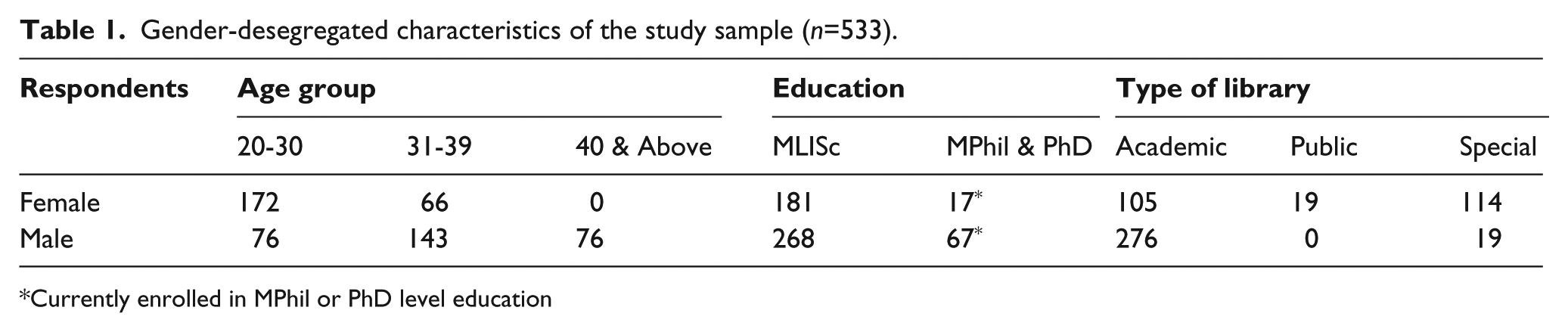
Table 1 shows that 55.34% male and 44.62% female respondents participated in survey. A majority of respondents (84%) were qualified at Master’s level with MLISc degrees and 16% of respondents either possessed or were enrolled in a research degree, i.e. MPhil or PhD.
Gender-desegregated characteristics of the study sample (n=533).
Currently enrolled in MPhil or PhD level education
Level of understanding about gender issues
Various questions on gender inequality, gender-desegregated data, gender discrimination, social roles of women and men, classified female roles in the society, etc. were asked of the survey participants to determine levels of understanding about gender concepts and values. These questions range from simple to difficult to explore the knowledge of the survey participants on three scales, i.e. good, satisfactory and poor.
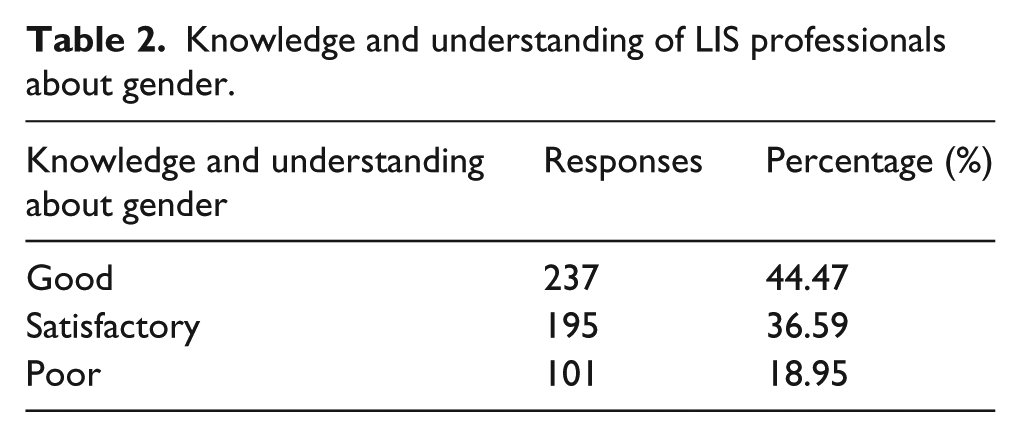
A good level of understanding about gender and its allied concepts was recorded during this research; 44.47% and 36.59% survey participants were found to have Good and Satisfactory knowledge of gender and its related concepts respectively as shown in Table 2 and Figure 1.
Knowledge and understanding of LIS professionals about gender.
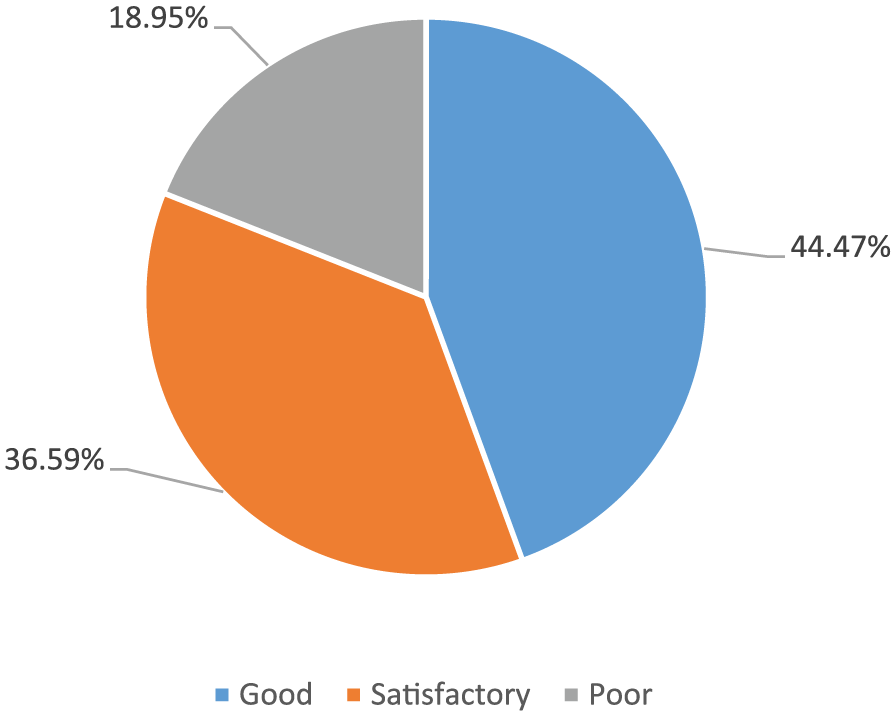
Knowledge and understanding of LIS professionals about gender (n=533).
This means that mainstreaming gender in Pakistani libraries would be more than welcome if due consideration was given to removing barriers. However, respondents (at this level) disagreed that gender stereotyping in the workplace may hinder and limit the marginalized gender’s capacity-building opportunities and chances.
Perceptions about taking gender mainstreaming initiatives at organizational level
The concept of gender refers to the culturally orchestrated assignment of roles and expectations as to how females and males behave in a given environment. Therefore, perceptions and attitude towards taking initiatives to foster a gender-responsive culture within libraries is of paramount importance. From the outset, the survey participants confirmed a high-level commitment in prioritizing gender issues in policies, procedures, planning, budgeting, management, space allocation, collection and resource usability, and a gender-responsive environment within libraries, as shown in Table 3. A majority of librarians (i.e. 48.03%) expressed that they were either currently or would prioritize actions to promote a gender sensitive culture. On the other hand, a slight majority (i.e. 40.15%) confirmed the lack of such activities by choosing ‘We do not consider gender in planning’. The remaining 11.82% were of the viewpoint that it was not necessary to consider gender issues in library management.
Considering gender in all activities at the workplace.
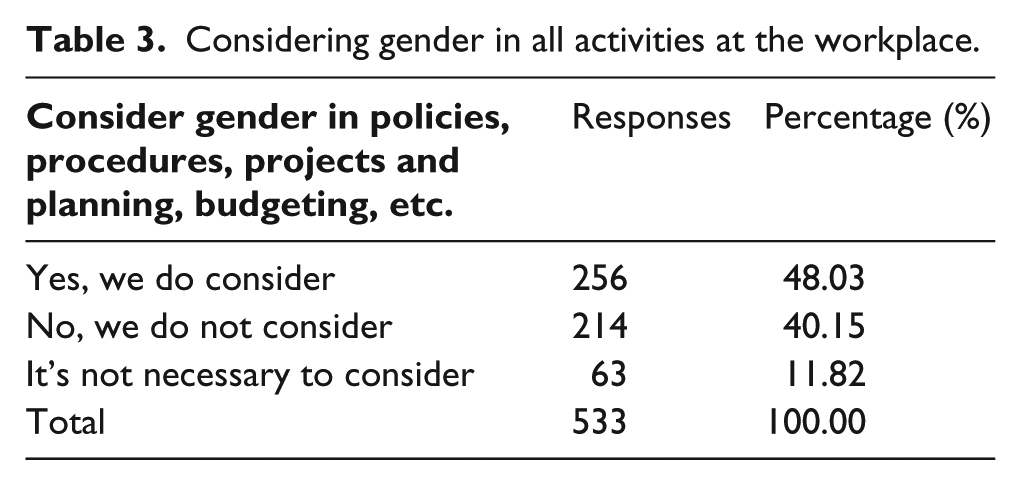
This scenario illustrate that Pakistani LIS professionals are at the middle of mainstreaming gender where almost half of the studied population is responsive towards gender issues. Capacity building and proper resource allocation would be required for mainstreaming gender in Pakistani libraries.
Gender-sensitive communication skills of LIS professionals
Communication and interventions can reinforce beliefs and social norms or ultimately establish new beliefs, attitudes, and social norms (Espinosa, 2013). Gender-sensitive communication skills are necessary to create gender awareness through advocacy. The survey questionnaire asked questions to assess the gender-sensitive communication skills of the respondents. Almost half of the survey participants (i.e. 48.22%) confirmed fair usage of gender neutral words in their communication as shown in Table 4.
Examining gender-sensitive communication skills.
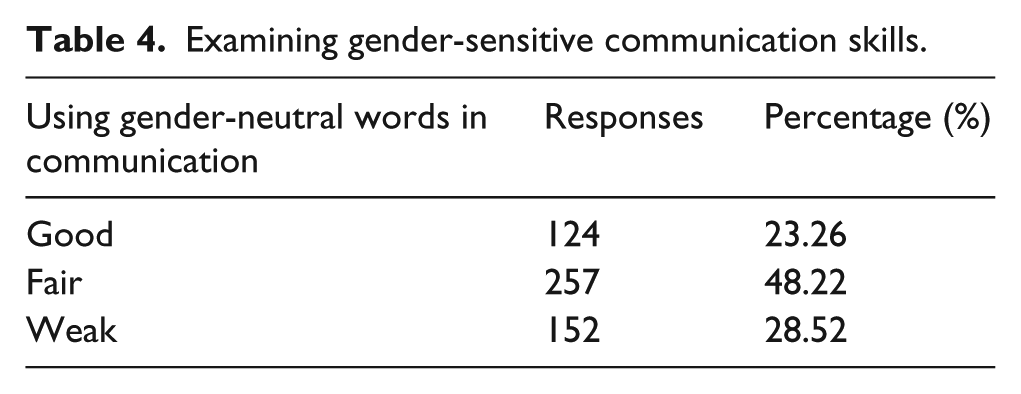
Result shows that LIS professionals’ gender-sensitive communication skills will support advocacy and mainstreaming activities in libraries and will also help to encourage gender-associated components at the workplace. However, it equally important that an institution should also reflect gender-sensitive communication in its publications in order to create awareness among readers.
Organizational culture and perception with regard to gender issues (as perceived by the respondents)
Members of academia, despite their exposure to higher learning, are not totally immune to backward cultural beliefs, biases and prejudices. Culture plays a vital role, for better or worse, in shaping the perceptions and attitudes of people towards a range of issues, including gender.
A series of questions were asked of the survey participants about the gender considerations in their respective organization. For example, reflection of gender issues in institutional publications, decision making, policy formulation such as sexual harassment and initiatives taken for sensitizing employees on the gender issue.
Almost half of the survey respondents (48.13%) confirmed that their organizations did not respond to gender issues or the librarians were not aware of such activities within their respective organizations, as shown in Table 5.
Respondents’ perception of organizational culture related to gender.
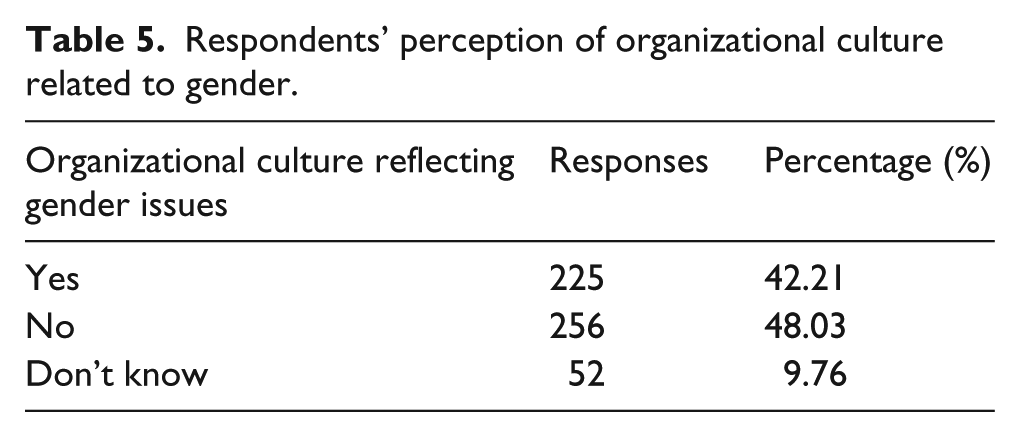
This situation somehow is alarming because the majority of organizations confirm that gender
Problems in mainstreaming gender in Pakistani libraries
Candid opinions of the female librarians helped in identifying issues and problems that hinder the gender-mainstreaming process at organizational level in libraries. Some of the notable problems identified during analysis of the questionnaire are that female LIS professionals:
are considered stereotypical thinkers and are inclined to hold only female-oriented roles as defined by the local community;
demonstrate that they can contribute a lot if given appropriate placement in society and especially in the field of LIS in Pakistan;
pointed out that the hiring authorities are male dominant so giving less preference to or are much more reluctant to recruit females. It was suggested that hiring authorities must include females so as to examine the capabilities of female candidates on an equal footing;
have no exclusive professional forum to resolve the managerial issues of female library staff;
have fewer or even no capacity-building opportunities available;
have no specific quota for females in the LIS field
The underrepresentation of women in the LIS profession was identified as the one of the main hurdles to mainstreaming libraries in Pakistan. The smaller number of women in librarianship in Pakistan entails an almost ‘symbolic image of the discipline as masculine, which in turn reinforces the minority position of women’ (Lamont, 2009: 141).
Conclusion
As laid out in the objectives, the main research question this study sought to answer was whether the Pakistani LIS community is aware of gender issues; whether they are ready to mainstream gender into the workplace in order to contribute towards the attainment of reducing Pakistan’s ranking as eighth-worst in terms of equal access to education, or otherwise.
It was equally important to weigh up the gender-related perception and attitudes of the LIS community and determine convincingly the acceptance and difference of opinion on mainstreaming gender in Pakistani libraries. Findings reveal that 44.47% and 36.59% of LIS professionals have a Good and Satisfactory knowledge of gender and its related concepts respectively. However, their readiness to take initiatives to mainstream gender in their workplace is compromised because of lack of capacity building as well as socio-cultural and organizational constraints. The underrepresentation of the marginalized gender in institutional publications; not ensuring a gender-friendly environment in library; no gender-sensitive atmosphere for users; no opportunity to ensure privacy in information retrieval were all commonly identified issues in the majority of libraries, whereas the majority of LIS professionals are committed to future endeavours in incorporating individual-level efforts. However, a considerable amount of guidance and direction is required in terms of capacity-building measures for LIS professionals.
Finally, the overall situation is that currently18% of the LIS professionals have poor knowledge about gender; 11% are of the opinion that gender mainstreaming is no longer necessary for libraries in Pakistan; 28% LIS professionals lack gender-sensitive communication skills; and nearly 10% are unaware of the importance of or have no clue about gender mainstreaming at an organizational and cultural level.
Footnotes
Declaration of Conflicting Interests
The author(s) declared no potential conflicts of interest with respect to the research, authorship, and/or publication of this article.
Funding
The author(s) received no financial support for the research, authorship, and/or publication of this article.