



Abstract
This article reports on the administrative structure and collaborative activities of faculty and librarians within Vietnamese universities to evaluate their impact on teaching and research, as well as their collaborative benefits, advantages and disadvantages. The authors used a qualitative method to determine the current status of collaboration between faculty and librarians, and conducted 29 in-depth interviews with key participants at Vietnamese universities. The findings indicated that such collaboration was often based on the collaborators’ personal circumstances and that librarian liaison partnerships primarily related to the faculty’s profession, personality and attitudes at different units. Further, universities focused on collaborative activities to support teaching and research – designing syllabi, research support activities and collection development. The results of this study will be useful for stakeholders at universities in reviewing the effectiveness and limitations of collaborative relationships.
Keywords
Introduction
The implementation of the ‘renovation’ policy (Doi moi) by the Vietnamese government in 1986 brought radical changes, especially in the socio-economic and educational fields. Vietnamese higher education has made significant progress in enhancing the quality of teaching and learning, as well as increasing the number of higher education institutions, lecturers and students (Ninh, 2013; Tran and Villano, 2017). Vietnamese universities have expanded the number of disciplines and introduced innovative curricula, teaching methods and information resources (Human Development Department, 2008). However, they have also faced challenges, including poor infrastructure, space limitations, passive teaching methods and a lack of qualified teaching staff. Additionally, libraries and the available information resources did not meet user needs, curricula were rigid and of low quality, and the link between education/training and job markets was weak (Harman et al., 2010; Harman and Nguyen, 2010; Hien, 2010). Furthermore, the limited number of publications by Vietnamese researchers in international journals, as well as the low salary and heavy workload of academic staff, was reflected in Vietnamese higher education (Hayden and Lam, 2010). Therefore, universities in Vietnam have to improve their educational quality and meet accreditation requirements (Denison et al., 2017).
The transformation of higher education in Vietnam requires academic libraries to transform and innovate as well, acknowledging the pivotal role of collaboration towards a common university mission. Faculty–librarian collaboration plays a critical part in improving the quality of teaching and research. Numerous studies have indicated the benefits, significance and positive outcomes of such collaboration. According to Kezar and Lester (2009), it is important for administrators, faculty, staff and students to recognize and offer incentives, an administrative and human resource structure, values, resources and rewards to develop collaborative relationships. The establishment and completion of a clear administrative structure in which there is a division of stakeholder responsibilities and roles in collaborative work is necessary and will help direct faculty–librarian collaboration towards fulfilling the university’s vision and mission. However, few studies have reported cases that have established an essential administrative structure to support collaboration (Thull and Hansen, 2009; Wang, 2011).
Similarly, a limited number of studies in Vietnam have only focused on partnerships for collection development and information literacy instruction, as well as factors that cultivate and develop collaborative relationships. These studies indicate that budgets, time constraints and an asymmetry in resources were challenges that Vietnamese universities faced when working to build relationships. Administrators realized that the importance and need for building administrative structures was pivotal, but required many factors and support from stakeholders in the process (Diep, 2011; Pham, 2016). Therefore, this study is crucial and useful for administrators, faculty and librarians to identify the current status, pros and cons of collaborative work, and then find well-rounded solutions to improve and develop collaborative relationships.
The researchers conducted 29 semi-structured interviews with three key groups, including faculty, librarians and administrators (deans and vice deans of faculties and directors and deputy directors of libraries) at four universities in Vietnam to explore the faculty–librarian collaborative situation supporting teaching and research.
Research objectives and questions
This article aims to identify the current situation and barriers in order to evaluate the benefits, advantages and disadvantages, and then to establish effective strategies in boosting faculty–librarian collaboration. The article answers two questions relating to faculty–librarian collaboration: (1) What are the administrative structure and collaborative activities that support teaching and research at Vietnamese universities? (2) What is the effectiveness of faculty–librarian collaboration and how may collaborative relationships be enhanced at Vietnamese universities?
Literature review
In order to have an overall understanding and to make a comprehensive comparison of the results of this study with previous studies, it is necessary to show the prominent findings of prior literature on the administrative structure and collaborative initiatives between faculty and librarians. Moreover, the characteristics of the two theoretical frameworks are also mentioned as the basis for carrying out this study.
Administrative structure
The administrative structure is considered to be an important part in navigating collaboration to achieve an organization’s goals. In a model concerning the factors (for example, governance structure, sociocultural dynamics and personal dimensions) that have an effect on faculty–librarian collaboration, Pham (2016) indicated that a dynamic and flexible structure and a high level of autonomy enable the development of collaboration; meanwhile, differences between the organizational structures of faculties and libraries could enable or impede the establishment of partnerships. Another piece of evidence revealed that university governance structure systems do not focus on development strategies or collaborative plans. Issues related to the responsibilities and tasks of academics and librarians working together are not clearly defined. Furthermore, universities provided an imbalanced resourcing structure to support the implementation of collaboration frameworks and policies. Strategies for developing collaboration were insufficient, since libraries focused on collaboration in teaching rather than research, while faculties displayed a more research-focused orientation. Thus, the level of collaboration varied in different circumstances, and successful relationships were based on individual partnerships. (Pham, 2016: 192)
Other studies highlight the essential role of building an organizational structure for collaborative activities. It is crucial to have the support of senior management and to arrange courses and meetings with stakeholders. Without top-down guidance, collaboration between individuals only occurs when needed (Thull and Hansen, 2009; Wang, 2011). Another study showed that the library’s organizational structure is not flexible, and a lack of support from leaders is a significant barrier to collaborative initiatives (Diep, 2011).
In a survey among 480 scholars, professors, librarians and publishers in universities in Hong Kong, Singapore, Thailand and Taiwan, Yu et al. (2019) identified that collaborative leadership had not been actively supported or officially established at the surveyed universities. Therefore, the researchers proposed that managers establish incentives to implement collaborative projects. In studies related to policy, university policy is one of the crucial factors that increase librarian–faculty partnerships according to Bruce (2001).
Faculty–librarian collaborative activities
The previous research findings indicated that there are four main faculty–librarian collaborative activities – namely, curriculum partnerships, research and academic partnerships, collection development, and the creation of information products and services.
Previous studies indicate that collaborative efforts help develop assignments and syllabi, the usage of subject resources, curriculum management systems and search engines to deliver student learning, and research skills; improve lifelong learning and information literacy skills; and establish teaching programmes related to a specific course (Diep, 2011; Kenedy and Monty, 2011; Pham, 2016; Scripps-Hoekstra and Hamilton, 2016). Moreover, a number of studies also revealed the significance of collaboration in enhancing social and academic skills, learning methods, and the research competence of academics and students (Bennett and Gilbert, 2009; Junisbai et al., 2016); providing library resources via information literacy skills, scholarly databases and electronic resources (Laverty and Lee, 2014; Parton and Fleming, 2007; (Tumbleson, 2016); and conducting teaching and research activities (Rodwell and Fairbairn, 2008). For instance, Floyd et al. (2008) determined that the number of scholarly resources cited had dramatically increased and the quality of students’ research had improved with bibliographic citation courses that guided students in determining appropriate subtopics and organizing a literature review.
Similarly, the joint activities involved in policy formulation and the selection, evaluation, organization and provision of library materials are also noted in prominent literature. The current literature was enriched by the report of Rodwell and Fairbairn (2008) and White (2004), who mentioned the procedures for collection development and digital resources to meet research needs and curricula; as well as to supplement and to manage materials relating to specific subjects (Pham, 2016).
Additionally, there are numerous examples available of faculty–librarian collaboration in supporting researchers in collecting, managing, citing, disseminating and storing data (Federer, 2013; MacMillan, 2014); bibliometric analysis, bibliographic instruction, research data management and curation, open-access publishing and e-research services (Corrall, 2014; Kennan et al., 2012; Kennedy and Green, 2014; MacMillan, 2014); creating information products such as web-based research guides and LibGuides (Little et al., 2010; Sugarman and Demetracopoulos, 2001); and searching for and selecting channels for publishing or hosting e-research services (Corrall, 2014).
In Vietnam, Denison et al. (2017) detailed research support activities conducted at universities such as instruction in the use of databases and online resources; research support software (for example, RefWorks, SPSS, EndNote or Prezi); providing information resources and bibliographic information to researchers according to their needs; and archiving research. However, these services were provided by libraries when required by users and did not involve collaborative activities.
Research methodology
This study aims to provide a broad overview of the administrative structure and faculty–librarian collaboration activities at Vietnamese universities using interview data. In this research, four Vietnamese universities were selected for the study (Table 1). The selection of the universities was based on three criteria. First, these national-level public universities have a large number of students (over 16,000) and lecturers, and offer many undergraduate education programmes, postgraduate programmes and international link programmes. Second, they are the top universities in education programmes and the fields belonging to their strengths and missions, and are research- and technology-oriented universities and leading centres for training, research and innovation in Vietnam. Third, they cover many scientific fields (for example, social sciences, technology, natural sciences, economics, agriculture, agronomy, animal science and veterinary medicine). Therefore, establishing collaborative relationships between faculty and librarians is crucial and necessary in enhancing their research performance and the quality of their education, and thereby achieving their common goals.
Number of key informants.
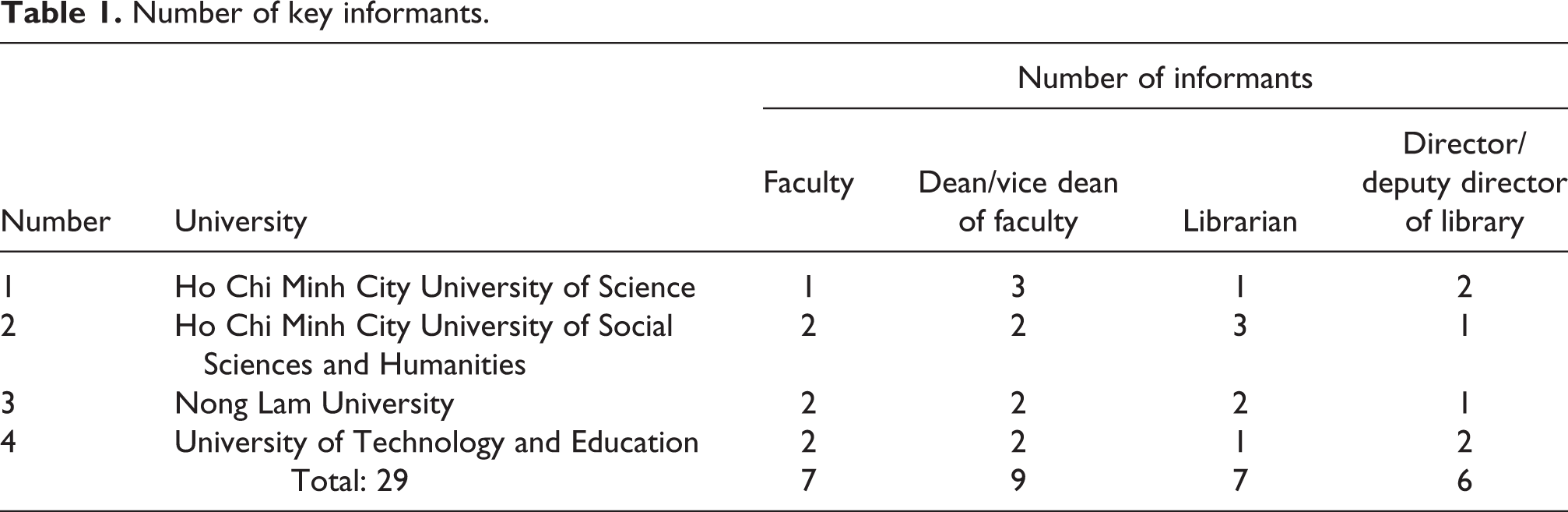
This article is part of a research project that is studying the current situation and factors that affect faculty–librarian collaboration, and contributes to the development of a collaborative model shaped by the Vietnamese context. The interview protocol was developed based on the theoretical frameworks of Pham (2016) and Kezar and Lester (2009) regarding the factors influencing collaboration and the reorganizing of universities’ features. These theories adequately provide the theoretical foundation in order to help draw a comprehensive picture of the collaborative status and organizing features of universities to support collaboration, as well as identify the advantages, drawbacks, barriers and enabling elements that influence collaboration.
The questions focus on elucidating the interviewees’ perceptions of collaborative plans, policies, objectives, activities and means of contact, and the management of collaborative relationships at different units, as well as identifying the participants’ views on the advantages and disadvantages of establishing a partnership (see Appendix 1).
According to Brockington and Sullivan (2005), a qualitative methodology is useful for researchers to understand individuals’ cognition, experiences and perspectives of issues in the world. Thus, the data collection through semi-structured interviews concentrated on three main groups of participants – namely, faculty, librarians and administrators (directors and deputy directors of libraries and deans and vice deans of faculty) – and collecting documents. The interview form helps to improve the data’s detail and completeness from different participants on the same topic. Individuals’ willingness to take part in the interviews represents the selection criterion for acquiring the interview samples. Additionally, key informants also joined in the collaborative process and provided in-depth understandings of faculty–librarian collaboration. Furthermore, interviewing administrators to determine their views, perceptions and experiences helps in understanding issues concerning strategies, policies, processes, resources, collaborative work, and the weaknesses and strengths in collaborative partnerships.
The researchers contacted the directors and deputy directors of the libraries via email to inform them of the research topics and purpose, and ask them to arrange an interview schedule. In addition, the names and contact information of librarians, faculty and deans or vice deans of faculty who would be willing to be interviewed were also consulted and suggested. Furthermore, informants were also selected from the survey respondents based on their willingness to share their perspectives in order to gain an in-depth understanding of collaboration practices.
The interviews were conducted at the four universities during a two-month period from March to April 2019, with each interview lasting between 30 and 75 minutes (around 30–40 minutes for faculty and 30–75 minutes for the librarians and administrators). In order to show adequate data from participants, it is imperative to transcribe every word, which helps analyse and verify the appropriate data in the next stages (Pickard, 2007). Therefore, after every interview, the researcher transcribed the recorded files. The transcription process took from two to four hours for each recorded file.
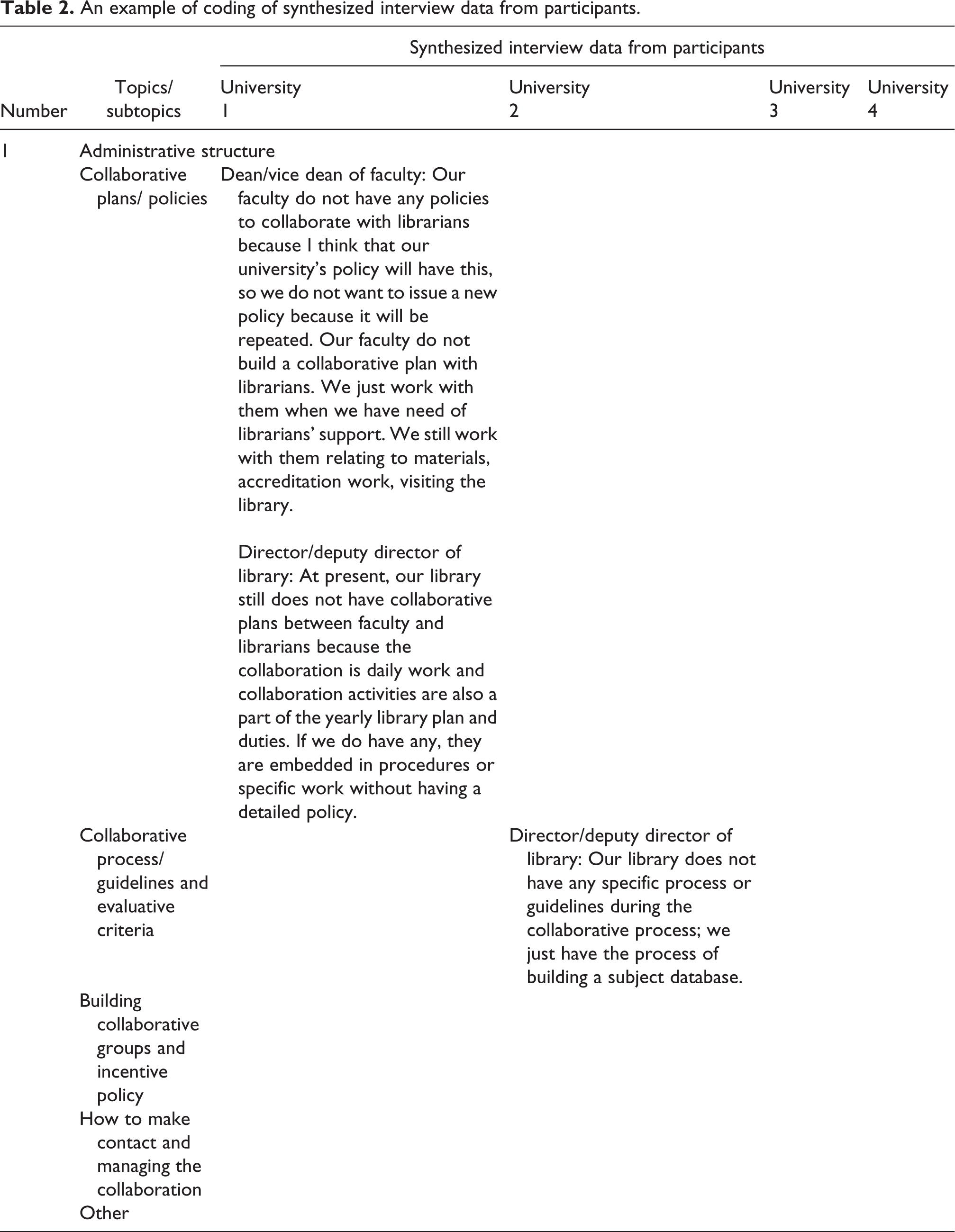
The interview data was analysed following detailed questions. The answer was expressed under each question. Then, the similarity and difference of perspectives and ideas of themes, topics, subtopics and new issues from collected data were gathered and recategorized. Following each topic/subtopic, the perspectives and perceptions of the informants were synthesized and aggregated under the respective rows. For instance, the interview questions concerning the administrative structure were synthesized under the subtopics as shown in Table 2.
An example of coding of synthesized interview data from participants.
Research findings and discussion
Administrative structure
Collaborative plans/policies
The four universities show similar results. At most academic libraries, faculty–librarian collaboration has been integrated into specific policies (for example, circulation, collection development and information services) with a focus on building subject databases, publishing textbooks and proceedings, designing syllabi, and instruction on seeking and using databases and online resources, for example, rather than developing a separate collaborative plan or policy: The library management board has developed an annual strategic plan for the library. However, this is a general plan for all activities without having a separate plan for collaboration work. For faculty-related work, some functional parts of the library could set up separate goals for each team, but these plans are for internal use only and could change, primarily depending on the faculty. (Library director 1)
One of the library directors commented: ‘Contacting the faculty depends on each person’s communication skills. For tasks that need the faculty’s collaboration, librarians will be flexible and proactive in contacting them because the faculty are very busy; so we cannot give a detailed collaborative plan’. Therefore, the director of the library hoped that university leaders will show interest in the faculty–librarian collaboration by issuing an official policy to require the faculty to collaborate with librarians; if it is not compulsory, the faculty will not care about the library because they think that these are useless activities and that they do not get any benefits from them.
The collaborative initiatives that had been implemented were frequently included in the annual report of the library. In other words, most administrators confirmed that faculties did not need to create a collaborative plan/policy because of the library’s functions and the good relationships among libraries and faculties: I found that our unit and academic library have had a very close and friendly relationship. When needed, we can contact librarians to ask for their help, achieving initial goals and performance without building any plans. (Vice dean of faculty 1) Library and faculties are independent units having separate functions and roles…A library is a place to serve and to meet teachers’ and students’ needs; thus, we can contact and ask for support when required. I think there is no need to formulate any policies for collaboration. (Dean of faculty 1)
The results reflect Denison et al.’s (2017) evaluation that research support services are provided by the library when required by faculty, without a clear collaborative strategy/policy between library staff and faculty.
Collaborative process/guidelines and evaluative criteria
The results are similar among the Vietnamese universities. In most cases, the faculty and librarians said that collaborative processes/guidelines are often seen in specific processes relating to library activities, such as collection development, instructions for searching in databases, and searching for and providing information. In these processes, the roles and responsibilities of the stakeholders are clearly defined. Examples can be found at the University of Technology and Education library, which has developed textbooks and published proceedings, or at the Ho Chi Minh City University of Social Sciences and Humanities library, which has developed subject databases.
In terms of evaluative criteria, collaborative effectiveness is primarily assessed from the degree of completion of an individual’s work in their year-end reports and whether their initial goals have been achieved. One administrator mentioned: ‘Our library has not published specific regulations in official documents, but specific tasks are assigned to librarians every year. If librarians do not finish their responsibilities, they would receive a low evaluation of their performance’. A faculty member also indicated: When I work with librarians, I often contact them as individuals and do not report to my dean. Usually, in the results of the year-end report, I only report results achieved through the products instead of reporting during the work process. Administrators also have not managed the working time of faculty members, just rely on the final results.
Building collaborative groups and incentive policy
At most academic libraries, there is a group of librarians who handle the various work of faculty (for example, instruction in the use of databases and online resources, subject databases, syllabi, collection development and information services). However, librarians not only conduct collaborative work; they also undertake other responsibilities. In cases of a heavy workload, library administrators may change or call in other librarians for support if necessary. During the working process, librarians are required to report difficulties and immediately seek solutions. Librarians prepare exchanged and revised content before working with faculty.
The administrators said that they arranged opportunities for their staff to attend conferences and training, and take short courses to improve their knowledge, skills and qualifications, or they provided flexible work schedules. However, no specific incentive policy was implemented for faculty–librarian collaboration. It mainly depended on the university’s policies. A library director stated: ‘My library has not had any incentive policies because this is part of a librarian’s work; therefore, we would rely on their work performance and review and evaluate it at the end of the year’.
How to make contact and managing the collaboration
There are many ways for faculty and librarians to connect in the collaborative process, such as social networking, face-to-face, or by email or telephone. At Ho Chi Minh City University of Social Sciences and Humanities, the librarians frequently use email for collection development and face-to-face communication and phone calls for other activities, while they rarely use social networks to interact with faculty as they are only used with members of faculty who they have close relationships with: ‘There are some cases librarians send emails to the faculty, but they never reply; therefore, it is easier and more convenient to contact faculty directly’ (Librarian 1).
At the other universities, a variety of methods are used to contact librarians: email and Facebook at the University of Technology and Education, and Facebook, Zalo (a Vietnamese social network), email, telephone and in person at Nong Lam University and Ho Chi Minh City University of Science. In general, choosing communication tools depends on the nature and urgency of the work and faculty–librarian relationships: ‘I use a lot of communicative ways. However, choosing appropriate ways to make contact depends on each situation. For instance, for urgent work, I call the librarians, but send an email or message via Facebook, Zalo for other circumstances’ (Librarian 2).
Managing the differences in faculty–librarian collaboration in different faculties depends on the specific characteristics of the research field, the discipline, and the faculty’s ability to adjust and handle specific situations. Some of the librarians indicated that most faculty were very polite, friendly, enthusiastic and willing to support librarians, while others did not care: ‘different personality and attitudes; some faculty are very excited to collaborate, others are not cooperative or ignore librarians’ requests’ (Librarian 3). The reasons for this issue will be explained in the evaluation of collaboration below.
In the Faculty of Economics Nong Lam University, most faculty are encouraged to read and use English material in their teaching and research; thus, it is complicated for librarians to ask the faculty about collection development because discipline-specific material has been brought in at the unit’s library and may meet their research needs.
Collaborative objectives and activities
While, in general, the faculty mentioned collaborative relationships primarily in relation to teaching and research, from the perspectives of the librarians, they had a variety of objectives. It may be noted from the results from the faculty that they had many needs when working with librarians: (1) the need for librarian support to search for documents, books and textbooks regarding their teaching fields: ‘I connect with a librarian to gain more information, especially new material, because the librarian normally knows information resources and knows how to search, and helps in searching documents relating to disciplines and topics which I am researching’ (The faculty 1); (2) to satisfy document-searching needs and access information resources supporting research needs; (3) to exchange material and to support the publishing of learning material (for example, textbooks or online lectures) and conference proceedings; and (4) to create a close and friendly working environment: ‘it depends on each person’s needs; like [name of a vice dean of faculty], my objectives concern communication, accreditation, curricula evaluation, or talking about the databases’ (Vice dean of faculty 2). However, one faculty member claimed that there were no goals in the collaborative process: I have no goal because everyone has different roles and tasks. From the university’s perspective and the relationships between individuals, it is best not to set any goals at all. I think it is good for us to be able to talk, to communicate with each other without setting up any purposes; in teaching and research, it is also not necessary.
Additionally, the librarians noted other objectives. They sought to consult faculty in collection development and circulation policy, and to identify material in various disciplines to meet faculty needs. They also thought that faculty could help librarians by requiring and encouraging students to use the library’s resources, introducing and promoting material to students, and coordinating students’ participation in library events.
Designing syllabi
In recent years, Vietnamese universities have evaluated educational quality. Faculty must therefore ensure that the syllabi follow accreditation standards, in which references used in the syllabi must be available in the institution’s library. However, the designing of syllabi varied greatly between the four universities.
The University of Technology and Education showed a close connection between faculty and librarians. Ordinarily, faculty relied on the information resources provided by librarians to create a syllabus. When materials were not available at the library, faculty would propose to supplement or replace them with other literature. The textbooks and reference systems at this university adequately met the faculty’s and students’ learning and teaching needs. It is, therefore, convenient for assessing quality assurance.
By contrast, at the other universities, most of the faculty commented that the library’s collections were old and inadequate to satisfy their teaching needs, and that they rarely used their materials and the available information resources at the faculty libraries to design a syllabus. Consequently, the librarians spent more time checking references. If the material used in the syllabi was not available at the library and could not be supplemented, librarians required the faculty to delete or replace it with other material; however, some faculty did not cooperate: Building a syllabus is the most strongly connected activity between faculty and librarians since librarians will directly contact faculty to recheck and adjust a syllabus (if any). However, contacting is tough…some faculty are not willing to collaborate because they are (1) afraid of change, (2) do not have time, (3) do not have a budget for modifying and updating the syllabus, so they do not care. (Library director 2)
Collection development
Librarians and administrators reported that their library annually raised funds for collection development. Thus, in order to enhance the quality of information resources to meet learning, teaching and research needs, it was essential to collaborate. Usually, librarians would send a list of publications to the faculty to ask for their selection, or require a list of specific material relating to the faculty’s teaching and research fields, and would then notify the faculty after purchase. The results of this study support Le’s (2010) findings about librarians’ roles in the acquisition of information resources based on specific subjects, creating subject guides and reading lists, and introducing new collections for faculty. However, most faculty complained that the library’s information resources merely met students’ basic learning needs; in particular, there was a lack of specialized databases and online resources. Therefore, most faculty searched and used external information sources for their research activities.
According to the librarians, they also encountered challenges that impeded collection development, such as limited budgets, no faculty support, or complicated policies and procedures. One library director reported: Faculty do not care about our library because they are very busy…Sometimes, librarians send emails or documents to require the faculty’s support in selecting material from publishers’ lists, but they ignore them. Furthermore, our university’s procedures are complex, including six steps; thus, after approval by managers, publishers no longer have the material required; in some cases, if our library selects and sends this list to faculty, we are not sure whether those books will be selected or not.
Research support activities
Vietnamese universities primarily focus on research support activities – that is, instruction in using online resources and databases; introducing research support software (for example, Endnote, Latex, EEWOWW or Mendeley); publishing textbooks and conference proceedings; seeking and providing information resources based on researchers’ demand; and archiving research work.
Instruction in using online resources and databases was the most important and most often performed activity at the Ho Chi Minh City University of Social Sciences and Humanities. This university’s library started providing instruction on using databases to 20 faculty members in 2017. Relying on syllabi, library staff extract lists of specialized material from the library databases and organize sessions that take place in the faculty/department office. This activity helped build close relationships with faculty: Many years ago, the library did not actively contact faculties or departments in guiding and sharing new information; rather, it merely provided support when asked by the faculty. However, our library now wants to show a proactive role in approaching the faculty to promote useful information resources for them that they do not know of. (Library director 3)
The number of needs for seeking and providing information resources services based on researchers’ demand at universities was limited for three reasons: (1) the faculty already had good information search skills; (2) the information resources did not satisfy their research needs; and (3) faculty could use other sources to seek more in-depth information. However, some of the librarians said that although few faculty members used this service, they recommended that their students contact librarians for searching assistance and to provide documents to serve their research needs.
In terms of introducing research support software, all of the librarians commented that most of the faculty had good skills and knowledge of using software to support research. Thus, the librarians introduced them to some common and useful software (for example, Endnote, Latex, EEWOWW and Mendeley) via websites and Facebook pages: ‘For research or citation, most members of our faculty [the Faculty of Information Technology Ho Chi Minh City University of Science] use support software proficiently; thus, we do not need any support or guidance from librarians’ (Vice dean of faculty 3).
When asked how they supported faculty in publishing textbooks and workshop proceedings, the librarians indicated that they worked with a reputable publisher and were responsible for supporting procedures, documents, appraisal and publication costs. Publishing support was a regular activity and highly appreciated by the University of Technology and Education faculty. There were sustainable and close relationships between librarians and faculty, in which both parties were willing to support each other in certain activities.
No collaborative work was in place to archive and manage research data at the academic libraries. Faculty members wanted to manage their data using their personal computers, mobile storage devices, Google Drive, Dropbox and so on. However, since their libraries followed the published university deposit policy, for theses, dissertations, textbooks and reference books, they were required to submit a hard copy and compact disc.
Other collaborative activities were conducted at these Vietnamese universities, such as supporting faculty in organizing conferences, events and seminars (i.e. exhibiting specialized material, receptions and seeking grants); introducing books to faculty; providing documents and data to evaluate the curricula; developing software; and managing faculty/department libraries. The University of Technology and Education library staff also supported faculty in confirming statistics and providing application documents and files for the titles of Associate Professor and Professor. Furthermore, some of the libraries have developed a liaison librarian model and provide a designated research room to stimulate and assist with research needs, or a link for faculty to deploy a learning and research consultation service for students.
Evaluating the collaboration
The results, in general, show the different findings from the interviewees’ perspectives relating to the evaluation of collaborative effectiveness. Most of the faculty explained that, within the scope of collaborative work, they highly appreciated the librarians’ support because the library staff were friendly, enthusiastic and supportive. However, when asked to explain why faculty were not interested in the library or did not support library staff in collaborative activities, several reasons were cited: the lack of promotion of information resources and library services; limited information resources, especially discipline-specific databases at the library; faculty’s research needs were not urgent, thus their use of information resources and library services was limited; time constraints; and individual needs: Connecting to librarians depends on personal needs because we cannot request the relationship between faculty and librarian to be like this or like that…For some activities that need librarians’ support, the faculty also contact them to ask for their help. (Vice dean of faculty 4)
By contrast, the evaluative results provided by the librarians are entirely different. It is essential to realize that the collaborative relationship between librarians and faculty is superficial and non-intensive, not frequent and continuous. The collaborative work that takes place in the first and necessary steps between individuals is provided as needed but without a sustainable connection. This may be due to several factors: the universities having no collaborative plan/strategy to require collaboration; many faculty and administrators not perceiving the roles and benefits of a faculty–librarian collaboration relationship; faculty not understanding the role of librarians and the services provided by the library; in daily practice, faculty being unwilling to collaborate with librarians to solve problems, contacting them mainly when they need librarians’ support for issues that they cannot resolve by themselves; librarians and faculty not establishing a collaborative process, guidelines or evaluative criteria, and collaborators’ responsibilities and roles not being clearly defined; librarians’ knowledge and skills being constrained in supporting faculty to conduct teaching and research activities; and, with regard to psychological issues, librarians not being confident about their knowledge and skills when working with faculty.
These reasons are similar to those from previous studies in Vietnam, where faculty underestimated librarians’ teaching capacity (for example, teamwork skills and English language skills); thus, this influenced opportunities for librarians to establish a collaborative relationship with partners. Furthermore, the lack of support from leaders and administrators, faculty’s work overload and limited time, and limited knowledge about specific subjects/majors have prevented librarians from implementing collaborative initiatives (Diep, 2011; Nguyen, 2008; Pham, 2016). Therefore, these librarians hoped that collaborative models would become more professional in the future.
The results from the interview data indicate the different perspectives of faculty and librarians. However, collaborative work at these Vietnamese universities has achieved the following: Faculty members and library staff are proactive in collaborating to design syllabi and curricula to meet accreditation standards. Moreover, faculty appropriate the roles of librarians in supporting their students to search for information and providing information resources following research needs. At the University of Technology and Education, the library plays a critical role in promoting research activity by connecting with publishers to support publications on campus. Various information channels and social networks have capitalized on contacting the faculty and promoting the libraries’ products and services. A group of librarians has been established who are willing to support faculty at units to deploy collaborative work. Library staff have excellent expertise and skills, and are enthusiastic about supporting faculty. Collaborative work has been integrated into the yearly plans of faculties and the academic libraries, although with no strategic plan for faculty–librarian collaboration. Librarians are flexible and ready to support faculty when problems arise, as well as organizing meetings to resolve these problems, thereby experiencing mutual cooperation. Administrators at academic libraries have created opportunities for librarians to join events and activities to improve their knowledge and expertise, and expand their relationships.
Although collaboration in Vietnam only focuses on primary collaborative initiatives, the administrators, faculty and librarians desired that collaborative partnerships be promoted and extended for the following benefits: Faculty members play essential roles in advertising information resources to students and enhancing the effectiveness of library use. Faculty members are useful to consult and provide information about resources relating to their extensive expertise, which librarians are limited in. At the same time, librarians can provide new information resources and guide the use of databases for faculty. Librarians can save faculty time in searching for and selecting documents. Librarians can connect to valuable publishers and support the publishing process of faculty. To capture faculty’s teaching and in-depth research needs for timely support. The improvement of teaching and research skills and the performance of collaborators.
Conclusion
Based on the evaluation of collaborative effectiveness, the authors have provided recommendations to improve and develop sustainable faculty–librarian relationships. Leaders should develop and publish a collaborative plan that defines the roles and responsibilities of faculty and librarians, and identify compulsory rules in the collaborative process. In addition, they ought to develop information resources, especially specialized databases and advanced discipline-specific knowledge. On the other hand, librarians need to self-study and enhance their specialized knowledge, research skills and competencies to support faculty in publication strategies and research activities. They must be more proactive in communicating with faculty, actively promoting information resources and useful services for the faculty’s teaching and research. Librarians also need to actively promote the library and information products and services, as well as information resources. Furthermore, the authors argue that libraries and faculties should design a specific collaboration process and guidelines, and identify criteria to evaluate the effectiveness of their collaboration. Finally, it is recommended that a liaison librarian model is deployed to better support faculty in their teaching and research activities.
Footnotes
Appendix
The interview protocol.

| Interview questions | Librarian | Faculty | Dean/vice dean | Director/deputy director of library |
|---|---|---|---|---|
|
|
✓ | ✓ | ✓ | ✓ |
|
|
✓ | ✓ | ||
|
|
✓ | ✓ | ✓ | ✓ |
|
|
✓ | ✓ | ✓ | ✓ |
|
|
✓ | ✓ | ✓ | ✓ |
|
|
✓ | ✓ | ||
|
|
✓ | ✓ | ✓ | ✓ |
|
|
✓ | ✓ | ✓ | ✓ |
|
|
✓ | ✓ | ✓ | ✓ |
|
|
✓ | ✓ | ||
|
|
✓ | ✓ | ||
|
|
✓ | ✓ | ||
|
|
✓ | ✓ | ✓ | ✓ |
|
|
✓ | ✓ | ✓ | ✓ |
|
|
✓ | ✓ | ✓ | ✓ |
Acknowledgements
The authors are grateful to all of the participants and administrators at the four universities in Vietnam for their valuable contributions to this study.
Declaration of conflicting interests
The authors declared no potential conflicts of interest with respect to the research, authorship and/or publication of this article.
Funding
The authors disclosed receipt of the following financial support for the research, authorship, and/or publication of this article: This research has been sponsored by the Vietnamese government (Project 911).
