



Abstract
Findings from a study of the advantages and disadvantages accrued by individuals from their public library use, and the impact of this on citizenship at individual and community levels, are presented. The analysis of longitudinal focus group data collected on two occasions at eight UK locations at a time of a so-called ‘public library crisis’ demonstrates a strong sense of the epistemic role of public libraries, and their conception as safe, welcoming, community-owned spaces. Links between public library use and the development of citizenship are less easily identified. However, the evidence shows that public library use facilitates participation in society, and provides resources to allow individuals and communities to fulfil their societal obligations.
Introduction
Between 2010 and 2016 the number of UK public libraries decreased by 14% (BBC, 2016). Library closures, and associated cuts to continuing services, have prompted strong (and often emotional) responses amongst active and passionate public library users, as well as within professional groups such as librarians and authors (see, for example, Blackmann, 2013; Cassidy, 2015). Such reactions are often framed in terms of a UK ‘public library crisis’, with attention drawn to contravention of the requirements of legislation 1 that authorities provide comprehensive and efficient library collections to the communities that they serve (for example, Barron, 2012). Whatever the value of the attention that the so-called ‘crisis’ attracts amongst public library enthusiasts and the media, it is more likely that academic research that explores the societal good of public libraries, and generates findings from robust studies, will be taken seriously at policy levels. The content of this paper concerns one such piece of research that seeks to explore issues on the broad theme of public library roles and value.
Here are presented findings from a study that was designed to consider the advantages and disadvantages accrued by individuals through public library use, and the impact of this on citizenship at individual and community levels. The analysis of focus group data collected at eight UK locations (first in 2015, and again in 2016) demonstrates a strong sense of the epistemic role of public libraries (i.e. related to their contribution to the development of knowledge), and to their conception as safe, welcoming spaces that belong to the communities in which they are located. Here active public library users learn new skills, further their education, develop their careers and make new contacts. Links between public library use and the development of citizenship have also been identified from the analysis of these data. The evidence shows that public library use facilitates participation in society, and provides resources to allow individuals and communities to fulfil their societal obligations.
To set the context for this work, there follows a literature review that covers the main themes of the role of public libraries in the 21st century, and an assessment of their value. The application of Phases 1 and 2 of a three-phase longitudinal focus group methodology for the study follows. The findings are then articulated according to four main themes that have emerged from the analysis of the data: (1) the epistemic role of libraries; (2) the primacy of print; (3) public libraries as safe, inclusive community spaces; (4) community ownership of public library services, and citizenship. These themes are discussed with reference to the extant literature, and their implications considered in terms of their contribution to understandings of the value and impact of engagement with public library services.
Literature review: The role of public libraries and measurement of value
In the early 21st century public library commentators such as Brophy (2001) and Totterdell (2005) noted that public libraries have traditionally been most readily conceived according to epistemic functions related to the acquisition of information and knowledge (often for education purposes), alongside the provision of access to culture, leisure and recreational materials. However, they argued, public libraries represent more than the physical buildings in which they are located and the resources that they contain. Rather, they are social entities that deliver additional value that includes supporting and assisting users with a variety of tasks through the provision of expert professional staffing. The inclusive nature of public libraries was also noted in this earlier work (Brophy, 2001), as was the sense of public libraries as community hubs that ‘exist to serve the needs of people, to help them live, learn and develop and to act as part of the social glue which holds communities together’ (Brophy, 2006: 3).
Wider contributions that accrue from public library services, it has been claimed, include a positive impact on civil society. For example, reference has been made to the support of ‘the self-education of the citizenry in order that they may become fully participating members in a democratic society’ (Alsted and Curry, 2003: 2). This can be attributed to the creation in public library settings of social capital, i.e. current or potential resources held within networks of relationships possessed by individuals or social units (Nahapiet and Ghoshal, 1998: 243). This is thanks to the provision of universal access to information sources in defined spaces (Goulding, 2004; Johnson, 2010; Varheim, 2007).
Furthermore, Johnson (2010) argued for measurements of social capital generation in public libraries as a fruitful way to assess library performance and impact, and one that is more appropriate than quantitative measures such as counting library visits or book loan transactions. This claim was later tested in an empirical study conducted in three branch libraries of a public library service in an American mid-west city. Johnson (2012) concludes in this later study that social capital is built through relationships and interactions between library staff and users through: the building of trust; connecting people to both community and information resources; the provision of social support; reductions in social isolation; helping users to learning online skills; and the creation of a positive community space. She states that when library staff envisage their services fundamentally as providing access to information resources and leisure materials, they may be ignoring the impact of the development of social relationships with users.
Johnson’s study is just one in a body of work undertaken by both academics and practitioners that represents a significant sub-discipline of library and information science research, i.e. that which focuses on measuring library performance to demonstrate value and impact. Motivations for such studies are prompted by the desire, and political need, to show the positive outcomes of library investment. Their output includes practitioner guides, such as the Scottish Libraries and Information Council (SLIC) (2015) publication How Good is our Public Library Service? to help demonstrate the impact of libraries on communities. To complement this, SLIC and the Carnegie Trust have also developed a national strategy for public libraries in Scotland (SLIC and Carnegie Trust, 2015). This focuses on areas such as literacy, digital inclusion, economic wellbeing and social wellbeing. Equally, analyses of public library outcomes and the larger social role that they play at national levels have been published by academic researchers. For example: Vakkari et al. (2015) compare the perceived benefits of public library usage across five culturally different countries (Finland, Norway, the Netherlands, South Korea and the USA), and highlight the differences in societal outcomes for the public library services in each country; Spacey et al. (2015) consider the extent of role of the public library in providing access to online information to the general public in the UK.
The development of meaningful success criteria is essential to studies of library value and impact (Markless and Streatfield, 2006). The identification of relevant indicators also depends on understanding user needs (Hernon and Altman, 2010: 10) and potential social impacts (Kerslake and Kinnel, 1997: 12). Examples of outcomes to measure include: knowledge gained by users; increased information literacy competencies; higher academic or professional success; social inclusion; and increases in individual wellbeing (Poll and Payne, 2006, p. 550). Such outcomes are easier to specify in types of library other than public because the desired outcomes of public library use are not necessarily defined by local authorities (unlike academic libraries, for example, where user objectives are more likely to align with institutional goals such as higher student attainment).
Traditionally quantitative methods have been adopted to demonstrate public library return on investment to the authorities that provide their funding. For example, McMenemy (2009) advocates the measurement of both outputs and economic impacts to provide evidence of value for money, and the adoption of contingent valuation to assess a library’s economic value. Details of similar studies in other library sectors have been published. For example, a study at national library level revealed a £4 return generated (in terms of public good, knowledge transfer, intellectual capital, etc.) on every £1 invested in the British Library (Pung et al., 2004). Similarly, academic libraries use metrics and learner analytics to demonstrate impact on outcomes such as retention and achievement by students in their respective institutions, as exemplified in the JISC Library Impact Data Project (Stone et al., 2012). A further example from academic libraries is the LIRG/SCONUL Impact Initiative. This assessed the impact of higher education libraries on specific outcomes around learning, teaching and research in UK universities (Markless and Streatfield, 2005).
Of the few exceptions to quantitative approaches is the social audit approach. This was applied to the public sector outcomes that UK libraries were expected to demonstrate in the 1990s (Linley and Usherwood, 1998). It was successful to some extent but, in effect, this study simply reiterated the perceived value that public libraries have in all aspects of community life. That said, the case study data from Newcastle and Somerset provided much evidence of the perceived value, worth and impact through testimonials and stories.
Public libraries have previously been identified as ‘public spheres’ in which reliable and adequate information can be accessed to inform opinion and debate (Webster, 2014) and, in turn, develop citizenship within communities. However, this type of impact has not been measured directly in a piece of academic research (albeit that other factors that may contribute to this, such as social capital and social inclusion, have merited attention). Identification of this gap in the literature prompted the development of the empirical work described in detail below.
Methodology
Selection of a longitudinal focus group approach
For this work it was necessary to select research methods that would enable the collection of data from public library users about their experiences of library use and its impact. It was also important to this study – with its aim of generating findings at the level of the community – that the participants reflected collectively on these themes. It was felt that this was less likely to be achieved through the implementation of some of the more commonly qualitative data collection methods adopted in library and information science research, such as surveying or interviewing.
A focus group approach appealed since focus groups give simultaneous access to several data subjects who possess certain characteristics, and can provoke discussion in the form of a conversation in response to well-constructed questioning. The conversation can be captured as a qualitative data set for later analysis to aid understanding of the research topic (Krueger and Casey, 2009: 6).
A further consideration was the identification of an approach that would allow for observing and evidencing social development over an extended period in a longitudinal study. Prior work has noted that focus groups are suitable for this purpose (Lewis and McNaughton Nicholls, 2013: 61–62). Here interval contingent recording affords the opportunity to involve the same participants in the study at regular and pre-determined times (Bolger and Laurenceau, 2013). It was also anticipated that reconvening the focus groups over the course of this study would build familiarity and trust amongst the membership, lead to deep and open discussion, and thus generate richer data sets in the later meetings.
Implementation of the longitudinal focus group approach
The decision was taken to first pilot the focus group approach in one public library service and – assuming that it was both practical to implement, and generated suitable data for analysis – apply it to the whole study. The pilot was held in Liverpool in September 2014. Eight public library users who represented a diverse population in terms of gender, age, ethnicity, level of education and nationality, answered the call for participation advertised on posters and on the council web site. When gathered together they responded to questioning on their attitudes towards the public library service, opinions on the function of public libraries, and their understanding of citizenship and libraries. This exercise was deemed a success on the basis that the participants understood the questions that they were asked to discuss and their conversations generated data that were usable for future analysis.
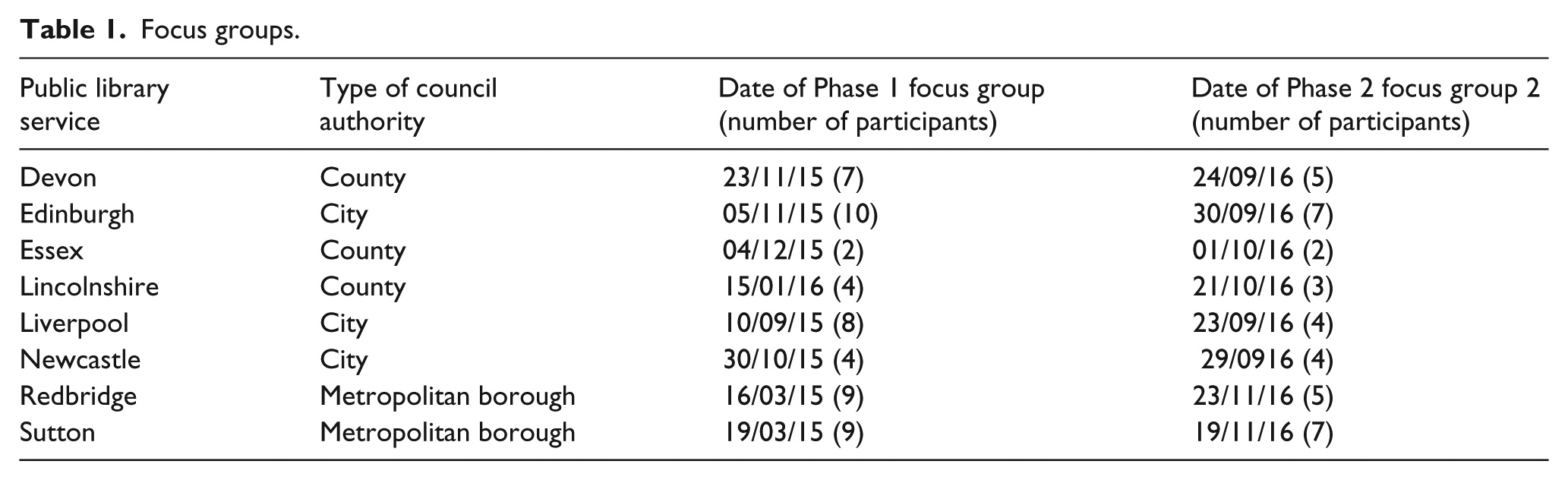
Further public library services were then approached to participate in the larger study. Table 1 lists them with the timings of each focus group, and the distribution of the 53 participants. While the participants were self-selecting, they came from a cross-section of the UK population: they ranged in age from 15 to 83; the majority was female (66%), most were British (85%); the ethnic make-up was split across individuals who identified as white (70%), Asian (21%), and Afro-Caribbean (9%); and there was variety in their levels of educational attainment.
Focus groups.
An important characteristic shared by members of this group, and one that distinguishes them from the general population, is that they were all enthusiastic users of public library services – so much so that they were willing to give up their free time to participate in focus groups on the theme of this research. In this respect they should be considered collectively as a self-selecting group of atypical active public library users. While this might be viewed as a weakness of other research that seeks to establish general opinion about public libraries in the UK, for a study such as this (which sought to explore the advantages and disadvantages accrued by individuals through public library use, and the impact of this on citizenship at individual and community levels) this was essential to the research design. To include infrequent public library users in such a study would not have generated suitable data for analysis.
The analysis of the data from the pilot study contributed to a refinement of themes for the Phase 1 and 2 focus group conversations. These were reframed as a values framework based on three factors:
the epistemic function of libraries;
access to libraries, information and support;
integration and inclusion.
The questioning included the same elements identified for the pilot: attitudes towards the public library service, opinions on the function of public libraries, and their understanding of citizenship and libraries. The participants also spoke about demands for, and use of, knowledge and information.
The Phase 2 meetings in 2016 allowed for an exploration of the additional themes of individual and community learning and development, as afforded through public library services. The participants were asked to discuss and reflect upon their personal development and involvement in their communities in the intervening 8–12-month period, and the extent to which (if at all) this had been facilitated through their library use.
The 16 focus group conversations were audio recorded and transcribed, and then the text coded using Nvivo 10. The coding scheme reflected the three elements of the values framework, and the sub-themes that emerged in the focus group discussions:
access (physical)
access (IT and e-resources)
books and monographs
citizenship and participation
community cohesion
integration
knowledge capital
knowledge and information sharing
people and library users
social capital
space
transactional capital
(A further round of focus group meetings took place at the end of 2017 as the third and final phase of data collection for this study.)
Findings from the Phase 1 and 2 focus groups
Four main themes emerged from the analysis of the focus group data: (1) the epistemic role of libraries; (2) the primacy of print; (3) public libraries as safe, inclusive community spaces; (4) community ownership of public library services, and citizenship. Each is discussed in turn below.
The epistemic role of libraries
There was unanimous agreement amongst all focus group participants that the primary functions of the public library service relate to its epistemic role. The part that the public library plays in the generation and exchange of knowledge and information, and the link between knowledge and power, surfaced quickly in the Phase 1 focus groups, and was constantly revisited in Phase 2. As illustration, a retired male doctor in Liverpool said: …handling all those really old manuscripts and books … It’s knowledge, just a body of knowledge. And knowledge is power, I believe. Knowledge is power!
Similarly, a female participant from Lincoln who works as a school teacher, explained: I essentially feel empowered. I have all that information, knowledge and creative stuff at my fingertips.
According to the participants, a number of public library services contribute to this epistemic role. These include the provision of access to information in print and online formats, and expert knowledge in the form of library staff. The latter is regarded as adding most value when answering enquiries and facilitating access to the print stock. Space in which to consult and consume such resources is also important. Many participants mentioned the impact of these services on education (their own and that of their children), by making links between accessing literature, learning to read and literacy, and life-long public library use.
In the Phase 2 focus groups the participants gave examples of a diverse range of topics that they had studied with the support of public library resources to inform themselves, satisfy their curiosity, or develop their skills: aromatherapy; cookery; drawing; gardening; learning to play musical instruments; and local history. Access to political party and council information merited particular attention because this enables political participation. The Liverpool focus group members, for example, reported being able to make informed decisions regarding political activity having consulted such sources.
The value and impact of this epistemic function of the library was further validated in discussions when participants reported that they feel ‘let down’ or disadvantaged when resources and support are unavailable at their public library. For example, in Lincoln there was concern over an ever-diminishing book-stock, and several participants reported a lack of confidence in the ability of unqualified library staff to support them with enquiries, particularly in respect of access to digital resources and computer use. Equally in Newcastle and Sutton there was dissatisfaction at staff who were ill-equipped to support new multi-functional aspects of the public library service delivery.
The primacy of print
The participants showed enthusiasm for the printed monograph as the primary information format offered by libraries. This opinion was shared by all participants across the eight focus groups, regardless of member demographics. For example, a Redbridge participant (retired, male) said: My favourite thing about the public library is that you can just grab any book that you like and you can just sit as long as you like and read it, and if you really like it you can get another one! Books!
Indeed, nearly all the participants valued print information over online. Print was highly regarded for its reliability, credibility and trustworthiness. This judgement applied especially to reference materials, children’s literature and self-help or instructional books, where a preference for accessing print over digital was evident. Even in the case of straightforward factual material, such as bus timetables or community information, these active public library users reported that they trusted printed versions more than their electronic counterparts. There was also a sense that engagement with a printed source is a more rewarding and enjoyable experience than consulting a computer, whether this be for recreational or educational reasons.
It should be emphasised that these findings do not appear to be associated with low levels of computer literacy, nor with age. For the most part, the participants were active and competent computer users, and even the digital natives in the cohort, who spoke at length about their enthusiastic use of technology, shared this opinion with the older participants. Rather, the analysis of the data for this study indicates a perception that the public library is a place to access print information held in books. This distinguishes public libraries from other types of library service, as noted by the focus group participants who were also active users of academic and school libraries.
Public libraries as safe, inclusive community spaces
Other functions of public libraries (beyond those encompassed in the epistemic role) are evident from the analysis of data from the focus group conversations. These relate to the notion of public libraries as important community spaces. A general finding is that they are highly valued for their inclusivity. The participants regularly made comments such as ‘Libraries are for everyone’, ‘Everyone is equal in a library’, ‘It is the one place where everyone is equal’ and ‘There is no prejudice in the library’. This view was expressed most strongly in the focus groups with the city and metropolitan borough public library users. In these focus group meetings the ties between public libraries and social levelling were explored and related to social cohesion outcomes.
In addition, it was noted that people from diverse backgrounds are actively welcomed in public libraries. (This issue was considered more extensively in Phase 2 when the focus group participants reflected on the extent to which public libraries support inclusion and the development of multicultural communities. It is suspected that this was because at the second set of meetings the participants were more comfortable with one another and felt more confident about speaking out about sensitive topics). One of the participants from Essex (male, retired civil servant) elaborated on the question of diversity in respect of ethnicity when he said: It’s inclusive. It makes you feel part of the group. I think that society consists of groups doesn’t it? But I see the library more as a coherent group and it’s very inclusive of people from different backgrounds and cultures.
Another from Redbridge (female, university student) pointed to the different generations that use public library services: You’re never too old to go to a library. You see really old people reading newspapers and you see really young people on the computers or like reading a book or studying or researching. A library is a place where you see every generation.
Public library space was also regarded as physically safe and secure by the focus group participants, especially by those in urban environments. For example, a male college student from Liverpool said: When you’re on the streets no one cares about you. It’s like every man for himself. When you come in here you can just communicate with anyone, you can discuss things with people. There’s loads of things that you can do.
The focus group members eagerly explained that the bringing together of diverse members of the community in public libraries allows for interactions with a mix of people that includes other library users, friends and colleagues, and library staff. They spoke of the personal benefits of this in terms of skills development and learning, as well as making new contacts. The participants who spoke about meeting and getting to know other public library users and interacting with library staff shared largely positive stories in which they were the beneficiaries of information, friendship or socialisation. A female university student in Redbridge, for example, valued the opportunity that this offered for ‘socialising with every kind of person’.
Another in the same focus group (female, college student) made a favourable analogy with social media: The library is like a social media space but in real life. It’s like Facebook, but you can actually go and talk to the people for real.
It was generally acknowledged that as inclusive community spaces where diverse groups can interact, public libraries should offer facilities additional to the established primary function of the provision of print information in book format. The focus group participants provided examples of groups and clubs that meet at their public libraries (for example, GridClub; coding clubs; homework clubs; reading groups; local history groups; music clubs), and classes on offer (for example, Zumba). These were viewed as part of the evolution of public library service delivery that helps guarantee sustainability. However, in some instances, and particularly in the discussions held in the city centre central library buildings in Edinburgh, Liverpool and Newcastle, there was some suggestion that the primary epistemic function of the public library is being diluted by the provision of these additional community services.
Associated with these findings on public libraries as safe, inclusive community spaces is another that concerns library staff and the ways in which they promote inclusion as part of their work roles. Non-discriminatory access to expert staff available to assist the general public with a range of tasks was acknowledged as one of the benefits of public library use. For example, a Newcastle participant (female, health worker) highlighted that she developed computer literacy as a public library user: I learnt how to use computers in the library. [The library staff] showed me how to get online and how to search. I would never have had access to all of that before
An unemployed female participant in Newcastle explained that the public library staff were assisting her job search: The staff are great. They will always show you how to do stuff. You don’t need to book on a course to set an email account up for example. They’ll just show you. The Job Centre doesn’t have computers now, yet you are meant to do all your job searching online. You can now only access this in the library. So having the staff available to help is so important.
Community ownership of public library services, and citizenship
Community ownership of public library services emerged as a key theme in the analysis of the focus group data, particularly from conversations that included discussion of diminishing council budgets. Here participants expressed their anger and frustration at service cutbacks and closures.
The dominant view is that a public library is at the heart of its community and, as such, is owned by that community. This sense of ownership was conveyed in the opinion that aspects of community development (for example, educational and social), and indeed community survival, depend on provision of public library services. It is also evident in the reported actions of users to support the libraries in their communities. For example, a Liverpool participant considered that access to a public library is a basic human right, and participants revealed that they were active in providing feedback to their libraries about service performance, and/or that they had lobbied their councils about public library services provision. There was general agreement on three core points: (1) public libraries provide community; (2) community members expect access to libraries; and (3) communities need libraries to function.
A significant finding related to this theme of community ownership can be drawn from a comparison of opinion between those focus group members whose public library services are subject to risk from cuts and those whose public library services are under less pressure. In the latter group, which included study participants from Devon, Essex, Redbridge and Sutton, there was stronger recognition of the role of public libraries in generating community activity and community ethos.
The main finding on citizenship from the two rounds of focus groups relates to the extent to which the focus group participants believe that public library use supports them in participating in, and fulfilling their obligations to, society. It should be noted, however, that in the Phase 1 focus groups the participants struggled with the concept of citizenship and its relevance to a discussion of public libraries. In the Phase 2 meetings, a focus on how individuals might be politically informed through public library use generated examples relevant to the theme of citizenship. For example, a participant from Sutton explained that he consulted information about planning permission for a proposed traveller site to be established on his estate. He informed his neighbours of this and they then lobbied the council to change the decision, taking into account alternative suggestions. (This question of citizenship was explored at greater length in the Phase 3 focus groups held at the end of 2017 and will be reported upon in due course.)
Discussion: Priorities of place, print, people, and professionals
These findings reveal that active public library users regard the primary function of public library services as being a core place to access information and knowledge, in print format, with the assistance of library staff. Thus the epistemic role of the public library service located at the heart of the community appears to be just as important now as it was almost 20 years ago (as reported by Brophy, 2001, 2006 and Totterdell, 2005). This is despite the introduction of additional (competing) services over the course of the past two decades. This key finding, which prioritises print over digital formats, aligns with findings of prior research from the early 21st century in the realm of Information Society Studies (see, for example, Duff, 2000: 183). Of particular interest here, however, is that the argument for the longevity of the print monograph is forwarded by engaged, computer-literate, public library users. This is not a question of the computer-illiterate rejecting technology adoption, but of computer-savvy individuals expressing a preference for information in print format. This thus brings into question public library collection development strategies that favour online provision.
The notion of public libraries as public places owned by the community is tightly connected with the outcome of community cohesion. For the majority of the active library users in this study, the changes to service delivery to accommodate group meetings and facilitate social interaction are welcomed, and seen to facilitate the generation and exchange of social capital across diverse groups. This strengthens the value of similar findings in prior studies, such as Johnson (2012). This work also add a further dimension to Webster’s (2014) contention that public libraries are places that should be considered ‘public spheres’.
While the active public library users who contributed to this study did not refer to a ‘public library crisis’ using the emotive vocabulary as outlined above, they have an awareness of the precarious political and economic environment within which public library services are delivered. This was evident at the focus group meetings in complaints about staffing and book stock levels, and questions about the diversion of funds from core print services to new initiatives. That the active users regard their local public library as their own also adds to their frustrations about funding cuts and closures.
The main advantages to be accrued from active public library use expressed by the focus group members relate to: the acquisition of information, knowledge and skills; opportunities to socialise and develop friendships; and having a safe place to visit within their community. In the first two rounds of questioning the focus groups also generated new insight into the role of public libraries in citizenship development, and this theme was revisited in the Phase 3 focus groups held in late 2017. (The analysis of data from the last eight meetings will develop further the contribution of this study to the understanding of the wider role of public libraries in citizenship.)
The practical contributions of the study relate to data collection techniques and research design in impact studies. In respect of the former, the adoption of a longitudinal focus group approach has shown some advantages in encouraging participants to speak openly about sensitive topics (such as planning decisions that may disadvantage certain groups, as noted above) when groups reconvene in environments now considered to be familiar and safe. Thus a recommendation from this study is that longitudinal focus groups be considered appropriate for data collection elsewhere in library and information science research, especially in cases where there is a desire to generate rich and deep discussion amongst participants who would benefit from the opportunity to reflect between meetings with others participants and members of the research team.
A second practical contribution of this work relates to the danger of assuming that findings from one library sector are relevant to another. This work has shown, for example, that public library users who are also members of academic and/or school libraries made a clear distinction between these services in terms of preferred access to information in print or online formats. This indicates that impact evaluation tools may be limited in their transferability from sector to sector.
Conclusion
The analysis of data from the Phase 1 and 2 focus groups conducted over a two-year period has surfaced opinion amongst active users of public libraries as services that provide access to information and knowledge (and a range of other less important, supplementary functions) in physically safe, community-owned spaces staffed by experts. These can be used for the advantage of all, for example to learn new skills, for furthering education, for career development and to discover new network contacts. While the impact of public libraries on citizenship has previously been difficult to identify, the evidence from this study shows that public library use supports participation in, and the fulfilment of individual and community obligations to, society. This contributes to the debate around the conceptualisation of public libraries as public spheres in which access to quality information allows for the forming and discussing of ideas and opinions (Webster, 2014).
The novel deployment of a longitudinal approach to data collection through the convening and reconvening of focus groups over three phases has been demonstrated as an effective means by which to gather valuable data that can be used for impact evaluation in library and information studies.
Further analysis of the data generated in this study – in particular those from the Phase 3 focus groups held in late 2017 – will provide additional insight on these themes to extend further theory development as relevant to the value of public library use, and its link to citizenship development in the early 21st century.
Footnotes
Declaration of Conflicting Interests
The author(s) declared no potential conflicts of interest with respect to the research, authorship, and/or publication of this article.
Funding
The author(s) received no financial support for the research, authorship, and/or publication of this article.
Notes
Author biographies
