




Abstract
Viewing public libraries as Complex Adaptive Systems, the current study analyzed leadership within these systems in terms of complexity and innovation. This included a leader’s capacity for ambiguity and emergence, features of leadership in different contexts, and perceptions of success and innovation. From a list of current public library directors and managers, 15 participants completed a 30-minute phone interview that followed a semi-structured guide. By analyzing the intersection of complexity of approach with complexity of context, eight leadership approaches were uncovered through coding. Results suggest that most participants engaged with most of the leadership approaches at some point. In addition, most of these approaches were seen as successful and innovative—though in different ways. Findings suggest that traditional hardline distinctions between leadership and management—or innovative and non-innovative—are no longer useful. This study is an important contribution to the study of public library leadership, as it applies theories of complexity to both approach and context.
Introduction
Viewing libraries as Complex Adaptive Systems (CAS) significantly changes how leadership, innovation, and success are defined. Given the tremendous change surrounding public libraries, it is important that the subtleties surrounding their ability to adapt be considered. The current study analyzes this ability to adapt, tying it to leadership and innovation. Leaders guide these systems, and adaptation itself requires innovation.
CAS theory has been applied within information science broadly, but it is difficult to find in empirical studies of librarianship. While previous work has outlined theoretical and conceptual frameworks for viewing the library as a CAS, the current study uniquely operationalizes this view and applies it to actual cases. This allows it to reveal additional emergent layers of library leadership and innovation that come out of the data, rather than analyzing leadership based on a priori categories.
These terms—complexity, leadership, and innovation—are thus important for public libraries. Yet, there is little agreement on their meaning or how they should be approached. Complexity is often limited to the truism that change is constant—yet not received much attention. Theories of complexity are something “librarians have somewhat ‘stumbled’ upon … through the course of natural descriptions of their libraries” (Gilstrap, 2009: 65). Leadership has generated a vast landscape of information, with a WorldCat search showing over 80,000 books with leadership in the title. Leadership did not receive much attention in the library literature until the 1990s (Mason and Wetherbee, 2004), though research into library leadership has certainly increased since then. Yet, it is still difficult to argue with Burns’ (1978: 2) early statement that “leadership is one of the most observed and least understood phenomena on earth.” Innovation is an equally popular—and equally misunderstood—concept, seen mostly as a constant goal without many clear paths. Several studies in librarianship have considered innovation, though it is often couched in different terms (Gorham and Bertot, 2018). Hamel and Tennant (2015) suggested that, in spite of innovation being one of the hottest topics in business, “it’s hard to think of any business challenge where real progress has been harder to come by.”
The current study brings these concepts together to provide a holistic story of leadership in public libraries that accounts for complexity and innovation. This story includes a view of libraries as CAS, where library leaders do best when they are intentional in how they deal with ambiguity and human emergence. This story includes a more nuanced view of innovation that suggests innovation in everything cannot always be the goal. It includes additional details about the context in which leadership takes place, suggesting that any one leader can take on several different approaches appropriate to these shifting contexts. Most importantly, this is a story of what leads to success for public libraries as they strive to meet the needs of a diverse and changing population within a continuously shifting environment.
And this story is not one told from the perspective of one researcher or library director. Rather, it comes out of interviews with 15 directors and branch managers in the southern United States. These semi-structured interviews were qualitatively coded to reveal the hidden subtleties in these leaders’ approaches to innovation, complexity, context, and success. From this intensive research, eight approaches to leadership were uncovered—each differing in important ways, and most indicative of self-described success. The study is unique in this approach to telling the story of public library leadership, and it provides an important contribution to the discipline in viewing public libraries as CAS.
Literature review
Leadership
Leadership is a multifaceted concept with no universally agreed upon framework or definition (Wong, 2017). There have been several good reviews of library leadership (Gilstrap, 2009; Phillips, 2014; Wong, 2017). Studies of leadership in librarianship have considered the general lack of training (Feldmann et al., 2013), the response of professional associations to the need for new library leaders (Hicks and Given, 2013), and librarians’ perceptions of a priori leadership types within their libraries (Martin, 2016). The current study is unique in its emergent development of leadership approaches as they are connected with complexity, innovation, and success.
One important early component of library leadership was worker empowerment (Sullivan, 1999). Empowerment focuses on decentralizing power, noted in the move in libraries from command and control leadership to leadership for all (Walton, 2007). It has a “humanistic flavor” (Bowen and Lawler, 1992)—one that Tom Peters suggested is an attempt to move away from “policies and procedures that treat [workers] like thieves and bandits” (as cited in Zemke and Schaaf, 1989: 68). In this sense, leadership itself is conferred on all library staff: “Librarians conceive leadership as a process of influence that can happen in all levels of the organization” (Wong, 2017: 162).
Another important component of library leadership is the distinction between transactional leadership—focused on rewards and discipline for performance—and transformational leadership that garners a shared vision to “stir … employees to look beyond their own self-interest for the good of the group” (Bass, 1990: 21). Martin (2015) found that leaders of academic libraries were more likely to engage in transformational leadership. However, both approaches are useful depending on context. For instance, although transformational leadership may be better at effecting real change (Martin, 2015), transactional leadership has been found effective in overcoming knowledge hoarding (Nguyen and Mohamed, 2011: 217).
Yet another important component of library leadership is how it is distinguished from management. Whereas the latter is thought to be more about planning, organizing, and producing order, the former is more about establishing a direction, aligning people to that direction, and producing change (Kotter, 1990). One is not inherently better than the other, however, as both are needed: “Strong leadership without much management can become messianic and cult-like” (Kotter, 1990: 8). This need was reaffirmed in academic libraries: “The department head of reference services should be both a leader and manager” (Unaeze, 2003: 115).
A final important component for library leadership in the current study is context: “Contextual factors that take into account leaders’ task and relationship behavior” (Gilstrap, 2009: 62). Awareness of context is what enables a library to adjust to meet the needs of a diverse and shifting population (Allard et al., 2007), and enables special libraries to better show their value (Chakravartula, 2017). Contextual sensitivity is what marked success for inside-out leadership training for librarians in South Africa (Hart and Hart, 2014).
A comprehensive review of leadership is beyond the scope of the current study. Instead, the study was interested in uncovering aspects of leadership in the specific research context. The existing literature led to the following question:
RQ1: What does leadership in American public libraries look like?
Leader as shepherd in Complex Adaptive Systems
The current study views leadership within the context of libraries as CAS. Although Cruzat (1980) provided an early outline of medical librarianship as a complex system—consisting of schools, professional groups, and associations—this is not an approach taken often in studies of librarianship. Gilstrap (2009: 73) suggested that this view of libraries is essential: “Thinking about libraries as complex systems and learning organizations shifts our foci from traditional modes of operation and organization to respond to the rapidly changing external environment.” Herold (2005) outlined the central importance of information in CAS models, linking it to librarianship’s role in learning and knowledge. Spencer and Watstein (2017) considered academic libraries as CAS in the context of the space itself and how these spaces can be designed to meet the shifting learning needs of students. While these previous works offer models to view the library as CAS, they do not go so far as to apply these models to specific cases.
When CAS is applied to actual cases, it is not done to the extent of the current study—where CAS is a driving theory. De Bem et al. (2016) characterized a university library as a CAS, but this was done more to frame the larger story of knowledge management implementation within the library—noting CAS as a background element—rather than to guide the study. There is also broader information science research that utilizes CAS in its operationalization, but this tends to be outside of the library—namely in connection with information architecture (Burford, 2011; Campbell and Fast, 2006). It is in the operationalization of these complexity concepts within actual cases inside of libraries that the current study is unique.
A CAS is made up of “living, independent agents … [who] self-organize and continuously fit themselves, individually and collectively, to ever-changing conditions in their environment” (McElroy, 2000: 48). Leadership plays an important role in shepherding the system through this complexity. This shepherding is one of keeping the library at the edge of chaos (Stacey, 1996). A successful leader is one who is able to identify this edge, and ensure the system remains there—neither too comfortable nor too uncomfortable. At this edge, “the system will be changeable, but not violently so” (Stacey, 1996: 86). This shepherding occurs as leaders manipulate the system’s control parameters. Outlined by Stacey (1996), these are the three parameters that push or pull the system away from this edge of chaos: information flow concerns the rate at which information enters and moves around the system; diversity concerns the rate of nonconformity within the system; and richness of connectivity concerns the social ties among individuals. Turning these up generally invites more chaos, while turning them down invites increased comfort.
There are no universal standards for where a system should be in terms of each control parameter. Instead, within each system there exist different critical points “when there is enough anxiety to provoke exploration but enough containment to prevent the mind from shutting down” (Stacey, 1996: 132). Part of leadership’s shepherding role is the identification of these critical points and the creation of conditions to turn these parameters up or down accordingly.
Finding the edge becomes even more difficult when a leader recognizes that there are multiple critical points even within one single system: simple, complicated, complex, and chaotic. David Snowden’s Cynefin model outlined four decision-making contexts in organizational systems that require different leadership approaches (Snowden, 2002; Snowden and Boone, 2007).
Simple contexts have solutions that are obvious and widely agreed upon, with clear cause-and-effect patterns. The adoption of best practices from the profession works within these contexts, because additional thought and effort is not needed: “Exhaustive communication among managers and employees is not usually required because disagreement about what needs to be done is rare” (Snowden and Boone, 2007: 70). A primary concern here is assuming clarity when there is none, resulting in oversimplification.
Complicated contexts have less certainty, though experts are capable of identifying from among several potentially correct answers.
In complex contexts, “right answers can’t be ferreted out” (Snowden and Boone, 2007: 74). Leaders must exhibit patience in these areas as the path forward is revealed.
In chaotic contexts, nothing can be known, and leaders are in emergency response mode “to stanch the bleeding” (Snowden and Boone, 2007: 74).
The current study focuses on two elements particularly integral to this shepherding: ambiguity and emergence—and a leader’s capacity for both in a given context. The decision to focus on these concepts comes from their recurring connection with CAS in the existing literature, which will be further outlined in the next sections.
Ambiguity
The ambiguity within a CAS suggests a lack of linearity and predictability, as the system operates in “a continuous inflow and outflow … never being, so long as it is alive, in a state of chemical and thermodynamic equilibrium” (Von Bertalanffy, 1968: 39). Depending on the critical point for each control parameter, a leader may need to increase or decrease this element. This is done with recognition, however, that ambiguity cannot be completely eliminated: “The detailed behaviour of any complex system is fundamentally unpredictable over time” (Plsek and Greenhalgh, 2001: 626–627). In areas where innovation is essential for continued survival, ambiguity must be harnessed, as “nothing novel can emerge from systems with high degrees of order and stability” (Pascale, 1999). This is often marked by experimentation and failure to identify peaks of fitness within the system’s rugged external landscape (Kaufman, 1995). Here, the system attempts to “search the whole space … methodically, trying out each square meter, to find the peak” (Kaufman, 1995: 155).
Emergence
Emergence is the extent to which leadership engages in bottom-up decision making. Similar to ambiguity, this bottom-up element cannot be completely avoided, as a CAS is inherently emergent. They are full of independent agents with unique interests and experiences (Mennin, 2007; Rouse, 2008). The local rules created by the interaction of these agents is how a system adapts (McElroy, 2000). The level of emergence is impacted by how leadership views system agents—as inherently lazy or self-motivated to work. This was identified by McGregor (2006) as a Theory X or Theory Y approach, respectively. It is also impacted by the room created by leadership for conversation, as emergence requires interaction: “[The] productive interaction of individuals can lead to novel approaches to issues” (Plsek and Greenhalgh, 2001: 626).
The existing literature led to the following question:
RQ2: What is a leader’s approach to complexity as noted in ambiguity and emergence?
Innovation
The current study was interested, not just in complexity and leadership, but in how both impact innovation. Innovation can include brand new products or services that move the system into a new “space of possibilities” (Carlisle and McMillan, 2006: 6), or it can include modifications of existing products or services (Rice and Rogers, 1980). Schumpeter (2004: 88) distinguished between innovations and inventions, emphasizing the actions of innovation because “as long as they are not carried into practice, inventions are economically irrelevant.” Innovation includes the development of workarounds and noncanonical knowledge—a phrase used by Brown and Duguid (1991)—to approach problems with solutions outside of the procedures established by official leadership or traditional routines. In this way, innovation begins with a recognition that existing information is insufficient, thus requiring new solutions. It involves the creation and social refinement of knowledge to resolve tensions and develop claims that are distributed within and applied to organizational knowledge structures (McElroy, 2000).
The discussion of innovation within librarianship is nothing new, though researchers have come to different conclusions at different times. Buckland (1996: 63) noted how technological innovation—though a “vital force in librarianship in the late nineteenth century and again in the late twentieth century”—was absent in the library literature between these dates. Jantz (2012: 5) suggested that, implied in Jess Shera’s work, is the “impression that libraries are bound in tradition and are not responding to the forces that originate outside of the university.” More recent research has suggested that innovation is now a fundamental component of librarianship: “There is considerable evidence from the perspective of university librarians that the academic library is moving from a somewhat static organization to a dynamic one in which the rates of innovation are increasing” (Jantz, 2012: 9). Similarly, Gorham and Bertot (2018) outlined the large amount of research suggesting the need for innovation within public libraries—though those exact words have not necessarily been used.
In librarianship, the innovation discussion turns to a specific type of innovation: social innovations. These are “new or different way[s] to address a societal problem or pursue a charitable mission that is more effective, efficient, sustainable, or just than prevailing approaches” (Salamon et al., 2010: 2). Social innovation is being taught in library schools (Masten, 2018), and it is seen in efforts to partner with community organizations (Turner and Gorichanaz, 2018).
The existing literature led to the following question:
RQ3: How do public library leaders perceive innovation within their library or library system?
Methodology
An interpretivist paradigm—with assumptions of a subjectively created truth—guided the design of the current research. This included the use of qualitative interviews and coding. Using this approach, the focus was on the lived experiences of participants as they expressed it, with the assumption that this represents reality (Berger and Luckmann, 1966). Coding was done under the category of directed content analysis (Hsieh and Shannon, 2005), with an approach to analysis that strives to keep “in intimate relationship with data” (Strauss, 1987: 6).
Sample and process
Participants in this type of interpretivist study should be those best able to express the problem under investigation (Morse, 1991). Because the current study was interested in leadership, library directors and branch managers were seen as best able to do this. After Institutional Review Board (IRB) approval, a list of public library managers and directors in the American South was obtained from a state library. Using simple random sampling, 15 potential participants were sent an email describing the study and inviting them to participate in a 30-minute phone interview. They were offered a $10 gift card for participating. All potential participants responded and participated in the study. Two participants were branch managers, and the other 13 were library directors. Each participant was from a different county in the state, increasing the breadth of insight from very different contexts. Because most were directors of entire systems, they represented libraries in both rural and urban settings. Of the 15, eight were female and seven were male.
To ensure accuracy, each phone interview was recorded. Immediately following the interview, notes were taken about potential findings, patterns, descriptions of events, etc. This enabled the development of an audit trail (Morrow, 2005), which increases the dependability of the research findings. The use of quotations in the current paper is evidence that all major findings can be traced back to specific interactions with participants. As soon as possible after an interview, a transcript was prepared. These transcripts were then imported into Nvivo for qualitative coding.
Measurement tool
A semi-structured interview guide was created to engage participants in discussions of their leadership practices. This included the extent to which they were comfortable with ambiguity and emergence, providing answers to RQ1 and RQ2. Questions about the capacity for ambiguity included how the library comes up with new ideas and how they identify if an idea will be successful; how aware they are of the community around them and the information that comes in about it; how they share ideas with library staff; and how they approach decision making. Questions emergence included how library staff is organized; the use of rules and policies; responses to staff complaints; the role of a job description; how well employees know each other; and a participant’s awareness of human capital assets.
For each question, participants were asked to provide a detailed example. This enabled an analysis of the context in which the noted leadership approach was used. This was important because (a) leaders engaged in several different approaches depending on the nature of the situation, and (b) uncovering the complexity of the context provided more nuanced answers to RQ2. Because the researcher was not in a position to objectively gauge success, additional probing questions asked participants to reflect on the success or lack of success for each example they provided. Participants were not asked specifically about innovation until the very end of the interview, as asking prior to the end would have likely primed them to think in terms of innovation. It was important to get answers to ambiguity and emergence without participants thinking about how their answers fit with innovation. Yet, because innovation was still a central component of RQ3, it was directly asked at the close of the interview.
Analysis
Transcripts were coded in Nvivo using directed content analysis. With this approach, several codes gathered from the literature were used to guide initial coding (Hsieh and Shannon, 2005). Yet, additional codes were uncovered to extend these existing conceptualizations. Because participants were assumed to engage in several approaches, the unit of analysis was the specific situation—rather than the specific participant. First, transcripts were coded for the nature of approaches to ambiguity and emergence. A second coding pass was made to analyze the nature of the contexts described by participants—guided by the Cynefin model (Snowden, 2002; Snowden and Boone, 2007). An additional coding pass was made to look at success as described by participants. This also included types of innovation.
After these three coding passes, coding queries in Nvivo allowed for the discovery of patterns among the various codes. This step uncovered various approaches to leadership based on context, e.g. approaching a complex situation with high ambiguity. Several coding matrices were then conducted within Nvivo to show patterns in each type and noted success and innovation.
Results
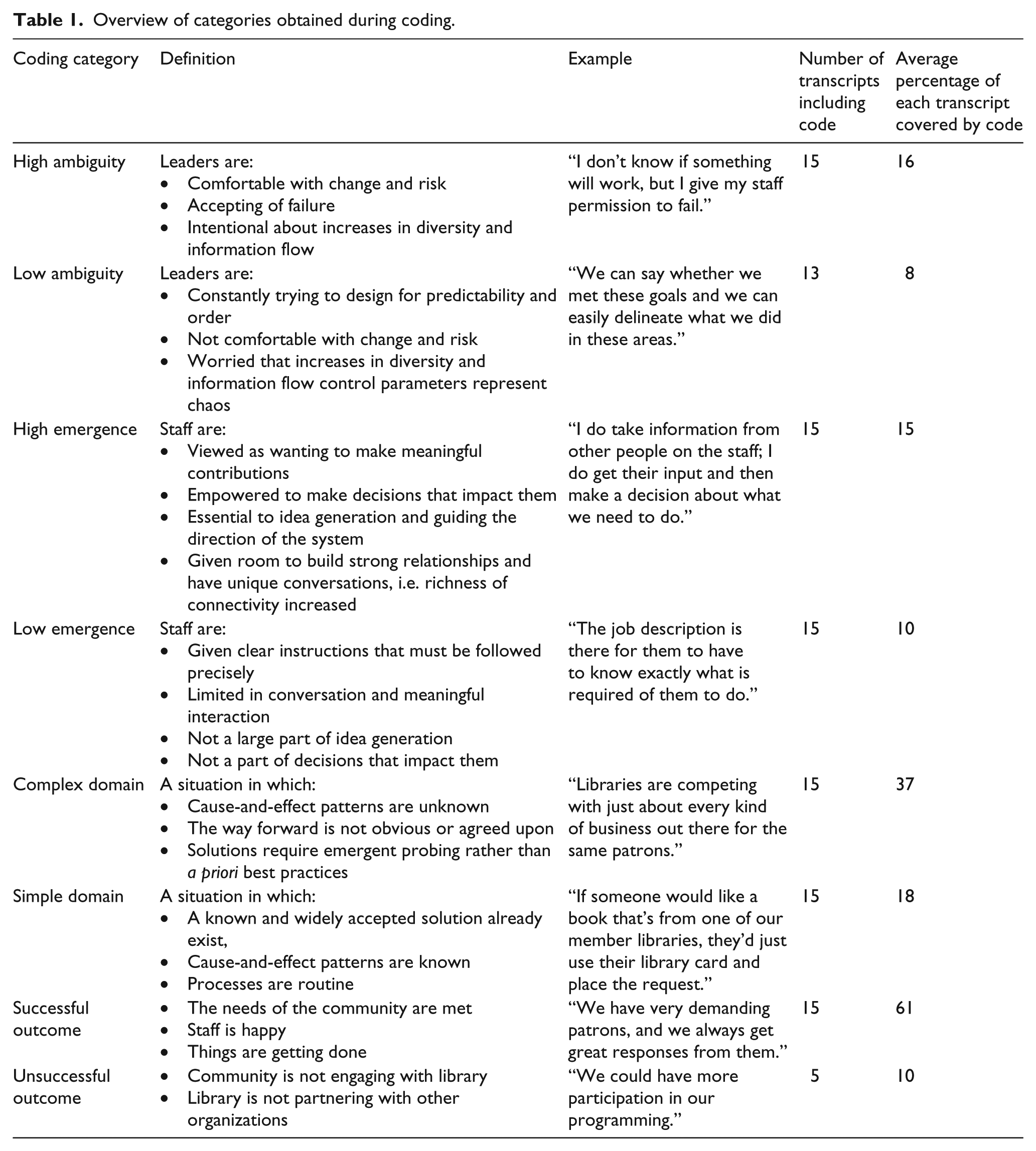
Table 1 outlines the primary coding categories, along with a definition and an example quote. Also included in Table 1 is an overview of the number of transcripts that included the code, and the average percentage of those transcripts including that code. In contrast to a prominent myth about qualitative research, the use of counting—and the analysis of frequency—enables the discovery of patterns, ensures that all data has been considered, and can be used to supplement qualitative findings (Sandelowski, 2001). One notable finding is that the high complexity codes (high ambiguity and high emergence)—though seen in a similar number of interviews—were seen much more often in those interviews than low complexity codes (low ambiguity and low emergence). In addition, results show that library directors perceive themselves to be working within mostly complex—rather than simple—environments. Finally, participants tended to view most of their approaches as successful.
Overview of categories obtained during coding.
Leadership approaches
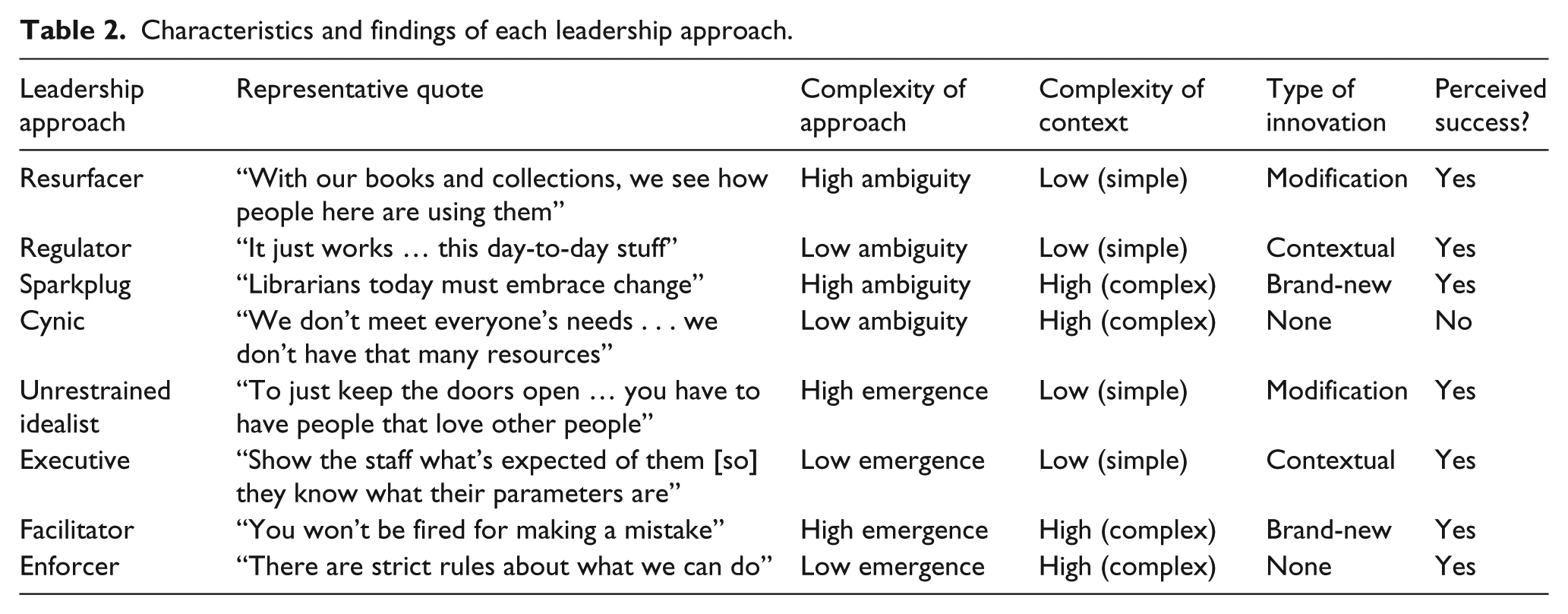
Analysis revealed eight different approaches to leadership. This section describes each approach as well as its link to self-described success—providing answers to both RQ1 and RQ2. Table 2 provides an overview of the complexity of approach and complexity of context indicative of each leadership approach.
Characteristics and findings of each leadership approach.
The Resurfacer
The Resurfacer is focused on bringing assumptions about best or simple practices to the surface. This approach shows a high capacity for ambiguity within simple domains. Ten participants indicated engaging in this kind of leadership at least once, accounting for about 4% of each participant’s transcript. This approach was generally successful, most often credited with an increase in the community’s use of—and appreciation for—the library: “We have plenty of patrons show up at a program and they seem to be enjoying themselves.”
A Resurfacer makes use of best practices—including the provision of e-books and audiobooks—yet suggests that the very decision to adopt these best practices must come from the influx of ambiguous information from the community: “When we have patrons they’ll come up to us and they may suggest this program or that.” And when these practices from the profession are adopted, they change often based on local context: “With our books and collections, we see how people here are using them.”
This openness to experimentation and change even in areas considered to have an obvious answer is central to a Resurfacer. This was noted with policies regarding late fees. One director noted the extreme flexibility and discretion with which this policy is applied, noting: “At the end of the day, access guides the decision.” Here, the broader mission adds ambiguity to what was a simple policy with clear rules.
Because the Resurfacer brings in more information from the community, they often adopt practices that may seem out of date to an outsider. One library director noted the need for a fax machine. In spite of the county administer suggesting that “nobody uses faxes,” this director “could tell what people wanted by the questions they asked.” They ordered fax machines, and “believe it or not, we have lots of faxes going out of here.” Another director stopped using self-serve checkout machines and copiers: “[People] don’t really know how to use the machine, and they don’t want to break the machine. And they love that someone else is like, ‘Here. I’ll be happy to make it for you.’”
The Regulator
A Regulator is focused on clear progress toward demonstrable results. This approach shows a low capacity for ambiguity within simple domains. Ten participants indicated engaging in this kind of leadership at least once, accounting for about 6% of each participant’s transcript. This approach was generally successful, most often credited with getting things done: “It just works, and this day-to-day stuff has been developed by years and years of trial and error and practice.”
Regulators differ from Resurfacers in the need for more certainty in the areas of librarianship that have established best practices: “We want to be as efficient as possible and make sure no one is duplicating efforts or wasting time, so we can do more things that matter.” There is little room for experimentation, as success needs to be nearly guaranteed before a project is undertaken—as noted with building projects: “It’s not like you can build a library and decide you don’t like it or it’s not working for some reason and tear it down.” Financial restrictions also limit experimentation: “We can’t just go do everything we want. We have to look at the budget.” In areas like collection development, clear and direct rules guide practice: “We have a collection development and management policy that guides our decisions about what we add to our collection.” Experimentation is limited to other areas as permitted by the budget.
A Regulator must show results, often to meet the dictates of administrative officials—which a Regulator is tasked with implementing: “We are governed by a library board of trustees who sets policy, and then we implement that policy.” This results-driven approach is noted in the use of standardized metrics: “We have to do performance metrics so that we can clearly articulate to the public and to the county government that we are worth the investment.” A Regulator is often charged with fixing problems in established processes: “When I got here, I walked in the door and the person with the most technical skills was spending 20 hours a week cleaning spyware off of computers. There was no firewall. We weren’t compliant with CIPA.”
The Sparkplug
A Sparkplug is focused on adaptation—and the development of strong community relationships to direct it. This approach shows a high capacity for ambiguity within complex domains. All 15 participants indicated engaging in this kind of leadership at least once, accounting for about 11% of each participant’s transcript. This approach was generally successful, most often credited with increased community satisfaction and use of the library: “We find that the interactions with the library users are the most valuable thing that we offer, and it’s why folks keep coming back.”
Sparkplugs have a vested interest in the community that goes deeper than other approaches: “Every encounter needs to be invested with dignity, and that’s for everyone. Little babies are every bit as important as a board member or the chairman of the board.” As a result, decisions come only after “talking to folks and getting their help.” In doing so, Sparkplugs take advantage of what one director noted as a distinct advantage of public libraries: “We see a broader cross-section of the community than probably any other group, except maybe doctors.”
With this community interaction, a Sparkplug acknowledges the need to adapt to change: “A traditional librarian mindset has typically been that you’re stationed at a service desk to do a job. That is not the libraries of today.” This adaptation is a near direct reference to the theory of CAS: “Librarians today must embrace change. They must, or they’re going to be dead.” Armed with this acknowledgment, a Sparkplug is able to handle the uncertainty of any idea or approach: “Programs are never guaranteed, and you just do everything you can on your end to make it as good as you can and then you hope it comes.” This is seen as a function of the context: “There’s no formal written document that says how to do a children’s program or how to do an adult program.”
The Cynic
A Cynic is focused on making clear-cut decisions with little community input, coming from a pessimistic view of the library’s ability to do anything more. This approach shows a low capacity for ambiguity within complex domains. Only three participants indicated engaging in this kind of leadership at least once, accounting for about 5% of each participant’s transcript. This approach was generally unsuccessful, attributed with low community participation: “[If we knew more] we would probably have more participation.” This was the only approach where participants admitted a clear lack of success: “I think we know a lot about the people who already love us. I don’t think we know enough about the people who are not coming in.”
Whereas a Sparkplug is connected to the community, a Cynic has only a surface-level understanding of the community—mostly centered around demographics rather than information needs: “Half of the folks are older, the other half are young with families. We’re 50/50 on race.” This is used to make decisions about collections: “[Not knowing more about the community], you are going off of reviews of what people say will be popular or when people say, ‘Oh, everybody’s going to love this.’” This often leads to a priori assumptions about the community: “There’s a segment that doesn’t need our services, and so they’re not going to come in … you have to concentrate on members of the public that need your service.”
A Cynic’s often attributes this approach to a lack of resources: “We have no R&D department, so how to know what the community wants you to do sometimes can be a little tricky too.” This lack of resources led to a certain level of pessimism regarding the meeting of community needs: “We don’t meet everyone’s needs. That’s impossible meeting everyone’s needs. We don’t have that many resources.”
The Unrestrained Idealist
An Unrestrained Idealist sees unlimited potential in system agents, marked by a high capacity for emergence within simple domains. Thirteen participants indicated engaging in this kind of leadership at least once, accounting for about 3% of each participant’s transcript. This approach was generally successful, most often credited with increased staff satisfaction: “I think life is pleasanter in your work day.” It was also credited with getting things done.
Unrestrained Idealists give staff greater responsibilities, even in areas with existing rules and “task lists.” Staff “know that that they can change this [list] during the day depending on what the need is.” This is also noted in approaches to the organization of staff to do this simple work: “All staff here are trained, including myself, to—in the spur of a notice—if somebody has to go home sick or whatever, then we can all help out at the front desk.” This was often seen as necessary for smaller libraries.
An Unrestrained Idealist sees value is organizational redundancy and cross-functional work—not limited to certain types or levels of staff: “A majority of the staff have had a chance at some point to participate in some cross-functional special project, which I think is good.” And this redundancy is seen even with tasks that have established guidelines. Rather than creating silos of responsibilities in collection development, for instance, Unrestrained Idealists include “someone from children, adult, teen, someone from a branch, someone from management, someone from technical services to get as many different perspectives in the room as we can have.”
With an enlarged view of staff potential, Unrestrained Idealists increase staff training even for those in traditional library roles: “We implemented a full-time library skills trainer so that we have a dedicated trainer that trains library skills, from the circulation staff on.” This is the result of viewing every job as undergirded by more complex human elements: “To just keep the doors open—and keep the basic and more traditional library services going—you have to have people that love other people.”
The Executive
The Executive is focused on efficiently getting things done in “routine situations that arise in the course of the day.” This approach shows a low capacity for emergence within simple domains. All but one participant indicated engaging in this kind of leadership at least once, accounting for about 5% of each participant’s transcript. This approach was generally successful, most often credited with increased employee satisfaction: “They feel protected because they know exactly what to do.”
An Executive relies on highly organized hierarchical schemes to direct behavior: “I’ve found chain of command strictly is the best way.” The goal is to “show the staff what’s expected of them [so] they know what their parameters are.” Staff is viewed as wanting and needing this explicit direction: “I learned from teaching that children do better when they know where the line is.” Within this structure, staff conversation is “polite and friendly . . . but not too personal.” Not only is this done to reduce workplace hostility, but it is intended to increase productivity: “If they focus on work or on task at hand, staff don’t discuss personal things.”
This structure can create a separation of human resources into those who are creative and those who are not: “The administrative folks, they’re the people who are good with spreadsheets … and those folks sometimes don’t even have the creative bent.” Here, the simple nature of the task is assumed to translate to characteristics of the staff member doing that task, i.e. simple tasks are done by less creative people. These people “have a different role” when it comes to “bringing ideas to the table … I try to include them, but not at the level of these folks who really are my creative folks.”
This approach was sometimes used to fix obvious problems in following guidelines—especially those with clear legal ramifications. For instance, one director upon arrival noted misuse of overtime and that “the library’s time keeping was abominable.” This director established clear directions and rules for behavior, not allowing deviations from this, because “I am not going to put myself in a position where I’m going to be sued.”
The Facilitator
The Facilitator is focused on the emergence of a staff that takes a creative lead. This approach shows a high capacity for emergence within complex domains. All participants indicated engaging in this kind of leadership at least once, accounting for about 10% of each participant’s transcript. This approach was generally successful, most often credited with increased employee satisfaction: “They feel important and empowered, and that’s so important to staff.”
A Facilitator is intentional about creating room for relationship development: “Every meeting we have, every staff day, we do activities that are solely designed to get people to talk to each other and get to know each other better.” This is done to increase diversity: “I want there to be a great deal of intellectual diversity amongst those positions. I don’t want people that are mirror images of me, for sure.”
A Facilitator extracts and pools information seemingly unrelated to the job itself: “Finding out about a church that someone may attend, depending on how much of a religious person you are. Or do you belong to a certain club or organization?” This pooling enables bottom-up decision making: “I allow everybody to be able to make decisions and answer the tough questions at the front desk when they come up.” This process is aided by the guarantee that “you won’t be fired for making a mistake.” Staff insight is valued even when a Facilitator has a great idea themselves: “There have been some ideas that I’ve put out there that the group had some really valid points as to why it wouldn’t work or shouldn’t work. I’ve said, okay, well, let’s just scratch that.”
This is possible because of a positive view of staff. In contrast with an Executive’s separation of staff into creative and non-creative categories, a Facilitator agrees that “all my staff are very creative people.” Coming from a recognition that much of this is hidden, a Facilitator “brings out the individual’s interests and talents … to exploit it.” One director recalled a single mother who wanted to do more: “I gave her more to do. I created a title for her. And she has lived into it. She has just done so beautifully.”
The Enforcer
The Enforcer is focused on quick decision making under perceived constricted circumstances. This approach shows a low capacity for emergence within complex domains. Twelve participants indicated engaging in this kind of leadership at least once, accounting for about 4% of each participant’s transcript. This approach was generally successful, most often credited with increased employee satisfaction as participants assumed this is what staff wanted: “It keeps people from getting upset when other people are trying to do their job.”
An Enforcer limits emergence for several reasons. First, they see themselves as in a position of needing to implement the decisions made from county administration: “We’re considered a department of county government, and so there are strict rules about what we can do.” Things are done “because a board member a county administrator wants to see it change.” The limitation on staff input is seen as a beneficent given that the decision has already been made: “There’s nothing more damaging than having everybody do something if it’s a forgone conclusion.”
Second, an Enforcer limits emergence due to the realities of geographic dispersion for rural libraries—where staff input was more difficult to get: “To go out to one of my rural branches, it takes about a half hour one-way and then to meet and then to come back and you talk about half a day gone.” A third reason for limited emergence is the assumption that employees do not want more responsibilities given their low pay: “If you’re a desk clerk making a little salary, you would prefer a very strict policy for every situation, so you always just have something to make it easier.”
An Enforcer limits interaction in accordance with perceived critical points: “You’d always like that interaction to increase up to the point where the relationships are cordial and friendly, but not to the point where it starts dominating … and you find dull conversations that take them away from their assigned duties.” When these points are crossed—and the system is in chaos—the Enforcer takes over: “When something has to happen, I do make an executive decision … you’re in triage mode.”
Innovation
Results revealed three types of innovation within public libraries, helping to answer RQ3. At times, this involved the development of something brand new, while at other times this involved contextual changes and modifications to existing products, processes, or services. A third type of innovation came out of this study, however, which is arguably unique to librarianship. There was a strong indication among participants that even the most basic processes, services, or products of the library profession can represent a fundamentally disruptive innovation to a community who has never seen it before. All but the Cynic and Enforcer engaged in one of these types of innovation.
As complex contexts were approached with high complexity (either through ambiguity or emergence) brand-new products, processes, and services emerged. This included the Sparkplug and the Facilitator. These are the disruptors. One director noted the development of a gaming program with teens, led by someone with background in the gaming industry. This was a new idea “created essentially from scratch,” and its disruption was noted in stakeholder reactions: “I had to deal with school teachers who came in and said, ‘how dare you do this.’”
As simple contexts were approached with high complexity (either through ambiguity or emergence), modifications to existing products, processes, and services were noted. This included the Resurfacer and the Unrestrained Idealist. Here, leaders are doing things differently and modifying best practices. For example, talking with patrons is not new, and there have been several models about how this interaction should occur. Yet, “we are innovative in the way that we talk to our patrons and innovative in the way that we interact with other community groups.”
Areas where simple contexts were approached with a low degree of complexity (either through ambiguity or emergence) might easily be disregarded as non-innovative. These are areas where existing best practices were used: “I’m very good at going to other libraries and stealing ideas.” This included the Regulator and the Executive. Yet, participants were adamant that even the most basic of library practices can represent important innovations to a community: “The really basic stuff that libraries do—buying free books and checking them out to people—is kind of a radical idea.” Participants who noted they lacked the resources to offer “the shiny” or advanced technology still considered themselves to be innovative: “To the community I am innovative, but not to the profession.” Here, innovation is contextual.
Discussion
What does leadership look like?
In answer to RQ1, this study confirms several aspects of leadership noted in previous studies. It included empowering workers (Sullivan, 1999), establishing a shared vision (Bass, 1990), and an awareness of context (Gilstrap, 2009). Yet, leadership also included dictating direction, establishing clear guidelines and rules, and rewarding behavior. This represents the typical line of demarcation between leadership and management (Kotter, 1990). Yet, this line has the potential to label people—rather than situations—as one or the other. This labeling—disliked by participants—tends to discount management as less than leadership. It also allows for an implicit assumption that some people are leaders and others are managers—even when recognizing that both are needed (Kotter, 1990). This study reaffirmed the need for one individual to embody the qualities of both leadership and management, shifting among these based on context. Yet, it goes further to suggest that the distinction between leadership and management may no longer be useful, given how often these roles overlap and how it tends to be dismissive of planning and implementation. As one participant noted—after reflecting on establishing guidelines for technical compliance—“If I had someone tell me, ‘That’s not leadership,’ I would have just hit the roof.”
Libraries as Complex Adaptive Systems
In answer to RQ2, one important finding of the current study was the engagement of public library leaders with aspects of complexity. This study confirmed that libraries are, indeed, CAS—as they are made up of agents struggling to adapt to an environment around them that is constantly changing (McElroy, 2000). Yet, in line with Snowden and Boone (2007), a complex approach was not always required for every problem within these systems.
For instance, most participants placed some limitations on emergence. This was often done out of a recognition of the system’s critical point (Stacey, 1996), or to match the organizational domain (Snowden and Boone, 2007). The Enforcer recognized the potential for increased emergence to overwhelm the system’s control parameters, pushing it over the edge into chaos (Stacey, 1996). The Executive recognized that the increased complexity and efforts of emergence were unnecessary in areas of library practice with established and agreed-upon procedures—i.e. simple domains (Snowden and Boone, 2007)—so long as employees actually did agree with leadership that their lives were better as a result.
Similarly, the limitation on ambiguity—and its accompanying need for predictability—served an important purpose in fulfilling essential roles within the library. The Regulator was able to apply existing best practices to simple areas where such practices fit, and this helped them get things done. With an awareness that their libraries are CAS, leaders are better equipped to respond to changing conditions both internally and externally in ways that maximize resources and are successful.
Blind spots and admitted defeat
This is not to suggest that every participant approach was appropriate—or their description of success accurate. The limitations placed on emergence and ambiguity can introduce problems that the leader may not recognize. For instance, although the limitations placed on emergence can work in times of chaos or increased government control—to keep the system at the edge of chaos and not over it—it is full of potential blind spots. It is for this reason that Snowden and Boone (2007: 70–71) placed the simple domain adjacent to the chaotic domain: “The most frequent collapses into chaos occur because success has bred complacency. This shift can bring about catastrophic failure.”
The negative results of these blind spots were seen in overly strict guidelines for non-routine problems, a priori assumptions of staff as inherently less creative, assumptions of a child-like state in adult employees, and the suppression of relationships out of a fear of decreased productivity. These blind spots show the pessimism of Theory X regarding human nature and can be disruptive to the system. This is particularly problematic when those in positions of authority assume that their limitation on emergence actually benefits those whose emergence is limited.
The limitations on ambiguity represent different problems. In the case of the Cynic, it results in admitted defeat in their attempts to suppress ambiguity in favor of predictability. Here, ambiguity is less controllable than emergence. While an employee’s participation can be limited to stave off chaos, an uncertain future can never be fully predicted. Even when success was high and ambiguity low, this was more an indication of momentary stability than active suppression of ambiguity. There is little a Regulator can do to ensure the current approach will work for the next five years.
Innovation
In answer to RQ3, this study also provides important findings about innovation in public libraries. A casual reading might suggest that only Sparkplugs and Facilitators—because of their complex approach in complex situations—are innovative, or in charge of innovative libraries. One might even allow that Resurfacers or Unrestrained Idealists are innovative, as they still approach the system with complexity.
What this study suggests, however, is that the implementation of simple solutions can, itself, be innovative. Regulators and Executives are innovative, as they are able to implement the essential functions of librarianship for the public. This is because innovation itself is defined contextually, and a distinction is made between what is innovative to the library profession and the community. As one participant suggested, “I think if libraries didn’t exist, and someone introduced public libraries now, it would be seen as some radical, left-field idea.” Thus, it is important for library leaders to gauge the type of innovation that is most appropriate for their library or library system. This is a rejection of traditional definitions of innovation that suggest a need to completely change all parts of the library in order to survive in a changing environment.
Limitations
The current study was limited to the self-perceived success of library directors and managers—especially problematic when it concerns assumptions of employee satisfaction. It was noted that directors and managers were initially seen as the most capable of talking about leadership. However, the results moved into areas where these leaders were not in such a position, e.g. discussions about staff empowerment. Given that this was a central theme, future research should include staff in these discussions to gauge whether or not they feel empowered. Yet, given the role of these participants in creating the environment for success, their perception was important to consider. The use of phone interviews also represents a limitation, as nonverbal cues are removed from data collection. However, the ability to reach an entire state by phone was seen as providing richer data than the face-to-face interviews that would be possible if the study was limited to a few counties.
Conclusion
The findings of the current study have several importance implications for practice. It suggests the need for library leaders to consciously identify their leadership approaches in order to be more strategic about intended outcomes in various situations. It highlights the value and necessity of accepting limited predictability, while showing that emergence can be used strategically based on context. And, although most approaches were linked with innovation, it is important to remember that this is not static. In other words, while an Executive approach for certain situations may be innovative now, the same approach in those situations a year later likely will not. This is a function of the changing landscape.
The current study represents an important contribution to the study of leadership within public librarianship. It outlined the theory of CAS as it applies to public libraries and the leadership of these libraries. This was especially important as innovation is seen as a necessary component of such a system’s ability to remain alive in the midst of a rapidly changing environment. By suggesting two components of complexity to focus on—ambiguity and emergence—the current study was able to uncover the complexity within the leadership approaches of 15 library directors and managers. By engaging participants in a carefully designed interview, subtle distinctions based on the context of a given situation were uncovered. Out of this came eight approaches to leadership, representing different combinations of approach and situational complexity. Most were associated with success, though potential blind spots emerged that public library leaders would be wise to account for. In addition, the study suggests that earlier dichotomies may no longer be applicable to the profession. This includes those separating leadership from management, and those separating innovative from status quo.
Footnotes
Declaration of conflicting interests
The author(s) declared no potential conflicts of interest with respect to the research, authorship, and/or publication of this article.
Funding
The author(s) received no financial support for the research, authorship, and/or publication of this article.
