



Abstract
The personal legacy created throughout a person’s lifetime is increasingly dependent on the lifespan and reliability of computers and electronic data storage. This runs the risk that personal legacies stored electronically and often at web addresses unknown to successors may be less complete compared to legacies from the era of analogue data carriers. Dozens of online services have been launched over the past decade to address this problem, but many of them have been discontinued or are not reliable enough to entrust with important data. This article offers a critical review of already existing research on digital legacy preservation and an overview of the available tools and resources to demonstrate that libraries do not yet play an active role in preserving digital legacies, despite the fact that this could not only enhance the sustainability and reliability of preservation, but also be a marketable library service. With this article, the authors would like to draw attention to this service, which is still considered atypical today; provide an objective description of the current situation; and propose a preliminary model for developing such a service in order to set the stage for future research.
Keywords
Introduction
As an increasing number of memories which were earlier stored in a physical form become digital content (for example, letters, photographs or collections), there is a growing need for these to be preserved for our families and acquaintances. This is proving to be a difficult task as there is currently no data storage solution which can securely preserve digital data for an unlimited period of time, or at least for the duration of a person’s lifetime. Most people have experienced data loss. Sometimes the data lost is easily replaced; sometimes the loss equates to a small personal tragedy. The Verge reported on a similar incident in June 2019 (Hollister, 2019). A worker took approximately 2400 photographs of the ruins of the World Trade Center after its collapse due to the terrorist attacks on 11 September 2001 while he was cleaning up the debris. The photographer has since died, but his legacy included a compact disc (CD) collection with the pictures. Only 18 years have passed since the pictures were burnt to the discs, but the majority of them cannot be read, and therefore an irreplaceable piece of the digital legacy has been lost.
There is an increasing number of web services dealing with preserving digital legacies. Some undertake sending farewell messages after the user’s death through email or social media sites (for example, GhostMemo, GoneNotGone, MyGoodbyeMessage and SayGoodbye), while others can be used to create memorial webpages (for example, Journal-of-Life, LifeNaut, LifePosts, Remembered and Tributize). There are more and more services dealing with the preservation of personal digital content (for example, photographs, passwords of user accounts, subscription data or last wills), which then gets handed over to the designated persons after the user’s death (for example, My Wonderful Life, PartingWishes, SafeBeyond, SecureSafe and The DocSafe). It is worth mentioning the work of Nansen et al. (2017) and the volume written by Carroll and Romano (2011), which dedicates a whole chapter to the phenomenon of the mass spread of services dealing with digital legacy preservation.
Digital legacy preservation is such a popular topic among experts in the field and interested parties that in 2015 James Norris of University College London, who was also the creator of DeadSocial.org, founded the Digital Legacy Association. The purposes of the organization include raising awareness of the importance of digital legacy preservation; taking part in (British) legislative procedures; creating tools and guides to facilitate the preservation of digital legacies; and organizing training and conferences. It holds an annual Digital Legacy Conference at a different location every year. In 2019, it took place in Berlin, and its focus was on providing information to patients in hospitals and sick people, and helping them preserve their digital legacy.
Compared to physical objects and memories, a digital legacy is a lot more vulnerable, and if the owner does not arrange for its preservation before their death, their successors may lose invaluable parts of their heritage. Even so, very few people make arrangements for the fate of their digital data after their death, or are even aware of what they should do in order to have something to pass on at all, and prevent losing their digital data in the future. Passing away is not a topic that is readily discussed during everyday conversations, and most people are reluctant to act to preserve their digital data so that their successors can access it after their death. As a result, many invaluable and important memories are lost.
In this article we consider several aspects of the issues caused by the increasing amount of digitization in people’s everyday lives, primarily regarding personal legacies stored in digital form. We also define the concept of a digital legacy; introduce the difficulties of its identification and long-term preservation; and provide commercial and library-related examples for the preservation of a personal digital legacy. The article intends to draw attention to the importance of preserving personal digital legacies and to propose a preliminary model of library cooperation aimed at developing this service. Our work has been guided by the following research questions:
What does the existing research on digital legacy preservation suggest concerning the role libraries may play in the process?
What tools and resources are available for digital legacy preservation in general?
Based on the outcomes of previous research and the best practices of other (related) fields, how can the sustainable management and the long-term preservation of digital legacies be modelled for this field – i.e. the context of libraries?
We used the following methods to answer the research questions:
A comprehensive literature review was conducted to identify projects, services and organizations which deal with the preservation of personal digital legacies.
Library services, websites, blogs and papers were scanned to find examples of personal digital legacy preservation from the field of librarianship.
Existing (non-profit or for-profit) service models (outside of the library profession) were sought which have been proven to be effective and could be transferred to the environment of libraries. In this work, we were aided by the literature on the topic, online blog posts, and organizations which themselves collect tools and services aimed at preserving personal digital legacies, and publish them on their platforms (for example, the Digital Legacy Association and Library of Congress).
We used both general web search engines (for example, Google and Google Scholar) and multidisciplinary databases (for example, EBSCO’s Academic Search Complete and Library, Information Science and Technology Abstracts; ProQuest Central and ProQuest Dissertations & Theses Global; JSTOR; ScienceDirect; and Web of Science). Our search terms were ‘(personal) digital legacy’, ‘(personal) digital estate’, ‘(personal) digital heritage’, ‘managing (personal) digital legacy/estate/heritage’, ‘(personal) (digital) preservation/conservation/storage’ and ‘born-digital’. Furthermore, we included in our study the website of the Digital Legacy Association and its contents, and the papers and abstracts of the presentations delivered at the annual Digital Legacy Conference organized by the association. Thus, we created six groups of sources and academic literature for our analysis: (1) management and preservation of digital data; (2) management and preservation of personal digital data; (3) management and preservation of digital legacies; (4) management and preservation of personal digital legacies; (5) services for preserving digital data (also categorized in our study); and (6) legislation, policies and standards.
Literature review
Over the past decade, many books and articles have been published on digital legacies and, more specifically, on preserving a personal digital legacy. Few of these, however, are scientific in quality (i.e. truly research-based) and adopt a complex approach. The latter works are the subject of the following review.
Theoretical grounds
The preservation of personal digital legacies has many aspects. The technical methods for the long-term storage of digital data are definitely among these, but those who have experience of digital data management have also encountered problems related to copyright and data protection, as well as ethics. The issue of preserving personal legacies begins with the question of whether the legator recognizes during their lifetime what their digital legacy could include and whether they make any arrangements related thereto. Edited volumes, including discussions on digital data written by information professionals offering different perspectives, serve as good starting points for delving into the subject.
The most comprehensive compilation of work by experts in this field was published in a volume edited by Donald T Hawkins (2013). The contributors to this volume argue for the importance of archiving personal digital legacies and provide useful advice for the reader on the technical implementation of proper archiving. Hawkins (2013: 16) enumerates the following potential target audiences of the volume: consumers who want to know how to prepare an archive of family or personal history; academic researchers; libraries of all types; historians and authors who are collecting biographical material on prominent people; and public officials and local historical societies. The foreword is by Brewster Kahle, the founder of the Internet Archive, which was created to archive web content. In the first few lines, he highlights how vulnerable and temporary digital content is, and notes that it is a great challenge to find an archiving solution which enables the truly long-term preservation of digital data, since both online services and optical discs have finite lifespans. Kahle (2013: 14) argues that ‘[l]ongterm data storage, especially for personal-scale projects, is evolving with new ideas, but it is safe to say there is no consensus yet on how to protect our personal collections’. As examples he mentions the services of GeoCities, Apple MobileMe, Yahoo! Video and Google Video, all of which have already ceased to exist. The volume introduces many endeavours that raise awareness of the appropriate preservation of personal digital legacies. These include the Personal Archiving Conference initiated by Jeff Ubois, which has been organized several times since its launch, and the website The Digital Beyond, created by Evan Carroll, which collects useful tools for preserving personal digital legacies and makes the relevant legislation available. There is a whole chapter on software and services that facilitate the preservation of digital legacies. Aaron Ximm (2013: 188), one of the developers of the Internet Archive, provides a comprehensive introduction to its services and adds that ‘we define active archiving, in this context, to mean archives or components of archives that autonomously collect themselves, on behalf of their owners’.
The volume also includes case studies describing major data losses (Ashenfelder, 2013; Conklin, 2013; Marshall, 2013; Prom, 2013), and the authors describe the challenges hindering the long-term archiving of digital data. Some of these challenges are technological in nature, as Christopher J Prom of the University of Illinois and Catherine C Marshall, a researcher at Microsoft, point out, but they also argue that many instances of data loss could be prevented by properly informing and training people. Mike Ashenfelder (2013: 32), a former employee at the Library of Congress, writes that his library started to deal with the topic of preserving personal digital legacies because he realized that many people aim to preserve their digital data but, because they do not use the most appropriate methods, regularly lose precious data: ‘Even worse, most people were not aware of the potential threats to digital files: getting stuck on obsolete media, getting lost, or accidentally being deleted’. He concludes by arguing that libraries should take on the role of educating and supporting people in archiving personal digital data.
Technical background
Preserving our digital data requires a good systems approach and adequate technical knowledge. The task is made even more difficult by the constantly changing technological environment. Brianna H Marshall’s (2017) work, describing the techniques of preserving personal digital content, is valuable not only for private individuals, but also for those intending to help others in preserving their legacy. Marshall (2017) shows that ‘[p]ersonal digital archiving is relevant to information professionals, organizations, and institutions of all types’ (10), and states explicitly that the preservation of personal digital legacies is a task for information professionals:
Information professionals have a stake in the PDA [personal digital archive] discussion not only because any number of the digital records currently being created by private individuals could one day be acquired by our repositories, but because we ourselves create vast and diverse personal digital archives of our own. (11)
The first set of chapters (Condron, 2017; Cook, 2017; Ng, 2017; Severson, 2017; Wittenberg and Emmelhainz, 2017) provides practical help with archiving digital content created on different platforms. Understanding the guides does not require any specialized knowledge; they are primarily for everyday users. The chapters themselves are written by experts in each platform – for instance, digital photography, social media, web content and audiovisual materials. The guides list specific software and web services which can be used to archive personal digital data.
The second set of chapters (Mears, 2017; Milbrodt and Schreiner, 2017; Norton-Wisla and Wynne, 2017) uses case studies to introduce public library projects which aim to collect, preserve and make accessible personal digital content while involving readers in the process. These case studies also describe how library professionals working in different positions at public libraries can collectively take on roles in creating unique and valuable databases of personal digital legacies with readers’ involvement.
The third set of chapters describes how the library can contribute to the preservation of personal digital legacies by educating users. Post (2017: 161–162) writes that people usually do not realize the importance of properly archiving their personal digital legacies: ‘Increasingly, artists recognized that their materials not only have use in their day-to-day careers as artists, but might also hold value as part of the cultural memory of their communities’. We also believe that the increasing digitization of personal legacies and the potential loss thereof (either through data loss or the lack of systematic archiving) may have unforeseeable consequences in the long run. One only needs to consider how the majority of our current historical knowledge is derived from personal legacies (letters and manuscripts, for example). Libraries can help people experience less data loss by educating their users: ‘If an artist is unsure about which cloud storage service to use, a librarian may offer to conduct a follow-up consultation to review different options and find an optimal storage solution for the artist’ (Post, 2017: 163). As a result of learning how to preserve personal digital legacies, future researchers may manage research data in a more professional manner as well: ‘Teaching PDA builds a foundation of knowledge that not only helps students manage their personal digital materials, but can be translated into research data management skills that will enhance students’ academic and professional careers’ (Mannheimer and Banta, 2017: 170).
In the final set of chapters, Schultz (2017: 196–198) points out that the processes of archiving and data management have gone through significant changes, and there are many data formats which are not manageable or preservable with the tools that are currently in use: ‘The greatest danger is that libraries and archives will confuse this new paradigm of computer media with previous generations of fixed technology’. This applies particularly to data created in different applications, parts or all of which are not even created locally on the user’s device, but in the cloud server of the company developing the application. We also address this issue in the current article. Therefore, the education of professionals working with information – including, for instance, librarians – is extremely important because this is the only way to keep up with all the changes: ‘Librarians and archivists can and should familiarize themselves with the range of different apps that users may be employing to create and manage data that falls under their desired collecting areas’ (Schultz, 2017: 193).
The publication of Marshall’s (2017) book was sponsored by the American Library Association, which indicates that the library profession is beginning to realize that libraries have not only the opportunity, but possibly also the obligation to take on the duty of preserving personal digital legacies.
Another work related to libraries is the publication of Libraries Unlimited, in which Kowalczyk (2018) writes about the practice of long-term secure data storage from a technological perspective. The book is based on the activities and practices of a librarian who has experience in digital content management. It serves as a standard reference for organizations and institutions that are beginning to build their own data storage systems. We are introduced to the concept of digital curation, which is ‘important outside of libraries and academic organizations’ because, as more information is created in the digital era, the ‘legal system needs to account for maintaining digital data’ (Kowalczyk, 2018: 4). The author says that ‘curating for digital material has become a field of study and a profession’ (Kowalczyk, 2018: 4). The work also addresses the concept of ‘trusted digital repository’, which is extremely important in relation to the truly long-term preservation of digital data (we discuss this in detail later in the section on ‘Trusted digital repository’). As Sylvia (2018) puts it in her review of the book published in the Library Journal, it is ‘[e]ssential reading for librarians, archivists, records managers, and anyone interested in safeguarding digital data – in other words, just about everyone’.
Library instruction
One of the greatest pioneers in this respect is the Library of Congress, which, in 2003, as part of the National Digital Information Infrastructure and Preservation Program, launched the website digitalpreservation.gov, where four years later it started to publish content facilitating the preservation of personal digital legacies on a dedicated page entitled ‘Personal archiving’. In 2013, the Library published a collection of papers, which primarily comprises the best posts from its blog, The Signal, related to personal digital archiving (National Digital Information Infrastructure and Preservation Program, 2013). It shows that those who will wish to acquire knowledge about the first half of the 21st century 50 years from now will have to turn to digital documents, and it depends on us how many of the digital documents being created now will be available in the future: ‘This means we have to preserve lots of digital information for a long time’ (National Digital Information Infrastructure and Preservation Program, 2013: 3). The book provides technical guidance on the collection and long-term preservation of personal digital legacies, on the one hand, and explains why personal digital legacies are extremely vulnerable without proper attention, on the other: ‘Without some focused attention, any personal collection is at high risk of loss – and quick loss at that’ (3). Some chapters provide assistance in archiving different types of documents (for example, text messages, photographs or other files), while others discuss storage methods (for example, the chapter on ‘Personal archiving in the cloud’ lists both the advantages and the drawbacks of cloud computing). The authors provide ample reasons for carefully considering which technology we entrust with storing our data, and point out that cloud computing, which is widely popular and considered trustworthy nowadays, does not fully guarantee that our data will be kept safe for posterity: ‘The saying “Don’t put all your eggs in one basket” applies to personal archiving and not storing your digital collection in only one place. No digital storage medium is 100 percent guaranteed’ (22).
Among the currently available academic works on the novel topic of preserving personal digital legacies, we have highlighted those that we consider essential. These are publications of high academic quality which provide guidance both to everyday people managing their own digital content and to those professionals who intend to assist such individuals, or possibly plan on providing services aimed specifically at the identification, organization and long-term preservation of personal digital legacies within an institutional framework. Based on the outcomes of previous research, in this article we describe a possible model for creating such a service in a library setting (see the section on ‘Possibilities for libraries in digital legacy preservation’ below).
The concept of a digital legacy
We can consider as a digital legacy all data that exists in a digital form, the creation of which can be linked to any given person. Part of this consists of electronic user accounts, passwords and data stored on hardware or remote servers to which financial value is linked. The easiest to grasp among these are different financial services (for example, PayPal, TransferWise, Curve, Revolut, Square, Shopify Payments and Stripe); user accounts and subscriptions registered with web services (for example, Netflix, Spotify and Deezer); and, increasingly, online accounts related to computer games. The latter include systems operating as digital stores with the primary function of selling computer games online (for example, Steam, Origin, GOG, Itch.io and Battle.net). All of the purchased content is linked to a specific user account, and it is not unusual for these to be worth thousands of dollars after years of collecting (in many cases, the value is increased by gifts and rewards received on top of the purchases themselves).
Another part of a digital legacy consists of user accounts, passwords and data stored on hardware and remote servers to which no financial value is linked. The successors do not suffer financial loss if these are lost, but they still have value, be it sentimental (for example, family photographs), academic (for example, an unfinished publication) or practical (for example, a list of contacts) – or any other value that makes them worth preserving.
A digital legacy is therefore a lot more than just photographs and text documents, and as digitization appears in more and more areas of life, it is becoming increasingly difficult to organize a person’s digital legacy and keep track of what it entails. It is an interesting phenomenon that an increasing part of digital legacies is in the hands of technological corporations or businesses. We tend to regard these (for example, Google, Facebook and YouTube) as services that will always exist, even if some of them are only a few years old. Facebook, for example, was launched only in 2004, and its worldwide success came even later.
The uniqueness of digital objects
People are living an increasingly significant part of their lives in the digital space. When someone is sitting in front of a computer or using their smartphone, they are seemingly dealing with only one thing, but they may be spending their time more efficiently than if they were engaging in activities that are clearly visible to the outside observer. An increasing number of everyday things are being moved to the digital space, a few of which we have collected in Table 1 (with the analogue or physical object on the left and a version realized through a digital service on the right).
Analogue/physical objects and their forms realized through a digital service.
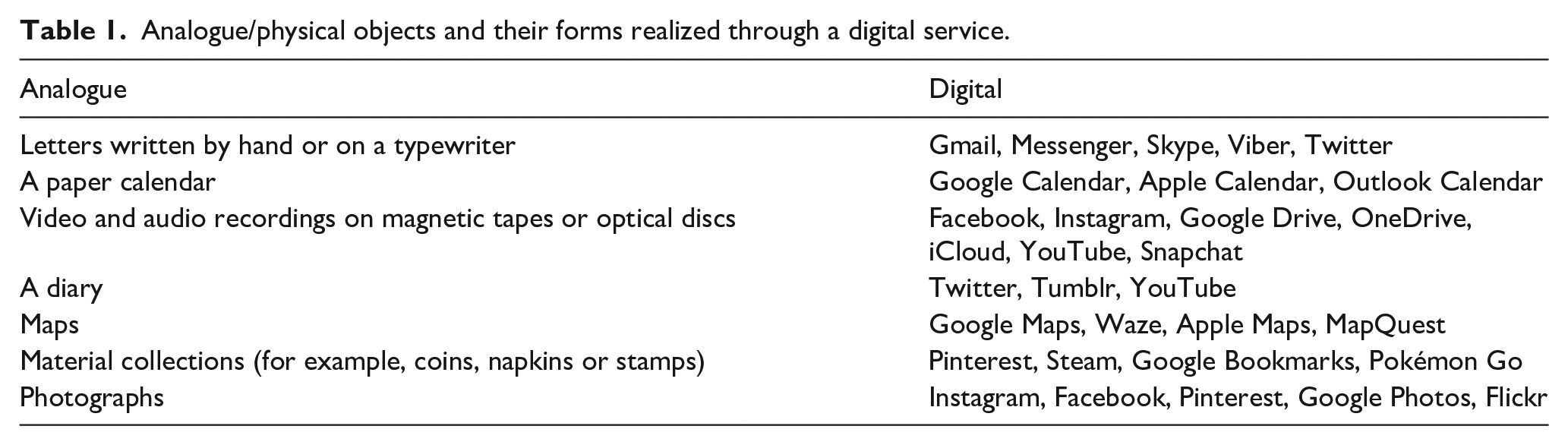
Objects, intellectual work and seemingly insignificant mementos left behind reveal who a person was in their life. Most people have encountered the personal effects of their parents and grandparents, each telling a story about their owner, adding a small detail to the image created of them. A handwritten notebook, side notes in a book, personal letters, school transcripts, photographs, a filled calendar or a map used while travelling say a lot about a person. We are still familiar with these objects today, but our descendants will only see a few of them because, nowadays, most of the legacies listed above are created digitally instead. This is dangerous not only because they can easily be destroyed if we do not arrange for their redundant and long-term storage, but also because a digital legacy is less personal than its physical counterpart. In the case of a physical photograph or a handwritten letter, the data carrier itself tells a story: the wrinkles, the damage, the stains and the notes on the back (for example, the names of the people in a picture) show its history and the process of its creation. These are all tangible items, the identification and preservation of which is unlikely to pose difficulties for heirs, considering that they are mostly kept at home or in a workplace.
Defining a legacy that exists in a digital form is a considerably less exact process, since it is difficult to define what has value and what is worthless data unavoidably generated by information technology processes. Are only the files saved on a computer’s hard drive important? What about files uploaded to online service providers? The same questions arise related to emails, user accounts, online calendars, computer games, blog posts and content posted on social media. The options provided by the virtual space are so diverse that a comprehensive list cannot be created which anyone could arrange for the complete preservation of their personal digital legacy. Another challenge is that there are certain types of content which should be archived together with their own context, because without that they may be sterile and meaningless to successors. The best examples include posts published on social media sites and the interactions linked thereto (likes, comments, shares), which become an intrinsic part of the published content, supplementing it.
If we consider a legacy as all the data (including pictures, texts, user accounts and passwords) created throughout a person’s lifetime, we are talking about a passive collection, revealing both the good and the bad about its owner. There are also active collections; these are the data that was publicly shared by the owner while they were alive, or consciously sorted by them. An active collection may include, for example, a photograph album publicly shared on a social media site, comprising pictures taken from the best possible angle. There is a lot of digital data that is not considered valuable by the creator during their lifetime, the importance of which becomes apparent only after their death. A seemingly worthless photograph in a smartphone’s memory may have incredible sentimental value for successors or historians.
Therefore, personal digital legacies do not only include documents which are available in an analogue format as well, even as part of a public collection, but also entirely new types of documents which did not exist before, and thus we have no experience in their long-term preservation.
The challenges of preserving a digital legacy
The problem of visibility
The digital life of a person does not end with their biological death. The user accounts and subscriptions they leave behind live on without an owner, and most of them cannot be transferred in the way that real property and personal property can (for example, a house, car or watch). During the probate procedure, the latter can easily be discovered and legally transferred. It is practically impossible, however, to explore a personal digital legacy completely if the deceased person did not make any arrangements related thereto while they were alive. Recently, legislators have realized that some kind of regulation or guidance is necessary. Therefore, government legislation and recommendations have been published related to the preservation of digital legacies. The USA has the best developed legislation. Several member states (for example, Connecticut, Delaware, Idaho, Indiana, Nevada, Oklahoma, Rhode Island and Virginia) have adopted regulations (National Authority for Data Protection and Freedom of Information, 2015) which, albeit with certain limitations, enable successors and relatives to access the personal data of the deceased. Furthermore, the USA has adopted a federal Act governing this access: the Fiduciary Access to Digital Assets Act, which was adopted in 2014 and reviewed in 2015 (Uniform Law Commission, 2015). Regarding Europe, we can mention the recommendations of Hungary’s National Authority for Data Protection and Freedom of Information (2015) about the fate of online data after death, and the recommendations of the UK’s Information Commissioner’s Office (2013) on the right of public access to information on deceased individuals held by public authorities.
Christopher Eiler, a German entrepreneur, also recognized the difficulties of identifying digital legacies, so in 2013 launched the service Columba, which can only be accessed through funeral directors. At the request of relatives, the company attempts to find all the online subscriptions and memberships of the deceased. Columba has contacts with most of the online companies in Germany, and approaches them directly during the research process; in turn, they pay Columba for helping them keep their databases clean and up to date. Columba has also developed its own algorithm so that it can easily browse databases to search for the subscriptions and memberships of the deceased. An obvious value of this service is that it provides relatives with access to the part of the digital legacy of the deceased that would have been otherwise lost, and they can cancel ongoing subscriptions, for example. Because, during this research, sensitive content may be discovered as well, of which successors would not necessarily like to be informed, Columba reveals it to relatives only if they have previously made a statement declaring that they would like to see all the user accounts that are found (see HVG, 2019).
Copyright issues
Another challenge is that the terms of service of certain web services do not include what happens to a given profile or subscription after the owner’s death. Furthermore, there are instances where it is stated that the account cannot be transferred or inherited. This is included in the terms of service of Verizon (2019), one of the biggest digital and mobile media corporations: ‘With the exception of AOL accounts, all Verizon Media accounts are non-transferable, and any rights to them terminate upon the account holder’s death’.
The difficulty of establishing ownership
In the case of digital legacies, another problem is the fact that clearly establishing ownership is difficult, since usually there is no need to provide real identities in the digital space and, in many cases, there is therefore only a user name available to identify digital content and user accounts. There have been efforts aimed at making each individual’s activities in the virtual space traceable, but even if there was a universal solution, probably not many of us would use it voluntarily. In 2011, the then US president, Barack Obama, announced that the government was working on the so-called National Strategy for Trusted Identities in Cyberspace, a system which would provide uniform identification for citizens on online platforms (Schmidt, 2011). A similar effort in Hungary is the Ügyfélkapu (‘Client Gate’) system, which enables an increasing number of official administrative procedures to be conducted without the need for separate authentication for each case type. Even in the academic world, there are endeavours to prevent authors’ publications from floating around on the World Wide Web unclaimed, and to make their entire body of work easy to browse. These include, for example, ORCID and Magyar Tudományos Művek Tára – The Hungarian Scientific Bibliography (MTMT), which has been developed by Hungarians (for more on this, see Kiszl et al., 2018: 322).
The technological limitations of long-term preservation
Manes (1998) dealt with the challenges related to archiving a digital legacy before the turn of the millennium in the New York Times: ‘There is no surefire way to guarantee that your personal digital legacy will be available 50 or 100 years from now’. The problem itself is not new, but it has not yet been solved.
Files archived in electronic data storage are considered by many to be completely safe, their integrity remaining untouched as time passes. Optical discs (for example, CDs, DVDs and Blu-ray discs) have a life expectancy of up to 100 years in theory (Lunt et al., 2011), but this is highly dependent on the environment in which they are kept. Their lifespan is affected by light, humidity and temperature. Therefore, their actual longevity is a lot shorter than the theoretical maximum, but even 100 years is a short time compared to the oldest written analogue document, which is 4500 years old and dates from the time of King Cheops (Carlo, 2013). Hard drives, which store data on discs coated with a magnetizable layer, are not suitable for long-term data storage either, because the magnetic signals recorded on the surface of the discs weaken with time, and the integrity of the data is compromised. A better method than optical discs and hard drives is archiving on solid state drives, which, due to their construction, promise a significantly longer life expectancy. However, their manufacture is currently too expensive for them to be widely used for archiving purposes, and redundant data storage is necessary with this technology as well (Stellar, 2019).
So-called ‘cloud’ storage is increasingly popular for storing digital data. Cloud computing is a field of information technology. There are different cloud-based services, but what they have in common is that the services are operated on the service provider’s devices, and not on dedicated hardware equipment. In a cloud-based system, the files and settings created by users are never stored as one single copy in a specific storage location of a server, but are stored in a redundant way, usually in at least three copies on three different storage sites. This ensures that even if one of the service provider’s tools becomes inoperable, there is no disruption in the service. Nevertheless, we can never be entirely certain that data stored in cloud storage is completely safe, and that it will never be lost. There have been several instances of data loss in the history of cloud computing. A major incident happened in 2011, when Google accidentally deleted the contents of more than 150,000 email accounts. With a flawed software update, Google not only deleted one copy of the data stored in the accounts, but almost all of the copies. Luckily for users, Google had archived all the data on magnetic tapes, which it used to restore the lost data, albeit very slowly (Weintraub, 2011). Magnetic tape technology may appear to be obsolete, since it has not been used in everyday life for a long time. However, it is one of the most durable and cost-effective data storage solutions to this day.
Besides the technological aspects, preserving digital legacies also requires serious organizational efforts and information literacy on the part of those involved. In the section on ‘Digital legacy preservation as an industry’ below, we will see that many have recognized the increasing demand for assistance in preserving personal digital legacies, and that libraries, for the most part, have realized the importance and relevance of this issue.
The personal digital legacy preservation efforts of the Library of Congress
We were looking for examples (best practices) of personal digital legacy preservation in which a library was involved. Some libraries have dealt with this area in the past in the form of a few lectures. Examples include a lecture on the preservation of personal digital legacies by Katlin Seagraves (Carrie, 2019), a librarian at Tulsa City County Library, and a presentation by Lindsay Braddy (2018), a librarian at Skokie Public Library, entitled ‘Managing your digital legacy’. However, the only library which has paid particular attention to the issue of preserving personal digital legacies is the Library of Congress.
The Library of Congress recognized before the turn of the millennium that libraries need to take part in the preservation of digital legacies. In 1998, it created a working group which was tasked with developing a comprehensive digitizing strategy. Two years later, Congress provided US$100 million to the Library so that it could launch the National Digital Information Infrastructure and Preservation Program (2003) to preserve digital information sources. The Library of Congress founded the National Digital Stewardship Alliance in 2010, which many institutions (universities, corporations and government agencies) joined. Their common goal is to create standards and policies related to the preservation of digital content. The Alliance has been operating as part of the Digital Library Federation since 2016 (Library of Congress, 2016).
The Library of Congress recognized that it is not enough to seek solutions for digital content preservation on a national level, but that the preservation of personal digital legacies is just as important, and ‘without some focused attention, any personal collection is at high risk of loss’ (National Digital Information Infrastructure and Preservation Program, 2013: 3). On the website of the National Digital Information Infrastructure and Preservation Program, the Library published recommendations related to the preservation of personal digital content for the first time in 2007, in the ‘Personal archiving’ menu, and later compiled a publication (National Digital Information Infrastructure and Preservation Program, 2013), whose contributors include experts from the Library of Congress, the Metropolitan New York Library Council, Penn State University Libraries and the University of Texas. Furthermore, the Library regularly posts content related to personal digital archiving on its blog, The Signal.
Members of the profession have recognized this issue, and efforts are being made to have libraries take on a supporting/mentoring role in preserving personal digital legacies. We therefore make an attempt at modelling the way in which libraries may be instrumental in the preservation of digital legacies in a sustainable and reliable manner (see the section on ‘Possibilities for libraries in digital legacy preservation’ below).
Digital legacy preservation as an industry
There is a growing awareness that something needs to be done to preserve our digital legacies, and some see this as a business opportunity. The idea itself is not entirely new – corporations and businesses have been dealing with estate administration for a long time – but preserving digital legacies requires an entirely different set of skills and technical conditions. The concept of a trust has existed in the Anglo-Saxon legal system for many years, but other countries have adopted it with major or minor changes. In the case of a trust, a trustor temporarily transfers their property in whole or in part to a trustee. The trustee manages the property, aims to preserve or even increase its value, and then transfers it to the beneficiary or beneficiaries in whole or in part on a predefined date. The owner of the property does not need to be incapacitated to execute a trust agreement; it can be done if someone wishes to make arrangements in their lifetime so that their property gets into the right hands. In this way, inheritance disputes can be avoided and successors can be prevented from wasting their suddenly acquired inheritance, since the terms of the agreement can stipulate that the trustee shall not transfer the assets to successors in one lump sum.
Corporations and businesses that deal with preserving digital legacies operate similarly. The owner of the digital data entrusts the trustee with all or part of their digital data, passwords and pre-written messages, to be delivered to their loved ones and acquaintances after their death. The first such online service was Final Thoughts, which was created by Michael Krim after he survived strong turbulence over the Atlantic Ocean on a flight from London to Los Angeles. After living through this shocking experience, he realized that anyone’s life may end without having the chance to say goodbye. On the Final Thoughts website, users can write emails, which are forwarded by the system to the provided email addresses after their death.
In 2008, Legacy Locker was created with a similar mindset, but with a very different goal. It served to store passwords used on the Internet. The registered user could store all of their passwords on the website, and could also designate who should have access to the stored data after their death. This concept was considered innovative back then, but today there are many similar services since, as people are living an increasing part of their lives in the digital space, the need has arisen that everything that has been created digitally should not be lost in the case of unforeseen events. This includes not only death, but also disease and mental deterioration. The original service is no longer operational. It was replaced first by Password Box and was later integrated into the service True Key.
In the following sections, we examine some of the services that are aimed at the online preservation of digital legacies in whole or in part. The goal is to introduce the opportunities of online legacy management and to provide inspiration for libraries with an interest in launching their own services. There are services which are able to manage a wide range of digital legacies, and there are some that specialize in a certain area, such as password management or sending messages after the user’s death.
Password management services
Memorizing friends’ phone numbers has been a rarity since the spread of newer communication channels, but there is also an increasing number of passwords to remember. There are services now available online which used only to exist in science fiction novels. Today, we can use our smartphones to manage our bank accounts, buy securities, rent a car, pay utilities bills, buy plane tickets, submit tax returns or stream live videos. One thing that these services have in common is that they all require passwords and, if someone wants to keep their passwords safe and reliable, they should use a different one for each service – preferably, one that includes upper- and lower-case letters, numbers and special characters.
Internet access for the general public started to become widespread just over 20 years ago, in the late 1990s, but the mass spread of web services requiring passwords came later. Nevertheless, according to a 2015 survey (Le Bras, 2015), the average US citizen has 90 different user accounts that require a password. It is difficult to deny that if we took the advice to use a different password for each online service, most people would find it impossible to remember at least 90 different passwords.
This problem is what brought about the launch of password management services. Most people have probably encountered these, since the most popular web browsers (Chrome, Safari, Firefox and Edge) are all capable of storing a user’s passwords on remote servers and synchronizing them between the user’s different devices (for example, laptop and smartphone). Of course, there are also password managers that are not integrated into web browsers, and these usually have a wider range of functions.
Password managers are built on different models. Offline software (for example, Password Safe, Enpass and KeePass) does not synchronize passwords between devices automatically, and storing the password database itself is the user’s responsibility (for example, on their own devices or with a cloud-based storage provider such as Google Drive or OneDrive). Online services (for example, LastPass, Dashlane and 1Password) are a lot more convenient since the service stores the passwords on its own servers, and these are constantly synchronized between the user’s devices.
Services for end-of-life planning
Password management services can keep our passwords safe not only during our lifetime, but also after our death, for our successors. However, the majority of these services were not created specifically to preserve our personal digital legacies, but to make our everyday online logins more convenient. On the other hand, there are many services that enable the planning of what happens after our death. There is a non-exhaustive list of some of these services in Table 2. There is a plus sign in the ‘legacy’ column of any given row if that specific service is aimed at the comprehensive preservation of digital legacies – for example, if it stores uploaded pictures, passwords or a last will. The plus sign in the ‘message’ column shows that, after death, the service can send messages that were written and addressed while the user was alive. There are different ways of timing this service. The most common method is that if the user does not log into the website for a certain period of time, the service provider attempts to contact them via previously provided channels. If they fail to establish contact, they send out the pre-written messages. Services with a plus sign in the ‘memorial’ column are for creating online memorial pages. Any given service may have more than one function. The year in parentheses after the names of the services is the date of their launch.
A non-exhaustive list of some end-of-life planning services.
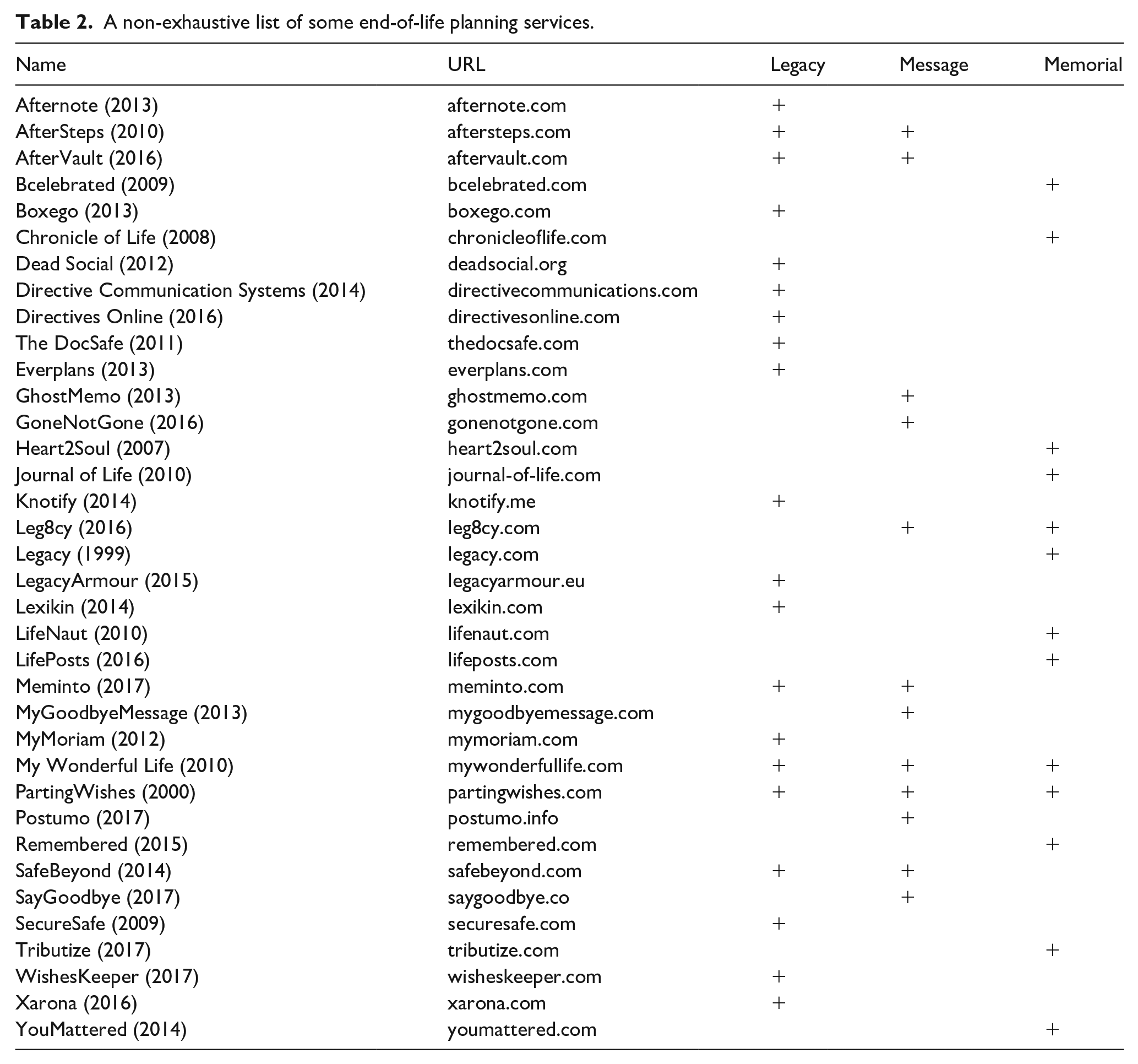
The services listed in Table 2 offer a wide variety of opportunities for end-of-life planning. Some are very simple (for example, a memoir can be shared on a blog-like platform), but there are a few that offer a more diverse and creative set of services. A good example of a simple operation is Chronicle of Life. This is basically a digital object storage service which, according to its own account, meets the criteria of a trusted digital repository. The aim of a trusted digital repository is to store digital content for a long period of time (we will discuss this further below). Pictures, text and other multimedia content can be uploaded to the website. Five megabytes of storage space is available for free and, for a one-off payment of US$19.95–179.95, 100–2000 megabytes of data can be secured.
AfterVault, which has been operating since 2016, is a service with more complex functions. It allows users to store an extremely wide variety of digital data, such as contracts (for example, life insurance policies and bank agreements), a last will, user accounts, bank data, lists of personal property, details of investments, and information on collections and their value. It is also possible to write messages, which will be sent to the provided email addresses after death, and to create different collections on the website and link different agents to each one. AfterVault has three subscription categories: monthly (US$9.99), annual (US$69) and lifelong (US$299).
A similar service is offered by AfterSteps (aftersteps.com). This service, which operates like a virtual assistant, uses a checklist to help the user consider which documents and data are worth storing in the long term (for example, a last will, financial documents or wishes for the day of their funeral), and sends reminders regularly if it deems a certain document or provision to be in need of an update. The user may grant access to the data stored with the service to a maximum of three agents. AfterSteps is not free; its annual subscription fee is US$89 and the lifetime subscription has a one-off fee of US$499.
The fact that there are dozens of services for end-of-life planning operating simultaneously shows that they are in high demand. It is not easy, however, to choose a service that we have to assume will store our digital content on its platform for a long time and make it accessible to our successors after our death. Most of these services are operated by individuals or small organizations, companies or businesses with two to three employees at most. Maybe this is why it is not surprising that the average length of time that current services have been operating is six years, with most of them being even more recent than that. This low number can partially be attributed to the fact that this is a fairly new field which is still in its infancy, and a lot of service providers cease their operations after just a few years. During our research and the writing of this article, we have encountered many digital legacy preservation services that have been discontinued after just a few years. Examples include capsoole.com, eterniam.com, legacyvault.com, secretvalet.com, gonetoosoon.org, loggacy.com, lastwords2love.com and remember-me.com.
Trusted digital repository
Seeing this list of discontinued services and how the majority of legacy preservation services are just a few years old, the question may arise as to whether our digital data is in safer hands with these service providers than on our own computers or external data storage. The popularity and long-term operation of certain services provides some guarantee for trustworthiness and long-term operation, but can it guarantee the lifelong safekeeping of irreplaceable personal data?
The long-term storage of digital data has been a problem for decades, and several guidelines and standards have been created related thereto. One of the most important among these is the trusted digital repository. Its first comprehensive definition is included in the joint report of the Research Libraries Group and Online Computer Library Center (2002: 3): ‘A trusted digital repository is one whose mission is to provide reliable, long-term access to managed digital resources to its designated community, now and in the future’.
In 2007, at the Center for Research Libraries, Chicago, four organizations in the field of data preservation held a meeting, during which they defined the 10 basic characteristics of digital preservation repositories (Center for Research Libraries, 2007a). The four organizations were the Digital Curation Center, DigitalPreservationEurope, nestor and the Center for Research Libraries.
Open Archival Information System model
After creating a definition of the trusted digital repository, several different models were designed describing in greater detail what makes a digital repository trustworthy. The most widely known theoretical model is the Open Archival Information System, developed by the Consultative Committee for Space Data Systems. Its first version, which was finalized in 2002, was registered by the International Organization for Standardization as ISO 14721:2003, and its newest version, which was updated in 2012, is ISO 14721:2012 (International Organization for Standardization, 2003, 2012a). The Consultative Committee for Space Data Systems brought together those national space agencies that were concerned with preserving extremely valuable space research data. The Open Archival Information System defines principles only and does not establish specific technical criteria; the model has four fundamental entities: the producer, the consumer, management and the archive itself.
Related standards
Experts in the field of information management realized that it was not enough to establish a theoretical model of a trusted digital repository; conformity thereto needed to be certified, therefore a certificate was necessary to be awarded to those repositories that were successfully certified. The US National Archives and Records Administration and Research Libraries Group (2005) created a checklist for issuing the certificate to trusted digital repositories: An audit checklist for the certification of trusted digital repositories.
In 2007, as a further development of the checklist, a new document was created through cooperation between Europe and the USA: Trustworthy repositories audit and certification: Criteria and checklist (TRAC; Center for Research Libraries, 2007b). In 2011 and 2012, however, several changes were adopted; it was finally recognized as an official standard in 2012 (International Organization for Standardization, 2012b). The document separates the criteria of auditing and certifying under three main headings: ‘Organizational infrastructure’, ‘Digital object management’ and ‘Technologies, technical infrastructure, security’.
The International Organization for Standardization published a new standard document in 2014 related to ISO 16363:2012 (International Organization for Standardization, 2012b). The 2014 standard defines the criteria which need to be met by experts auditing conformity to ISO 16363:2012. The standard is based on document ISO/IEC 17021:2011 (International Organization for Standardization, 2011), which establishes the general requirements for auditors. ISO 16919:2014 (International Organization for Standardization, 2014) defines specifically those personal conditions that are essential for an auditor to officially certify conformity to the TRAC document.
As we can see, more than a decade’s worth of work and the international cooperation of professional organizations was necessary to create a document which guarantees that digital repositories built accordingly will be long-term, operational, trustworthy and secure, and the uploaded documents will be readable for a long time and their integrity will not be compromised. At the government level and in the case of databases storing critical data, this reference model is already in use, since it was developed for the preservation of space research data in the first place. Unfortunately, most of the services created for the preservation of digital legacies cannot guarantee that the data uploaded to their servers will be available and usable after a long period of time. During our research, we have found only one service – Chronicle of Life, launched in 2008 – which, according to its operators, conforms to the criteria of trusted digital repositories, and also guarantees that the data it manages will be available forever. We have found no reference to whether it was officially audited. The services of the Chronicle of Life Foundation seem to be a good choice for preserving personal digital legacies, but it is not suitable for the all-round management of digital legacies, because it does not have the functions and storage capacity that would enable the management of the digital legacy of an entire lifetime.
A tool for the long-term preservation of personal digital legacies is available and may be freely used. The problem we see is that there is no service currently in operation which is structured based on the trusted digital repository mode and available for widespread use by the masses.
Possibilities for libraries in digital legacy preservation: a library model for preserving digital legacies
The library is an institutional system with plenty of experience in long-term data preservation. Therefore, we consider it capable of creating and managing digital repositories that meet all the requirements of ISO 16363:2012 (International Organization for Standardization, 2012b) and related standards. This standard imposes complex criteria (related to infrastructure, staff and finance) on the operators of trusted digital repositories which are difficult to fulfil, but bigger, primarily national, libraries would be capable of doing so. Furthermore, libraries are institutional systems that do not operate based on the market; in most countries, their maintenance is provided for by law. The possibilities of libraries preserving personal digital legacies are shown in Figure 1.
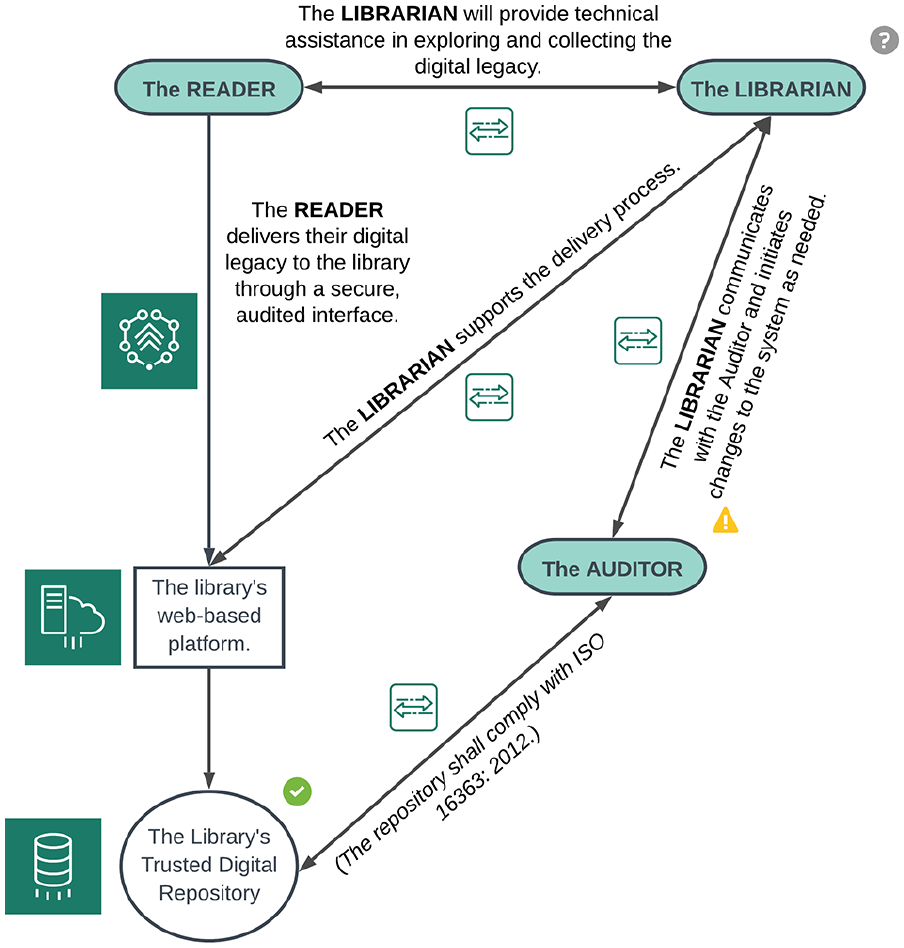
Library model for preserving digital legacies.
As Figure 1 shows, there are five main parties to the preservation of digital legacies by libraries: (1) the reader; (2) the librarian; (3) the web-based platform; (4) the trusted digital repository; and (5) the auditor, who certifies that the system is running in a safe and sustainable manner, in compliance with the relevant standards. In what follows, these will be described in more detail. This section also highlights the prerequisites of the service – namely, the special skills required on the part of librarians; the features that make institutions particularly adequate (ideal) for providing this service; and the reasons why it should be a paid service.
The reader
The first party initiating the process of preservation is the reader who feels the need to preserve their own digital legacy. In the previous sections, we have shown that there are several different services for digital legacy preservation operating simultaneously in the market, which proves that there is a demand for these services. People are looking for simple solutions to preserve their digitally created data safely in the long term. The most significant disadvantage of these services is that they cannot guarantee that the content stored in their database will be available several years later, even after the death of the user – for their successors, for example. Public collections are already involved in the preservation of personal legacies – for example, in the case of digitized or analogue collections containing the letters of poets, politicians and other public figures; archived pictures and audio or video recordings; or even unfinished manuscripts. Public collections therefore have experience in this field. The most important aspect for users is that they need to be able to trust the organization that is entrusted with the preservation of their digital data, as they wish to store their legacies in a place which has a verifiable background and a long history of operation, whose maintenance is possibly provided for by law. In this sense, institutions managing public collections seem to be the ideal choice, especially national libraries, whose maintenance is indeed provided for by law in many countries; they are also open to everyone and therefore reach a very wide audience. As opposed to archives and other public collection institutions, libraries also serve as public spaces; they are places of entertainment, the consumption of culture, connection, work and learning. Libraries are generally liked and trusted by the population. According to a survey, 78% of Americans said that their local library helped them find trustworthy and reliable information (Horrigan, 2017: 19). Therefore, libraries appear to be an obvious choice for the implementation of a service that is primarily based on trust and stable operation.
The librarian
The second party to the service is the librarian who is personally contacted by the user. In a digital legacy preservation service, librarians would assume a supporting role, helping users to explore and collect their digital legacy, and identify where their digital legacy could appear, and they would provide technical help in collecting, organizing and possibly digitizing it. This is consistent with the aspirations of the Library of Congress; the employees of the Library publish materials and guides on a dedicated web page assisting in the preservation of personal digital legacies. Ideally, librarians will possess the high-level information skills required to take on this supporting role. We believe that it is important that the librarian is an active participant in this process, because this will build trust in the service, and human labour is essential for the careful identification and safe storage of digital legacies.
The library’s web-based platform
There are many examples of web-based platforms for digital legacy preservation services – not in a library setting, but connected to the market services introduced in this article. On a web-based platform, the user can find guidance on how to collect, upload and organize their personal digital legacy. It is important that the platform should not require serious information technology skills from the user; it should be easily manageable, and its operation should resemble that of an ordinary, non-library service.
The library’s trusted digital repository
Admittedly, the most important party to this service is the library’s trusted digital repository, which is responsible for the truly long-term, possibly lifelong, preservation of users’ personal digital legacies. Its implementation requires great effort from the organization, and it is not solely an information technology task since, for a trusted digital repository to be compliant with the provisions of the ISO 16363:2012 standard (International Organization for Standardization, 2012b), it needs to conform to infrastructural, organizational and legal criteria. However, the standard itself and the related standard documents mentioned in this article provide detailed guidance on implementation.
The auditor
The last indispensable party to the service is the auditor, whose constant presence is essential to guarantee that the library does indeed operate its personal digital legacy preservation service in a manner which ensures that users’ digital legacies will be intact and available for decades to come. There is a standard prescribing the criteria for the audit of a trusted digital repository (ISO 16363:2012), and another which prescribes the personal criteria to be met by the auditor in order to be authorized to certify conformity to the standard document (ISO 16919:2014).
Required skills
Librarians are information professionals who possess the skills required to process, store and provide large amounts of data. Many organizations in the field of librarianship have published proclamations or guidelines on the knowledge and skills that librarians should possess in order to perform their duties properly. These documents have been collected by the American Library Association (2020) and published on its website. The common points of these documents include the ethical use of information; the analysis of complex problems; the knowledge and use of new technologies; a high level of digital literacy and information literacy; and the use of effective communication techniques. We believe that these are also the skills that make a librarian suitable for assisting people with the identification and long-term preservation of their personal digital legacies.
Ideal institutions
We consider the implementation of this service to be feasible in public collection institutions which possess the necessary resources (human, organizational and infrastructural), since the operation of such a service requires considerable effort on the part of the institution. As mentioned earlier, it is also important that people trust the institution enough to entrust it with the preservation of their personal digital legacies. Public collection institutions have the necessary professional potential to provide assistance to the users of the service in identifying, organizing and preserving their personal digital legacies; thus, aside from a library, such a service could also be provided by an archive. However, the meagre academic literature on the topic mostly covers the issue of personal digital legacies in relation to libraries. This may not be a coincidence since, compared to archives, libraries seem to be considerably better known and more often visited by the average person, and are considered to be more open to the public. The standard documents referred to above in the ‘Trusted digital repository’ section serve as a good starting point in assessing whether a given institution may be suitable for the implementation of the service described in the model.
We believe that it would be consistent with the role of the library to assume the maintenance of personal digital legacies. A statement by the International Federation of Library Associations and Institutions (2013) on libraries and development states that ‘[t]hey can support formal, informal and lifelong learning, the preservation of folk memories, traditional and indigenous knowledge, and the national cultural and scientific heritage’. This includes promoting the preservation of data, similarly to how libraries are already preserving material on paper. The countless documents with immeasurable intangible value stored at the Library of Congress serve as a perfect example. These include the first draft of the Declaration of Independence, handwritten by Thomas Jefferson; a handwritten copy of Abraham Lincoln’s Gettysburg Address; and the invitation written by David Wills, a lawyer from Gettysburg, to Lincoln to the dedication ceremony where the president gave his most well-known speech.
Not so long ago, historians considered it natural that, in order to explore the history of an era, an event or the life of a prominent person, they turned to paper-based documents. If a poet passed away, their successors opened their desk drawer, where they could find the handwritten notes, farewell letters and mementos of the deceased. Digital data storage has the benefit that we do not need paper to record information, therefore it can be easily transferred, copied and edited. People are using less and less paper in their everyday lives, and a time may come when we will not use paper at all, and all information will be stored as bits and bytes.
Why a paid service?
We therefore envision personal digital legacy maintenance by libraries as a paid service because, in this way, the operation would not only be sustainable, but would also serve as a source of income for libraries. There are many paid digital legacy preservation services on the web with very little information available on their background, but they have been operational for years, which shows a great user demand. On top of their fundamental duties, libraries have been providing paid services for many years. These are not free (which might seem contradictory to the spirit of the library) because their operation would not be feasible otherwise. A good example is the selective dissemination of information service provided by many libraries, which was available as early as the 1960s as a paid service. The operation of these paid services does not infringe on people’s right of access to information; they are still services that are loved by, eagerly used by and useful for people. If a library undertook to implement and operate a personal digital legacy preservation service, it would almost certainly only be viable as a paid service, since it is impractical to impose the costs of maintaining a trusted digital repository on an external partner or the maintainer. Similarly, it would be unwise to transfer the necessary resources from the library’s other fields of operation for the maintenance of a service that does not belong to the fundamental duties of a library.
Conclusion
Libraries have the opportunity to become active participants in the efforts aimed at preventing the 21st century from becoming an information black hole for future historians. In this article, we have introduced several services that preserve digital legacies in order to point out that most of them do not guarantee the lifelong storage of the digital legacy on their servers. Furthermore, this data needs to be not only preserved, but also secured, so that, as technology develops, old file formats remain usable (by regular file conversions). National libraries are usually sizable, old, historical organizations, and would be able to provide far better guarantees. User confidence would therefore be greater than in the case of services without a serious organizational background that do not provide any guarantees.
Footnotes
Declaration of Conflicting Interests
The author(s) declared no potential conflicts of interest with respect to the research, authorship, and/or publication of this article.
Funding
The author(s) received no financial support for the research, authorship and/or publication of this article.
