




Abstract
This study tried to unveil the female students’ awareness level in the department of information technology, Umm Al Qura University, Saudi Arabia with the criteria of digital citizenship under the digital revolution in the world today. The digital transformation has a great effect on how persons would deal with the digital data and information. The study depended on the descriptive analytical methodology, because the nature of this methodology is suitable for the subject of the study from the beginning of data collection, that are required to the study, analyzing and interpreting data, to the results phase, that contributes in achieving the goals of this study. Current results pointed out that the total level of female students’ awareness level with the nine criteria of digital citizenship was medium with an average of 139.3 degree. The total values of the nine criteria from the lowest to the highest value ranges from 149 to 237 degree. In some criteria, the female students’ awareness level was high, but in other criteria, this level was medium. The students’ awareness level was raised with the following criteria: “digital access to the information sources”, “educational services”, “electronic market”, “digital communication”, “digital etiquette”, “digital laws”, “digital rights and responsibilities”, and “digital security”. On the other hand, female the students’ awareness level was medium with two creating the criterion of “promotion of digital culture” and the criterion of “digital health and safety”. Among the most important recommendations of this study is the enlightenment of society with the digital revolution, and the dissemination of a culture of digital citizenship among Members of the Society, in addition to putting forward a plan at the level of Saudi universities to teach the “digital citizenship” curriculum.
Keywords
Methodological introduction
Introduction
Information technology and communication have become an important part of the daily life of society. Today, we are living in an age called a digital age. In addition, digital communication methods have developed and demanded more skills which leads to the appearance of a new concept called “digital citizenship”. This term was used for the first time by Prensky (2001), who described the difference between students and teachers a in digital native population and digital immigrants.
Prensky (2001) defined the digital citizens as the citizens who are using digital technology, and understand it by nature rather than the digital immigrants who are the new to the technology and did not use it.
Moreover, the term of digital society was used to indicate the society that provides to its individuals a learning chance, entertainment and social reaction through different applications of modern information technology (Al-Maslamani, 2014). Furthermore, information technology and communication should depend on the extent of understanding degree of the user, and degree of his information awareness. Since information technology has become used widely in our daily life, and in order to benefit from its advantages and to avoid its risks, individuals in the society need to know the at least the bases of digital citizenship.
Everyone in society must work to eliminate information illiteracy. In addition, high use of technology is associated with several moral problems. Although of the benefits and advantages of internet, that provided a rapid alternative form of information and production of digital content, the same technology raised a group of social and moral problems, such as piracy, misuse of information, and illegal access of the protected content, in addition to healthy problems such as exposure to the screen and internet addiction.
Problem of the study
The phenomenon of misuse of information technology and communication was widely spread, although the spreading information technology and communication has several advantages, but some individuals of the society misuse this technology, that may be ascribed to different factors such as shortage of learning or training in schools and universities, so some advanced states such as Canada, UK and USA tried to teach some axes of digital citizenship in curricula of digital education, because of related values and correct behaviors must be planted (Al-Gazar, 2014). That urged some states and organizations to overcome the problems related to misuse of information technology through different initiatives to develop the awareness of the students with digital citizenship. The forum of Umm Al- Qura University under title “digital citizenship”, towards a safe electronic community on January 24, 2019, is one of contributions that could help in putting forward bases of developing digital and information awareness to the students, both male and female. As a result, there are a number of dangers that can come due to the use of online technology, especially among university students, this study attempts to answer the following questions:
What is the concept of digital citizenship that students of the Department of Information Science at Umm Al-Qura University should understand? What are the criteria for digital citizenship that are used to measure the degree of awareness and familiarity with the elements of digital citizenship? To what extent are the students of the Department of Information Science at Umm Al-Qura University aware of digital citizenship? What are the methods that can be used to educate female students in the Department of Information Science at Umm Al-Qura University about digital citizenship?
Importance of the study
The importance of this study is derived from the importance targeting youth students, and the necessity to raise their information awareness, helping them to know the safe use of information technology and communication in response to requirements of the digital age within which we live, and what this age imposes on the education in general and the university. This study aims to understand the current position among the students in the university, in terms of their awareness of the criteria of digital citizenship, and methods of raising their digital awareness.
Objectives of the study
This study aims to:
Recognizing the concept of digital citizenship, which should be understood by female students of the Department of Information Science at Umm Al-Qura University. Recognizing criteria of digital citizenship, which are used to measure the degree of awareness and familiarity with the elements of digital citizenship. Measuring the level of awareness of female students in the information department at Umm Al-Qura University with the criteria of digital citizenship. Determining methods of raising awareness of female students in the information department at Umm Al-Qura University with the criteria of digital citizenship.
Terms of the study
Digital citizenship
Digital citizenship is considered a new dimension of citizenship dimensions, that develop and vary according to the developments and changes in the society, as the development of technology in the society resulted in a new concept of citizenship (digital citizenship), that associate citizenship with various factors, out of them is the association with existence of the society, and the obligation of the individual with a group of moral principles (Choi, 2016).
The term of digital citizenship is considered a nearly new one, and there are different definitions having the same implied meaning, both Ribble and Baily (2004) defined digital citizenship as: “behavior's rules related to using technology”, and both Al-Masry and Shaat (2017) referred to the definition provided by Ribble and defined digital citizenship in 2014 as “optimal use of technology”. In addition, the American association of school libraries defined digital citizenship as, “the art of knowledge of how to use things in a professional manner, with full respect on internet” (Maughan, 2017; Nagy, 2019). Moreover, Netsafe (2018) defined digital citizenship as “abstract social and cultural concept, based on a mixture of values and facts”.
Furthermore, Shaaban (2020) defined digital citizenship as “rules, controls, criteria and customs that are followed in the optimal use of technology that are needed by students in the supreme studies to contribute in the promotion and developing of the society”.
According to the previous definitions, we could say that the concept of digital citizenship is based on three main elements for using information technology, which are:
- Moral behavior in using information technology. - Information awareness when using information technology. - Required skills in treating information
technology.
Concepts pointing to digital citizenship varied, out of them are: “electronic citizenship, and visual citizenship”, both of them have the same definition of digital citizenship (Fallata, 2020).
In this study, Digital citizenship is defining as skills, rights and duties that the students must be acquainted with to guarantee the safe use of information technology.
Digital citizen
According to (Mazen, 2016), the digital citizen defined as “the citizen that uses internet in a regular and effective way”. The citizen is classified a digital citizen when he is able to use the digital apparatus (Al-Qahtani, 2018).
Ribble (2008) reported that the digital citizen must enjoy the following characteristics:
- Understanding the human, cultural and social cases related to technology and practicing the moral and legal behavior. - Calling to practicing legal, safe and responsible use of information and technology. - Showing the positive position towards using technology
that supports cooperation, learning and productivity. - Obligation with the intellectual honesty, respecting different societies and cultures in the visual environment. - Keeping the personal information - Time management that he spends in using technology, and must protect himself against the harmful information that spread through internet. - Ability to use technology of information and communication. - Use of the modern technologies in educational, cultural and economic activities. - Possession of skills of critical thinking in the digital space. - Perfect language of information technology, its symbols and texts. - Recognizing challenges of information technology and manage them effectively. - Use of information technology and communications to communicate with the others in a positive way. - Characterized with honor, impartiality, and moral behaviors in using information technology. - Respect of privacy, expression freedom in the digital society. - Participation in promotion values of digital citizenship.
According to the site (Netsafe, 2015), News Land, digital citizen must enjoy some characteristics and skills that qualify him to be a digital citizen, acquainted with his rights and duties in the digital society, these skills could be summarized in the following points:
In addition, the site of Netsafe (2018) defined the digital citizen as the citizen that acquire digital skills, knowledge and situations fluently to participate in the society as an active learner for long life.
Learning for long life requires three combined elements: eliminating digital illiteracy, digital efficacy and digital intelligence (Pornpongtechavanich and Wannapiroon, 2021).
The elimination of digital illiteracy is recognizing skills, and understanding how to achieve the most benefit from tools, instruments and digital technology that are present with us. Digital efficacy means the development of individual skills in the visual world, and acquiring the components of digital efficacy in terms of retrieving, using, creativity, innovation, self-development, life quality, teaching, learning, communication and coordination in addition to the ability to use instruments and technology
Digital intelligence means the knowledge of how to use digital technology in the present time, and the adaptation to access information Pornpongtechavanich and Wannapiroon, 2021)
Al-Qarni (2021) refers that the digital citizen must have a group of skills that could be summarized as following:
- A user acquainted with information technology and communication. - Using the digital technology in education and cultural activities, - Develop his skills in the electronic space. - Acquainted with digital technology and communication effectively. - Communicate with the others using information technology and communications. - Characterized with moral behaviors in using information technology and communications. - Respects privacy and freedom of expression in the digital world.
In this study, we are defining the digital citizen as the citizen that possesses the sufficient ability and required skill to use information technology and communications with the obligation of moral behavior in utilizing this technology, and care to learn for long-life.
Theoretical frame of the study
Using information technology and communication are no longer limited to exchange information only, but information technology becomes a pattern in our life. We live now in a digital community, so it became necessary to take into account the digital citizen term, who enjoys a high level of technological awareness, and it recognize the criteria of digital citizenship, and the methods of its application. The digital citizenship governs the digital community and puts the laws and the criteria that individuals in this community must be obligated. These laws and criteria guarantee to them the access and the use of information. These laws and criteria help them to protect their privacy, and their safety, and to respect the rights and liberties of the others.
The digital citizenship expresses in the normal conditions the behavior criteria that is obligated to use technology. However, this obligation increased in the time of Covid-19, which played an important role to use the electronic education and distant education. Although the electronic education appeared since 1990s (Assaf, 2020), however, it played an important role in increasing the applications of various digital technologies for many educational, cultural, economic and social goals, due to the urgent need to encounter unexpected changes, that were caused by Covid-10.
Literature
Based on Saudi digital library database, the researcher could access to some literature that could be classified as following:
Literature related to the subject of digital citizenship in general
The research could obtain some literature that treated the subject of digital citizenship in general, through investigating the concept of digital citizenship, its development, or axes of digital citizenship, research participations in the field of digital citizenship…etc. as following:
Studies treated the role of the library in the education of the digital citizenship
Out of the studies that pointed out, the role of the library in education of the digital citizenship are the following:
Study of
Studies related to digital citizenship in the schools
Some of these studies focused on the status of digital citizenship in the schools, and the extent of awareness of the students with the axes of digital citizenship, and what they should do to raise the level of their awareness of digital citizenship. According to this study we obtained the following:
In addition, some studies focused on teachers in the schools to recognize the importance of teaching digital citizenship as an independent curriculum or integrated digital citizenship in the present curricula (Hui and Campbell, 2018). In addition, some studies called for teachers to put and measure the digital citizenship for adolescent (Kim and Choi, 2018).
Studies related to the digital citizenship in the universities
Some of the studies addressed the digital citizenship in the universities to respond to some different related questions. Out of these studies was the study of Tolba (2018) that mainly aimed at recognizing the role of digital citizenship in solving educational technological problems of the students in the faculty of education, Taif University.
Study of Al-Smadi (2017), sheds the light on the concept for the students in the Qassem University for digital citizenship, and in this contest, the study of Nassar (2019) aimed at recognizing the concept of the students in the open Arabian University, Saudi Arabia, for digital citizenship.
Some studies tried to measure the level of digital citizenship of the university students, such as:
Study of Al-Masry and Shaat (2017) tried to investigate the level of digital citizenship with a sample composed of students from the Palestinian University. Nagy (2019) studied the digital citizenship, and the extend of its awareness by some students from the department of libraries and information, Assuit University, an exploratory study.
Some studies focused on the role of social media in promoting the concept of digital citizenship to some students in the university, out of them the study of Al-Sayed (2016), about the role of new media in supporting digital citizenship to the students in the University of Banha, Egypt. The study of Abu Al-Magd and Al-Sayed (2018), examined the role of social media and the method of its employment in promoting the dimensions of digital citizenship to the students in faculty of education, King Faysel University. But the study of Zoein (2017) mainly focused on the efficacy of using electronic codes in teaching geography on developing skills of digital citizenship to the students and teachers in the faculty of education, Monofia University, this study used the experimental methodology.
The focus of this study is to determine strengths and weaknesses points, with the goal of proposing ways to improve digital citizenship among female students.
Goals of digital citizenship
Al-Gazar (2014) explained that the digital citizenship does not aim at putting forward obstacles against in contrary to human rights and freedom values, but aims at protecting the user through encouraging good behaviors, and combating bad behaviors in digital transactions.
Both of Shahada and Ahmed (2019) determined goals of digital citizenship as following:
- Helping students to benefit from advantages of the digital world according to specific programs. - Protecting students from risks of digital
technologies - Developing the awareness of the students to their rights, duties and responsibilities in the digital era. - Helping students and qualifying them to encounter challenges of the digital world. - Participation of the students positively in digital world leading to the promotion of the society. - Using new digital technologies in learning and teaching.
Shaaban (2020) confirmed that the goals of digital citizenship are inspired from the need to use digital technology in learning and teaching and raising the awareness of the students with their rights and duties. In addition to avoiding the negative use of these technologies in the digital era, but to use them in an effective and positive way.
Al-Qarni (2021)
mentioned that digital citizenship must realize the following goals:
- Awareness with the concept of digital citizenship in different stages of age. - Increasing the level of digital safety. - Obligation with good digital behavior to represent the state in a best image. - Reducing negative effects of using internet. - Spreading the culture of expression freedom, and the obligation to the morals of digital citizenship. - Preparing an integrated reference for electronic cases to facilitate informing the person with these cases. - Promoting the concept of self-control.
From the previous goals of digital citizenship, its importance is obvious in preparing a digital citizen, capable to handle the digital technologies, and the responsible use of information and communication technologies.
Themes of digital citizenship
Digital citizenship is composed of 9 themes, according to Ribble and Baily (2004) that could be summarized as following:
Digital access
Means giving an equal chance to all persons in the community to digital access. The social, economic, and political level should not be obstacles for giving equal accessibility for all persons in the society. Ribble and Baily (2004) reported that not all people in the community have equal chance to the information technology. In addition, the majority of people around the world have no accessibility or have a limited chance of accessibility, accordingly we need to support the equal digital rights.
Digital market
In digital environment the seller and buyer must be obligated laws and criteria, as most of the market economy of the countries in this century pass through digital channels (Al-Sayed, 2016).
Internet became a joint global market, so the digital citizens need to be intelligent consumers, who have the ability not to fall a victim of false transactions through internet, they also need to understand that goods and services available within international sites may violate the local laws in their countries.
Digital communication
which means the extent of availability of the digital communication channels, and how digital citizen can use these methods, such as emails and social media.
Promotion of digital culture (eliminating digital illiteracy)
Al-Dahshan and Al-Fawahmi (2015) indicated that the concept of illiteracy in this era is no longer limited to the ability of the person to write and read but extended this to the digital dimension. Eliminating digital illiteracy became a goal for the states that seek to build new and developed communities of knowledge through providing their peoples with basic skills that enable them to use computers in their daily life.
Digital behaviors
This related to educating and training the user of information technologies the criteria of good digital behavior and user become a responsible digital citizen, out of these criteria determined by Zoein (2017), are the following:
- Not publishing any personal information belonging to any other persons without their permission. - Respect opinions of other persons - Confirming the sources of information before publishing.
Digital laws
Digital laws are laws that govern the digital community, and criminalize every one may violate this community. These laws define the digital responsibility for actions. Accordingly, the digital citizen must be educated in these laws, and must be acquainted with the laws related to using technologies. The digital citizen should be able to differentiate between the legal use and illegal use, such as laws of copy write, laws of intellectual property, laws of privacy protection, penetration of the electronic sites and pages of others… etc., that guarantee using information technologies legally, and not violating the rights of others.
Digital rights
Digital rights are rights that may be enjoyed by the digital citizen in the technological world, such as right of privacy, right of expression, right of communication without determining the identity. Al-Sayed (2016) defines the right of digital citizen as “the extent of the technology users to protect their digital rights and the rights of the others, and to defend them”.
Digital health and safety
Digital health and safety mentioned in this axis means both physical and psychological health, that are related to educating the digital citizen by the measures and procedures that must be taken to protect himself, and prevent the risks that may threaten his digital security, such as not disclosing the password of his personal page on internet to anyone, the interest in down load, the setting up of anti-virus programs on his personal computer, and the sign out form his page on internet after every use of this page…etc.
Digital security
Digital Security means the self-protection of the digital citizen, in the sense of educating and training the digital citizen the measures that he must take to protect himself and prevent what might threaten his digital security, for example, not divulging the password of his personal pages on the Internet to any party, and taking care of downloading anti-virus programs on a device The personal computer, and the need to log out of its pages on the Internet after the completion of use … etc.
Results of the studies: the level of awareness of female students, in the department of information with digital citizenship
Methodology of the study
The study depended on the descriptive analytical methodology, because the nature of this methodology is suitable for the subject of the study from the beginning of data collection, that are required to the study, analyzing and interpreting data, to the results phase, that contributes in achieving the goals of this study.
Instruments for data collection
The current study depended on an electronic questionnaire, which was designed and developed by the researcher based on some of the previous studies related to the axes of the digital citizenship to reveal the awareness of female students in the department of information science with the criteria of digital citizenship. One of the most important studies, this questionnaire is based on, is the study of (Al-Masry and Shaat (2017)) as well as the study of (Nagy, 2019).
The researcher experimented with the questionnaire, through presenting it to some students in the department, to respond to the questions and to explore their opinion about clarity of questions and statements in the questionnaire. The number of students participating in this phase is 21 students.
The questionnaire is composed of the following sections:
Statistical treatment
This study used triple Likert scale to respond to the questions in the questionnaire in the second section, related to the level of awareness of female students with the criteria of digital citizenship. In the first section, this scale was used to respond questions related to the extent of knowledge of female students about the concept of digital citizenship.
The statistical program (SPSS, version 21) to extract the results, and Chi-2 test was used to test the statistical assumption, “There is no significant correlation at the probabilistic level 0.05 or 0.01 between: the level of awareness of female students of digital citizenship standards and their attendance at training courses or workshops.”
The study community
The study community is composed of female students in the department of information science, Faculty of computers and Information systems, Umm Al-Qura University, 287 female students responded, using simple random sample method.
This study was conducted in accordance with the Declaration of Helsinki 1975, revised in Hong Kong 1989, http://www.wma.net, adhered to the guidelines of the Ethics Review committee of the Umm Al-Qura University, and was conducted at the end of the academic year 2020–2021 AD. Study design, steps, details were all explained to all participants who provided form agreeing for participation in this study and publication of its results.
Limits of the study
-
-
-
-
Results related to description of community sample
Total number of female students participated in the study is 287. Students are distributed into four levels in the second term. The highest percentage of students was from the 8th level (41.5%) of total sample, and in the second rank are students from the 4th level (33.8%), and in the third rank students from the 6th level (23. %), and finally, students from the 2rd level are in the fourth rank (1.7%). Reduction of percentage of students from the first level may be ascribed to the fact that the department does not accept new students since the academic year (2018–2019), due to developing the plan of the department after shifting the department from the faculty of social sciences to the faculty of information technology and information systems, and the need to graduate all female students under the old plan before accepting new students. (Table 1)
Distribution of female students in the sample according to teaching level.

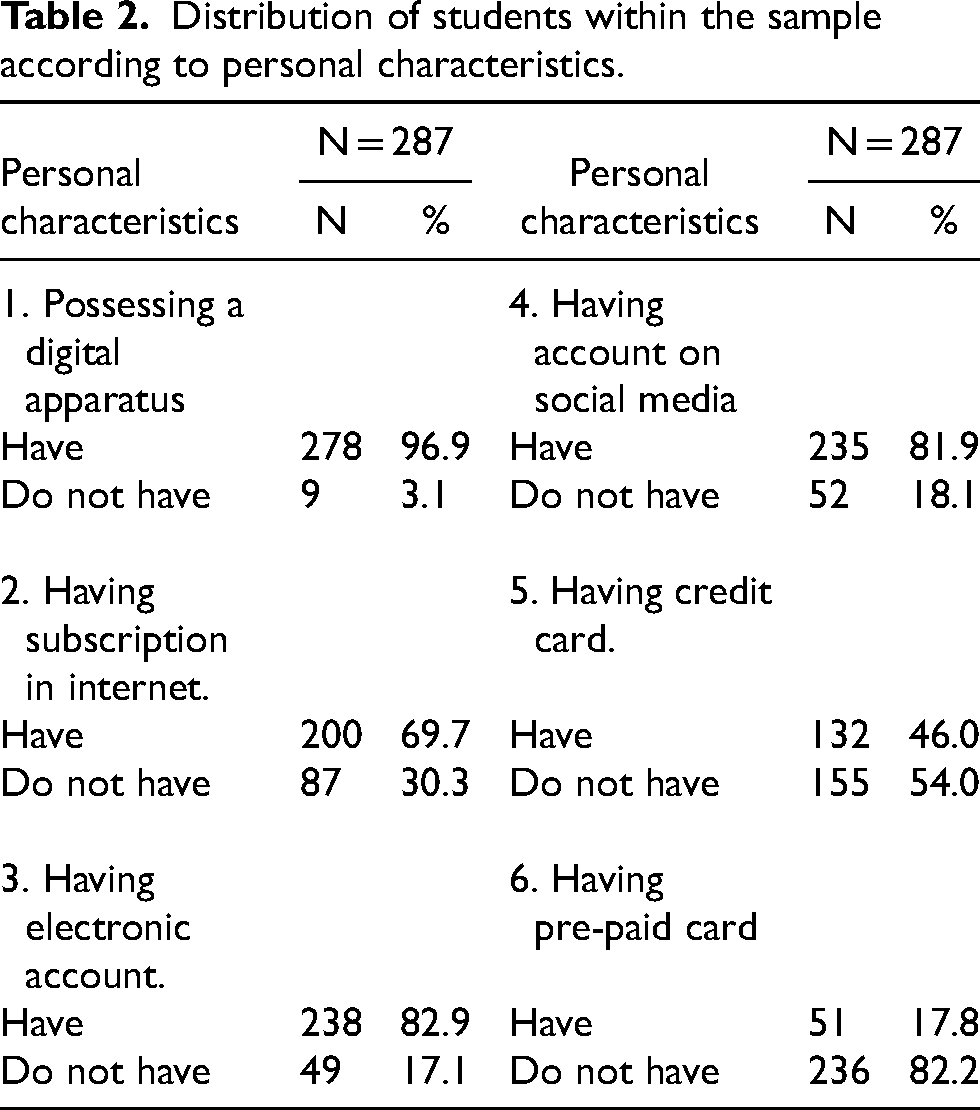
A percentage of 96.9% of female students in the sample have a digital apparatus, out of them 69.7% have subscription in internet that confirms the wide of spreading of digital technologies among the youth in this digital age. That makes the raising level of digital citizenship in the community in general and among the youth in particular, very important matter. A percentage of 82.9% of the students in the sample have electronic account, 81.9% of the students have an account on social media. Abu Al-Magd and Al-Sayed (2018) confirmed that the spreading of social media on a wide scale among persons of the community and youth in particular, has an important effect on the promotion of digital citizenship, as the social media became the most popular in the visual and social life of most of people in the community, specially the youth.
Results show that 46% of students have credit cards, and 17.8% of the students have pre-paid cards, in spite of their young age, and being still in the education phase. This delineates the spreading of the idea of digital transactions within the community. (Table 2).
Distribution of students within the sample according to personal characteristics.
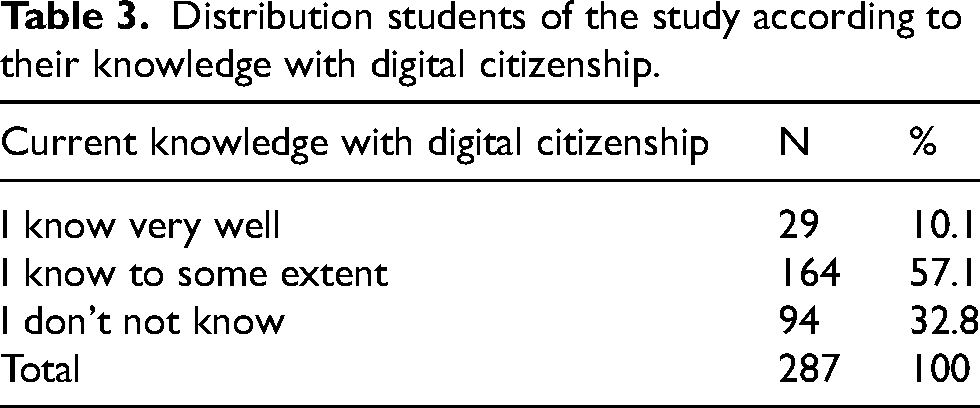
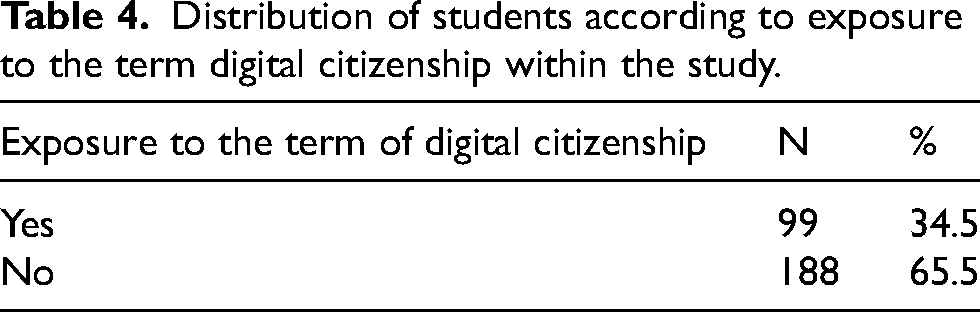
The most percentage of students in the sample indicated that they have a medium knowledge of digital citizenship, as 57.1% of the sample indicated that they know this concept to some extent, whereas 32.8% indicated that they do not know any information about digital citizenship, and 10.1% of the students reported that they have a good idea about digital citizenship (Table 3). A percentage of 34.5% of the students reported that they know the term of digital citizenship from their study in the department of information, and 65.5% of students are not exposed to the digital citizenship through their study, the highest percentage, that urges to include a scientific content containing digital citizenship and its fields, and to train the students to apply the criteria of digital citizenship (Table 4).
Distribution students of the study according to their knowledge with digital citizenship.
Distribution of students according to exposure to the term digital citizenship within the study.
Results related to the level of awareness of students within the sample with the criteria of digital citizenship
The level of awareness of students within the sample with the criterion of digital access to sources of information and educational services
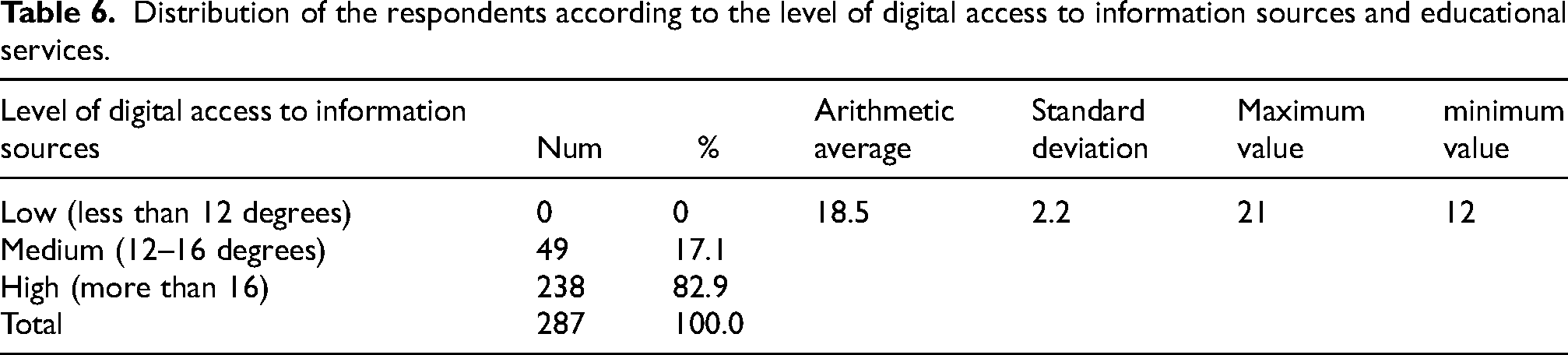
From the results illustrated within Table 6, we could see that the level of awareness of students within the sample with the digital access to sources of information and educational services is high (Arithmetic average = 18.5%), while the lowest and highest values varied from 12–21 degrees.
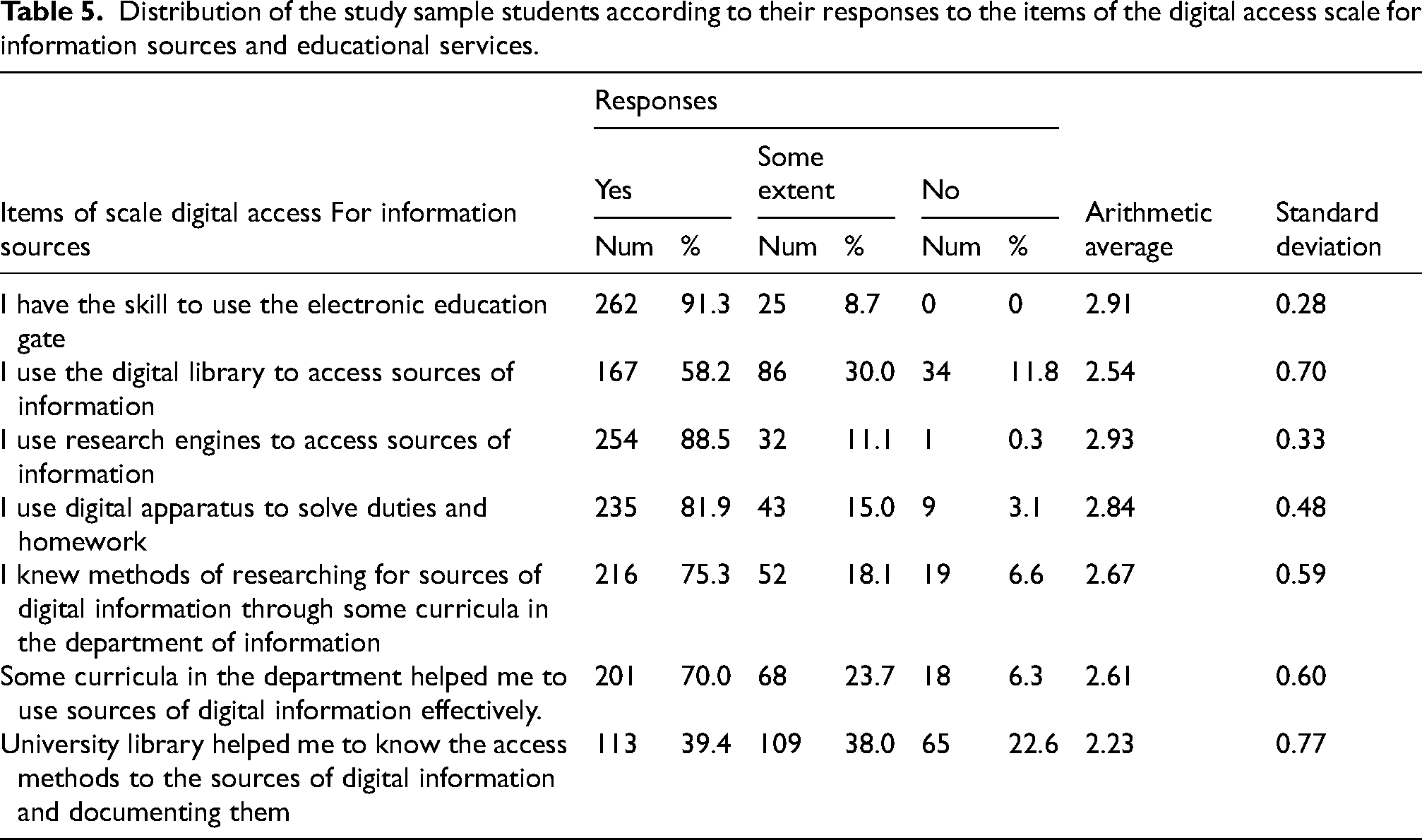
“Using research servers to access information sources” was in the first rank, with arithmetic average 2.93 degrees. In the second rank was “the availability of the skill that is required to use the gate of electronic education”, with arithmetic average 2.91 degrees. In the third rank was “using digital apparatus in solving problems and doing homework”, with arithmetic average 2.84%, that may be ascribed to the total dependence, during the spreading of covid-19, on distant education, that increased using digital educational instruments, and electronic sources of information.
In addition, results indicated the participation of curricula in the department in recognizing how the students could access to sources of digital information, and how they could use. The degree of medium for “recognizing method of searching for sources of digital information through some curricula in the department” was 2.67 degrees, in the fourth rank. In the fifth rank was “the participation of some curricula in the department in how the students could use sources of digital information effectively, not accessing these sources only” with arithmetic average 2.61 degree. In the sixth rank was “using digital library to access sources of digital information” with arithmetic average 2.54. Finally, in the last rank was “the help provided by the library in the University of King Abdulla to the students to learn methods of accessing sources of digital information and documenting them” with arithmetic average 2.23. This may be explained by the fact that these libraries do not provide sufficient training courses to the students on how they could use sources of digital information, and methods of access as illustrated in (Tables 5 and 6).
Distribution of the study sample students according to their responses to the items of the digital access scale for information sources and educational services.
Distribution of the respondents according to the level of digital access to information sources and educational services.
Students’ awareness level with criterion of electronic market
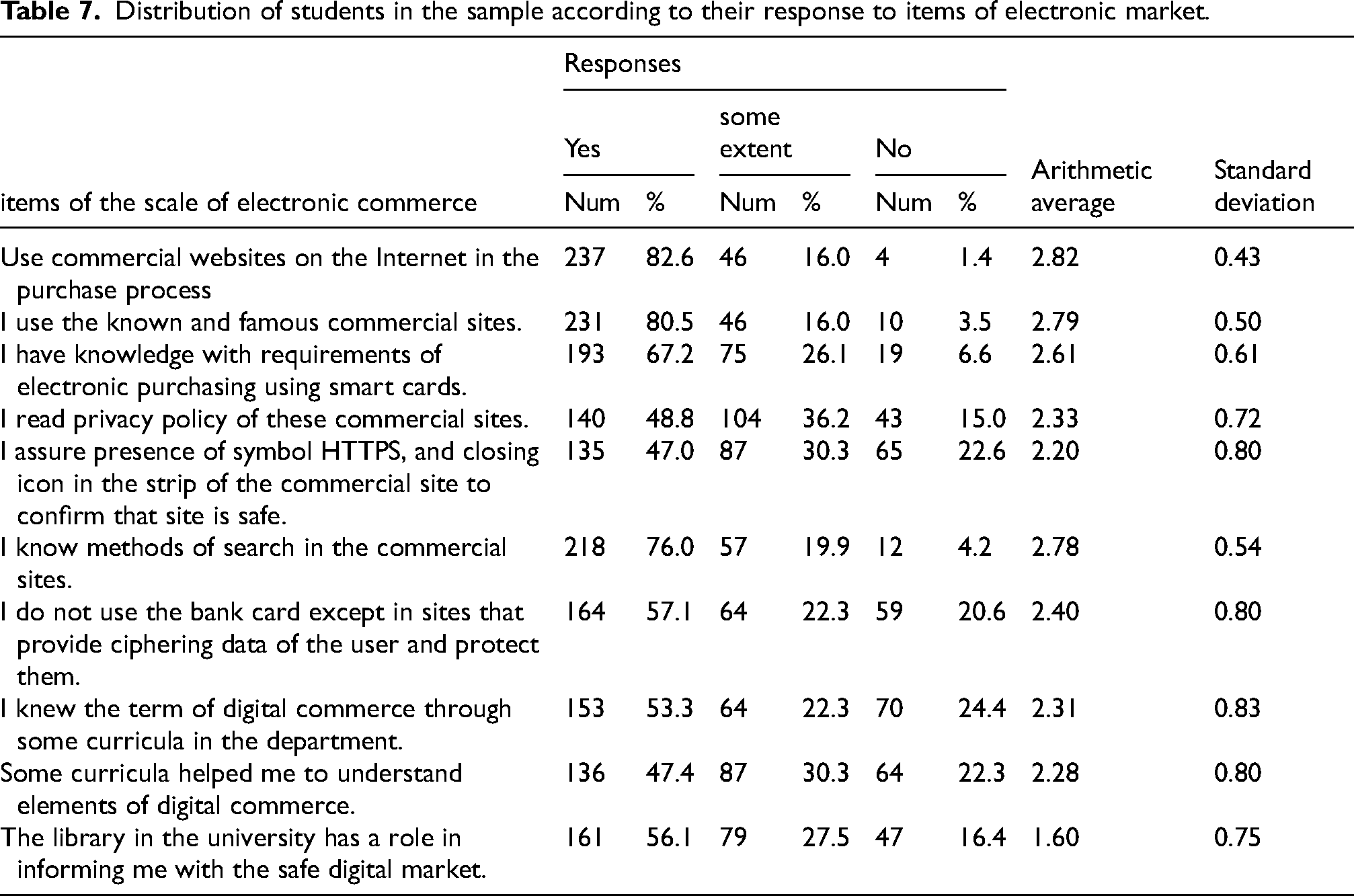
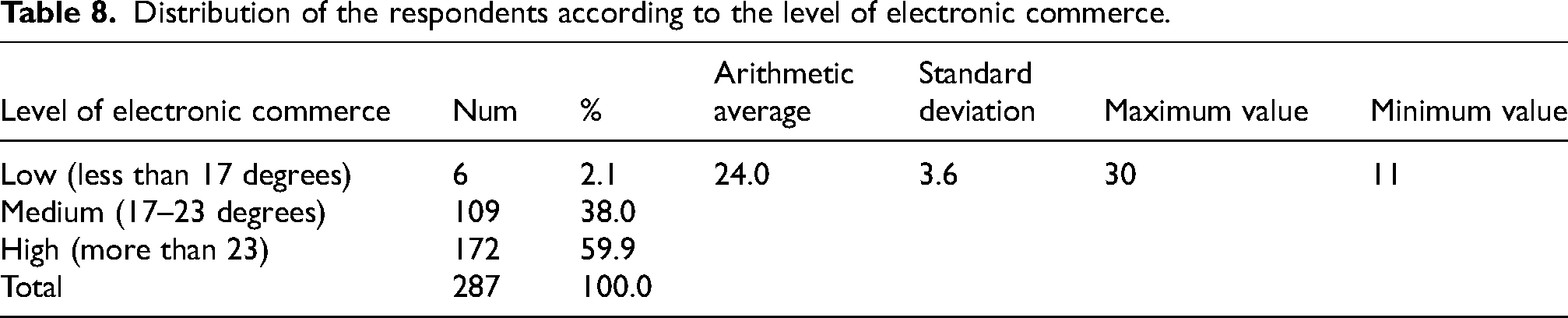
From Table 8, we could conclude that student's awareness level with criterion of electronic commerce was high, with arithmetic average 24.0 degree, values of electronic commerce ranged for lower value and higher value (11–30). Table 7 shows the item of electronic market scale. The higher value of arithmetic average for this item exceeding the item of using famous international sites with average 2.82 degrees. That may be attributed to the care of the students to use the safest sites from their point of view. Another reason is the reputation of the site as an element of the trust and attraction of consumers. The lower value of arithmetic average was for item (the library in the university has a role in informing me with the safe digital market), as the library in the university does not provide the students with information about electronic market, and the lack of training courses and workshops about this matter (Tables 7 and 8).
Distribution of students in the sample according to their response to items of electronic market.
Distribution of the respondents according to the level of electronic commerce.
Students’ awareness level ab the criterion of digital communication
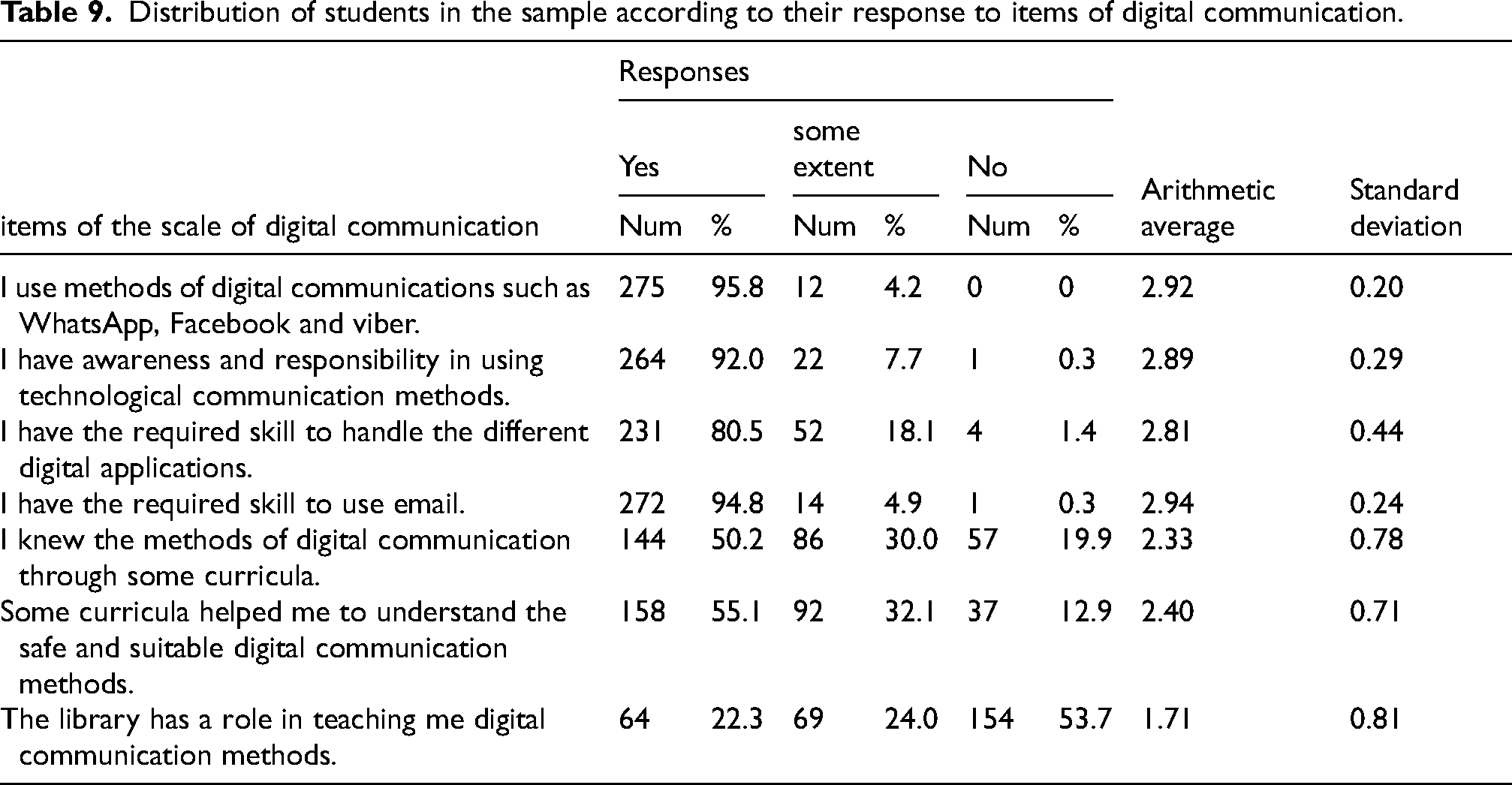
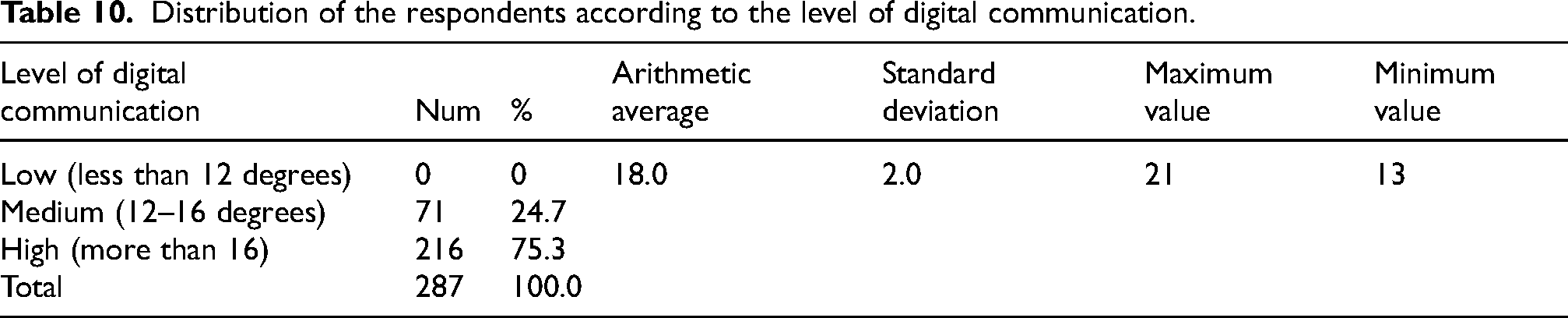
Results illustrated in Table 10 that awareness level of the students of the field of communication was high, with average 18.0 degrees, values for electronic communication for lowest and highest values varied from 13–21. Table 9 illustrates items of the scale of digital communication, and the highest value of the average was for the item ((I have the skill to use email), with average 2.94 degree, because the email in the Umm Al Qura University was the only official method of communication among students and teaching staff, while other communication methods in the university were not accredited. That enhanced the students to be acquainted with skills of using email. The lowest value was for the item ((The library in the university has a role in informing me about the methods of digital communication) with average 1.71 degree, that may be explained by the fact that the university does not provide the students with sufficient information about digital communication, and the lack of training courses and workshops about this topic (Tables 9 and 10).
Distribution of students in the sample according to their response to items of digital communication.
Distribution of the respondents according to the level of digital communication.
Students’ awareness level with the criterion of promotion of digital culture
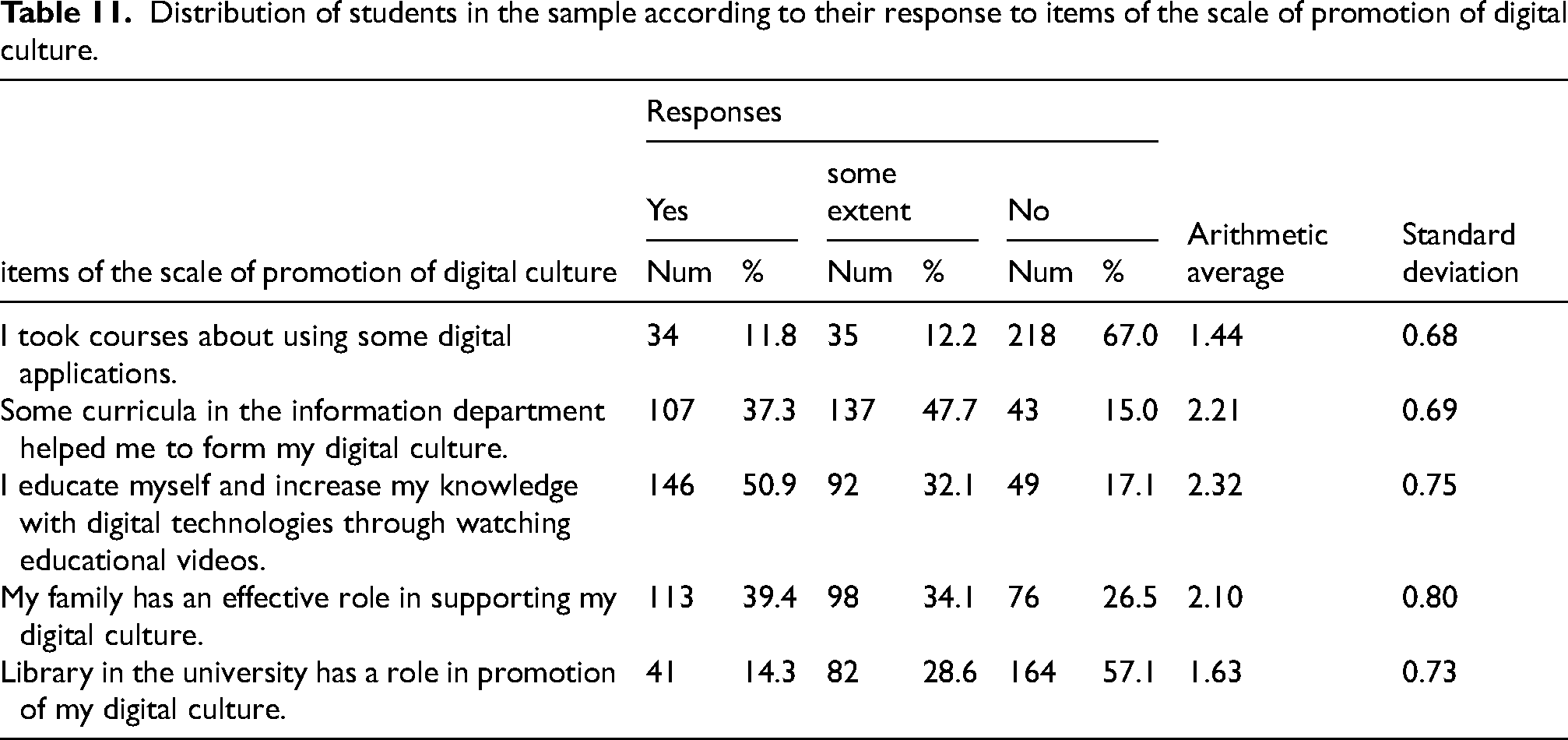
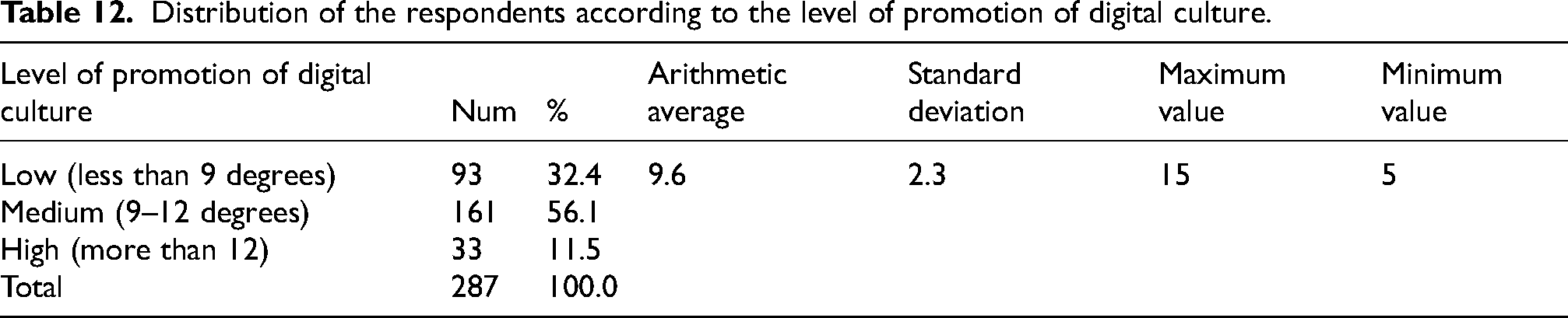
From Table 12, we could see that students’ awareness level with the field of promotion digital culture was medium, (with average of 9.6 degrees), and values of promotion digital culture varied from the lowest to highest values (5–15 degrees). Table 11 illustrates items of the scale of promotion digital culture, and the highest value was in the item (I educate myself, and my knowledge with digital technologies from watching educational videos), with an average of 2,32 degree, due to the care of students to raise their level in handling digital technologies and depending on themselves in this matter. That was confirmed by results, whereas the lowest value was for the item included in the statement (I took training courses about using some digital applications) with an average of 1.44 degree, due to the insufficiency of training courses either in the department of the faculty or in the university to raise the students’ awareness level with the fields of digital citizenship, out of them is digital culture (Tables 11 and 12).
Distribution of students in the sample according to their response to items of the scale of promotion of digital culture.
Distribution of the respondents according to the level of promotion of digital culture.
Students’ awareness level with the criterion of digital etiquette
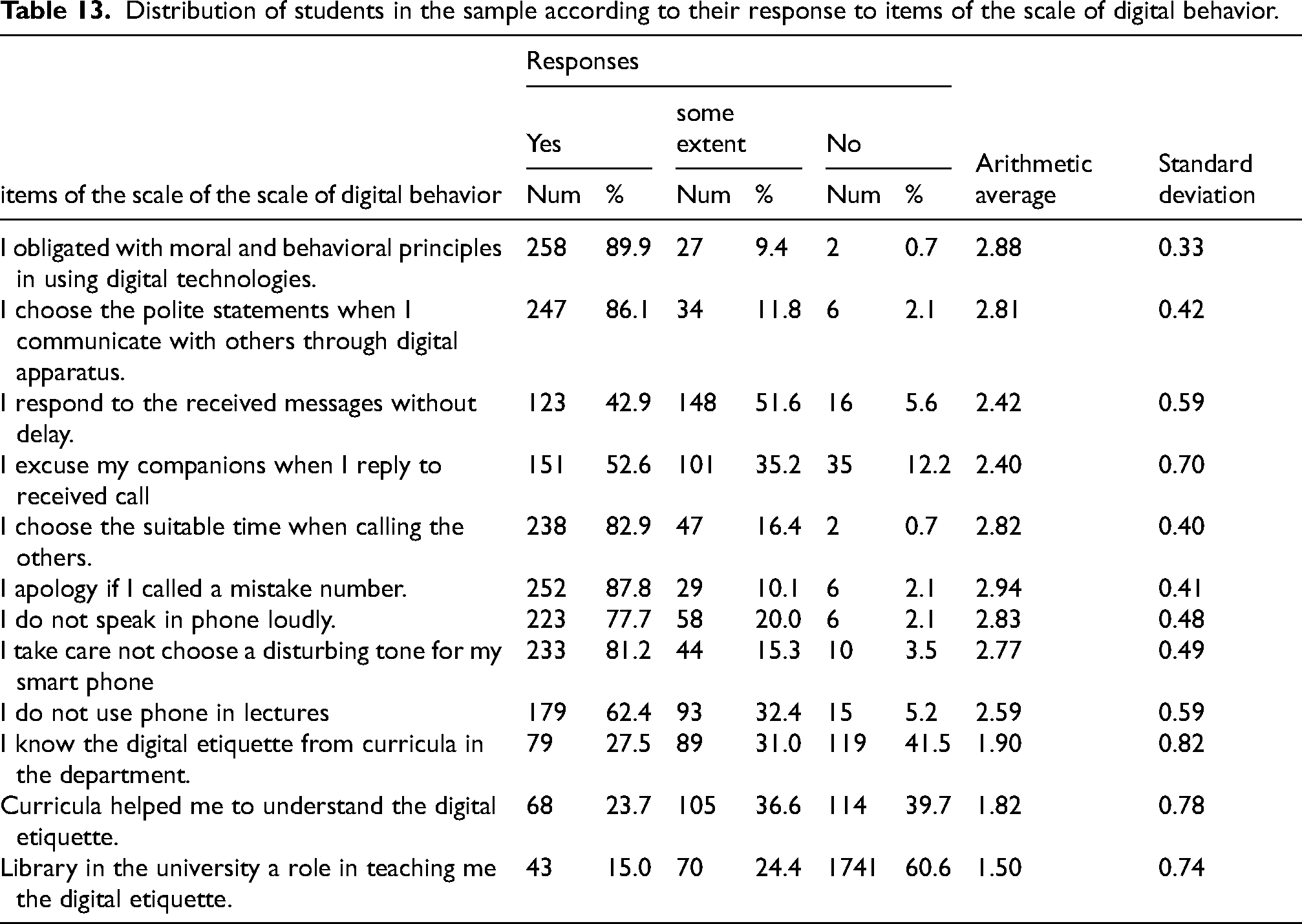
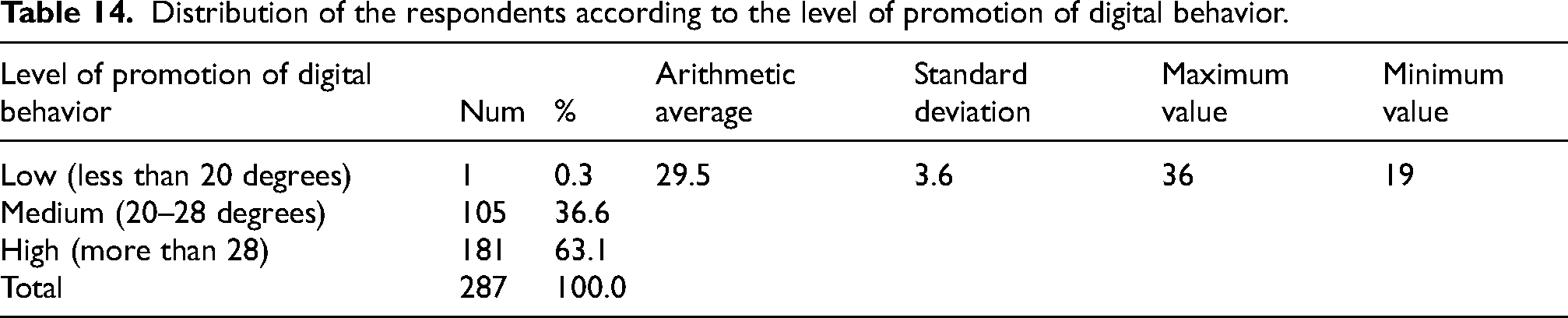
Results in Table 14 illustrate that Students’ awareness level with the criterion of digital behavior was high, with an average of 29.5 degree, whereas the values of digital behavior varied from lowest value to highest value from 19–36 degree. Table 13 illustrate the items of the scale of digital behavior, and the highest value of arithmetic average was for the item included in the statement (I apologize if I mistake in calling a phone number) with an average 2.94 degree, and the lowest value was for the item included in the statement (the library has a role in teaching me digital etiquette) with an average 1.50 degree, that may be ascribed to the fact that the library in the university does not provide the students with sufficient information about digital communication, or training courses and workshops on this matter (Tables 13 and 14).
Distribution of students in the sample according to their response to items of the scale of digital behavior.
Distribution of the respondents according to the level of promotion of digital behavior.
Students’ awareness level with the criterion of digital laws
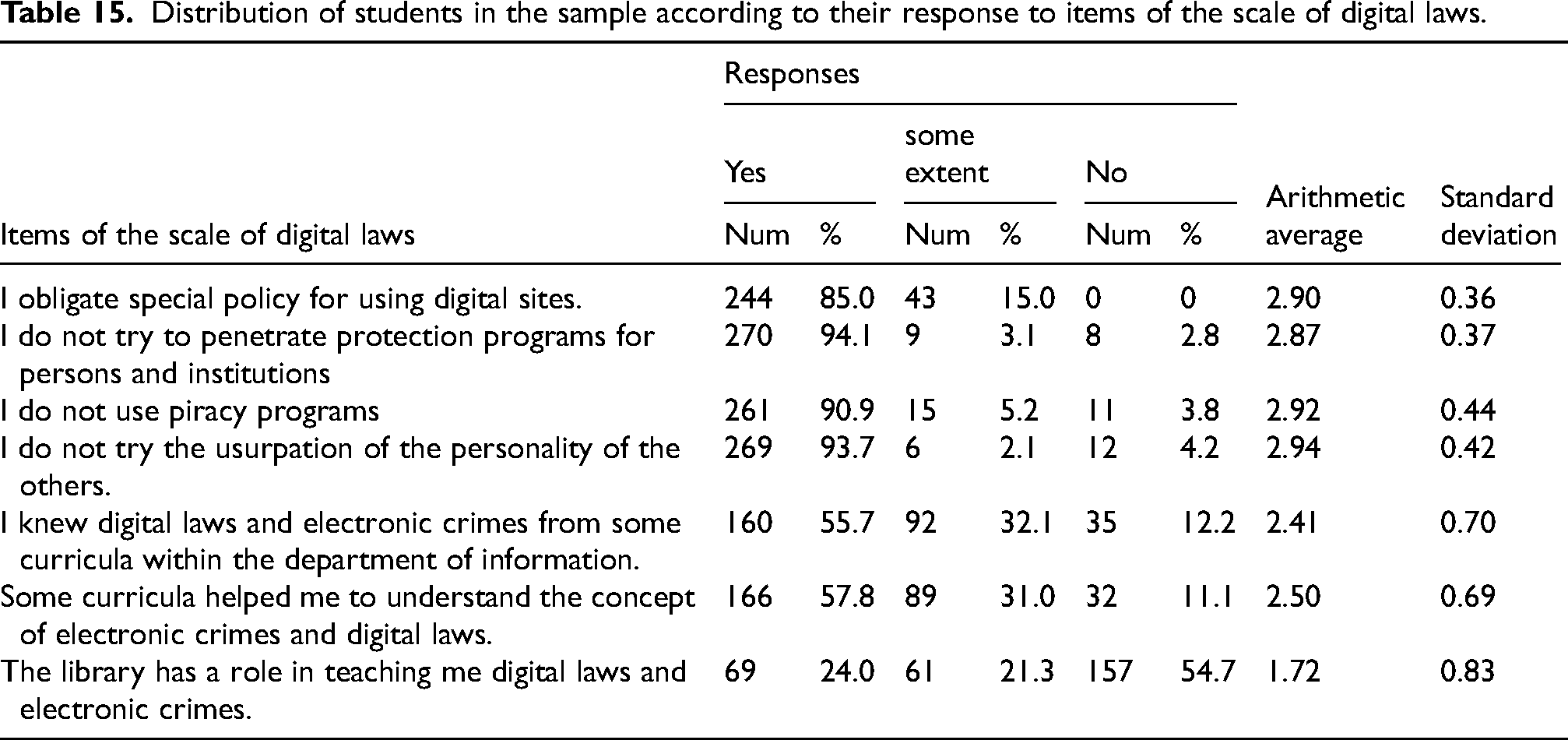
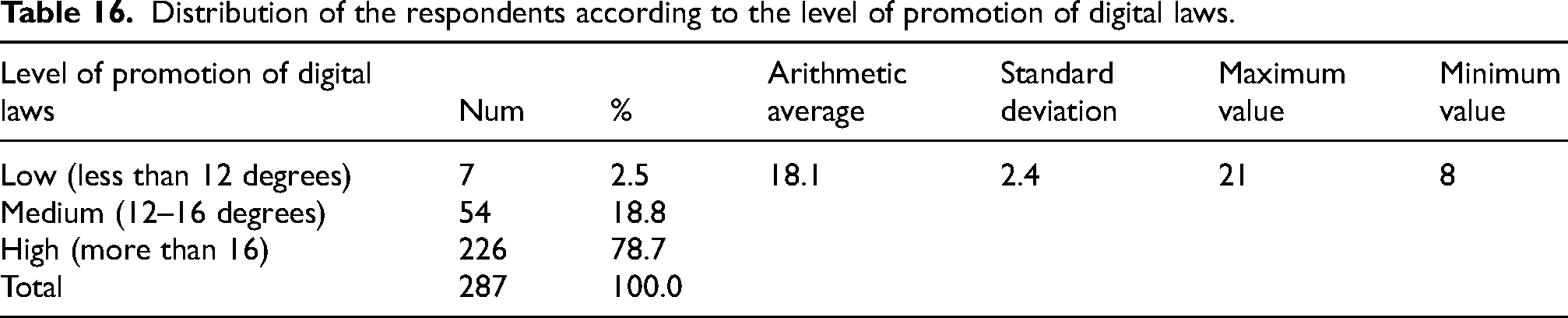
From the results of Table 16, we could conclude that the students’ awareness level with the criterion of digital laws was high, with an average of 18.1 degree. Values of digital laws varied from lowest values to highest values (from 8 to 21 degree). The table illustrates items of the scale of digital laws, the highest value was for the item included in the statement (I do not try the usurpation of the personality of the others) with an average of 2.94 degree, that may be ascribed to the severity of laws in Saudi Arabia, with regard to information crimes. This warning “out of usurpation personality of the others”, continuously presented by the authorities against violating laws. The lowest value for this item in the statement (the library has a role in teaching me digital laws and electronic crimes), with an average of 1.72 degree, that may be ascribed to the inability of the library to provide the students with sufficient information about digital law, and lack of training courses and workshops about this matter (Tables 15 and 16)
Distribution of students in the sample according to their response to items of the scale of digital laws.
Distribution of the respondents according to the level of promotion of digital laws.
Students’ awareness level with the criterion of digital rights and responsibilities
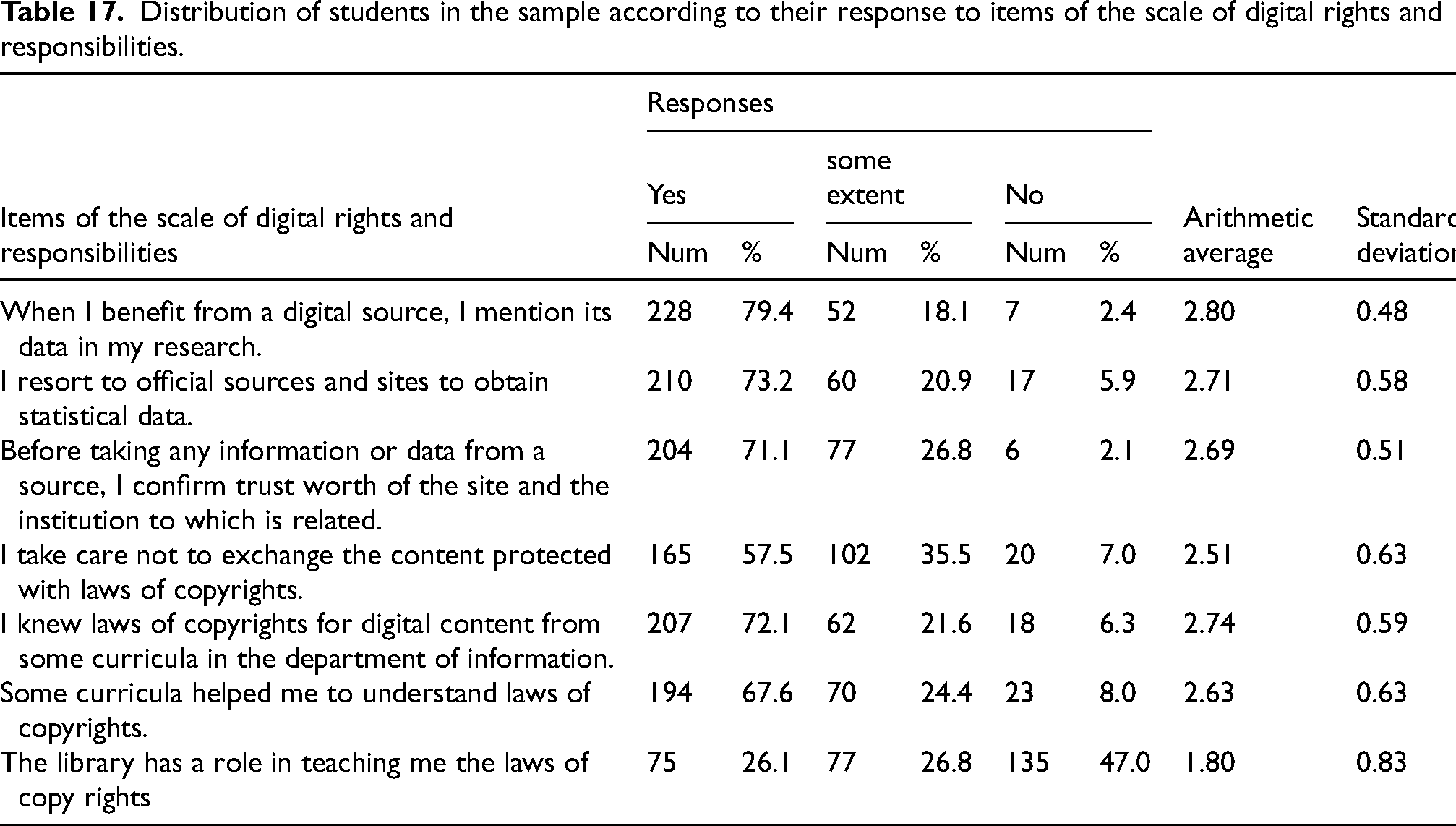
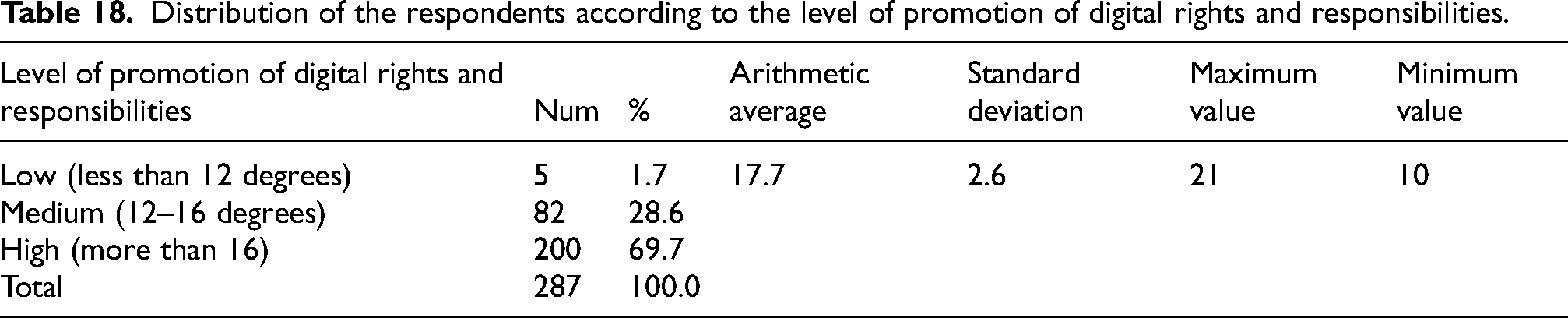
From the results within Table 18, we could conclude that the students’ awareness level with the criterion of “digital rights and responsibilities” was high, with an average of 17.7 degree, and the values of digital rights and responsibilities varied from lowest value to the highest value, from 10 to 21 degree. In addition, Table 17 illustrates items of scale of digital rights and responsibilities. The highest value was for the item included in the statement (when I benefit from a digital source, I mention its data), with an average of 2.80 degree. That may be explained by the fact that the goals of some curricula in the department point out to documenting the sources and references in scientific research. Another reason is the training of the students on this matter, such as research methodology, in addition to other curricula, out of its goals is the explaining of copy rights, laws of intellectual property, that was confirmed by the result included in the item no.5 (I knew laws of intellectual property for digital content from some curricula in the department of information in the university), with an average of 2.74. The lowest value was for the item included in the statement (the library has a role in teaching me laws of digital copyrights) with an average 1.80 degrees. That may be attributed to the fact that the library does not provide the students with information about copyrights, and lack of training courses and workshops on this matter (Tables 17 and 18).
Distribution of students in the sample according to their response to items of the scale of digital rights and responsibilities.
Distribution of the respondents according to the level of promotion of digital rights and responsibilities.
Students’ awareness level with the criterion of digital health and safety
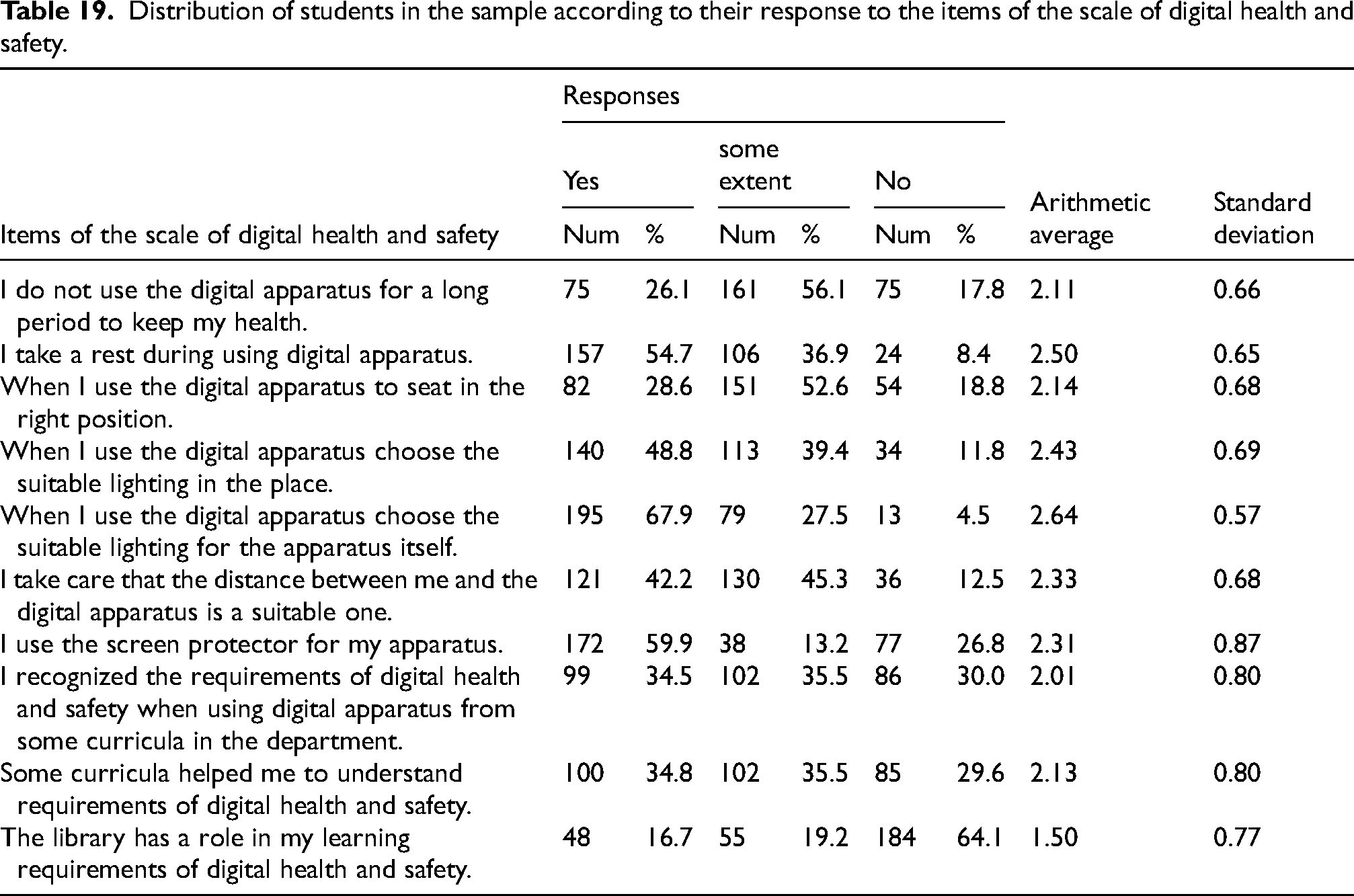
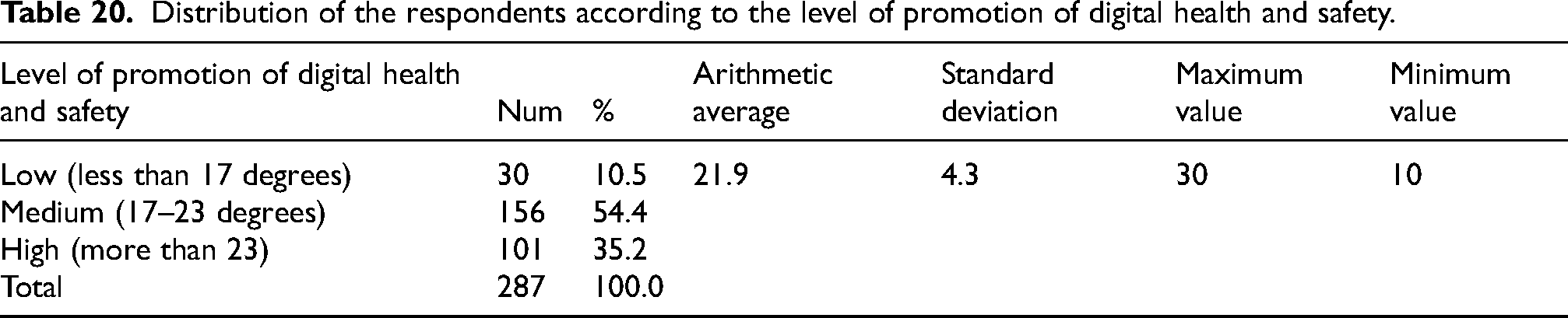
Results in Table 20 point out that the students’ awareness level with the criterion of “digital health and safety” was medium, with an average of 21.9. Values of “the digital health and safety” varied from lowest to highest value, from 10–30 degrees. Table 19 points out to the items of scale of digital health and safety, the higher value was for the item included in the statement (I take care when using digital apparatus to determine the suitable lighting), with an average of 2.64 degree. The lowest value was for the item included in the statement (the library has a role in teaching me the requirements of digital health and safety), with an average of 1.50 degree. That may be attributed to the fact that the library does not provide the students with sufficient data and does not hold training courses and workshops on this matter (Tables 19 and 20).
Distribution of students in the sample according to their response to the items of the scale of digital health and safety.
Distribution of the respondents according to the level of promotion of digital health and safety.
Students’ awareness level with the criterion of “digital security”
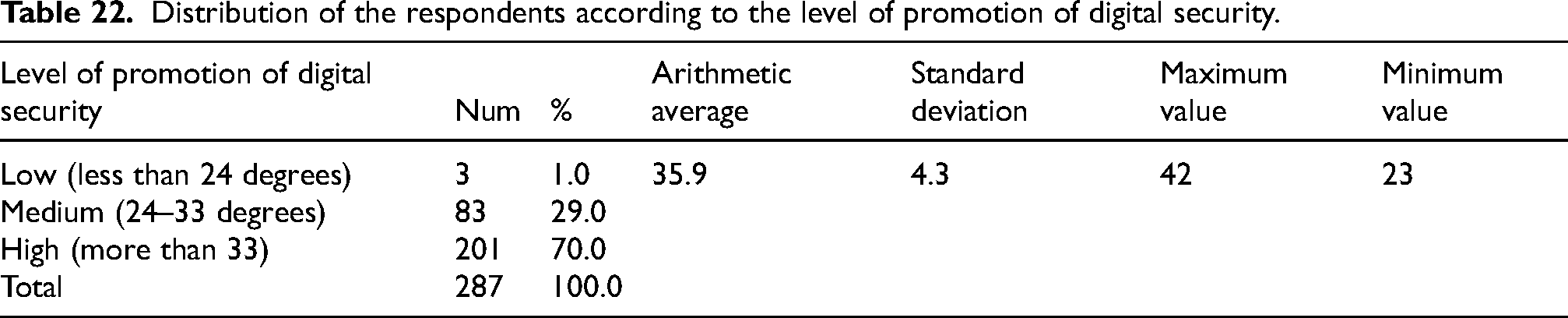
From the results pointed out in the Table 22, we could conclude that the students’ awareness level with the “criterion of digital security” was medium with an average of 35.9 degrees. The values of digital security varied from lowest to highest values from 23 to 42 degrees. Table 21 illustrated the items of the “scale of digital security”, the highest value was for the item included in the statement (I used a safe engine on internet), with an average of 2.92 degrees. The lowest value was for the item included in the statement (the library has a role in teaching me the requirements of digital security. That may be attributed to the fact that the library does not provide the students with sufficient data and/or does not hold training courses and workshops on this matter (Tables 21 and 22).
Distribution of students in the sample according to their response to items of the scale of digital security.
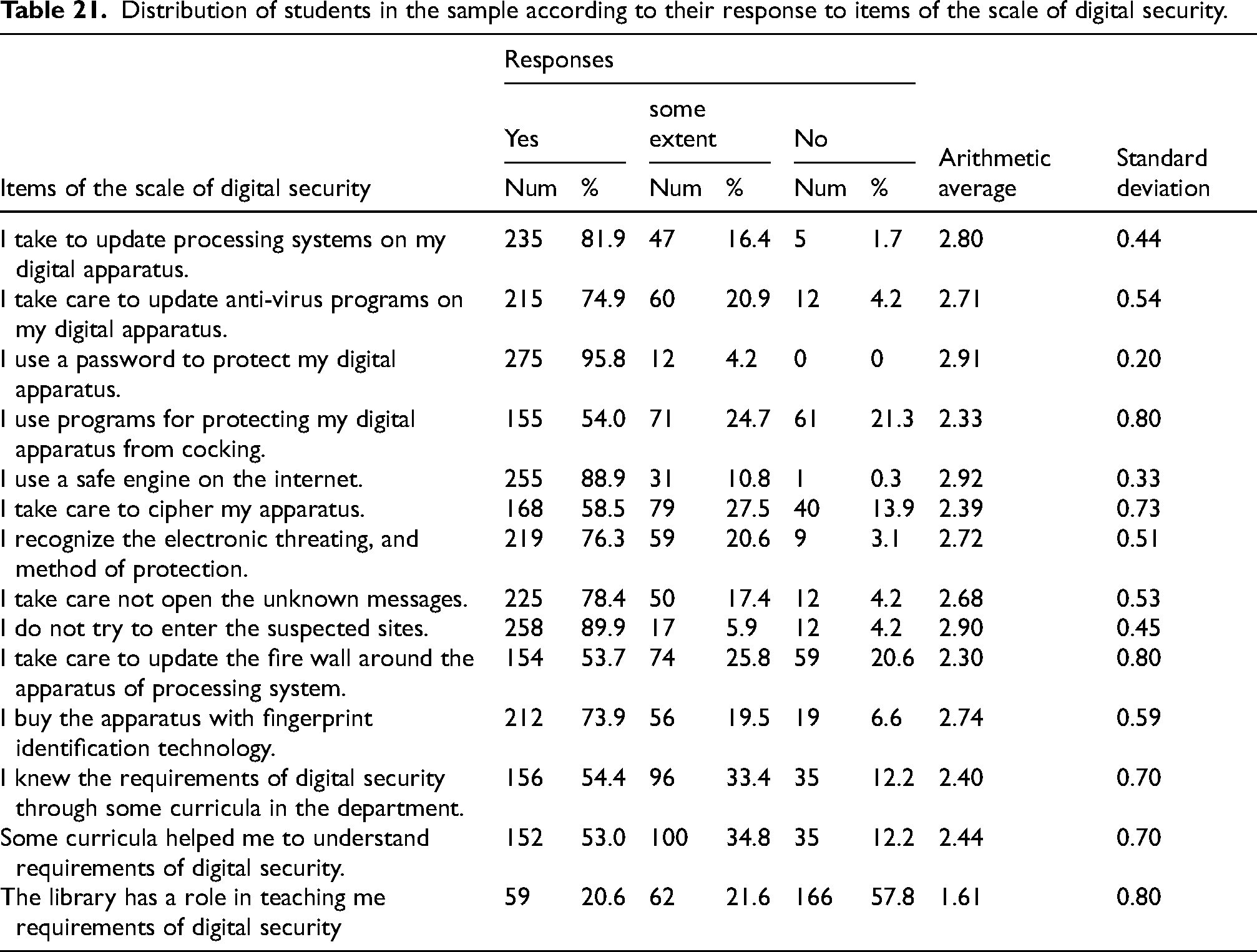
Distribution of the respondents according to the level of promotion of digital security.
Students’ awareness level with the nine criteria of digital citizenship
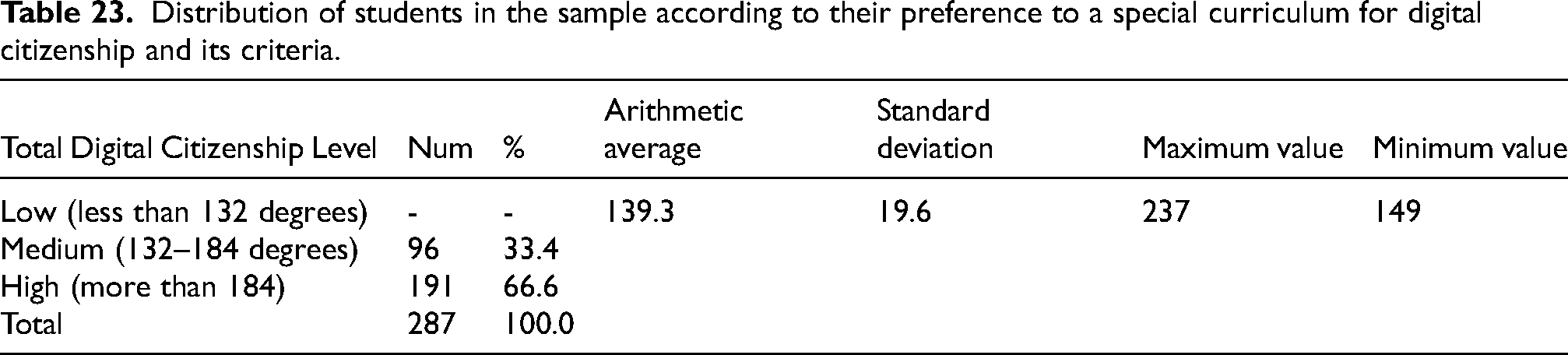
Table 23 points out to the total level of Students’ awareness level with the nine criteria of digital citizenship, which was medium with an average of 139.3 degree, the value of joint nine criteria varied from lower value to higher value, from 149 to 237 degrees. That may be explained by the lack of exposure to criteria of digital citizenship in the curricula of the department with the sufficient and required degree, in addition to there is no special curriculum for digital citizenship in the university, the faculty or in the department.
Distribution of students in the sample according to their preference to a special curriculum for digital citizenship and its criteria.
The relationship between awareness of the students with the criteria of digital citizenship and attendance of training course
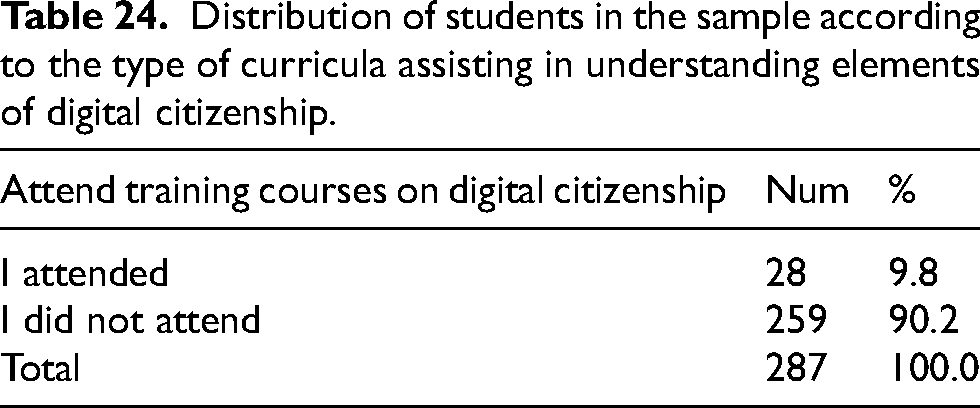
The highest percentage of the female students (90.2%) did not attend training courses or workshops, except 9.8% only that attended training courses and workshops. That was reflected on the students’ knowledge of the concept of digital citizenship, and being acquainted with its fields (Table 24).
Distribution of students in the sample according to the type of curricula assisting in understanding elements of digital citizenship.
The test of Ch2 was used to test the statistical assumption stipulates that “there is no significant relation on the significance level 0.05 or 0.01 between the students’ awareness level and the attendance of training courses and workshops”.
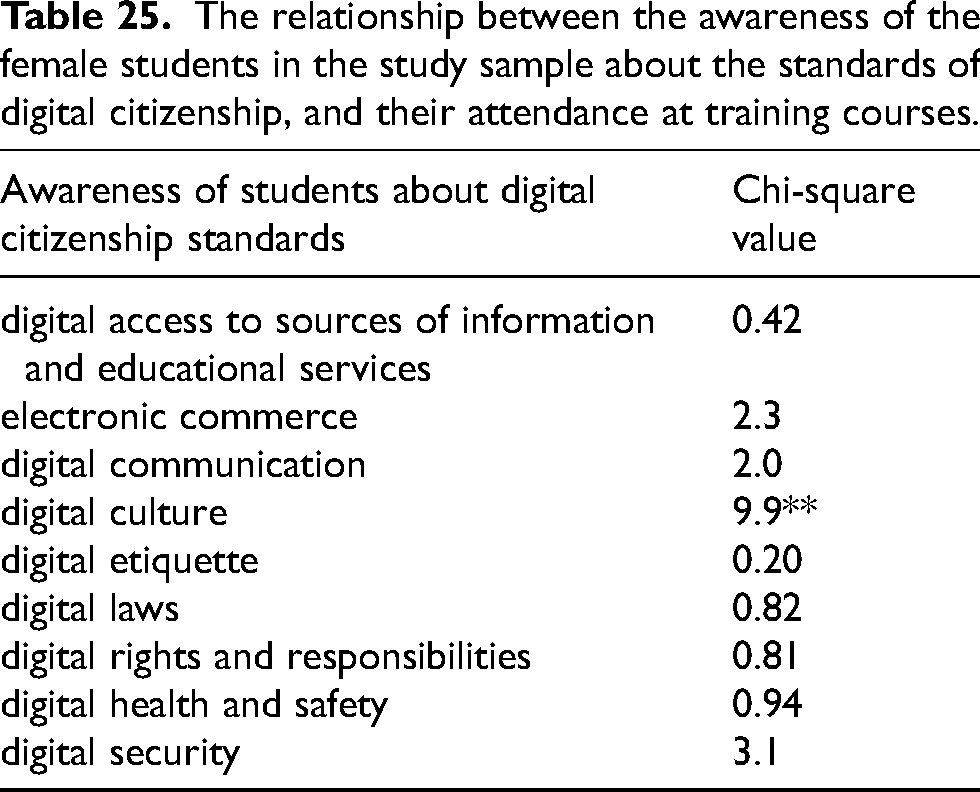
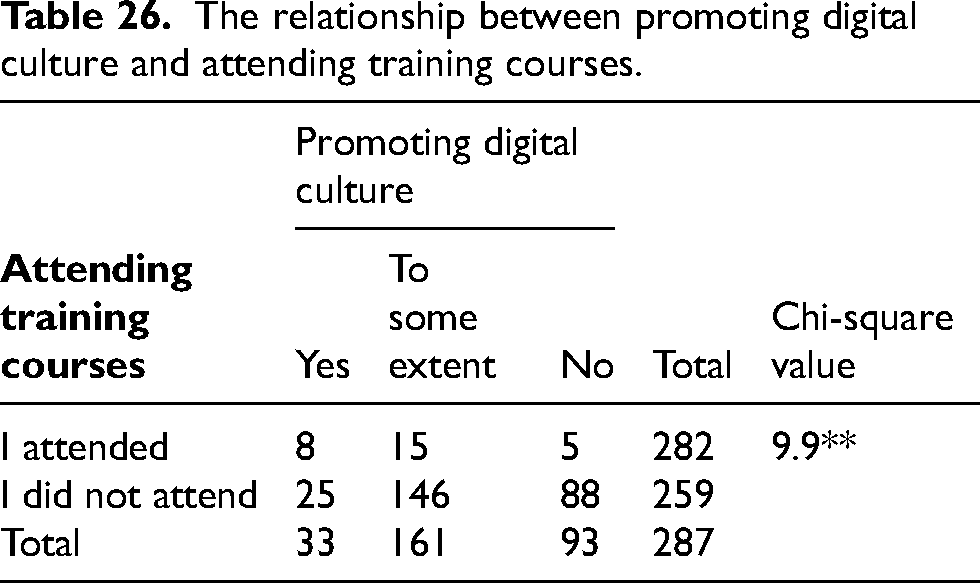
Table 25 illustrates the criteria of digital citizenship and the value of Ch2 test. By testing the significance of the relation, we could conclude that there is a significant relation between the training courses and workshops and the criteria of digital citizenship, with one exception. The significant relation between the promotion of digital citizenship and the attendance of training courses and workshops. As illustrated in Table 26, the value of Ch2 for the relation between the promotion of digital citizenship and the attendance of training courses and workshops was 9.9, that is a significant one on the probability level 0.01 (Tables 25 and 26).
The relationship between the awareness of the female students in the study sample about the standards of digital citizenship, and their attendance at training courses.
The relationship between promoting digital culture and attending training courses.
Assistant curricula help the understanding of the elements of digital citizenship
Table 27 points out the curricula in the department of information that helped students from their point of view to understand the criteria of digital citizenship. These curricula below were arranged from top to bottom in terms of the most assistant to the least assistant. On the front was the curriculum of information technology (21.3%), the highest percentage that a curriculum in the department obtained. That is a rather weak percentage that requires reconsidering the curricula in the department, to serve the requirements of the digital age, raising students’ level to encounter the digital revolution and the associated data revolution.
Curricula that helped students understand the elements of digital citizenship.
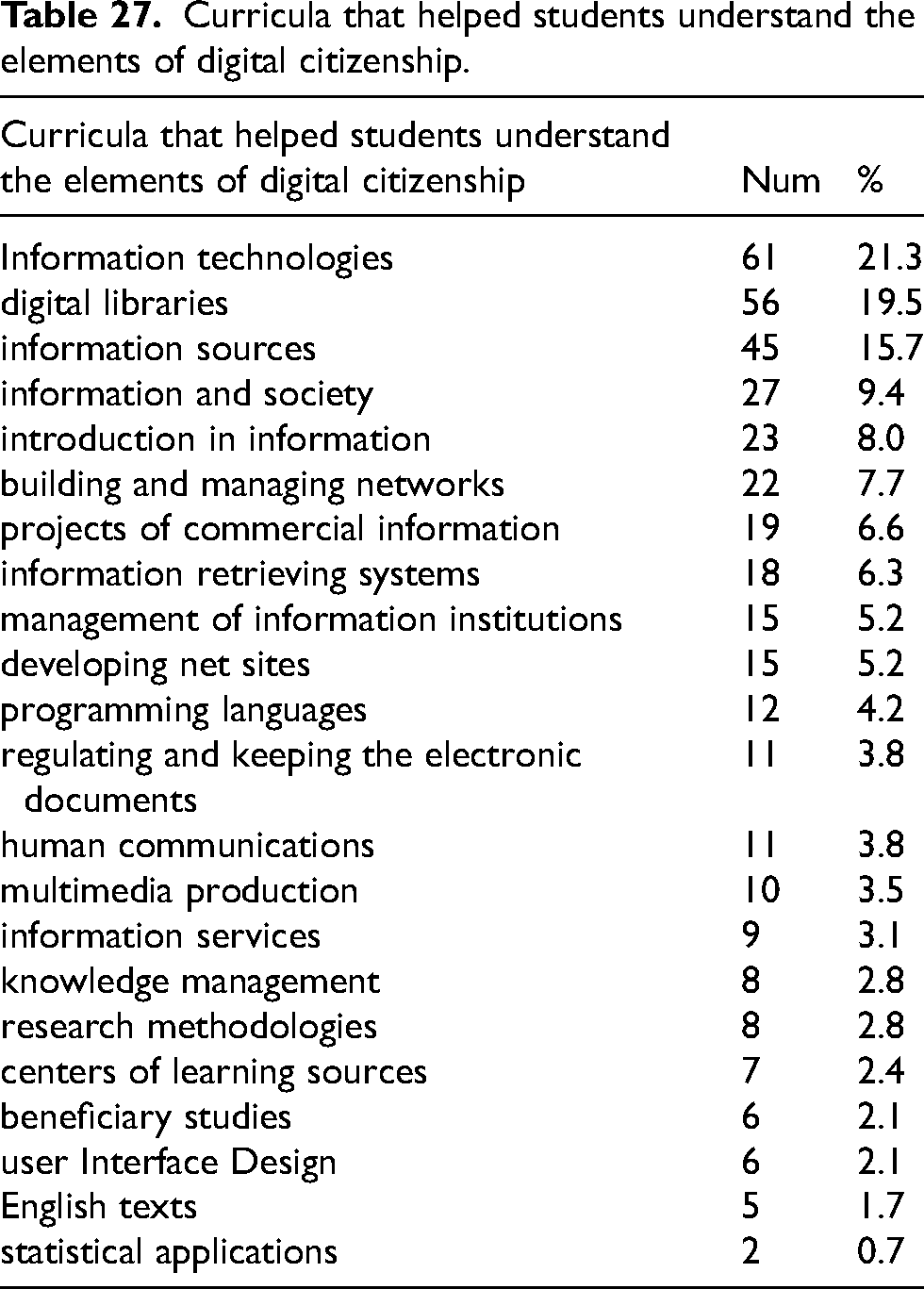
The arranged curricula are as follows: (Table 27)
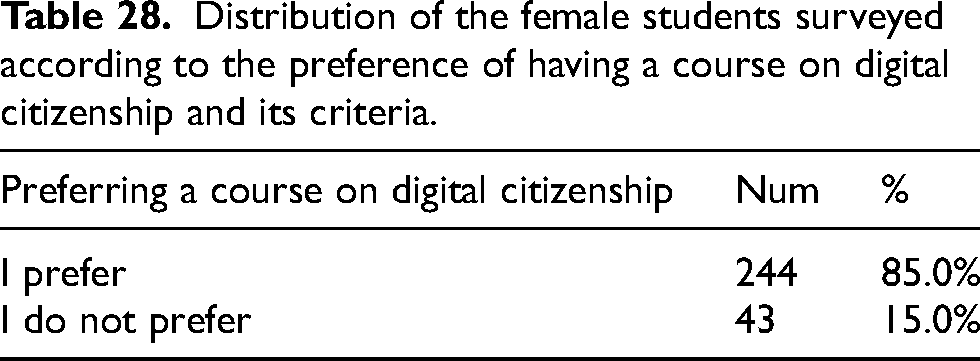
Results of the study confirm the importance of adding a special curriculum for digital citizenship. That is taught on the level of the university and may be divided into several levels. This recommendation is proved by 85% of the female students who preferred a special curriculum for digital citizenship. That may raise their awareness level with different criteria of digital citizenship. (Table 28)
Distribution of the female students surveyed according to the preference of having a course on digital citizenship and its criteria.
Conclusion
To sum up, this study tried to unveil the female students’ awareness level in the department of information technology, Umm Al Qura University, Saudi Arabia with the criteria of digital citizenship under the digital revolution in the world today. The digital transformation has a great effect on how persons would deal with the digital data and information.
Current results pointed out that the total level of female students’ awareness level with the nine criteria of digital citizenship was medium with an average of 139.3 degree. The total values of the nine criteria from the lowest to the highest value range from 149 to 237 degree. In some criteria, the female students’ awareness level was high, but in other criteria, this level was medium. The students’ awareness level was raised with the following criteria: “digital access to the information sources”, “educational services”, “electronic market”, “digital communication”, “digital etiquette”, “digital laws”, “digital rights and responsibilities”, and “digital security”. On the other hand, female the students’ awareness level was medium with two creating the criterion of “promotion of digital culture” and the criterion of “digital health and safety”.
Results pointed out that the role of the university library in forming the awareness level of female students with the criteria of digital citizenship was in the last rank for most of the digital citizenship nine criteria. It was found that the role of libraries in forming students’ awareness with 8 criteria, but the “digital culture” was the exception. These nine criteria are: digital access to information sources and educational services, criterion of “electronic market”, criterion of “digital communication”, “digital etiquette”, “digital laws”, “digital rights and responsibilities”, “digital health and safety”, and “digital security”. Upon this result, the role of the university library should be increased to participate in raising female students’ awareness level with the criteria of digital citizenship. Increasing the role of the library may be through organizing training courses and workshops for the students, in addition to issuing publications that may help in raising the female students’ awareness level with the criteria of digital citizenship, and enlightenment campaigns using different digital communication methods, such as sending messages via email of the university, and the site of digital library.
In the front of the curricula that helped students to understand digital citizenship was the curriculum of “information technology” with a percentage of 21.3%. This is the highest percentage curriculum obtained in the department. However, this is a relatively weak percentage. That underlines the importance of adding a special curriculum for digital citizenship on the level of the university. The proposed curriculum could be divided into several education levels that may help in raising the awareness of the students with the criteria of digital citizenship. This idea was supported by 85% of the students of the sample community.
Recommendations
Community enlightenment with digital revolution, and to spread the culture of digital citizenship among individuals of the society.
Putting forward a plan on the level of Saudi universities to teach a curriculum of “digital citizenship”.
Allocating a curriculum for digital citizenship being taught on the level of the university that could be divided into several educational levels to enhance the awareness of students with the different criteria of digital citizenship.
Holding workshops for the students may help in raising their awareness with the criteria of digital citizenship.
Reconsidering curricula in the department of information, including the criteria of digital citizenship, that may be suitable for every curriculum.
Organizing enlightenment campaigns specially for digital citizens using digital platforms in the university.
Holding debates for the students with deanship of electronic education, department of cyber security, and the faculties in the university specified in the technological fields to raise the awareness of the students with digital citizenship and its criteria.
Training the female staff in the university on how they could enhance the awareness of the female students with digital citizenship.
Helping the students and training them on Academic level and how they can detect unaccepted digital behaviors, and post them on a specified place in the university.
Future studies
- Design a training program to raise the awareness of the student with the criteria of digital citizenship; an experimental study.
- A proposed curriculum for the criteria of digital citizenship, could be taught to the students in the library.
- Extent of awareness of the teaching staff in the “information department “within the university with the criteria of digital citizenship.
