




Abstract
The aim was to examine how different aspects of time pressure are associated with health and gender. The study is based on data collected by cross-sectional questionnaire from 153 female and 167 male journalists at three editorial offices in Sweden. Spearman correlation coefficients by gender were analysed between six different time pressure variables and seven health measures. For women three health indicators correlated significantly with time pressure expressed as “short of time for reflection”. For men, health as expressed by four indicators was primarily related to “lack of efficiency”. Severe time pressure correlated especially highly with stress but only to an almost negligible degree with neck and shoulder symptoms. Our analysis showed that the relation between time pressure and health differs between women and men and that time pressure can be interpreted in several different ways.
Introduction
Time pressure
Time pressure is linked to changes in working life, with longer work hours and faster work pace. In empirical studies, individuals' perceptions of time pressure are measured in different ways. Few scholars have examined different aspects of time pressure (Boisard et al., 2005; Roxburgh, 2004; Szollos, 2009). Southerton and Tomlinson (2005) have argued that it is necessary to move beyond one-dimensional interpretations of the “time squeeze” when investigating “hurriedness”. They identify three mechanisms to explain senses of feeling pressed for time. Time pressure can be expressed alternatively as (1) insufficient time available to complete all the tasks required for the worker; (2) demands by employers that overrun the time frame traditionally allotted to work; and (3) job requirements that overlap in time, creating conflict.
The perception of time scarcity in working life, as well as in life generally, is widely held (Boisard et al., 2005; Fourth European Working Conditions Survey 2005; Robinson and Godbey, 1997; Roxburgh, 2004). People today feel pressured to meet increasingly intense demands at work, with constant reorganisations and demands for efficiency (Boisard et al., 2005; Härenstam and the MOA Research Group, 2005). A gradual increase over the last decades in the percentage of persons who experience time pressure is reported in Sweden and in many other countries (Burchell et al., 2007; Lehto and Sutela, 1999). In the EU12 countries the perceived intensity of work, as measured by speed of work and tight deadlines, has continued to increase for both men and women, although the rate of increase differs (Burchell et al., 2007). In the period 1991–2000, the intensity of women's jobs increased faster than the intensity of men's jobs. However, during 2000–2005, men have shown the greatest increase in the proportion of those working at fast pace more than 50% of the time. This pattern of increasing work intensity for men during 2000–2005 is further underlined in relation to how often they work to tight deadlines.
The Work Environment reports show that time pressure is one of the most frequently reported working environment risks for both men and women in Sweden (SCB and SWEA, 2001, 2006; SWEA, 2008). The percentage of employed persons who say they have too much to do rose sharply from 1991 to 1999 (from 48% to 60%) and subsequently declined in 2005 to a level of about 50%. While the burden for women has been rising again since 2005, being 58% 2007, the proportion of men who agree that they have too much to do is unchanged (about 50% in 2007) (SWEA, 2008).
The general factors of increased and expanded tasks are the reasons given for the increased pace of work. Some studies show little difference between women and men in general (Boisard et al., 2005). However, when studied from a gender perspective (Lehto, 1998; Lehto and Sutela, 1999; cf. Lilleaas and Widerberg, 2001; Widerberg, 2006), women and men described different reasons for their increased pace. Women highlighted the lack of human resources, while men emphasized higher production goals and increased competition.
Well-being
Work intensity has been increasing in most countries, but its effect on well-being varies. According to a report by the European Union it has a negative effect on self-reported health and on work–life compatibility. Paradoxically, it has a positive effect on satisfaction with working conditions (Burchell et al., 2007). Although the subjective experience of time pressure is a significant work-related stress factor, little research has focused on how different forms of the experienced time pressure in working life are related to different aspects of health. According to some studies, time pressure has high explanatory power in relation to mental ill-health. Roxburgh's (2004) results indicate that experience of time pressure is positively associated with depression among both women and men. In addition, the subjective experience of time pressure seems to be an important mechanism which might explain higher depression rates among employed women compared with employed men. A Swedish population study shows that the lack of time pressure is one of the predicting factors for good long term health in working life (Aronsson and Lindh, 2004; cf. Boisard et al., 2005). Time pressure was measured by determining if workers were forced to cut down on lunchtime, to work over time or to take the job home. It seems that there was a significant difference in the health advantage of sufficient resources and experience of good quality for men and women. The women gained more advantages of these factors than men. These differences indicate that time pressure has gendered effect (Sirianni and Negrey, 2000).
According to Devereux et al. (2004) those reporting exposure to psychosocial work risk factors (i.e. extrinsic and intrinsic effort) had the greatest likelihood of reporting high perceived job stress. Extrinsic effort concerns job demands such as constant time pressure, interruptions and disturbances at work, job responsibility, pressure to work overtime and increasing demands on the job. Intrinsic effort refers to an individual coping pattern characterised by being overwhelmed by time pressures, inability to relax and switch off after work and sacrificing too much for the job. Bernard et al. (1994) studied 1050 newspaper reporters and found a positive relation between experienced work load as a consequence of work with deadline and pain in the neck–shoulder region.
Different models have been developed to explain work place stress. The demand, control, social support model (Karasek and Theorell, 1990) suggested that support may act as a buffer in high demand situations (Cooper et al., 2001). The stress-energy model used to measure mental strain and to study individual's reactions of work situation from psychological or medical view point is another useful method (Kjellberg and Wadman, 2002) based on a two-dimensional model for mood (Sjöberg et al., 1979).
Knowledge production organisations
Much debate has been devoted to the question of time pressure in knowledge production organisations and what features of the work environment affect knowledge workers. Some studies indicate very high level of time pressure and stress among journalists. Studies both from the United States (State of the News Media, 2005) and from Germany (Weischenberg et al., 2006) show that journalists rank time pressure high among the list of negative aspects of the journalistic profession. A broad study carried out in Sweden analysed changes in journalism from 1989 to 2005 (Asp, 2007; Djerf-Pierre, 2001). 1 The proportion of those feeling stressed had not increased from 1989 despite extensive changes in the media industry. However, when journalists were asked about changes associated with their job in the past 5–10 years, most reported that their work became more stressful.
Gender segregation
The gender segregation is fundamental for the understanding of the conditions which shape women's and men's opportunities in the work organization. A gender segregation, which is based upon the distribution of work tasks and positions between women and men in the organizations, contributes to a social order which leads to different conditions for women and men. When it comes to working hours, there are so strong gender specific patterns on the Swedish labour market that researchers are talking about a third dimension of segregation – the gender segregated time (see SOU, 1998). Burchell (1996), who has studied some gender balanced professional groups' internal segregation argue that the working time is an additional factor that is important for understanding of the mixed professions' internal segregation.
Segregation has been shown to be very stable. However, higher education is contributing to desegregation processes in the labour market where higher educating women are entering into male dominated high qualified jobs (Bettio and Verashchagina, 2009). As profession journalism has for long been male dominated, but is now one of the few professions with balanced gender division in terms of equal distribution of women and men. Our objectives are interesting from this background: Have working conditions, in terms of time pressure, for women and men been influenced by the integration of the sexes that has taken place in journalist profession, and how these conditions are related to health. Gender segregation is a wide concept (Bettio and Verashchagina, 2009). Instead of studying relations between women and men, the interest in this article is in comparing them.
Objectives
In order to investigate the patterns of time pressure and health among journalists in daily newspaper industry the following questions were asked:
How frequently do female and male journalists report six different aspects of time pressure and seven different measures of health on three editorial offices in Sweden? How are different time pressure indicators related to each other? What are the relationships between various health indicators? What health indicators are related to time pressure for female and male journalists?
The study is exploratory in nature and therefore descriptive statistics are used to explore associations between different aspects of time pressure and self-reported health.
In addition to work condition family conditions and private circumstances could add workload and stress (Larsson, 2007; Sirianni and Negrey, 2000; SOU, 2002). It is important to link these spheres together, and examine the total time pressure. However, in this article, we have chosen to focus on the association between time pressure and health on the basis of conditions in paid work.
Materials and methods
We have used case study as a research strategy. One large sized, one medium sized and one small sized daily newspaper were included in the study. They were studied holistically in a frame of a larger research project by including quantitative and qualitative sources of evidences (Tyrkkö and Karlqvist, 2005). The project followed an interactive research approach aiming to contribute to development of the physical and psychosocial work environment. This article presents results from a questionnaire study which was a part of this project.
Material
There are about 160 newspapers published in Sweden in 2010. The three editorial offices investigated in this study were a small office, a medium sized office (both located in the middle of Sweden) and a large sized office (located in the south-west of Sweden). They belong to two different groups of newspapers of different size and location. The large sized office belongs to a group of daily morning paper published in the three main cities in Sweden. This type of publication represents about 25% of total newspaper circulation. The two others belong to the group of regional and local newspapers which are published at least three times a week. The average circulation amounts to about 35,000 copies, representing about 45% of total circulation (European Journalism Centre, 2010).
The population studied consisted of journalists (92%) and some other office staff groups (8%) at these three editorial offices. We refer to our study group as “journalists”. The medium-sized editorial office had 70 journalists and the small sized office had 27 journalists. The large sized office had 314 journalists. Jobs in the editorial offices included in our study were writers, editors, bureau chiefs, photographers, archivists and administrators, while receptionists, salespeople and computer technicians were excluded.
Methods
Questionnaire
Information was collected by a self-administrated questionnaire sent to all journalists in October 2000 (large sized) or December 2001 (other offices). 2 Response rate was 78% (320 respondents) varying little among the offices. Among the journalists at the small sized office the response rate was 80%, at the medium sized office 81%, and at the large sized office 77%. The main reasons given for not participating were parental leave and sickness absence. The questions were adapted from the questionnaires from a study by Kjellberg and Wadman (2002) and from an unpublished study (Kjellberg et al., 2002) of the large sized office included in this article. The questionnaire covered several areas such as working conditions, work load, physical and psychosocial conditions, education, salary, aspects of physical and mental health and work–family interface. The respondents were asked about a variety of time-related experiences, including forms of time pressure and their frequency.
Measures
In this study the time pressure is considered as an aspect of individuals' psychosocial working conditions (Dapkus, 1985; Roxburgh, 2004). Health was measured with questions on general health (Steiner and Norman, 1989) and several different aspects of health related symptoms. We used answers from six questions in the questionnaire that represent time pressure and seven questions that represent health (see Appendices A and B). These indicators were assessed with the same scales as in the previous research (Tyrkkö and Karlqvist, 2002; Kjellberg and Wadman, 2002). Job title and years of experience were used as control variables.
Time pressure was assessed using six indicators. Responses underdrawn in Appendix A were considered as cases having time pressure.
Tight deadlines Short of time in relation to good results Difficult to think because of frantic work environment Short of time for reflection Forced to cut down on lunchtime, to work overtime or to take job home. This question was not included in the questionnaire used in data collection at the small and medium sized offices. Lack of efficiency
Health was measured by using seven indicators (see Appendix B for further details):
Self-reported general health. Responses underdrawn in Appendix B were considered as cases being unhealthy. The following six indicators were constructed as indexes (see Appendix B). Neck and arm symptoms Psychosomatic symptoms Stress. In the questionnaire, some responses are in opposite order. In the index the items are recoded in the same direction. Respondents were considered to have stress symptoms if the total score divided by six was greater than 2.4, as recommended as the zero point in the stress-energy model (Kjellberg and Wadman, 2002). Tiredness Negative emotions Short of energy. In the questionnaire, some responses are in opposite order. In the index the items are recoded in the same direction. Respondents were considered to be short of energy if the total score divided by six was greater than 2.7, as recommended as the zero point in the stress-energy model (Kjellberg and Wadman, 2002).
Control variables were:
Job title: “What is your job title?” Five alternatives: writer and editor, photographer administrator, bureau chief and the others. Years of experience: “How long have you been working at this newspaper office?”
Statistical analysis
The gender difference in exposure frequency and prevalence of symptoms was expressed as a difference between proportions with 95% confidence intervals (Gardner and Altman, 1989). The association between time pressure and health was investigated by correlations and index construction. Spearman's rank order (Spearman's rho) was used to compute measures of associations between time pressure and health variables, respectively. The associations between time pressure and health variables were calculated by using partial correlation analysis by taking into consideration the effects of job title and years of experience. Significance levels were 0.001, 0.01 and 0.05. The statistical package used for the analysis was Statistical Package for the Social Sciences (SPSS) version 17.0.
Results
Different aspects of time pressure and health: How common are they?
The relative frequency (%) of women and men with time pressure related and health related factors; difference between the percentage of women and men with 95% confidence intervals (CI).
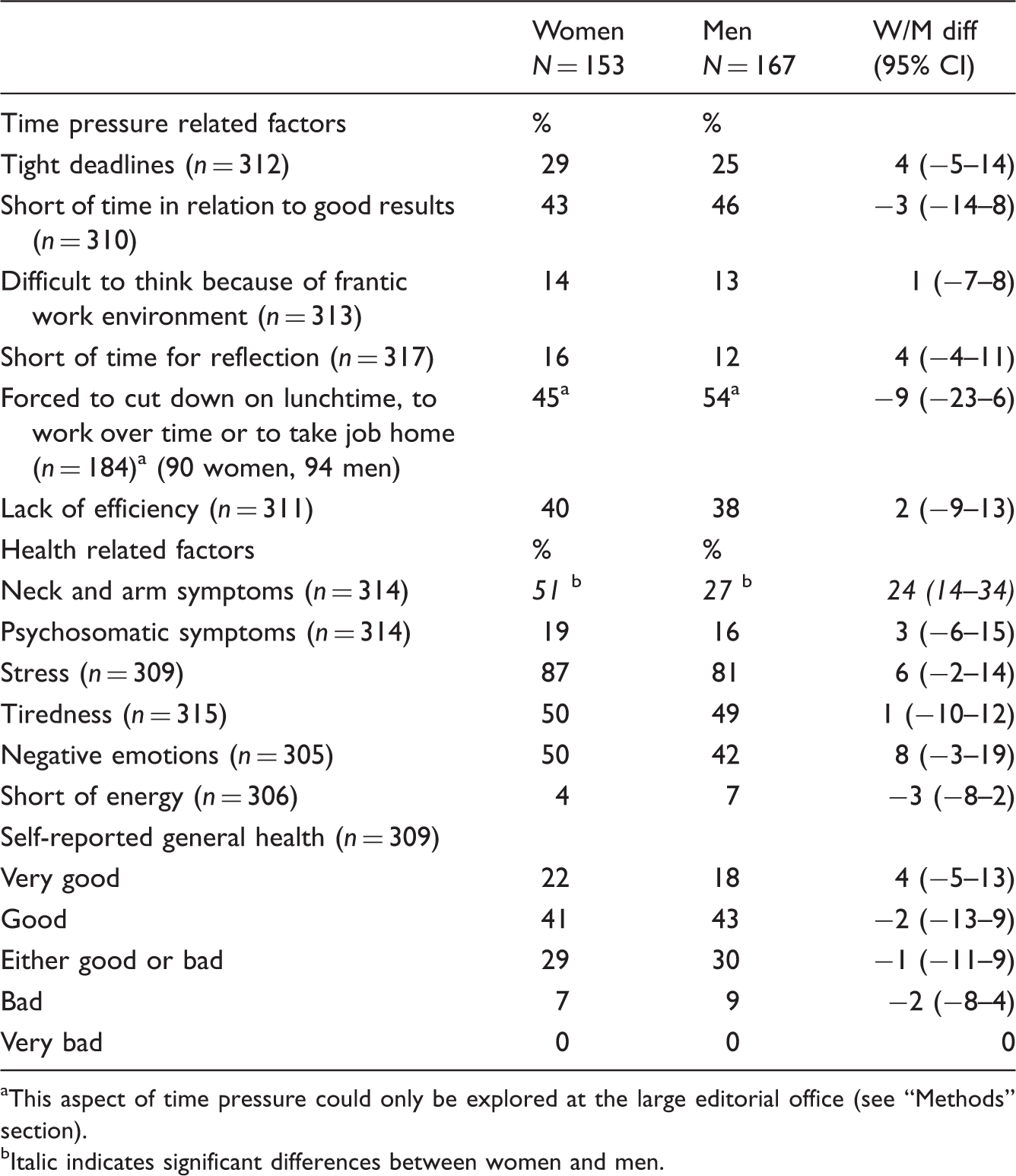
This aspect of time pressure could only be explored at the large editorial office (see “Methods” section).
Italic indicates significant differences between women and men.
The table gives mixed grades when it comes to time pressure related factors. There were no statistically significant differences between female and male journalists. A little less than 50% of them seemed to have short of time in relation to good results at least a couple of times a week. About 25% stated that they perform their work under pressure of deadlines at least a couple times a week. Many journalists reported lack of efficiency.
As shown, Table 1, the greatest gender difference was found in neck/shoulder symptoms. As many as 51% of the women reported these symptoms and only 27% of the men, difference: 24% (95% CI: 14–34). More than 80% of the journalists showed signs of stress as measured by the stress-energy model (Kjellberg and Wadman, 2002). On the other hand, they showed much of high engagement (either under press or without press) in their work and only 6% reported that they were short of energy (bored). Their general health was reported very good or good by 62%.
Correlations between different time pressure aspects
Correlation coefficients between different time pressure variables among men and women at three editorial offices.

p < 0.05; **p < 0.01.
For several factors, correlations were about 0.4–0.5 (moderate correlation, see Williams, 1968). Thus, these factors showed moderate correlations with each other and were included simultaneously in the coming analyses with health aspects. The most closely related variables were not the same among men and women.
Correlations between different health symptoms
Correlation coefficients between different health symptom variables among men and women at three editorial offices.

p < 0.05; **p < 0.01.
For several factors, correlations were about 0.4–0.7. Throughout, most correlations were of higher strength for the women than for the men. Thus, these factors show rather high correlations with each other, and were included simultaneously in the coming analyses with time pressure.
General health correlated with all symptoms with exception of short of energy among both men and women, but the correlations were rather weak (range 0.262–0.443 among men and 0.215–0.482 among women).
Correlations between time pressure and health
Correlation coefficients between different time pressure variables and different health symptom variables among men and women at three editorial offices, controlled for job titles and years of experience.

p < 0.05; **p < 0.01; ***p < 0.001.
There were gender differences in the associations between health and aspects of time pressure (Table 4). Stress was associated with almost all time pressure factors in women and men. The strongest association with stress symptoms in women occurred with the item “forced to cut down on lunchtime, to work over time or to take job home because of the amount of work” (0.511). “Short of time for reflection” also showed a substantial relationship to stress (0.417). In men, stress was most connected with a “frantic and messy working situation” (0.450). Tiredness was associated with only one time pressure factor in women, “forced to cut down on lunchtime, to work over time or to take job home” (0.385). Among the men, tiredness was associated most strongly with “lack of efficiency” (0.300).
One interesting finding was that few associations existed between time pressure factors and neck and shoulder symptoms. The female journalists reported more musculoskeletal symptoms but these seemed not to be connected to time pressure at all. On the other hand, there were positive relationships between neck–shoulder symptoms and “tight deadlines”, “short of time in relation to good results” and “forced to cut down on lunchtime, to work over time or to take job home” for the men.
“General health” seemed not to be connected to time pressure at all for men. “Short of time for reflexion” correlated significantly (p < 0.01) with “general health” for women.
Discussion
The study aimed to shed light on the relationship between time pressure and health among journalists from a gender perspective.
The main findings are summarized below.
How frequently do female and male journalists report six different aspects of time pressure and seven different measures of health on three editorial offices in Sweden? A little less than 50% of female and male journalists seemed to have short of time in relation to good results at least a couple of times a week. As many as 45% of the women and 54% of men were forced to cut down on lunchtime, to work over time, or to take job home at the large editorial office. Of all, 29% of women and 25% of men stated that they perform their work under pressure of deadlines at least a couple times a week. Many journalists reported lack of efficiency. As many as 51% of the women and only 27% of the men reported neck/shoulder symptoms, which was a significant difference. More than 80% of the journalists showed signs of “stress” as measured by the stress-energy model (Kjellberg and Wadman, 2002). On the other hand, they showed much of high engagement in their work and only 6% reported that they were short of energy. Their general health was reported very good or good by 62%. How are different time pressure indicators related to each other? All six time pressure indicators correlated positively, although the correlations were of different strength. In general, the correlations seemed to be higher among women than among men. What are the relationships between various health indicators? The highest correlated forms of health symptoms for both men and women were those based on tiredness and negative emotions followed by stress. What health indicators are related to time pressure for female and male journalists?
There were gender differences in the associations between health and aspects of time pressure. Stress was associated with almost all time pressure factors in women and men. The strongest association with stress symptoms in women occurred with the item “forced to cut down on lunchtime, to work over time or to take job home because of the amount of work”.
In men, stress was most connected with a “frantic and messy working situation”. The greatest difference between men and women concerning time pressure variables influencing health variables were “lack of efficiency”, where men showed statistically significant associations with health symptoms ascertained by all items except “general health”, “neck/shoulder symptoms” and “short of energy”. For this time pressure variable women showed no statistically significant health symptoms at all. On the other hand, women showed a larger number of associations between “short of time for reflection” and health symptoms (three variables) than men (one variable). When women felt they had “short of time for reflection” in their job and had to “cut down on lunchtime, to work over time or to take job home” they reported stress, tiredness and negative emotions. When men thought their work situation “lacked efficiency”, they reported many symptom variables, especially stress, tiredness, negative emotions and psychosomatic symptoms.
Concept of time pressure
The time pressure indicators in our study are linked to different aspects of time use and temporalities related with the psychosocial working conditions. “Tight deadlines” refers to the volume of time required to complete sets of tasks in relation to an allocation of tasks within time (see Southerton and Tomlinson, 2005). The most common time mechanism in the journalists' accounts of their work is scheduled time. They have to work according to externally imposed and controlled timetables, such as deadlines, “hand over's” between shifts, meetings and press conferences. Deadlines are encountered again and again and they make journalists aware of and dependent on the passing of time. Our results show that women more often than men had to meet tight deadlines. This difference, however, was not significant. For women tight deadlines was rather strongly correlated to the length of workday. For men the correlation between these variables was not significant. For both women and men tight deadlines were highest correlated to the quality of job in form of good results.
We have read newspapers for several centuries, but according to Lash (2002) it makes a difference that the amount and speed of information in society as a whole has increased drastically (e.g. Boczkowski, 2005). The work leaves no space for a journalist to breathe, to be alone or to think. One could argue that the “‘basic human right’ to be slow” (Tella, 2000: 87), to be reflective is threatened. Looking at the results according to this aspect of time pressure, we see that, in contrary to our expectations, there were not so many journalists lacking time to reflection. Women, more often than men, had short of time to reflection, but this difference was not significant.
Time pressure is often studied as an individual problem requiring individual coping strategies (Larsson, 2007; cf. Francis-Smythe and Robertson, 1999). “Forced to cut down lunchtime, to work over time or to take job home” refers to a challenge of controlling time. It deals with extended working hours by reducing time spent in leisure and other activities, as well as to allocation of tasks. It can be seen as a consequence of time pressure and as a strategy to mastering it. However, the ability to finish tasks within the assigned working hours, may not only depend on individual aspects, but may also be related to how the work is organised. It indicates transcending the rigid time and space related boundaries of working day and/or working place (Härenstam et al., 2005). The percentage of those who have been forced to cut down on lunch time, to work overtime or to take work home in the whole workforce in Sweden has increased since 2003 for both women and men, to about 40% among men and 35% among women in 2007 (SCB, 2003; SWEA, 2008). Compared to these results the percentages were higher in our study. Men used more often this strategy. There are, however, a number of interesting dimensions of how this variable is associated to other time pressure aspects and health conditions. These different patterns of association could be due to different workload outside the workplace.
Efficiency is about being focused, organized and productive at work. It might be possible that time pressure stimulates performance (for example, in terms of efficiency) through increasing the tempo in work. There might be a threshold for time pressure when it turns to have efficiency costs. On the other hand, time pressure can also be an effect of lack of efficiency (e.g. due to frequent interruptions in work, see Boisard et al., 2005). Lack of efficiency seems to be a key factor for health consequences of time pressure for men in our study. For women the correlation between this variable and the other forms of time pressure was significant but links to health were not as clear as among men. For women longer work hours was a more important factor.
Concept of health
Seven different health indicators were used in this study. Some reflect frequency (musculoskeletal and psychosomatic symptoms, tiredness), some intensity (stress, energy and negative emotions) and one a subjective “feeling” (general health). Self-reported general health: “How would you estimate your general health right now? Is it … very good, relatively good, neither good nor bad, relatively bad, very bad?” This question has been shown to have good test–retest reliability and correlates strongly with other direct or indirect measures of health (Idler and Benyamini, 1997; Steiner and Norman, 1989). In this study only slightly more than 60% of the journalists rated their general health very good or good compared to above 75% in other comparable studies. This variable correlated significantly, however low, with all other health indicators, with exception of “short of energy”, among both men and women. General health ratings are broad and seemed not to relate specific to time pressure variables. As shown in this study, the combination of different time pressure factors and different health indicators has a more complicated association.
Neck–shoulder symptoms are common among employees within computer intensive jobs and musculoskeletal symptoms are more common among women (Karlqvist et al., 2002; Ortiz-Hernández et al., 2003; Punnett and Herbert, 2000) as shown in our study of journalists. This variable correlated significantly, however rather low, with three other health indicators beside general health (negative emotions, psychosomatic symptoms and tiredness). Psychosomatic symptoms correlated significantly with three other health indicators (tiredness, negative emotions and stress). Stress symptoms, as measured in this study with the stress-energy model (Kjellberg and Wadman, 2002), correlated significantly with two other health indicators (tiredness and negative emotions). Tiredness showed a marked relationship with negative emotions.
The stress-energy model has earlier been used, for example, among assembly workers in car body factory and an electronic industry, employees of a travel agency and journalists from a daily newspaper (Kjellberg and Wadman, 2002). Among other things, they found hardly any journalists or travel agency employees in the low energy group. The complaints reported by the journalists and the travel agency employees were strongly correlated to stress scores but not at all to energy scores. In our study we found a majority of the journalists in the high energy group and the same conclusions about complaints and energy can be drawn to our study.
Gender, time pressure and health
One starting point for the present study was that different indicators of time pressure were not completely interchangeable, even though they could measure the same latent dimension to some extent (cf. Ballard and Seibold, 2004). But even though the indicators are interrelated and have common influences on an individual's health, there could also be some unique mechanism(s) that link each dimension to health. Furthermore, a specific time pressure measure may have varying impact on health for women and men.
While the level of time pressure was roughly equal across gender, the associations between time pressure and health were stronger among women than men. The six dimensions seemed to be of varying importance among female and male journalists studied due to the different aspects of their health.
Our analyses show that time pressure factors to some extent reflect overlapping time pressure in terms of short of time in relation to tasks to get done. The variable “short of time in relation to good results” has shown high relation to high demands (Karasek, 1979) in the journalistic job (Tyrkkö and Karlqvist, 2005). This relation has been validated by Kjellberg and Wadman (2002). High pressure in time indicates high mental demands. Evaluations of stress levels in our study indicated co-variations with the level of demands in this respect. Earlier studies show that severe time pressure does not only correlate with low well-being and mental health problems (Roxburgh, 2004) but it is often a central aspect in life situations which generates mental problems (SOU, 2002). Psychosocial load is dominated by regularly working under time pressure (Boisard et al., 2005). We found different relations between the ill health symptoms caused by stress and the feelings of being under time pressure among men and women. The connection between stress, as well as tiredness, and time pressure was a rather general feature for the three editorial offices and most blatantly for the women.
The results show the importance of the different time pressure and health indicators. Health results are different for women and men: men in this study tend to be in better health than women. Women in the three editorial offices reported more musculoskeletal symptoms than men in almost all body regions, especially neck and shoulders, which also are in line with earlier studies (Bernard et al., 1994; Nelson and Silverstein, 1998, Ortiz-Hernández et al., 2003). Increased time pressure is also related to the occurrence of work-related musculoskeletal disorders (Bernard et al., 1994; Devereux et al., 2004; Karlqvist et al., 2002). In the study by Karlqvist et al. (2002), the “probability of meeting time limits and quality demands” (time pressure) was shown to be associated with higher prevalence of musculoskeletal symptoms among female visual display unit (VDU) operators and lower prevalence of symptoms among male VDU operators. Kjellberg and Wadman (2002) showed that the variable “short of time in relation to good results” increased the risk of getting musculoskeletal symptoms. Contrary to what was expected, musculoskeletal symptoms were, to a low extent, only associated with time pressure among the men in our study.
Job title refers to the different occupational positions of women and men. The work organization puts different demands on employees in different positions. These demands also intervene in the family life. By controlling for job titles, we have controlled for the gender segregation based on organizational factors that has previously been shown to matter to working time (Bettio and Verashchagina, 2009; Djerf-Pierre, 2007). Thus, we could focus on time pressure and its association to health.
The character of the journalistic work
The working conditions are dependent of the profession carried out. Journalists, as well as employees in many other occupations, work under severe time constrain (i.e. a rapid and jerky tempo, demanding alertness) (Deuze, 2005; Löfgren Nilsson, 1999; Sørensen and Grimsmo, 1993). Time competence (see Fuehrer, 2010; Kirner et al., 2004) means, among other things, that a journalist must be able to report quickly and accurately and that he or she has to plan and organize his/her own work in relation to the collective working process. Particularly distinguishing for the journalistic work is the demand for time and quality to match each day (Löfgren Nilsson, 1999: 207).
More than 80% of respondents in a Swedish study 2005 listed time pressure as one of the most distinguishing features of this job (Löfgren Nilsson, 2007). Our results reinforce the findings on this earlier study: time pressure appears to be the prime contributing factor to high stress levels faced by journalists today. The association between time pressure and health among men and women is different. The challenge for employees is to effectively managing stress in journalistic work. The first step is to identify the top sources of time pressure for women and men. The causes behind time pressure in journalistic work at editorial offices are complex, relating to personal ambitions, newspapers' market situation, staffing, the technical capability to transmit information and many other factors. Most newspapers today are working under economic pressure, which has impacted staff size and workload in the editorial offices. Long hours and chronic deadline pressure can be significantly negative factors among journalists with “limitless” working conditions (Hansson, 2004; Härenstam et al., 2005). These are factors that contribute to stress. Our study was focused in factors inside the work places and did not look at these above mentioned factors. One might add that in many countries journalism is a very dangerous profession covering violence, accidents, trauma, crime and war. These conditions are dangerous to health and life and certainly add more stress in journalistic work but were not included in our study.
The general health among the journalists in this study was lower (62% very good or good) than comparable studies, which report above 75% among white collar workers (SCB, 2006). This might be a consequence considering their work with many factors of time pressure. On the other hand, we knew, based on results of our previous study (Tyrkkö and Karlqvist, 2005) that men, who still worked at one of the editorial offices, where only those with good health. “Healthy worker effect” means that either will those, from healthy aspects, most suitable be employed (primary healthy worker effect) or will those showing unhealthy symptoms leave their employment (secondary healthy worker effect) (Last, 1988). We could eliminate some effects of “secondary healthy worker effect” by keeping the years of experience under control when studying the association between health and time pressure.
Our earlier research of journalistic work (Tyrkkö and Karlqvist, 2005) shows that a great majority of journalists report that they find their work very rewarding. A strong commitment to work might explain why there was a weak association between time pressure and short of energy. In a study where, among others, Norwegian journalists took part, Burke and Fiskenbaum (2009) found less obsessive job behaviours, greater work satisfactions and higher levels of psychological well-being among respondents scoring higher on “passion” in a “passion versus addiction” questionnaire. Reinardy (2011) raises some serious issues about the future of journalism in his study of burnout among journalists, and their intentions to leave the profession. He found that younger journalists (34 and younger) are more dissatisfied than older journalists, and indicate intentions to leave. The main reasons that create job dissatisfaction and exodus were money or salary, hours or schedule, stress or burnout and family life.
It seems that time pressure do not affect everybody at editorial offices in the same way. The organizational time is not monotemporal, but pluritemporal, which means that different types of time exist in parallel and simultaneously (Ballard and Seibold, 2004, cf. Butler, 1995). Different groups at an editorial office (e.g. writers, editors and chiefs) have their own temporality depending on how time is organized in work practices. In many type of journalistic work there is a gender-based differentiation of positions and areas of coverage (Djerf-Pierre, 2007). As reported elsewhere (Tyrkkö and Karlqvist, 2005) the job titles were partly different for women and men at the three editorial offices in this study why this factor was included in our analysis as a control variable. Job titles are partly task oriented and not only based on the organizational structure. Hence it is meaningful to make direct comparisons between men and women doing the same type of job. It would be of interest to study how job descriptions are being formed and how these descriptions are reflected in occupational positions. This is an aspect of journalistic work where we most likely will see major changes in the future (Boczkowski, 2005). However, it is outside the scope of this study.
Methodological considerations
Questionnaires for self-evaluation were used as methods to analyse time pressure and health. One large sized, one medium sized and one small sized daily newspaper were included in the study. A total of 320 staff members answered the questionnaire. Since this is a cross-sectional and relatively small study, there is not enough material to draw far-reaching conclusions.
Opportunities to generalize from the results of the case studies are often based on the existing theories the study is based on. Generalization to a larger population or other sectors is more difficult and less exact. Although the history and culture of journalism might play a role in how the work at an editorial office is perceived by its staff, it does at the same time represent a modern sector of society where information handling rather than material processing is at the forefront. In this sense the conclusions from this case study would have relevance for working conditions from a gender perspective in other professional areas.
Our aim was to contribute with additional facts and understanding of gender differences in journalists' work and health. Underlying our contribution to the discussion was that journalist jobs is a profession with balanced gender division. Our detailed case study of association of time pressure and health within this occupation has hinted at ways in which breakdowns in occupational segregation have been replaced by other forms of gender segregation. Our analyses question the usefulness of concentration to the occupation level and therefore underestimate the gender differences even within balanced occupations.
The study of the relationship between time pressure and health poses a number of methodological problems. There are several biases that tend to conceal any direct link between them (Boisard et al., 2005). Our earlier study among the same journalists showed that frequency of time pressure was rather identical at the three working places in newspaper production included in this article, irrespective of financial status, number of employees and circulation. Pressure to produce quickly was as high for the slimmed organisation of the big city newspaper, which was competing on a tough media market, as for the small newspaper that struggled for survival (Tyrkkö and Karlqvist, 2005). To study members in the same occupational group in the same media sector and by controlling for job titles and years of experience helped us to minimise some effects of biases associated with different working conditions.
The aim of our study was essentially descriptive. We obtained information on the frequency of time pressure and its dimensions, but not on its reasons. Even where high levels of time pressure and health problems are reported, circumstances other than the job are commonly involved (Larsson, 2007; Roxburgh, 2004). In addition to time pressure in work there can also be time pressure in private life and, especially, related to activities which combines these spheres (Larsson, 2007). For instance, women who are both working and raising families are more apt to report higher levels of stress (Roxburgh, 2004; Zuzanek, 2004). Separated and divorced parents similarly report more stress and time–pressure problems (Zuzanek, 2004). Even though it is important to link these spheres together (see e.g. Tyrkkö, 1999), and examine the total time pressure, we have chosen to focus on the association between time pressure and health on the basis of conditions in paid work.
Conclusions
The analysis of time pressure and health among journalists indicates associations with different strengths for women and men. Health problems are not equally sensitive to time pressure. Stress and tiredness are particularly associated with time pressure. Our data were not sufficient to analyse causality relationships between time pressure and health.
Based on the results, we suggest some propositions and a series of directions for future research: Journalist profession is one of the few professions with balanced gender division. Although generalizability of our findings is limited, the results may include several implications for future comparative research of time pressure and health in gender segregated sectors of the labour market. The time frame of the journalists is not only caused by terms of production, but is related to private life. This study includes only paid work. Future studies would take family related work in consideration when study time pressure and health.
This study did not explore the pathway between time pressure and health that has to be done in future studies.
Footnotes
Conflict of interest
None declared.
Funding
This research received no specific grant from any funding agency in the public, commercial, or not-for-profit sectors.