




Abstract
Part-time employment rates are increasing in Australia, for both women and men. However, gendered patterns in part-time employment status are typically associated with mothers’, rather than fathers’, transition to parenthood. This study uses data from the 2006 Negotiating the Life Course survey to investigate whether part-time employment reduces time pressure for women compared to men, when temporal job quality is considered. Our results show that women employed in shorter part-time hours had better time pressure outcomes, overall and at work, than women employed in longer part-time hours. Yet findings show that a lack of access to temporal flexibility and irregular work schedules negatively impact time pressure outcomes for both men and women. We conclude that time pressure benefits gained from being employed part-time, may be diminished when there is poor temporal job quality.
This article investigates employee time pressure in relation to the quality (temporal) and quantity (hours) of employment. Specifically, we examine whether working reduced paid hours, or part-time employment status, decreases women and men’s time pressure. In Australia, the proportion of employees working part-time increased between 1979 and 2009 from 34% to 45% for women, and from 5% to 16% for men, an 11% growth for each gender (ABS, 2010). The main, although not only reason, employees report for working part-time is to better balance work and family life (ABS, 2013). Part-time employment is generally assumed by workplaces and policy makers to be a ‘family-friendly’ arrangement that helps employees manage time pressure. Yet there is growing critique of the gendered assumptions underpinning such ‘family-friendly’ arrangements, which are primarily taken up by mothers, not fathers, in Australia (Charlesworth et al., 2011; Craig et al., 2008). Similarly, in Europe and North America, gender-neutral workplace policies that provide family-flexible options have not resulted in major changes to fathers’ paid working patterns (Ciccia and Verloo, 2012; Ranson, 2012).
Time pressure (feeling rushed or pressed for time) remains a persistent concern for many employees, who report it having negative impacts on their health, well-being and relationships (Pocock et al., 2007; Strazdins et al., 2007, 2016). Time pressure intensifies with excessive (Voydanoff, 2007) or incompatible time demands (Hosking and Western, 2008) and when there is a lack of time for necessary (e.g. self-care) and discretionary activities (e.g. leisure time) (Gunthorpe and Lyons, 2004). In the workplace, time pressure is often linked to heavy workloads, tight time deadlines and/or a shortage of staff (Lehto, 1998; Skinner et al., 2012). In this context, time pressure is recognized as a ‘strain-based demand that increases employees’ negative emotions, stress and fatigue’ (Voydanoff, 2004: 402). Yet ‘they may also be referring to other aspects of time, such as the intensity of their temporal experience, which is connected to an accelerating pace of life, rushing and trying to do more’ (Strazdins et al., 2016: 22). According to sociological time research, the rapid rate of social and cultural change since the end of the Second World War, and the inherent speeding up of time and tasks associated with advances in information and communication technologies, have intensified experiences of time pressure (Rosa, 2013).
Literature review
In this section we briefly review Australian time use studies to examine the factors that contribute to time pressure across gender. For instance, studies have showed housework and childcare continue to demand more time from women than men, irrespective of their paid work pressures (Baxter et al., 2008; Pocock et al., 2009). Then we examine empirical evidence on part-time employment and its potential to reduce such time stress.
Time use studies – contributions to time pressure and stress
The Australian Bureau of Statistics (ABS) Time Use Surveys, conducted in 1992, 1997 and 2006 (ABS, 2008) investigated gendered patterns in paid and unpaid time use (Bittman, 2004; Craig, 2007). Results across the years showed that the time spent on domestic activities was consistently higher for women compared to men, and that there was a spike in time spent on household work among women aged 30 to 50 years (ABS, 2008; Bittman, 2004). Further, women with a child age 0 to 4 years spent on average over 80 hours per week on childcare, compared to 30 hours by fathers (ABS, 2008). For men, working long hours (greater than 45 hours per week) contributes most to time stress and work–family time conflicts (Baxter et al., 2007; Skinner et al., 2012).
Does part-time status lead to better time balance?
It is mostly women who use part-time employment to balance paid work and family responsibilities. Some research found that women who worked part-time could achieve better time sovereignty to facilitate children’s schooling, extracurricular activities and medical appointments (Rose, 2017; Peters et al., 2009). Hence, women may use part-time employment as a strategy to manage their numerous time demands and pressures (Rose, 2017; Baxter et al., 2008; Craig and Mullan, 2009). While part-time employment has shown some potential to improve time balance (Beham et al., 2012; Kossek and Lee, 2008; Tausig and Fenwick, 2001), there is mixed empirical evidence supporting its time pressure reducing benefits (Booth and van Ours, 2008; Gregory and Connolly, 2008; Laurijssen and Glorieux, 2013; Pocock et al., 2009). For instance, the Belgian panel study by Laurijssen and Glorieux (2013) found that part-time employed women whose jobs entailed ‘routine work’ (e.g. repetitive tasks) had less time pressure relief than women in better quality part-time positions.
Our previous research found that women who worked only minimal part-time hours (<15 hours per week) were the only group to be more satisfied with their time pressure overall and at work, but not at home (Rose et al., 2013). More specifically, part-time employment does not necessarily reduce time pressure for women to the same extent as it does for men, due to the greater proportion of unpaid domestic and care work women do relative to men (Pocock et al., 2009). Moreover, a study in the United Kingdom (UK) found that when women were employed part-time, they took less leisure time on weekends, relative to full-time employed women and men (Chatzitheochari and Arber, 2012).
Part-time employment and job quality
The characteristics of part-time employment vary by country. For example, in the Netherlands, where part-time employment rates are high for men and women, part-time work conditions are typically the same quality as full-time jobs (Peters et al., 2009). In Australia, part-time jobs are generally inferior in quality relative to full-time positions (McDonald et al., 2009; Charlesworth and Baird, 2007; Charlesworth et al., 2011). They typically have low autonomy and minimal benefits (e.g. no paid sick or holiday leave) and have been found to worsen work–life conflict and diminish employee well-being (Hosking and Western, 2008; Strazdins et al., 2007).
Other noted pitfalls of part-time employment include limited professional development, stalled career progression and minimal superannuation accrual for retirement (McDonald et al., 2009). These issues combine to place women at a higher risk of poverty (Olsberg, 2004). More recently, the growth in part-time and temporary employment across the Organisation for Economic Co-operation and Development (OECD) has been mainly in reply to employer, rather than employee, demand for labour flexibility, and as a response to economic insecurity following the global financial crises (Duncan and Pettigrew, 2012; Kauhanen and Nätti, 2015).
Why work part-time? Human capital and gender theoretical perspectives
A human-capital perspective posits that employees with lower skills, education and work experience (lower human capital) are more likely to work in poorer quality, part-time jobs that are lower-skilled (Campbell and Burgess, 2001). In the UK, poor quality part-time jobs are clustered at the lower end of the occupation hierarchy and usually require minimal human capital to enter (Blackwell, 2001). Poor quality part-time jobs tend to be low-waged, low-status and have short-term or insecure tenure (Kauhanen and Nätti, 2015; McDonald et al., 2009; Webber and Williams, 2008). Research suggests that part-time workers, especially those on casual or temporary contracts, are at highest risk of losing their jobs in tough financial times, due to their marginalised status (Campbell et al., 2009).
Gender perspectives suggest that dominant social norms still position mothers as primary carers and secondary earners (Fagan, 2004; Lewis and Campbell, 2007; van Egmond et al., 2010). As a result, in the western world, it is predominantly mothers who are clustered in poorer quality part-time jobs, while fathers generally occupy the longer-hours, better quality, full-time positions (Strazdins et al., 2007). Moreover, Australian women employed in professional occupations are more likely to downgrade to less senior part-time roles after having children than their spouses (Yerkes et al., 2017). However, when Australian fathers work part-time, it tends to be in the worst quality jobs (Strazdins et al., 2007). Comparatively, in the Netherlands, where a large percentage of both men and women are employed part-time, it is men who are predominantly concentrated in longer-hours part-time positions, and women with children in the shorter-hours part-time jobs (Peters et al., 2009).
Overall, part-time employment patterns are shaped by a combination of gender-role and human-capital factors. Part-time status is also shaped by macro influences, including economic conditions, government policy and social welfare support (Fagan, 2004; Olsberg, 2004). However, Charlesworth et al. (2011) have noted that the association between job quality and quantity (part-time vs. full-time hours) is an area that has been largely overlooked in Australian research. Our study investigates a range of job quality measures including job contract type and temporal (time-related) job characteristics, including sociability (e.g. whether employees work weekends or nights), predictability (whether employees have regular work schedules), flexibility (whether employees can modify the time and/or place where they work) and predictability (regularity of work hours). Thus, we extend our previous study examining variations in the number of hours worked (part-time vs. full-time) (Rose et al., 2013), to include a job quality dimension that is specifically focused on temporal aspects of employment most likely to affect time pressure.
Hypotheses
Despite the assumptions that working part-time reduces time pressure, the research we have reviewed suggests that this outcome may be overstated or uncertain. For employees, this may depend on the number of hours of part-time employment undertaken (i.e. longer versus shorter part-time hours). Our first hypothesis, broken into part (a) and (b) is:
H1: (a) Women working longer part-time hours (reduced full-time) will report the same levels of satisfaction with time pressure at home, work and overall as women working full-time hours, and (b) those women working shorter part-time hours (minimal and half-time) will report higher levels of satisfaction with time pressure than women working long part-time or full-time hours.
One possible explanation for observed differences in time pressure satisfaction across work hours might be that shorter-hours part-time jobs tend to have lower job quality, particularly those aspects of job quality with temporal qualities, such as autonomous flexibility and scheduling control (Fagan, 2004; Strazdins et al., 2007). Jobs with these characteristics may increase feelings of time pressure rather than relieving them. Our second hypothesis is:
H2: Job quality characteristics, particularly those with temporal qualities, will change the association between satisfaction with time pressure and explain some (or all) of the differences between those working full-time, long part-time and short part-time hours.
Data source
This study uses the 2006 Negotiating the Life Course (NLC) survey (McDonald et al., 2000). This survey was designed to investigate how women and men negotiate paid and unpaid work and includes a wide range of work–life indicators, including employment history, relationship history, unpaid work, social attitudes, demographic and health and well-being characteristics. Although the NLC survey is longitudinal (with Wave 1 conducted in 1996/7, Wave 2 in 2000 and Wave 3 in 2003), the questions about time pressure were not asked until Wave 4 in 2006. The data were collected using computer assisted telephone interviewing (CATI), with a response rate of 63% for Wave 4.
The 2006 sample comprised 3138 respondents (1169 men and 1969 women). This included a top-up sample of 2000 respondents, who were added to the original sample; this increased the overall sample size and corrected for loss of representativeness in terms of the broader Australian population. We exclude women who were not employed (n = 586). Women who were employed on an irregular or intermittent basis (n = 83) were also excluded because we were unable to reliably estimate their weekly paid work hours. We also dropped cases with missing data on the three different time pressure variables (n = 31), the job quality variables (n = 19) and socio-demographic control variables (n = 9). Due to these omissions, the total number of employed women in our analytic sample was 1242. In order to examine gender differences, we include employed men. After excluding missing data, the total number of men included in our analyses was 858.
Measures
Dependent variables
We measure satisfaction with time pressure using the following questions:
How satisfied are you with the amount of time you have to do the things you want to do?
How satisfied are you with the amount of pressure you are under at home?
How satisfied are you with the amount of pressure you are under at work?
Time pressure satisfaction is measured on a Likert scale ranging from 1 (extremely dissatisfied) to 9 (extremely satisfied). We assess time pressure in different domains as we expect that experiences at work may differ from those at home. We refer to the first measure as ‘overall time pressure’, the second measure as ‘time pressure at home’, and the third measure as ‘time pressure at work’. Although the second and third questions about time pressure at home and at work could be interpreted as referring to a broader conception of pressure, the consecutive placement of the three questions in the survey suggests they are most likely to measure perceptions of time pressure. Previous research supports the notion that satisfaction, although subjective, is a valid measure to assess well-being indicators such as time pressure (Greenhaus et al., 2003). Table 1 reports the summary statistics for all variables used in the analyses.
Descriptive statistics on variables for employed women and men.
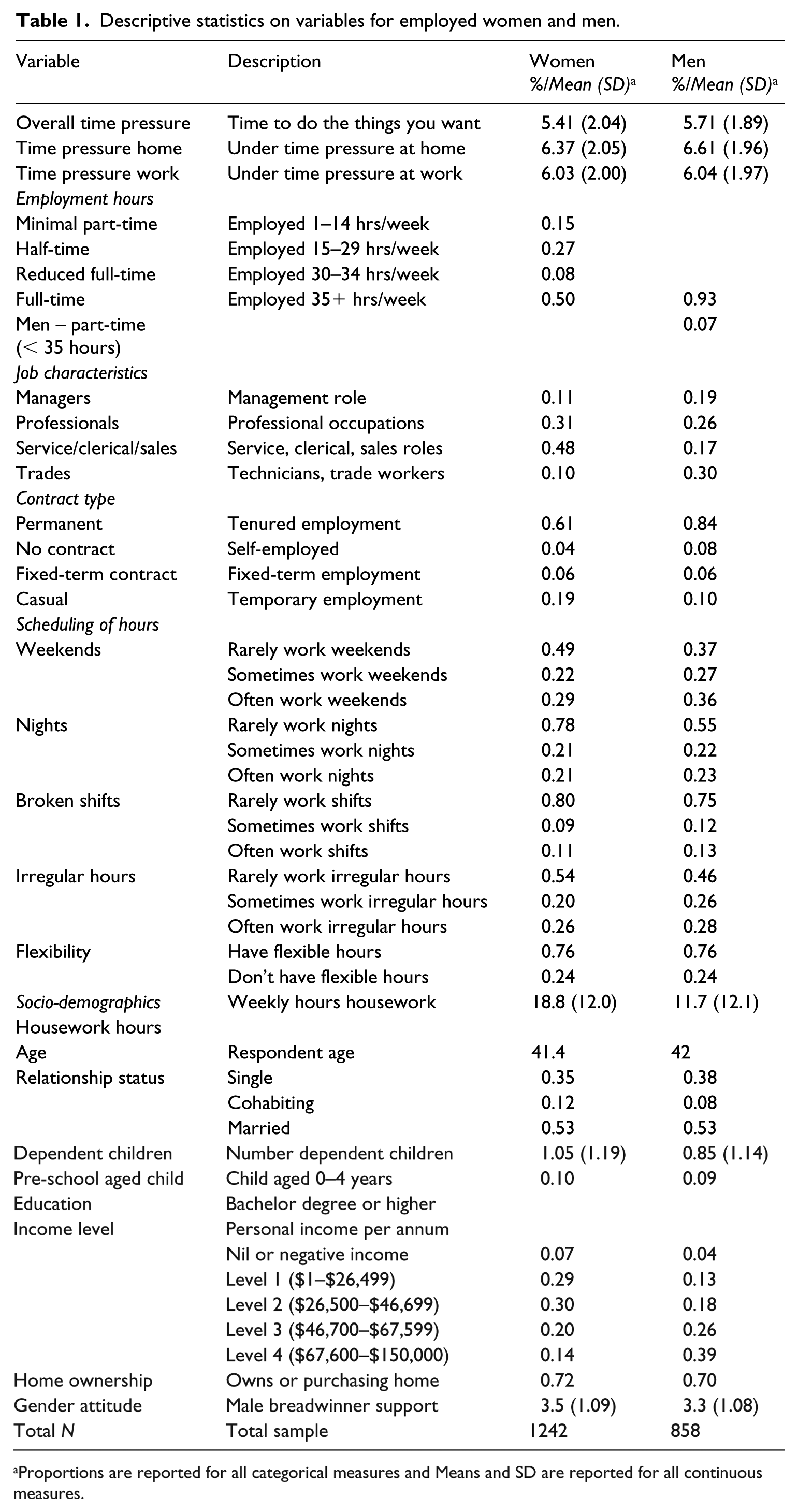
Proportions are reported for all categorical measures and Means and SD are reported for all continuous measures.
Key independent variables
Employment hours are derived from the question, ‘How many hours per week do you usually work in your main job?’ Although ‘usual hours’ has the potential to vary from ‘actual hours’ worked, a comparison of Wave 1 and Wave 2 of the NLC survey found there was negligible difference between usual and actual hours reported by Australian employees (van Wanrooy, 2002). In Australia, full-time employment is defined as 35 or more hours of employment per week (ABS, 2010). For the women in our sample, we disaggregate full-time and part-time employment according to the number of hours employed: the respondent is full-time if they are employed 35 or more hours per week (coded 1), and reduced full-time if the respondent is employed 30–34 hours per week inclusive (coded 2). Half-time hours is defined as 15–29 hours per week (coded 3) and minimal part-time employment is defined as 1–14 hours per week (coded 4). Due to the small proportion of men who worked part-time in our sample (12%) and the statistically small cell counts (<100) in each of the three part-time categories, we use only two paid work hour categories for males: full-time (35 hours or more per week) and part-time (1–34 hours per week). We use ‘full-time’ employment as the reference category.
The measure of occupation was derived from the survey question, ‘In your main job, what is your occupation?’ Occupations are grouped according to the Australian and New Zealand Standard Classification of Occupations (ANZCO) (ABS and SNZ, 2006). For the purpose of analysis, these groups are coded into four main occupation categories including: 1 = managers (reference group), 2 = professionals, 3 = service, clerical and sales, and 4 = trades. We include occupation due to evidence that professionals (e.g. managers) have higher time demands than non-professionals (e.g. service, clerical and sales workers) (Beham et al., 2012).
The employment contract variable was derived from two survey questions. The first was ‘In your main job, do you work on a permanent, fixed-term contract or casual basis?’ Respondents were asked to self-nominate which employment category applied to their job. A set of dummy variables was created to determine job contract: 1 = permanent (reference group), 2 = self-employed (no contract), 3 = fixed-term, and 4 = casual (temporary). The self-employed group were classified as having ‘no contract’ because they worked for themselves. We include employee contractual arrangements as previous research shows that permanent contracts are usually associated with higher quality jobs and casual contracts with lower quality jobs (Campbell et al., 2009; McDonald et al., 2009).
We also included a range of variables that refer to temporality and scheduling of work hours and are derived from the survey question, ‘Does your main job require you to work 1) weekends, 2) nights, 3) broken shifts, or 4) irregular hours?’ Each of these response options were coded as: 1 = rarely or never (reference group), 2 = sometimes, and 3 = often and included as dummy variables. The final job characteristic is job flexibility, derived from the question ‘Can you have flexible working hours if you need them?’ This variable is coded as a dummy variable (1 = Yes).
Demographic characteristics
We included a range of socio-demographic control variables prior research has found to be important for time pressure (Baxter et al., 2007; Craig, 2007). A measure of time spent on housework was derived from the survey question asking how many hours the respondent spent each week on tasks including meal preparation and clean-up, shopping for food and other essentials, and housework chores including vacuuming and laundry. Time spent on housework is gendered, with women usually spending three times the amount of time on domestic tasks as men (Baxter et al., 2008). This variable was included as a continuous measure of time spent on these tasks per week.
Respondent age was included in the models as a continuous variable ranging from 18 to 64 years. Relationship status was coded into single (reference group) = 1, cohabiting = 2, and married = 3. Parental status was determined by the presence and number of dependent children living in the household (aged less than 18 years). This variable is continuous and ranges from 1 to 8 children per household. A further dummy variable is created for the presence of a pre-school child aged from infant to 4 years (1 = Yes). Time spent caring for dependent children is disproportionately carried out by women, and young children (< 5 years) demand the most of parental time resources (Craig, 2007; Craig and Mullan, 2009).
The education variable measured the highest level of education completed. Categories include: incomplete primary or secondary, complete secondary, vocational qualification, undergraduate or associate diploma, or a Bachelor degree or higher. A dummy variable was created for respondents who had a Bachelor degree or higher (1 = Yes). Education is coded this way as degree-qualified professionals usually work in occupations with higher time demands (e.g. overtime) (Peters et al., 2009).
Income was derived from a survey question asking respondents to estimate their personal income for the last year from all sources. For the purposes of analysis, personal income is coded as a series of dummy variables divided into quartiles. These categories are 0 = nil or negative income (reference category), 1 = $1 to $26,499 per annum, 2 = $26,500 to $46,699, 3 = $46,700 to $67,599, and 4 = $67,600 to $150,000 or more earned per annum. Both higher education and income levels are typically associated with jobs that require higher responsibility (such as management) and longer hours (Webber and Williams, 2008). A dummy variable was also created measuring whether the respondent owned or was purchasing their home (1 = Yes). Home ownership raises the financial need to maintain or increase paid work hours, which increases time pressure at work (Bianchi et al., 1982). Homeowners spend more time on maintenance and repairs relative to renters, and this may increase time pressure at home (ABS, 2009).
The final control variable measures respondents’ attitudes to gender roles: ‘It is better for the family if the husband is the principal breadwinner and the wife has primary responsibility for the home and children.’ Scores for this measure range from strongly agree (1) to strongly disagree (5). The lowest score on this scale (1) indicates more conservative gender attitudes and the highest score (5) less conservative ones. Conservative gender attitudes are associated with additional time on women’s housework, and fewer hours in paid work after having children (Baxter et al., 2008).
Analytic approach
Our dependent variables were scales ranging from 1 to 9; all of them had approximately normal distributions. We therefore used multivariate ordinary least squares (OLS) regression models 1 to assess associations between job characteristics and time pressure while controlling for the effects of other relevant socio-demographic variables. We estimated three different models in order to assess the relationships between paid work hours and time pressure. 2
Model 1 (baseline) estimated the effects of employment hours on the three measures of time pressure in order to determine whether there is an association between paid work hours and time pressure for women (in Table 2), and men (in Table 3). Model 2 included job characteristics (occupation, job contract, scheduling of paid work hours, and access to job flexibility) to measure whether job quality characteristics change the associations found in the first model. In Model 3, other social and demographic measures, including age, relationship status, education, income, and the time spent on domestic work are included. Table 2 reports the results for women on each of the three models.
Employed women, job characteristics and satisfaction with time pressure.
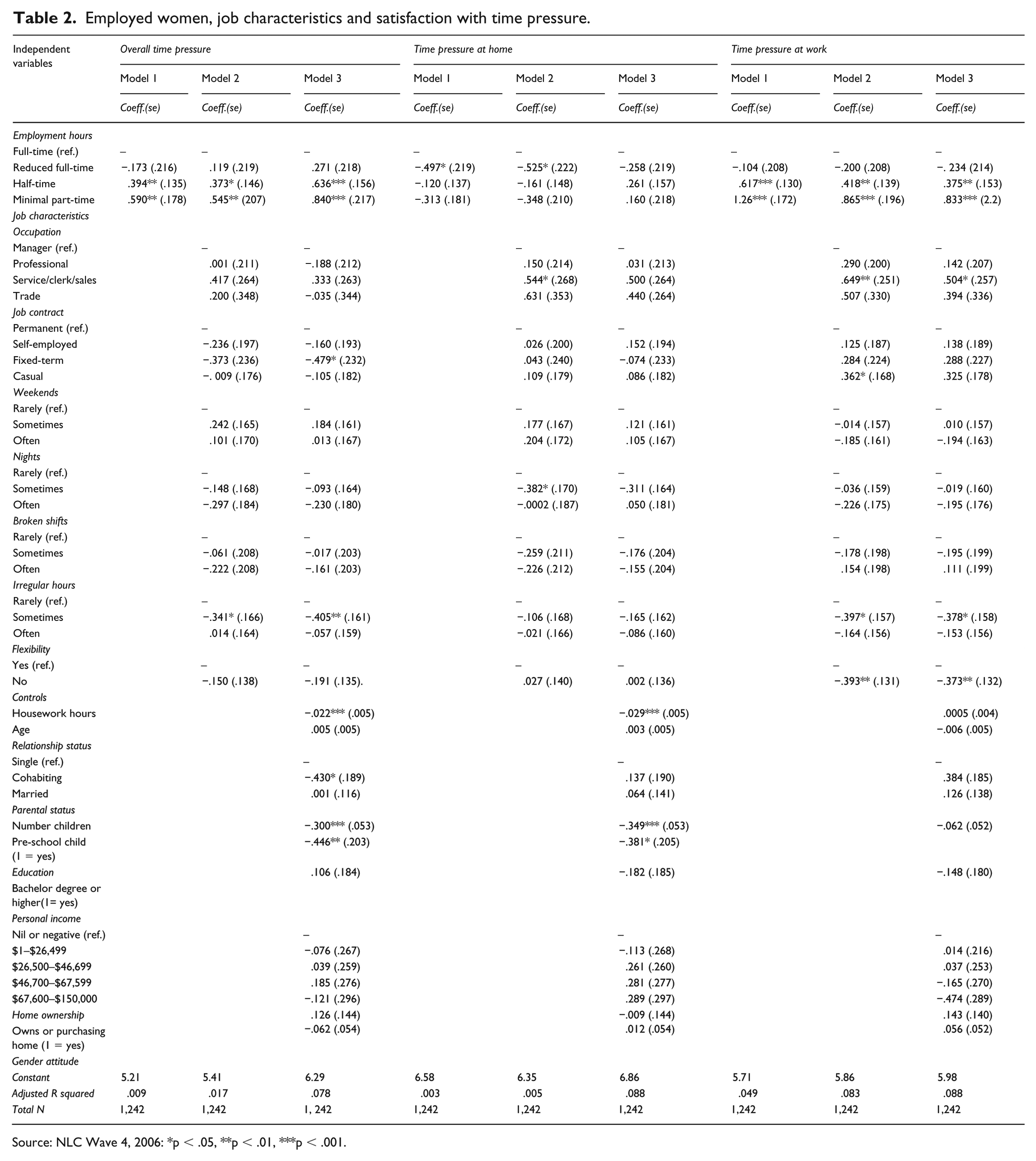
Source: NLC Wave 4, 2006: *p < .05, **p < .01, ***p < .001.
Employed men, job characteristics and satisfaction with time pressure.
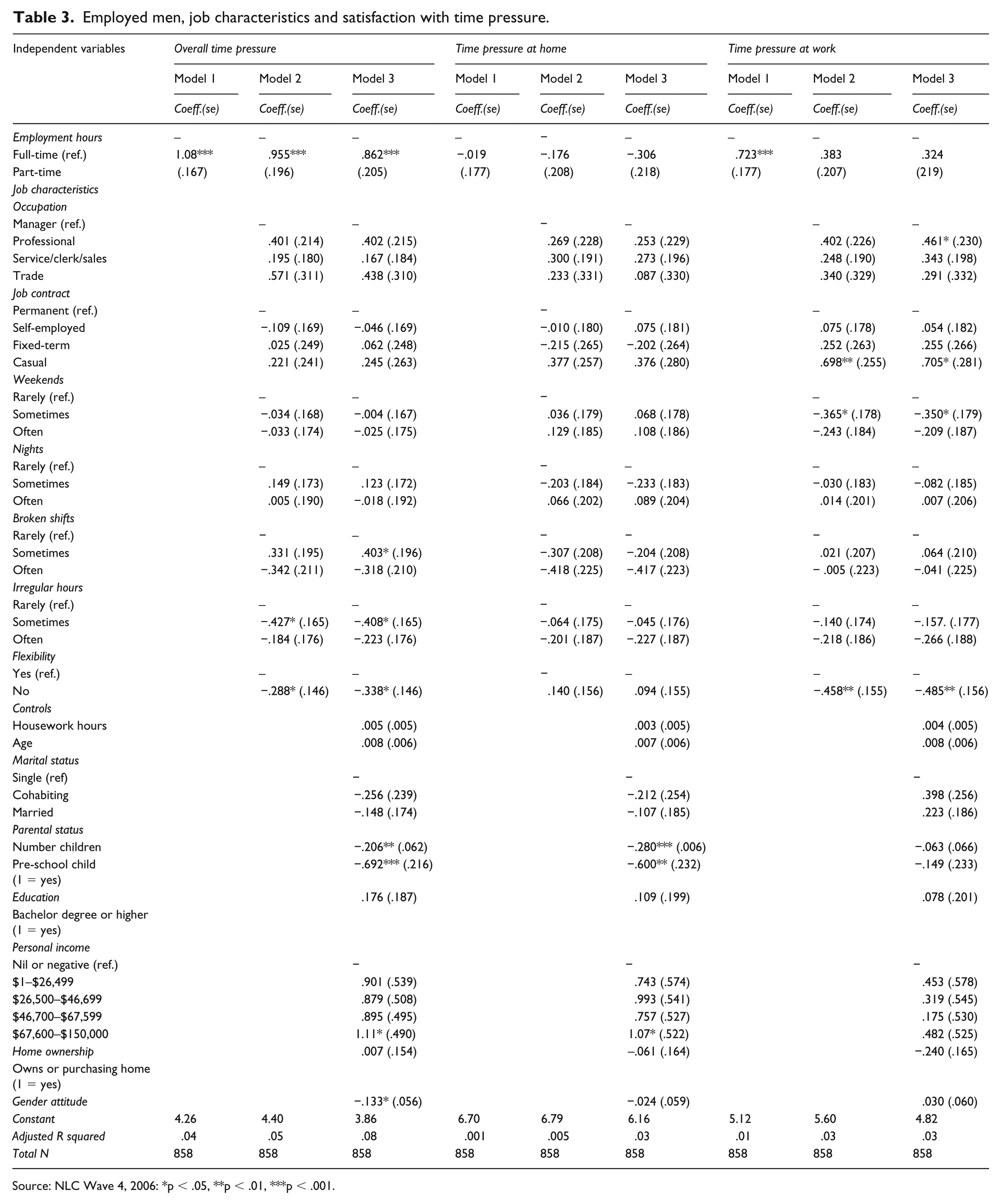
Source: NLC Wave 4, 2006: *p < .05, **p < .01, ***p < .001.
Employment hours results – women
The results from Model 1 examining overall time pressure reported in the first column of Table 2 showed that women who were employed half-time (16–29 hours per week) and minimal part-time hours (1–15 hours per week) had significantly higher levels of satisfaction with their overall time pressure and time pressure at work than women employed full-time (p <.01). Of note, women employed for reduced full-time hours (30–34 hours per week) were not significantly different from women employed full-time in this respect. Our findings concur with previous research that found employees who work longer part-time hours had similar workloads and time stress at work as full-time employees (Pocock et al., 2007).
The results for satisfaction with time pressure at home showed that women employed on reduced full-time hours were significantly less satisfied than women working full-time (p < .05). This result also held when job characteristics were taken into account. It is possible that women working reduced full-time hours experience similar time demands with regard to housework and childcare responsibilities as other groups of part-time employed women, and therefore fail to gain commensurate support from their husbands to the same extent as women employed in full-time jobs (Fagan, 2004; Baxter et al., 2008).
These results support H1 (a) Women working long part-time hours (reduced full-time) will report the same levels of satisfaction with time pressure at home, work and overall as women working full-time hours. Women employed for 30–34 hours or long part-time hours did not gain time pressure relief in any life domain as expected. Moreover, our results showed that in terms of time pressure at home, women in long part-time hours fared worse than their full-time employed counterparts. These results also support H1 (b): Those (women) working shorter part-time hours (minimal and half-time) will report higher levels of satisfaction with time pressure than women working long part-time or full-time hours. Our results suggested that women working shorter part-time hours (minimal and half-time) were more satisfied with time pressure overall and at work than women working longer part-time hours and full-time employed women. These results hold when job quality characteristics (Model 2) and demographic variables (Model 3) are added, as discussed in the following section.
Job quality results – women
Model 2 included job quality measures and evaluated whether they change any of the associations found in the first models. After we accounted for job quality characteristics, the associations between employment hours and satisfaction with time pressure observed in Model 1 held in Model 2. Overall, our job quality measures were not significantly associated with time pressure, with a few notable exceptions. First, women who ‘sometimes’ worked irregular hours had significantly lower levels of satisfaction with overall time pressure and time pressure at work (p < .01). This finding is consistent with Baxter and Chesters’ (2011) study of employed women in the service sector which found that women who worked unpredictable schedules had poorer work–family time balance than women who worked regular weekly hours.
While a growing number of industries employ workers on an ‘on call’ basis to meet the peaks and troughs of demand (Kauhanen and Nätti, 2015; Webber and Williams, 2008), our findings suggest that when employers fail to provide employees with a predictable schedule of hours, it decreases satisfaction with time pressure. For instance, it is very difficult to organise childcare and family-related activities without prior notice of when an employee is scheduled to work. Further, unpredictability in employment hours restricts the time and energy available to employees for activities outside of paid work (Duncan and Pettigrew, 2012). While results showed that working on a casual contract is associated with higher satisfaction with time pressure at work compared to women in permanent positions (p < .05), this may be due to the relatively short hours typically associated with casual positions.
The next notable finding in regard to job quality was that not having access to flexibility was negatively associated with satisfaction with time pressure at work (p < .01). This is consistent with an Australian study of women employed in the service sector which showed that women with access to flexible start and finish times were better able to reconcile their paid work and care responsibilities (Baxter and Chesters, 2011). The results from Model 2 also indicated that women with jobs scheduled at night had lower levels of satisfaction with time pressure at home (p < .05). This finding adds to previous research that finds unsocial paid work schedules increase individual time strain and time conflict for families (Hosking and Western, 2008; Strazdins et al., 2006). Further, when mothers work nights they often experience time stress associated with a lack of sleep that is compounded by a ‘second shift’ of household and care work during the day (Hochschild, 1989; Maume et al., 2010). When mothers work night shifts, using what Craig (2007) refers to as ‘time shifting’, they often take time away from leisure and self-care in order to maximise their time with children.
Finally, our results in Model 2 showed that women working in service/clerical/sales jobs have significantly better time pressure at home (p < .05) and time pressure at work (p < .01) compared to women in ‘other’ occupations. This finding could be related to non-professional jobs such as service jobs, which may provide better time balance and less spillover of time pressure than jobs requiring professional or other qualifications (Beham et al., 2012). Further, service, clerical and sales jobs tend to be female-dominated and more likely to entail shorter part-time hours and therefore provide better time balance than the more time-demanding and intensive professional occupations (Tausig and Fenwick, 2001).
In Model 3, we included socio-demographic control variables that are relevant to time pressure. We further examined whether prior findings held once we controlled for the presence of children and time spent on housework (variables that are associated with increased time stress for women). Model 3 results showed that time spent on housework and number of dependent children in the household had a significant, strong negative association with satisfaction with time pressure overall and at home (p <.001). However, while housework and the presence of a pre-school child in the home decreased satisfaction with time pressure overall, only housework decreased satisfaction with time pressure at home for women. This may indicate that men are becoming more involved in care of children than housework (Wall and Arnold, 2007). When partners in heterosexual relationships show that they are involved fathers, women perceive this as a fair trade-off for men’s lower contributions to domestic chores (Kawamura and Brown, 2010; Rose, 2017).
Further, in the final model (Model 3), women on fixed-term contracts reported significantly lower satisfaction with overall time pressure than women in permanent tenure jobs (p < .05). This result may be related to fixed-term contract employees working longer hours or more intensively in an attempt to gain tenure, in comparison to employees in secure, permanent employment (Brown and Sessions, 2005). Interestingly, our finding that women employed on casual contracts were significantly more satisfied with time pressure at work does not hold in Model 3, once family status variables are included. This could suggest that women on casual contracts also manage the bulk of family care work.
In summary, the results indicated that not all part-time employed women experienced reduced time pressure overall or at work, suggesting that reducing employment hours does not necessarily provide the solution to time pressure or better work–life balance for all groups of women. Research has found that women increase time spent on housework and childcare, and men contribute less in these areas, particularly when women work part-time rather than full-time (Rose, 2017; Pocock et al., 2009; Skinner et al., 2012). These findings support our second hypothesis H2: Job quality characteristics, particularly those with temporal qualities, will change the association between satisfaction with time pressure and explain some of the differences between those working full-time, long part-time and short part-time hours. For women specifically, temporal qualities, including intermittent irregular hours and no access to flexibility, had a negative impact on time pressure overall and at work.
Job quality results – men
Table 3 shows the results for men. The main difference in these models is that men’s employment hours are divided into two categories: 1 = full-time employment of 35 or more hours per week (reference category), and 2 = part-time employment of 34 hours or less per week, due to small numbers of men who worked part-time.
The results from Models 1, 2 and 3 reported in Table 3 showed that men who were employed part-time experience significantly greater satisfaction with overall time pressure than men employed full-time. 3 For men, paid work hours were not significantly associated with time pressure at home. However, a slightly different pattern exists for men’s satisfaction with time pressure at work. In Model 1, as shown in the third column of Table 3 (Time pressure at work), men who worked part-time had significantly higher levels of satisfaction with time pressure at work than men who worked full-time (p. < .001). But Model 2 showed that satisfaction with time pressure at work was not maintained when job quality characteristics were taken into account.
Results show that for men, working weekends had a significant negative association for satisfaction with time pressure at work (p < .05). Other job quality characteristics that had an impact on time pressure satisfaction for men included a lack of flexibility (Time pressure at work) and working irregular hours (Overall time pressure). Yet the result that men working broken shifts had greater satisfaction with overall time pressure in Model 3 (Overall time pressure) (p < .05) challenges research that found broken shifts put employees at greater risk of work–family time conflicts (ACTU, 2000). It is possible that this inconsistency in findings may relate to how men fit their paid work shifts around their spouses’ schedules and whether split shifts make them absent from time-pressured parts of the day at home (e.g. child bathtime or bedtime routines) (Rose et al., 2015).
In terms of an individuals’ employment contracts, men employed to work casual hours reported higher levels of satisfaction with time pressure at work than others (Table 3, Model 2 and 3, Time pressure at work), likely due to the fewer hours typically associated with such jobs and/or casual workers being less likely to work overtime (Campbell and Burgess, 2001; Peters et al., 2009). Yet our results show that men in professional jobs have higher levels of satisfaction with time pressure at work compared to men employed in ‘other’ occupations (p < .05). This may be due to greater autonomy over time, and the ability to do paid work from home (Peters et al., 2009). However, it should be noted that 85% of men in our sample employed in professional occupations worked full-time and only a very small number of men (33 in total) worked part-time. This contrasts with the 43% of professional women in our sample who worked part-time.
Together, these findings offer additional support for the second hypothesis H2: Job quality characteristics, particularly those with temporal qualities, will change the association between satisfaction with time pressure and explain some of the differences between those working full-time, long part-time and short part-time hours. For men (and women), the temporal qualities important to time pressure satisfaction included having regular hours and access to flexibility. Doing paid work on weekends negatively affected men (but not women); this finding may be related to gender differences in the number of hours worked (e.g. mostly half-time employed women worked weekends) and occupational differences (e.g. construction work).
Discussion
In this study, we examined whether variations in job quality and quantity affected women’s and men’s time pressure at home, at work and overall. Specifically, we wanted to understand more clearly how temporal aspects of job quality impact employees’ time pressure outcomes and whether part-time employment status significantly reduced time stress. In terms of paid work hours, our models showed that, for women, not all part-time employment categories were associated with lower levels of time pressure. While women who worked half-time (15–29 hours per week) and minimal part-time hours (1–14 hours per week) reported higher levels of satisfaction with time pressure overall and at work, they did not have increased satisfaction with time pressure at home. Further, women who worked longer part-time hours (30–34 hours per week) do not differ, in terms of time pressure satisfaction, from women who worked full-time.
In contrast, for men we found part-time employment was associated with better time pressure levels overall, but it was not associated with better levels of time pressure at work when job quality characteristics were factored into the model. This suggested that job characteristics, and particularly poor job quality, could counter some time pressure gains for men employed part-time. This finding confirms research by Strazdins et al. (2007) that found when men with children work part-time, it is often in the worst quality jobs. Overall, our findings suggest that part-time employment is not necessarily effective in reducing time pressure for women or men; it depends on the domain (work or home), the number of hours worked and temporal job quality. Our analyses found that having jobs that are flexible and have a regular schedule of hours is important to time pressure outcomes for both genders. Our findings align with research finding that a regular pattern of paid work hours, or a set schedule, is important in fitting time around children’s substitute care schedules (Poelmans and Caligiuri, 2008).
There are some limitations to our study, including its cross-sectional design. Due to the cross-sectional nature of the data, we are limited to observing only associations and correlations between employment hours and perceptions of time pressure. Even though we control for a large number of covariates, we cannot unequivocally rule out bias in our estimates or infer any causality. Our results need to be interpreted with this in mind. While it would be optimal to use a longitudinal design to examine how time pressure outcomes changed for women and men over time, and particularly across key life events such as the birth of a child, earlier waves of the NLC survey did not ask participants about time pressure. Another limitation is that all models had low r2, suggesting that they explained little of the variability (or variance) of the response data around its mean. Even though the literature we have reviewed and previous research would suggest that the factors we have in the model may explain more of the variability, future research may want to consider other factors that impact time pressure experience. Additionally, as this data was collected in 2006, it is possible that the employment context may have changed since then. Finally, the benefit of part-time employment in reducing time pressure is likely to vary across nations and therefore cross-national studies are needed to determine how country context is associated with differences in the quality and experience of part-time employment.
Conclusion
This study presents some challenges to previous research and policy that positioned part-time employment as ‘family friendly’ or the solution to time pressure. More research is needed to investigate optimal flexible arrangements for women and men, so that gender inequalities associated with the uptake of part-time employment and the quality of such jobs can be more closely scrutinised. Although women with children are likely to continue to show interest in part-time employment, government departments that legislate on work and family policy need to consider whether it is the most equitable way to address time stress. A more nuanced approach than pitching part-time employment as a ‘family-friendly’ strategy could contribute to a more meaningful debate and genuinely contribute to alleviating time pressure for families. Australian workplaces need to look beyond its reliance on mothers employed part-time and towards alternative ways to promote better time balance. Given the high numbers of Australian women who transition to part-time employment after having children, this study’s finding that not all types of part-time employment alleviate time pressure has important consequences for employee health (stress, sleep and illness) and well-being (happiness and job satisfaction) (Booth and van Ours, 2008; Lehto, 1998; Maume et al., 2010; Strazdins et al., 2007).
There are some promising part-time options in the US and Europe. Organisational research in the US has found that some workplaces (approximately 10%) are starting to implement reduced-load work arrangements to retain talented professional employees who are seeking to better balance their career and personal life (Kossek and Lee, 2008). This ‘new concept part-time work’, which may entail a reduced workload and hours, is typically only available to a select group of highly skilled professionals (Hill et al., 2004). The ‘new working conditions’ are increasingly available across Europe and provide employees with greater autonomy over when and where to work; however, issues still remain with time intensity associated with squeezing workloads into reduced hours and the associated problems of work spillover into unpaid overtime (Peters et al., 2009). In addition, employees who have the flexibility to work from home may find it more challenging to quarantine their paid work from family time (Rose, 2017).
Finally, we suggest that greater research is needed into job quality measures across countries and within occupational sectors where part-time employment is growing in prevalence. We argue that this approach needs to be applied equally to women and men seeking employment options that might better balance their work, family and personal lives. Moreover, workplaces need to assist employed parents to manage time pressure and foster well-being by promoting gender equitable, family-friendly policies. As previous research has shown (Ciccia and Verloo, 2012; Craig, 2008; Ranson, 2012) gender-neutral arrangements don’t always work to encourage men to work less or care more, with some ‘father-specific’ policies and incentives in Scandinavian countries showing greater promise (Daly, 2011).
Footnotes
Acknowledgements
The authors would like to acknowledge the input of Professor Janeen Baxter into earlier drafts of this article. We would like to acknowledge the input of Gerry Loiacono to the final draft.
Funding
This research received no specific grant from any funding agency in the public, commercial, or not-for-profit sectors
