



Abstract
This study investigated the informal science education (ISE) field to determine whether it currently functions as an effective community of practice. Research questions included: How do professionals describe and self-identify their practice, including what missions, goals and motivating factors influence their professional work? What challenges do they face and how are these resolved? Is participation in ISE activities perceived as core or peripheral to their work? Open-ended interviews were conducted with high-level representatives of 17 different ISE sub-communities; results were analyzed qualitatively. Findings showed this broad assortment of ISE sub-communities as not currently functioning as a cohesive community of practice. Although examples of shared practice and ways of talking were found, evidence of widespread, active relationship-building over time and coalescence around issues of common concern were absent. A current “map” of the ISE community is proposed and thoughts about how this map could alter in the future are suggested.
Keywords
1. Introduction
A fundamental, even if rhetorical, goal of most societies is to foster citizens with the desire, abilities and tools to fulfill their quest for knowledge and engagement, including in the critically important fields of science, technology, engineering and mathematics (STEM). Although traditional formal education plays critical roles in supporting STEM learning, there is growing awareness of the contextual nature of learning which assumes that attitudes toward, and understandings of STEM are equally, if not more, likely shaped by an individual’s direct, personal experiences, needs, expectations, and culture (cf., Bell et al., 2009; Falk and Dierking, 2010; Falk, Storksdieck and Dierking, 2007; Sturgis and Allum, 2004; Turner, 2008; Wagner, 2007).
This perspective emphasizes the contributions of the vast informal science education (ISE) network – including, but not limited to science museums, community-based organizations with mandates for informal STEM learning, STEM-oriented television, film, books and after-school programs and the Internet – all suited to the public’s ever-expanding desire for free-choice STEM learning, across their lifetimes and days. In part, the U.S. National Science Foundation (NSF) funded the Center for the Advancement of Informal Science Education (CAISE) to help fulfill this potential. A major goal was to facilitate participation in, and leadership within the free-choice STEM learning community. In order to support such a dynamic, grassroots community though, one must understand who currently identifies with and participates in the community, as well as who does not. Also important are the broad questions and issues community members face, and the tools they perceive are needed to improve their work. Responding to this need, this exploratory research study is an initial effort to chart the current “landscape” of the ISE community.
2. Research goals and theoretical framework
Overarching study goals were to determine the current state of the ISE field (primarily in the U.S.), and the degree to which it functions as an effective community.
Theoretical framework
The theoretical framework for the research was Community of Practice (CoP). A CoP is “a unique combination of three fundamental elements: a domain of knowledge, which defines a set of issues; a community of people who care about this domain; and the shared practice that they are developing to be effective in their domain” (Wenger, McDermott and Snyder, 2002: 27, original italic). In the case of this study, the domain of knowledge is ISE, the community is ISE professionals and the shared practice includes STEM-focused work and communication around creating exhibitions, programs and new media, journalism and film-making.
CoP posits that participation within a community influences the identity of participants, and individuals evolve as a result of participating; in turn the community evolves because of their participation. Given its focus on community practice, CoP was selected from several possible frameworks, because it seemed a particularly useful tool for mapping the current “landscape” and activities of the ISE community.
We first needed to determine who currently identifies with and participates in the community, as well as who does not. The working hypothesis was that if the multiple individuals and organizations that constitute the community are a “true” CoP, we would observe a group of people with common goals, for example, a concern or passion for STEM, who engage in shared ISE practice through long-term social interaction as they strive towards meeting those goals. An effective CoP shares more than a common set of products, information or skills though. In dynamic communities, members participate in active relationships over time (Lave and Wenger, 1991; Wenger, 1998) and organize around issues that matter to them (Wenger, 1998). If this were the case for ISE, we would also be able to observe and document such long-term activities and relationships.
The CoP construct was originally conceptualized to describe and understand relatively small, delimited domains of practice, such as midwife apprenticeships in the Yucatan. However, it is increasingly being used to frame larger, more complex multidisciplinary communities in which individuals from several different professional communities or disciplines overlap and share information, tools and resources to advance a common goal. Appreciating the diversity of a multidisciplinary CoP is important because there are differences in how, and to what extent various sub-communities may choose to identify and participate. For example within ISE, there are some sub-communities such as science centers, for which ISE is likely considered the very core of their work; perhaps even the primary reason for their existence and already an integral part of their day-to-day thinking and operation. In other sub-communities, new media, for instance, engaging the public in science through informal education may not be a central focus, nor the professional community identified with most. Some or much of their time may be dedicated to other activities – research, conservation or formal education – not necessarily ISE-focused; their ISE practice is more peripheral. Implicit within the CoP framework is the assumption that as the understanding of the value of a community increases, groups that currently perceive the community as peripheral to their goals may choose it to be more of a core practice, another reason why this framework was appealing for this effort.
Although we discussed CoP from the individual perspective, the unit of analysis for this study is the professional sub-community to which the individual identifies. Individuals in a peripheral community may spend all of their time engaged in ISE work; likewise individuals in communities in which ISE is a core practice may not personally engage in ISE. Our categorization of professional communities in this study is not meant to describe every individual in the sub-community, but rather the general role of ISE in the sub-community’s practices as a whole.
3. Methods
Study design
This study was focused, exploratory research, employing a CoP approach to understand the ISE community within a larger sociocultural context thus the convenience sample size is small and focused. An initial list of ISE professionals to interview was compiled by drawing from CAISE’s (and our) extensive network of contacts within the field; the list included individuals from a wide variety of groups involved in ISE activities. The final list included representatives from Youth-Serving Community Organizations, Adult Community Organizations, Science Centers, Botanical Gardens, Natural History Museums, Zoos and Aquariums, Children’s Museums, Environmental Organizations, University Extension, Public Television and Radio, Journalists, Health Organizations, After-School Science, New Media, Libraries, Science Societies and Film-Makers. In order to gain as unbiased a view of the field as possible, we developed selection criteria to insure diversity in terms of work focus, expertise, size of the organization(s) represented and geographic location. The majority of the sample interviewed was from the U.S., but individuals from Europe, Canada and Australia were also included. Most significantly, we selected individuals prominent within each of the 17 target sub-communities. Suitable participants included executive directors, organizational directors and deputy directors, national funders and internationally recognized ISE professionals, all of whom could credibly represent the professional community or communities in which they participate.
Because the NSF’s ISE program is the dominant funder of such STEM efforts in the U.S., we assumed that their rhetoric and philosophy impacts the field (particularly important to consider because CAISE’s efforts are supported by NSF ISE). We hypothesized that individuals currently funded by NSF ISE would strongly: (1) connect to the ISE domain of knowledge; (2) identify with colleagues who consider themselves in that CoP; and (3) consider ISE central to their shared practice. To consider this influence as an independent variable we made a conscious decision to include in the sample both the “core” group of individuals who regularly apply for and receive funding from the NSF ISE Program as well as individuals outside this sphere, e.g., individuals never having or not recently receiving NSF ISE monies (though not funded by NSF ISE, this latter group were still leaders or emerging leaders in the ISE field).
Face-to-face interviews were conducted with the NSF ISE-funded group during an ISE PI Summit hosted by CAISE in July 2008 in Washington, D.C. Individuals outside of the NSF-funded group were contacted via email and invited to participate. In compliance with IRB (Institutional Review Board) procedures, participants were given information about the study’s purpose both in the invitation to participate and in the interview introduction.
Interview protocol
Data collection protocols were identical in both the in-depth telephone and face-to-face interviews. Because of the exploratory nature of the study, interviews were open-ended and conversational in nature (Appendix B1). Such an approach builds rapport and trust with the person being interviewed and enhances the validity of findings by allowing researchers to more deeply understand what people actually say and do in context (Goodwin and Horowitz, 2002). In order to reduce bias, unless details were specifically requested, information about CAISE and its funder were not made explicit until the end of the interview.
The goal of each interview was to understand how that individual representing an ISE sub-community described and positioned him/herself, the particular professional community within ISE with which s/he identified, and the major challenges faced by that community. Questions probed research participants’ community identity, the domain of knowledge involved and their shared practice in terms of:
Mission and goals of the community.
Obstacles to accomplishing goals.
How and to whom the community makes the case that what they do is important.
Sources of funding.
Perception of the community vis-à-vis ISE.
Analysis
Interview data were reduced and coded by researchers. Data were analyzed using text analysis; a detailed, qualitative method for identifying concepts and categories that emerge from interviews (Bernard and Ryan, 1998) enabling researchers to systematically identify, code and categorize primary patterns or themes within participants’ responses in order to recognize rich and complex patterns as well as capture the often complex and unpredictable ways in which patterns are related to one another. Cross-validation of these codes and a member check with representative ISE professionals not in the sample were also conducted.
4. Results
Ten face-to-face interviews with NSF ISE-funded individuals were conducted, along with 25 phone interviews of non-NSF ISE-funded individuals, resulting in a total “n” of 35. There seemed to be little selection bias; the only reason given for non-participation was time constraints. Both phone and face-to-face interviews lasted approximately 45 minutes.
NSF-funded vs. non-funded groups
Qualitative analysis demonstrated that responses from the 10 NSF ISE-funded groups and the 25 non-funded groups were essentially identical; comparisons as a function of group membership yielded no additional insights. Thus the need to separate data from these two groups was deemed unnecessary and all further analysis was conducted using the combined responses of all research participants.
Domain of knowledge
Only five of those interviewed specifically, without prompting identified ISE as the professional community with which they engaged. The most common type of response by about half of those interviewed related to institutional or domain identity (science centers, museums, environmental education, etc.). Typical responses were:
Aquariums and zoos – the museum community in general. Non-governmental organizations, conservationists and non-profits. (Director of a global network of zoos, aquariums, and museums) Public affairs community, informal education including public education videos and documentary films. (Independent film-maker) Primarily, the environmental education community, but also communications – marketing and branding. (President of a national foundation)
Although only five spontaneously identified ISE as their community of practice, when prompted, all 35 reported overlaps to some degree with the ISE community. Half were quite emphatic, stating that they were “definitely” or “absolutely” a part of the ISE community and that most or all of what they do is ISE. Characteristic responses included:
We were among the founders of ISE and are daily practitioners. It’s not all we do, but a big part. (Director of a national youth organization) Yes, just by definition, we are a part of ISE. Radio is informal – it is how adults get educated; it’s their source for information. (General Manager of a public radio station)
One person interviewed who represented science writers felt that there was some overlap between her field and ISE, but “not a lot,” stating that her community provides services to the ISE community, but is not a part of it.
The missions and goals shared by those interviewed tended to converge on a few broad ideas centered largely on improving society. Mechanisms for accomplishing these goals included improving decision-making skills, helping to create a science literate population, improving quality of life, and helping people stay healthy. Several of those interviewed made the point that knowing about science is critical to everyday life – both improving quality of life and supporting people being responsible citizens. One said, “In this age, our lives depend on knowledge. We need air clean enough to breathe, quality prescription medications, traffic lights that are programmed to keep people safe – everything relies on science and technology.” Informing and inspiring the public by raising awareness, increasing interest and making connections between STEM content and the public’s everyday lives were common responses. Encouraging youth to consider STEM careers and helping to promote environmental stewardship were also mentioned by several of the individuals interviewed.
Community of people and shared practices
After institution or domain, the most frequent response about the community with which s/he identified, related to the individual’s perceived professional role and the shared practices in which s/he engages. A third responded with various forms of “educator” (e.g., “general” educator; science educator; environmental educator). Other responses included: after-school provider; youth development executive; scientist; and broadcaster. At the end of the interview, research participants were asked to rate how closely they personally self-identified with a list of different types of educators; the strongest associations were with Informal Science Educator and Public Service Provider.
Even if they did not self-identify themselves as educators, a majority of those interviewed agreed that they supported education. These participants indicated that while many in their field are educators, they themselves play a more administrative role within their organization. This likely reflects the number of ISE leaders in the sample, all of whom we felt could represent the professional community or communities in which they participate broadly. Those interviewed overwhelmingly agreed that the professional communities/institutions they represented have educational missions. Indicative responses included:
Education is one of the last great mechanisms to improve society – it’s a pathway to a better life. (University educational researcher) Yes, missions are increasingly education-centered. It used to be social and civic development, now they are more education-focused. (Program Director of a youth development organization)
Four individuals did not give a definitive “Yes” to the question of whether their community had an educational mission, but all gave a qualified “Yes.”
Participants also discussed how and to whom they make a case for the importance of their community’s work (the assumption being that this might reveal commonalities across the ISE community). Those interviewed indicated that they most need to make a case to policy-makers and funders; as one put it, “to those with money and those with power.” The most effective arguments supporting their existence tie back to institutional mission: improving people’s lives, fostering the next generation of STEM professionals and contributing to an informed and scientifically literate citizenship. Many stated that although data demonstrating these impacts are most persuasive, empirical evidence is often difficult to find. In many cases though, simple information such as demographics and numbers served can be effective in making the case.
There were many similarities in where sub-communities seek funding, and most listed multiple sources including federal sources. NSF – ISE in particular, Department of Education, Department of Defense, Environmental Protection Agency, etc. were mentioned by all but one study participant. Corporations and private foundations were also mentioned by half of the participants; private donors were listed by a quarter and state government named by a few.
The most frequently mentioned obstacle to meeting the goals of the community was lack of resources – primarily funding. Another common theme was the “fragmented” nature of the community or the lack of a “united front.” In order to make changes in policy and/or practice, several of those interviewed felt that the ISE community needs to coalesce around similar ideas and goals. Typical responses included:
Money, and not enough resources to rigorously prove impact; everything is still anecdotal. The lack of unity is also a huge hurdle – we need to work better together and for the same ends. (President of a national foundation) Sustainable funding. The fragmented community, we need a common identity – we all need to get under the same banner. We need one field, not seven little ones. (Program Director of a youth development organization)
Mapping the current ISE landscape
This research study’s primary goal was to chart the current ISE community landscape. Rather than being definitive, the intention was to provide a glimpse of the community from a diversity of its participants, some whose work is central to ISE and some whose is peripheral. Our overall working hypothesis was that if multiple individuals and organizations that compose the ISE community are an effective CoP, we would be able to describe them as a group of people who share common goals and engage in the shared practices of ISE through regular social interaction with each other. This was observed somewhat, but even though all research participants identified themselves as an educator or supporting the educational mission of his/her institution to some degree, interviews revealed that members of the ISE community primarily identified with the institutions within which they work, and/or through the specific media they utilize to communicate (e.g., exhibitions, print, film, broadcast and online media), rather than as a unified field of practice.
To further explicate these findings, we qualitatively represented the data from the 17 sub-communities sampled within a two-dimensional space (Figure 1). The figure separates the two dimensions of ISE – the informal to formal educational process on the X axis and the commitment to promoting public understanding of STEM on the Y axis.
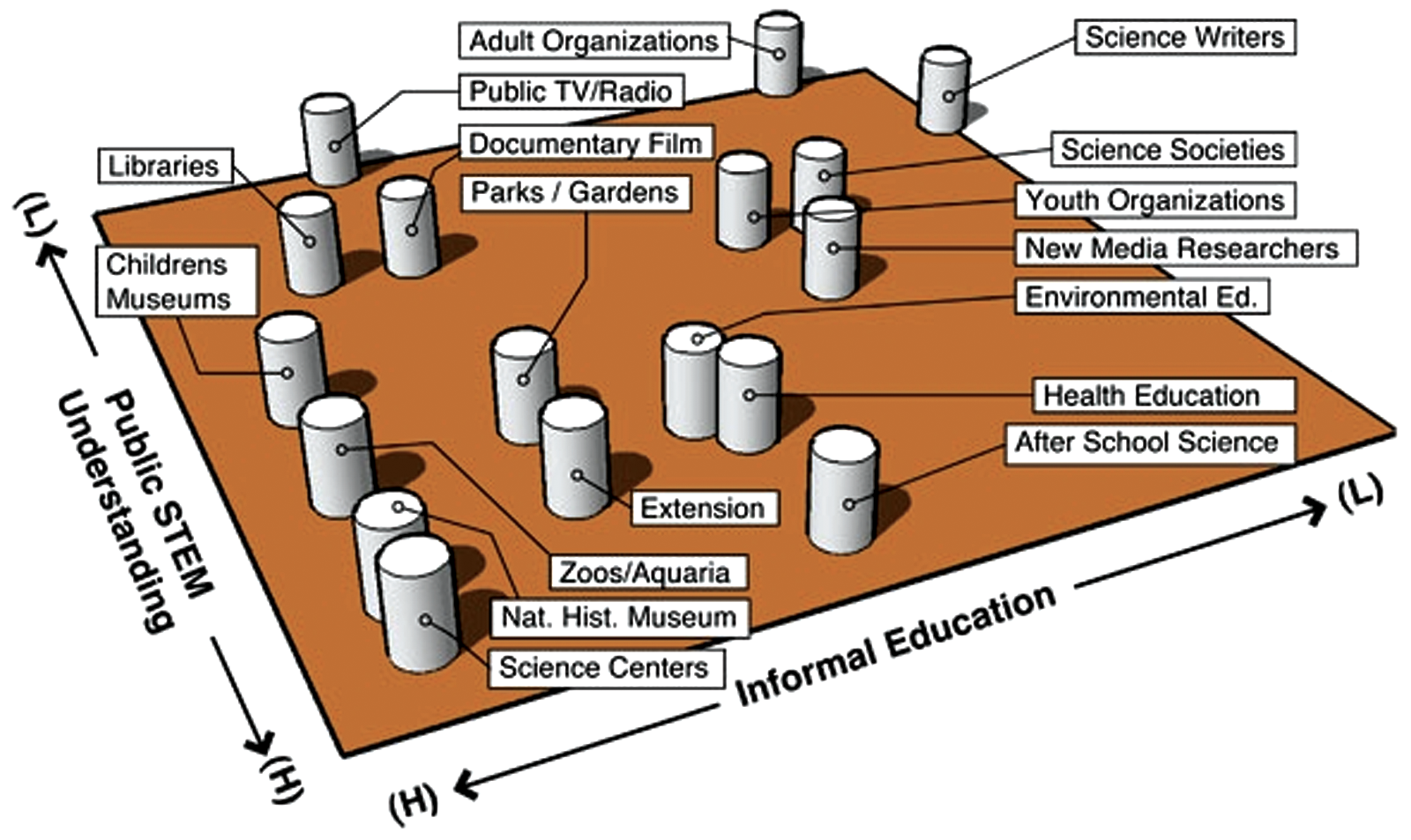
Two-dimensional representation of current ISE landscape as a function of identification with informal education as an educational process and public understanding of STEM as an educational goal.
5. Discussion and conclusions
We interviewed a diverse set of individuals for this study, each of whom was considered a leader within one of 17 different types of professional communities involved with ISE. Without prompting, the vast majority self-identified themselves first and foremost as being part of their immediate professional sub-community (e.g., science center professional, writer, environmental educator, etc.). When prompted though, a majority acknowledged that at some level they are also part of the larger ISE community. Nearly all of those interviewed acknowledged that the communities they represented closely associated with the goals of ISE, and nearly half were quite emphatic that most or all of what they do is ISE-related. Interestingly though, the various sub-communities represented in our sample positioned themselves differently vis-à-vis ISE; some perceived their community as “daily practitioners of ISE” while others perceived their community as “a cog in the wheel of where people get their information regarding science.” A small subset saw ISE as a narrow portion of the more general efforts of their community. For example environmental educators described their mission as conservation, with science as just one facet of that work. Similarly, youth organizations saw their mission as youth development with ISE serving as a tool for accomplishing that goal.
Disaggregating the two dimensions of the ISE CoP that all participants discussed enabled us to create a visual representation of the ISE community space, although caution needs to be used when generalizing from this small, qualitative data set. These preliminary data appeared to confirm our initial hypotheses that some sub-communities consider ISE at the very core of their work while others consider it more peripheral. The analytical frame in Figure 1 shows that some communities currently perceive themselves as tightly committed to the central tenets of an ISE CoP, for example, Science Centers, Natural History Museums, and Zoos and Aquariums, with Children’s Museums as an outlier to this group. Science Writers, Science Societies, New Media and Adult and Youth Communities currently view ISE as more peripheral to their work. The remaining groups, Broadcast Media, Documentary Film-Makers, After-School Science providers, Parks and Gardens, Health Education and Environmental Education communities, currently perceive themselves as somewhere in the midrange of these two dimensions.
Based on these preliminary findings it is fair to conclude that the broad assortment of ISE institutions that constitute the ISE field are not currently functioning as an effective and cohesive CoP, even a complex, multidisciplinary one. However, there are sub-communities that are participating more fully, for example, the organizational cluster of Science Centers, Natural History Museums, Zoos and Aquariums and possibly Children’s Museums. These four sub-communities currently strongly share missions and complementary subject matter focus, are a cohesive community of people who care about this domain and have many commonalities of practice shared between them. Supporting this finding is the fact that significant subsets of these communities regularly attend the same conferences, read the same journals and cross-hiring between them is common. Participation in these shared social practices considerably decreases the further one moves beyond this “science museum-like” cluster.
That said, across the array of sub-communities sampled there were many examples of shared practice and ways of talking about the work of the community. Although each of the representatives of the various sub-communities positioned themselves vis-à-vis ISE quite uniquely, there were four striking and important similarities between all groups:
Considerable agreement in the importance of public STEM understanding and literacy.
Widespread convergence about the value of informal/free-choice learning and commitment to informal education practices.
Funding sources by and large the same.
Similar evidence and arguments for making the case for their value.
These findings suggest that the sub-communities within the overall ISE community do share many common goals, as well as engage in many shared practices. Importantly, no one in the sample categorically excluded themselves from the ISE community, with the exception of one individual who perceived that the science communication/education sub-community did not feel that ISE was a critical reason for existing. It is worth reiterating that even though individuals chosen for this research were in a position to represent the views of the broader community they represented, the validity of these initial conclusions requires more extensive and robust research.
ISE will only become an effective CoP when participants within the various sub-communities choose to learn and advance their practice through regular interaction and communication within the overall community. Although such interactions regularly occur within each of the sub-communities, there is currently little evidence for significant boundary-crossing or linking across the field. There was also little evidence of active relationships over time or organizing around issues that matter to members of the broader community (unless required by funders). At present, barriers seem to be preventing the various ISE entities from naturally coalescing into a fully functional ISE community of practice. Two possible hypotheses explain this finding:
Hypothesis One: There is no historical, sustained need for an overall ISE CoP and by extension it is unlikely there will be a need in the future.
Hypothesis Two: Existing ISE sub-communities lack an overarching vision that enables them to recognize the significant value that a robust CoP would afford.
The data collected in this current study are insufficient to confirm which of these or any other hypotheses is most valid, and as within any complex system, the ISE community is not in stasis. Regardless of the reasons for the current state of the ISE community, the social, economic and political contexts for ISE are rapidly evolving; these changes rather than history are likely to influence which of the two hypotheses emerges as most valid in the future. We believe the most likely scenario is that most of the ISE sub-communities will eventually coalesce into a single, multidisciplinary community with increasingly overlapping domains of knowledge and practice. In the mean time, this exploratory study provides a preliminary snapshot of the current terrain of the community, illuminating strengths and weaknesses, serving as a benchmark for future investigations of the field, and providing some fundamental framing for those hoping to support this incipient but growing community.
Footnotes
Acknowledgements
The authors wish to thank all of those who participated in these interviews and our colleagues at the Center for the Advancement of Informal Science Education, in particular Ellen McCallie, Wendy Pollock and John Beck who assisted us with identification of interviewees. Thanks also to Greg Kise for his assistance with Figure 1. This work was supported in part by a grant from the U.S. National Science Foundation; the opinions expressed do not necessarily represent the views of the NSF.
Author Biographies
References
Supplementary Material
Please find the following supplemental material available below.
For Open Access articles published under a Creative Commons License, all supplemental material carries the same license as the article it is associated with.
For non-Open Access articles published, all supplemental material carries a non-exclusive license, and permission requests for re-use of supplemental material or any part of supplemental material shall be sent directly to the copyright owner as specified in the copyright notice associated with the article.
