




Abstract
This article examines the dramadoc genre’s potential to enhance public understanding of science. It focuses on a case study of the UK dramadoc If…Cloning Could Cure Us, which employed a combination of fictionalised drama, documentary interviews and interactive features to explore uses of human cloning in stem cell research. The author conducted 20 focus group screenings of the programme to examine the impact that the dramadoc had on people’s knowledge and opinions. Results show that although critics claim that the genre’s combination of fact and fiction will lead audiences to misunderstandings, the dramadoc also has the potential to increase people’s scientific understandings. New understandings, however, do not necessarily translate into more favourable attitudes towards the topic. The article concludes by arguing that in spite of the programme’s achievements in improving public understanding of science, the dramadoc could have gone further to engage audiences in genuine dialogue about the new technology.
Keywords
1. Introduction
The British Broadcasting Corporation (BBC) recently produced If…Cloning Could Cure Us (Morgan and Sutton, 2004) as part of the IF dramadoc series, which combined drama and documentary conventions to explore how important societal issues might play out in the future. If…Cloning Could Cure Us revolved around a fictional court case set in 2014 – Dr. Alex Douglas was charged with conducting therapeutic cloning (TC) research on embryos older than the 14-day limit set by UK law. TC is a real field of scientific experimentation that involves cloning a human embryo, in order to extract stem cells, which scientists hope will grow into organs or tissues to treat diseases and injuries (Rhind et al., 2003). In the programme, Alex Douglas undertook TC research because she hoped that it would generate stem cells to repair the spinal cord of her paraplegic patient, Andrew Holland. However, her research had yet to prove successful.
As the drama portion of If…Cloning Could Cure Us unfolded, documentary material explicitly interrupted the narrative. Documentary material consisted of news footage, factual statements typed on the screen and, most prominently, interviews with real-life4 experts including scientists, ethicists, a policy-maker and a “pro-life” 1 campaigner. These experts commented on how they thought the drama compared to reality, and provided information that helped audiences interpret the drama.
The programme was innovative not only because it used drama and documentary conventions to communicate information about TC, but also because it attempted to engage audiences in policy debates about the technology. At the end of the dramadoc, viewers were encouraged to take part in a telephone poll to determine whether the fictional character, Alex Douglas, should be found innocent or guilty of conducting TC research on embryos past the legal limit. Audiences were also prompted to visit the BBC website where they could post their opinions about TC. If…Cloning Could Cure Us was broadcast to 750,000 viewers (3.1% of the total audience share) in December, 2004.
In this article, I explore the If…Cloning Could Cure Us programme’s success in communicating science. I begin by outlining two theoretical paradigms in science communication: public understanding and public engagement. I then outline the If…Cloning Could Cure Us production team’s strategies for achieving both types of science communication. Next, I describe the focus group methods that I used to examine audiences’ responses to the dramadoc. I conclude by reflecting on what these findings mean for how television producers might better communicate science in the future.
2. Approaches to science communication
In 1985, the UK’s Royal Society released a report entitled The Public Understanding of Science (Bodmer, 1985). The report raised concerns that public interest and support for science were declining. Its authors therefore advocated for scientific literacy as the key to overcoming public apathy and public opposition towards science. The authors argued that if general publics were more knowledgeable about science, they would be more inclined to support it. Consequently, the report urged scientists to go into the public domain and educate people about science.
It was not long, however, before this approach to science communication was heavily criticised (e.g., Gregory and Miller, 1998; Irwin and Wynne, 1996). The movement was denounced for presenting science as the ultimate system of knowledge and ignoring the idea that science is constructed, not to mention uncertain and “hotly contested” (Gregory and Miller, 2001: 62). In the model, scientists were poised to pass on their supreme knowledge to the ignorant masses, who were expected to passively absorb it and thereby become supportive of scientific advances (Gregory and Miller, 2001: 61). There was no opportunity for publics to contribute to public policy debates about the future direction of science. Consequently, the public understanding approach to science communication was a unidirectional, top-down transmission.
Criticisms of the public understanding model soon gave way to the contextualist movement in science communication. This perspective envisioned a more sophisticated two-way relationship between science and publics. Science was recognised as an imperfect system of knowledge; thus, the contextualist approach to science communication tried to validate “other knowledge domains that influence attitudes towards science and technology” (Sturgis and Allum, 2004: 58). In particular, it considered the context in which publics’ alternative forms of knowledge emerge. For example, it examined how social values, personal experience and trust in institutions shape public perceptions of science (e.g., Wynne, 1992; Yearley, 2000).
According to the contextualist perspective, publics’ lack of support for scientific progress was attributed not to ignorance or misinformation (as was the case for the public understanding model), but rather to the fact that general publics have other ways of evaluating science. This approach encouraged publics to employ their alternative knowledge and become involved in discussions about the future direction of scientific developments. The contextualist model of science communication was no longer about simply conveying science to publics; it was about engaging publics with scientific debates. It was therefore referred to as the public engagement approach to science communication.
In 2000, the UK government validated this approach to science communication in a report that called for publics to become active in scientific policy debates (i.e., House of Lords, 2000). The report argued that two-way dialogue between publics and experts would foster publics’ trust and support for science. Even today, however, public understanding communication activities continue to be practised under the fallacious label of public engagement (Irwin, 2006). Wilsdon and Willis (2004) recently examined prominent examples of so-called public engagement (e.g., the 2003 GM Nation? debate) and found several problems with the way engagement activities are currently practised. They therefore coined the term “upstream” engagement to identify genuine engagement activities that do more than simply appearing to consult general publics. In the following section, I identify the strategies that the If…Cloning Could Cure Us production team pursued in order to achieve both the public understanding and public engagement models of science communication.
3. The programme, production aims and background science
Informing and educating audiences
The BBC’s mandate is to create programming that informs, educates and entertains, and the If…Cloning Could Cure Us production team intended its dramadoc to achieve all three aims. The programme’s primary objective, however, was to inform and educate audiences in line with the public understanding model of science communication. Paul Woolwich, the executive producer of the second IF series, explained that the entertainment aspect of the dramadoc was merely a strategy for keeping audiences interested long enough that they could be informed and educated about TC. He hoped that audiences would come away from If…Cloning Could Cure Us with “at least three new pieces of information about therapeutic cloning” (personal communication, 10 May 2007).
To ensure that the programme would be both informative and educational, the creators hired a researcher with an undergraduate degree in life sciences and a master’s degree in science communication. They also relied heavily on two scientific consultants and two legal consultants to verify that the information in the programme was accurate.
The production team then used a repetition technique to convey information to audiences. The dramadoc avoided being tedious or condescending, however, by reiterating key information in different ways. For example, the programme commonly used the dramatic plotline to pique audiences’ interest in a new concept. Then just as audiences were left wondering what the new concept was, the programme tended to introduce a “fact screen” (i.e., a screen that has a factual statement typed on it) to define the term. The fact screen was typically followed by one or two documentary interviews, where experts reworded the definition and offered their opinions on the concept being introduced. If additional clarification was necessary, the programme would often return to one or more of these devices to elucidate the point further. This repetition technique allowed viewers a second chance to catch information that they may have missed. It also reinforced the key ideas of the programme.
In addition to ensuring that new information reached audiences, the production team had the added challenge of making sure audiences could distinguish new factual information from fictional elements in the dramadoc. To help viewers decipher fact from fiction, the production team used a disclaimer at the start of the programme: “The scenario you are about to see is fiction. The interviews and issues are real.” The production team also relied on fact screens and expert interviews to clarify where the fact in the dramatic scenario ended and fiction began.
The end result of the creators’ efforts was a one-hour dramadoc that conveyed a great deal of scientific, ethical and legal information about TC. For example, the programme explained the difference between reproductive cloning (RC) and TC. It said that while both types of research involve cloning a human embryo, RC and TC differ in their motives for cloning the embryo. According to the programme, the goal of RC is to create a human baby that is a genetic match for another human being. The goal of TC, on the other hand, is to create an embryo that is a genetic copy of a patient, so that stem cells can be extracted from the embryo. The hope is that these embryonic stem cells will grow into organs and tissues that are a genetic match for the patient and can ideally be used to treat the patient’s ailment (e.g., a spinal cord injury or diabetes). In the case of TC, the extraction of embryonic stem cells destroys the cloned embryo, so the embryo never develops into a baby as it does in RC. If…Cloning Could Cure Us further explained that extracted embryonic stem cells are typically thought of as a more promising treatment than using stem cells from the adult body. This is because embryonic stem cells have the flexibility to grow into all cells in the body, while adult stem cells only turn into a limited number of cell formations.
If…Cloning Could Cure Us also introduced viewers to some of the risks and ethical concerns associated with TC. In particular, the programme discussed the potential for tumours to develop once the newly grown organs or tissues have been inserted into the patient to treat his or her illness. The programme also debated the likelihood that other genetic abnormalities found in cloned animals, would also be found in cloned embryos. It then explored the notion that women from developing countries might be exploited and forced to donate their eggs for the process of cloning the human embryo. Despite these concerns, If…Cloning Could Cure Us maintained that there have been no successfully documented cases of TC worldwide. The programme did explain, however, that UK legislation allows licensed scientists to conduct TC research on embryos up to 14 days old. Day 14 is when the embryo begins to differentiate into specialised cells.
Even with all the useful information put forward in If…Cloning Could Cure Us, the dramadoc failed to differentiate TC from embryonic stem cell research (ESCR). The programme used both terms, but never explicitly stated that TC is just one form of ESCR. While there are a number of ways to acquire embryos for ESCR (e.g., using surplus embryos left over from abortion or fertility procedures), TC involves creating an embryo that is an exact DNA match to a patient for the purpose of extracting stem cells (Rhind et al., 2003). Some scientists believe that this cloning procedure would be superior to other ESCR approaches that use surplus embryos, because stem cells extracted from a cloned embryo would generate organs or tissues that would not be rejected since they are an exact match for the cloned patient.
While there is considerable overlap between TC and ESCR, public opinion research has shown that the distinction between the two is very important to people’s understanding of the technology. Nisbet’s (2004) opinion poll research indicated that Americans make a moral distinction between stem cells taken from cloned embryos and stem cells taken from surplus embryos. Public support was significantly lower for TC, which uses cloned embryos, than it was for other forms of ESCR, which use surplus embryos. The difference between these two types of research should therefore have been articulated in If…Cloning Could Cure Us if the goal of the programme was to fully inform and educate viewers about TC.
Engaging audiences
In addition to the production team’s primary motive of informing and educating, members of the production team also talked about their desire to engage audiences with discussions and debates surrounding TC. “The BBC is a multiplatform, multimedia organization, which means that in a senior position at the BBC . . . you are always encouraged to engage the audience in more active ways,” said Mary Downes, the series editor of IF (personal communication, 13 May 2007). This emphasis on engaging audiences is closely aligned with the public engagement model of science communication.
The If…Cloning Could Cure Us production team used interactive devices to engage audiences with debates about TC. The production team’s first device was a telephone poll. At the end of the dramadoc, audiences were asked to call in and vote on whether the fictional character, Alex Douglas, should be found guilty or innocent of conducting illegal research on embryos older than 14 days. The cost of voting was 10 pence per call and the votes were calculated after the dramadoc, during a 30-minute television debate with TC experts. Viewers who participated in the telephone vote acted as the jury of the fictional court case because their votes determined whether the BBC aired the innocent or guilty trial ending after the debate. When If…Cloning Could Cure Us was originally broadcast, 1.5% (n = 11,616) of viewers took part in the telephone vote. An overwhelming 81% (n = 9,381) of these people were in favour of seeing Alex Douglas go free. Consequently, the BBC ran the innocent story ending.
The production team’s second interactive device was a web forum on the BBC website. The forum asked, “Does this type of research and potential treatment herald a medical revolution, which will save countless lives? Or is it just one step too far in an ethical minefield?” In response to this question, Geoff of Northern Ireland wrote, “This stem cell therapy is a cure, as is a cold medicine, a flu jab or radiotherapy.” In contrast, Zoe from Exeter claimed, “I personally feel that allowing stem cell research to go ahead would be wrong in most cases. Where do we draw the line in exploiting human life?” (BBC, 2004). Only .01% (n = 39) of viewers participated in the online forum when the programme initially aired.
4. Research methods
My research on the If…Cloning Could Cure Us dramadoc consisted of 20 focus groups with 124 participants. The focus groups were designed to explore whether the creators of If…Cloning Could Cure Us achieved their primary motive of informing and educating audiences about TC. The groups also examined if new information in the dramadoc affected people’s opinions about TC. Focus group methodologies have proven useful in similar studies that explore media effects (e.g., Jhally and Lewis, 1992; Kitzinger, 2004).
While market researchers tend to undertake statistically representative sampling in focus group research, my research pursued qualitative sampling, which involved selecting a range and composition of groups that were likely to reflect diverse opinions on the subject. Kitzinger and Barbour (1999: 7) argue that this approach to sampling results in a broader range of responses, which can offer greater insight into the research topic. Table 1 summarises the qualitative sample in my study. Focus groups were held in the UK and Canada to examine whether different cultures and contexts (e.g., the UK allows TC, while Canada does not) would have an effect on audience reception. I conducted four general public groups in the UK and two in Canada. General public groups consisted of people who had no obvious interest in TC, meaning that they were not devoutly religious, nor were they scientific experts or patients. There were also six stakeholder groups in each country. I selected these stakeholder groups based on the assumption that they would have vested interests in the topic that might prompt varied responses to the If…Cloning Could Cure Us programme. Finally, each country had a mixed focus group. Unlike the other focus groups, these groups were heterogeneous. They were each composed of a woman and a man with no specific interest in the issue, two Catholics, a stem cell scientist, a medical doctor, a spinal cord injury patient, and a Parkinson’s patient. The decision to have mixed focus groups was made with anticipation that people from different backgrounds might incite their fellow participants to reveal alternative ideas about the programme that would not be expressed in a homogeneous group.
Focus group sample.

The recruitment technique varied for each group, although I did not offer any monetary incentives to take part in my study. General public participants were enlisted through Rotary organisations, as well as through friends who asked their colleagues and family members to participate in the study. Catholics were identified by parish priests, while scientists were recruited through university websites. Doctors were enlisted predominantly through medical mailing lists. Participants with spinal cord injuries and Parkinson’s disease were located through patient organisations, such as the Canadian Paraplegic Society and the UK Parkinson’s Disease Society. Although these recruitment techniques were generally successful, there were a few instances where I recruited participants to take part in a specific group and subsequently discovered that they were also members of another stakeholder group. This happened in the case of a handful of doctors, scientists and Parkinson’s patients, who were also practising Catholics.
The information that I gave participants prior to the study differed for each group. General public and Catholic participants were invited to participate in a focus group on a surprise topic. They were not told in advance that the topic would be science because I worried that this would result in a self-selected sample of people who were either scientists or interested in science. The remaining groups were invited to view and discuss a television programme about a type of science that was relevant to their stakeholder group. I did not specify the exact scientific topic because I wanted to prevent participants from researching TC ahead of time. In light of the secrecy surrounding the precise topic, I inadvertently recruited one UK stem cell scientist who saw the programme when it originally aired. This participant’s responses have been excluded from the study.
Focus groups took place either at the university or at the home of a participant who offered to host the group. They typically lasted three hours. At the start of each focus group, participants were asked to complete a pre-viewing questionnaire that involved short answer responses. 2 The goal of the questionnaire was to assess participants’ initial knowledge and opinions about TC. After finishing the pre-viewing questionnaire, participants watched If…Cloning Could Cure Us. I encouraged participants to watch the dramadoc as though they were viewing it in their own home, in an effort to dissuade them from scrutinising the programme with artificially enhanced attentiveness. At the end of the dramadoc, participants completed a post-viewing questionnaire, which contained a few questions exploring the dramadoc’s effect on people’s knowledge and opinions about TC. 3 Once the post-viewing questionnaire was complete, participants spent an hour discussing If…Cloning Could Cure Us. Discussions were recorded and fully transcribed.
Following the completion of the focus groups, pre-viewing questionnaires were coded to identify the range of TC knowledge that participants had prior to watching If…Cloning Could Cure Us. They were also coded to ascertain participants’ initial opinions about TC. I subsequently coded the post-viewing questionnaire and focus group discussions, which involved pinpointing occasions where participants discussed or demonstrated increases in TC knowledge as a result of viewing the programme. For example, codes labelled instances where participants exhibited new knowledge relating to the goal of TC; risks and benefits associated with the procedure; ethical concerns linked to TC; UK legislation for TC; and differences between TC and RC. I also coded any misunderstandings that participants had regarding TC. I then coded if and how participants’ opinions on TC changed after viewing the dramadoc, as well as the reasons that participants gave for their opinion change.
The following section summarises the findings from my focus group research. In presenting these findings, I provide an indication of the number of focus groups and, where possible, the number of individuals that exhibited a particular piece of knowledge or opinion. My decision to provide numbers is not based on an assumption that my findings can be generalised to a wider population; it is only intended to indicate the significance of a finding in relation to the unique demographic studied in my research. My findings also highlight the few differences between general public and stakeholder groups; however, there were no differences between how British and Canadian focus group participants reacted to the programme. There was also no marked difference in the responses of male and female focus group participants.
5. Results
Dramadoc’s impact on knowledge
Previous research indicates that despite considerable media coverage, general publics have relatively little knowledge of TC. Nisbet (2004: 138) wrote, “it appears that the public remains in the dark about science and the policy driving the controversy” surrounding TC and ESCR. Consistent with the findings of previous research, my study of If…Cloning Could Cure Us also found that the majority of focus group participants had limited knowledge of TC prior to watching the dramadoc. My coding of the initial questionnaire showed that only 9% (n = 11) of 124 participants had a strong knowledge of TC, meaning that they could differentiate it from ESCR (Figure 1). This 9% was almost equally composed of participants from both general public and stakeholder focus groups. Although the majority of participants could not define TC, more than half of the participants offered either a strong or partial description of embryonic or adult stem cell research in the pre-viewing questionnaire. I determined that participants had “a strong knowledge of stem cell research” if they identified the goal of stem cell research, as well as some of the risks, benefits or ethical issues involved. People exhibiting “partial knowledge of stem cell research” listed at least one or two correct pieces of information about stem cell research, although part of their answers may have been incorrect.
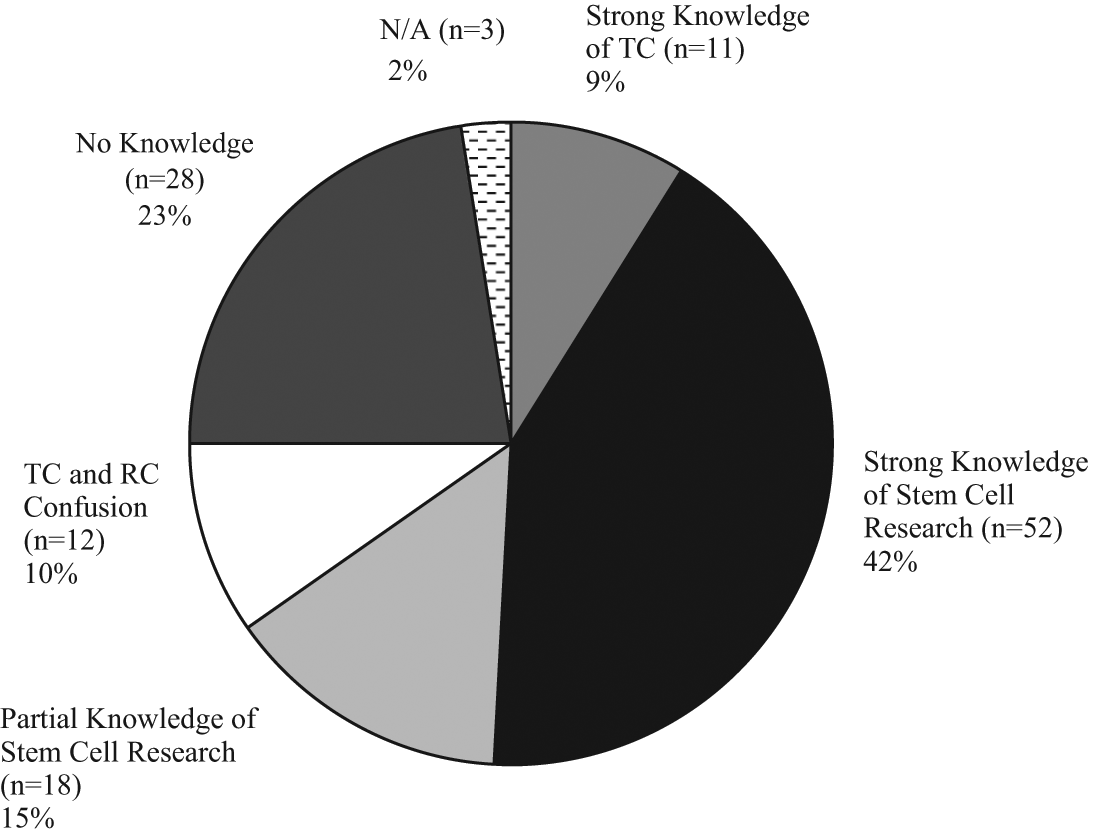
Assessment of participants’ initial scientific knowledge (based on answers in pre-viewing questionnaire).
After watching If…Cloning Could Cure Us, 15 additional participants said in either the post-viewing questionnaire or focus group discussions that they clearly understood the difference between TC and ESCR. This increase was quite remarkable given that the dramadoc did not explicitly differentiate between the two forms of research. It was therefore only participants, who were coded as having a strong knowledge of stem cell research in the initial questionnaire, that were able to use the dramadoc’s description of TC to draw distinctions between the two types of research. Catholic #5 said:
Prior to watching the show, I was sort of thinking about stem cell research and therapeutic cloning as one thing. And what I see from the show is that . . . therapeutic cloning is a form of stem cell research. It’s not synonymous with stem cell research. (Group 10)
However, even with Catholic #5’s revelation, the post-viewing questionnaire and the focus group discussions indicated that most participants thought TC was tantamount to ESCR after viewing the dramadoc. Catholic #6 said, “I don’t think there’s much difference between embryonic stem cell research and therapeutic cloning. Therapeutic cloning is just a new phrase for stem cell research” (Group 8). In another discussion, General Public #3 said, “I didn’t know it was called therapeutic cloning. Isn’t it stem cell therapy? It was published much more in this country as stem cell research” (Group 1). Despite the fact that most participants came away from the programme believing that TC and ESCR were one and the same, almost all of the focus group members learned new information about TC from the dramadoc.
During the focus group discussions, 96% (n = 119) of participants said that the dramadoc presented them with information, ideas or opinions that they had not previously considered. Even a very knowledgeable stem cell scientist took away at least one new piece of information from the programme (Group 20). The finding that the majority of participants believed that they learned something from If…Cloning Could Cure Us is consistent with research on television drama series (e.g., Davin, 2003; Elkamel, 1995), which showed that viewers often say they use dramas to increase their medical knowledge. My post-viewing questionnaire and focus group discussions, however, established that in addition to feeling as though they had learned something, participants actually took away a considerable amount of information from the programme. Table 2 illustrates key pieces of If…Cloning Could Cure Us information that were assimilated across more than 50% of the focus groups.
New knowledge acquired from If…Cloning Could Cure Us.

There were five focus groups (four with scientific experts and one with spinal cord patients) that did not demonstrate an improved understanding of the goal of TC after watching the dramadoc. This is because all the participants in these five focus groups already understood the goal of TC prior to viewing the programme. This means that 100% of the groups that could have learned about the goal of TC, did learn about it.
I place the term “legal inconsistency” in scare quotes to acknowledge that although one of the experts in the dramadoc claimed that there is a contradiction between legislation regulating TC and legislation regulating abortions, the expert’s argument overlooked the fact that an embryo outside of the body is very different to an embryo inside a woman. In the latter situation, the woman who is carrying the embryo also has rights, which may compete with those of her embryo.
Below I discuss the three pieces of new information that were absorbed by the largest number of focus groups: the risk of tumours, ethical concern about egg donor exploitation and UK legislation regulating TC. In each section, I present focus group participants’ initial knowledge of the specific topic, describe the way If…Cloning Could Cure Us conveyed the new information, and present evidence that many participants received the information.
The risk of tumours
When the pre-viewing questionnaire asked “What do you think are the risks, benefits or ethical issues associated with therapeutic cloning?” only 6% (n = 7) of participants listed the risk of tumours. People who raised this risk were doctors, scientists and in one instance, a science teacher.
If…Cloning Could Cure Us spent a significant amount of time exploring the risk of tumours. Tumours were discussed, for example, in a documentary interview with stem cell expert Dr. Stephen Minger. He explained that “the risk of tumour formation should be nil” if the stem cells are differentiated into cell types that are very specific for a particular disease.
The drama portion of the programme subsequently raised the risk of tumours in a heated scene between Alex Douglas and her patient, Andrew Holland:
Why didn’t you tell me about the tumours?
It’s not relevant.
Why not let me be the judge of that? Look, we aren’t talking about some minor side effects you know – high temperatures, a rash on the back of the neck!
Those images are old! It’s not really related to the work that we are doing [pause] to your treatment!
Not really?
One of the reasons that I use 19-day-old embryos is to minimise the risk of tumour development. I have explained this at length. Did you really want me to show you scary pictures?
You should have been honest with me – that’s all I’m saying.
You said you were ready to undergo this procedure. You approached me! Don’t be affected by SAGE’s [pro-life group] infantile tactics at this stage! [Andrew Holland wheels himself away before Alex Douglas finishes her final sentence] Andrew! [she sighs]
Many focus group participants vividly recalled this scene and thus acknowledged the risk of tumours in either the post-viewing questionnaires or discussions of 17 out of 20 focus groups. Thirty focus group participants listed the risk of tumours when the post-viewing questionnaire asked, “Are there any risks, benefits or ethical concerns associated with therapeutic cloning that you did not list in the first questionnaire, but you would like to list now?”
Several of these same participants went on to mention the risk of tumours in the focus group discussions. Parkinson’s Patient #5 said:
As somebody with Parkinson’s, at this point I don’t care what the risks are. I would rather take on the risk of developing a tumour than live with the disease, but that’s just me personally. (Group 14)
Eleven additional focus group participants raised the risk of tumours in the discussions; these participants had not been aware of the risk when they completed the initial questionnaire. This means that at least 33% (n = 41) of participants across 17 focus groups acknowledged an increased awareness of tumours in either the post-viewing questionnaire or discussion.
Ethical concern about egg donor exploitation
Another example of learning occurred when If…Cloning Could Cure Us raised many participants’ awareness about the potential for exploitation of egg donors. Only one focus group participant, who was a doctor, listed this particular concern in her initial questionnaire (Group 20). This finding was not surprising, given that most people get their cloning information from the media, and this ethical issue is not typically introduced in media coverage about TC or ESCR (Williams et al., 2003: 806–808). The issue was, however, given significant attention in If…Cloning Could Cure Us.
The programme introduced the idea of egg donor exploitation in the drama portion of the narrative when a young Chechen woman, Hadjat Tataev, testified for the prosecution. Hadjat Tataev claimed that she was exploited when she donated her eggs to research similar to Alex Douglas’s. Hadjat Tataev explained that she was paid very little to donate her eggs and that she also had to have a hysterectomy due to medical complications resulting from the procedure to remove her eggs. After reliving this story on the stand, Hadjat Tataev pointed at Alex Douglas and yelled, “I am no longer a woman because of people like you!”
Throughout Hadjat Tataev’s testimony, the programme cut to several documentary interviews, where experts further discussed the concern about exploitation of egg donors. One of these experts was pro-life campaigner Josephine Quintavalle:
The idea that a young woman from Chechnya should get into this terrible state because somebody else wants to get a hold of her eggs to provide a cure for, in this case, Andrew let’s say – I really see these kind of relationships as akin to slavery. Someone else’s body is being put to the service of another.
After hearing the story of Hadjat Tataev and listening to the documentary interviews, all but one focus group mentioned the risk of donor exploitation in either the post-viewing questionnaire or during the discussion. The ethical concern was catalogued by 28 participants in the post-viewing questionnaire. Additionally, participants across the majority of focus groups engaged in passionate discussions about whether this type of research was likely to result in the exploitation of egg donors:
. . . We just don’t know what’s going to happen. There are so many opportunities for exploitation, like that woman from Chechnya in the show, who was mutilated or had to have a hysterectomy. You can clearly see stuff like that going on in renegade labs . . .
Are you wearing anything made by Nike?
Am I wearing anything made by Nike?
[group laughs]
It’s exactly the same issue as Nike is it not? I mean there is going to be exploitation somewhere no matter which industry.
(Group 6)
UK legislation on TC
In addition to increased awareness about the potential for tumours and exploitation, many participants stated that If…Cloning Could Cure Us also increased their awareness that TC is legal in the UK on embryos up to 14 days old. Prior to viewing the dramadoc, only 10% (n = 13) of participants could correctly identify their country’s TC legislation. This 10% was almost equally composed of British citizens who were aware that TC is legal in the UK (n = 7) and Canadian citizens who were aware that TC is illegal in Canada (n = 6). Participants in stakeholder focus groups were more aware of the legislation in their country, but three members of the general public groups also knew about their country’s cloning legislation.
After viewing If…Cloning Could Cure Us, more than half of the participants across 19 focus groups understood that TC is legal in the UK on embryos up to 14 days old. It was easy for participants to digest this information because it formed the basis of the dramatic scenario – Alex Douglas was charged with breaking the law because she experimented on embryos older than 14 days. The 14-day rule was also reiterated throughout the documentary portion of the programme.
Despite the dramadoc’s repetition of the 14-day law, at least 14% (n = 17) of participants across 11 focus groups said during the discussions that they were confused about whether the 14-day law was fact or fiction. The confusion stemmed from the dramadoc (which was set in 2014, and shown to participants between 2005 and 2007) referencing a 2008 piece of UK legislation. At the beginning of the dramadoc’s futuristic storyline, there was a courthouse sign stating that Alex Douglas was being charged under the Human Embryology Act 2008. The programme then cut to a fact screen, which clarified that there is already similar UK legislation in the real world. The fact screen read, “The Human Embryology Act of 1990 makes any experimentation on human embryos older than 14 days illegal.” The screen was followed by a documentary interview with Suzi Leather, who was the director of the Human Fertilisation and Embryology Authority when the dramadoc was produced. Suzi Leather said:
Alex Douglas has broken a fundamental pillar of the 1990 legislation – that there should be no research on embryos older than 14 days. The punishment is 10 years, a fine, or both. So this is a very serious offence for which Alex Douglas could serve a very long prison sentence.
The fact screen, in conjunction with the interview, should have enabled people to understand that the 14-day rule exists in real 1990 legislation. However, some focus group participants seemed to either miss this clarification, or forget it by the time the 2008 legislation was mentioned again at the end of the programme. The dramadoc concluded with the judge summing up, “Members of the jury, you’ve heard the evidence. Dr. Douglas is charged, under the 2008 Human Embryology Act, with illegal experimentation on human embryos . . .”
This final statement left a number of focus group participants confused about whether the UK already has legislation to regulate TC. Below is a passage that shows how one person’s mention of the 2008 legislation shakes others’ confidence that the 14-day legislation is real:
The law in the show hasn’t actually been passed, so that was a bit confusing.
With the law, is there already a law that says that 14 days is the maximum amount of time for embryo research?
Yes there is.
Because they just kept talking about the 2008 law and I kept thinking, “Are they making up laws?”
At least, I think [hesitates] that law is real.
It wasn’t clear.
No, it wasn’t clear.
(Group 1)
When I asked associate producer John Hay why the production team invented a 2008 law when a 1990 law was already in place, he explained that the production team wanted audiences to be clear about the offence that they would be asked to vote on (personal communication, 12 May 2007). As the 1990 Act currently sits, however, the offence that Alex Douglas would be charged under is relatively vague: “keeping or using an embryo after the appearance of the primitive streak.” The production team therefore decided to create a fictional 2008 legislation that contained the less ambiguous offence of “illegal experimentation on embryos.” In this way, the production team tried to ensure that audiences would clearly understand the offence and that the 1990 legislation would not be misrepresented. However, an unexpected side effect of this decision was that some focus group members became perplexed about current UK legislation.
Participants’ confusion regarding the 14-day legislation substantiates critics’ assumptions that dramadocs will lead to misunderstandings because audiences will be unable to differentiate between fact and fiction. Paget (1998: 62) wrote, “Some commentators will always hold that the inherent representational dangers of the dramadoc/docudrama (especially of misleading a gullible public) far outweigh any informational advantages claimed.” However, fact/fiction confusion was rare in If…Cloning Could Cure Us, and it could have been avoided if the producers had carried out a public screening and discussion of the dramadoc prior to broadcasting, in order to identify instances where the boundaries between fact and fiction needed to be more clearly articulated in the programme.
The effect of increased knowledge on opinions
As I have shown, If…Cloning Could Cure Us for the most part improved focus groups’ knowledge of therapeutic cloning. According to the public understanding approach to science communication, these improvements in scientific knowledge should lead to increases in participants’ support for science and scientific technologies (Bodmer, 1985). This section therefore explores whether new information from the dramadoc had a positive impact on participants’ support for TC.
Figure 2a indicates that the new-found knowledge from the dramadoc did not necessarily translate into increased support for therapeutic cloning, as advocates of the public understanding model would lead us to believe. Most focus group participants (44%, n = 55) did not change their opinion after viewing If…Cloning Could Cure Us; they used the programme to reinforce their initial ideas about TC. There was a smaller group of participants (31%, n = 39), however, who used the dramadoc to form an opinion because they were initially unsure about their opinion on TC. The opinion that these participants formed was largely influenced by their membership to a particular group. For example, members of the general public, patients, doctors and scientists groups tended to be for TC. Catholics, on the other hand, were more likely to be against TC. Participants who identified themselves as very religious, and also belonged to another stakeholder group, tended to use their religion as a moral compass to vote against TC. This happened in the case of a few Catholic doctors, a Protestant scientist and one Catholic Parkinson’s patient. This finding is in line with previous research (e.g., Evans, 2002) indicating that religion is one of the main factors that determines whether a person will support TC.
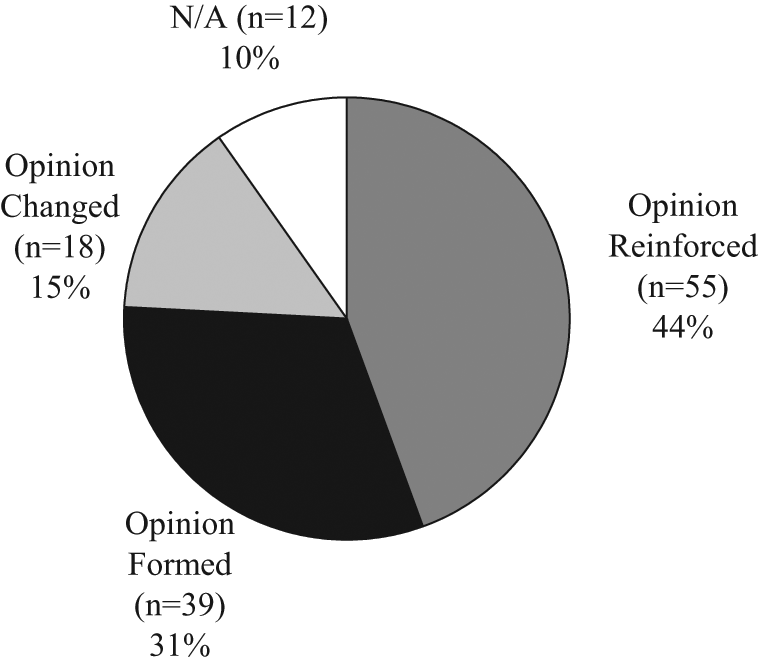
A comparison of participants’ TC opinions in the pre- and post-viewing questionnaire.
In addition to participants who formed an opinion, there was a smaller group of participants (15%, n = 18) who used dramadoc information to change their initial opinions about TC. As Figure 2b illustrates, most people who amended their opinions only did so slightly. Fourteen participants moved their TC opinions from “for” to “for with caution” in the post-viewing questionnaire. For with caution means that participants emphasised the need for regulation and the need for the technology to be used properly. For example, General Public #4 noted in the post-viewing questionnaire that she was “for therapeutic cloning as long as it adheres to laws and procedures” (Group 4). Scientist #3 wrote, “I am still for, but I see a need for greater regulation/protection of the egg donors” (Group 15).
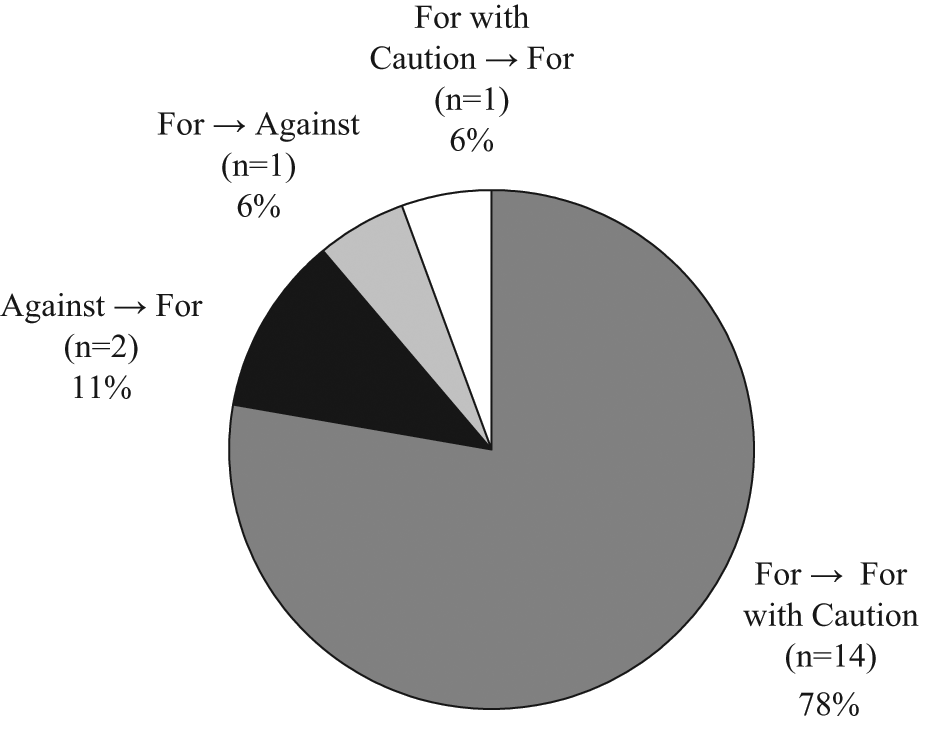
How the 18 participants in Figure 2a changed their opinions between the pre- and post-viewing questionnaire.
Further to participants who amended their opinions slightly, there were also three people who completely reversed their opinions after watching If…Cloning Could Cure Us. These participants reversed their opinions because they had the wrong idea about what TC was prior to viewing the dramadoc. For example, two people confused TC with RC and therefore said they were against TC in the pre-viewing questionnaire (Focus Groups 3 and 4). These participants quickly overturned their initial opinion in favour of TC after the dramadoc clarified the difference between TC and RC. In contrast, Doctor #6’s assumption that TC and ESCR were one and the same, caused him to state that he was for TC in the initial questionnaire. He quickly changed his mind, however, once the dramadoc explained that TC involves creating a life in order to extract stem cells. This information allowed him to differentiate between TC and other types of ESCR. The participant said that while he could support ESCR that uses existing embryos left over from fertility and abortion procedures, his “religious beliefs would not allow him to condone the creation of embryos for TC research” (Group 18). This comment illustrates how important the distinction between TC and ESCR is in determining whether people will support the technology. Perhaps more focus group participants would have been against TC if the dramadoc had clearly identified the difference between TC and ESCR. Blurring the boundaries between the two technologies may allow politicians and scientists to gain support for TC.
Regardless of whether participants used If…Cloning Could Cure Us to reinforce, form or change their opinion, the dominant position after viewing the dramadoc was for TC. This result was to be expected, as a significant portion of the focus groups involved stakeholders that are typically supportive of TC (i.e., doctors, scientists and patients).
6. Discussion and conclusion
The creators of If…Cloning Could Cure Us predominantly took a public understanding approach to science communication, and my focus group research has shown that they were largely successful in their efforts to educate and inform. However, the production team also made an effort to embrace the public engagement model of science communication through a telephone poll and web forum. While these efforts to engage publics were a step in the right direction, this type of engagement was limited. The telephone poll, for example, did not offer any meaningful opportunity for audiences to engage with real-life debates on science and scientific policy. It asked viewers to vote on a fictional policy issue, as opposed to a real-life issue. The dramadoc producers might therefore have considered combining the existing fictional voting question with a factual question (e.g., Are you for or against TC?), as a way to offer audiences a voice in real-life scientific policy debates. However, even if the producers had included a factual question, the telephone poll and the web forum would still not be examples of upstream engagement.
An examination of Wilsdon and Willis’s (2004) four criteria for upstream engagement raises some important ideas about the way television programmes like If…Cloning Could Cure Us could go beyond the public understanding model of science communication to more fully engage audiences in scientific debates. According to Wilsdon and Willis (2004: 29), upstream engagement involves activities that take place early in the development of a technology, so that they can still impact the direction of the technology and related scientific policy. This was certainly not the case for the If…Cloning Could Cure Us programme, which asked viewers to engage with the human cloning issue after the use of the technology had already been decided and regulated. In the future, television producers might therefore consider creating programmes about scientific endeavours that are in their earliest stages of development, so that viewers’ opinions can influence the trajectory of the technology.
A second characteristic of upstream activities is that they have mechanisms that allow ideas discussed during an engagement activity to feed back and affect real-life scientific policy development (Wilsdon and Willis, 2004: 22). In the case of If…Cloning Could Cure Us, this feedback mechanism might have involved the BBC producers mailing a copy of the voting results and forum comments to the UK government’s Chief Scientific Advisor. However, no such mechanism existed for the dramadoc and consequently, there was no genuine opportunity for viewers to affect the future direction of TC.
A third feature of upstream engagement is that it opens debates about science to questions beyond risk assessments (Wilsdon and Willis, 2004: 26). Publics should feel free to discuss questions such as:
Why this technology? Why not another? Who needs it? Who is controlling it? Who benefits from it? Can they be trusted? What will it mean for me and my family? Will it improve the environment? What will it mean for people in the developing world? (Wilsdon and Willis, 2004: 28, emphasis removed)
The If…Cloning Could Cure Us programme did manage to go further than exploring questions of risk because it addressed other issues such as the ethics of TC. The telephone poll and forum questions, however, limited the types of questions with which audiences could engage. For example, the telephone poll question (i.e., “Should Dr. Alex Douglas be found guilty or innocent of conducting illegal research on embryos older than 14 days?”) eliminated opportunities for audiences to be against TC. A guilty verdict gave audiences the chance to object to the fact that Alex Douglas did TC research on embryos past the 14-day limit, but it did not allow audiences to object to the fact that she did TC in the first place. Similarly, the web forum question (i.e., “Does this type of research and potential treatment herald a medical revolution, which will save countless lives? Or is it just one step too far in an ethical minefield?”) restricted people from commenting on issues beyond the benefits and ethics of TC. Other types of engagement activities, such as unstructured focus groups, would have offered If…Cloning Could Cure Us audiences more opportunity to set the agenda for discussion.
A final feature of upstream engagement is that it allows people to engage with a wide range of experts – not just scientific experts (Wilsdon and Willis, 2004: 22). The If…Cloning Could Cure Us text should be commended for including interviews with a broad spectrum of experts. However, the telephone poll and web forum did not offer opportunities for people to interact with different forms of expertise. In the future, producers might consider working with the government to combine their programmes with citizen juries and consensus conferences, which are examples of engagement activities that allow people to engage with, and ask questions of a variety of experts.
Footnotes
Acknowledgements
This article is based on the author’s PhD research, which was supervised by Dr. Jenny Kitzinger at Cardiff University. It was funded by the UK Overseas Research Students Award Scheme; the Social Sciences and Humanities Research Council of Canada Doctoral Fellowship; and the Cardiff School of Journalism, Media and Cultural Studies.