



Abstract
Climate change offers serious challenges to the effectiveness of science, communication, and community. It demands us to look back upon what we have done in regard to science and technology. In addition, it leads us to examine human efforts invested to solve collective, shared problems by communication and community. The process of behavior per se is found to be greatly overlooked in the establishment sciences, both natural and social, and in both theory and practice. A theory of behavior is introduced and explicated as a platform to solve such commons’ problems as climate change. Finally, we find principled ways to improve effectiveness of communication and community by developing human capabilities so that we can win our battle against climate change and other potential tragedies of the commons.
1. Introduction
“Houston, we’ve had a problem,” Apollo 13 astronaut James Lovell Jr. told the ground command in 1970. An oxygen tank exploded. The crew had to fly back instead of landing on the moon. The command team in Houston was engaged and prepared enough to work together with the crew for any possible accident. Such a co-engaged and built-up community enhanced the crew’s survival.
Now, we hear a similar cry, “Earth, we have a problem: climate change.” This time, scientists cry out to Earth’s inhabitants for help (Emanuel, 2007). The climate problem threatens us with harsh weather, rising seas, economic and social distress, and disease. Are we listening though?
What exactly are science’s communication problems here? Not just public literacy, nor support for science, nor attracting future scientists: These are the usual communication goals of science. Two other problems – not entirely of communication – are acceptance of scientific findings and then acting on them as a community. Many problems, it seems, are involved.
Climate change as a problem is itself a consequence of public need with a significant scientific and technological contribution. We needed to solve energy and transportation problems for survival. We developed fossil fuels and cars by scientific findings and technological innovations. Then, we thickly populated and polluted the Earth with greenhouse gases such as carbon dioxide: the main source of anthropogenic climate change.
In doing all this we have produced the grossest instance of the tragedy of the commons to which Hardin (1968) refers in regard to overpopulation. He argues for individuals’ conscience as the behavioral solution to the planet’s potential catastrophe. Meanwhile, Crowe (1969) deplores every institution’s singleness of purpose for success and the insularity of natural and social sciences, and suggests individuals’ consciousness as the key behavioral factor in solving it.
Crowe also makes the observation that no technical solution is possible for this “tragedy of the commons” problem. I disagree. Technological invention (e.g., the steam engine, medical devices, weaponry) has often preceded principled scientific understanding. It is actually commonplace in compositional behavior, where it is sometimes seen as an art. Procedures, it should not be forgotten, are technological advances. It is true, however, that technological advance could be enhanced by scientific findings – and might well be if the scientists did not blind themselves to relevant, but neglected, behavioral principles, a handicap self-imposed by focusing their attention on the order of things, on relationships observed after the fact. The handicap disadvantages behavioral necessity, the nature of things, whose concern is, before the fact, behavioral relating – that is, functioning – that can and does produce new relationships.
With regard to a collective effort, Hardin (1998) later asks, “It is easy to call for interdisciplinary syntheses, but will anyone respond?” (p. 682). The same question could be asked for public participation. Whoever is deemed more responsible, science must exert some leadership on the community’s response to the climate problem, moving into what the scientific establishment may once have avoided as the domain of public policy.
Science may despair that the public lacks scientific literacy of climate change and its solutions (e.g., Leiserowitz, 2007). For example, only 34% of US adults think that Earth is getting warmer because of human activity (Pew, 2010). The public may be pushed, in vain, to learn relevant scientific knowledge by all kinds of information campaigns (see Kim, 2007a). But, fundamentally, what we see here is an ineffectualness of establishment sciences, both natural and social.
2. Establishment sciences’ ineffectualness
It goes without saying that any solution, aka an invention, comes from need, which follows a problem. Carter (2010a, 2010b) points out two distinctive but interdependent problems: situational problems and the behavioral problem. (They are interdependent relative to two solutions: the behavioral solution, the means, and the situational solution, the ends.) We face one situational problem after another, some like climate change threatening our very lives. The behavioral problem is always with us, to develop the capability needed to be an effective change agent. But it has been solved, so to speak, by “talented” individuals not by science. And, critically, it has been solved ad hoc, only as an aspect of the situational problems encountered. Science has failed to address it directly and productively. So, we are not prepared, typically, before a situation arises to operate effectively, especially as a community. Consider the rueful comments made about communication problems, after the fact of devastating events like the Sumatra-Andaman earthquake and Hurricane Katrina.
Our need to solve a situational problem prompts us to solve the behavioral problem in advance. For example, technological inventions (e.g., car, airplane) are situational solutions for their corresponding situational problems (e.g., transportation). Scientists had to somehow solve their behavioral problem to produce those inventions. Nonetheless, they paid little attention to inquiring about the behavioral problem per se so that their capability to solve situational problems has not been properly or fully developed. This overlooking of the behavioral problem and its full-fledged solution greatly impedes our solving situational problems more productively.
The relationship between science and technology
The whole picture of the relationship between science and technology was changed by the Second World War and its subsequent Cold War. Scientists were mobilized for and successful in making technological inventions such as the atomic and hydrogen bombs and interplanetary spaceships. The famous 1945 report, Science – The Endless Frontier, by Vannevar Bush, who led US military science and technology policies during the Second World War, was an exemplar of connecting science closely with technology. From this emerged the “linear/reservoir” model where knowledge from basic science flows into a reservoir for applied science or engineering that creates technological innovations for solving problems in society (Pielke and Byerly, 1998). Science was considered to be indispensible for and constitutive of technological innovations, and thereby, more academic funding for basic science research continued to be recommended (Schmitt, 1984). However, Ziman’s (1998, 2000) notion of “post-academic science” is much blunter. He stresses that today any scientific endeavor contains a large team of scientists with a correspondingly big budget, focusing on solving a specific, practical problem. It invokes state patronage, industrialization, bureaucratization, and new ethical complications. Such efforts are designed to solve mostly situational problems.
Nonetheless, no one denies that science focuses more on finding facts, while technology more on solving situational problems. However, the above linear/reservoir argument from science to technology is often reversed: Technology feeds science. Think about how much the microscope and the telescope, inventions in the 17th century, have contributed to pathology and astronomy. A technological theory of elasticity, hydrodynamics or thermodynamics originated from engineering and flowed into physics. Then, they interacted with each other for further advancement (Layton, 1971). So, it is beyond question that science and technology influence and interact with each other, never in one linear direction (Barnes, 1982; Price, 1969).
Science’s initial concern with fact finding is about what and how things were and are. Science is usually defined as “an exploration of the material universe that seeks natural, orderly relationships among observed phenomena” (Simpson, 1963: 82). This physical-sciences-focused definition subsumes the notions of given order, substantialism, and reductionism that everything can be reduced to physical, chemical, or biological components. Such science aims to dig out the structure of relationships inside and/or between objects, or relationships seen as objects. It is not much interested in an entity’s behavior – except as structure (genetic inheritance) dictates behavior. Problem-solving behavior is still not all that well served. Biological (innate) nature is often used as the overarching explanation for nurture and behavior (e.g., Wilson, 1978, 1998).
Establishment science’s neglect of behavior per se does not differ in the social or behavioral sciences either. Their subject matter is full of behavioral particulars, individual and/or collective, but they are treated in the manner of the physical sciences – or given a “qualitative” interpretation. There prevails an assumption that a field grows as a discipline by imitating physics’ research traditions of substantialism and reductionism. Thus, for example, mind is considered as a system of properties, primitive ingredients, or physiological substrates of body (e.g., brain) or as a reactive black box between outside stimulus and bodily response (Barrett, 2009; Fodor, 1981; Skinner, 1990). Most popular concepts such as attitude, personality, schema, and learning are construed and (rather arbitrarily) measured along those traditional lines. We rarely see the process of behavior per se.
One consequence is that many social science departments suffer a split between clinical and academic faculties. But the worst consequence is that the natural history of the behavioral problem, extending back beyond the beginnings of evolution (Carter, 2010b), is forfeit, as though that history were of no consequence. The behavioral problem is embedded in those who must supply the solution to the situational problem. But those who assume or are assigned responsibility may or may not possess the needed capability for the behavioral problem.
Kaplan (1964) warns that those traditions bias us to focus on “the search for entities and structures rather than for processes and functions” (p. 323). Because the establishment sciences have neglected looking into behavioral functioning per se, they remain ineffectual with regard to challenging the ever-present, basic behavioral problem – but, ironically and tragically, effectively divorced from society’s policy making.
3. The explication of behavior as process rather than decision
Behavior per se has a structure of its own, its own unique principles, and a history only partially manifested in and by observed behaviors. Carter (e.g., 2003, 2010a, 2010b) distinguishes circumstantial effects from compositional effects, the latter requiring attention to the behavioral problem. It has general principles that do not depend on inductive concepts and a focus on the particulars of behavior.
The theory posits that Everything’s general persisting conditions are partial order, discontinuity, and consequentiality – qualities without quantity. Any entity, living or nonliving, is a behavioral entity in light of omnipresent collisions, given partial order, and thus of problems (sometimes situational, always functional) after the Big Bang. Behavioral entities are in consequence and of consequence. Further, partial order implies three significant conditions for behavioral entities: incomplete instruction, possibility, and behavioral necessity. The last of these is the source of the behavioral problem and the basis for functional development – that is, of problem-solving capabilities.
It should be noted that any entity’s body and behavior are structurally independent but functionally interdependent. Body is limited in capacity, while behavior is, via development, relatively unlimited in capability. Body is conditioned by evolution, while behavior is conditioned by development. We can make a step as well as take a step. Bodies are of consequence but behavior more so. To construct a step (and solution), we must understand behavioral structure before the fact: the functioning components of which it is constructed.
Behavior’s basic unit (metaphorically its atom) consists of two modes of relating: minding and moving. The former provides an instruction that will guide and commit the latter to take a step. Moving requires minding to provide one instruction (the singularity requisite). This step produces an outcome (perhaps more) constituting (again, metaphorically) a molecular structure. Humans, as multi-step takers, whose later steps take advantage of earlier steps, can and do construct compound and complex behavioral molecules. But the essence of behavior lies in the minding–moving interdependence.
The minding–moving characterization of behavioral structure as relatings enables us to set aside the crippling question of the physiological “mind–body” relationship (Fodor, 1981), which confounds and confuses the structures of body and behavior. This perspective lets us attend to the matter of functionality, the behavioral problem which is the genesis of our looking to develop a community capability to attack situational problems like global warming.
Minding is itself often a developed sequence of relating acts whose need is dictated by collisions to be avoided or arranged, acts of: exposing, focusing attention, cognizing, questioning, remembering, and imagining. We expose ourselves to the environment and encounter many potentially relevant things. We focus our attention on one thing out of those relevant things (e.g., Simons and Chabris, 1999). Then, we might cognize (relate that thing to another), question (given incomplete instruction), remember, or imagine in order to produce an instruction for moving. Questioning (especially pointed – cognitively directed – inquiring), remembering (bringing the past to the present), and imagining (bringing the future to the present) can be fruitfully augmented by communication (Carter, 1988, 1990; Kim, 2003, 2007a).
These are functional requisites for a behavioral entity, somewhat met by sensory capacities (e.g., vision’s focal and peripheral features, re focal attention and exposure), sometimes usefully enhanced as developed capabilities (e.g., reading skills – not just of language). Cognition is of special importance. It is not the relationship of observer to observed, which was its historic usage (hence the equating by some of cognition and recognition); it is the bringing together of things: the relating, not the relationship (cognition as product, not process). Cognition together with communication is our master builder. Together they can imagine what might be – and help make it come about.
4. Climate change as a collective challenge
Communities need these capabilities to succeed as change agents. They need them in their members, and they need them to be shared by those members, so that they understand how solutions are built and what each other is doing – or must be doing – as they work collectively. New technology may be required, in this case procedures as well as tools. As behavior’s processual structure is disclosed and behavior per se understood before the fact, we can see how community capability should and can develop and how communication can help to develop our capability.
The climate problem is a global challenge; it involves everyone. That is why it should get special attention – but attention as the ever-present behavioral problem not just as a situational problem rivaling another, more devastating, world war. If we look into the characteristics of climate change as a situational problem, the significance of the behavioral problem reveals itself too.
A situational problem can be individual or collective. It may be more or less immediate, more or less tangible. Climate is both a shared and a tangible problem in that it impacts the whole community and we individually experience differences in weather: rain, snow, wind, and sun. Weather’s immediacy urges us to engage with it so that we could be prepared to take an umbrella or a coat. That is also why weather is the best selling problem and content (news) in media reports (Kim, 2009).
The situational problem of climate change is beyond everyday weather conditions. It is globally shared but much less tangible and immediate to most individuals. Moreover, it is conceived to be extremely costly to act upon (Ungar, 1998). This intangibility, less urgency, and heavy cost make it difficult to engage individually, and especially, collectively. So, most policies to solve the climate problem attempt to transform it into a tangible economic issue that typically involves consumer decision making. For example, individual climate change-mitigation behavior focuses primarily on adopting (reduced) “household energy use, recycling, surface transportation behavior and purchase of green products,” and policy for climate change-adaptation behavior focuses on “increasing household preparedness against natural disasters” (Maibach, Roser-Renouf and Leiserowitz, 2008: 490). In fact, those individuals might be more engaged with economic benefits than the climate problem. So, climate change is downgraded to an individual, situational problem of just choosing an available solution, not a collective, behavioral problem that the whole community should engage with to construct more effective possible solutions. An aggregate of individuals, not a community, is operating.
Such policy concerns are subject to a confusion between problems and issues (Carter, Stamm and Heintz-Knowles, 1992; Kim, 2007a; Kim, Carter and Stamm, 1995). Issues present themselves as competing solutions to a situational problem. The situational problem itself may be poorly defined, and the behavioral problem pretty much neglected. Frustration and partisanship abound. For instance, the US refusal of the Kyoto Protocol continues to be an international hot issue (e.g., McCright and Dunlap, 2003).
Facing a situational problem and lacking constructive capability, we tend to inquire of, even rush to, solutions already available. This practice makes it difficult for individuals to operate as a community (and there will be losers in most decisions, eroding what community there was), to prepare an agenda shared by them, prior to gathering information, questioning, and constructing one or more solutions. Worst, we lose out on developing the capability for problem solving.
The popular concept of deliberation represents social sciences’ predominant concern for issues and decision making. Benhabib’s (1996) “articulating good reasons in public” (p. 71) notion of deliberation is about available, competing solutions as options, not about the situational problem, its far-reaching consequences and almost certainly not about the behavioral problem, its consequentiality and its lack of development. Politics and the economy, which focus respectively on voting and purchasing, promote societal decision-making systems. Habermas’ (1989) notions of “ideal speech” and “public sphere” bring interpersonal communication into the picture, enhancing deliberation toward a more civil or democratic society. This function of interpersonal discourse is emphasized in current political and public life and research on it (e.g., Cho et al., 2009; Gastil, 2008). But talking about what?
The Danish consensus conference started in 1987 exemplifies a public deliberation initiative to resolve more science-related issues such as permitting genetically modified organisms or irradiated foods (see Grundahl, 1995). It brings together expert scientists and interested citizens to discuss an issue and recommend their opinions to policy decision-makers. However, a comprehensive review of 26 recent deliberation cases conducted in Europe concludes that the application of public deliberation remains highly constrained, though widely extolled (Hagendijk and Irwin, 2006). It operates in many unexpected ways due to lack of procedural design. It is often used as political insulation in response to public unrest, but ends up extending conflict for all participating groups. In short, issues and decision making cannot avoid conflict, even in married life (e.g., Sillars, 2010). Climate change as a situational problem, we must conclude, is not suited for resolution via an issue agenda.
It cannot be overemphasized that climate change is a situational, shared problem. Sharing immediately evokes the matter of a collective agent with the capability to construct solutions. We need to look into existing concepts alluding to the collective agency, prior to further explicating the problem of collective behavior. An example is the concept of public. There can be three alternative conceptions of the public as a collectivity (Kim, 1999, 2007a). First, public is an aggregate of individuals. Its siblings are audience, consumers, and mass. It has a physical body, a (chance) gathering of individuals, though seen as a collectivity. Second, public is an aggregate of partisan collectivities involved in decision making. Issues, and the critical and analytic communication about them, are supposed to mold multiple publics along each alternative solution. Democracy is considered to favor and require these “issue publics” (Blumer, 1966; Habermas, 2006). Those respective publics exist in their behavioral processes, but they are divisive when they focus on choice. The term public usually refers to the above two types. Third, public is a collectivity involved in problem solving. This is not the traditional public, but, rather the pure community whose interest centers on a shared problem, not an issue. This community (per se) exists in its behavioral process, having no inherited, corporeal body, and is non-divisive (Kim, 2003). Above all, this collectivity goes forward for construction of a new solution(s), not just to make a choice. Now, we see why climate change, a shared problem, necessitates that a community-type collectivity be accomplished.
5. Engagement as individual and collective behavioral process
As we are exposed to and focus our attention on a problem and begin, by cognition and communication, to consider its circumstances and consequentiality, we get into the problematic situation to which Dewey (1938) refers. It is a time for inquiry. And it is a time to remember that which is relevant, and a time to imagine what is possible – as means and as ends. We begin to engage with that problem with whatever capabilities of minding and moving we possess, individually and collectively.
We can conceive of engagement as a concept that embraces a history of practices, of ways in which individuals have participated in the name of this or that community. However, engagement has to be more than these practices. It also needs to be all that it takes when available practices do not suffice. Engagement, we must understand, is the challenging process of behavior from problem to solution, drawing not only on the conditions of the problematic situation but also on the demands of the behavioral problem.
Thus, Kim (2003, 2007a) conceptualized engagement for measurement purposes as the process of exposing, focusing attention, and cognizing so that a behavioral entity could complete a minimum sequence of behavior prior to moving. Such sequential development of engagement reflects a situational problem’s relevance and its need for solving. The more relevant and in need for solving the problem is, the further engaged we must be with it. Kim (2007b, 2009, 2011) found that the public’s greater engagement with a shared problem yielded higher potential public engagement with science for solving that problem. This relationship applied to many societal problems such as global warming, energy shortage, war, economic uncertainty, and even the rich–poor gap.
This conceptualization also applies to collective engagement as a sequence of co-exposing, co-focusing attention, and co-cognizing. Figure 1 delineates many potential sequences of collective engagement with regard to co-minding. This shows reciprocal arrows between co-minding’s diverse acts. It indicates that there is inherently complex gappiness among the collectivity members and their concerns, and thus, communication acts might help bridge those gaps in and for collective engagement.
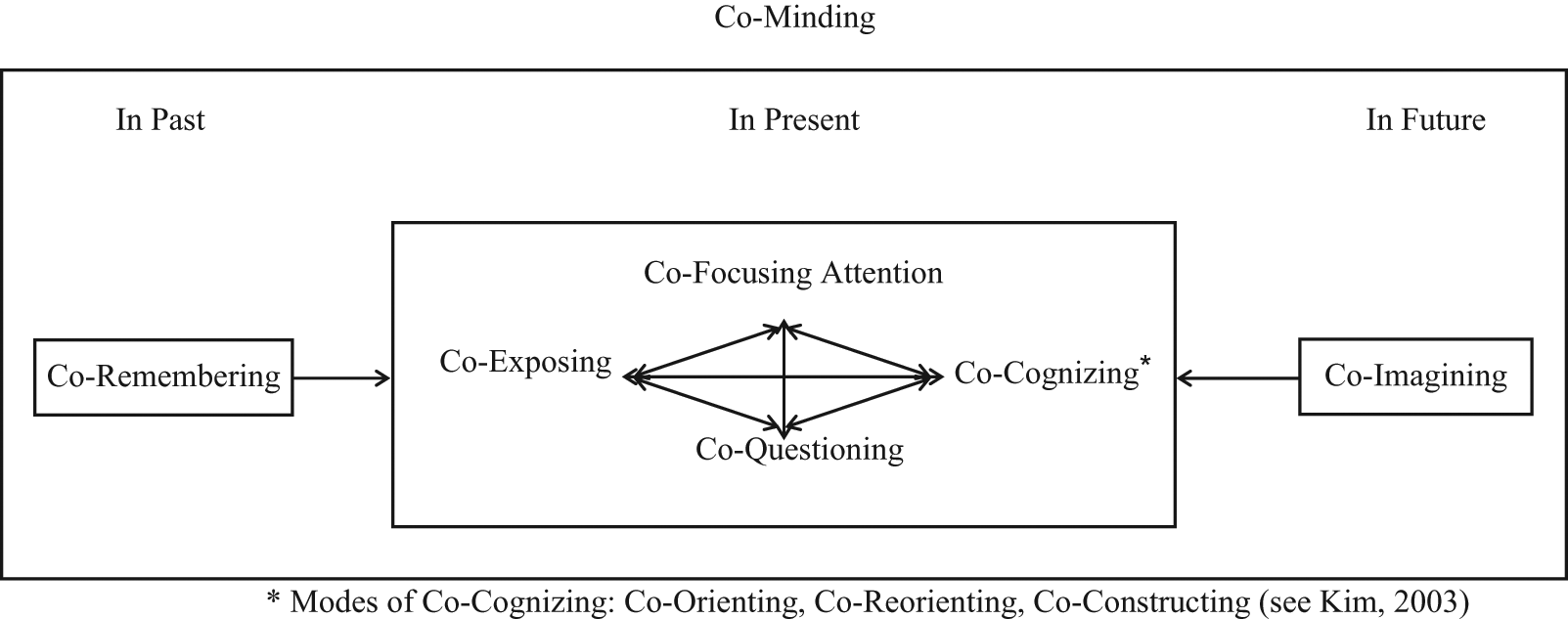
The manifold processual model of collective engagement: co-minding.
One kind of solution for the community’s behavioral problem might be the following sequential procedure of collective engagement. The aggregate public might be co-exposed to the problem of climate change. The climate problem’s potential consequentiality might engage them to co-focus attention on it – the so-called “community of interest.” Genuine collective engagement 1 is likely to begin with an agenda predicated on co-cognizing. But, the community will not easily extend its co-focused attention to further co-cognizing, to constructing a solution for the climate change problem. Co-cognizing might get help from co-questioning, the act of inquiring about unclear ideas and dubious facts, for instance, for mutual understanding among the community members. It might also get some lessons from co-remembering of bringing past common experiences (e.g., Hurricane Katrina) to the present. Above all, co-cognizing might become very innovative by co-imagining, the act of bringing the future, as possibility, into the present. Especially, the act of co-questioning might instigate co-imagining constructively.
Co-cognizing might, for example, produce a multi-faceted solution. We should bear in mind that several single-purposed technologies could lessen the climate problem. However, as we have seen in the case of a biofuel (i.e., corn ethanol), a portion of an aggregate solution can worsen matters (i.e., deforestation and global food shortage).
Downs’ (1972) popular notion of the “issue-attention cycle” reflects the difficulty of co-cognizing for solving societal problems such as racism and poverty. These shared problems quickly obtain the public’s co-focused attention, as soon as they get the media’s attention. However, as those problems get into the public’s co-cognizing, they are changed to competing solutions. They are caught then in the issue of benefit vs. cost. Soon thereafter, media and public attention may fade. This kind of attention cycle is also found in media attention for climate change in the US (Trumbo, 1996). This media attention cycle is more apparent in the US than in France, according to Brossard, Shanahan, and McComas (2004). Whether public or media, the process of collective engagement has difficulty getting beyond co-focusing attention and the limited co-cognizing of decision making. This strongly suggests that we need to develop innovative procedures for summoning up the rest of co-minding’s functional capabilities so that we can produce a better solution.
When co-cognizing is brought in, it may often be limited to co-orienting to the situational problem, attending primarily to available information about the immediate environs (see Kim, 2003). It may or may not involve memory, though knowledge in learning theory presumes memory’s omnipresence (e.g., McGuire, 1985). It seems obvious that personal relevance of, and/or worry about, global warming does not necessarily bring knowledge gain of it (Kahlor and Rosenthal, 2009). Accurate knowledge of global warming is found to be a strong predictor of behavioral intentions to take voluntary actions or favor public policies for battling against it (Bord, O’Connor and Fisher, 2000). But there are not many who have accurate knowledge, and they would already have probably been through several engagements (e.g., the full process of minding) with global warming. Thus, knowledge as a product of individual engagement might not matter all that much for combating the climate problem. Clearly the community’s constructive capability is far more needed than its individual members’ knowledge gain of climate change.
6. Communicating as help
The act of communicating is familiar as bridging gaps, essential for a community’s existence. Communication’s content is familiar to us as information to be shared by community members or, perhaps, as information to be learned by its members or prospective members. But communication’s functionality is much greater than this with regard to the molecular development of a collective behavioral solution.
Communication is uniquely versatile. It finds application in both minding and moving (Carter, 2010a, 2010b). It is the “carbon” of behavior’s molecular synthesis, crucial to the making of a step, collective or otherwise. Within minding, its act and representation enable imagining that which is possible (to be found or made), put a point on questions asked, afford verbal long-term memory (so that experiential impressions can be saved along with sensory images), and make short-term memory plausible (accommodating an ever-changing present by its “here today, gone today” transitory, minimally polluting nature). Within moving, as act it substitutes a relatively low cost effort for a more expensive move (for example, to secure someone else’s attention). As act and content it gives expression to emotion as well as thought. Communication could do more for problem solving if its functional potential were understood in a better explicated structural view of behavior.
A window to the world
What do we know now about communication’s functionality with respect to problem solving? We know that the act of communicating serves co-exposing by transmitting and exchanging information, as a window on the world. Rather than being directly exposed to climate scientists, the public is co-exposed to the climate problem by the popular media. In Germany, media have portrayed the situational problem as a global climate “catastrophe” to attract audiences (Weingart, Engels and Pansegrau, 2000). In the US, media portrayals appear more concerned with showing a balance of opinions than reporting the facts fairly (Boykoff, 2008; Boykoff and Boykoff, 2004). A few scientists who disagree with the reality of climate change get the same amount of media coverage as the vast majority of scientists who agree about it. In the UK, portrayals are seen to lean toward the ideological (Carvalho, 2007). Media ideologies work to select scientists to be covered, the facts and their implications. Co-exposure clearly does not guarantee co-focused attention or co-cognition about the climate problem.
Co-focusing attention
The act of communicating, as by media, might also help co-focusing attention. An empirical study on the film The Day After Tomorrow infers that the film may have sensitized viewers to climate change and motivated them to act somehow (Lowe et al., 2006). But, the study does not claim further engagement. Mass media might succeed in setting an agenda by serving co-focusing attention (e.g., McComb and Shaw, 1972). But, we rarely find evidence that media succeed in summoning the other acts of collective engagement for problem solving. Rather, media tend to rush to invite issues and decision making, to celebrate controversy as a means of getting audience attention. The movement of “public journalism” is unexceptional, insofar as it is limited to fostering “issue publics” and their “deliberation” (see Voakes, 2004). Mass media as a solution do not meet the demands of the behavioral problem. The promise of new media for education and public affairs has, historically, been lost to economic exploitation.
Persuasion vs. engagement
Communication, focusing more on content, is often treated as a panacea for solving the behavioral problem in regard to a situational problem: An appropriate message will instruct and/or persuade the public, as audience, that a step be taken. It becomes the proposed behavioral solution, neglecting the fact that a community, not an aggregate, may need to take that step.
When urgency of the climate change problem is emphasized, messages are expected to mobilize an aggregate public. All findings of establishment communication research are urged to be applied (e.g., Moser and Dilling, 2004). Communication is promoted (wishfully?) as the best strategy for persuasion. It is to join with marketing to combat public health problems resulting from climate change (Maibach et al., 2008). In persuasive campaigns (e.g., for recycling), use of neighborhood opinions or block leaders is recommended (Burn, 1991; Schultz, 1999). Presently, “digital” opinion leaders are added to traditional ones for public campaigns with regard to climate change (Nisbet and Kotcher, 2009). All such campaigns target an aggregate public’s individual behaviors, not a community’s collective engagement with constructing a new solution. This is a typical means-end, choice-based strategy for solving both situational and behavioral problems.
Even “smart” communication is preferred (Ockwell, Whitmarsh and O’Neill, 2009). It hopes to foster public demand for climate change regulations that politicians could not but support. Then, those politicians are expected to use political capital to introduce environmental legislation as a positive investment, not threatened by the voting citizenry.
Message research has not been all that productive, whether viewed from the sender’s point of view or the receiver’s. Communication as the transfer of information is a seductive message–sender notion, as though transmission were our only concern. “Information processing” is a vague conception of how messages are, or could be, received. Communication effectiveness – its development – is forfeit to “communication effects” – the concern for what we are now capable of. Yet, the problems we face require more than our present capability. We speak of “whatever it takes,” giving expression to our motivation, instead of “all that it takes,” in recognition of our functional needs.
As long as communication research is focused on the message or media, it is likely to miss the full functionality of communication for achieving engagement. For example, the “uses and gratifications” approach (Rubin, 2002) considers media or messages as gratifying needs, but after the fact. It neglects the process of behavioral engagement and thus does not tell how media or messages could help that process to be effectively served before the fact. Persuasive communication is found to invite more focused attention on the message sender than that on the message content (Dube, 1998). Public information campaigns, mostly focused on content, are argued to be futile, confirming only the pattern: “Like communicates best with like” (Dervin, 2010: 251).
Stamm, Clark, and Eblacas’s (2000) survey found that, as people progress into further engagement with global warming, they tend to use more mass media and interpersonal communication and have more understanding in regard to it. When they confront the situational problem and begin to think about its solutions, their family and friends are used as important informational sources. But any such engagement can be frustrated – often from a lack of efficacy, a sense that the problem is beyond their control capability. Thus, collective engagement and commitment are necessary to overcome or lessen individuals’ lack of efficacy. The act of communicating can and ought to enable them by functionally helping the respective acts of co-minding (see Figure 1).
7. The process of collective problem solving
There exist already some highly engaged, very committed persons with respect to climate change: climate scientists, environmental NGO members, public policy makers, labor unions, organized citizens in jeopardy, and so forth. They can be deemed stakeholders with regard to climate change – not that those who lack collective affiliation also lack a stake in the future. These already engaged individuals could be pathfinders, leading the way for others.
But stakeholders have not yet co-focused attention on the same situational problem so as to tackle it together. They have not developed a process of co-minding, that process which would embody community – that is, partnership, which could produce a joint, constructive solution to which all partners are agreeable, which would commit to a co-moving, that is, to taking a step together they made together.
However, this pseudo-partnership abounds in “partnership” research. For example, research emphasizes partnership attributes of mutuality, identity, balance, autonomy, equal participation in decision making, accountability, and transparency (Brinkerhoff, 2002), shared knowledge and power (Hook, 2006), commitment, coordination, trust, communication quality, and conflict resolution techniques (Mohr and Spekman, 1994), and, strategic fit and mutual benefit (Eweje and Palakshappa, 2009). Notably, the question of “How?” is absent.
Pseudo-partnership settles for simple combining of resources and division of labor to solve a shared problem. So, it makes the most of every party’s individual autonomy and equal allotment of participation, decision making, power, resources, and so forth. And, as long as it is more concerned with decision making, constructive partnership will be a distant dream.
When such “partners” meet a public craving to deal with a practical, social problem (e.g., mad cow disease, food shortage, or war) that is “essentially transdisciplinary” (Ziman, 2000: 70, emphasis in original), they are frustrated in trying to work together. In academia, for instance, disciplines are indifferent to the full process of engagement with constructive, collective problem solving. As Kaplan (1964) points out, “What is needed is to unite the disciplines in one mind and not just under one budget” (p. 408).
To combat climate change, Fischhoff (2007) argues for communication design by coordinating knowledge from three disciplines: climate science, decision science, and social science. However, such coordination might be an impossible or unfeasible goal, because the climate problem needs a multi-disciplinary partnership for problem solving, not decision making. Disciplines are territorial and narrowly fragmented for any potential division of labor. Yet interdisciplinary (not just multi-disciplinary) research is needed, especially in policy research (Pielke and Byerly, 1998). Disciplines might be liberated and united through the all-out utilization of the processes of behavior in collective engagement with problem solving.
Stakeholders, partnerships, communities … these terms tend to focus our attention on relationships rather than relatings: the behavioral components of effective constructive change effort – that behavioral molecule which constitutes a solution to a problem.
In this context how do current practices of communication and community with regard to global warming look? Even for partnership, Johnstone, Ackers, and Wilkinson’s (2009) decade review deplores the lack of understanding for “the process of partnership” in research, but “in terms of decision-making processes” (pp. 271–272). In decision making, partnership is hardly fruitful, limited to choice behavior, not bearing the fruit of collective construction. As discussed, a first requirement for building community is to retain focus on the problem, not jump ahead to our ready-made solutions.
A case study
Logsdon (1991) analyzed two cases of collective problem solving that had occurred in Silicon Valley in the 1980s. They were the problem of traffic congestion and the problem of leaking underground chemical toxic tanks. Both were byproducts of the area’s booming high technology industry. It took time for industry and the public to come to share these situational problems that impacted each of them. Then, interdependently, they worked together to solve the shared problems. They enacted a sales tax increase for funding specific highway projects and an ordinance to regulate hazardous materials storage. Implying how important it is to develop the community before the fact, Logsdon concludes:
Developing a community of interests may be the only method for solving many social problems in this period of government cutbacks, and this decentralized approach may yield more social experiments and perhaps more effective remedies than does traditional reliance on large-scale government programs. Resolving conflicts through collaboration may lead to fewer conflicts in the future as adversaries begin to build trust and relationships with one another. (p. 36, italics added)
To be effectively productive, a community should compose itself as a change agent by way of procedures by which its agents are capable of and responsible for collective problem solving. Decision making was found to be inefficient as well as ineffectual when its procedures were not specified in public deliberations (Hagendijk and Irwin, 2006) and had no pre-negotiated order in inter-organizational crisis collaborations (Nathan and Mitroff, 1991).
Figure 2 suggests a sequential, schematic behavioral molecule of collective problem solving by the community, relative to stakeholders and partnership. It is one example of co-minding’s possible applications, especially stressing the process of problem solving to produce a constructive, shared solution.
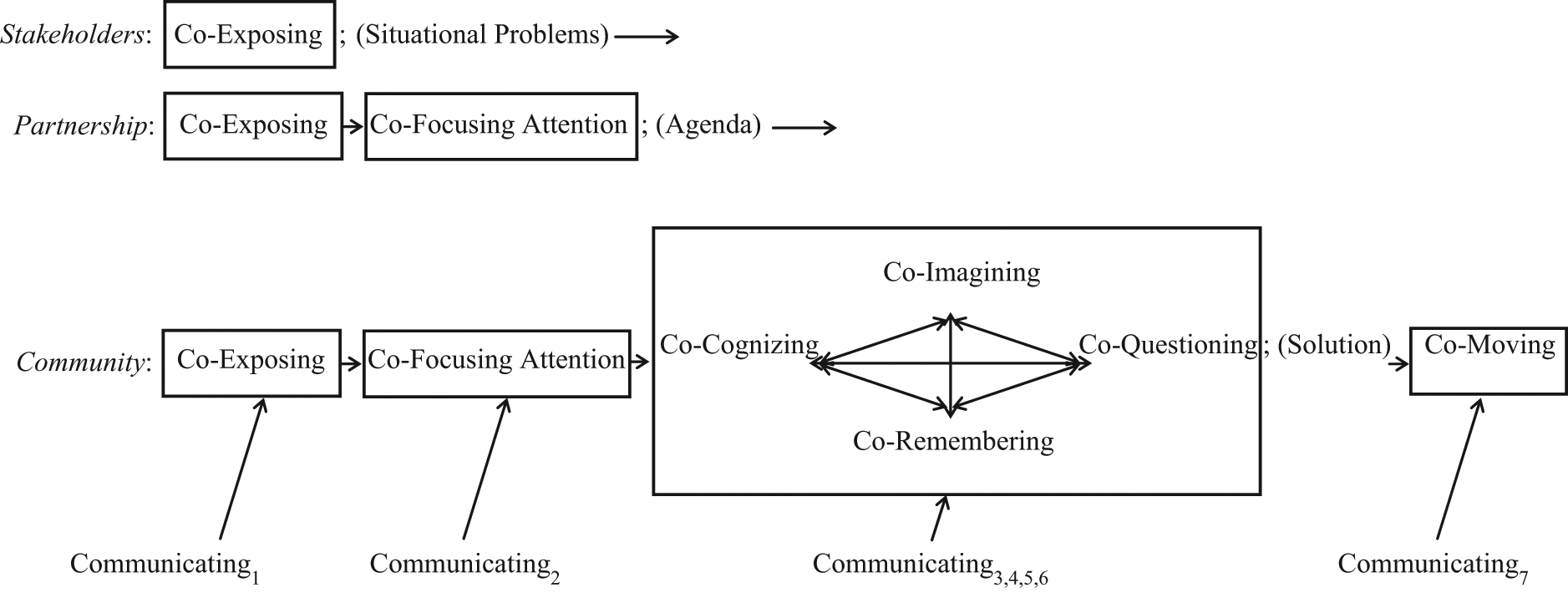
A schematic behavioral molecule of community, relative to stakeholders and partnership.
Stakeholders are co-exposed to the same problem, for instance by media, and are most concerned with their respective situational problems. Partnership builds at least an agenda by co-focusing attention on the same problematic situation. On the other hand, community would or should try to have the full repertoire of collective problem solving acts for that agenda.
First, this schematic behavioral molecule shows the independent significance and difficulty of achieving co-focused attention. For example, the relative intangibility of the climate problem makes it hard to attract conjoint attention, even from stakeholders. Joint attention might be helped by individuals’ prior cognizing, questioning, and so forth, being ready to work together to combat the problem. Co-focused attention begins to compose partnership, perhaps to develop into community. It is a collective behavioral entity being realized that is not an aggregate.
Second, the nascent community behavioral molecule shows the possible magnitude, literally boundless, of developing collective capability by the acts of co-cognizing, co-remembering, co-questioning, and co-imagining. Also, it makes manifest the value of behavior’s capability, independent of body’s capacity. Community members could achieve configuration and imagination for producing a possible, new and composite solution by cognizing, questioning, and/or remembering together. They could help develop each other to tackle their common problem with a shared sense of what constitutes an effective operating system.
Third, the behavioral molecule enables us to conceive behavioral consequentiality before the fact, not just after the fact – although in the latter instance it provides an improved after-the-fact explanation. The molecule illustrated below is only one example of developing collective problem-solving capability. For instance, a simple arithmetic combination of co-minding’s six acts, excluding co-moving, yields 720 possible designs. So, we could plan numerous developments before the fact and observe their consequences after the fact. Research on them could be more inventive and evaluative. Our current research tradition for developing our problem-solving capability, focusing after the fact on order, prediction, and, worst of all, available practices, is incomplete and inadequate.
Fourth, the behavioral molecule enables both understanding and agreement among community members. Those two concepts have long been favored as consequences of content-focused communication (see Kim, 1986, for their explication). Agreement (e.g., attitude or opinion change) is more favored but less feasible than understanding, in regard to the primary function of communication as information exchange (not persuasion). A jointly constructed solution, produced through the process of collective engagement with problem solving, would be more agreeable as well as more understandable among community members. This possibility sharply contrasts problem solving with decision making. As elaborated above, the former is inherently engaging and constructive, while the latter is divisive and conflictual.
Lastly, the behavioral molecule for community problem solving illustrates the capabilities of, and capabilities due to, the act of communicating. As elucidated above, in regard to collective engagement, the act of communicating is indispensible to the full process of collective engagement with problem solving. It is very powerful, but in terms of its multi-faceted functionality. It is functional to bridging or connecting gaps among persons and their concerns for co-exposing and co-focusing attention. And it is especially functional to enabling such acts as co-cognizing, co-questioning, co-imagining, and co-remembering. Figure 2 shows the sequential, varying functionality of the act of communicating to fulfilling the process of community problem solving. It also denotes how important the timing of those seven communicating acts is. Every act of communicating can be effective, as it matches each need for the process of collective engagement.
8. Discussion
Now, we see that the tragedy of the commons, for example, or any shared, situational and behavioral problems such as climate change, could have technical solutions. Those solutions can be produced when the collective behavioral problem is solved by fulfilling the process of collective engagement, namely, community problem solving. The behavioral problem has priority as the key to producing a constructive solution for any situational problem in which community members can fully participate, developing one another’s capabilities. More than anything else, that situational solution produced is very likely to be a newly composed solution, not one or a combination of existing practices. It goes without saying that it will be more agreeable as well as understandable to all community members.
The process of community problem solving involves three major concepts of co-minding, communicating, and community. Especially, minding and co-minding can be developed with/by ideational mechanics (see Carter, 1978, 1992; Carter and Stamm, 1993, 1994; Kim, 1986, 2007a; Kim, Carter and Stamm, 1995, for details). They make an instruction, solution, or ordering for co-moving, not just taking it from the environs. But, they never work without communicating. Co-minding and communicating together enable us to constructively develop our community before the fact. Co-minding is also followed by co-moving, which uniquely needs collective facing, motions, tools, and procedures. We see that our research doesn’t have to be limited, after the fact, to current practices. Their particulars, via inductive generalization, are overemphasized as the only avenue to behavioral understanding.
The new sciences of behavior and community are expected to complement the incomplete establishment sciences and to enhance our constructive, collective capability for survival. Those establishment sciences have been more attuned to logical necessity than to behavioral necessity, to body movement and location than to behavioral structure. Finally, our new behavioral structure of the process of community problem solving (e.g., Figure 2) would help to invent a new design or reform for replacing, enhancing, or complementing the current decision-making-dominant paradigm of social behaviors and systems such as voting, consumerism, deliberation, free-market economy, and so forth.
Footnotes
Acknowledgements
This research was supported in part by grants from Sogang University (2009 Special Grant), Bayer Korea (2009 TOPS Round), and the National Research Foundation of Korea (2009-371-B00046). Much gratitude is due to Emeritus Professor Richard F. Carter (University of Washington) for his insight and support. The author also thanks Gerald J. Baldasty, Vice Provost and Dean of the University of Washington Graduate School, for providing a perfect shelter for this research during the second half of 2009. Alan Sillars (University of Montana), Charles Pavitt (University of Delaware), Martin Bauer (London School of Economics), and anonymous reviewers provided helpful comments too.