




Abstract
The history of nuclear power generation in Japan is analyzed with respect to how the organizational structure of the “nuclear villages,” composed of government, private companies and the academic world, negotiated with the growing technology before the Fukushima accident took place. Although nuclear specialists were aware of the potential for a disaster, that did not prevent the enthusiasm for nuclear. The majority of people trusted that new technology would make life easier. The organizational structure of the village consisted of a triangle in which each of the three groups and sub-groups maintained relationships with each other and with the village as a whole to secure its own share of the economic benefits. Based on the sociological theory of norm, we demonstrate that the structure and nature of the relationships in the village facilitated the acceptance of nuclear power despite the element of threat.
1. The Fukushima nuclear power plant accident
The most powerful earthquake on record, measuring 8.8, later adjusted to 9.0, on the Richter scale, attacked the Pacific side of the Tohoku area, Japan at 2:46 p.m. on March 11, 2011 (Japan Meteorological Agency, 2011). The quake, formally named the Great East Japan Earthquake, caused a huge tsunami, higher than 10 meters, which devastated a wide coastal area, more than 500 kilometers in direct distance (see Figure 1). As of the end of 2012, about 19,000 people were reported killed or missing. More than 390,000 households were partially or fully destroyed. The number of evacuees reached more than 400,000 at the peak (Kahoku-shinpo-sha, 2011). Twenty months after the quake, as of December 2012, more than 320,000 people remained in temporary dwellings and places other than their original homes.
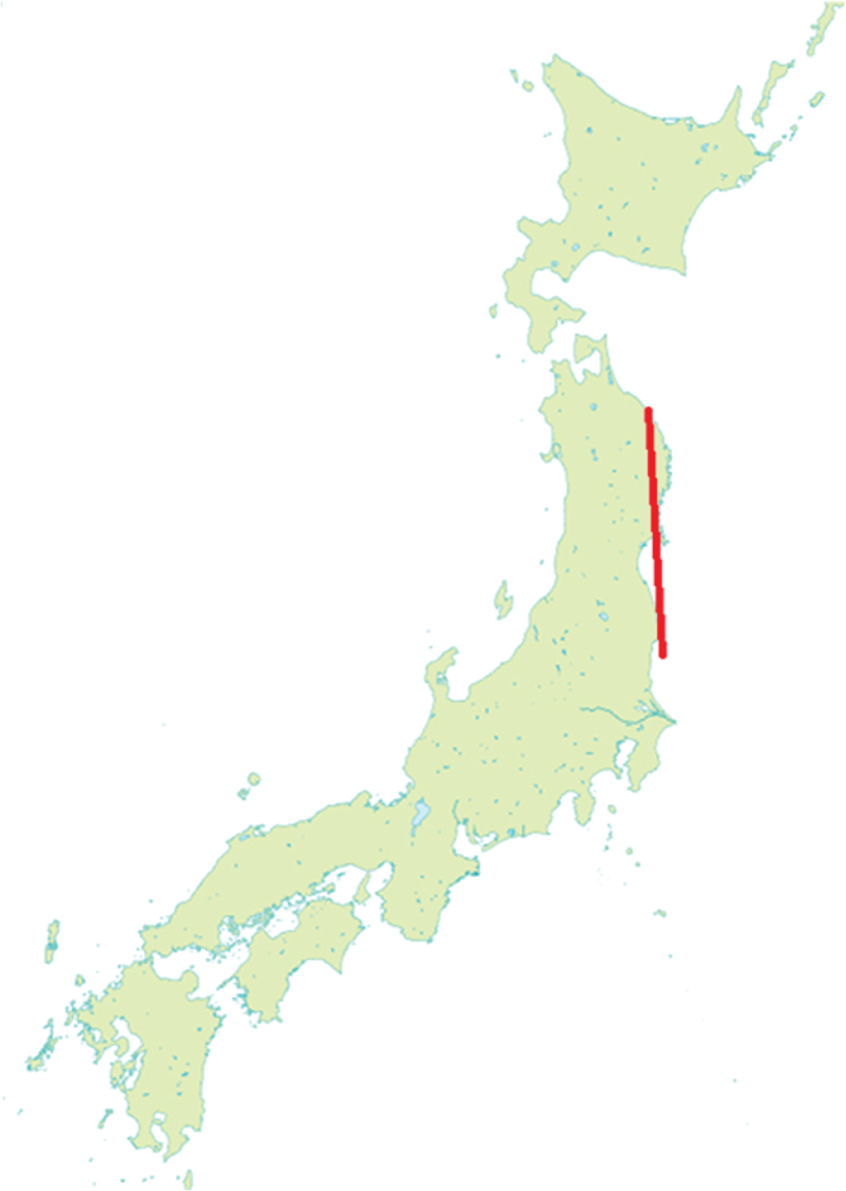
Affected area of the Great East Japan Earthquake.
Damage from the natural disaster was exacerbated by the accident that occurred in the Fukushima nuclear power plant of the Tokyo Electric Power Company. 1 Three reactors in operation (Reactors Nos. 1–3) were scrammed, i.e. stopped quickly, when the plant was hit by a violent seismic tremor. The next step should have been cooling down the reactors because the reactors were kept at such high temperatures that nuclear fuel would melt down unless they could be cooled by water.
However, electricity became unavailable and thus the coolant pumps failed to work. Backup electricity coming from outside the plant was stopped because the power transmission system collapsed due to the quake. Emergency diesel generators collapsed when the 14–15 meter tsunami inundated the plant about 50 minutes after the quake (Figure 2).
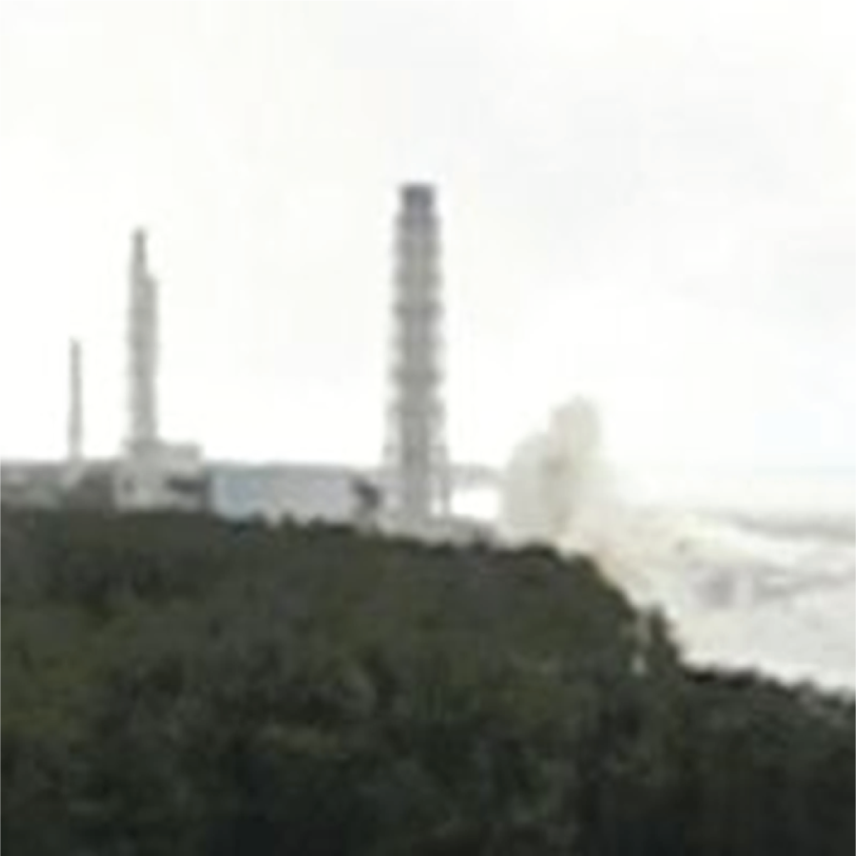
10-meter tsunami attacking the Fukushima nuclear power station.
According to the four investigation reports mentioned below, all the nuclear fuel in No. 1 reactor is estimated to have melted down by 6:00 a.m. March 12, the day after the quake. Melted fuel spilled from the reactor pressure vessel into the reactor container. This process is referred to as melt-through. Melt-down and melt-through occurred in Reactor Numbers 1–3. The buildings that housed No. 1 and No. 3 reactors exploded due to the hydrogen produced by the melt-downs on March 12 and 14, respectively (Figure 3).
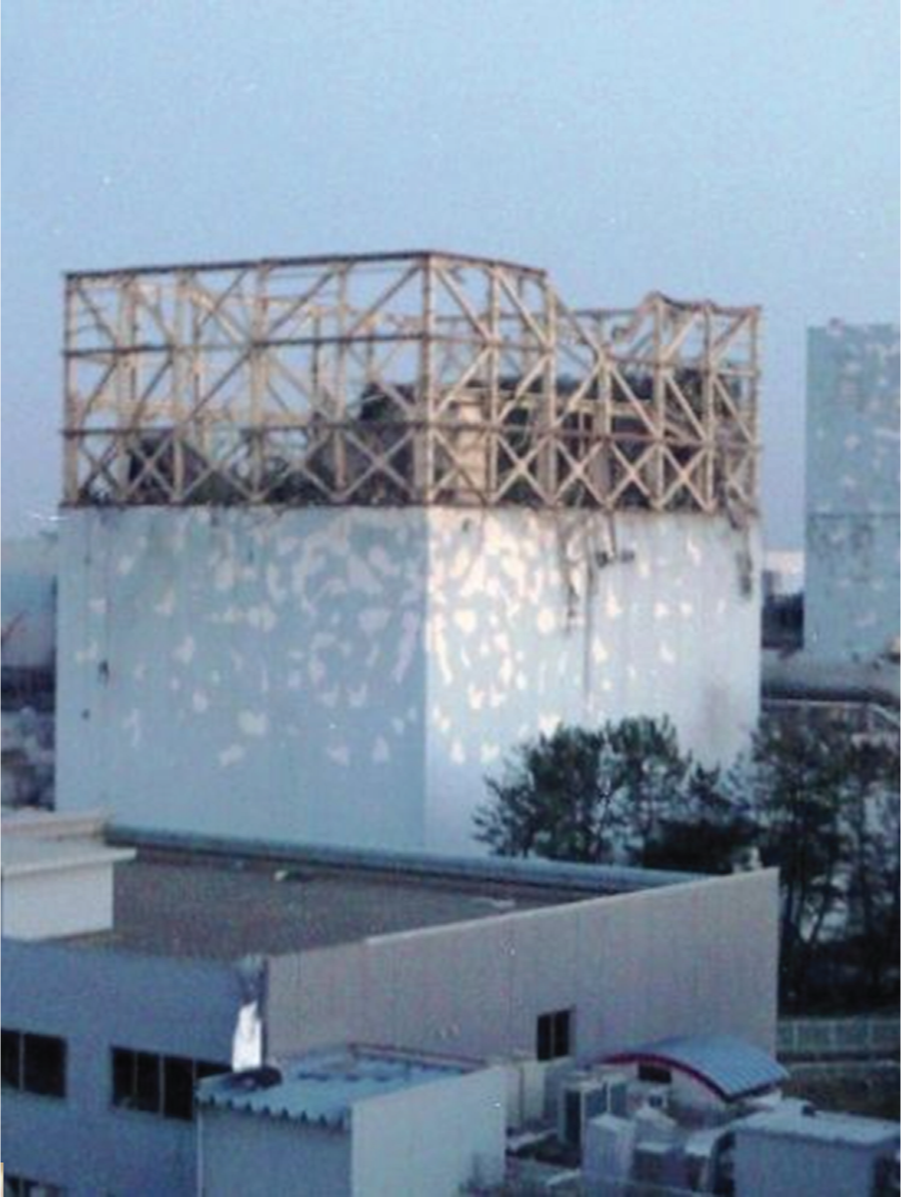
Reactor No. 1 plant that was blasted by the hydrogen explosion.
More precise details of the accident are still unclear. Four investigative committees were organized: the Diet (an independent investigation commission), a government committee, a group of citizens who specialized in nuclear power and the Tokyo Electric Power Company (TEPCO). Each group published its reports on various internet sites. 2 Information from the investigation depended mainly on personal interviews and was only partial because the measurement system collapsed as a result of collateral damage from the accident. Three of the four reports were cautious in stating how much the quake alone contributed to melt-down although a report by the Tokyo Electric Power Company concluded the reactors could have been cooled down if the tsunami had not struck the plant. All four reports emphasized that a future task remained, i.e. to perform an on-the-spot investigation to look deeper into what really occurred during the accident. However, despite the need to examine the site for evidence, it is still difficult to predict when the on-the-spot investigation will be possible because of the danger from radiation. Besides the four reports, reports by mass media and formal announcements by the government and TEPCO were traced deliberately for nine months following the accident and summarized in English by Shibutani (2011a, b, c).
Since a huge amount of radioactivity was emitted into the air, a large area was contaminated. The government initially designated the area within a 20 km radius from the Fukushima nuclear power plant as a danger zone and evacuated all residents. But high radiation was observed beyond the zone. Most residents still cannot return to their home towns and have no expectation of when they can return in the future.
Soil and sea water were also contaminated. People were reluctant to eat agricultural and marine products in Fukushima for fear of radiation poisoning. Harmful rumors were sometimes spread, which made people more anxiety ridden. In addition to the air and water pollution, tremendous piles of rubble were left in many areas affected by the quake and tsunami, and still remain. This trash buildup has hindered and disturbed restoration of the environment for habitation. Local governments outside the affected area were ready to accept the rubble and burn it but this presented a risk to them because the rubble could be radioactive and contaminate a pristine environment.
2. Theoretical framework: Norm theory
When an accident results in melt-down or melt-through, it is classified as severe. The nuclear specialists who originally cautioned that there was a very slight risk involved in having nuclear power plants confessed that they had not envisioned the possibility of a severe accident until the Fukushima accident occurred. They were accused of having been spellbound by the myth of safety (Kuroda, Ino and Yamaguchi, 2012). Although there were nuclear specialists who had knowledge of the tremendous damage that could result from a nuclear disaster, they did not take adequate precautions such as building emergency robots or instituting greater safety measures. Although the Ministry of Economy, Trade and Industry oversees the nuclear industry, there was an unreasonable overconfidence in Japan’s technology that was used in the nuclear power generators. How were the scientists and people trapped by the myth of safety?
This paper will explore how and why even nuclear specialists came to assume that a severe accident would never happen from the viewpoint of the sociological theory of norm proposed by Msaachi Osawa (1990; Sugiman, 2008). In his theory, a norm is defined as an infinite set of actions and recognitions that are assumable. In this definition, norms have nothing to do with moral goodness or psychological comfort. Actions that are assumed to take place are the ones that follow the norm concerned while actions that are not assumed to occur are the ones that do not follow it.
Importantly, a set of assumable actions and recognitions are not determined by psychological processes inside an individual person. In this point, Osawa’s theory is different from psychological theories of norm in which norms are defined as actions and recognitions that are perceived as standard, taken for granted or expectable by people in a certain group or society. Instead, a set of assumable actions and recognitions are determined by the power of an abstract figure, i.e., a third person, who differs from any members of a group but represents all of them.
Osawa’s theory is characterized by taking reference to a concept of the big Other (Grand Autre) proposed by the French psychoanalyst, Jacques Lacan (Shingu, 2004). It is assumed a third person is constructed, or fictionalized, more precisely, through the intermingling of plural persons between which the distinction is lost. One experiences the perception and emotion of the other person at his/her position. Communal experience becomes more salient than differences of experiences of each person when the intermingling occurs frequently and intensely. This leads to a situation in which the communal experiences are crystallized into a norm that is a voice of the third person who is an abstract figure, different from any intermingling persons.
In the theory of norm, the concept of the third person is said to develop in a specific way. In the primitive phase, the third person constructed from intermingling is visible in the sense that it overlaps with a concrete person like his or her aura. The norm is specific, depending on a concrete situation in which the intermingling takes place and the sphere of influence, i.e., the area where the instance of the third person is effective, is small. When two different spheres of influence are closely located, the third person can develop if its norm is transmitted into the other sphere of influence. More development makes the third person more invisible in the sense that it overlaps less with a specific person. In addition, the content of norm becomes more general and the sphere of influence becomes larger.
There is a concept of a human being as a physical body having a mind within the skin, which is called the “mind-in-a-body paradigm” (Sugiman, 1999). The paradigm extended to the development of the third person. If you are located in the sphere of influence of a third person who is highly developed, you can hear the voice, which seems as though it comes from the invisible third person, anytime and anywhere. Under such a situation, you feel as if you wear the source of the voice indicating the norm, or as though you had the source in your shirt pocket, for example. The source of the voice is taken as the mind in a body.
Individualism, prevalent in modern Western Society, is a strong version of the paradigm of the mind in the body; it is believed that a person judges his/her actions to be taken in the mind, and moreover, he/she should do so. Thus the third person abstractly held by the individual, is developed to a high degree in this context. In contrast, collectivism is a moderate version of the paradigm and in this context the third person is developed to a lesser degree, thus remains overlapping with a specific person. The specific person is, or should be, more relevant to the judgment of one’s action in collectivism than in individualism.
Importantly, the third person whose instance you follow is not yourself but an abstract person who is different from, but represents, specific persons in the sphere of influence. “Most people around you” might be an expression you can use when you refer to the third person. In individualism, “most people around you” is a huge group of persons who cannot be represented by a specific person anymore, rather, can be represented by an invisible abstract figure like a god. In collectivism, however, “most people around you” is restricted to a tangible group of persons that can be represented by a specific person. It should be noted that the mind is not inside the skin, but instead the voice of a third person who represents “most people around you” although the size of “most people” differs between individualism and collectivism.
The stock market is a good example that demonstrates one is moved by the voice of “most people around you.” You don’t buy the stock you personally believe is going up. Instead, you buy the stock you believe “most people around you” believe is going up. This is the case even in countries where individualism is valued, but it is more likely in collectivistic countries like Japan where one is affected by a tangible group of people around oneself in many situations other than the stock market.
It is simplistic to assume that collectivism is ranked lower or less mature than individualism. Foreign mass media praised the orderly behavior demonstrated by victims in shelters and other places after the Great East Japan Earthquake. Such behavior was possible because the victims believed that most people around them endorsed the belief that one should not behave selfishly. On the other hand, the process of acting on the premise that others will act in a certain way may also have had its drawbacks in this case. One might ask why and how a nuclear specialist would have been convinced that most specialists around him/her believed a severe accident in a nuclear power plant would never happen (until the Fukushima accident occurred).
Keeping the theory of norm in mind, we will find out why and how participants in the nuclear village were entrapped into the myth of safety. For this purpose, two kinds of reflection will be made; one is a historical reflection of nuclear power generation in Japan and the other is a reflection on the organizational structure of the village.
3. Historical reflections
We Japanese can never forget the horrific atomic bombings and their aftermath in Hiroshima and Nagasaki in 1945 when we say anything about nuclear power. Japan is the only country in the world that was victimized by the military use of nuclear power.
In the period after World War II, 1945–1952, all nuclear-related experiments were suspended by the US occupation force and all nuclear-related facilities such as the cyclotron were demolished. In 1952, when Japan restored its independence, discussion started in the Science Council of Japan regarding whether studies on nuclear power should be resumed. The Science Council of Japan might be referred to, or functions, as a parliament of scientists. Resumption was not accepted because the majority of Council members were afraid that their nuclear studies might be caught up in the already fierce nuclear arms race between the US and the then USSR.
In parallel with the academic discussion, a group of politicians including Yasuhiro Nakasone (1918–), prime minister from 1982 to 1987, started to play an active role in introducing nuclear power generation from the US. Irritated by the inactivity of the academic world, he proposed a budget of 14 million dollars for nuclear power research which was realized in 1955. Nuclear researchers became aware of it from the media. This effort surprised bureaucrats working for industry who had assumed that financial measures would be made only after the academic world had decided to start nuclear studies. They left most of the budget unused for the first year because they had virtually no knowledge of nuclear power. But, the budget for nuclear studies nonetheless continued to increase rapidly.
Besides the politicians, a prominent figure named Matsutaro Shoriki (1885–1969) promoted the introduction of nuclear power generation from the private sector. His influence was ubiquitous because he contributed significantly to the growth of the Yomiuri newspaper company before the war and established a private television station after the war.
In March, 1954, a Japanese fishing boat, the Lucky Dragon #5, was contaminated directly by radioactive fallout from a US hydrogen-bomb test in the South Pacific Ocean. This disaster led to a fierce anti-US and anti-nuclear movement. Shoriki was worried that the movement might expand further and lead to communization of the country, and campaigned to promote the peaceful utilization of nuclear power. Besides inviting nuclear specialists from the US to lecture in Japan, he held the Exhibition for Peaceful Nuclear Utilization in thirteen cities from 1955 to 1957, which attracted more than 360,000 visitors. In Hiroshima, the Exhibition was held in the Hiroshima Peace Memorial Hall and replaced the usual displays that featured horrible memories of the atomic bomb with a special display showing futuristic themes such as nuclear powered vehicles, medical applications and industrial possibilities. The Exhibition was successful even in Hiroshima although the replacement of the original display initially met with criticism.
The trend toward the introduction of nuclear power generation had been nurtured in the 1950s, and was followed by the preparation and use of an experimental reactor. The trend was supported by the naïve trust of the vast majority of people in the possible benefits brought by science and technology. Children were introduced to the concept of nuclear energy as part of their education. A perfect example is illustrated in the Japanese language textbook the present author used when he was in the sixth grade of elementary school in 1963 (Shiga et al., 1961). The first chapter in the textbook was titled “The Third Fire” and printed in color, rare at that time. The first fire was obtained by human beings in primitive times by using the friction of stones and wood. This was followed by the second fire, electricity, which was discovered and started to be utilized in the modern age. The third fire was nuclear power. The following is an English translation of the part of the book where the third fire is described:
Civilization proceeded further. We obtained a new fire for the third time. This was the third fire, that is, nuclear energy. But, we should not forget the fire was used as a weapon to burn Hiroshima and then Nagasaki in 1945. The humans obtained such a horrible fire that 400,000 people were killed in a fleeting moment by a great pillar of fire. But, we know that horrible fire has the power to produce limitless energy. However, since nature does not have a will, it is the humans who can make a decision using wisdom and conscience. It is the third fire that tests our wisdom and conscience. Burn, third fire! Burn and burn with our conscience for peace.
The first commercial reactor was put to work in Tokai village in 1966. Subsequently, the number of commercial reactors increased from four in 1970, to 22 in 1980, 39 in 1990, 51 in 2000 and 54 in 2010. The most rapid increase was made during the twenty years of the 1970s and the 1980s. In that period, however, two large accidents took place in the US (Three Mile Island in 1979) and the then USSR (Chernobyl in 1986). But, the increase in reactors was not attenuated in Japan by the news of these two accidents. Instead, two “oil shocks” in the 1970s, in which oil was used as an economic weapon by Arab countries and the price of oil was sharply increased for the countries that supported Israel, were the impetus that convinced Japanese people of the necessity to rely more on nuclear power. The conviction of necessity of nuclear power prepared grounds for the myth of safety that entrapped most nuclear specialists in 1990s. But, most ordinary people were not as enthusiastic about nuclear power as they had been in the 1950s to the 1960s and became indifferent to it. In the 1970s and 1980s, many citizen movements occurred to protest environmental pollution by manufacturing companies. Some emphasized the danger of nuclear. But their influence was not sufficient to change the attitude of the majority of ordinary people toward nuclear power.
In the period from the 1990s until the Fukushima accident, nuclear power generation obtained a second motivation, that is, prevention of global warming. The Japanese government established a policy that pursued “Genshiryoku-rikkoku” which means the “establishment of a state on the basis of nuclear power,” while the term “Nuclear Power Renaissance” was favored in the West. Ordinary people were likely to appreciate nuclear power generation as the only option that they could rely on to reduce the use of fossil fuels and secure sufficient electricity. The positive attitude of ordinary people toward nuclear power generation was reflected in the results of public opinion surveys (see Table 1).
Change in public opinion regarding nuclear power generation.
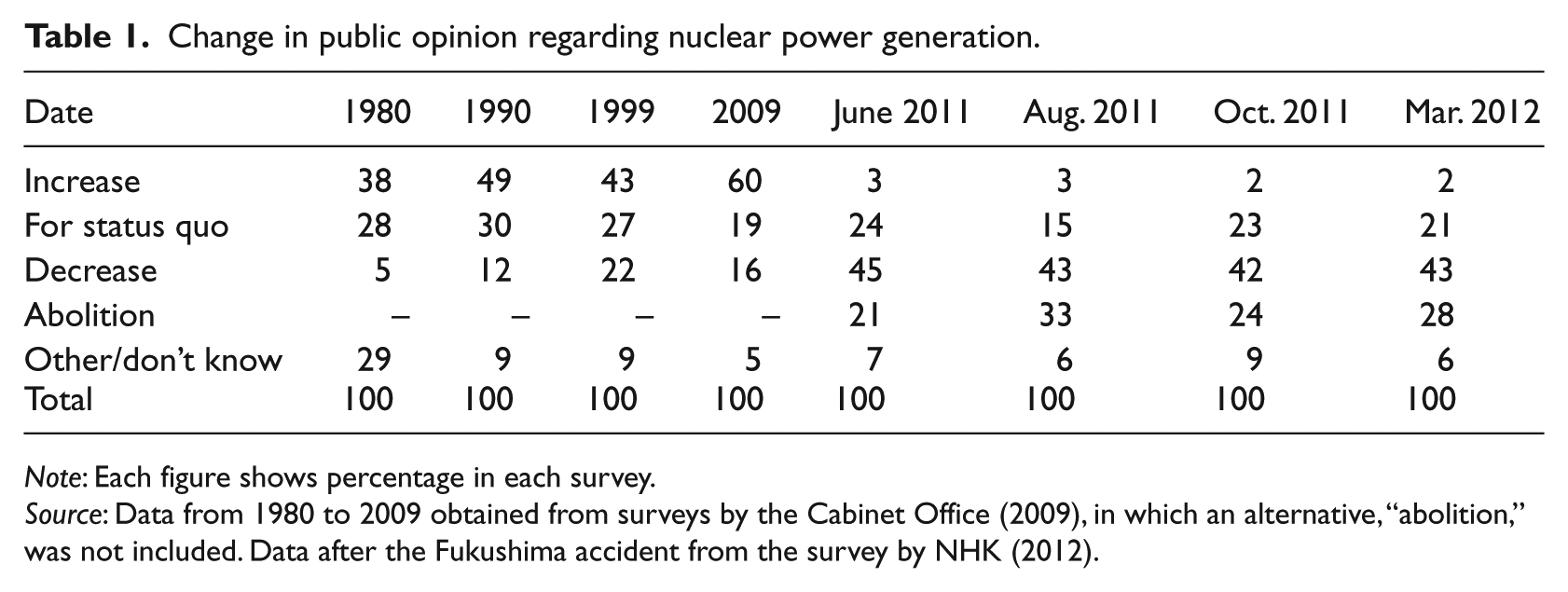
Note: Each figure shows percentage in each survey.
Source: Data from 1980 to 2009 obtained from surveys by the Cabinet Office (2009), in which an alternative, “abolition,” was not included. Data after the Fukushima accident from the survey by NHK (2012).
The governmental policy along with the positive attitude of ordinary people naturally made nuclear specialists believe that people around them assumed the necessity of and even the safety of nuclear power. Persons who were in prestigeful positions in government and industrial sector played a role of the their person for those specialists.
But, the increase in reactor numbers was much slower in this period than in the 1970s and 1980s. This meant less construction was planned in the 1980s than before because it takes around ten years to build a nuclear power plant. Japan had been in a long economic slump since the 1990s but the business of nuclear power plant construction had stagnated earlier than other business areas. This was partly because the proportion of electricity generated by nuclear power was approaching 20%. This proportion was taken as constituting nearly the optimal combination with electricity generated mainly by fossil fuels such as natural gas, oil and coal. 3 It was no longer beneficial to have more nuclear power plants when more expensive construction costs were taken into account.
4. Organizational structure
The history of nuclear power generation, which was initiated by politicians and then promoted by bureaucrats and private power companies, produced a unique triangular relationship among nuclear-related governmental organizations, power companies and researchers specialized in nuclear power. The triangle is often called the “nuclear village,” in a pejorative sense due to its exclusiveness. We will see details of each participant in the village and of relationships among them.
National government
Nuclear power generation initiated by politicians became the territory of bureaucrats working for nuclear-related administration in the national government as shown in Table 2. The administration of nuclear power in Japan was characterized by dual control in which two different ministries played a central role in nuclear power administration (Yoshioka, 1999). Specifically, the Ministry of Economy, Trade and Industry (METI) was responsible for the practical and commercial use of nuclear power while the Ministry of Education, Culture, Sports, Science and Technology (MEXT) was responsible for facilitating research and development. 4 In spite of the division of work, the relationship between the two ministries was no exception to sectionalism, which is often criticized with the saying “there are ministries but there is no country.”
Governmental sectors for nuclear administration.
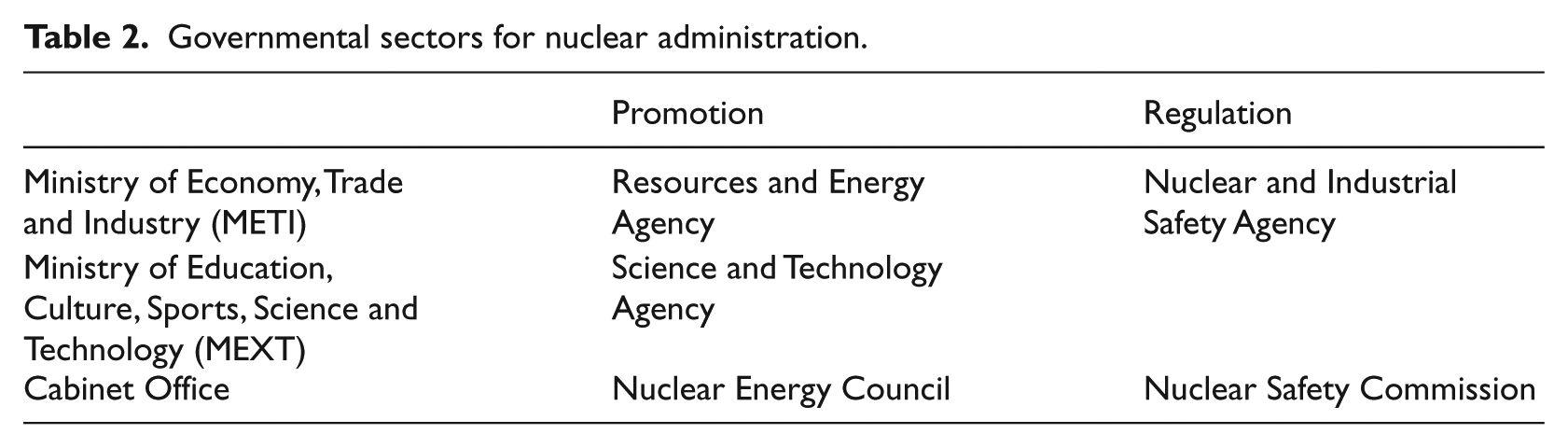
To compound matters, nuclear-related administration was not carried out by the main body of a ministry but by an affiliated agency of each ministry. The Resources and Energy Agency, affiliated with the METI, promoted practical use while the Science and Technology Agency, affiliated with the MEXT, promoted research and development. An agency might be compared to an island beside a mainland. People living on the island are likely to envy those living on the mainland, that is, the ministry with which the agency is affiliated. But, at the same time, people living on the island can enjoy special advantages that cannot be seen from the mainland. That was how rivalry between the two agencies made nuclear power administration a place where bureaucrats maintained their own special authorities and vested interests, by keeping their activities far from public attention.
Dual administration was also found in the area of safety regulation. The Nuclear Safety Commission in the Cabinet Office and the Nuclear and Industrial Safety Agency affiliated with the METI were responsible for regulations to maintain the safety of nuclear power plants. Such a dual system might enhance safety administration but might also lead to neither body taking responsibility, which became well known after the Fukushima accident.
It was also a problem for the METI to have both an accelerator (Resources and Energy Agency) and a brake (Nuclear and Industrial Safety Agency) for nuclear power generation in a single ministry.
Electric power companies
Many electric power companies were integrated into ten companies on a regional basis after the war. 5 Each company was allowed to monopolize the electricity supply in its region and, at the same time, was required to take responsibility for stable supply. In addition, the company was legally allowed to recover all costs, including expenses for research and development, by the price of electricity. These conditions guaranteed stable management for electric power companies, which provided a leading status in each regional economy. The Tokyo Electric Power Company was the largest among all the electric power companies in Japan. The company had a great deal of influence not just in the Tokyo area but on the national government.
Electric power companies and national government officials were intimately connected. A former government official of high status was often recruited by a private company after his retirement and appointed to a responsible position. The custom is called “Ama-kudari” in Japanese, which translates literally as “descending from heaven.” The former official is expected to be a lynchpin between an electric power company and the government, which causes conglutinative relations between the two.
The private sector in the nuclear village is huge. Besides electric power companies, the private sector includes heavy industry companies that construct nuclear power plants, manufacturing companies that produce nuclear fuels and many small companies that provide labor for the maintenance of plants. These companies tried to keep strong relations with national and even local governments to maintain their benefits.
Researchers
Researchers specializing in nuclear engineering were one of the major components of the nuclear village. Most researchers were proponents of nuclear power generation although there were a few researchers who were opponents. Some researchers worked in technological development of nuclear power generation and others worked in safety regulation. They sometimes became members of committees of national and local governments and sometimes worked for electric power companies and plant-makers. 6
Close collaboration was found again between researchers and government. Some researchers gave an academic reason for the promotion of nuclear power generation while receiving a huge amount of research funds from governmental organizations. Such a researcher is called “Goyo-gakusha” in Japanese, a government-patronized scholar. It is easily imagined that they did not hesitate in enjoying similar relations with private sectors.
Although the majority were proponents, a few researchers had already emphasized the possible dangers of nuclear power generation and insisted that it should be abandoned. Jinzaburo Takagi (1938–2000) was one of the most prominent opponents. He was a physicist specializing in nuclear chemistry. He started his career as a researcher working in universities and research institutes but he quit these and established a think tank to analyze and propose nuclear policies from a standpoint independent from the nuclear village. He warned of the unsustainability of nuclear power generation, the danger of plutonium and the possible risk of earthquakes. He published many books, which made him a symbol of anti-nuclear power generation (e.g., Takagi, 1981, 1983, 1986). 7
As we saw from examining the three kinds of stakeholder above, mutual dependence in the nuclear village enhanced the norm that critical accidents would never occur. This was because the stakeholders could not benefit from the mutual dependence any more if they could not believe the other stakeholders worried about the possibility of severe accidents. It is safe to say the norm was attributed to prestigeful people such as a political leader in the nuclear politics, a president of the power company and an authority in the area of nuclear studies.
Mass media and citizens
In addition to considering the people in the nuclear village, we should pay attention to what people outside the village, specifically, mass media and ordinary citizens, were doing before the Fukushima accident. For the mass media, any problems with a nuclear power plant were good materials to criticize electric power companies. But, the criticism was concerned only with attracting readers and audiences. It was rare for the mass media to discuss seriously the details of possible severe accidents and their subsequent social disasters.
Ordinary citizens are divided into two groups: those living near nuclear power plants on the one hand and citizens living far from the plants and depending on the electricity generated in distant plants on the other. Residents near the plants were likely to be more positive about nuclear power generation than people living far away. This is partly because they had much more knowledge about nuclear power generation, defense in depth, 8 for example, and were much more acquainted with people working for the plants. Moreover, many of their family members and other relatives actually worked for the plants or for local shops and service businesses that depended on income from the people working for the plants. Also, they could enjoy the financial benefits that were provided by the national government as compensation for accepting a possibly dangerous facility. Likewise, electric power companies gave donations and financial support to the local government as well.
In contrast, nuclear power plants were a so-called NIMBY problem for people living far from them. NIMBY is an abbreviation of “Not In My Back Yard” which says “I agree on the necessity of a certain facility but I refuse to have it constructed near my house.” A nuclear power plant is a typical NIMBY problem, along with facilities such as a waste disposal center, a crematorium and so on. For those people, electricity was taken for granted as what automatically flowed out of wall sockets in the way that water flowed out of a faucet.
5. Conclusions
The historical reflection in this article demonstrates how nuclear power generation in Japan was initiated by the strong leadership of a small group of politicians and business persons without sufficient academic credentials, scientific examinations and fundamental studies. The number of nuclear power plants increased sharply for three reasons: the trust of many ordinary people in science and technology in the 1950s to 1960s, two “oil shocks” in the 1970s that resulted in increased oil prices and the need for non-dependence on fossil fuels, and the anti-global-warming movement in the 1990s to 2000s.
A huge amount of economic benefits were secured for the private sector including electric power companies, national and local governmental organizations related to nuclear power generation and residents living in the areas where nuclear power plants were constructed. Nuclear power generation became a source of economic benefits, or vested interests, for people who had direct dealings with it.
The reflection on organizational structure in this paper indicated that nuclear power generation was promoted by a large triangle, called the nuclear village, consisting of three kinds of groups, i.e., government, private sector and academic specialists. Each group consisted of sub-groups such as agencies in the ministry; electric power companies, plant construction companies and so on in the private sector; and departments of nuclear engineering in universities and other nuclear-related research institutes in the academic world.
Each group and sub-group in the nuclear village enjoyed a share of the huge amount of economic benefits that was spent to promote nuclear power generation. In addition, governmental ministries and agencies competed with each other to expand their power. Not only relationships with other groups or sub-groups but relationships with the village as a whole were maintained to secure one’s own share. The village itself and relationships in the village had become a measure to enjoy one’s own vested interest.
A severe accident was the ultimate threat to the promotion of nuclear power generation that sustained the village. Also, many benefits would have to be given up if a severe accident was prepared for by the spending of an enormous amount of money. It was more comfortable for participants in the village to persuade each other that a severe accident would never take place. Such persuasion was made within and between groups and sub-groups in the village. As a result, people in the village had reached a point where they believed that persons around them assumed a severe accident would never occur.
We have investigated organizational problems that were historically developed in the village until the Fukushima accident occurred, by depending on the sociological theory of norm without attributing failures to the psychological processes of an individual person. One might conjecture that, following the Fukushima accident, the norm has been changed that before the accident made people in the nuclear village believe that persons around them assumed a severe accident would never occur. But the current situation is too complicated to arrive at a simple conclusion.
It is obvious that the optimistic norm, long prevailing in the nuclear village, critically called the myth of safety, has disappeared, due to the fact that a severe accident took place. The norm has become more cautious, where people in the village acknowledge the possibility of a natural disaster, and have taken precautions to defend power plants from such an event. The facilities and equipment of a nuclear power plant are now constructed with a new electricity supply system, a higher coastal levee etc. intended to withstand a tsunami higher than that of the Fukushima accident.
Most people in the village look to maintaining a norm that persons around them assume nuclear power generation can be continued, or even should be continued in the future. More than half of the politicians including former and current prime ministers have also followed the norm. This is reflected in the fact that the government permitted two of fifty-four reactors, Reactor Nos. 3 and 4 of the Ooi plant of the Kansai Electric Power Company, to resume operation. 9 The reasons were that the government judged that sufficient safety measures for a severe accident had been secured on the one hand, and on the other, predicted a shortage of electricity was possible in the forthcoming summer in the area where the plant had supplied electricity. The two reactors resumed working in July, 2012.
The norm to continue use of nuclear power is also reflected in the establishment of a new governmental organization for the regulation of nuclear power generation. A new organization named the Nuclear Regulation Authority was established in September, 2012 under the Ministry of Environment. This aimed at integrating regulatory functions of the government that had been exerted dually by the Nuclear Safety Commission in the Cabinet and the Nuclear and Industrial Safety Agency in the Ministry of Economy, Trade and Industry. Also, the Authority was established to resolve the longstanding likelihood of conflict between promotion and regulation, roles that had been played by two different organizations that belonged to a single ministry, i.e., the Resources and Energy Agency and the Nuclear and Industrial Safety Agency in the Ministry of Economy, Trade and Industry.
When we turn to public opinion, an option of decreasing the number of nuclear power plants is preferred to other options such as “abolition” and “keeping the status quo” as shown in Table 1. Together, “abolition” and “decrease” are supported by more than 70% respondents. In recent opinion polls in the mass media, about 60% answered “No nuclear power generation should be pursued but it is necessary for the time being” (Nihon Keizai Shimbun, 2013) and “Nuclear power generation should be abolished before (24%), in (22%) or after (12%) the 2030s” (Asahi Shimbun, 2013).
It might be safe to say that in public opinion, the question is how fast the number of nuclear power plants can be decreased. Unfortunately, Japan has suffered an economic slump for 20 years, although people expect economic recovery from the new government that took office in December, 2012. It is clear that no or fewer nuclear power plants will make economic recovery more difficult. The norm in the nuclear village that contributes to a long term dependence on nuclear power generation looks much more robust than we imagined when we predicted its decline soon after the Fukushima accident. The road to the abolition of nuclear power generation might be as long as the road completing the decommissioning of the Fukushima plant, which it is estimated will take more than 30 years.
Footnotes
Funding
This research received no specific grant from any funding agency in the public, commercial, or not-for-profit sectors.