




Abstract
Up till now, the transition to a bio-based economy mainly involves expert stakeholders. However, the actions required are of a collective scale necessitating public engagement for support and action. Such engagement is only successful if members of the public believe their participation holds efficacy. This belief is closely linked to their personal representation of the issue. We report findings from our Q methodology workshop that explored public’s efficacy beliefs on their perceived ways for engagement with a bio-based economy. Participants were provided with stakeholders’ visual representations depicting a concourse of the transition to a bio-based economy for Q sorting. We found five efficacy beliefs that differ in scale on which participants consider themselves capable for action. These results indicate that members of the public foresee distinct and shared ways and levels in how they can engage with the transition to a bio-based society that do not always concur with stakeholders’ views.
1. Introduction
Our economy is in transition, from being fossil fuel based to bio-based (Commission, 2012; OECD, 2009). This bio-based economy uses bio-renewable materials and bio(techno)logical processes for the production of chemicals and materials such as medicines and plastics, and energy for transport and other usages (Langeveld et al., 2010). Many scientists, policymakers, industrialists, and non-governmental organisations (NGOs) believe in the potential of industrial biotechnology for a bio-based economy and the development of a more sustainable society (Bang et al., 2009; Commission, 2012; Paula and Birrer, 2006; Soetaert and Vandamme, 2010). This transition is likely to significantly affect developments that deal with sustainability, mobility, food-and-energy security, governance, public health, safety, logistics and social and industrial infrastructure (Langeveld et al., 2010), and their growing global interdependence. The changes involved put pressure on people’s sense of control over their living environment and way of life. With their personal choices and forms of participation, the public is expected to influence the direction of development of this transition (Gijsbers et al., 2005; Paula and Birrer, 2006). The complex nature and scale of a bio-based economy and its associated developments requires collective action necessitating public engagement (Sleenhoff, Landeweerd and Osseweijer (2015)).
Public awareness of the bio-based transition is limited (Asveld et al., 2011; Pesch et al., 2010). Berg et al. (2013) even claim that public representations of a bio-based economy are currently non-existent. Up till now mainly (non-)governmental, scientific, technical, biomass providing, and processing stakeholders are involved in developing the transition. These stakeholders have different and sometimes conflicting narratives and values about bio-based developments which complicate public engagement (Cuppen et al., 2010). However, Sleenhoff, Cuppen, and Osseweijer (2014) have shown that despite the complex nature of the transition and the public’s limited awareness, they do construct their own representations of a bio-based economy based on stakeholders’ visuals.
Any attempt to engage the public with the bio-based transition will confront the public with stakeholder representations. O’Neill et al. (2013) found that for climate change, such representations not only play an important role in denoting the importance of the represented issue, but also, they play an important role in how capable the public feels they are to contribute to the issue. This connects to what Macnaghten and Jacobs (1997) described: public engagement will be more successful if their feelings of being able and capable to do something is developed at the same time as their awareness. Or as Wynne (1991) put it, “those who do or develop the motivation often show great alacrity at seeking out sources and assimilating science” (p. 118). Visual representations have the capacity to stimulate awareness and efficacy at the same time.
One needs to study in what way stakeholder representations engage the public; not merely in terms of “negative/positive” but also in terms of facilitating collective support and action or obstructing this. Adding to the unraveled emotions people have toward the transition to a bio-based economy (Sleenhoff et al., 2014), this article focuses on their perceived efficacy for engagement. We will explore the ways in which the public believes it can contribute to a bio-based economy. This insight should help to advance efforts for meaningful public engagement for collective action. In this article, we describe which different efficacy beliefs we found among the public at large toward a bio-based economy. We approached this without taking an actual position toward the transition to a bio-based economy, focusing on processes of engagement and collective action rather than on justification of this transition as such, and without seeking to deliver tools and instruments for public legitimation of this transition. We do, however, take the position that a morally and democratically justified transition to a bio-based economy needs an open dialogue in society.
This article is built up in the following way: Section two introduces ways for meaningful public engagement with a bio-based economy. The third section describes how social representations influence public engagement. In the fourth section, we discuss the necessity for developing the public’s efficacy belief for public engagement while they are developing their own representations. In the fifth section, we describe how we elicited the different efficacy beliefs using stakeholders’ representations for sorting in a Q methodology workshop. The results are presented in the sixth section. In the seventh section, we discuss our findings and conclude with implications for collective public engagement with a bio-based economy in the final section.
2. Meaningful public engagement with a bio-based economy
The master narrative of a “knowledge based bioeconomy” for Europe promotes industrial research and development for opening up new markets for the exploitation of renewable and sustainable resources (Birch et al., 2010; Levidow et al., 2013). Up till now, scientists, industrialists, and policymakers are the predominant stakeholders involved besides farmers and NGOs. They call for an open and informed dialogue that includes the public at large during the development of this bio-based economy (such as Commission, 2011: 74; 2012: 8, 13, 27). Through such open dialogue, stakeholders anticipate the lifting of the perceived problem of a public deficit of knowledge, a well-known problem in public engagement and science policy literature (Irwin, 2014; Stilgoe et al., 2014; Sturgis, 2014). However, this is a very institutionally driven, instrumental approach to engagement which often does not lead to more meaningful engagement of the public. Quite the opposite; where stakeholders expect to increase the legitimacy of their actions through such activities eliciting public opinion, they rather quench the public voice (Cooke and Kothari, 2001; Wynne, 2006).
Public engagement can offer means to deal with the tensions between values of science for the economy and democracy by opening up social choices (Stirling, 2012). Taking emotions into account has been suggested to enhance public engagement with complex issues (Osseweijer, 2006; Pidgeon and Fischhoff, 2011; Roeser, 2012). As an integral part of our decision-making, reflection, perceptions, and behavior, emotions provide people with cues on how to evaluate information and its presenters and act accordingly (Hoijer, 2010; Kahan, 2010; Nussbaum, 2001). Emotions entice reflection which will influence people’s choices as they not only have to take into account the effect of their choices on their personal life but also on their wider community or future generations.
When emotions are taken into account for public engagement, then different social representations of a bio-based economy emerge (Sleenhoff et al., 2014). These representations show that the public at large have different conceptions of a bio-based economy which do not necessarily reconcile with the master narrative of a knowledge based bio-economy. These representations give insight into how the transition to a bio-based economy has become more concrete and tangible for members of the public; how they envision such a new economy (Wynne, 2014). Being aware of these different public narratives of a bio-based economy should facilitate opening up dialogue with policymakers as they make public views explicit. In their evaluation of public engagement initiatives within Europe, Felt and Wynne (2007) also stress the importance of considering and reflecting on such different narratives as they represent people’s different perspectives.
3. Visual social representations of a bio-based economy
Social representations are shared understandings, beliefs, and practices of unfamiliar phenomena by individuals in social groups. They can be regarded as networks of ideas, metaphors, and images that include emotions, attitudes, and judgments (Moscovici, 2002). Social representations are generated through communication and show how people make sense of complex unfamiliar issues and how that understanding is transformed into everyday knowledge (Joffe, 2003; Moscovici, 2002).
Images or visual social representations are extremely powerful in making the abstract and unfamiliar more concrete (da Rosa and Farr, 2001). They have also been found efficient in collective meaning making since they externalize emotions (Mamali, 2006). Such representations have the capacity to quickly convey messages, condensing complex issues as well as the capacity to engage and motivate people (Nicholson-Cole, 2005). And since they can cross cultural and geological barriers, such visual representations have greater intelligibility and interpretability (da Rosa and Farr, 2001).
By the process of communication through various media and occasions about bio-based developments and expansions, relevant stakeholders cluster themselves into social groups with shared views and social representations thereof. In their public communication, they make ample use of photographs, pictures, infographics, cartoons, metaphors, and other forms of visual representations to illustrate and support their messages. By doing so, they create specific social representations of a bio-based economy that can be regarded as identifying characteristics of those groups. The images indicate how stakeholders understand and give meaning to this development, and these representations are also taken up in public understanding. Analysis of such stakeholder representations can help in bridging the gap between the public and the technical and scientific developments associated with a bio-based economy as they transform this complex phenomenon into hybrid forms which draw on both science and the public’s everyday life world (Bauer and Gaskell, 1999).
4. Collective engagement for a bio-based society
The development of a bio-based economy will dictate changes to society which will likely affect various aspects of our daily life. Which actions and behavior changes are necessary, desired, and accepted from the perspective of sustainable development and the extent to which members of the public can and are willing to act is up for debate. This requires public engagement which means effort, ranging from the processing of information to the production of an opinion or taking action. In order for members of the public to exert themselves, contributing to the transition, they need to feel confident and capable to do so. So, identifying meaningful ways in which they can respond is important (Ballard, 2005; Gehrke, 2014; Lorenzoni et al., 2007).
Results of a study on the impact of climate change imagery for public engagement showed that such representations play an important role in promoting feelings of efficacy besides increasing the saliency of the issue. Also the emotions attached or evoked by such images have been found to influence people’s level of engagement (O’Neill and Nicholson-Cole, 2009). Considering these findings with regard to the transition to a bio-based economy, stakeholders would be wise to consider the messages their imagery communicates and the type of responses it will generate.
Promoting awareness alone does not lead to meaningful engagement of the public (Irwin, 2006; Irwin et al., 2013; Jaspal et al., 2013). Their efficacy beliefs have to be developed simultaneously (Macnaghten and Jacobs, 1997) giving perspectives and facilitating members of the public to develop ways through which they want to engage with the transition. What they buy, how they choose to travel, how they vote, how they recycle their waste, and even their level of acceptance of technology and governance will influence the development and structure of a bio-based economy. Thus if one does not provide members of the public with a sense of being capable to change and affect their own situation or the wider world, attempting public engagement is futile.
Despite the difference between the various master narratives about the bio-economy, they all point out that some form of collective action, including that of the public at large, is required (Levidow et al., 2013). When people have an idea of how they can take action, making meaningful contributions, they have been found to be more inclined to learn new skills and adopt alternative behaviors (Ballard, 2005). Motivations and actions are partly guided by their beliefs of personal efficacy (Bandura, 1995, 1997). These beliefs have been found key for individual and collective behavior (Bandura, 2000).
Efficacy beliefs influence how people think, how they will act, what goals they set for themselves, and their commitment to achieve them (Bandura, 1995). For collective public engagement with a bio-based economy, members of the public need to be empowered in ways they can contribute. Therefore, they need to be able to develop and share their own narratives, establishing their own relations with, and representations of the bio-based transition and belief for collective action. Stakeholder representations form an important and powerful connection to how people will build a shared belief in how they can make a meaningful contribution.
Gaining insight into how people consider themselves capable to contribute to the transition can enhance the required collective action. This requires an open method that allows people to construct their own perspectives of the issue at hand. Q methodology is such a method that takes divergence and complexity into account. Besides, through Q sorting, people start to engage with the issue at hand. The sorting process offers an opportunity to learn what a bio-based economy encompasses.
5. Method
Q methodology is a method used for studying people’s subjectivity in a structured and statistically interpretable way (Barry and Proops, 1999; Cross, 2005) developed by William Stephenson (1953). His methodology follows a holistic approach (Brown, 1996) for the analysis of complex and diverse viewpoints, opinions, beliefs, or attitudes in a population without losing the complexity of the issue (Stirling, 2010). Q methodology gives insight into the variety of viewpoints that exist among a population rather than the prevalence of viewpoints within a population (Cuppen et al., 2010). These viewpoints are unraveled through the process of Q sorts. Participants are asked to rank a number of items which together represent all the relevant aspects of all discourses on a topic (“concourse” 1 ). By doing so, participants evaluate the items in relation to other items revealing their subjective viewpoint (Smith, 2001). Based on their expressed similarities and differences in Q sorts, shared viewpoints among participants can be identified (Brown, 1997; McKeown and Thomas, 1988). Normally, textual statements are used as items for sorting. However, visual images are used increasingly (Fairweather and Swaffield, 2001; O’Neill et al., 2013; Sleenhoff et al., 2014) as they have proved to produce rich and subtle interpretations of complex phenomena and our world is too complex to understand by just a verbatim description.
This study draws upon the image sorting Q methodology described by Sleenhoff et al. (2014). For our Q sorts, we collected pictures used in public communication by bio-based stakeholders as defined in Sanders and Langeveld (2010) supplemented with pictures which were retrieved by searching the Internet using specific keywords. This resulted in a series of over 300 different pictures. Having removed overlapping finds the remaining pictures (100) were individually refined by eight colleagues who are knowledgeable on the bio-based economy. Each colleague was asked to select 40 pictures that according to their view represented the full range of views on a bio-based economy. They were also asked if they felt if any particular view was missing. Based on their most and least selected pictures complemented with their suggestions, we compiled a set of 48 pictures. 2 Pilot testing our set affirmed the used pictures were comprehensible and our procedure for sorting was understandable and easy to follow.
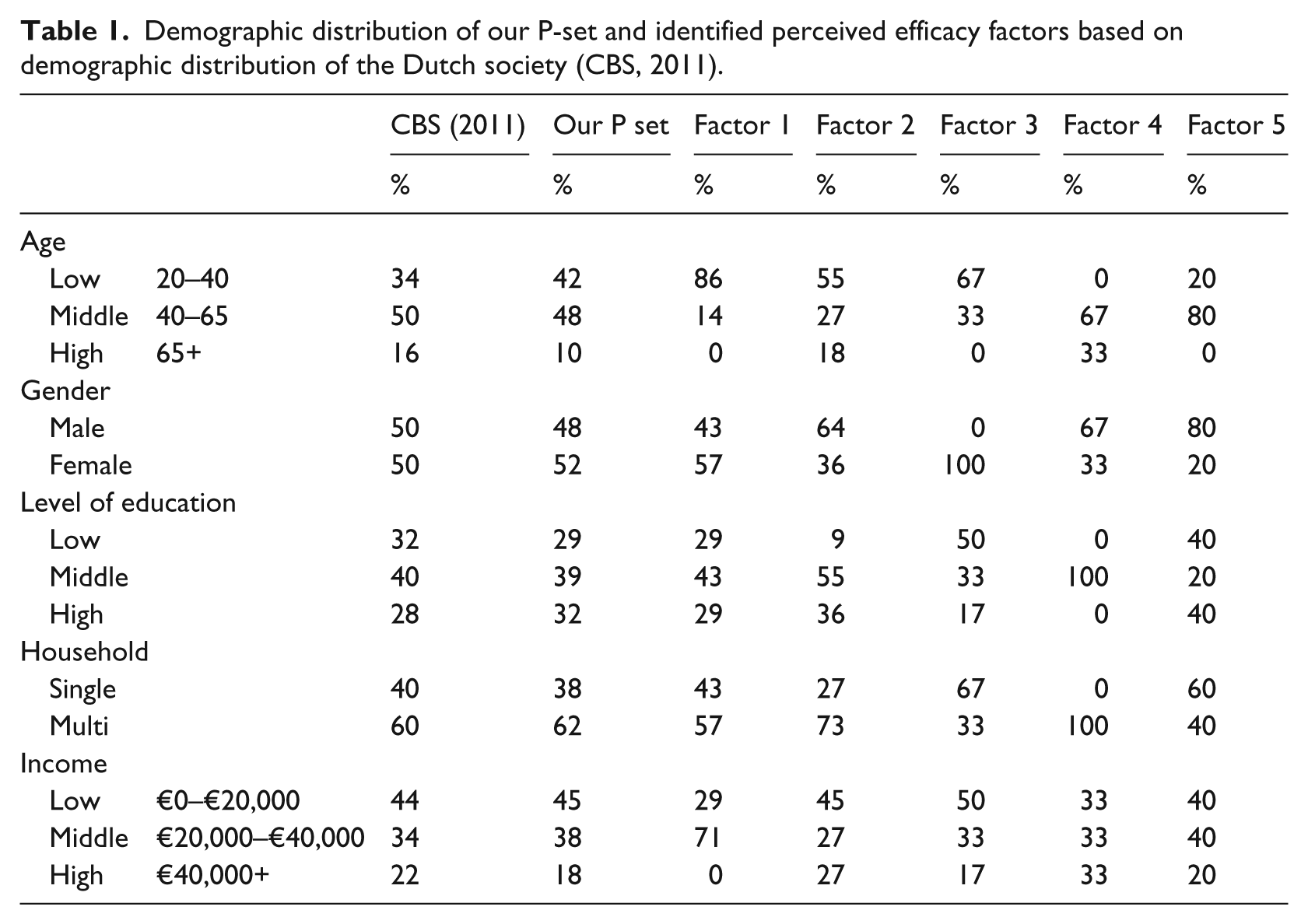
Participants were recruited by a marketing research company so together they resemble the average demographic of Dutch society (CBS, 2011). As we did not have any basis to assume that particular groups within society differ in level of being able to do something or their perception of being able to do something (efficacy beliefs) with regard to a bio-based economy, we aimed for a diversity among our participants based on demographic factors such as age, level of education, level of income, household composition, and gender (Table 1). We included only adults for participation as they are currently the ones who make choices relevant for a bio-based economy (e.g. in their shopping or mode of transport) and excluded individuals who work in bio-based-related branches (as we were of course interested in the engagement of those who are not professionally involved).
Demographic distribution of our P-set and identified perceived efficacy factors based on demographic distribution of the Dutch society (CBS, 2011).
In a face-to-face interview setting, 38 participants were provided with our set of 48 randomly numbered color printed images, a sorting grid and a step-by-step instruction guide (based on Exel and Graaf, 2005). For unraveling the perceived efficacy of the participants, they were asked to rank the pictures on a scale from the ones that made them feel most enabled (+4) to those that made them feel least enabled (−4) to act. Having completed the sort, participants were interviewed and invited to elaborate on their sortings focusing on the extreme ranked pictures. They were asked to describe the kind of action they perceived themselves (dis)enabled of performing and why. Participants were asked to record their own sort on a score sheet, so we gathered both quantitative and qualitative data.
6. Results
The Q sorts were analysed using factor analysis on the correlation matrix calculated from the participants’ Q sorts. This procedure identifies the number of natural groupings of Q sorts, based on the degree to which these sorts are similar or dissimilar to one another. Together with the interview data, these number of groupings can be interpreted as distinct views. We used PQ method 2.20 3 for the factor analysis applying Principle Component Analysis for the factor extraction and varimax for the factor rotation (see Table 2). These are common procedures with Q methodology. For the composition of idealised Q sorts for each factor, factor arrays were calculated (see Table 3). To decide on the number of factors to extract from the Q sorts, we used Goldberg’s (2006) method for visualizing the hierarchical structure of our data set (Figure 1). It showed that the data contained at least three factors. Based on a close inspection of the different factor solutions—taking into account which of the participants loaded on a factor defining that factor and the interview data—we selected the five-factor solution for their perceived efficacy beliefs. In total, 32 participants loaded onto a factor. These five factors explained between the 9% and 14% of the explained variance in Q sorts and collectively 53%. By interpreting these factors through an iterative process between the distribution of the pictures, the loaders and their interview data, they are converted into efficacy viewpoints.
Correlation coefficients of Q sorts for the five perceived efficacy factors.

A respondent defines (or loads) a factor if: the respondent correlates statistically significant with that factor; the loading of a respondent on a factor should exceed the multiplier for the statistical significance level (p = 0.01) divided by the square root of the number of statements, in this case: 2.58*1√48 = 0.37 (see McKeown and Thomas, 1988).
Factor array of the perceived efficacy belief sorts per factor.

Statements with the highest factor scores (−4, −3, 3, or 4) are called characterizing statements or that factor. Statements with a factor score that differs significantly between factors from other factors are called distinguishing statements for that factor (*p < 0.05; †p < 0.01). Statements that are not distinguishing between any of the identified factors are called consensus statements (‡p > 0.01).
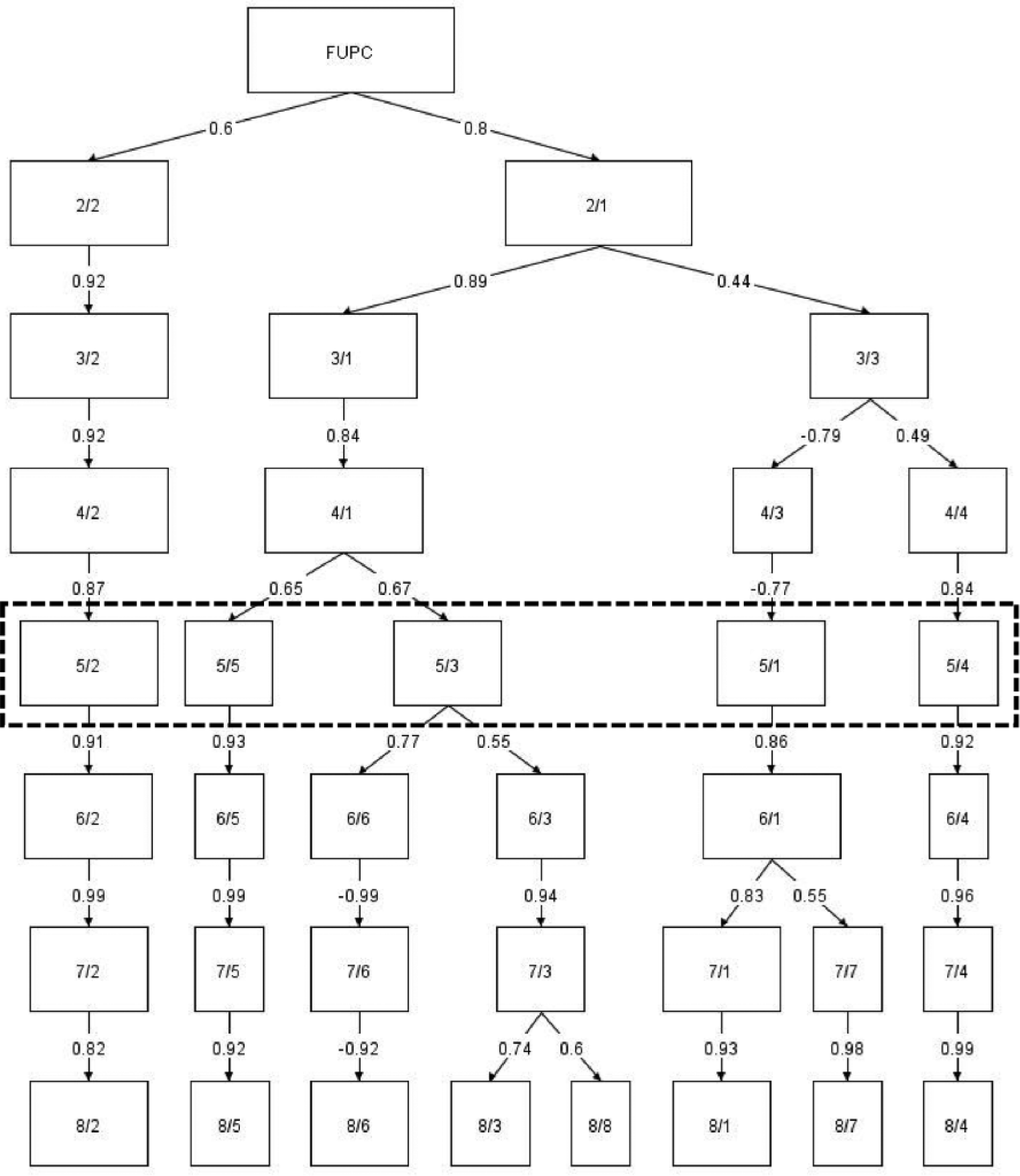
Factor diagram showing the hierarchical structure of the efficacy dataset (Goldberg 2006). Each row of the diagram shows the factor solution for the data (from separate analyses of the data) from one factor at the top to eight at the bottom. The boxes in each row represent individual factors, and the width of the boxes their percentage explained variance. The arrows between the boxes indicate the most important correlations between the different factor solutions and the numbers the corresponding correlation coefficient.
To what kind of engagement do participants consider themselves capable?
The five factors that resulted from the factor analysis were interpreted as five different beliefs on how participants see themselves capable of engaging with a bio-based economy (efficacy). The characterising pictures—those with the highest and lowest scores—and the pictures that distinguish most between factors are useful in interpreting a factor. Together with the interview data of the participants that significantly loaded onto a factor, we interpreted each factor. Below we describe each viewpoint.
Efficacy belief 1: Conscious shopping by …
Table 3 shows seven participants loaded on this factor. These are mainly younger participants with a lower to middle level income (see Table 1). Two participants have a negative correlation coefficient making this a bi-polar factor. This means that the participants with a negative correlation coefficient hold an opposite perspective to what is represented by this factor based on the positive correlating participants. Therefore, we present a twofold description for this factor.
(a) Conscious shopping by consumption.
Particiant quote: ‘I can help improving things by making conscious choices. This [biofuels] reminds me that even by fuelling up my car I can help our planet.’
These participants are willing to engage with a bio-based economy because they consider themselves capable of several personal actions through which they perceive they may positively contribute to a cleaner and more sustainable society. Their actions are mainly guided toward more sustainable consumption. They want to make efforts in the use of biofuels, green energy, and bio plastics but also consider action for recycling without the loss of current consumption or major behavior change. The food versus fuel discussion, and the possible unfair treatments of people living in developing countries involved, is of less importance for their engagement and no reason for them to reduce their consumption pattern. Consuming participants are aware of the possible negative consequences connected to biofuels development; however, they still consider it an improvement. The more complex and wider issues connected to a cleaner and sustainable society such as deforestation, air pollution, inequity, or reducing the greenhouse effect are discouraging for these participants. They feel that despite their individual contributions they will not halt or limit these developments.
(b) Conscious shopping by sacrifice. Participant quote: ‘Society is unable to take a step back; we say we agree with being more efficient and using less but we don’t act upon it.’
These participants are willing to engage with a bio-based economy because they feel this development will positively contribute to solving complex issues such as the reduction of carbon emissions and more sustainable sources of energy. They also consider themselves capable of several personal actions through which they perceive they may positively contribute to a cleaner and more sustainable society. However, their actions are mainly guided toward more conscious consumption, reducing their consumption pattern. These sacrificing participants think that they can make a difference with their personal actions by consuming less or paying more for specific products. At the same time, they are discouraged from engaging with the transition because they believe that people will not be able and willing to downsize their consumption pattern to make a difference. They do not think that society is willing to drive smaller, more compact and economically friendly cars, use biofuels, or eat less or no meat.
Efficacy belief 2: Saving the world despite the technical terms
Participant quote: ‘These protesting people against the forest & climate disaster due to the production of biodiesel make me feel I have to become a member of Greenpeace too.’
Table 3 shows 11 participants loaded on this factor. These are mainly middle to higher educated male participants (Table 1). These participants are prepared to engage with the bio-based economy because of the anticipated negative consequences of its development such as the destruction of nature, unfair treatment of people from developing countries, and an increase of greenhouse gas emissions. By taking personal actions such as protesting, donating money, purchasing environmentally friendly products, or collecting frying oil for recycling, they consider themselves able to avert these negative consequences. Concurrently, these saving the world participants are discouraged to engage with a bio-based economy because of the technical and chemical aspects involved in its establishment. They consider such bio-based processes and innovations as the work of experts that work in industry and factories. They feel unable and powerless to influence or have control over them. Participants claim they lack sufficient understanding thereof to be able to make a meaningful contribution.
Efficacy belief 3: Recycle to …
Factor 3 is also a bi-polar factor. There are three people who have positive correlation coefficients for this factor and three who have negative correlation coefficients (Table 3). All significantly loading participants are women who are mainly low educated and have a single household (Table 1).
(a) Recycle to be like nature.
Participant quote: ‘Even if we close the loops in our processes we will be unable to prevent destruction.’
These participants are eager to engage with the bio-based economy because of its cyclic character. They are attracted by the idea that this new approach to the economy is part of a natural process in which loops are being closed. The conversion of biomass into different sorts of energy and products enhances the success of their personal contributions. They consider recycling as something that everybody should be able to do, for closing their own loops. On the other hand, the to be like nature participants feel that with recycling they are not able to avert negative consequences such as the destruction of nature and stealing food and the living environment of other people and animals.
(b) Recycle to prevent disaster.
Participant quote: ‘We should alert other people to more environmentally friendly behaviour such as recycling too.’
For these participants, the negative aspects of a bio-based economy trigger them to recycle. They believe that if we all make more conscious decisions, we can avert the negative consequences. They are even willing to encourage others to do the same. They feel that recycling is one of the things they can do to help avert the further destruction and pollution of our environment. For them, the extra emphasis on the closing of product loops and recycling is unnecessary. They feel it should be something that is natural to everybody to do. Preventing disaster participants are discouraged to engage because they question how they can be sure about the nature and environmental friendliness of the products they use and recycle. They feel they lack sufficient information to make well-informed decisions.
Efficacy belief 4: Filling my car with the “right” fuel
Participant quote: ‘I can reduce the use of fossil fuels by making the conscious choice for using bio-fuels. I am the one who determines where I fuel up my car.’
Table 3 shows three participants loaded on this factor. These are all middle educated, having a more person household, middle to older aged participants (Table 1). These participants are willing to engage with a bio-based economy because of the production of biofuels. They feel capable to carefully select the type of fuel they use, reducing their fossil—non-renewable—fuel consumption. They believe that by choosing wisely they contribute to preventing further pollution of the environment and rapid depletion of fossil fuels. The outlook that even a bio-based economy, with biofuels, could still pollute the environment is demoralising for them as they perceive this to be a practice they cannot influence.
Efficacy belief 5: System limits personal contribution
Participant quote: ‘Noting I do will make a difference, money and economy play the major part here.’
Table 3 shows five participants loaded on this factor. These are mainly middle aged, single living males that have received either lower or higher education (Table 1). This behavioral perspective is focused on the system people inhabit. A participant’s inclination to engage or not is connected to the extent they feel they have control over the system or not. System limits participants feel able to contribute to the bio-based economy by making small changes in their behavior such as buying bio-plastics, reducing their personal energy consumption, driving on biofuels, and paying attention to the amount of packaging of the products they purchase. With their personal actions, participants perceive they can positively contribute to the transition to a bio-based economy. On the other hand, they feel unable to contribute to the development of a bio-based economy due to the scale of its development and the occurrence beyond their sphere of influence. They do not believe voting for specific political parties would make a difference.
7. Discussion
The hierarchical factor structure (Figure 1) and the factor interpretations show that participants with a “saving the world” efficacy belief immediately stand out. These participants’ belief in being able to engage with a bio-based economy is triggered by representations of the negative consequences of a bio-based economy. Such representations have been found to arouse negative feelings of unfairness, inequality, and frustrations because of cruel acts against animals and nature (Sleenhoff et al., 2014). Because of these negative feelings, these participants are spurred into action. Here, they differ from the other factors where such representations made participants feel unable to make a meaningful contribution.
Our empirical results seem to partially contradict findings of O’Neill and Nicholson-Cole (2009), Hoijer (2010) and Moser and Dilling (2004) who argued that using or addressing negative emotions for engagement is more likely to disengage or make the public indifferent toward the issue. Moser and Dilling (2007) claim that negative emotional appeals can only be effective when there are sufficient supportive conditions that enable individuals to engage in a desired way, which reinforces their self-identity. Our approach allowed for participants to formulate what their desired way to engage was. Through sorting the images, participants constructed a context they could relate to and in turn, this created a perspective for them on how to act.
With the transition to a bio-based economy, different issues of industrial biotechnology, sustainability, climate change, and the environment melt together for public engagement. This can explain the two-sided negative emotional response of the “saving the world” participants. They are frustrated about how this transition deals with the environment and its sustainability aspects, enhancing their perceived efficacy. On the other hand, the “saving the world participants” felt unable to engage with the transition because of its more technical aspects and their perceived lack of knowledge thereof. Here, the supportive conditions for their engagement were missing.
The “saving the world” belief also adds empirical evidence for Roeser’s (2012) point about the necessity of emotions for practical and moral decision-making with regard to issues of risky technologies or climate change. The participants that significantly load onto this factor show how experiencing moral emotions such as fairness or equality—which are considered as a form of cognition or insight—can motivate people to engage. These participants reported they considered themselves more inclined to participate in demonstrations, donating money to NGOs and buying more environmentally friendly products.
The hierarchical factor structure (Figure 1) and the factor interpretations further show a distinction between the “recycle to” and “system limits” efficacy beliefs, on the one hand, and the “conscious shopping” and “filling my car” on the other. Participants with one of these four efficacy beliefs consider themselves capable through more positive representations whilst more negative representations make them feel less capable or even incapable of contributing to a bio-based economy. 4 Despite this commonality across beliefs, participants differ in the size in which they perceive the context of their engagement.
Participants with a “Conscious Shopper” and “Filling my car” belief regard their level of engagement as the personal actions they can undertake and control. They are more focused on the different means through which they can take personal responsibility on an individual level. In contrast, participants with a “recycle to” and “system limits” belief tend to regard their efficacy more on the systems level they inhabit. They perceive their engagement on a society or economic level which is a higher aggregation level than that of the former two beliefs. These participants’ efficacy beliefs are more focused on the changing context of the transition and to what extent their behavior can influence that development.
The difference between the two distinct lines of efficacy beliefs seems to correspond with the differences between personal and collective efficacy (Bandura, 1995, 2000). Where personal efficacy is about the belief in one’s own capabilities to organize and execute the course of actions toward a desired outcome, collective efficacy concerns a group’s shared belief in collective power to produce desired results. These beliefs will influence the types of future participants seek to achieve, how much time and effort they are willing to invest and to what extent they will interact with others to coordinate their activities for collective action.
These five senses of efficacy have further implications for meaningful collective public engagement as personal efficacy is a strong indicator for concurrent and future behavior (Milne et al., 2000). Our results indicate that there are commonalities in the demographic backgrounds of the participants per factor. This suggests that particular groups within society could be identified based on their demographic background. However, as Cormick and Romanach (2014) argue, segmentations of the public based on their values toward science and technology provide greater insight in how they engage than on those based on demographics. And identifying people based on their behavior is also problematic since our results show that participants name similar actions they consider themselves capable of. However, they differ in their motivations for doing so. Meaningful public engagement can not only be determined by the way people act. The emotions people have toward the transition (Sleenhoff et al., 2014) and other personal and social characteristics will also influence their engagement (Lorenzoni et al., 2007).
Prior to exploring participants’ efficacy beliefs, we also unraveled their emotional views, since taking emotions into account is expected to enhance public engagement (Pidgeon and Fischhoff, 2011; Roeser, 2012). In this earlier study, we found four emotional views among our participants: compassionate environmentalists, principled optimists, hopeful motorists and cynical environmentalists (Sleenhoff et al., 2014). As emotions underlie motivation and behavior, connections between the different beliefs are expected to be found. However, we were not able to determine a significant correlation between people’s emotional views and their perceived efficacy beliefs. Nevertheless, from the descriptions of the different emotional views and efficacy beliefs, it is apparent that there are connections between them. For instance, participants with a “saving the world” belief have been found to have either a “compassionate,” “principled,” or “cynical” view. For these participants, their concerns toward the environment, and fairness connected to their envisioned bio-based economy, are likely instigating their belief for this action. However, a more detailed discussion of possible correlations between participants’ emotional views and efficacy beliefs fall beyond the scope of this article. More research is needed to more closely look into how the link between these two aspects for people’s engagement is forged.
8. Conclusion
This article shows what efficacy beliefs participants develop through the interaction with stakeholders’ representations of a bio-based economy. The aim of this study was to explore in what way such representations would engage the public. We applied Q methodology using stakeholders’ visual representations and found five efficacy beliefs. These create insight into how, besides the public’s awareness, they believe themselves (in)capable of making a meaningful contribution to the transition. The different efficacy beliefs show that the public connects with this transition in distinct and shared ways. It also shows how their contributions could add to more collective action and support for a bio-based economy through purchasing and recycling behavior.
Taking into consideration the current results, current practices of public engagement with a bio-based economy and stakeholders’ interpretation thereof show a discrepancy. Stakeholders mainly want to engage the public for two reasons: their support is perceived to be necessary to their role as consumer (Zachariasse et al., 2011), and they need to be aligned to legitimize the current shaping of the bio-based economy (Commission, 2012; Paper, 2007: 13). However, our results show that members of the public foresee different ways and levels in how they should engage with the transition. These public ways to engage do not always concur with how stakeholders perceive they will engage, for instance, when members of the public want to make a meaningful contribution by consuming less. And our results also indicate the public wants to engage in ways that are not welcomed by the predominant stakeholders of industry, policymakers, and scientists, by voicing their concerns through supporting public protests or donating money supporting such initiatives. The representations and approaches that members of the public build based on stakeholders’ representations do not obviously match with stakeholders’ vision and approach to a bio-based economy.
Our findings call for further discussion about in what way members of the public should be engaged with the transition to a bio-based economy. In what way can interaction for meaningful engagement between members of the public and stakeholders be created? Another interesting subject for further study would be to see if people actually engage with the transition as they would do based on their found efficacy and whether that contribution is meaningful. Further work is necessary to examine the relation between peoples’ emotional views toward a bio-based economy and perceived efficacy belief.
This research was conducted in response to the call for more meaningful collective action and support that includes the public, with regard to the transition to a bio-based economy (Sleenhoff et al., 2015). We have shown that people believe there are different ways to engage with this transition, based on stakeholders’ visual representations of a bio-based economy. Stakeholders should be more aware of the implications and effect of their own representations for public engagement, because it is most likely members of the public will encounter these representations when they start familiarizing themselves with its development. This analysis also sheds light on the methodological uses of how visual social representations engage the public by developing different modes of efficacy toward a bio-based economy alongside their personal representations. This should be taken into account for meaningful public engagement and different forms of collective action for a more bio-based economy.
Footnotes
Acknowledgements
The main author would like to thank two anonymous reviewers for their helpful comments to an earlier version of this article; Dr Eefje Cuppen, Dr Laurens Landeweerd, and Professor Peter Verheijen for their valuable support to the research that resulted in this article.
Funding
This article is the result of a research project of the CSG Centre for Society and the Life Sciences, carried out within the research program of the Kluyver Centre for Genomics of Industrial Fermentation in The Netherlands, funded by the Netherlands Genomics Initiative/Netherlands Organization for Scientific Research.
Supplementary materials
A copy of the imagery used in this study can be retrieved by contacting the corresponding author.