



Abstract
News value theory rates geographical proximity as an important factor in the process of issue selection by journalists. But does this apply to science journalism? Previous observational studies investigating whether newspapers preferentially cover scientific studies involving national scientists have generated conflicting answers. Here we used a database of 123 biomedical studies, 113 of them involving at least one research team working in eight countries (Australia, Canada, France, Ireland, Japan, New Zealand, the United Kingdom, and the United States). We compiled all the newspaper articles covering these 123 studies and published in English, French, and Japanese languages. In all eight countries, we found that newspapers preferentially covered studies involving a national team. Moreover, these “national” studies on average gave rise to a larger number of newspaper articles than “foreign” studies. Finally, our study resolves the conflict with previous conclusions by providing an alternative interpretation of published observations.
1. Introduction
Geographical proximity is widely considered by the theory of news value to be an important factor in the process of journalistic issue selection (Badenschier and Wormer, 2012). However, the relevance of this factor for science journalism is still questioned. Indeed, two surveys of German journalists reported conflicting results: the first found that the involvement of German scientists is a major selection factor while, according to the second one, it played no role (Badenschier and Wormer, 2012). Moreover, observational studies aimed at testing whether newspapers preferentially cover scientific finding involving national scientists have generated conflicting conclusions. On one hand, Bauer et al. (1995) reported that UK newspapers preferentially covered studies with a national team, but this study only investigated UK newspapers published before 1991 (Bauer et al., 1995). More recently, Fanelli (2013) investigated the coverage of scientific studies published in a single journal (PNAS, the United States) over 2 years (2008 and 2009) by Italian and British newspapers. Fanelli concluded, “newspapers in the two countries tended to over-represent local (national) research.” However, this quantitatively small study did not consider the intensity of the coverage but only whether a single study was covered or not (Fanelli, 2013). On the other hand, Einsiedel did not find a preferential coverage of local researches in the Canadian press (Einsiedel, 1992). Similarly, Bucchi and Mazzolini (2003) observed that the Italian press covered Italian and US researches equally and concluded that the international dimension of science predominated (Bucchi and Mazzolini, 2003). However, except for Fanelli’s study, these quantitative studies have not taken into account the fact that countries do not equally contribute to the scientific production. In a country with a small scientific sector, newspapers will mostly cover research findings that do not involve a national team in absolute terms but might strongly favor, in relative value, the very few findings which involve a local team.
Whether newspapers preferentially cover scientific findings involving national scientists is an important question regarding the relevance of the concept of medialization with respect to science. This concept encapsulates the changes in political processes that have occurred over recent decades in democratic societies. It theorizes the increasing role of the media within a number of related developments (Peters et al., 2008b). Several authors have looked at medialization with respect to science (Peters, 2012; Peters et al., 2008b; Rödder et al., 2012; Weingart, 1998). As outlined by these authors, the concept of medialization postulates a mutual and increasing orientation from science toward the media and reciprocally. According to this concept, scientists and their institutions have modified their activities in order to gain media attention. They suppose that this attention will (1) augment the public legitimation of science, (2) increase policy-makers’ awareness on issues judged important by scientists and (3) help secure funding.
The concept of medialization has been supported by surveys of scientists (Allgaier et al., 2013; Dudo, 2012; Dunwoody et al., 2009; Ivanova et al., 2013; Koh et al., 2016; Peters, 2012; Peters et al., 2008a), which show that researchers expect their investment in the media to result in positive outcomes for their careers and research funding. It is also in line with the development of public relations (PR) departments by scientific institutions (universities, research institutes, scientific foundations) in order to promote their own scientific products through press releases, press conferences, and active contacts with journalists (Palmer and Schibeci, 2014; Peters, 2012). Because most of the public support to research is national, this PR activity is aimed at attracting the interest of national or regional medias. A recent case study of 21 media documents covering neuroscience research (Lehmkuhl and Peters, 2016) showed that several of these articles highlighted a neuroscience finding because it involved a local team. However, quantitative studies concluding that geographical proximity plays no role in science journalism would constitute, if confirmed, a very strong argument against the relevance of medialization with respect to science.
In order to clarify this issue, we used a database of scientific articles associating risk factors with 10 pathologies and that were covered by English-language newspapers (Dumas-Mallet et al., 2017). We identified the countries of the scientific teams involved in each study and collected the newspaper articles covering these studies in English, French, and Japanese languages published in eight countries: Australia, Canada, France, Ireland, Japan, New Zealand, the United Kingdom, and the United States. Then, we tested whether national newspapers preferentially covered studies involving national scientists.
2. Methods
Selection of studies
We selected studies from a database of 161 biomedical studies associating risk factors with three neurological diseases (Alzheimer and Parkinson’s disease, multiple sclerosis), four psychiatric disorders (attention deficit hyperactivity disorder, autism, major depressive disorder, and schizophrenia), and three somatic diseases (breast cancer, glaucoma and rheumatoid arthritis) (Dumas-Mallet et al., 2017). From these 161 biomedical publications we only considered (1) studies covered by at least one newspaper article published in one of the eight countries considered here and (2) studies published in 2000 or later. Studies published before 2000 were not considered because their media coverage, identified using Dow Jones Factiva, was incomplete. Indeed, before 2000, Dow Jones Factiva mainly sourced newspapers distributed in the United States and few from other English-speaking countries. After 2000, this web source more extensively included the daily press in Australia, Canada, Ireland, New Zealand, the United Kingdom, and the United States. Therefore, we selected 123 studies that are listed in supplementary information (http://pus.sagepub.com, Text S1).
Newspaper coverage
The coverage of these 123 studies by English-written newspapers published in Australia, Canada, Ireland, New Zealand, the United Kingdom, and the United States was already collected from Dow Jones Factiva (Dumas-Mallet et al., 2017). This coverage was checked again and a few newspaper articles were added. The coverage of these 123 studies in French and Canadian newspapers written in French was collected using the Europresse database as previously described (Dumas-Mallet et al., 2017). Briefly, the following keywords were used in each search: “chercheur* OR scientifique*.” Each search also used specific keywords that included the name of the pathology, one or several keywords that characterized the study (e.g. “gene”) and was restricted to 1 month after the publication date of the study. The same search strategy was used to investigate the coverage of these 123 studies by four Japanese newspapers: Yomiuri Shimbun, Asahi Shimbun, Mainichi Shimbun, and Nippon Keizai Shimbun. They are the four most popular dailies in Japan with a 2017 circulation number ranging from 2,625,000 to 8,733,000. Due to the absence of an online service gathering together all Japanese newspapers, the search was limited to these four newspapers and used each newspaper’s online database.
Country of publication
Because international newspapers (e.g. International New York Times) were not considered here, each newspaper was unequivocally associated with a specific country. For each scientific study, we considered two levels of association with a country. At the first level, we used the authors’ affiliation list mentioned in each study to identify the country in which each research team was working. Therefore, studies involving international collaborations were associated with several countries. At the second level, we only considered the country in which the corresponding author was affiliated. Indeed, we assumed that even in a study involving international collaborations, there is a leader team that usually includes the corresponding author. Thus, at this second level, each study was unequivocally associated with one country.
In five cases, newspaper articles simultaneously covered two scientific studies that investigated the same question and were published the same day in prestigious journals. Therefore, the newspaper coverage of these 10 studies consisted in the addition of newspaper articles covering just one study plus those also covering both studies.
Data analysis
For each country, we calculated two indexes. The first only considered whether a study was covered or not. It compared for each country the share of studies covered by newspapers among all studies involving a national team to the share of studies covered by newspapers among all studies without any national team. To quantify possible differences between both shares, we calculated their relative ratio (equivalent to a relative risk in medical studies). To determine whether this ratio statistically differed from unity (i.e. the null hypothesis), we calculated the 95% confidence intervals using the MEDCALC online calculator.
The second index compared for each country the average number of newspaper articles covering studies involving a national team to the average number of newspaper articles covering studies without any national team. Both indexes were calculated again when considering the unequivocal association of each study with a country using the affiliation of the corresponding author.
3. Results
Data overview
Our search for the newspaper coverage of these 123 association studies retrieved 1416 distinct newspaper articles. Among them, 1286 articles reported on only one scientific study and 130 simultaneously covered two studies. All together, these 130 newspaper articles covered five pairs of studies. No newspaper article covered more than two studies. Taking into account two times the 130 newspaper articles that simultaneously covered two studies, it follows that the 123 studies in our database attracted the interest of 1546 newspaper articles. The number of newspaper articles published in each country and covering each of the 123 associations studies is given in supplementary information (Table S2).
The 123 association studies considered here where distributed as follows:
63 studies only involving researchers from one of the eight countries considered here (712 newspaper articles).
10 studies performed by scientists outside these eight countries (66 newspaper articles).
50 studies performed by international collaborations (768 newspaper articles).
Preferential coverage of national studies
For each country, most studies involving a national team attracted the interest of at least one newspaper published in the same country. In contrast, newspapers less often covered studies without a national team involved (Table 1). This difference reached a high degree of statistical significance for all the countries tested except for Ireland, despite huge differences in absolute values (Table 1).
Preferential coverage of studies involving a local team.
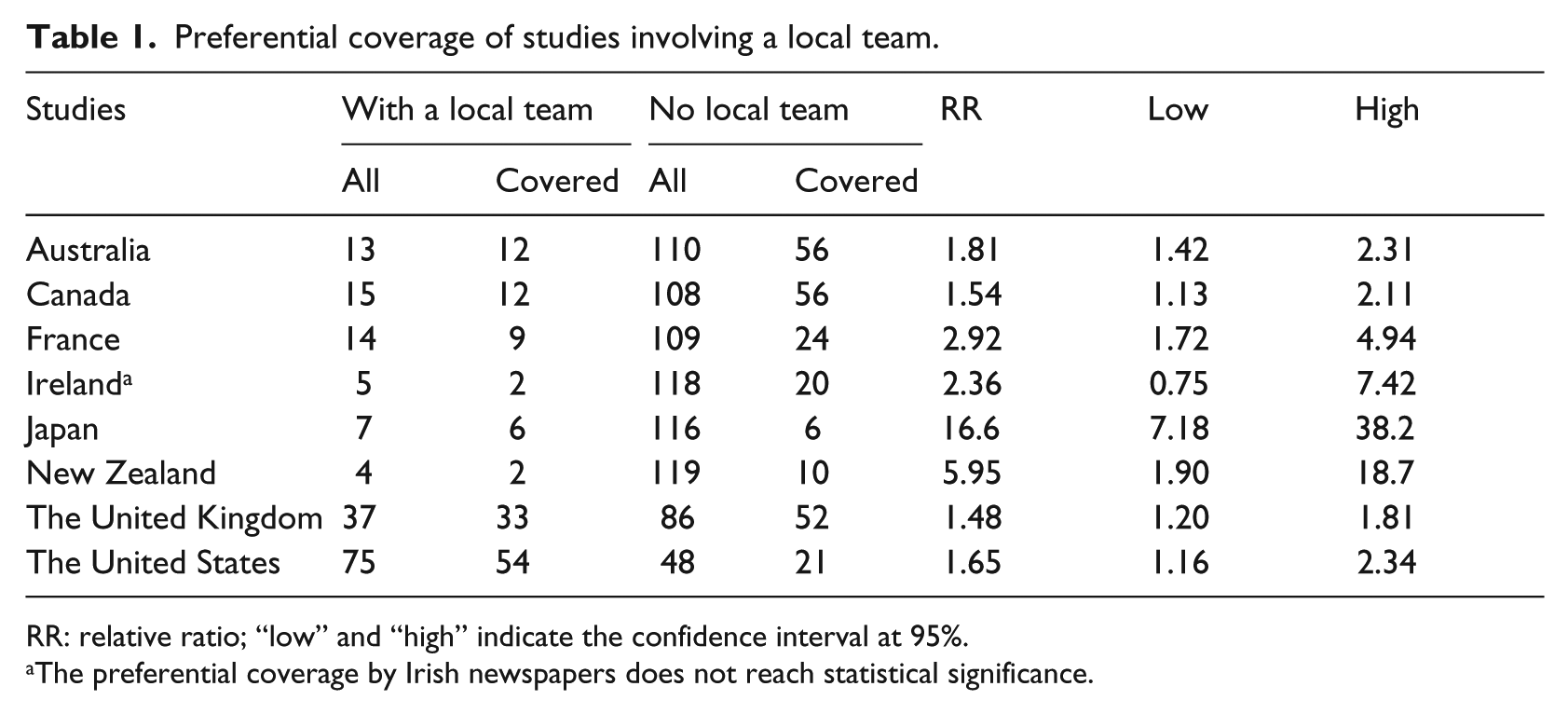
RR: relative ratio; “low” and “high” indicate the confidence interval at 95%.
The preferential coverage by Irish newspapers does not reach statistical significance.
The same difference in coverage is also observed when each study is unequivocally associated with a specific country on the basis of the address of the corresponding author (Table 2). It should be underlined that of the 123 studies in our database, 98 were associated with one of the eight countries considered, whereas the address for correspondence of the 25 others mentioned a country not investigated here (Table 2). Ireland and New Zealand were excluded from this analysis because they included either no or only one national study, respectively.
Preferential coverage of studies with a corresponding address in the same country.

RR: relative ratio; “low” and “high” indicate the confidence interval at 95%.
Coverage intensity: National studies versus foreign studies
For this second level of analysis we compared, for each country, the average number of newspaper articles covering studies involving a national team to that of newspaper articles covering studies without any national team (Figure 1a). For all but one country, the average number of the former exceeded that of the latter (Figure 1a). The only exception is France and this is due to the atypical coverage of just one out of 26 foreign studies covered by French newspapers. Indeed, this 2004 study, associating hepatitis B vaccination with multiple sclerosis (Hernan et al., 2004), has been covered by 34 French newspaper articles. This study was also covered by 10 newspaper articles published in three other countries. Therefore, the French coverage of this specific study far exceeded the average of the coverage by any other country. 1 When this atypical coverage is not taken into account, the average number of French newspaper articles covering studies with a national team (3.56) exceeds that for the coverage of foreign studies (2.70).
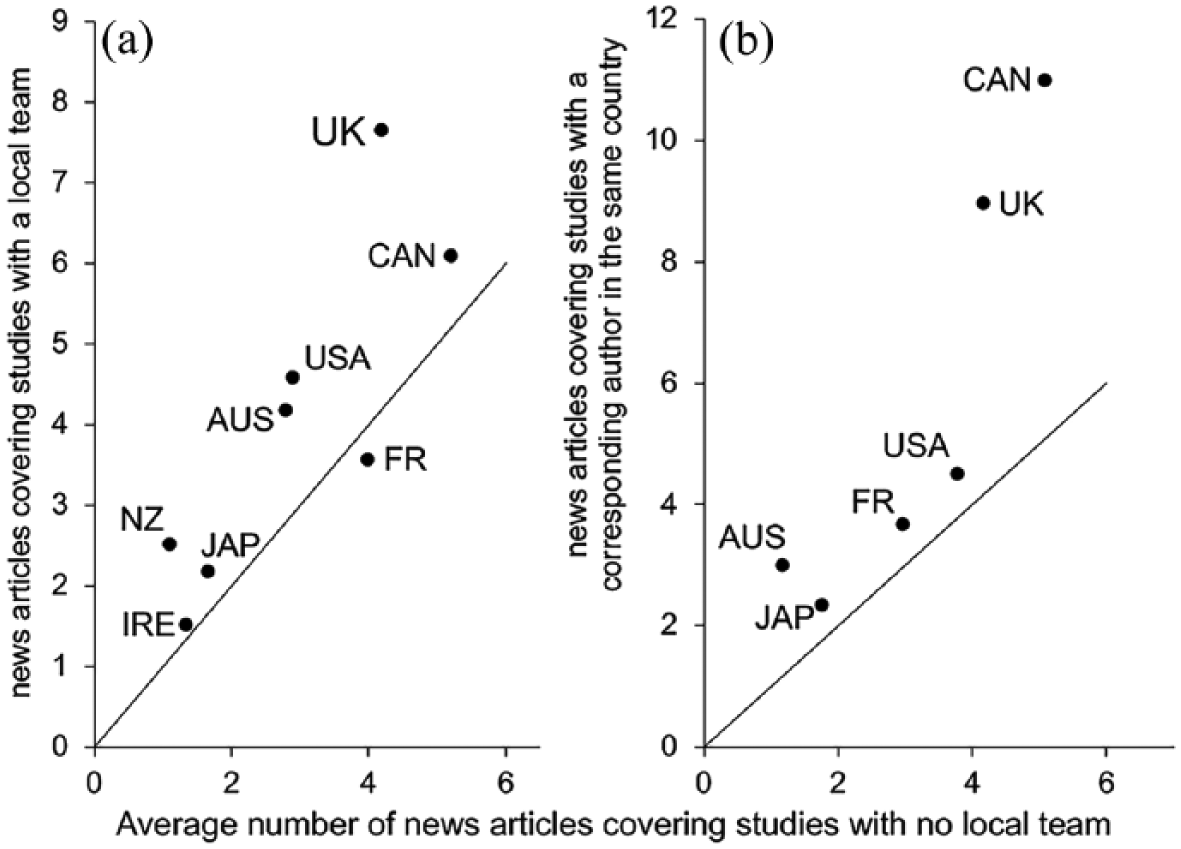
Average number of newspaper articles covering association studies: (a) For each country, the vertical axis shows the average number of newspaper articles covering a study involving national scientists whereas the horizontal axis indicates the average number of newspaper articles reporting a study without national scientists. (b) Similar data presentation of the coverage of studies unequivocally linked to a country on the basis of the address of the corresponding author (vertical axis) versus that of foreign studies. Data for Ireland and New Zealand are excluded because the number of observations is too small.
The same comparison was performed again when each study was unequivocally associated with a single country on the basis of the address of the corresponding author (Figure 1b). For this analysis, data from Ireland and New Zealand were again excluded because they included either no, or only one national study, respectively. Regarding the six remaining countries, the average number of newspaper articles covering a national study always exceeded that for foreign studies (Figure 1b).
4. Discussion
Our observations support the view that newspapers preferentially cover biomedical studies that involve national researchers. First, these studies tend to be more frequently covered than studies without national researchers. Second, they generated a higher number of newspaper articles than the latter. Both differences are also observed when considering the unequivocal association of a study with only one country on the basis of the address of the corresponding author. Therefore, in accordance with the theory of news value (Badenschier and Wormer, 2012), science journalism does not differ from normal journalistic practice with regard to the influence of geographical proximity on issue selection.
Two previous studies defended the opposite conclusion, that is, no preferential coverage of national studies (Bucchi and Mazzolini, 2003; Einsiedel, 1992). Although both studies investigated the press coverage of science in general, they can be compared to this study because they mainly examined newspaper articles covering biomedical findings (50% and 80%, respectively). Einsiedel (1992) studied seven Canadian newspapers published in 1987 and concluded, in the Canadian context particularly, the remoteness of science is characterized by its occurrence in other places (and especially its frequent occurrence in the US). Interestingly, science coverage appears to go against the normal journalistic practice of emphasis on the local angle.
In absolute terms our observations are in line with these previous results: Canadian newspapers covered 12 studies involving a local team and 56 studies that did not involve Canadian researchers. However, our interpretation is based on the relative coverage: Canadian newspapers covered 12 out of 15 studies involving Canadian scientists, but only 56 out of the 108 studies without Canadian researchers. Similarly, Bucchi and Mazzolini (2003) analyzed the content of one major Italian newspaper from 1946 to 1997. Because an almost identical number of science stories “referred to the United States and to Italy,” the authors concluded that, in the Italian press “as in Canada, the international dimension of science stories also seems dominant.” Although we did not investigate Italian newspapers, it is likely that the Italian case would be similar to the French one: a preferential coverage of studies involving national scientists, in relative terms, but a weaker coverage in absolute value.
Although our quantitative observations are in line with previous ones, our interpretation questions the conclusions proposed by Einsiedel (1992) and by Bucchi and Mazzolini (2003). Both studies investigated in Canada and Italy newspaper articles covering scientific studies “referred” to each country versus those covering studies “referred” to the United States. The reverse study, that is, the coverage by US newspapers of US studies versus that of Canadian or Italian studies, would show a completely different picture: a massive preferential coverage of US studies by US newspapers in absolute terms. This points out that comparisons in absolute values are not relevant. Our approach in relative terms shows that, in the eight countries considered, national newspapers preferentially cover association studies involving a national team.
Except for Japan, we observed no major differences between countries regarding both indexes expressing this national preference although these seven countries differ widely in terms of population size and scientific production. The preference of Japanese newspapers for studies involving Japanese scientists seems much greater than in the seven other countries. This might result from language difficulties. Indeed, newspaper articles reporting on biomedical findings often quote their scientific authors (Dumas-Mallet et al., 2018). Japanese journalists might face difficulties in interviewing foreign scientists. This interpretation exemplifies the view that practical factors might contribute to the preferential coverage of biomedical findings involving national scientists. National scientific institutions might also contribute to this preferential selection through their PR professionals who publish press releases, organize press conference, and maintain a network of “loyal” journalists by offering them access to exclusive materials (Bauer and Gregory, 2007). Moreover, because journalists are under time-pressure, they increasingly rely on these press releases and other source materials prepared by scientific institutions (Bauer and Gregory, 2007; Peters, 2012). Although our observations suggest that these PR efforts are rewarded, we provide no direct evidence that science journalists willfully select national studies in the aim of promoting them.
5. Limitations
We investigated the newspaper coverage of biomedical studies associating a risk factor with 10 pathologies. It is likely that our conclusion would also hold true regarding the coverage of other types of biomedical studies. The generalization of our conclusion to other scientific domains is more uncertain and remains to be tested. We only investigated general newspapers and ignored other influential media types: television programs and online media. Indeed, when dealing with biomedical information, television programs rarely cover specific studies that can be unequivocally identified (Bourdaa et al., 2015). Therefore, this prevented us from considering them in the context of this study. However, it is likely that the selection of newsworthy issues by television editors is influenced by newspapers. It is also of note that newspaper articles are highly visible on the web. Therefore, despite the decline of newspapers in terms of circulation numbers and the growing impact of new media, much of the scientific information received by the public still originates from traditional journalism (Leshner et al., 2017).
The 123 association studies considered here were selected following a three-stage process. In the first one, all meta-analyses associating a risk factor with 12 pathologies and published from 2008 to 2012 were selected. This selection retrieved 663 meta-analyses reported in 306 distinct scientific articles (Dumas-Mallet et al., 2016). The second step identified the 4723 primary articles that reported data included in these 663 meta-analyses (Dumas-Mallet et al., 2017). Therefore, the geographical distribution of the research teams involved in these 5029 scientific articles reflected that of scientific production and, at both steps, the selection process was not flawed by geographical bias. The third step identified among these 5029 scientific articles those covered by English-written newspapers. This search identified 156 primary studies and five meta-analysis articles (Dumas-Mallet et al., 2017). It ignored studies covered by non-English-language newspapers. From these 161 articles, we considered here the 123 studies published from 2000 to 2012 and covered by newspapers published in eight countries. Therefore, we neglected the few primary studies that might have been covered either in French or Japanese language by newspapers in Canada, France, and Japan and that have not been covered by English-written newspapers. If such studies exist among the 4868 scientific articles not covered by English-written newspapers, this geographical bias does affect our observations. However, the expected direction of the effect resulting from this possible bias is in favor of our interpretation. Indeed, among the 26 studies only covered in a single country (Australia, Canada, Ireland, New Zealand, the United Kingdom, and the United States), 17 involved researchers from the same country. It is likely that this preferential coverage would also hold true regarding possible studies only covered by French or Japanese newspapers and possibly missed by our search process. Therefore, if these unidentified studies were included in our database, the preferential coverage of national studies by national newspapers would be even more prominent.
6. Conclusion
Several surveys have shown that scientists increasingly interact with journalists and that they expect a positive outcome from these interactions regarding their career and research funding. Moreover, over recent decades, scientific institutions have widely developed their PR departments in order to promote their own scientific production (Peters, 2012). But are these efforts to gain media attention rewarded? A positive answer would imply that each national media would preferentially cover scientific findings involving researchers from their respective country. However, previous observational studies testing this prediction came to contrasting conclusions: two studies supported this preferential coverage while two others defended its absence. This study strongly supports the view that newspapers preferentially cover research results involving a national team. Moreover, it resolves the conflict between previous conclusions by providing an alternative interpretation of published observations.
When re-examined in the light of the present analysis, all published data lead to the conclusion that, as for other journalistic domains, science reporting emphasizes “local” news. This conclusion opens up several questions. Besides newspapers, do other media types also favor national research? Are newspapers prone to hyping research involving national scientists more than foreign studies? The concept of medialization implies that science’s institutions are increasingly oriented toward the media. This dynamic feature raises the following question: has the preferential coverage of scientific findings involving national scientists increased over recent decades? These questions deserve further investigation.
Supplemental Material
Table-S2 – Supplemental material for Do newspapers preferentially cover biomedical studies involving national scientists?
Supplemental material, Table-S2 for Do newspapers preferentially cover biomedical studies involving national scientists? by Estelle Dumas-Mallet, Aran Tajika, Andy Smith, Thomas Boraud, Toshiaki A. Furukawa and François Gonon in Public Understanding of Science
Supplemental Material
Text_S1 – Supplemental material for Do newspapers preferentially cover biomedical studies involving national scientists?
Supplemental material, Text_S1 for Do newspapers preferentially cover biomedical studies involving national scientists? by Estelle Dumas-Mallet, Aran Tajika, Andy Smith, Thomas Boraud, Toshiaki A. Furukawa and François Gonon in Public Understanding of Science
Footnotes
Funding
The author(s) received no financial support for the research, authorship, and/or publication of this article.
Notes

Author biographies
References
Supplementary Material
Please find the following supplemental material available below.
For Open Access articles published under a Creative Commons License, all supplemental material carries the same license as the article it is associated with.
For non-Open Access articles published, all supplemental material carries a non-exclusive license, and permission requests for re-use of supplemental material or any part of supplemental material shall be sent directly to the copyright owner as specified in the copyright notice associated with the article.
