




Abstract
In this work, using experiments, we investigate the role of the name of a technology on the informed evaluation of that technology. We argue that a name can influence interpretations by activating cognitive structures. Using genomics-accelerated breeding as a case, we show that the name ‘genomics’ makes people evaluate related information as similar to genetic modification. Replacing the name ‘genomics’ with ‘natural crossing’ causes evaluations similar to those for traditional breeding. The results show that a name can have a strong influence on public attitudes, and we call for more consideration in choosing a name for a technology.
1. Introduction
In recent years, science communication has become an important part of the introduction of different applications of genomics in society (Bos et al., 2010; Mogendorff et al., 2015; Pin and Gutteling, 2008). We have chosen genomics because public knowledge about this subject is still very limited (Sturgis et al., 2010). In addition, the name ‘genomics’ influences people’s perception of the technology, according to reports of scientists communicating about it. According to these reports, people spontaneously believe that genomics is the same as genetic modification (GM; Hall, 2010; Van Dam and De Vriend, 2002) and are hard to convince otherwise (Hall, 2010), even though the technology is in many ways similar to traditional breeding (Van Den Heuvel, 2008). The belief that genomics and the controversial GM are the same is significantly hampering the developments of the new technology and its products (Hall, 2010).
Within science communication and related fields, there has been some attention focusing on what resources people might use when they lack appropriate or specific knowledge to evaluate a technology (Bucchi, 2008). Several alternatives have been proposed, including general scientific knowledge (Scheufele and Lewenstein, 2005), risk perception relating to other technologies (Bredahl et al., 1998) and existing attitudes (Grunert et al., 2003). Although these alternatives can substitute specific knowledge when a person is making an initial evaluation, something more is needed to explain how the evaluation is reached when the person does not have any specific knowledge about what he or she is evaluating. What remains unclear is what exactly will determine which particular knowledge, risks or values are believed to be applicable and used in the evaluation. For example, will a person use attitudes towards biotechnology or towards asbestos to evaluate nanotechnology for food purposes?
An important feature of a technology is its name. Indeed, in several reports described below, indications can be found that for certain technologies the name of the technology plays an important role in its evaluation by the public. From these reports, a pattern emerges: to respond to an unfamiliar technology, people use a technology with which they are familiar and which appears related in name. This behaviour has been most notably observed in the fields of nanotechnology and genomics-accelerated breeding, where researchers indicate that people confuse their technology with another, assumingly similar, technology because of the name, and that controversies are transferred even though they might not apply. With respect to nanotechnology, several authors have mentioned that people tend to link nanotechnology with asbestos, a dangerous nanoparticle, and subsequently reject nanotechnology in general (including safe variants) and related applications (Currall et al., 2006; Kampers, 2009; Macoubrie, 2008). In the field of genomics, it has been reported that people believe that genomics is equal to genetic modification, which is regarded as controversial by many, making the evaluation of genomics unfavourable because of controversies that apply to GM (Hall, 2010; Van Dam and De Vriend, 2002). The reports point to people asking themselves ‘What is this technology?’ and using the name to form an answer that is not necessarily right.
In this article, we test the influence of expectations caused by the name of a technology in interaction with information provided about the technology. More generally, we argue that a name can determine which cognitive structures present in a person’s mind will be used for evaluations. In addition, we assert that pre-existing cognitive structures serve as a basis for further interpretation and learning, and that this provides an explanation for the stability of existing attitudes when new information is presented. Using the relatively new practice of genomics accelerated breeding as a case, we study in an experimental setting the influence of the name of a technology, in combination with information provided about the technology, on the evaluation of the technology.
The case of genomics
As mentioned, experts report that people tend to believe that genomics equals GM (Hall, 2010; Van Dam and De Vriend, 2002) and use their evaluations of GM to evaluate genomics. The transfer of controversies from GM to genomics is particularly ironic, since genomics is often considered an uncontroversial and safe alternative to GM (Tester and Langridge, 2010). Genomics entails the study of the function of the complete set of genes in a cell. When genomics is applied in plant breeding, traditional breeding is used to create new food products through natural sexual reproduction, whereas the use of GM in plant breeding involves the artificial recombination of genes. Compared with other methods, using traditional breeding to create new cultivars is far from controversial. The difference between genomics and traditional breeding lies in the fact that genomics is applied after reproduction to check whether particulate genes are present. From the perspective of reproduction and related risks, genomics is better understood when people apply their feelings and beliefs about traditional breeding rather than about GM. Because of the similarity of the name, people actually link genomics with GM when trying to give meaning to genomics. It is clear that, with all the controversies surrounding GM, the link between GM and genomics can potentially harm the development of genomics and the acceptance of any new genomics-assisted food products when they reach the consumer.
Ironically, using a name stressing the naturalness of the breeding practice might have the opposite effect. Research shows that natural (food) products are regarded as healthier, safer to consume and less risky for the environment to produce (Rozin et al., 2004; Van Haperen et al., 2012), which is the opposite of perceptions of GM (De Liver et al., 2005; Frewer et al., 1995; Wunderlich and Gatto, 2015). An important factor is the belief that ‘tampering’ by humans can introduce new risks and ‘untampered’ ‘natural’ contrast as being safe (see Rozin et al., 2004). Avoiding ‘genetic tampering’ and preventing (perceived) related risks is precisely one of the prominent reasons to apply genomics.
Lay evaluations and knowledge development
For experts working on genomics, the rejection of genomics for reasons that apply to GM may appear surprising (Hall, 2010; see also Van Dam and De Vriend, 2002). However, it becomes understandable if account is taken both of the large number of technical innovations with which people are confronted and of the knowledge necessary to make evaluations using technical details. In an investigation on the public perception of genomics, respondents claimed that it took too much time to understand the complex material (Dijkstra and Gutteling, 2012). In such situations, people have to fall back on cognitive shortcuts to make decisions and evaluations (Scheufele and Lewenstein, 2005).
The combination of two important psychological mechanisms, priming and categorization, may provide such a shortcut. In this article, we define priming as the activation of particular knowledge at the expense of alternative knowledge (Higgins, 1996). A name plays an important role in the activation of knowledge (Rosch, 1975). When experts communicate with one another using the name genomics, similar concepts are activated within their various minds. However, to activate that particular knowledge, the knowledge has to be present (Higgins, 1996). Although this might appear to go without saying, it is easily overlooked when experts create names that end up being used to communicate to the public, who do not have the knowledge to be activated. In such cases, the question is what will happen in the absence of the targeted knowledge structures.
A possible scenario is described in categorization theory, which describes a mechanism by which people give meaning to concepts with which they are unfamiliar. According to categorization theory, human knowledge is organized in categories of similar concepts (Rosch, 1978). New concepts with which people are unfamiliar can be interpreted by placing them in a category of familiar concepts that appear to be similar in some way to the unfamiliar concept (Loken et al., 2008) – a process called categorization. Categories are depicted by a name, a conceptual label (Rosch, 1975; Rosch et al., 1976). When people are confronted with an intangible concept of which only the name as a salient feature can be processed, a person can give meaning to that concept by searching for known (categories of) concepts that appear similar in name. As GM is generally familiar, the search for concepts that appear similar to genomics is prone to lead to thinking about GM, making the name genomics a prime for GM.
An important question that remains unanswered is whether people, when they have no information at all about what they are considering, will categorize it just on the basis of its name. Although from a rational perspective it might make sense to hold off making the initial categorization when there is no information or specific knowledge to justify a categorization, there are several indications that people might actually do the opposite. In situations where no information is available, people prefer a quick answer to the question of what a concept entails rather than an accurate answer (Kruglanski et al., 1993), especially in noisy daily-life situations where decisions are required (Kruglanski and Webster, 1996), such as while shopping for food in a supermarket.
In the literature, two possible explanations for this behaviour can be found. First, categorization can provide the basis for decision-making through attitude extension (Muthukrishnan and Weitz, 1991). When attitude extension occurs, attitudes about the known concept are transferred to the new concept, whereby the attitudes towards the familiar concept can be used to make decisions about the unfamiliar concept. Second, when people know nothing to very little, categorization provides a frame of interpretation, whereby categorization can act as a first step in acquiring more information. In the words of Rosch (1975), ‘to categorize a stimulus is to consider it’. Thus, categorization itself can be considered a form of understanding. To summarize, issues relating to a lack of knowledge can be solved by categorization, and a lack of knowledge can, therefore, enhance the need to categorize. In addition, the initial evaluation and the initial understanding are linked through the category used for categorization (p. 252).
When categorization occurs, previously activated categories have a greater chance of being used than inactivated categories (Herr, 1986; Higgins, 1996; Sedikides and Skowronski, 1991). Therefore, if a category is primed by a name (such as GM by genomics), the primed category is prone to be used rather than appropriate alternatives. In addition, when information about a technology is provided, activated categories will influence the processing of information (Ferguson and Bargh, 2004). Someone processing information will stop using activated categories if they do not apply, but categories will continue to be used as long as they are deemed applicable (Ferguson and Bargh, 2004). It is difficult to see that a category does not apply when only little information is known (or understood), making it improbable that people will search for an alternative one. In addition, expectations play an important role in what information is noticed, valued and remembered (Herr, 1986; Higgins, 1996).
These mechanisms make it difficult for laypeople to realize when they are using concepts that are unsuitable to make an evaluation, especially when they are dealing with complex and ambiguous technologies. Therefore, the process of understanding a complex technology is not the result of learning the isolated facts; rather, it results from how the facts relate to present and activated knowledge, whereby a name can determine the eventual ‘shape’ of understanding by activating present knowledge. When knowledge develops with new information, it will do so in terms of the initially activated cognitive structures and related attitudes; this explains why initial ideas and attitudes are very difficult to change.
Current research
In the current research, we experimentally test the influence of the name of a technology on the interpretation of information about that technology, using genomics as a case. We test the expectation that the name genomics will lead to biased processing of information, resulting in evaluations of the unfamiliar genomics shifting towards the evaluation of GM because of the name. In contrast, we expect a name that emphasizes the relation with traditional breeding to cause evaluations to shift towards evaluations of traditional breeding.
The main interest in this article is the impact of the name on the informed evaluation of the technology. Therefore, we compare the evaluation of genomics, called either genomics or natural crossing, with evaluations of more familiar agricultural techniques: GM or traditional breeding. In addition, we aim at making the first experiment as little an intervention as possible. A challenge is that, when information is provided during an experiment, the research itself acts as an intervention. In many studies on perceptions about a technology, this is problematic since, after receiving information, the participants are no longer representative of the public, of whom the majority do not receive any information. Because we are interested in the reaction to information, this is not necessarily a problem. However, there are two possible pitfalls. The first is providing information that a person would normally not encounter. We aimed at approximating the information that can be easily found by non-experts and people without access to academic sources such as journals. Using easily accessible information is particularly important because research in the field of genomics has proved that people’s motivation to search for information is minimal (Bos et al., 2010). Surprisingly, we found that only very little publicly accessible information is available about genomics in general, or about genomics and plant breeding in particular. Representative of the lack of information is the website everything about DNA (www.allesoverdna.nl), created by the Netherlands Genomics Initiative (NGI). The website offers a dictionary of DNA-related terms, but, strikingly, there is no explanation included for the term genomics; neither is an explanation provided anywhere else, or on the websites of any of the still active genomics centres linked to the NGI. These findings, in combination with the finding that people search for only little information, show that experiment participants may be provided with too much information. However, we did find one website, www.plantgenomesecrets.org, to be an easily accessible source of information about genomics for agriculture. The information provided therein formed the basis of the information used in the experiment, both in context and amount.
The second pitfall is that, because of the artificial situation created, respondents might be able to pay attention to details that, due to distractions in everyday-life situations, would usually escape them. To prevent this from happening, distractions (cognitive load) can be introduced during experiments to approximate a more everyday-life situation.
Using experiments, we test the way the name genomics influences an informed evaluation. We do so by asking respondents to evaluate genomics after reading a short description of the technology. Using a between-respondents design, genomics is called either genomics or natural crossing. In addition, respondents are asked to read about and evaluate either GM or traditional breeding. By doing so, we can compare the evaluations of these with the evaluation of genomics, and see to what extent the evaluations are similar.
2. Study 1
Participants and design
Participants were recruited and the study was administered by ThesisTools, a company specialized in web-based surveys. The company used a database with volunteers. Respondents were contacted and invited to participate in the study by email. The emails were distributed to reach a representative stratification with respect to the education, age and sex of the adult population in the Netherlands. In the email, invitees were told that the aim of the study was to record their opinion about different agricultural techniques and that they had a chance of winning €25 for their participation. Further, the email presented a hyperlink leading to the experiment. By clicking on the link, the email recipient could join.
The experiment had a 2 (context: genetic manipulation or traditional breeding) × 2 (name technology: genomics or natural crossing) design, and participants were randomly distributed. In total, 218 (103 men) people participated. The average age was 50.8 years and all educational levels were represented. In an attempt to create larger differences in evaluations, the more controversial sounding name ‘genetic manipulation’ was used during the experiment rather than friendlier sounding ‘genetic modification’.
Procedure
Introduction and manipulation
After clicking the hyperlink, the participant was randomly redirected to one of the conditions. First, the participant was asked to agree to a form of consent, which explained that the results would be processed anonymously and that he or she could stop at any moment he or she wished. To induce cognitive load, the participants were instructed to remember an eight-digit number without taking any notes, which they had to reproduce after finishing the questionnaire. After the cognitive load was induced, a cover story explaining the aim of the research was presented. The story stated that the goal of the questionnaire was to study how people felt about different ways of making new cultivars for food purposes. The cover story was followed by a manipulation that presented a short explanation of either GM or traditional breeding.
Participants in the traditional breeding context condition read:
In agriculture, new plant varieties are developed. A way to develop a new variety is traditional breeding. When traditional breeding is applied, pollen of one plant is put on the flower of another. The new plant that will result is a crossing of the “parents” and will share characteristics with both of them. For example, a plant bearing many tomatoes and a plant bearing round tomatoes can be crossed to produce a plant bearing many round tomatoes.
Participants in the GM context condition were presented the following text:
In agriculture, new plant varieties are developed. A way to develop a new variety is genetic manipulation. When genetic manipulation is applied, part of the DNA of one plant is put in the DNA of another. From the new DNA, a plant will develop containing characteristics of both plants. For example, the DNA of a plant bearing many tomatoes can be combined with the DNA of a plant bearing round tomatoes to produce a plant bearing many round tomatoes.
Then the name for the technology was manipulated. For participants in the genomics name condition, the explanation was followed by the text:
There are more ways of developing new plant varieties. One of them is Genomics.
Participants in the natural crossing name condition read:
There are more ways of developing new plant varieties. One of them is Natural Crossing.
After the participant pressed the continue button, a short explanation about genomics was presented, making it possible to compare the explanations. We tried to give a balanced explanation of genomics in terms of characteristics promoting the categorization with either GM or traditional breeding. For participants in the natural crossing condition, the name genomics was replaced with natural crossing. The remainder of the explanation was identical:
When Genomics (Natural Crossing) is applied, knowledge about the genetic material of the plant is used. After two plants which both have their own favourable traits have been crossed, the DNA of the new plant is checked for the presence of the genes responsible for the traits. Afterwards, plants that are considered suitable can be used to further develop the new cultivar.
Attitude measurements
After the manipulation, participants rated the unfamiliar context technology on 14 aspects on a 7-point scale adopted from Van Den Heuvel et al. (2008), which is a combination from several pre-existing scales that measure technology attitudes (Batra and Ahtola, 1991), product attitudes (Toncar and Munch, 2001) and consumer beliefs (Van Den Heuvel et al., 2007). Examples of aspects included the extent to which participants believed that the unfamiliar technology was useful (1 = very useless, 7 = very useful) and safe (1 = very dangerous, 7 = very safe). In order to test the effects on the acceptance of food produced with the technology, the scale was extended with three questions about participants’ putative actions in relation to a product produced with the technology and about the extent to which each participant would be willing to buy, eat and serve food produced with the unfamiliar technology (1 = totally not, 7 = having no problem with), resulting in a total of 17 questions (α = .98; see online Supplementary Appendix for the entire scale). After the unfamiliar technology, the context technology was evaluated (GM/traditional breeding) using the same questions (α = .99).
A dilemma with the current research is that not necessarily all participants were unfamiliar with genomics. Previous research, however, has shown that the wider public is still unfamiliar with genomics (Dijkstra and Gutteling, 2012; Sturgis et al., 2010). In a separate run pilot with 58 participants, none of the participants showed an understanding of how genomics was different from GM. Measuring respondents’ knowledge beforehand might give clues about genomics that would influence their first impressions, where post-measurement knowledge might be influenced by experiences obtained during the experiment. Therefore, the decision was made not to measure respondents’ individual familiarity but approach the unfamiliarity at a group level, resulting in all responses being included even though it might attenuate the sensitivity.
Results
We investigated the relationship between attitudes towards a familiar technology (GM or traditional breeding) and attitudes towards genomics (called genomics or natural crossing) using two statistical procedures. First, we used an analysis of variance (ANOVA) to examine the effects of the name used to describe genomics in combination with the familiar technology on the average evaluation. The results show the extent to which average attitudes are influenced by the name in combination with the context. Second, we performed linear regression between the attitudes towards genomics and the attitudes towards the familiar technology. The results show the extent to which participants use their attitude towards the familiar technology to shape their attitude towards the presented unfamiliar technology directly.
Comparison effects
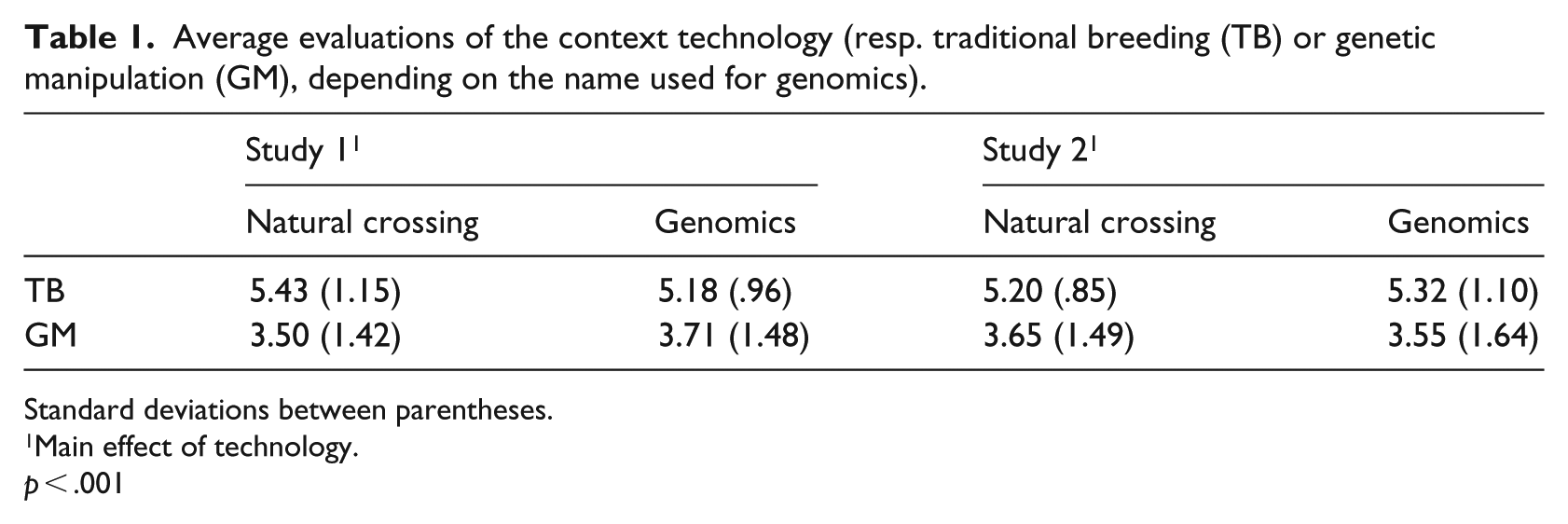
Following categorization theory and the principle of using activated knowledge to understand new information, we expected attitudes towards genomics to be similar to attitudes towards GM, and attitudes towards natural crossing to be similar to attitudes towards traditional breeding. To determine the similarity, we first examined the observed attitudes towards GM and towards traditional breeding, respectively. Because respondents could compare genomics with the familiar technology, it is possible that the evaluation of, respectively, GM or traditional breeding were influenced by the name, genomics. To investigate this, we carried out a 2 (context) × 2 (name technology) ANOVA on the attitudes towards the familiar technology. The ANOVA revealed only a significant main effect of the evaluation of the context technology, F(1, 214) = 96.05, p < .001, indicating that the evaluation of the familiar technology was not influenced by the name used to describe genomics. GM was regarded more negatively, M = 3.60, SD = 1.45, than traditional breeding, M = 5.29, SD = 1.04. These average evaluations of the familiar technologies enable us to study the direction of the comparison effects (for an overview of all the averages and standard deviations see Table 1).
Average evaluations of the context technology (resp. traditional breeding (TB) or genetic manipulation (GM), depending on the name used for genomics).
Standard deviations between parentheses.
Main effect of technology.
p < .001
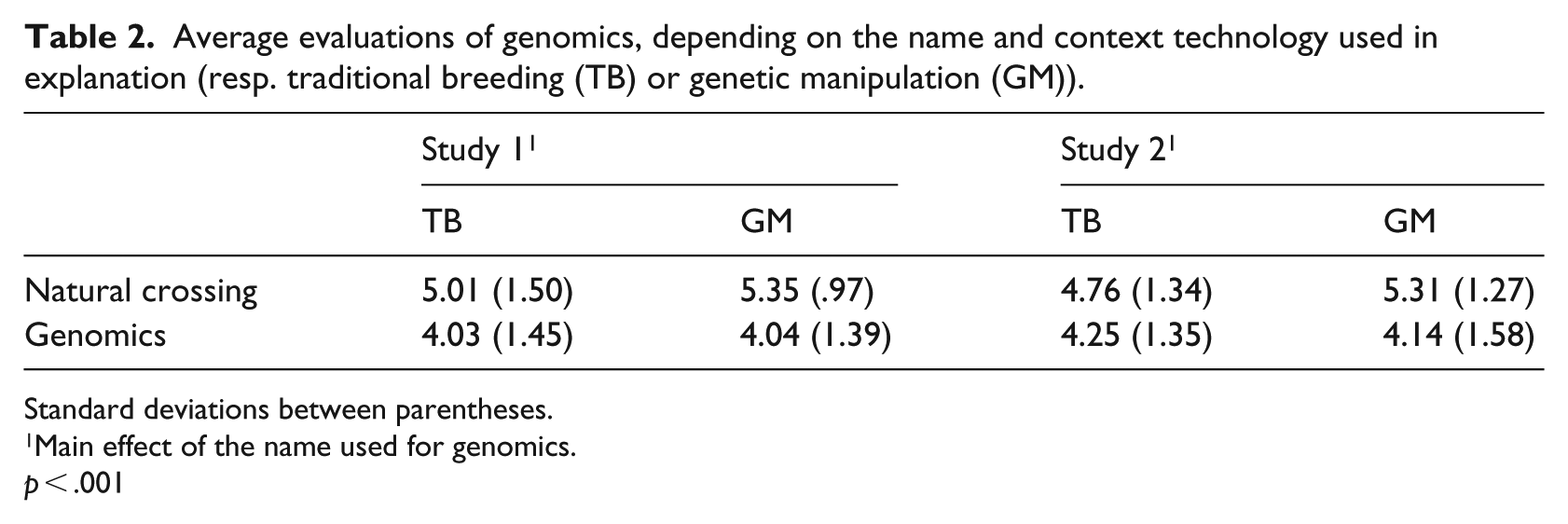
We expected attitudes towards genomics when called genomics to be similar to the attitudes towards GM, and attitudes towards genomics when called natural crossing to be similar to the attitudes towards traditional breeding. A 2 (context) × 2 (name technology) ANOVA revealed only a main effect due to the name, F(1, 214) = 39.33, p < .001. The name genomics caused a more negative attitude, M = 4.04, SD = 1.42, than the name natural crossing, M = 5.21, SD = 1.23 (for an overview of all the averages and standard deviations see Table 2).
Average evaluations of genomics, depending on the name and context technology used in explanation (resp. traditional breeding (TB) or genetic manipulation (GM)).
Standard deviations between parentheses.
Main effect of the name used for genomics.
p < .001
The results show that changing the name used in the explanation of genomics has a significant impact on attitudes towards the technology. When we compare the attitudes towards genomics and the attitudes towards GM, we can see that they are very similar, and the same is true for the attitudes towards natural crossing and the attitudes towards traditional breeding. Thereby, the results point to attitudes towards genomics being dependent on the association created by the name of the technology. To test the pattern directly, we carried out a linear regression to see if attitude extension occurred.
Categorization and attitude extension
With respect to attitude extension, the hypothesis was that the attitude towards a familiar technology would be used to form an initial attitude towards the unfamiliar technology. A scatter plot (Figure 1) shows a clear relation between the attitudes towards genomics and the attitudes towards GM.
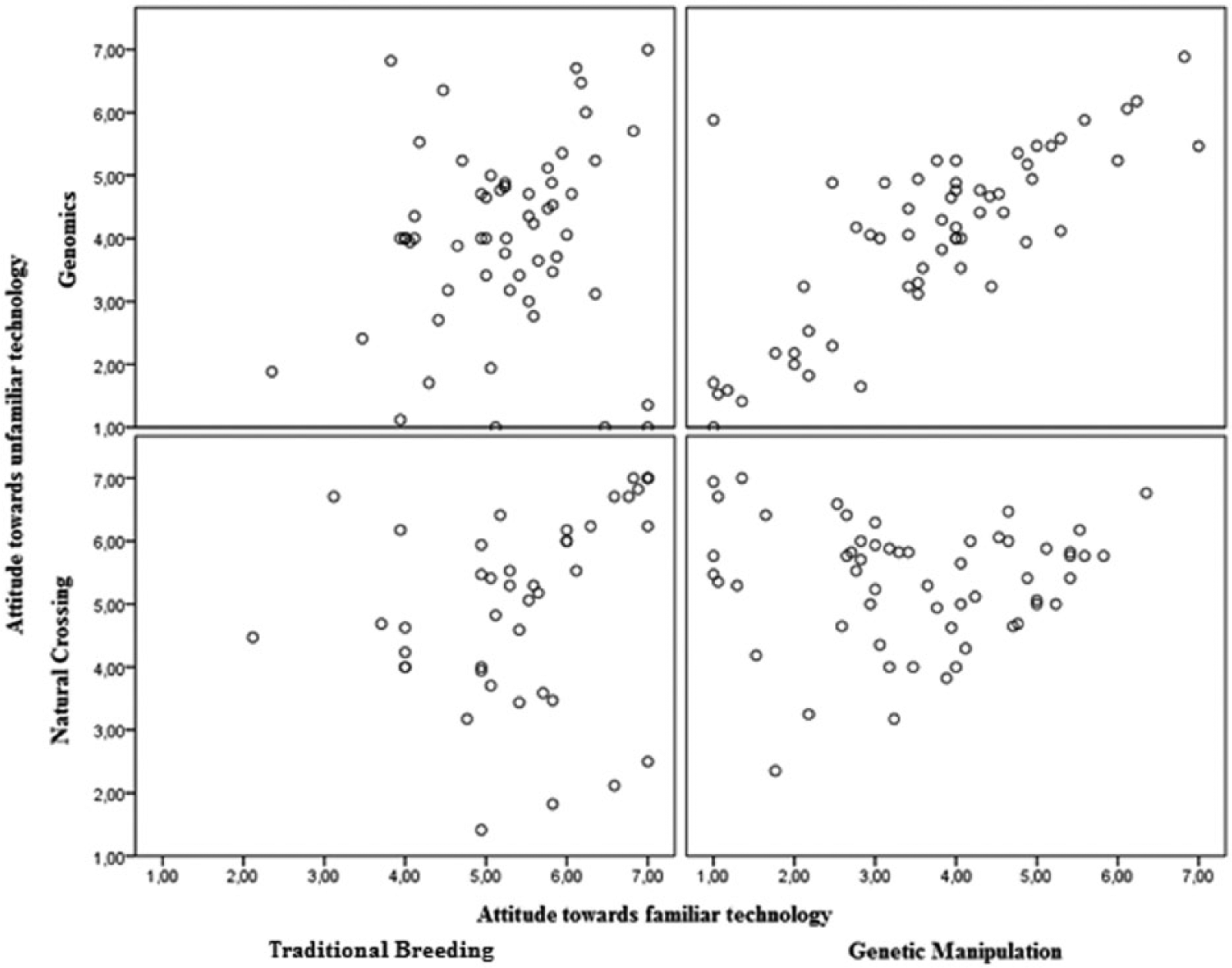
The relation between the evaluation of the familiar technology and the new technology under cognitive load (Study 1).
A less clear pattern appears between natural crossing and traditional breeding. Although there is a linear relation, the pattern displays more variance. Linear regression revealed a significant correlation between the reported attitudes towards genomics and towards GM, B = .74, 95% confidence interval (CI) [.58, .90], t(56) = 9.29, p < .001, with the attitudes towards GM predicting a large portion of the variance in the reported attitudes towards genomics, R2 = .61, F(1, 56) = 86.24, p < .001. When genomics is called genomics, there is a strong correlation between the attitudes towards genomics and the attitudes towards GM. No relation was found between the attitudes towards natural crossing and the attitudes towards traditional breeding, B = .35, 95% CI [−.05, .75], t(41) = 1.76, p = ns.
The scatter plot does not show a relation between the evaluations of genomics and traditional breeding or of natural crossing and GM. Linear regression did not reveal a relation between the attitudes towards genomics and the attitudes towards traditional breeding either, B = .221, 95% CI [−.17, .62], t(58) = .1.13, p = ns, nor between the attitudes towards natural crossing and the attitudes towards GM, B = .014, 95% CI [−.17, .20], t(55) = .12, p = ns. These results confirm that the relation between the attitudes towards the unfamiliar technology and towards the context technology only exists for the combinations where the similarity in name creates the impression that the context is considered appropriate for categorization.
Additional analyses show that the effect cannot be attributed to any confounding attributes of the sample.
Discussion
In the Introduction, we argued that a familiar plant breeding technology would be used to interpret and evaluate an unfamiliar technology if the name of the unfamiliar technology activated knowledge about a familiar technology. The results unambiguously show this to be true for genomics. The results show that the name genomics causes average attitudes towards genomics to be similar to attitudes towards GM, and linear regressions show a direct relation between the two.
The results also show that the average evaluation of natural crossing is similar to the average evaluation of traditional breeding. However, despite this and the scatter plot indicating a relation between the attitudes towards natural crossing and traditional breeding, linear regression failed to show a direct correlation between the attitudes of natural crossing and traditional breeding. A possible explanation is that people generally have a favourable impression of traditional breeding and natural crossing, resulting in the majority of the scores to be located in a small part of the spectrum. This results in a ceiling effect, making regression analyses less sensitive, and, hence, the lack of a significant result may be caused by the distribution of the data (Cramer and Howitt, 2005: 21). It is therefore difficult to determine whether or not a relation exists on the basis of the current results.
In addition to attitudes towards genomics and towards GM being very similar on average, the regression analyses show that the attitudes towards genomics are the direct result of the attitudes towards GM. When we compare the relationship between the attitudes towards genomics and GM and the attitudes towards genomics when called natural crossing and GM, we find that a change in the name completely undermines the perceived relationship. Although all participants in the related experimental groups received the exact same description of both GM and genomics, a relation between the two was perceived only when genomics was called genomics. Using the name natural crossing instead of genomics caused the association between genomics and GM to disappear and resulted in more favourable evaluations.
Possibly the induced cognitive load had more impact than expected. It is possible that people were too busy remembering the numbers with which they were presented and therefore were unable to pay attention to important yet subtle details even less than could be expected in daily-life situations. To investigate the impact of the cognitive load, we administered a second study without a memory task. The results show the extent to which the name influences an evaluation even when it is possible to pay attention without distractions.
3. Study 2
Participants and design
For the second study, the same materials and sampling method were used. The procedure was modified by removing the cognitive load induction. The study was administered concurrently with the first, preventing the participant to join both the studies. The change resulted in the manipulation being presented immediately after participants gave their informed consent; this was followed by the measurement of attitudes towards the unfamiliar technology (α = .98) and towards the familiar technology (α = .99). With the cognitive load induction removed, participants were no longer required to reproduce a pre-given number at the end of the questionnaire.
In total, 228 (111 men) people participated. The average age was 54.2 years with a comparable distribution among educational levels as Study 1.
Results
Comparison effects
Similar to the previous study, we first examined attitudes towards, respectively, GM and traditional breeding. In line with Study 1, a 2 (context) × 2 (name technology) ANOVA revealed only a main effect of the context technology, F(1, 224) = 94.55, p < .001, showing that the name of genomics did not have an effect on the evaluations of the familiar technology. Comparable to the first study, GM was evaluated less favourably, M = 3.60, SD = 1.56, than traditional breeding, M = 5.26, SD = .97 (for an overview see Table 1).
In line with the analytic procedure of Study 1, we carried out a 2 (context) × 2 (name technology) ANOVA to determine the influence of the name used in the explanation of genomics in combination with the context technology on the evaluation of genomics. The ANOVA yielded only a main effect of the name, F(1, 224) = 39.33, p < .001. When the name genomics was used, evaluation was less favourable, M = 4.20, SD = 1.46, than when natural crossing was used, M = 5.00, SD = 1.33 (for an overview see Table 2).
Categorization and attitude extension
We expected the attitudes towards genomics to originate from the attitudes towards GM and the attitudes towards natural crossing to be guided by the attitudes towards traditional breeding. The scatter plot (Figure 2) shows a clear pattern between attitudes towards genomics and attitudes towards GM, and a less clear pattern between natural crossing and traditional breeding. Linear regression revealed a significant correlation between the attitudes towards genomics and the attitudes towards GM, B = .65, 95% CI [.46, .85], t(53) = 6.75, p < .001, with the attitudes towards GM predicting a large portion of the variance in the reported attitudes towards genomics, R2 = .46, F(1, 53) = 45.50, p < .001. The results confirm that attitudes towards GM were used to evaluate genomics. Similar to Study 1, no significant relation was found between the attitudes towards natural crossing and the attitudes towards traditional breeding, B = .23, 95% CI [-.17, .63], t(62) = 1.16, p = ns.
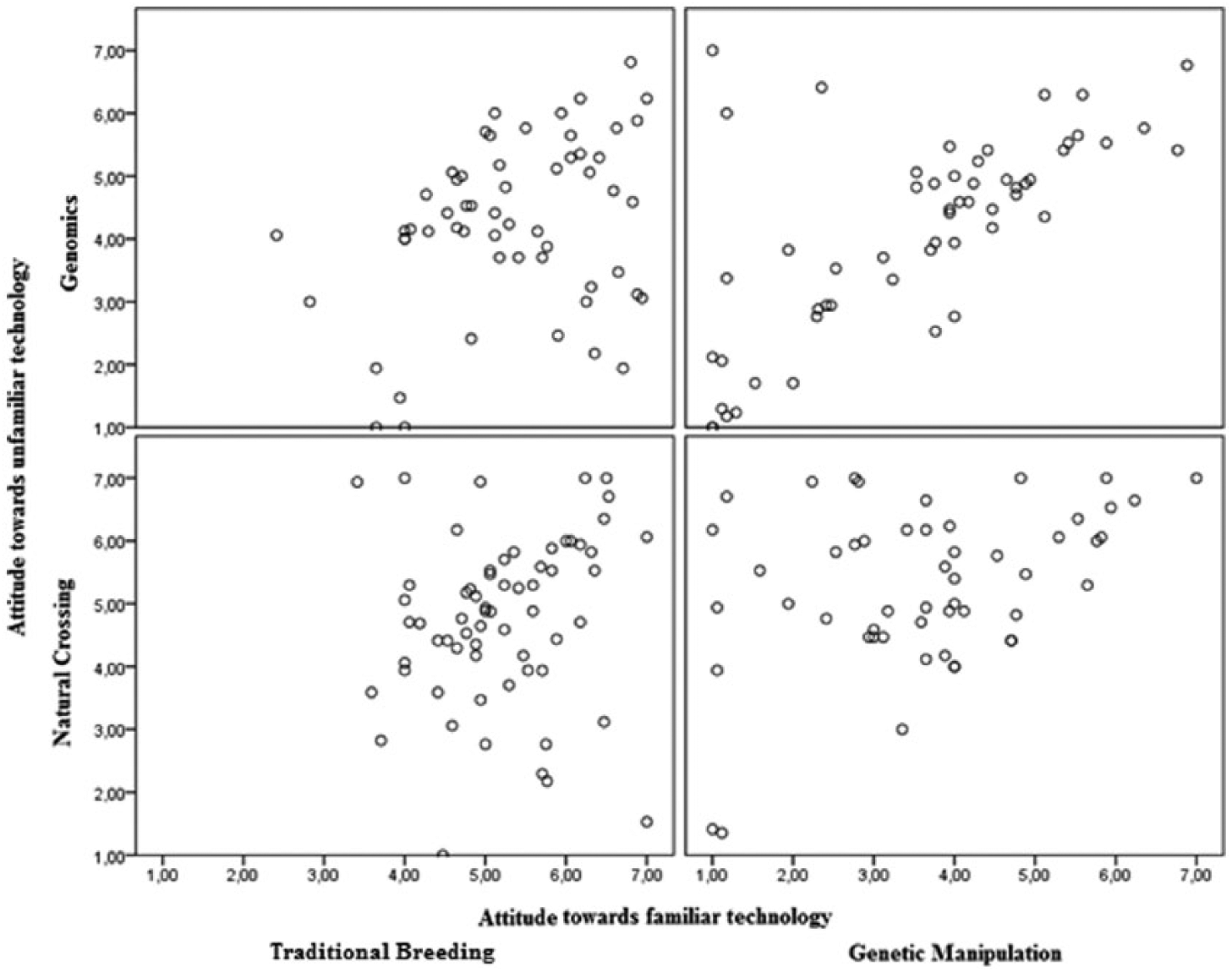
The relation between the evaluation of the familiar technology and the new technology without cognitive load (Study 2).
Different from Study 1, a significant relation was found between the attitudes towards genomics and the attitudes towards traditional breeding, B = .40, 95% CI [.08, .71], t(55) = 2.54, p < .05, with attitudes towards traditional breeding predicting a small portion of the variance in attitudes towards natural crossing, R2 = .11, F(1, 55) = 6.42, p < .05. The relation between natural crossing and GM also proved significant, B = .33, 95% CI [.11, .55], t(50) = 2.94, p < .01, with the attitudes towards GM predicting a small portion of the variance in attitudes towards natural crossing, R2 = .15, F(1, 50) = 8.63, p < .01. The results show that the attitudes towards the context technology influenced the evaluation of genomics even when the name did not encourage categorization.
Similar to Study 1, analyses failed to show any confounders.
Discussion
In Study 2, we removed the distraction procedure included in the first study to investigate its impact. The averages of evaluations of genomics (independent of the name used) approximate those of GM. Linear regression revealed a direct correlation between GM and genomics similar to Study 1, showing that the attitudes towards GM determine those to genomics also when people are able to pay more attention.
The observed pattern of evaluations of natural crossing is also similar to Study 1. The averages of natural crossing are closer to traditional breeding than GM. Yet, no direct correlation between natural crossing and traditional breeding is revealed by linear regression. The scatter plot indicates that the concentration of results might have caused a ceiling effect similar to Study 1.
Notably different from Study 1, linear regressions revealed positive correlations in both cases where the names were countervailing. To be precise, a more (un)favourable evaluation of the context results in a more (un)favourable evaluation of the technology. The ability of respondents to pay more attention to the descriptions of both the context and the new technology and to increasingly notice similarities can explain these findings.
To summarize, even in cases where people can pay attention and study the material presented, the bias remains. The name natural crossing causes more favourable evaluations than the name genomics. However, the ability to pay more attention does result in the information describing the context technology to influence evaluations in situations where a name does not encourage categorization.
4. General discussion
The results of the two experiments provide strong evidence that the name that is given to a technology can determine the evaluation of that technology, even in the presence of information about the technology. The results show that, after people have formed an impression about what a technology entails because of its name, this impression colours the interpretation of information, rather than information influencing the impression. We therefore conclude that the name plays a key role in the technology evaluation process.
In this article, we used the relatively new technology genomics as a case and followed up on reports that people confused genomics with GM. We argued that people use knowledge relating to GM because the term genomics is meaningless to them. We hypothesized that people try to give meaning to the meaningless term genomics by trying to categorize the concept and that, if they believe that they have found an appropriate familiar concept for categorization, they transfer their attitudes towards the familiar category to the new concept. Comparing the two studies (Figure 3) shows that people use the strategy of evaluating genomics using their attitudes towards GM after categorizing them together.
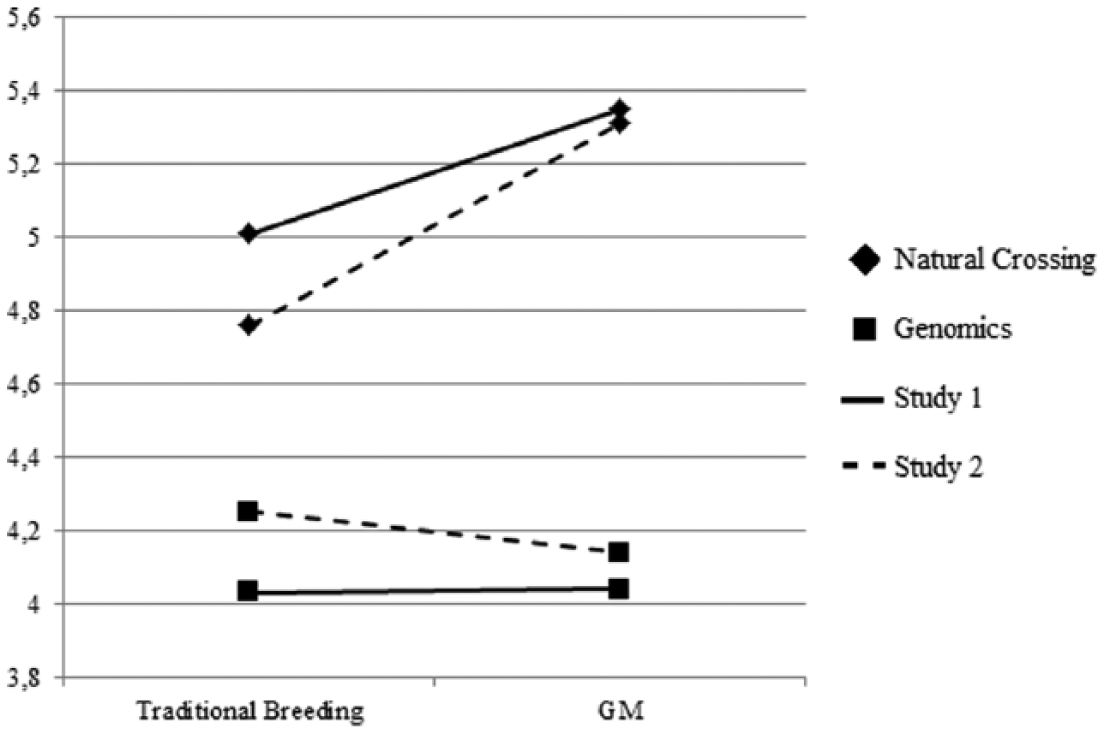
Results of Study 1 and 2 combined.
The current results are less clear about the relation between natural crossing and traditional breeding. The average evaluations resulting from the name natural crossing approximate those of traditional breeding and are also more favourable than those resulting from the name genomics. However, the results showed no direct relation between the evaluations of natural crossing and traditional breeding in both the current studies.
A probable explanation for this absence is a ceiling effect in combination with a limited sample size. As one reviewer pointed out, there has been little attention for the fact that small sample sizes can also cause errors when significant effects are found (Munafò et al., 2017). As such, results of small sample sizes should be interpreted with caution.
A notable difference to Study 1 is the presence of an influence of the information on the attitudes towards genomics in Study 2. As mentioned, the possibility to notice the commonalities between the descriptions of the context and genomics due to a lack of distraction can explain the presence of the influence. It is interesting to note, however, that the evaluations are still very close to those of the context technology; despite the observed influence of traditional breeding, the overall average attitude of genomics is closer to that of GM. The same pattern can be observed in the case of natural crossing, which is evaluated similar to traditional breeding despite being influenced by the evaluations of GM. As such, it appears that both the initial categorization and the description of the context influence the evaluation at the same time, but in opposite directions. Both the average values of the evaluations and the amount of explained variance found using linear regressions indicate that the initial categorization sets a standard which is slightly influenced by noted commonalities.
The results provide an answer to the question of what happens when people are confronted with a name that is meant to activate knowledge that is not present. Rather than passively doing nothing, or searching for the information, people try to give meaning to the concept by using knowledge that is already present. In other words, when a name targets non-existent structures, alternative structures become activated. Thanks to the alternative structures, the information provided can still be processed, but this can result in a different shape of understanding and attitudes than experts might have expected.
Conclusion
The results support the idea that people can form attitudes by using general scientific knowledge, risk perception or existing attitudes. At the same time, they show that using these alternatives to detailed study can be not much more than a transfer of attitudes from known or familiar technologies to a new technology, even when information is provided that highlights unique features of this new technology. Although the transfer of attitudes can be the result of a lack of cognitive effort, it is not necessarily the case. As mentioned in the Introduction, the expectations and activated cognitive structures influence the processing of information, including what is noticed and remembered. Therefore, the process of copying can result from not being able to see the differences because of a lack of knowledge. By acknowledging the role of a name in interpreting new information, scientists can prevent people from drawing conclusions or forming attitudes that do not necessarily apply.
The current results show the necessity for experts to take into account the effects a name can have on the public. Because the public has a fundamentally different frame of reference than experts, a name can trigger unexpected reactions. We argue that science communication can benefit when experts develop their language not based on their own perspective, but on actively explored associations that people have, so that when the name goes public (e.g. when the technologies are introduced into society or consortia are being formed), names that create more appropriate associations can be used. If this approach is taken, people can get the right idea from their own frame of reference, without the need of extensive knowledge.
The effects of a name are not only overlooked by experts. Since the publication of the report The public understanding of science (Bodmer, 1985), there has been an ever-growing interest in scientific circles about the way people evaluate technologies (Gregory and Lock, 2008; Gupta et al., 2012). Unfortunately, in the field of science communication, there has also been hardly any direct attention paid to the role that a name can have. To the best of our knowledge, this is the first research to systematically investigate the influence of the name of a technology on the evaluation of information. Although the role of a name is sometimes mentioned as possibly having an influence, it is often merely a remark that the name caused some issues due to confusion or misunderstanding (e.g. Ingold and Kurttila, 2000; Macoubrie, 2008). Moreover, many of the experiences about the public ‘not getting the name’ are not even making it into the literature because studies are about the larger themes, such as the democratic position of the public in the development of new technologies.
An unrecognized problem is that a name is not just a source of misunderstanding; it is a conceptual label playing an important role in the shaping of evaluations and knowledge relating to the technology and the larger issues surrounding them. Naming is framing. Often, the name appears to be the elephant in the room. Understanding that the elephant is there can prevent many problems.
Supplemental Material
Appendix__scale_of_17_questions – Supplemental material for The elephant in the room: How a technology’s name affects its interpretation
Supplemental material, Appendix__scale_of_17_questions for The elephant in the room: How a technology’s name affects its interpretation by Reginald Boersma, P. Marijn Poortvliet and Bart Gremmen in Public Understanding of Science
Footnotes
Funding
The author(s) received no financial support for the research, authorship and/or publication of this article.

Author biographies
References
Supplementary Material
Please find the following supplemental material available below.
For Open Access articles published under a Creative Commons License, all supplemental material carries the same license as the article it is associated with.
For non-Open Access articles published, all supplemental material carries a non-exclusive license, and permission requests for re-use of supplemental material or any part of supplemental material shall be sent directly to the copyright owner as specified in the copyright notice associated with the article.
