



Abstract
A conversion narrative recounts the process that led the speaker to reject one belief for a different, usually incompatible, alternative. However, researchers know little about whether, when, and, if so, how such messages affect audience attitudes about controversial science. Using a general US population-sample experiment, we assessed the attitudinal impact of three versions of a statement by Mark Lynas, an environmental activist who converted from opposing to championing genetically modified crops. Participants were exposed to (1) a one-sided pro-genetically modified message by Lynas, (2) a two-sided pro-genetically modified message in which Lynas indicates but does not detail his conversion, or (3) a two-sided pro-genetically modified message in which Lynas explains the process that prompted his conversion. We find that his conversion messages influenced attitudes by way of perceived argument strength, but not speaker credibility. This finding implies such messages induce greater elaboration, which may lead to durable attitudes that predict behavior.
Public understanding of science is often impeded by the influence of social group affiliations (Hornsey and Fielding, 2017; Nauroth et al., 2017; Nisbet et al., 2015). In “the competition of voices reaching the individual” (Campbell et al., 1960: 128), individuals often embrace “facts” favored by fellow group members, polarizing beliefs about a number of scientific issues (Pasek, 2017; Veenstra et al., 2014). A variety of group identifications, including partisanship, religious affiliation, and environmentalism (Drummond and Fischhoff, 2017; Kahan et al., 2011; Pasek, 2017; Veenstra et al., 2014, 2016) contribute to these belief gaps. In other words, gaps between scientific consensus and personal belief in these cases are not information deficits but instead are motivated rejections—an issue of trust and credibility accorded to experts and findings that conflict with group values (Bauer, 2009). Those responsible for messaging in such contexts must be conscious of this fact, and select messengers and content accordingly.
To overcome these group influences on attitudes toward contested science, individuals and organizations turn to a variety of rhetorical devices (Hornsey and Fielding, 2017). One form of argument communicators rely on in these contexts is the conversion message. A conversion message recounts the process that led the speaker to reject one belief for a different, usually incompatible, alternative. Examples of public-facing conversion messaging regarding contested science include conversions from anti- to pro-vaccine (Voices for Vaccines, n.d.); climate skeptic to climate believer (Pomeroy, 2018; The Guardian, 2018); anti- to pro-nuclear energy (Madrigal, 2007; Schellenberger, 2017); and as examined in the present research, anti- to pro-genetic modification (Storr, 2013).
Research centring on intergroup and intragroup communication dynamics (Djupe and Gwiasda, 2010) suggests these conversion messages may be an effective persuasive technique. However, the actual effects of such messages remain unknown. We undertake the first test here, the results of which may better inform strategic communication campaigns and provide a fine grained exploration of this popular form’s pathways to influence over attitudes toward controversial science. 1
We test our hypotheses using a general population-sample experiment in the United States. Our focus is the debate surrounding the safety of genetically modified (GM) crops. We test excerpts of an actual conversion message, delivered by a science writer and environmental activist, that details a transformation from anti- to pro-GM advocate. Conversion messages led to significantly more attitude change compared with a one-sided advocacy condition. We find that perceived argument strength, and not enhanced speaker credibility, accounts for this effect. In the following sections, we provide an overview of the theory behind our hypotheses by explaining potential mechanisms that could account for the attitudinal effects of conversion messages.
1. Conversion message as persuasive technique
Persuasion researchers frequently overlook content, focusing instead on extrinsic factors such as source and recipient characteristics. When messages are examined, researchers tend to focus on sidedness or order rather than the nature of the messages themselves (Slater and Rouner, 1996). This neglect of content has been called “the most serious problem in communication and persuasion research,” (Fishbein and Ajzen, 1981: 359). Despite calls to address the issue (Johnson et al., 2005; McGuire, 2000; O’Keefe, 2002; Reynolds and Reynolds, 2002), scholars’ understanding of the effects of the content of arguments remains rudimentary (Hoeken and Hustinx, 2009). Although scholars of rhetoric describe an array of techniques that strategic communicators may employ, 2 the functioning and effects of many have yet to be studied empirically (Slater and Rouner, 1996; Vancil, 1993). In this study, we empirically test a durable (Caldwell, 1983) rhetorical form, the conversion narrative.
An individual’s “conversion” may be rooted in a transformative experience, a thoughtful reconsideration of the facts, or some combination of the two. 3 Regardless of the domain, there seems to be something powerful about a conversion. For this reason, such messages appear to be common in public discourse. 4 Although scholars have examined the rhetoric of conversion messages (Booth, 1995; Caldwell, 1983; Fredriksen, 1986; Hindmarsh, 2005; Stromberg, 1993), they know little about whether, when, and if so how they influence attitudes at play in a debate over controversial science.
Despite, or perhaps because of the prevalence of conversion messages in popular culture and strategic communication, the perception of their effectiveness is based upon conventional wisdom, with surprisingly few empirical tests in persuasion research or other related communication literatures. While it is plausible that such messages are persuasive, the size of the effect and their mechanism are unclear. In this study, we advance and test two hypotheses that explain why conversion messages are effective.
The first potential mechanism of conversion message persuasion is the enhanced credibility that may attach to a person willing to admit to a dramatic change in belief. Those who switch teams to claim a once-derided stance may send a signal that the truth is more important to them than social or financial cost. In other words, the fact of conversion alone could make the speaker appear more trustworthy, regardless of the strength of the justification for the change. Second, conversion messages may work through argument strength. The fact that they by definition juxtapose an initial and subsequent stance may prompt closer scrutiny of their arguments. If this is the case, conversion messages may persuade those sharing a group identity with the speaker if the process underlying the shift aligns with the group’s values. At the same time, they may persuade others by appearing to provide a carefully considered justification for each claim. Dual process theories of persuasion suggest the difference between these mechanisms matters. Greater elaboration (e.g. scrutiny of argument strength) leads to more durable attitudes that are more predictive of behavior (Greenwald and Leavitt, 1984; Petty and Cacioppo, 1986).
2. Enhanced speaker credibility
Unexpected positions by a speaker may appear more credible than expected ones (Petty and Cacioppo, 1986). Specifically, messages that are costly for a speaker to make are more credible than “cheap talk.” For instance, politicians whose messages appear to be damaging to their own party are seen as more credible than those who toe the party line, and the credibility bestowed by such costly messages tends to materialize regardless of the listener’s political leanings (Berinsky, 2015; Groeling and Baum, 2008; Lupia and McCubbins, 1998).
This dynamic should be at work when someone who had publicly announced one stance rejects it in favor of a competing one. Costs are incurred because the acknowledgment that a previously held position was incorrect may carry social stigma and perhaps result in the cutoff of access to resources or compensation from those with whom the speaker had once been aligned. There is also general social reluctance to admit mistakes (Breines and Chen, 2013). Importantly, though, a conversion message entails more than just a source making a costly statement. A politician may engage in costly talk that denigrates a policy of his or her own party, without taking or defending a counter position, or without ever endorsing the policy in the first place. By contrast, a conversion message includes and justifies the arc of an individual’s opinion change.
Dutton (1973) did undertake a study of “convert communicators.” Because the “maverick” speakers in his experiment had abandoned a comfortable position to stake a new one—apparently guided by principle over payoff—they were seen as more trustworthy and elicited more opinion change than were those delivering the party line of their organization. Levine and Valle (1975) similarly found in the context of anti-alcohol communication that a reformed alcoholic was evaluated more favorably as a communicator than was “a lifelong teetotaller.”
Recent research more directly tests the supposition that such messages work through the motivation the audience perceives to have guided the speaker. Proposing a “contradiction effect,” Reich and Tormala (2013) argue that unexpected contradictions of one’s former stance can prompt attributional reasoning—the process by which individuals attempt to explain the causes of behavior and events—to determine the source of the shift. If positive attributions (e.g. new information has been gathered, greater thought has been accorded to the subject), then the appeal will be more persuasive. We test this as a potential alternative—though highly related—way perceptions of the speaker might account for a conversion message’s persuasive effects.
3. Enhanced argument strength
We also explore an alternate hypothesis: conversion messages work not through altering perception of the source, but by increasing the perceived quality of the message. In other words, conversion communication will be seen as making stronger arguments than messages that include the same facts, but lack the conversion arc. We test this with three messages: a one-sided advocacy message, a two-sided message in which the conversion is mentioned, and a two-sided message in which the conversion process is recounted in detail.
There is substantial evidence that thoughtfully processed, strong arguments are more persuasive than weak ones (Johnson and Eagly, 1989; Johnson et al., 2004; Wood and Quinn, 2003). Typically, researchers employ a cognitive approach to argument strength, focusing on audience perception. In this tradition, perceived argument strength is defined as the audience member’s perception of an argument’s quality, strength, and persuasiveness (Zhao et al., 2011). This perceptual variable has been shown to be a strong and reliable predictor of attitude change (Dillard et al., 2007).
There are a number of reasons conversion messages should be perceived as particularly strong arguments. Because they include references to a speaker’s prior position as well as her current, contradictory stance, they are a type of refutational two-sided message. Refutational two-sided messages, in which a speaker introduces criticisms against his or her stance in order to rebut them, increase perceived argument strength, reduce counterarguing, and increase persuasiveness relative to one-sided messages (Allen, 1991; Hale et al., 1991; McGuire, 1985; O’Keefe, 1999).
Moreover, messages that detail the process of conversion should be seen as especially strong arguments. As Djupe and Gwiasda (2010) point out, audiences are likely to consider not only the source, but the process by which the source arrived at their decision. Conversion messages that include “the consideration of a decision-making process,” (Djupe and Gwiasda, 2010: 75) may be seen as stronger arguments for this reason. Although understudied in persuasion research, the importance of process information is central in deliberative theory, where “the offering of reasons for political choice is the central act of public deliberation,” (Ettema, 2007: 143) and in procedural justice, where public perceptions of legitimacy hinge on perceptions of fair process (Gibson et al., 2003).
Why might conversion message effects work through perceptions of argument strength rather than speaker credibility? The unexpected incongruence of speaker and message (i.e. a pro-GM stance from a previously opposed environmentalist) in conversion messages may reduce reliance on peripheral cues—such as speaker characteristics—and enhance systematic thinking and scrutiny of argument strength (Maheswaran and Chaiken, 1991). This should allow for persuasion among both in-group and out-group members (Djupe and Gwiasda, 2010). Since the conversion message will be dissonant and novel to in-group members (i.e. environmentalists), they may be less likely to rely on heuristics, and instead look to the decision-making process to judge the argument. If this process is consistent with group identity (i.e. using their acceptance of the science of climate change as a model to reconsider evidence about GM food safety), they should be more likely to update their attitudes accordingly. Moreover, process cues provide a signal to out-group members that arguments are considered, plausible, and well-founded.
4. The GM context
We examine conversion message effects in the context of attitudes toward GM crops. GM crops have been engineered by humans to express, or suppress, a specific genetic trait by altering some aspect of an organism’s DNA (National Academies of Science, 2016). GM crops, such as corn and soy, are used widely in consumer food products in the United States. Because levels of Americans’ knowledge about GM crops tend to be low, but people tend to be wary of them, genetic modification is a suitable topic for conversion messaging. Only 43% of Americans know that GM crops are available for human consumption, and only a quarter (26%) believe they have eaten food that has been GM (Hallman et al., 2016). About 71% of Americans say that they have heard little or nothing about GM foods, but about 39% believe that GM foods present a risk to human health (Funk and Kennedy, 2016).
In a review of the scientific evidence, the National Academies of Science (2016) concluded that GM crops are as safe as conventionally grown crops. Despite this, the difference in opinion between scientists and the public on the safety of GM foods is larger than on controversial issues such as climate change, vaccines, and evolution (Funk and Rainie, 2015). That said, it is important to note that public skepticism toward GM crops is not in itself irrational. Little direct knowledge of the subject means individuals’ views are instead informed by similar cases (Marris, 2001), an informational shortcut that conserves cognitive resources. Furthermore, while reviews of research on GM crops’ effects on environment and health tend to find little evidence of negative effects (e.g. Brookes and Barfoot, 2017; Nicolia et al., 2014; Panchin and Tuzhikov, 2017), research is ongoing, and the public may take such ongoing debate as a cue of uncertainty (Dixon and Clarke, 2013). Moreover, some scientific studies—while controversial, or even retracted within the scientific community (Wallace, 2014)—have indeed reported negative effects of GM products. Public views may incorporate some of this evidence as a credible basis in forming an opinion.
Importantly though, unlike some other scientific issues, such as evolution or climate change, attitudes about GM foods do not seem to be related to political ideology or religious beliefs in the American context. Democrats and Republicans are equally likely to find GM foods unsafe to eat, and panel survey data show political ideology does not predict attitudes about GM foods (Funk and Kennedy, 2016). Religious beliefs also often divide attitudes about similar science issues such as stem-cell research and synthetic biology (e.g. Ho et al., 2008), but there is no evidence of religious belief influencing attitudes about GM foods. In sum, knowledge levels about GM foods are low, but there are strong perceptions of risk not associated with political or religious beliefs. In such conditions, messages that acknowledge concerns while offering explanations to counter them may be particularly conducive to attitude change. In this case, conversion messages may be able to persuade individuals to hold attitudes more consistent with scientific consensus.
5. Methods
Sample
Data were collected by Research Now from 28 March 2017 to 5 April 2017. US adults 18 years or older (N = 727) participated in the experiment hosted on Qualtrics. This sample excludes respondents who took more than 1 hour to complete the survey (n = 75). Participants completed the experiment in a median time of 14.10 minutes (M = 15.95 minutes, SD = 8.47). 5 Participants were 55.2% female and 81.7% White, with a mean age of 45.66, SD = 15.81, a median education of a bachelor’s degree, and median household income of US$75–US$100,000. Respondents had a mean of 0.40 (SD = 0.85) children under 18.
Party affiliation was measured with a 7-pt. item ranging from Strong Democrat (1) to Strong Republican (7) (M = 3.86, SD = 1.96). Ideology ranged from Very Liberal (1) to Very Conservative (5) (M = 3.00, SD = 1.13), and was computed by taking the average of social (2.99, SD = 1.43) and economic (M = 3.35, SD = 1.31) subscales (Cronbach’s α = .85 6 ). Mean religiosity was 2.20 (SD = 1.30) on a 5-pt. scale of religious service attendance, ranging from never (1) to more than once a week (5).
Design
The experiment consisted of three conditions designed using video excerpts from a talk given by Mark Lynas at the 2013 Oxford Farming Conference. 7 The first condition included a title page with his picture and note reading “Mark Lynas, author of High Tide: How the climate crises is engulfing our planet, and Six Degrees: Our future on a hotter planet, explains why he’s in favor of GMOs,” followed by footage of Mark Lynas explaining the benefits of GM crops: that they require less insecticide, that billions of dollars of benefits are accruing to farmers in developing countries, that eager farmers have pirated them into India and Brazil, and that the technology is safer and more precise than conventional methods.
The second condition included a title page with his picture and note reading, “Mark Lynas, author of High Tide: How the climate crises is engulfing our planet, and Six Degrees: Our future on a hotter planet, on changing his mind about GMOs,” followed by footage of Mark Lynas explaining a shift in his beliefs about GM crops. He discusses his prior beliefs about GM crops (that they increase the use of chemicals, that they benefit only big companies, that they are unwanted in developing countries, and that the technology is dangerous) and, having realized that these were “myths,” his current beliefs (that they require less insecticide, that billions of dollars of benefits are accruing to farmers in developing countries, that eager farmers have pirated them into India and Brazil, and that the technology is safer and more precise than conventional methods).
The third condition included a title page with his picture and a note reading, “Mark Lynas, author of High Tide: How the climate crises is engulfing our planet, and Six Degrees: Our future on a hotter planet, explains why he changed his mind about GMOs,” followed by footage of Mark Lynas explaining what he used to think about GM crops, what he thinks of them now, and how he changed his mind about them. This condition included the footage from condition two, but also included footage in which Lynas details his realization that the anti-GM movement he helped lead was a form of anti-science environmentalism, which was inconsistent with his pro-science environmentalism and advocacy regarding climate change. Realizing this contradiction prompted additional reading of the scientific literature, through which Lynas shifted his beliefs.
Condition 1, the advocacy message, was 1:30 in length. Condition 2 was 1:23 and Condition 3 was 3:15. This design allows us to test advocacy against conversion at equivalent length (1 and 2). As we are also interested in the potential effect of decision-making process information, we allowed Condition 3 to be longer. To maintain the equivalence of 1 and 2, and to avoid introducing additional confounding content to these conditions, we chose not balance length across all three.
Following the stimulus, participants were asked whether the speaker changed his mind about GMOs (1 = Yes)—which he did in Conversion conditions (2 and 3) but not the Advocacy condition (1). Conducted with analysis of variance (ANOVA), the manipulation check showed that the conditions significantly differed (F(2, 773) = 92.49, ηp2 = .193, p < .001). Post hoc analysis using Tukey’s honestly significant difference (HSD) indicated that those who saw a conversion message—both Condition 2 (M = 0.92, SD = 0.27) and Condition 3 (M = 0.91, SD = 0.28)—were more likely to say the speaker changed his mind than those in the one-sided advocacy condition (M = 0.54, SD = 0.50, both p < .001). The dependent variables were measured next followed by the mediator variables. A summary of all items can be found in Table 1.
Summary of dependent variable and mediators.

GM: genetically modified.
Dependent variable
Attitudes, behaviors, and policy support were measured as the dependent variable. These items were coded such that attitudes and behaviors favorable to GM foods (the argument made in the stimulus) were coded high. Behavioral and policy support outcomes were measured on 7 pt. scales ranging from Strongly Disagree (1) to Strongly Agree (7). These included “I would be comfortable eating genetically modified crops,” (M = 4.24, SD = 1.82), “I would support mandatory labeling of foods that have been genetically modified,” (reverse coded, i.e. opposition to labeling; M = 2.48, SD = 1.47), and “I would support a ban on growing genetically modified crops,” (reverse coded, i.e. opposition to ban; M = 4.26, SD = 1.75; Runge et al., 2017; Yue et al., 2015). We also used 5 pt. scales ranging from Not at all Confident (1) to Extremely Confident (5) measuring whether respondents were confident that scientists were confident that “that genetically modified foods are as safe as conventional foods” (M = 3.39, SD = 1.19), and whether the respondent was confident that “genetically modified foods are as safe as conventional foods” (M = 2.80, SD = 1.36; Corbett and Durfee, 2004). These five items had a high level of internal consistency (Cronbach’s α = .82); for the main effect analyses, these five items were standardized and used to create a mean scale of GM attitude (M = .01, SD = .75) in order to reduce measurement error and improve power (Ansolabehere et al., 2008). 8
Mediators
Perceived credibility (M = 4.65, SD = 1.15) was measured using a 7-pt scale with six items, addressing the speaker’s sincerity, honesty, trustworthiness, reliability, accuracy, and expertise (Cronbach’s α = .95).
Attribution (M = 4.83, SD = 1.20) was measured using a 7-pt scale with three items adapted from Reich and Tormala (2013; Cronbach’s α = .63): “How likely is it that the speaker gathered new information about genetically modified organisms before giving his final opinion?”; “How thoughtful do you think the speaker is?”; and “How likely is it that the speaker’s final opinion on genetically modified crops was the result of manipulation by others?” (reverse coded).
Perceived argument strength (M = 4.37, SD = .99) was measured on a 7-pt. scale. The final measure consisted of the average of perceived argument strength across the four arguments (Cronbach’s α = .93) made in the stimulus. These included that GM crops benefit insects (M = 4.54, SD = 1.08), that they benefit farmers (M = 4.45, SD = 1.08), that farmers are eager to use them (M = 4.19, SD = 1.04), and that they are safer than other conventional forms of breeding (M = 4.30, SD = 1.17). Each of these individual argument strength measures was the average of six items adapted from Zhao et al. (2011). The Cronbach’s α of individual argument strength items ranged from .84 to .88.
Random assignment was checked using analysis of variance. Conditions did not differ by any demographic (including gender, race, Hispanic origin, education, income, ideology, religiosity, and children under 18) with the exception of age and political party affiliation, both of which are controlled for in all analyses.
6. Results
Because we ask questions about the mechanism of conversion message effects rather than simply whether an effect exists, we therefore explore mediation—the process through which one variable exerts effects on another through one or more mediator variables (Preacher and Hayes, 2008). Bootstrapping, a data-resampling procedure used to produce confidence intervals for an indirect effect, is generally seen as a better method for estimating mediation hypotheses than older alternatives such as the Sobel test, as it can allow for confidence intervals that are asymmetric (MacKinnon et al., 2004; Preacher and Hayes, 2008). Therefore, bootstrapped 95% confidence intervals employing 5000 samples were calculated to test our mediation hypotheses. These statistical analyses were conducted with the PROCESS macro (Hayes, 2013, Model 4), which used ordinary least squares regression to estimate the direct and indirect effects of experimental conditions on attitudes about GM foods. PROCESS can simultaneously test the effects of two mediators, and their following effects on the dependent variable.
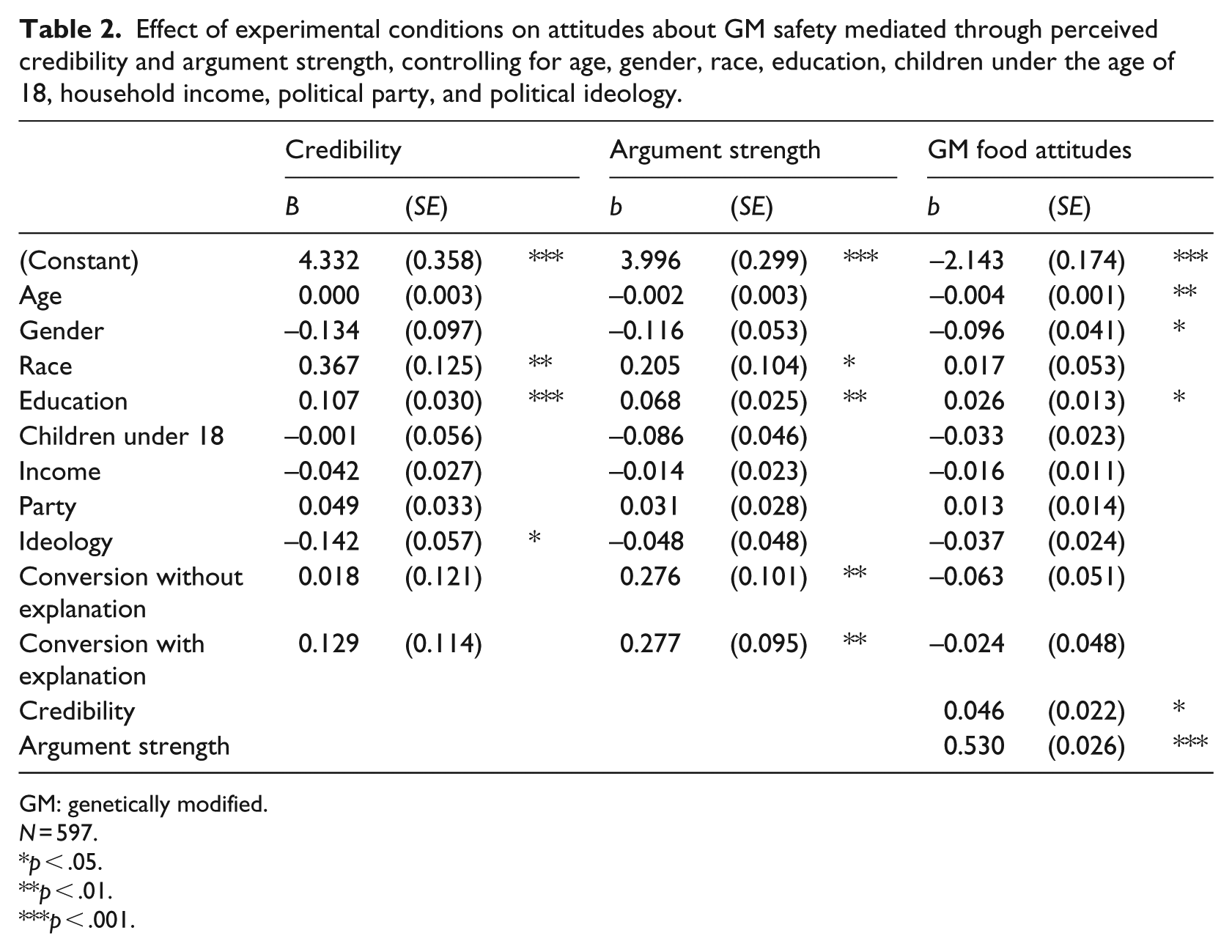
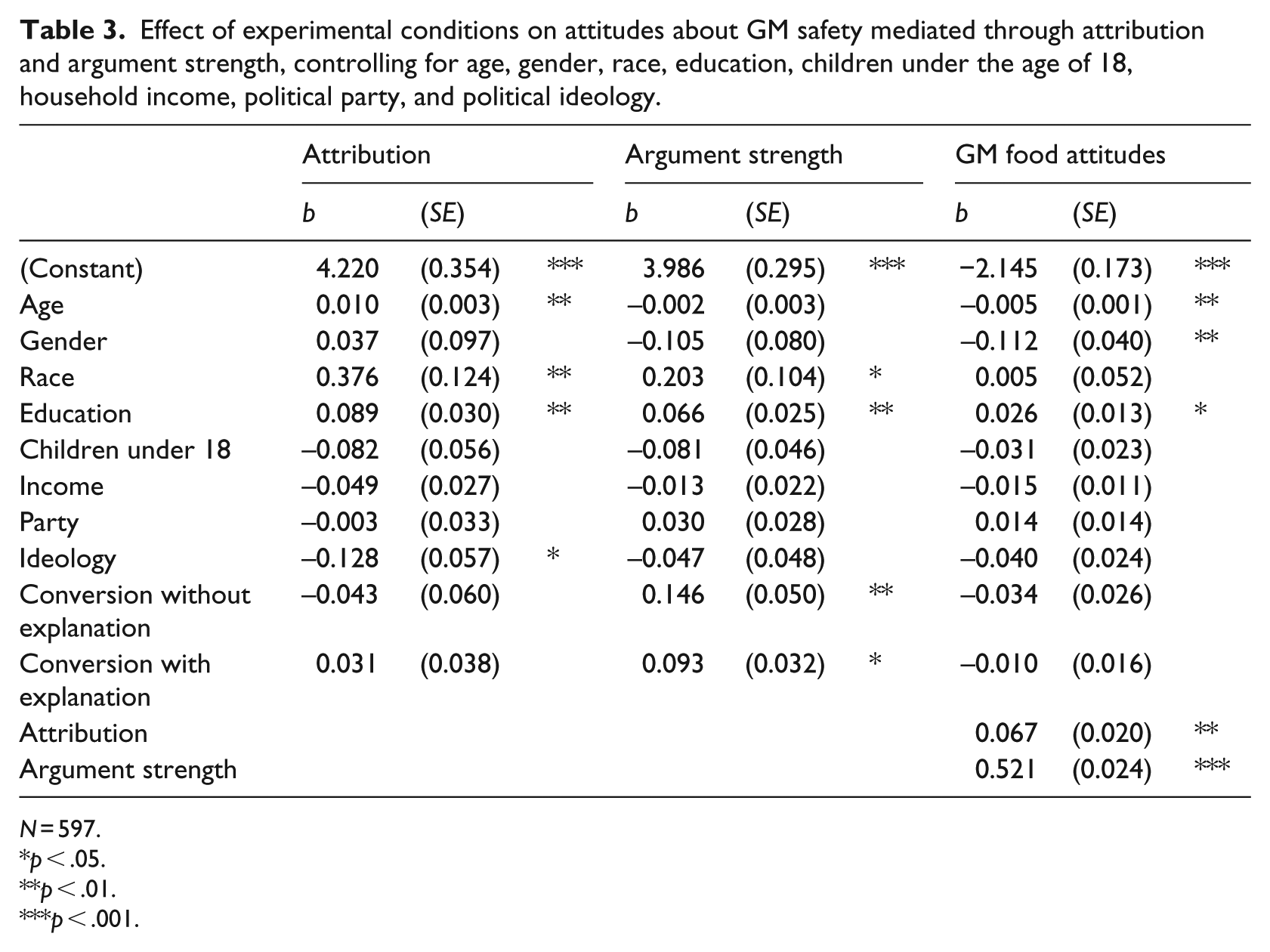
The competing hypotheses examine the mediating effects of views of the speaker and argument strength between the experimental conditions and attitudes about GM foods. The experimental conditions were first dummy-coded with the non-conversion message as the reference category before being entered as the independent variable, and the model also controlled for age, gender, race, education, children under 18, income, political party, and political ideology. We include a number of covariates to adjust for variables expected to relate to GM attitudes, as covariate adjustment reduces biasedness of effect size estimation (Lee, 2016; Lin, 2013). Models without covariate adjustment (controlling only for party and age, as per the random assignment check) are substantively identical and are included in the Appendix. The complete results are shown in Table 2 (comparing credibility and argument strength) and Table 3 (comparing attribution and argument strength).
Effect of experimental conditions on attitudes about GM safety mediated through perceived credibility and argument strength, controlling for age, gender, race, education, children under the age of 18, household income, political party, and political ideology.
GM: genetically modified.
N = 597.
p < .05.
p < .01.
p < .001.
Effect of experimental conditions on attitudes about GM safety mediated through attribution and argument strength, controlling for age, gender, race, education, children under the age of 18, household income, political party, and political ideology.
N = 597.
p < .05.
p < .01.
p < .001.
When looking at perceived credibility (H1a), the mediation was not significant. There was no direct effect of conversion without explanation (b = 0.02, p = .88), and no direct effect of conversion with explanation on attitudes about GM foods (b = 0.13, p = .26). There was no indirect effect through perceived credibility for either the conversion without explanation condition (point estimate = 0.01 (0.01), 95% confidence interval (CI) [–0.0111, 0.0153], or the conversion with explanation condition (point-estimate = 0.01 (0.01), 95% CI [0.0023, 0.0234]). H1a was rejected.
Replacing perceived credibility with attribution of the speaker’s motivation (H1b) produced similar results. There was no indirect effect through attribution for either the conversion without explanation condition (point-estimate = 0.00 (0.00), 95% CI [–0.0134, 0.0042]) or the conversion with explanation condition (point-estimate = 0.00 (0.00), 95% CI [–0.0025, 0.0091]). H1b was rejected.
However, when looking at argument strength (H2), the mediation was supported. 9 Both the conversion without explanation condition (b = 0.28, p < .01), and the conversion with explanation (b = 0.28, p < .01), significantly increased the perceived argument strength. The results indicate that the conversion without explanation had a positive indirect effect on perceived argument strength (point estimate = 0.15 (0.05), 95% CI [0.0375, 0.2554]), as did the conversion with explanation condition (point estimate = 0.15 (0.05), 95% CI [0.0436, 0.2501]). H2 was supported. Figure 1 depicts these results. In sum, conversion messages can influence attitudes about GM foods through perceived argument strength, but not perceived credibility of the speaker.

Indirect effect of conversion messages on attitudes about GM foods.
Finally, we considered the possibility of conditional effects on the relationship between the experimental conditions and the mediators. We tested the effects of climate change belief, environmentalism, and deference to science separately as moderators of the previous mediation models. Results indicate that the moderated mediation models were not significant. Deference to science directly influenced both perceived credibility and argument strength but did not moderate the effect of any treatment condition on the mediating variables. Climate belief did moderate the effect of the conversion without explanation treatment on credibility, but the model was not significant. Climate belief had no other effects. Environmentalism moderated the effect of the conversion with explanation treatment on perceived credibility, but the model was not significant. In other words, the mediational pathway of conversion message effects on attitudes by way of perceived argument strength was not conditional on key markers of environmental group affiliation. Full results of the moderated mediations can be found in Tables A1–A6 in Supplemental Appendix A.
7. Discussion
Conversion messages appear to be a common rhetorical device used by individuals and organizations to overcome the influence of group affiliations on attitudes toward contested scientific issues (Madrigal, 2007; Pomeroy, 2018; Schellenberger, 2017; Storr, 2013; The Guardian, 2018; Voices for Vaccines, n.d), in part because they highlight how an opposing position is actually aligned with the convert’s group’s true values. However, little research has examined the effectiveness of this technique, nor do we understand the mechanisms through which it might influence attitudes. In this study, we show that the GM conversion messages by a formerly anti-GM environmentalist, Mark Lynas, influenced attitudes toward GM foods via increased perception of argument strength and not enhanced speaker credibility. Because conversion messages’ effects stem from enhanced perceptions of argument quality, strength, and persuasiveness (rather than a heuristic judgment of the speaker), they are more likely to have been processed centrally, leading to more durable and persistent attitude changes (Greenwald and Leavitt, 1984; Petty and Cacioppo, 1986; Zhao et al., 2011).
The study showed that when compared with a one-sided advocacy message, the refutational two-sided conversion messages, through their perceived argument strength, were more effective at influencing attitudes about GM foods (Allen, 1991; Hale et al., 1991; McGuire, 1985; O’Keefe, 1999), but found no evidence for credibility as a mediator on GM attitudes (contrary to Dutton, 1973). This finding supports the notion that the unexpected shift in the position of the speaker—who previously held an anti-GM stance, but after revision now holds a pro-GM position—prompted central or systematic processing of the argument (Djupe and Gwiasda, 2010; Maheswaran and Chaiken, 1991; Petty and Cacioppo, 1986).
The mediating role of argument strength may stem from the inherent nature of the conversion message—requiring scrutiny, which in turn reveals justified arguments (in comparison with a one-sided advocacy message). In this way, conversion messages may serve as an exemplar of the deliberative process, with a single source. Moreover, our results suggest the conversion message structure can be broadly effective, and not necessarily conditional on audience members’ identity or attitudes, at least in similar lower salience contexts.
It is also worth noting that we find no difference between a basic conversion message and one including more elaborate information about how the conversion conforms with in-group norms. A more parsimonious conversion message appears to work as well as a more elaborate version. Said another way, conversion messages were more effective than advocacy whether equivalent in length (Condition 2), or longer (Condition 3). Moreover, we see no differential effectiveness between conversion messages, despite the length difference. It appears unlikely that length played any role in our observations.
In an environment in which attitudes toward contested science are often driven by group affiliation and associated value conflicts, these findings point the way toward an effective research-informed communication strategy (Hornsey and Fielding, 2017). By the same token, however, they also suggest the potential for conversion messages that intentionally undermine public understanding of scientific issues (e.g. McCright and Dunlap, 2017).
Although our results are based on a well-powered national sample of US adults, there are limitations to this study. First, the findings may not extend beyond the American context. Our sample includes a number of individuals who do not have strong pro- or anti-GM attitudes. 10 While this represents most US adults’ attitudes toward GM foods (Funk and Kennedy, 2016), conversion message effects, and mechanisms, should also be tested among those with strong pre-existing attitudes about GM foods. We also only examined conversion messages in the context of GM foods, where individuals generally have low levels of knowledge and familiarity with GM technology (Funk and Kennedy, 2016). Although a common limitation in communication experiments, relying on single message treatments leaves a possibility that any effects detected may be specific to the message topic or other characteristics (Jackson and Jacobs, 1983; Slater et al., 2015). Similarly, our decision to focus on a single direction of conversion—from anti- to pro-GM—warrants discussion. To be sure, future work should explore conversion messages dealing with different issues, and therefore potentially those of different direction. It is possible that narratives detailing shifts from favoring to opposing something, or from agreement with scientific consensus to against, might function differently than the message structure we examined. Finally, future work should also consider deep qualitative methods such as in-depth interviews or focus groups to better understand how the public makes sense of and are affected by these messages, which may extend beyond the models we test here.
Regardless, the persuasiveness of conversion messages has practical as well as theoretical implications. On the practical side, first-person delivery of two-sided messages that describe prior beliefs and explain current, more scientifically accurate ones may be useful in changing attitudes because they are perceived as inherently strong arguments. Although other topics should be tested and the longevity of the effect explored in future research, this study suggests that the intuition that conversion can help persuade vulnerable populations on scientifically aligned health practices (e.g. among vaccine hesitant populations) deserves greater attention.
Many groups attempt to influence public attitudes toward contested science, and do so by turning to a variety of arguments (Hornsey and Fielding, 2017). There is a great deal of research demonstrating that arguments perceived as strong are more persuasive (e.g. Petty and Brinol, 2010); however, there is less research on which particular rhetorical forms are perceived as strong arguments by general audiences (Hoeken and Hustinx, 2009; Slater and Rouner, 1996; Vancil, 1993). Our study adds to the field’s understanding by confirming conventional wisdom (Lazarsfeld, 1949; Watts, 2011) and demonstrating the existence of an effect of an important form of narrative that recounts one’s conversion, at least in the context of attitudes about GM foods. Future research should test whether conversion messages about other issues related to health and science elicit attitudes more consistent with scientific consensus, and are able to influence political or scientific beliefs more broadly.
Supplemental Material
Supplemental_PDF – Supplemental material for Conversion messages and attitude change: Strong arguments, not costly signals
Supplemental material, Supplemental_PDF for Conversion messages and attitude change: Strong arguments, not costly signals by Benjamin A. Lyons, Ariel Hasell, Meghnaa Tallapragada and Kathleen Hall Jamieson in Public Understanding of Science
Footnotes
Acknowledgements
The authors acknowledge Jeremy Quattlebaum for video editing, Dr. William K. Hallman for comments on design, and Scott Hamilton Kennedy for an advance copy of the film Food Evolution.
Funding
The author(s) disclosed receipt of the following financial support for the research, authorship, and/or publication of this article: This work was supported by the “Science of Science Communication” initiative of the Annenberg Public Policy Center at the University of Pennsylvania. This project has also received funding for Lyons’ time from the European Research Council (ERC) under the the European Union’s Horizon 2020 research and innovation programme [grant agreement number 682785].
Supplemental Material
Supplemental material for this article is available online.
Notes

Author biographies
References
Supplementary Material
Please find the following supplemental material available below.
For Open Access articles published under a Creative Commons License, all supplemental material carries the same license as the article it is associated with.
For non-Open Access articles published, all supplemental material carries a non-exclusive license, and permission requests for re-use of supplemental material or any part of supplemental material shall be sent directly to the copyright owner as specified in the copyright notice associated with the article.
