



Abstract
In an era where expertise is increasingly critiqued, this study draws from the research on expertise and scientist stereotyping to explore who the public considers to be a scientist in the context of media coverage about climate change and genetically modified organisms. Using survey data from the United States, we find that political ideology and science knowledge affect who the US public believes is a scientist in these domains. Our results suggest important differences in the role of science media attention and science media selection in the publics “scientist” labeling. In addition, we replicate previous work and find that compared to other people who work in science, those with PhDs in Biology and Chemistry are most commonly seen as scientists.
Who counts as an expert cannot be taken for granted. Whereas credentialed scientists used to hold unique positions of authority, changes in public values have led to a “democratization of expertise” in which a much broader cross section of people are perceived as having valid perspectives (Nichols, 2017). This orientation toward expertise is a form of “social constructivism” that blurs the line between experts and non-experts (Collins and Evans, 2002: 239). Here, we evaluate whom US adults consider “scientists” in the context of media coverage about climate change and genetically modified organisms (GMOs). We chose these topics because public controversy surrounds them, despite scientific consensus regarding climate change (Oreskes, 2004) and the safety of GM food (The National Academies of Sciences, Engineering, and Medicine, 2016). Climate change is often presented in the media with commentators voicing divergent perspectives (Feldman et al., 2012), which affects public perceptions (Boykoff, 2011). Similarly, oppositional and controversial frames are often found in media coverage of GMOs (Crawley, 2007), which can affect public support for biotechnology (Marques et al., 2015). This study asks the public to report on the sorts of people they consider “scientists” on these important topics.
1. Expertise
Research on expertise pays scant attention to whom people consider an “expert.” It is more common to see studies that manipulate characteristics important to an expert source’s credibility, such as that source’s knowledge and trustworthiness. Hovland and Weiss (1951) found greater opinion change when information was attributed to a highly credible source compared to a less credible one. Later research confirms that sources defined a priori as more experts are more persuasive than those lacking expertise (Druckman and Nelson, 2003). Research in science communication similarly shows that people are more apt to read scientific information from expert sources than from less qualified sources (Winter et al., 2010; Winter and Krämer, 2012).
There is a growing recognition that conceptions of expertise and credibility are complex. Previous work highlights the difficulty in demarcating science from other forms of expertise, as even “sociologists and philosophers argue over the uniqueness of science among intellectual activities” (Gieryn, 1983: 782). First, people do not always attend to a source’s expertise (Flanagin and Metzger, 2000). When they do, it is not always to ensure the credibility of the source. McKnight and Coronel (2017) found that when scientists shared information within their domain of expertise, people were more likely recall facts about the scientists’ expertise than they were to recall these relevant details when scientists shared information outside of their area of expertise. The result suggests that people do not necessarily critically reflect on a scientist’s credentials when the scientist shares information beyond their specialty.
Second, group membership can influence expertise attribution. Huckfeldt (2001) found that shared group membership and ideology influence who one perceives to be an expert. Individuals attribute more knowledge, honesty, and impartiality to sources with whom they share an in-group connection (e.g. Kahan et al., 2010). A plethora of studies on science-based issues such as vaccines (e.g. Kahan et al., 2010), stem-cell research (e.g. Critchley, 2008), and GMOs (Landrum et al., 2018) demonstrates that expert scientists and researchers are perceived by respondents as having more knowledge when they are also seen as sharing their cultural values (see also, Fiske and Dupree, 2014; Landrum et al., 2015).
Third, expertise is socially communicated and absent clear communication may not be recognized (Bunderson and Barton, 2010; Carr, 2010; Huckfeldt, 2001; Kuhn and Rennstam, 2016; Treem, 2012; Treem and Leonardi, 2016). The very existence of experts depends on the attribution of expertise by audiences (Treem and Leonardi, 2016), and boundaries between scientific and other types of expertise are constructed through discourse (Gieryn, 1983; Riesch, 2010). The practice of demarcating science from other types of knowledge is often studied as a communication phenomenon, where “demarcation rhetoric” (Riesch, 2010) from scientists and others construct epistemic boundaries that, among other things, ensure the epistemic authority of science (Lamont and Molnár, 2002). The media represent one avenue through which expertise can be communicated, as media use is related to beliefs about science and technology (Nisbet et al., 2002) and trust in scientists (Hmielowski et al., 2013).
2. Scientists as experts
Despite a broadening understanding of who counts as an expert (Collins and Evans, 2002; Nichols, 2017), research on public conceptions of scientists reveals a rather static notion of who counts as a scientist. A seminal study published in 1957 revealed that most high-school students in the United States perceived scientists to be elderly or middle-aged white males, wearing lab coats and performing chemistry-like experiments (Mead and Metraux, 1957). The “scientist as chemist” trope persists today (Finson, 2002). Scientist stereotypes are formed very early, with stereotypical attributes taking root as early as second grade (Chambers, 1983) and, to a large extent, crossing cultural boundaries (Narayan et al., 2013).
Contemporary work shows that public orientations toward science may be changing. Collins and Evans (2002) review several different waves of orientations toward science. They chronicle two orientations that exist today, one that sees experts and non-experts as having equally important views and a second that sees value in the perspectives of experts and a select group of non-experts. They contrast these with an older “age of authority” view, where there was a sharp distinction between experts and the lay public. This philosophical change in public orientations coincides with recent instances in which public views about science are at odds with scientific professionals. For instance, 88% of members of the American Association for the Advancement of Science (AAAS) agreed that it is safe to eat genetically modified foods, while 37% of US adults do. Similarly, 87% of AAAS members agreed that climate change is mostly due to human activity, compared to 50% of US adults (Funk and Rainie, 2015). Polarization accounts for some of the disagreement between scientists and lay publics. Most famously, climate change’s causes and consequences are politically polarized in the United States (e.g. Brulle et al., 2012; Dunlap and McCright, 2008).
Changing public perceptions of expertise warrants additional investigation into who counts as a scientist and whether perceptions vary across subgroups. Questions about public perceptions of scientific expertise are particularly warranted for arenas where science is politicized or publicly contested, as is the case with climate change and GMOs. Although notions of expertise are changing (Collins and Evans, 2002), we anticipate that those with advanced degrees in the physical or “hard” sciences like chemistry and biology (Hedges, 1987) will be more likely to be seen as scientists than those with other science-related positions or interests. As such, we investigate the following hypothesis:
H1. People will be more likely to perceive those with PhDs in chemistry and biology as scientists than to perceive those with other science-related positions or interests as scientists.
Although we hypothesize this traditional view of science will hold, subsets of US adults may diverge in who else they consider to be a scientist. As such, we explore whether political ideology, scientific knowledge, and media preferences may relate to who the public identifies as a scientist.
3. Ideology
Liberals and conservatives in the United States are polarized on climate change (e.g. Brulle et al., 2012), views of climate scientists (Funk and Kennedy, 2016), the legitimacy and credibility of environmental scientists (Gauchat et al., 2017), and how much they trust scientists on the topic of GMOs (Hamilton, 2015). In a study that explored trends in public trust in science in the United States between 1974 and 2010, Gauchat (2012) showed that public trust in science has remained fairly stable over the 36-year period, except among conservatives. Importantly, both liberals and conservatives tend to distrust science when it reaches conclusions that do not agree with their politics (Kahan et al., 2017; Lewandowsky and Oberauer, 2016; Suhay et al., 2015). It is possible that liberals and conservatives also hold divergent conceptions of expertise.
Previous work has explored differences between US liberals and conservatives in terms of their orientation toward others that has implications for how they conceive of expertise. For example, conservatives value adherence to group norms, following rules, and conforming to conventions more than liberals (Janoff-Bulman, 2009), and they tend to be more sensitive to boundaries and defining “us” and “them,” which makes them more exclusive when categorizing groups of people (Janoff-Bulman, 2009). Liberals tend to focus on intragroup variability and interdependence (Janoff-Bulman, 2009). Gauchat and Andrews (2018) found that educated conservatives are far less likely than liberals to emphasize autonomous authority or have “a disinterest in socially dominant audiences outside of the profession and field of knowledge production” (p. 569) when differentiating forms of scientific expertise. Therefore, conservatives may be more hierarchical and restrictive than liberals in their definition of who counts as a scientist. As these ideological differences are speculative, we pose a research question:
RQ1. Do impressions of who is a scientist vary by political ideology?
4. Science knowledge
It remains unclear “what linkage exists, if any (or what correlations exist), between stereotypical perceptions of scientists and cognitive growth or achievement with respect to science skills and content” (Finson, 2002: 342). Related research suggests that scientific knowledge should promote narrower definitions of who counts as a scientist. For example, research demonstrates that as children get older, they are better at recognizing that experts vary in their depth and breadth of knowledge, with less expectation for experts to have domain-irrelevant knowledge (Landrum and Mills, 2015). Work in political science finds that the more political expertise people have, the more accurate their judgments of a discussant’s political viewpoint (Huckfeldt, 2001). This work suggests that higher levels of science knowledge should predict more discriminant scientist labeling, in that those with higher science knowledge will be less likely to attribute the label “scientist” than those with lower science knowledge. We hypothesize the following:
H2. Science knowledge will positively predict seeing those with PhDs in chemistry and biology as scientists and negatively predict perceiving those with other science-related positions or interests as scientists.
5. Media preferences
Media and popular culture function as primary sources of information about who is and is not a scientist (Cheryan et al., 2013; Steinke, 2005). Previous work has explored the ways in which scientists are represented in books (Haynes, 2003), comic books (Locke, 2005), television (Orthia and Morgain, 2016), and film (Elena, 1997). Most of this work shows that depictions of scientists in the media mirror the “scientist as chemist” notion described above. As such, we presume that the news media will confer a narrow, rather than an expansive, view of who should count as a scientist. The news media rarely introduce people like high-school teachers or those merely maintaining an interest in science as scientists. Adding further evidence to this claim, we reviewed the major news networks’ descriptions of scientists and other experts when covering climate change and GMOs during the same time period that the survey data for this project were collected. We found that the majority of experts labeled as “scientists” were biophysical scientists. 1
We distinguish between two different types of science-based news media use: attention and selection. Previous research demonstrates that media selection and attention can have different effects on people’s perceptions (Kim and Rubin, 1997). We characterize purposeful selection of science content over other types of content as an active expression of interest. Attention to science news, based on our operationalization, could occur even if a person did not purposefully select science news but instead encountered it while searching for other information (e.g. watching for sports scores and sitting through a science segment). Thus, we categorize attention as a more passive for engagement with science news.
These two forms of media engagement coincide with changes in how audiences use media. Traditional media is described as pushing content to audiences, akin to providing content to which audiences can attend. Contemporary media require audiences to pull, or select, desired content (see Neuman, 2016). Although we anticipate that both selection and attention will positively predict “scientist as chemist,” we propose that the active selection measure will have a stronger effect than the more passive attention measure.
H3. (a) Media attention and (b) media selection will positively predict seeing those with PhDs in chemistry and biology as scientists and negatively predict perceiving those with other science-related positions or interests as scientists.
H4. Media selection will have a stronger effect than media attention on perceptions of who counts as scientist.
6. Method
Sample
Data for this study come from a previously unpublished wave of the Pew Research Center American Trends Panel, a panel of US adults gathered using probability-based methods and completing surveys by mail or Internet. The majority of the data for this study were collected as part of Wave 11, conducted between June 8, 2015 and June 29, 2015. We also use a science knowledge battery measured during Wave 6 of the panel, fielded between August 11 and September 3, 2014. The sample (n = 3057) was demographically diverse: 79% reported being White, non-Hispanic; 7.4% reported being Black, non-Hispanic; 7% reported being Hispanic/Latino; and 5.7% of the sample reported being of another ethnic or racial group. About half of the sample were female (51.7%). Median education was “Bachelor’s degree,” and 51.8% had a bachelor’s degree or higher. Median income was US$50,000 to US$75,000.
Variables
Who counts as a scientist
Participants were asked a series of questions about whether different categories of individuals counted as a scientist. The instructions stated, For this next question, we’d like you to think about media coverage of “scientists’ views” on issues like climate change and genetically modified food. Which of the following people would you consider to be a scientist? Check all that apply.
2
Participants were given a list of 10 different types of individuals. 3 In this article, we focus on four options and contrast the category that we anticipated most respondents would perceive as a scientist (a person with a PhD in chemistry or biology) with three categories that we anticipated would elicit less agreement on whether they count as scientists (high-school science teachers, undergraduate students studying science, and people who are interested in science). See Table 1 for percentages. Using a technique similar to McLeod et al., (2007), we created a new variable with three categories: those who said that only those with biology/chemistry PhDs were scientists (56.0%); those who said that those with biology/chemistry PhDs and at least one other category (high school teachers, undergraduate students studying science, or people who are interested in science) counted as scientists (29.8%); and those who said that those with biology/chemistry PhDs did not count as scientist, regardless of what they thought about the other categories (14.2%).
Percentage of participants considering each a scientist when it comes to thinking about climate change and GMOs.
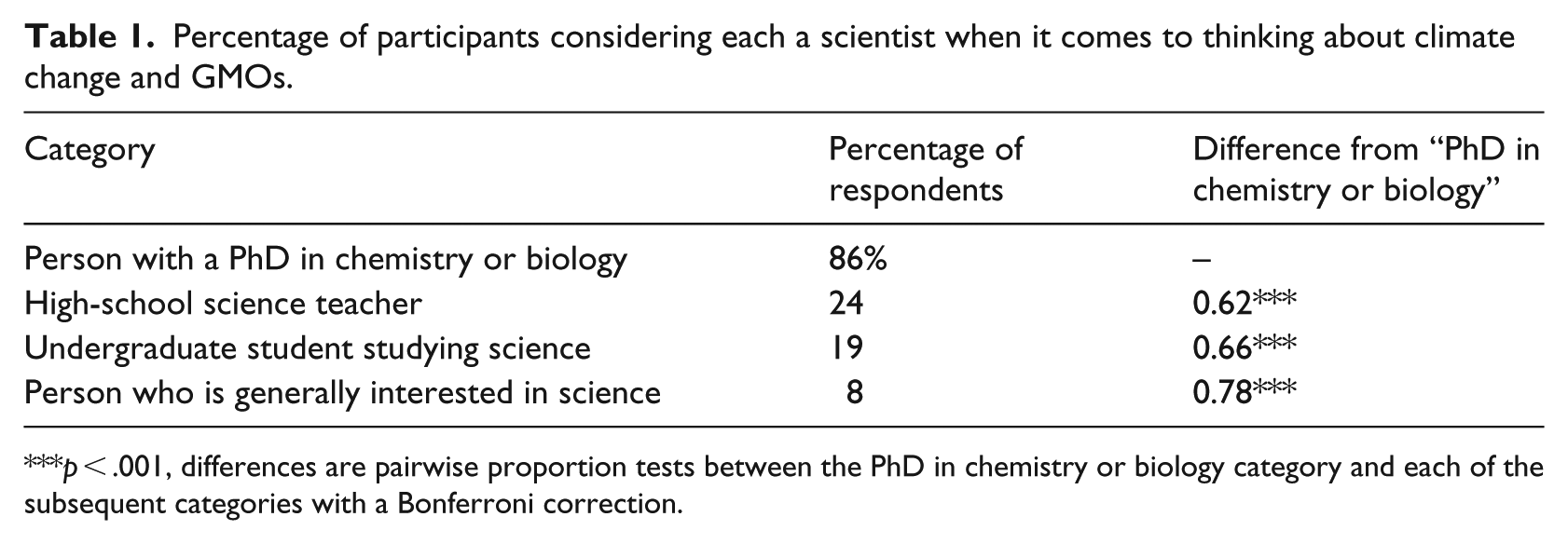
p < .001, differences are pairwise proportion tests between the PhD in chemistry or biology category and each of the subsequent categories with a Bonferroni correction.
Ideology
On average, participants identified as politically moderate on a 5-point scale (M = 2.92, standard deviation (SD) = 1.04).
Science knowledge
We created an additive index of 12 science knowledge items from Wave 6 (e.g. “a light year is a measure of distance,” “Water boils at lower temperature at high altitudes,” see Funk and Goo (2015) for more details). For each item, correct responses received a 1 and incorrect responses a 0. Scores could range from 0 to 12 (M = 8.09, SD = 2.14). 4
Attention to science news
Participants’ self-reported attention to science media was measured by asking “during the last week, how much attention did you pay to news about science?” This question was scored from 1 (No attention at all) to 4 (A great deal of attention; M = 2.46, SD = 0.90).
Selection of science news
To measure the active selection of science-related news, we asked two sets of items. Each set contained three parts. First, participants were shown a list of 10 article titles (two of which were science-related) and asked which one of the news stories they would be most likely to read. Participants who chose one of the science articles were given two points (+2). Next, participants were asked which other articles in the set of 10, if any, they would like to read. Participants who chose a science article at this time were given one point (+1). 5 Finally, participants were asked which of the articles, if any, they would avoid. For each of the science articles that participants chose to avoid, one point was subtracted (−1). Because there were two sets of these questions, participants’ scores could range from +6, meaning that they picked science articles first and second for both question sets, to −4, meaning that they chose to avoid both of the science articles for both question sets (M = 1.36, SD = 2.14). Attention to science media and selection of science news were only moderately correlated (r = .32; p < .001).
Analysis
We utilized descriptive statistics to answer H1 and a multinomial logistic regression analysis to examine RQ1 and H2–H4.
7. Results
Our first hypothesis that more people would say that people with PhDs in chemistry or biology are scientists than the other categories was confirmed. Pairwise proportion tests with a Bonferroni correction show that more people endorsed those with a PhD in chemistry or biology as being “scientists” than any other category (all ps < .001). As shown in Table 1, 86% of survey respondents said that they consider those with a PhD in chemistry or biology scientists compared to only 8% who consider those who are generally interested in science as scientists.
To examine our remaining hypotheses and research question, we conducted a multinomial logistic regression analysis predicting whether people believed that (a) only those with PhDs in chemistry or biology were “scientists,” (b) both biology/chemistry PhDs and at least one other category (high-school science teachers, undergraduate students studying science, or people who are interested in science) counted as “scientists,” or (c) those with biology/chemistry PhDs did not count as scientists. Political ideology, science knowledge, science news attention, and science news selection were included as predictors, and we controlled for demographic variables. The results are shown in Table 2.
Multinomial logistic regression analyses of who is considered a scientist.
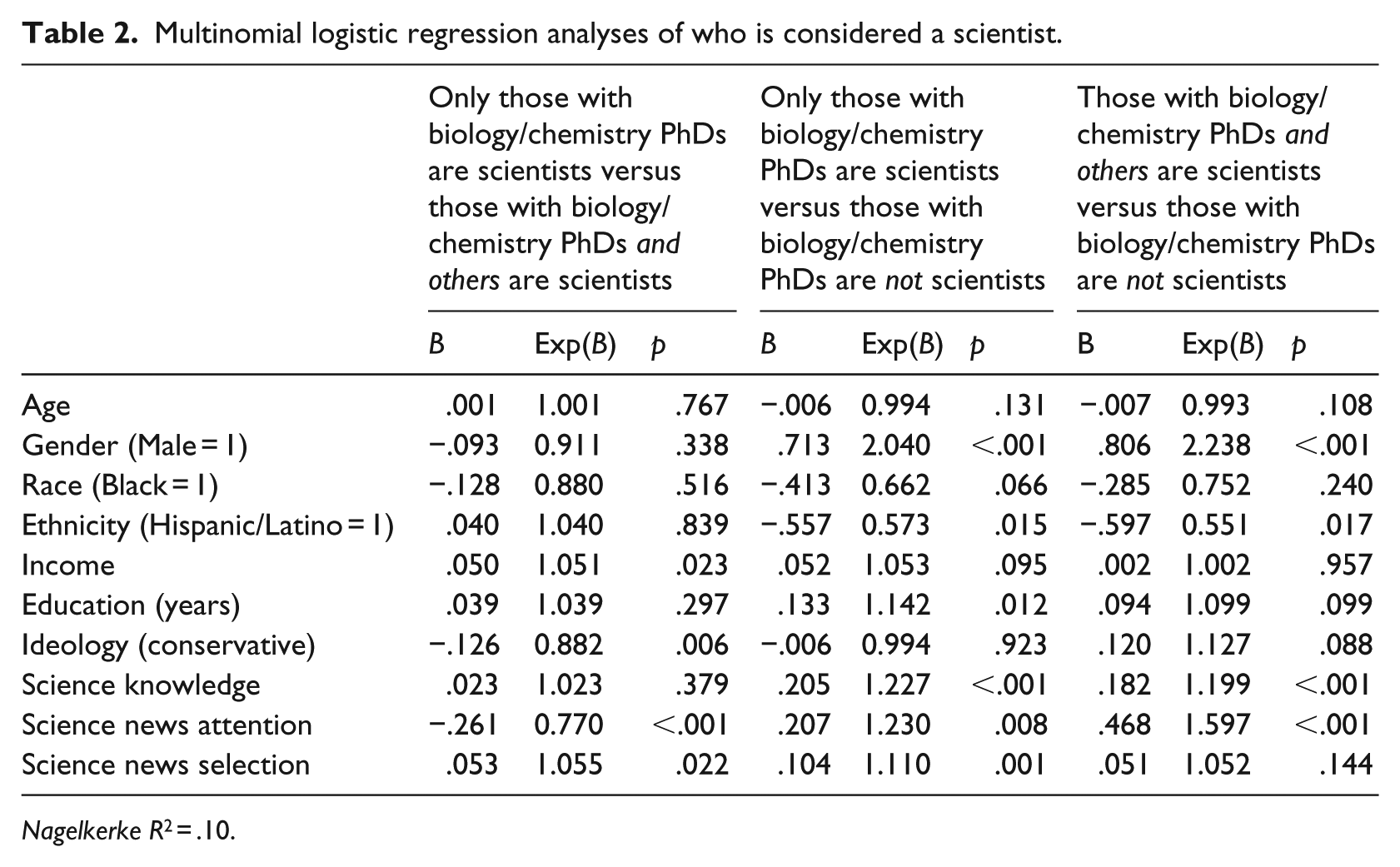
Nagelkerke R2 = .10.
Answering RQ1, liberals were more likely than conservatives to have a more expansive definition of who counts as scientist. Among those who thought that biology/chemistry PhDs count as scientists, liberals were more likely to say that at least one other category (whether high school science teachers, undergraduate students studying science, or people who are interested in science) counted as scientists compared to conservatives (B = −.126, Exp(B) = .882, p = .006). Expressed as probabilities and holding all other values at their mean or modal value, our model predicts that 72.5% of those who report being “very conservative” would believe that only biology and chemistry PhDs, and not the other categories, count as scientists. Sixty-one percent of those who report being “very liberal” would feel the same. Ideology did not significantly predict saying that those with biology/chemistry PhDs are not scientists (only those with biology/chemistry PhDs vs those with biology/chemistry PhDs are not scientists B = −.006, Exp(B) = .994, p = .923; those with biology/chemistry PhDs and others are scientists vs those with biology/chemistry PhDs are not scientists B = .120, Exp(B) = 1.127, p = .088). 6
H2 predicted that those with more science knowledge would have narrower definitions of who counts as a scientist. This prediction was partially supported. More science knowledge predicted endorsing only chemistry and biology PhDs as scientists over believing that these same people were not scientists (B = .205, Exp(B) = 1.227, p < .001). Put in another way, someone who scored in the fifth percentile on the science knowledge index was 76.0% likely to say that only PhDs in biology/chemistry count as scientists versus saying that these PhDs do not count, whereas someone who scored in the 95th percentile was 91.5% likely to do so. More science knowledge also predicted endorsing a broad conception of scientists (as both those with biology/chemistry PhDs and at least one of the other categories) over believing that those with PhDs in chemistry and biology are not scientists (B = .182, Exp(B) = 1.199, p < .001). Someone who scored in the fifth percentile on the science knowledge index was 62.9% likely to say that PhDs in biology/chemistry and those in another category count as scientists (vs saying that PhDs in biology/chemistry do not count as scientists), whereas someone who scored in the 95th percentile was 83.5% likely to do so. Scientific knowledge does not distinguish between those who think that only biology/chemistry PhDs are scientists and those who think that biology/chemistry PhDs and at least one other category are scientists (B = .023, Exp(B) = 1.023, p = .379).
Science news attention (H3a) and science news selection (H3b) were expected to correlate with a lower probability of endorsing non-biology/chemistry PhDs as scientists. Contrary to our predictions, self-reported media attention predicted greater odds of endorsing non-biology/chemistry PhDs as scientists versus saying that only biology/chemistry PhDs are scientists (B = −.261, Exp(B) = .770, p < .001). Converting these coefficients to probabilities, those with the lowest level of science news attention had a 72.6% chance of saying that only those with biology/chemistry PhDs were scientists versus saying that others, such as high-school science teachers, also were scientists. Among those with the highest level of science news attention, this percentage reduces to 54.8%. Those with higher science news attention also were more likely to have an expansive view of who counts as a scientist than to say that those with biology/chemistry PhDs were not scientists (B = .468, Exp(B) = 1.597, p < .001) and to say that those with biology/chemistry PhDs were scientists versus concluding that they are not (B = .207, Exp(B) = 1.230, p = .008). The fact that those with greater science attention endorse broader conceptions of who is a scientist provides no evidence for H3a.
Science news selection, however, was related to saying that only those with biology/chemistry PhDs count as scientists versus many different people counting as scientists (B = .053, Exp(B) = 1.055, p = .022). It is also related to saying that only those with biology/chemistry PhDs were scientists compared to saying those with biology/chemistry PhDs were not scientists (B = .104, Exp(B) = 1.110, p = .001). This provides evidence consistent with H3b. Those who scored in the fifth percentile on science news selection were 63.5% likely to say that a PhD in biology/chemistry counts as a scientist versus that multiple different categories count as a scientist, compared to a 70.6% chance among those who were in the 95th percentile. Furthermore, those who scored in the fifth percentile on science news selection had a 84.0% chance of saying that only those with biology/chemistry PhDs were scientists (vs saying that these PhDs were not scientists), compared to a 90.7% chance of those who were in the 95th percentile.
H4 proposed that media attention and selection would not only have similar effects, but that the effect of media selection would be greater in magnitude. As the effects went in opposing directions, we consider H4 disconfirmed.
8. Discussion
The idea that members of the public are prone to consider non-scientists as the epistemic peers of credentialed scientists is not supported by this research. A majority (56.0%) see only those with PhDs in biology or chemistry as scientists. This demonstrates that most US adults do discriminate between different levels of training when determining who counts as a scientist. The finding also is consistent with previous work on scientist stereotypes, suggesting that the scientist as chemist archetype persists within the context of media coverage of climate change and GMOs. The results of our robustness check for the scientist survey item (see Note 2) show that the scientist as chemist archetype persists when asking about expertise in domain-specific science (climate change, GMOs) and without specifying a domain at all. This suggests that the findings here may be applicable to impressions of scientists in general, but more work should be done to investigate this claim.
The results regarding how political ideology influences perceptions of expertise conform to psychological research about differences between conservatives and liberals. Consistent with literature suggesting that liberals have a less hierarchical approach, liberals were more egalitarian in who they counted as a scientist than were conservatives. At first blush, this result may seem to clash with the finding that conservatives are more distrusting of science (Funk and Kennedy, 2016; Gauchat, 2012; Hamilton, 2015), as liberals were more likely than conservatives to grant the scientist label to non-credentialed individuals. Yet a distrust of science does not necessarily imply a rejection of a credentialed view of who counts as a scientist. It is possible to accept that expert individuals count as scientists, while still disagreeing with their findings and recommendations. Put another way, it is possible that political conservatives can attack the credibility of specific scientists or types of scientists to justify their rejection of specific findings (e.g. Carmichael et al., 2017), while maintaining credentialed views of who counts as a scientist. It is also possible, as demonstrated in recent work in sociology, that liberals and conservatives differ in terms of their attributions of scientific expertise as a result of their differing dispositions toward autonomous culture (Gauchat and Andrews, 2018).
Science knowledge and science media selection predict perceptions of who counts as a scientist in expected ways—both were correlated with a narrower view of who counts as a scientist. As hypothesized, those with more specialized knowledge and a displayed interest in selecting science media that supersedes other topics were more discriminating about who should use the label “scientist.” By using a behavioral indicator of science news selection, we were able to discriminate between those who might self-report attention to science and those who have greater engagement.
Those reporting that they pay more attention to science news had more egalitarian views of who counts as a scientist; they were more likely to say that non-PhD categories (e.g. high school science teachers, undergraduate students studying science, or people who are interested in science) were scientists. There is some precedent for this; Jerit et al. (2016) found that manipulated exposure to a news article positively predicted knowledge about the article, but self-reported exposure negatively predicted knowledge. Actual exposure is more akin to our selection task, while recalled exposure is arguably comparable to our attention measure. Those merely self-reporting their attention display less discrimination than those actively demonstrating their interest in science.
This work broadens what we know about assessing scientific expertise in two key ways. First, rather than assuming that we know who the public considers to be a scientist, we explore assumptions about who counts as a scientist within a specific context: media coverage of climate change and GMOs. The results of this study replicate previous findings from more general inquiries into scientist stereotypes and suggest that generalized stereotypes persist even within domain-specific boundaries. Second, we find differences across non-demographic variables that could serve as the foundation for future work into scientist stereotypes and questions of expertise. Previous work has explored scientist stereotypes across cultural and educational boundaries (Chambers, 1983; Narayan et al., 2013; Türkmen, 2007) and within television programs and popular films (Elena, 1997; Haynes, 2003; Orthia and Morgain, 2016). Our work extends these efforts and suggests that media attention and selection predict scientists labeling differently. For media researchers, we should recognize that there is a difference here that likely has important implications for science communication, in that self-reported media attention is different from the choices individuals make when they prioritize media content.
There are several key limitations to this research and opportunities for continued scholarship. As we were interested in assumptions about expertise related specifically to climate change and GMOs, we did not ask participants to state their assumptions about the term “scientist” more broadly. This could have influenced the extent to which participants were willing to label each category a “scientist”—thus, care ought to be taken when generalizing these findings across all or other scientific domains. Similarly, given that climate change is politicized and politically polarized in the United States (Dunlap and McCright, 2008; Gauchat, 2012), it is difficult to interpret political ideology effects, as the specific issue of climate change may have influenced the way participants responded to the scientist items. The similarity of results across groups in our robustness test (Note 2) suggests the results of this study will remain consistent across domains; however, additional data collection is needed.
The results of this study stem from a sample of adults within the United States and ought not be generalized outside of that context. Although existing evidence regarding who counts as a scientist has shown little cultural variation (Narayan et al., 2013), there is an opportunity to replicate this study outside of the United States and explore differences in who publics consider a scientist across different domains. This work is especially important for topics like climate change, for which public perception may vary both within and between different countries (Lorenzoni and Pidgeon, 2006; Pidgeon, 2012), and GMOs, for which there are demonstrated cultural variants in public understanding and assessment of GM technology (Chern and Rickertsen, 2001; Herrick, 2005).
The manner in which we operationalized key variables may have influenced our results. The way we measured science knowledge, through trivia-style questions about scientific facts, is not the only way science knowledge can be assessed. Other science knowledge scales include measures such as numeracy and cognitive reflection (e.g. Ordinary Science Intelligence, Kahan, 2017). Furthermore, the knowledge measure we utilize here had low internal consistency (α = .643). It is possible that different ways of measuring science knowledge—including focusing on process—might have different relationships with who the public considers to be a scientist. As such, future work ought to explore the effect of alternative measurements of science knowledge. Similarly, our method of measuring media selection may have influenced the results. For instance, the science-focused headlines described balanced takes on polarizing scientific topics, such as climate change. Because of this, participants’ choices may reflect not a preference for science media, but a preference for politically laden or polarizing topics. However, pretesting of these items indicated that they were perceived as neutral. 7
Cross-sectional survey data like these do not allow us to make any inferences about causality. This is particularly of interest for the media variables, where the relationships we find could be a media effect, a selection effect, or some combination of the two. As a media effect, attention to and selection of science media could influence impressions of scientists. As a selection effect, those with particular impressions of scientists could have different media habits. Future research should look to parse these explanations.
Finally, we analyzed only a subset of the possible categories that may be relevant in determining who counts as a scientist. The groups that we analyzed are oversimplified (e.g. combining PhDs in chemistry and biology) and are neither comprehensive nor representative of the way traditional disciplines are organized. We suggest that future work explore different “scientist” categorizations and compare attributions of “scientist” labeling with public perceptions of other concepts. Future work could utilize literature regarding the boundaries of science and society to explore different dimensions of expertise attribution (Gieryn, 1983, 1997, 1999). This literature would be particularly useful as it explores the boundaries between science and non-science through a sociological lens that is well suited to explore the broader structural dimensions of expertise attribution.
Despite these limitations, this research offers key insights into who counts as a scientist in the public’s mind when thinking about media coverage of climate change and GMOs. The results show that traditional definitions of scientists as PhDs in chemistry and biology as scientists persists (Finson, 2002; Mead and Metraux, 1957). Yet, differences across subgroups signal that scientific expertise is not a static notion. Definitions of who counts as a scientist vary based on ideology and scientific knowledge. The relationships between media selection and attention further the idea that expertise is fundamentally connected to communication, a suggestion made in earlier work (Bunderson and Barton, 2010; Carr, 2010; Huckfeldt, 2001; Kuhn and Rennstam, 2016; Treem, 2012) and applied here in a new way. The proposed evolution of expertise (Collins and Evans, 2002) warrants continued study on how the public conceives of experts. Who counts as a scientist, we find, varies.
This work also has important implications for science communication practice. We are agnostic about what the “correct” belief is regarding who counts as a scientist. Rather, the purpose of our analysis is to demonstrate variability in what the public thinks when encountering the term “scientist” in the context of media coverage of climate change and GMOs. Our data highlight that the public may be diverse in their assumptions about who counts as a scientist within these domains, particularly across the political spectrum, different levels of science knowledge, levels of media attention, and media selection. We suggest that science communicators take heed that the term’s meaning is not monolithic in the minds of the public, and use of the general term “scientist” may have unintended consequences if science communicators use the term in manner that is inconsistent with public assumptions. We contend that it is incumbent upon communicators to articulate what the term “scientist” means, and, in doing so, clearly define the type of expertise the public can infer when the label is applied.
Footnotes
Acknowledgements
We thank the Annenberg Public Policy Center at the University of Pennsylvania for their support of this research.
Funding
The author(s) received no financial support for the research, authorship, and/or publication of this article.
