




Abstract
We have little systematic knowledge about scholars’ goals for public engagement in the academic literature. This study therefore provides a secondary analysis of two surveys of scholars that included closed-ended questions about goals. One survey from 2017 was from a sample of Canadian grant recipients from a federal science funding agency, while the second survey from 2018 comes from a sample of professors at top American research universities. The focus of this research is on both presenting novel data about scholars’ expressed goals and exploring the relationships between these goals and potential predictors of these goals, including demographics, past engagement behavior, and overall views about public engagement. Areas for future research are then described.
1. Introduction
Those who study science communication need to know what goals researchers are trying to achieve through their efforts to engage with people outside of academia. Building on the public relations and strategic communication literature (Hon, 1998), we define goals as the ultimate outcomes that a communicator might like to see happen as a result of their communication. These are often behaviors (e.g. change behaviors) but might also include outcomes that might be understood as pseudo-behaviors such as “support,” ‘value,’ or “accept as legitimate.” In contrast, we understand communication objectives as the outcomes (e.g. changes to evaluative beliefs, feelings, or frames) that may result from communication tactics and result in goal achievement. Tactics are thus the specific messages, styles, channels, sources, or communicative behaviors that strategic communicators can vary to achieve their objectives (Besley et al., 2019). Based on this perspective, it does not make sense to talk about achieving goals directly through communication. Instead, goals should be understood as the result of achieving communication objectives, and communication objectives should be understood as the result of successful communication tactics. Recent research from the science communication literature has sought to improve our understanding of scientists’ views about specific communication objectives and tactics (Besley et al., 2019), but little work has addressed what behaviors and pseudo-behaviors scholars want to actually achieve—if anything—through the time and other resources they devote to communication.
With continued regard to terminology, the current manuscript focuses on public engagement activities in the context of scholarly communication. We understand engagement largely in the cognitive sense inasmuch as we would expect that certain types of communication-related activities—especially those involving respectful dialogue—increase the odds that participants (including both scholars and non-scholars/audiences) will systematically (e.g. Chaiken, 1980) or centrally process communication (e.g. Petty and Cacioppo, 1986), and that doing so will increase the odds that they will develop or change their evaluative beliefs. In using the term engagement, we are thus signaling our focus on science communication that seeks to achieve goals as a result of the long-term evaluative belief changes that may occur when audiences are motivated and able to process new information about science, scientists, and related topics (Montano and Kasprzyk, 2015).
An additional assumption underlying the current project is that evidence-based communicators should seek to identify specific behavioral goals early in any discussions about communication. Indeed, science communicators may often need to be pushed until they have identified actual behaviors or pseudo-behaviors they would like to see change because of their efforts. We should not be happy with naïve responses like awareness or excitement (Christiana and Neimand, 2017) as these invite questions such as “but why do you want to increase awareness and excitement?” Scientists’ goals may change over time, but goal identification is still conceptually and practically important because goals provide an anchor around which to choose communication objectives that, if achieved through appropriate tactics, might result in shifts in goal achievement.
In this article, we will further elaborate on the place of goals in fostering more strategic scholarly communication in terms of public engagement and describe the current project. As an exploratory and secondary set of analyses, the emphasis throughout is on developing an initial knowledge base from which to build future research and theory.
2. Literature review
Recent research has attempted to understand science communicators’ public engagement choices as forms of planned behavior, building on the Theory of Planned Behavior (Fishbein and Ajzen, 2010) and the associated Integrated Behavioral Model (Montano and Kasprzyk, 2015). This line of research partly grew out of a concern that, as communication researchers continue to remind communicators, filling knowledge deficits is unlikely to change attitudes or behavior (Simis et al., 2016), and out of practitioners’ eagerness for clear guidance on objectives other than literacy to ethically prioritize (Besley et al., 2016). This resulted in a recognition that talking about communication objectives also requires differentiating such objectives from communication tactics and the ultimate goals of strategic communication, as discussed in the introduction. While some version of the tactics-objectives-goals differentiation appears common in the strategic communication (Hon, 1998) and behavior change literatures (e.g. Rice and Atkin, 2013), science communication scholars have generally not treated scholars’ communication choices about tactics, objectives, and goals as behaviors that can both be studied and reshaped.
The focus on developing a theory of strategic science communication as planned behavior initially focused on trying to understand scientists’ overall willingness to participate in public engagement activities as a function of attitudes, normative beliefs, and efficacy beliefs, consistent with the Integrated Behavioral Model (for a review, see Besley and Dudo, 2017b). However, beyond overall engagement behavior, only a few attempts have been made to use this approach to assess the degree to which the approach could be used to understand scientists’ willingness to choose specific communication objectives (e.g. fostering beliefs about scientific facts, scientists warmth, competence, or willingness to listen) and tactics (Besley et al., 2019). Similar to the studies on overall engagement willingness, the research has found that evaluative beliefs (i.e. attitudes) about specific objectives (e.g. is the objective ethical) and the expected efficacy of specific objectives and tactics in achieving scientists’ goals are often associated with greater willingness to prioritize an objective and tactic (Besley et al., 2019). The current research note therefore seeks to begin to try to understand what might statistically predict scholars’ prioritizing of specific goals using data that is less-than-ideal, but still better than what is otherwise available.
The goals included in the study
In our desire to understand what scholars want to get out of the time and resources they put into communication, we want to sidestep conceptual and ethical questions, such as those raised by Pielke (2007) and Donner (2014), about the degree to which academics need to decide if they are willing to advocate for specific policies, remain largely outside of public life, or choose some middle position. Instead, noting the statement by Pielke (2007) that “[i]f scientists ever had the choice to remain above the fray, they no longer have this luxury” (p. 8), we simply tried to identify an initial set of broad categories of behavior-like outcomes that at least some researchers might be willing to say they would prioritize. We did so by drawing on our own background in the field, as well as frequent conversations with practitioners involved in public engagement training activities (Besley and Dudo, 2017a; Besley et al., 2016; Yuan et al., 2019). Also, while we recognize that scholars may have personal goals for engagement (e.g. to advance their career), the current research focuses largely on broader public-oriented goals. Specifically, we focus on the following six goals.
Ensuring that policymakers use scientific evidence
One goal that scholars might wish to achieve is increasing the degree to which people in government draw on research when making decisions. In North America, this goal is at the heart of a variety of public engagement training and support programs, including the effort that COMPASS Science Communication (2019) does to connect scientists with policymakers and the American Association for Advancement of Science’s (AAAS) (2019) policy fellowship program. We also note that a previous version of the U.S. National Science Board’s (2012) Science and Engineering Indicators included questions showing that most Americans see a central role for science. Note, however, that the question in this study does not ask scholars about their willingness to advocate on behalf of specific policies.
Ensuring that our culture values science
The second goal is perhaps the vaguest of the goals analyzed here inasmuch as the term “value” is somewhat ambiguous. In the current context, it was used as a way to ask about the idea of engagement aimed at trying to get fellow society members to see the worth or usefulness of science. In this regard, the goal might be understood as a pseudo-behavior since a scientist who prioritizes this goal might be understood as prioritizing future support for a range of potential scientific issues. Nevertheless, we think this is a meaningful and indispensable goal for many existing public engagement activities where there is no immediate desired behavioral outcome but where there is still a hope for future benefit. For example, one might expect regular exposure to positive experiences with science and scientists to cultivate generally positive beliefs about science (Dudo et al., 2011).
Ensuring adequate funding for scientific research
A third, relatively concrete goal addressed in the current study involves ensuring funding for scientific research. As with the previous two goals, Science and Engineering Indicators has long tracked Americans’ views about science funding and found consistent funding support (NSB, 2018). Other research has looked at public opinion about funding for research into specific types of technology (e.g. Brossard et al., 2009) and general science funding.
Helping people use science to make better personal decisions
A fourth goal included in this study shifts the focus away from civic-oriented communication and instead asks scholars about a desire to help individuals make better personal decisions. For environmental researchers, the individual behaviors they want to see could include conserving energy or reducing consumption. Similarly, health researchers might want individuals to smoke or drink less, as well as exercise more. Beyond the natural sciences, some researchers might want people to prepare for retirement, make better relationship choices, or an infinite number of other behaviors. All of these, of course, are the subject of substantial literatures of their own (e.g. Rice and Atkin, 2013).
Fulfilling a duty to society
A fifth goal addressed in this study focuses on the degree to which scholars say they are engaging to fulfill a duty (i.e. a responsibility or obligation), rather than trying to accomplish any specific behavior. This is another somewhat of an abstract goal, but it also reflects a portion of the discussion that seems to occur around why scholars should devote resources to engagement (Horst, 2013; Loroño-Leturiondo and Davies, 2018). Underlying this idea seems to be a recognition that a substantial portion of academic research is funded by public monies (i.e. taxes) and a scientist who prioritizes this goal might be understood to be trying to remove a perceived psychological sense of obligation from their own shoulders through engagement activity. In some cases, this obligation may be explicit in the funder- or organization-imposed requirements but it could also be experienced as normative pressure from colleagues or stakeholders. This might be similar to organizational leaders who feel an obligation to “give back” to their community or society. In some cases, there may also be an expectation that doing so helps ensure ongoing legitimacy.
Professional reputation
Finally, while largely focusing on public goals, the current study includes a limited analysis focused on the degree to which scholars report that their goal for engagement is to strengthen their own reputation. This goal is not our primary interest (and was requested by a project partner) but including such a goal provides an interesting contrast to the five public-focused goals previously described. This last goal is also reflected in efforts to show that scholars who engage more are likely to receive benefits, such as seeing their work cited more frequently in both academic journals and the media (e.g. Liang et al., 2014). That being said, we also see potential value treating a broad category of “reputation” as a potential pseudo-behavioral goal inasmuch as a scientist considering public engagement activity participation might not have an immediate behavioral goal but may still want to start engaging so they can increase the odds that they are able to change behavior at a later date. Reputation building, in this regard, would be similar to fostering various trust-related beliefs (Hendriks et al., 2015). Individual trust-beliefs, in this regard, might be best understood as objectives (Besley et al., 2019), but the overall combination of trust-related beliefs could be understood as a reputation for trustworthiness. The long-term focus at the individual-level is similar, in this regard, to the long-term goal of ensuring one’s culture values science as described above.
One potential communication goal not included in the current study is getting young people, including those from diverse background, to consider science careers. This is because the surveys used were framed in terms asking scholars about adult-focused public engagement. It therefore did not make sense to ask about a youth-focused goal. Another omitted goal that deserves future attention is “learning from non-scientists in order to (re)shape research.” The idea of two-way communication, in this regard, means that scientists should be open to changing their own behavior as a result of public engagement activity.
Predicting scholars’ goals
As noted, the past research building on the strategic science communication as planned behavior model used variables associated with attitudes, normative beliefs, and efficacy beliefs to better understand scientists’ engagement-related choices. In those cases, the measures of attitudes, normative beliefs, and efficacy beliefs were directly tied to the behavior in question. Unfortunately, for this study’s analyses, there are not available measures directly connecting attitudes, normative beliefs, and efficacy beliefs to each goal. Instead, respondents’ overall views about engagement, as well as various demographic and other contextual variables (i.e. engagement willingness, past engagement behavior), are available to assess goal prioritization. There are several reasons why we think such an analysis is still important.
First, it seems substantively interesting to know if scholars with different attitudes toward engagement are more likely to rate specific goals more highly than other goals. The available measures specifically include questions about respondents’ belief that the people with whom they communicate would actually listen and treat the communicator with respect (i.e. procedural fairness), and whether their audience would have substantial background knowledge and capacity to understand:
RQ1. To what degree are attitudes about potential audience members’ (a) procedural fairness, (b) scientific knowledge, and (c) capacity to understand associated with respondents’ prioritization of different communication goals?
Similarly, it also seems worthwhile to know if respondents’ beliefs about their colleagues might be associated with differences in goal prioritization. Specifically, one might wonder if goal prioritization is associated with the degree to which respondents think that their colleagues actively participate in public engagement activities and approve or disapprove of engagement activities:
RQ2. To what degree are beliefs about colleagues’ (a) engagement activity and (b) relative acceptance of engagement associated with respondents’ prioritization of different communication goals?
Scholars’ beliefs about their overall ability to engage and engagement effectiveness could also be meaningful predictors of engagement goals. Specifically, respondents who feel relatively more skilled at engagement (i.e. relative self-efficacy beliefs) might be more likely to give relatively higher priority to what they perceive as more challenging goals. Similarly, it seems possible that scholars who see engagement as likely to be impactful (i.e. relative response efficacy beliefs) might also be more likely to prioritize harder goals, or perhaps all goals:
RQ3. To what degree are scholars’ beliefs about (a) their own engagement self-efficacy and (b) the overall response efficacy of engagement associated with respondents’ prioritization of different communication goals?
Finally, beyond attitudes, normative beliefs, and efficacy beliefs, any initial exploration of researchers’ goals needs to consider demographic factors, including standard variables like age (which also represents a proxy for seniority), gender, and ideology. Respondents’ self-reported area of study is also included:
RQ4. To what degree are scholars’ (a) age, (b) gender, (c) degree of liberalism, (d) field, (e) past engagement, and (f) engagement willingness associated with respondents’ prioritization of different communication goals?
Beyond academic interest, there is also a practical reason to study scholars’ goals in the way that we suggest here. First, organizations such as universities, foundations, scientific societies, and communication training groups may want to ensure that they are providing support in the areas that scholars prioritize. Second, there may be times that there is a reason to redirect scholars’ focus from one type of goal to another.
Canada and the United States
We have no particular reason to expect differences between the United States and Canada. We include analyses from both samples here in order to provide a built-in attempt at replicating any findings.
3. Methods
Full methods details are available in supplemental material. Key pieces of information include the following:
Respondents were recruited through email and completed the surveys online through the survey platform Qualtrics.
The Canadian sample was pulled from academics at 20 research universities who were listed in the Natural Science and Engineering Research Council of Canada (NSERC) recipient database as having received a “Discovery Grant” between 2012 and 2017.
With the Canadian sample, four emails were sent to each email address between December 2017 and January 2018 (with a break over the winter holidays) (Dillman et al., 2009). In the end, 1141 Canada-based scientists completed the survey for a response rate of 17%. Of these, 573 were available to the current study, because an embedded experimental design meant that makes half of respondents unsuitable for the current study.
The American sample was based on a randomized sample of academics from 62 research universities that comprise the Association of American Universities (AAU).
After five emails sent between September 2018 and October 2018, 772 scholars responded to the survey for a response rate of 11%. Of these, 516 completed 50% or more of the survey.
Measurement and analyses
The question wording for all measures used in the current study, including reliability coefficients for multi-item scales, is provided in Table 1. All of the non-categorical data—including scholars’ scoring of potential goals—were measured (or recoded) using 7-point response scales and have normal distributions. The primary analysis provided, consistent with the research questions, is point-biserial correlation (when the predictor variable is categorical) or Pearson correlation.
Descriptive statistics for all variables.
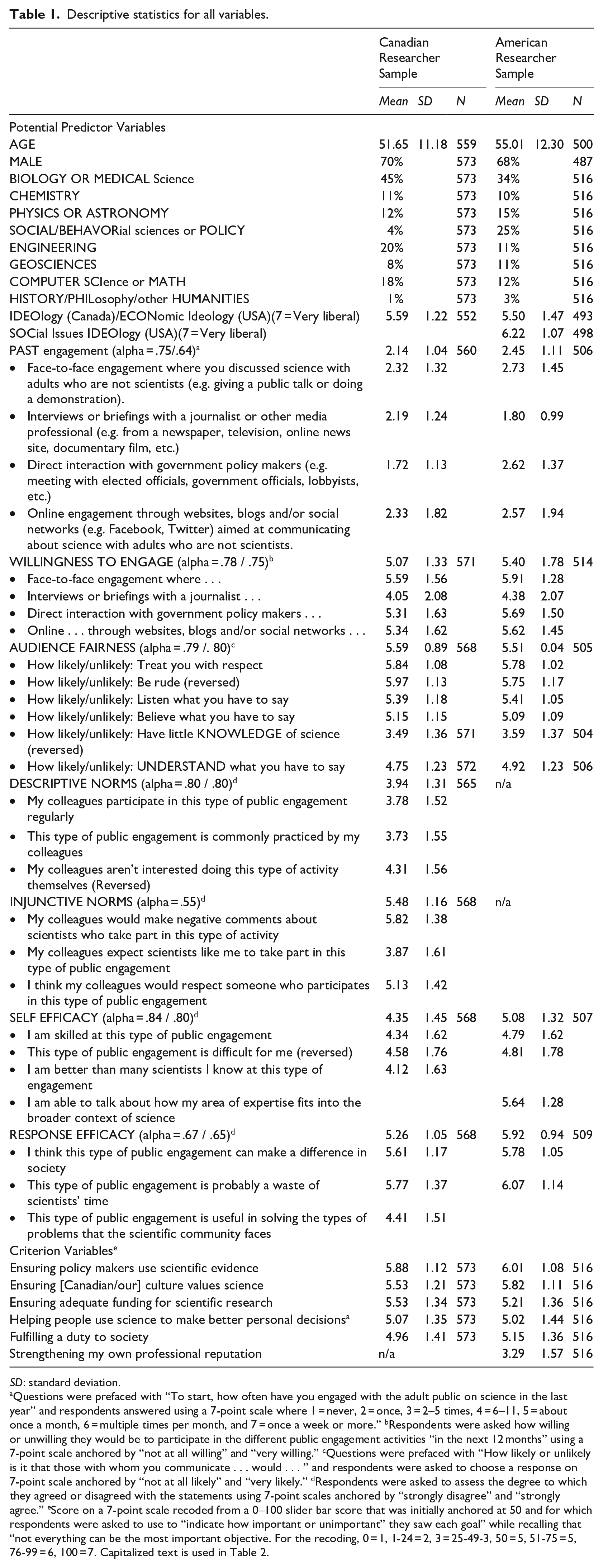
SD: standard deviation.
aQuestions were prefaced with “To start, how often have you engaged with the adult public on science in the last year” and respondents answered using a 7-point scale where 1 = never, 2 = once, 3 = 2–5 times, 4 = 6–11, 5 = about once a month, 6 = multiple times per month, and 7 = once a week or more.” bRespondents were asked how willing or unwilling they would be to participate in the different public engagement activities “in the next 12 months” using a 7-point scale anchored by “not at all willing” and “very willing.” cQuestions were prefaced with “How likely or unlikely is it that those with whom you communicate . . . would . . . ” and respondents were asked to choose a response on 7-point scale anchored by “not at all likely” and “very likely.” dRespondents were asked to assess the degree to which they agreed or disagreed with the statements using 7-point scales anchored by “strongly disagree” and “strongly agree.” eScore on a 7-point scale recoded from a 0–100 slider bar score that was initially anchored at 50 and for which respondents were asked to use to “indicate how important or unimportant” they saw each goal” while recalling that “not everything can be the most important objective. For the recoding, 0 = 1, 1-24 = 2, 3 = 25-49-3, 50 = 5, 51-75 = 5, 76-99 = 6, 100 = 7. Capitalized text is used in Table 2.
4. Results
At a descriptive level (Table 1), there are many similarities on many measures between the American and Canadian results. Nevertheless, recalling that we do not provide formal mean comparisons because of sampling differences, it may be noteworthy that the American sample has more social science scholars because of the sampling frame (e.g. the Canadian granting agency does not typically fund social scientists or humanities scholars). The American respondents also logged somewhat higher levels of past engagement (~4/10 of a point), engagement willingness (~3/10 of a point), and beliefs about both self-efficacy (~7/10 of a point) and response efficacy (~7/10 of a point) on the 7-point scale used to measure these constructs.
Another place where there is only a small difference between the American and Canadian scholars surveyed is in how they rated goals. Both clearly indicated that the most important goal is ensuring policymakers use evidence, and also indicated they saw it as quite important to ensure that their culture values science. However, funding was just as important as culture for Canadians, whereas funding scored somewhat lower (~6/10 of a point) for Americans. Of relatively lower priority in the American sample were the goals related to affecting individual behavior, duty, and personal reputation. However, with the exception of the duty question, the scholars seemed to indicate that all of these goals were potentially important by rating them well above the mid-point of the provided scale.
Turning to the research questions (Table 2), RQ1 asked whether audience attitudes are associated with communication goals. The results suggest that such relationships are somewhat rare or relatively small. The belief that audiences are likely to listen and be respectful (AUDIENCE FAIRNESS; RQ1a) was significantly related to three goals for Canadian scholars, but the biggest of these was related to ensuring cultural values (r = .17 or r2 = .03). Scholars’ beliefs about their audience’s knowledge (KNOWLEDGE; RQ1b) was only a small (negative) predictor for two goals in the Canadian sample. However, scholars’ belief that their audience would likely understand them (UNDERSTAND; RQ1c) was also a significant predictor for three goals in the Canadian sample and two goals in the American sample. The relationship between perceived potential for audience understanding and the goal of fulfilling one’s duty was the largest, but still relatively small (r = .17/.16 or r2 = .03).
Correlations between potential predictor variables and goal prioritization.

N for most correlations = ~500 (see Table 1). Variable names are also further described in Table 1. Dummy coded; “0” indicates respondent did not choose this category and “1” indicates respondent chose this category. Respondents could choose more than one category. Bold text indicates significance at p > .05 (two-tailed).
For RQ2, there appears to be little relationship between normative beliefs about engagement and communication goals. The only two significant relationships were for descriptive norms and suggest less than 2% shared variance (i.e. r2 = .02).
Efficacy beliefs—especially response efficacy beliefs—appear to be the most substantive predictor of the public engagement goals included in this study. Scholars’ belief in their own engagement skills (i.e. SELF-EFFICACY, RQ3a) were associated with giving higher levels of priority to goals associated with individual decision-making, duty, and reputation (with r2 between about .01 and .04). However, the respondents’ belief that public engagement could be impactful (i.e. RESPONSE EFFICACY, RQ3b) was a significant (and often substantive) predictor of most of the goals about which scholars were asked (with significant r2 between about .01 and up to .08).
Most demographic variables (RQ4), including field, seem to be relatively minor and inconsistent predictors of public engagement goals, although degree of liberal identification seems to be somewhat associated with higher ratings of policy-related goals in the American sample (e.g. ensuring policymakers use evidence-related goals), ensuring funding (with significant r2 between .01 and .04). Also, American respondents from computer sciences and mathematics seem to rate several of the goals relatively low (RQ4d). In contrast, both past engagement (RQ4e) and future willingness were among the most consistent predictors of goal prioritization.
5. Discussion and conclusion
We would argue that the most important results here might be the descriptive results showing that scholars from these two samples are perfectly willing to endorse various public engagement goals related to government policy and individual behavior. The evidence suggests that the scholars want decision-makers and others to support the use of science in policy and personal life, and they want funding for science. Scholars’ willingness to choose substantive goals also complements past similar work. This includes research focused on scholars’ willingness to prioritize a range of communication objectives—not just increasing science knowledge —and a willingness to consider a range of tactics that seem more likely to affect perceptions of scholars than increase science knowledge (Besley et al., 2019).
The correlation analysis also seems to complement past work around the idea of strategic science communication as planned behavior. As noted, such work has pointed to the importance of response efficacy (RQ2b) beliefs (i.e., the benefits of a behavior) in how scholars think about communication choices, while providing little evidence that normative beliefs (RQ3) and demographics, including field (RQ4), are associated with scientists’ communication choices. In other words, results so far suggest that a good way to get scholars to consider a tactic, objective, or goal might be to show that specific, evidence-based communication choices can make their public engagement more effective.
That being said, we reiterate that the current results are limited because the predictor variables used were not focused on the specific goals about which the participating scholars were asked. Rather, the best we can say from the current study is that a willingness to engage and belief in the effectiveness of engagement seem to be positively associated with higher overall prioritization of goals. This makes sense since someone who believes in the potential impact of engagement also seems more likely to have deeper goals for engagement. Also, it is noteworthy that the populations sampled resulted in somewhat older samples of researchers and it might be necessary to over-sample young scholars in order to make stronger claims about age as a predictor of goal beliefs. Similarly, we might expect a different pattern of results in other countries with different cultures of engagement.
An obvious next step would be to obtain data that specifically addresses scholars’ goal-specific attitudes (e.g. the perceived ethicality of a goal), normative beliefs, and efficacy beliefs. The goals studied might include some of those discussed here, but it might also be helpful to ask about some goals where there is less agreement (i.e. more variance). This might include asking scholars how much they would prioritize public engagement designed to see support for specific policies in their area of expertise or specific areas of funding (i.e. advocacy). Attention might also be turned toward additional reputation and career-enhancement goals. Whatever the case, such research could help improve science communication through the greater discussion about what the scientific community hopes to see happen as a result of their communication efforts.
Supplemental Material
Scientists_goals_in_the_US_and_Canada_-_Supplemental_Material_v3 – Supplemental material for Exploring scholars’ public engagement goals in Canada and the United States
Supplemental material, Scientists_goals_in_the_US_and_Canada_-_Supplemental_Material_v3 for Exploring scholars’ public engagement goals in Canada and the United States by John C. Besley, Todd P. Newman, Anthony Dudo and Leigh Anne Tiffany in Public Understanding of Science
Footnotes
Funding
The author(s) disclosed receipt of the following financial support for the research, authorship, and/or publication of this article: The authors received financial support from the Kavli Foundation, The Chan Zuckerberg Initiative, and The Burroughs Wellcome Fund. Additional funding was provided through internal university grants and research funds.

Supplemental material
Supplemental material for this article is available online.
Author biographies
References
Supplementary Material
Please find the following supplemental material available below.
For Open Access articles published under a Creative Commons License, all supplemental material carries the same license as the article it is associated with.
For non-Open Access articles published, all supplemental material carries a non-exclusive license, and permission requests for re-use of supplemental material or any part of supplemental material shall be sent directly to the copyright owner as specified in the copyright notice associated with the article.
