



Abstract
This study shows how cartoonists use iconic and stereotypical animals in their works to reflect society’s knowledge about the effects of climate change. Studying 1022 climate change cartoons including depictions of animals, we noticed that there is very little biodiversity depicted in cartoons. Cartoonists generally avoid using animals indigenous to their own countries; this point is especially true regarding the low presence of insects and other invertebrates. This text also encourages cartoonists to adhere to some recommendations to improve climate change communication. These guidelines are (1) using indigenous wildlife, (2) depicting invertebrate wildlife, (3) improving their knowledge about the biogeographical distribution of each species to avoid spreading misconceptions and (4) developing climate change communication from a positive point of view, appealing to potential improvements against the climate crisis, both for humans and for the rest of the species.
Keywords
1. Introduction
The scientific community agrees that we are currently immersed in a climate change (CC) process and most of its effects on the climate system are a consequence of human activity (Intergovernmental Panel on Climate Change (IPCC), 2014, 2018; World Meteorological Organization (WMO), 2020). Citizens have often focused on temperature when trying to describe CC. However, the Global Climate Observing System (GCOS, 2019) is raising awareness of seven state-of-the-climate indicators describing the most relevant domains of CC, grouped in temperature and energy (including surface temperature and ocean heat), atmospheric composition (atmospheric CO2 concentration), ocean and water (ocean acidification and sea level) and the cryosphere (glaciers and Arctic and Antarctic sea ice extent). According to these indicators, all parameters were greatly altered in 2019, which was a record year for ocean temperatures. CO2 concentration continued to rise, which led to the oceans absorbing around 25% of anthropogenic CO2 emissions during the past decade, which in turn resulted in an increase in ocean acidification. The sea ice extent in both the Arctic and Antarctica was below average throughout 2019; most remarkably, the Arctic was at record-low levels during the first two months of the year. In addition, glaciers are retreating (GCOS, 2019; WMO, 2020).
The variation or alteration of all these parameters results in a direct loss of biodiversity in the most heavily affected locations, and also alters the composition of plant and animal species, as shown in different studies (Intergovernmental Science-Policy Platform on Biodiversity and Ecosystem Services (IPBES), 2019; IPCC, 2014; Kapos et al., 2008; Nunez et al., 2019). Moreover, a meta-analysis by Radchuk et al. (2019) warns that animals’ adaptive response to CC is most likely insufficient. This directly threatens the survival of species, so immediate action is necessary and urgent to raise awareness and promote societal action. It is absolutely necessary to conduct CC communication with scientific rigour and following effective strategies, to make citizens feel as involved and informed as possible.
The animal icons of CC
From the onset of the climate crisis, polar bears and (a while later) penguins became animal stand-ins for global warming (Manzo, 2010a, 2010b, 2012; O’Neill and Hulme, 2009; Whitley and Kalof, 2014). The progressive destruction of their habitat with the increase in temperature allowed them to be presented as a symbol of the consequences of CC, even though their geographical distribution is circumscribed to the ice caps (more specifically, polar bears live in the North Pole and the different penguin species inhabit the South Pole).
During the first half of the twentieth century, polar bears were particularly infamous due to their aggressive character. They emerged as an example of hostility in a particularly inhospitable and wild location (Hill, 2009; McGhee, 2005; Potter, 2007). However, since the beginning of the 1950s, the use of American post-war era technology (such as planes, high-powered rifles and tranquilisers) to unsustainably hunt polar bears in the Arctic resulted in the symbolic transformation of these animals in the collective imagination. The ferocious and dangerous bears became unfortunate, helpless victims of uncontrolled hunting, especially threatened by the thawing of the ice cap (Archibald, 2015).
The spectacular 2004 photograph of two polar bears – probably a mother and her cub – on an ice block, coinciding with the publication of the fourth IPCC report, attracted even more of society’s attention (Garfield, 2007). Other images, such as the one published on Time’s cover in 2006 with the headline ‘Be worried. Be very worried’ – showing a lone bear floating on a small and rapidly collapsing ice sheet – made them look even more as victims. That summer, Al Gore released his documentary An Inconvenient Truth, showing a bear unsuccessfully trying to climb onto small chunks of ice. In May 2007, photographer Annie Leibovitz devoted the cover of Vanity Fair’s Green Issue to young Leonardo DiCaprio and Knut, a popular orphaned polar bear who was born in the Berlin Zoological Garden. They were photographed on an ice sheet at the Jökulsárlón glacier lagoon in Iceland, ice melting away under his boots. At the same time, the American National Wildlife Federation encouraged its members to donate money to adopt a polar bear and prevent ice from ‘melting [. . .] beneath their paws’ (Dunaway, 2009). In 2008, Hansen and Machin (2008) stated that ‘an image of a polar bear on an ice-floe is not about a particular animal, place or time but used to connote global warming, even if the image itself was taken at a time when there was a different agenda about wildlife conservation’ (p. 787). Owen and Swaisgood (2008) referred to polar bears as the ‘poster child for climate change and the focus of increasing media attention’ (p. 123). From around 2005–2009, visual images including polar bears gained prominence (O’Neill, 2019). Today, polar bears have become an icon of our times (Nerlich, 2019), representing ‘affective animals’ in the context of CC, a ‘physical and visual embodiment of the Arctic’ (p. 14) (Huggan, 2016).
Conversely, we are not so certain when penguins started to appear in the mass media: the 2005 Coca-Cola advertisement ‘Arctic Beach Party’ included both polar bears and penguins, but the ad did not seem to spread any climate protection message. In the spot, however, we can find the first instance of the error that gathers both species in the same geographical context, whether or not it was intentional. This misunderstanding is also observed in other more serious publications, such as Manzo (2012), where both polar bears and penguins are included as Arctic animals. Finally, in 2007, Time’s cover published a penguin picture with the headline “The Global Warming Survival Guide”.
CC in cartoons
Although the media reception of CC has been widely researched (e.g. Boykoff, 2007a, 2007b; Boykoff and Boykoff, 2004; see also Manzo and Padfield, 2016, and O’Neill, 2019, for more extensive bibliography), and images have been shown to impact how people feel and act on CC (Leiserowitz, 2006), the analysis of cartoons on this matter has traditionally been a marginal note at best (Domínguez et al., 2017). In fact, O’Neill and Smith (2014: 84) claimed that some types of visuals, as cartoons, ‘are either missing entirely, or worthy of more in-depth exploration’ (Manzo, 2012; Rudiak-Gould, 2011). However, cartoons are a very effective and useful tool to analyse the public perception of any current topic, whether we are talking about a social, political or even scientific issue and can both reflect and shape the cultural politics of CC (Bakker, 1999; Bouvier, 2001; Caswell, 2004; Giarelli, 2006; Manzo, 2012; O’Neill and Smith, 2014). In general, they tend to capture the general opinion of the country more veraciously than other opinion genres, such as op-eds (Domínguez and Mateu, 2013, 2014), showing that historians are paying more and more attention to visual resources as a research tool (Hansen and Machin, 2008; Sanchidrián Blanco, 2011).
Likewise, the perception of a news story can evolve as it develops, and a change of attitude over time can be perceived in the cartoonists with regard to the same problem (Domínguez, 2016; Domínguez et al., 2014). On the contrary, humour is a very efficient mechanism to bring an issue closer to a large number of potential readers (Anderson and Becker, 2018; Boykoff, 2019; Boykoff and Osnes, 2019), who in turn can spread the cartoonist’s message to their close friends and relatives (Shurkin, 2015).
Editorial cartoons can be found in the most influential newspapers, following and reinforcing the publication’s editorial policy. In this sense, newspapers continue to play a pivotal role in the dissemination of CC news and their public perception (Carvalho and Burgess, 2005; Ungar, 2000), so the presence of animal species in the cartoons they publish can help spread the news about biodiversity problems (Small, 2016). A particularly threatened biodiversity (Harley, 2011; Thomas et al., 2004), and one we must pay special attention to, is that of invertebrates (Sánchez-Bayo and Wyckhuys, 2019), generally forgotten by the media.
Therefore, the main objective of this article is to examine the presence, typology and use of animals in CC cartoons. In addition, we want to check whether the cartoonist’s toolbox only includes bear and penguin images or other species affected by CC are also present. Consequently, the present study aims to answer the following research questions:
How do bears and penguins appear in CC cartoons?
What other animals do cartoonists use to discuss CC?
What do the animals in CC cartoons convey?
2. Method
The cartoon set that makes up the sample of this study was obtained from online open-access image databases. The main cartoon databases repositories used were Caglecartoonspolitics, Cartoonstock, Cartoonist group, Cartoonsmovement and Toonpool, as well as Pinterest and custom Google image search. They are a very useful tool for collecting an abundant sample of CC cartoons. Cartoons published in the authors’ blogs were also included because they were considered to meet representativeness requirements (Giarelli and Tulman, 2003). One of the criteria followed to select the cartoons was the professionalism of the author. Those works that were evidently made by amateurs – due to style and content reasons – were excluded.
The terms used in the search were ‘climate change+cartoon’ and ‘global warming+cartoon’. The search was conducted in English, French, Spanish, Italian, Portuguese and German. As a result, we noticed that some cartoons connected CC to other environmental ideas, some of them more related to it than others. Some related examples were animal extinction or endangerment, the Kyoto protocol and the carbon footprint. A more unconnected one was the ozone layer hole. Then a second search was conducted introducing those concepts (animal extinction, Kyoto protocol, carbon footprint and ozone layer hole) used as keywords and followed by the term ‘cartoon’.
Only cartoons containing animals were included, whether or not they were the main characters. The following data were registered for each cartoon: digital platform and keyword used in the search, name and nationality of the author, date of publication of the cartoon and title. To facilitate the analysis, a coding structure was developed including the topics and subtopics discussed in the cartoons. Thus, two large groups were created, divided in turn into several subgroups:
Animals as CC indicators. This category comprehended cartoons portraying animals and evidencing any of the GCOS state-of-the-climate indicators. These Global Climate Indicators were identified by scientists and communication specialists in a scientific panel led by GCOS and they were later endorsed by the World Meteorological Organization (WMO, 2020). They provide key information for the most relevant domains of CC (atmospheric, oceanic and terrestrial). According to them, the following subcategories were created: (1a) animals affected by the thawing of glaciers and the decrease in Arctic and Antarctic sea ice extent (mostly bears and penguins); (1b) animals affected by the concentration of atmospheric gases; (1c) animals affected by ocean acidification and the change in sea level and (1d) animals that suffer the consequences of an increase in surface temperature and ocean heat.
Animals related to political and sociocultural factors. This category collects cartoons portraying animals to reflect on sociocultural factors and political conflicts derived from CC. It also includes cartoons showing animals related to tradition and folk tales. The subcategories are as follows: (2a) animals that represent ideological positions related with CC and (2b) animals that reflect cultural issues affected by or related to CC.
Finally, prior to the codification of the cartoons into the groups cited above, we carried out an independent intercoder reliability test with two independent coders, following Fleiss’ (1971) model. Reliability was established using 100 cartoons, approximately 10% of the total sample. Fleiss’ kappa coefficient for the main subgroups (k = 0.61) indicated a substantial agreement according to the standards (Wimmer and Dominick, 2011). Once codification reliability was confirmed, the entire sample was coded. All statistical analyses were performed using IBM® SPSS® Statistics Version 26 (IBM Corp, 2019).
3. Results: From bears and penguins to mosquitoes
Among all the CC cartoons found during the search process, a total of 1022 depicting animals were selected. All of them had been published on social media or general media (in press or online) between June 2000 and April 2019.
The cartoonists are from 60 different countries in all and use a wide range of animals (up to 69 species) that can be catalogued within the most relevant domains of CC or are related to political or sociocultural factors (Supplemental Table S1).
Animals as CC indicators
Animals of the cryosphere
To discuss the cryosphere, cartoonists use polar bears, penguins and, to a lesser extent, seals (10 cartoons) as examples of victims of the decrease in sea ice extent.
Polar bears are the most represented animal, with a total of 367 cartoons (35.9% of the total sample) by cartoonists from 44 different countries (Supplemental Table S1). Most of them depict bears as the main character in the cartoon, in a rapidly disintegrating Arctic environment, often alone and isolated on an ice floe (Figure 1a). On other cartoons, bears are drawn in exotic habitats, forced to migrate as a consequence of their natural ecosystem becoming uninhabitable (Ghamir Ali, Morocco; Patrick Chappatte, Switzerland; Riber Hansson, Sweden; Marian Kamensky, Austria).

Cartoons that belong to category 1: Animals as climate change indicators. (a) ‘Polar bear with sombrero’ Riber Hansson, Sweden, 2010. (b) ‘We want more ice’ El Roto, Spain, 2014. (c) ‘Penguin meets polar bear, and says: “Well, one of us is in the wrong cartoon”’ Royston Robertson, UK, 2006. (d) ‘Green New Deal’ Antonio Branco, USA, 2019. (e) ‘Now Trump knows, climate change is real!’ Shahid Atiqullah, Afghanistan, 2017. (f) ‘We’ve been flooded so many times the dog has grown fins!’ Paul Wooldridge, UK, 2014.
Penguins are the second most common animal. They star in a total of 187 cartoons (18.7% of the total) from 32 different countries, presented as victims of the thawing of the South Pole (Figure 1b). As in the case of polar bears, we also find references to penguins’ forced migration to other continents, to a search for more suitable habitats (sometimes even a refrigerator in a Western country, as is the case in a work by Roy Delgado, USA).
Bears and penguins share the same polar context in 45 cartoons (4.4% of the total; Patrick Chappatte, Switzerland; Schot, Netherlands). This is an obvious and serious conceptual error, because these animals never share a habitat (bears are indigenous to the North Pole, while penguins live closer to the South Pole). One of the illustrators even warned about this pervasive geographical misunderstanding in a cartoon (Figure 1c).
Animals related to greenhouse effect gases
Cows are the fourth most commonly used animals. They are featured in 42 cartoons, where they are depicted as directly responsible for methane emissions, a greenhouse effect gas (Figure 1d). In addition, the animal is chosen by artists from 14 different countries, which shows how international the association between these gases and CC effects is.
Canaries appear in cartoons connected to their use as carbon monoxide (another greenhouse effect gas) detectors in mining. Thus, they represent the alarm announcing the last chance to escape alive from the mine (Adam Zyglis, USA).
Marine animals, sea level and ocean acidification
All sorts of fish (the fifth most common animal, with 34 cartoons) are used to represent a hypothetical marine environment, generally decontextualized, and often located in urban or domestic spaces, to alert of the threat of the sea level increase (Figure 1e).
In relation to floods, cartoonists draw Noah’s Ark, with a diverse set of animals suffering the consequences of CC-related flooding and a rise in sea level (John Darkow, USA) or of droughts (Pavel Constantin, Romania; Cristina Sampaio, Portugal). A total of six cartoons refer to the impact of ocean acidification on coral (Jack Ohman, USA; Steve Sack, USA; Adam Zyglis, USA), although it is striking that none of the cartoons were the work of Australian cartoonists, who are closer to the Great Barrier Reef.
Animals related to temperature warming
Dogs are the animals chosen by most of the cartoonists (the sixth most used animal) to warn about the consequences of a temperature rise in family homes (Figure 1f). Meanwhile, camels, dromedaries, giraffes, lions, zebras, rhinoceros, iguanas and elephants are used in drought-related scenarios (Jaume Balaguer, Spain; Shanti-Savera Ernakulam, India; T-boy, Hungary), often living in deserted spaces or in deeply eroded locations. However, these animals are shown as benefitting from CC, as if their habitat had actually spread (Ayvalık, Turkey; Shanti-Savera Ernakulam, India; Ralph Hagen, Canada; John McPherson, USA; Mariagrazia Midulla, Italy). Mosquitoes appear as the favoured invertebrates, with the temperature increase allowing them to colonize new habitats (Theresa McCracken, USA; Aitor Menta and Dani Gove, Spain).
Animals connected with political and sociocultural factors
Ideological leaning
The study analysed the presence of elephants, taking into account that they sometimes appear just as animals, with no symbolic weight (8 cartoons) (Dario Castillejos, Mexico), but most of the time they are used to symbolize the US Republican Party (72 cartoons) (Figure 2a). The latter use of elephants occupies the third position in number of cartoons, although it should be noted that all the cartoonists in this case are North American. Similarly, donkeys represent the US Democratic Party, although they appear much less (20 cartoons) (Lisa Benson, USA; Daryl Cagle, USA; Jimmy Margulies, USA).

Cartoons that belong to category 2: Animals related with political and sociocultural factors. (a) ‘News item: Rapid climate change could spell catastrophe sooner than expected’ Nick Anderson, USA, 2016. (b) ‘Climate change and hurricanes’ Jimmy Margulies, USA, 2017. (c) ‘Global warming’ Mike Luckovich, USA, 2010. (d) ‘Climate change and Santa’ Dave Granlund, USA, 2015.
The representation imbalance between donkeys and elephants could be clearly attributed to the fact that the Republican Party policy is closer to CC denial; so many North American illustrators express their disagreement with this political point by representing their animal symbol in an ironic or paradoxical way. However, some cartoons contain the same contrarian message and ridicule the ideological stance represented by the donkey (Rick McKee, USA). Thus, these two animals are used in numerous cartoons with no further mission than to stand as symbols of the two antagonistic political currents.
Sociocultural aspects
Cartoonists show the danger of CC by using iconic extinct species, like dinosaurs (in seventh place, with 31 cartoons) (Figure 2b), but they also use mammoths (Carol Simpson, USA) and dodo birds (Bill Day, USA; Dave Granlund, USA). Their use in cartoons warns about the threat of future CC-related extinctions, and about the fact that humans could be among those species. They are used to criticize social reactions that downplay global CC impact. Humans are compared with dinosaurs, indicating that neither of them expected their ultimate extinction.
Conversely, vultures (Bill Schorr, USA), crocodiles (Bill Day, USA; Dave Granlund, USA) or sharks (Diego Ibáñez, Spain; Paresh Nath, India) are used to represent a physical threat to humans, due to their nature as predators or scavengers. Therefore, they become a symbol of the dangers facing society as a result of CC.
Ostriches, hens, frogs, turtles, snails and groundhogs appear in many cartoons to denounce a change in social attitude towards CC. With ostriches, cartoonists allude to their alleged (and untrue) behaviour of burying their heads in the ground, with many cartoons linking it with irresponsible attitudes in relation with CC (Clay Bennett, USA; Jimmy Margulies, USA). Illustrators also represent hens as a symbol, based on the traditional tale ‘Henny Penny’, in which a hen repeatedly shouts that ‘the sky is falling!’ (Eric Allie, USA). A similar case is that of frogs, used in relation to the belief that they are unable to perceive a gradual change in their body temperature, and compared with humans being unable to react to CC (Figure 2c). As for turtles and snails, both are used to denounce how long it takes governments to implement measures to slow CC (Frederick Deligne, France; Chris Slane, New Zealand). Groundhogs are depicted confused and unable to announce the change of season due to general climate disorder (Bruce Plante, USA).
Reindeer are the eighth most commonly represented animal (they appear in 30 cartoons) and are always linked to Santa Claus (Dave Granlund, USA), with cartoonists creating a parallel between the ice thawing and the danger that this Christmas tradition will disappear (Figure 2d).
How cartoons portray animal biodiversity
Taking into account the represented biodiversity (Table 1), we can identify a total of 69 animal species separated into nine groups, including the five vertebrate classes (fish, reptiles, amphibians, birds, and mammals), arthropod invertebrates (including only the insect class) and non-arthropod invertebrates, with representatives from the Cnidaria phylum (Anthozoa and Scyphozoa) and the Mollusca phylum. To facilitate the analytical process, we do not distinguish close taxons.
Groups of animals depicted in the cartoons with the number of species included among them and the number of cartoons in which they appear.
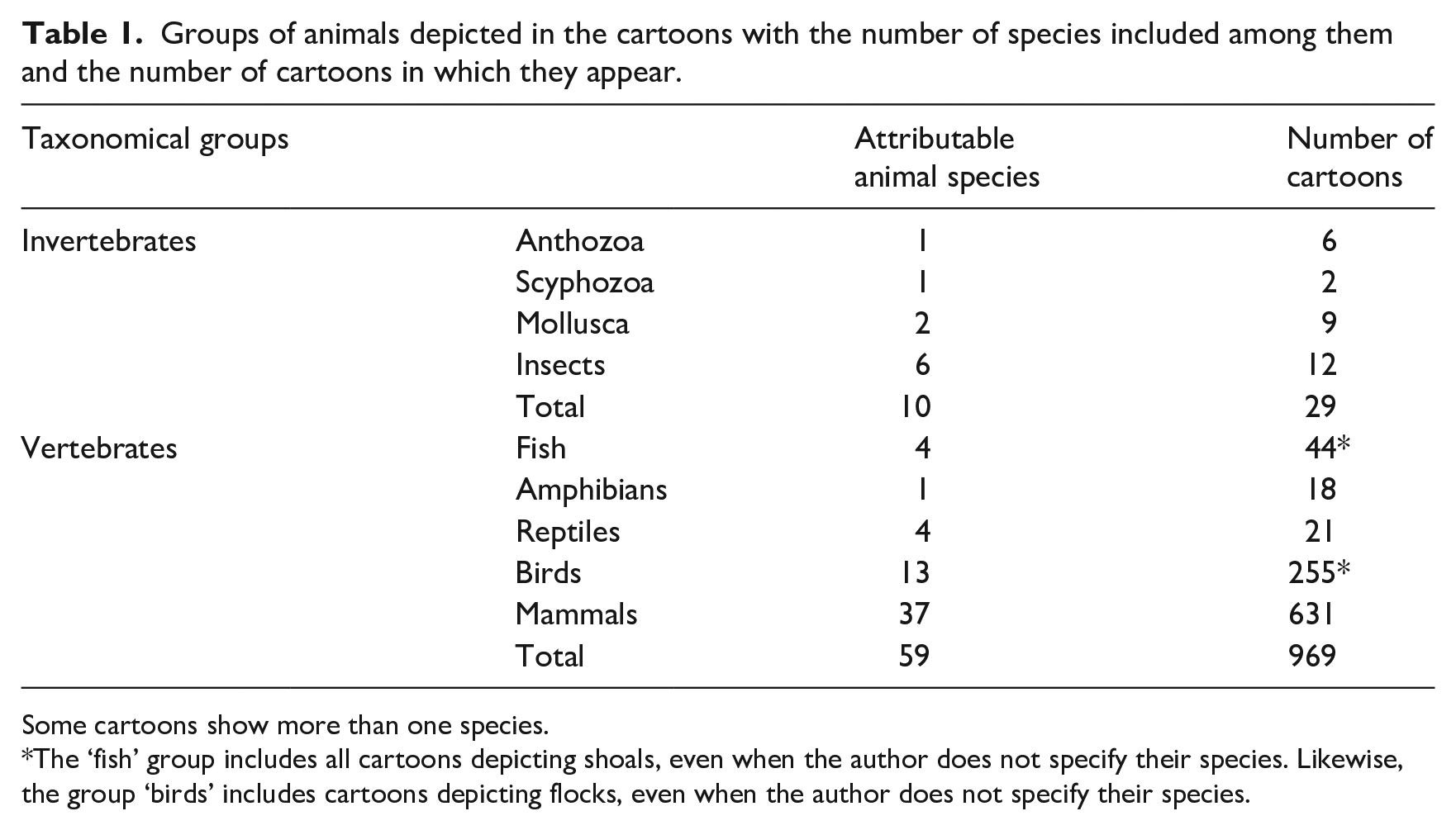
Some cartoons show more than one species.
The ‘fish’ group includes all cartoons depicting shoals, even when the author does not specify their species. Likewise, the group ‘birds’ includes cartoons depicting flocks, even when the author does not specify their species.
The class with the greatest biodiversity is mammals, with 37 represented species. It is also the one with the highest representation (631 cartoons). The most common mammal species are polar bears, cows, dogs, reindeer, brown bears, giraffes, seals, dromedaries, elephants, cats, horses and mammoths, among others. We find some mammal species that are native to each country, such as the Iberian lynx (Santi García and Dani Gove, Spain) or the manatee (Jeff Parker, USA), but their presence is scarce.
Birds are the second most prominent class, in addition to being also second in species diversity. The most represented species are penguins (as a symbol of CC), hens (as folk tale figures), canaries (as representation of carbon monoxide detector), ducks (in the background), ostriches (referring to the misconception that they hide their head in the ground) and eagles (although the latter is used only in the US communication ecosystem and appears only in 5 cartoons – 0.97% of US cartoons – as a national symbol, unrelated to CC impact on the animal). Only 2 cartoons discuss bird migration as a consequence of CC (Croydon, UK; Jose Neves, Portugal).
A very small number of cartoons show fish, reptile and amphibian biodiversity (4 species, 4 species and 1 species, respectively). In 77% of the cartoons that include fish, they are shown as diverse shoals representing a flooded space. In this case, it is difficult to assign the drawings to a specific species. However, there are specific references to blowfish (1 cartoon), angelfish (1 cartoon), clownfish (1 cartoon) and sharks (7 cartoons), although the latter are always represented as CC hazards, rather than victims. The reptiles depicted in the cartoons include turtles (10 cartoons, always to represent slowness); snakes, appearing in 3 cartoons as a victim of CC, but without specifying the direct consequences; iguanas, which appear only in 1 cartoon as benefitting from an increase in temperature; and cocodriles (sensu lato), which are present in 7 cartoons, sometimes as alligator or caimans, showing the great challenge of fighting CC.
Frogs are the only amphibian represented; 61.1% of the cartoons in which they appear recreate the ‘boiling frog effect’, and in 22.2% of the cases, cartoonists from New Zealand, Argentina and the United States show them as victims of CC, pointing out the poor condition of the ponds in which they live. The remaining 16.7% show them metaphorically representing the Green New Deal, through the green colour of the frog.
Only 12 cartoons deal with insects, and they show only 6 different species. Cartoonists refer to mosquito migration due to the increase in temperature in 3 cartoons, and to butterfly migration in 2, although neither of them focuses on monarch butterflies. Cockroaches appear in 2 cartoons as the only surviving animal as a result of CC and as the victims of the California wildfires. On the contrary, ants (2), flies (1) and locusts (2) appear without any specific role.
Mollusca (snails and octopus), anthozoans (coral) and scyphozoans (jellyfish) are the last group both in the number of depictions and in biodiversity, and their presence is merely peripheral.
The bear and the penguin
Cartoons with bears and penguins are present in almost all studied countries, sometimes alone and sometimes together. If we consider the countries with more than 10 cartoons, only Canadian cartoonists do not portray them together. Brazil devotes almost 50% of the cartoons to the penguin, while Austria and Turkey chose the polar bear as the main symbolic animal to reflect CC effects. On the other side, of the cartoons we studied, none of those from Austria, Netherland, New Zealand and Switzerland depict any penguins (Figure 3). Paradoxically, countries that have in their territory bears (Canada) and penguins (New Zealand) do not use them widely as symbols; however, they are used indiscriminately by others that do not have them. There is no biogeographical use in the iconic representation of these animals.

Presence (in percentage) of main animals (polar bear and/or penguin, or none of them) in the cartoons studied. Only countries with 10 or more cartoons have been considered in the graph (a sample of 870 cartoons from a total of 1022). Numbers inside the bars represent the cartoons belonging to each category.
4. Discussion: Use and abuse of CC stereotypes
There is a concomitance between the main topics discussed in CC cartoons that depict animals and the state-of-the-climate indicators published by GCOS in 2019. This indicates that cartoons reflect the main social concerns regarding the effects of CC. Thus, as previous studies have revealed (Bakker, 1999; Bouvier, 2001; Caswell, 2004; Giarelli, 2006; Manzo, 2012), the analysis of this opinion genre is an ideal tool for the study, in this case, of CC communication.
Iconic animals
Both polar bears and penguins stand out as great stereotypical symbols of global warming and the melting of the poles, to the extent that cartoonists from Mediterranean or tropical countries (like Spain or Brazil, respectively) use them more than other potential symbols of their own biodiversity.
The use and abuse of these two symbols get to the point that they are often drawn together on an ice floe, even though this is a biogeographical impossibility, given the fact that each species inhabits a different pole. In this sense, Canada is the only country whose cartoonists do not mix polar bears and penguins in the same cartoon. In the same vein, cartoonists depict very little biodiversity, and other conceptual errors abound, such as using camels and dromedaries interchangeably, when they belong to different continents and colonize different habitats.
Clearly, when graphic humourists want to show the consequences of CC, or the lack of agreement in a Climate Summit (the IPCC or any G8 meeting), they almost systematically resort to symbolic animals, falling into the bear and penguin stereotypes. This may produce a sense of alienation in the reader, and a perception of passivity in the face of environmental policy (Leiserowitz et al., 2010). It is surprising that culturally and geographically distant countries such as Brazil or Turkey end up using very similar animal repertoires. According to construal-level theory (Trope and Liberman, 2003, 2010), using distant animals, alien to the local collective imagination, would produce greater psychological distance and reduce the motivation to take action and mitigate the problem. This might be a significant obstacle for climate engagement.
The lack of use of native wildlife stands out. Thus, we observe the paradoxical circumstance that cartoonists from Brazil are the ones that use penguins the most, while New Zealand artists use them the least (even though there are abundant penguin colonies in some of the country’s southern islands). Conversely, Brazilian cartoonists do not use any Amazonian animals, but profusely portray polar bears, reindeer and so on. Costa Rican cartoonists do not show any frogs affected by CC, despite being some of the most endangered amphibians (Ryan et al., 2014). Another example of this is Spain, where only one cartoon discusses the impact on Iberian lynx.
A positive perception of the consequences for savannah animals permeates some cartoons. These tend to consider that savannah habitats would spread, and their animals would benefit from CC. In the cartoons, elephants, zebras, camels, rhinoceros and giraffes colonize Europe and North America, roaming at their leisure, while iguanas benefit from the increase in temperature, with cartoonists ignoring the serious impact that CC would have on their natural habitats.
In general, artists focus on the consequences of CC, but very few of them address its causes. When they do, they reduce them to the greenhouse effect gases released by cows.
Biodiversity
The biodiversity shown by the cartoonists in relation with CC effects is very poor and conceptually superficial. Of the 10 million animal species that currently exist on Earth, approximately 99% are invertebrates (Johnson, 2003), 7 million are terrestrial arthropods and 5.5 million are insects (Stork, 2018). Therefore, over 75% of animal species are arthropods (Lewis et al., 2002). Arthropods perform many essential ecological systems within global ecosystems, such as decomposing dead organisms, stirring the soil to allow plant roots to grow and participate in nutrient cycles that lead to soil fertility, favouring ecological balance by maintaining other animal populations within ecologically healthy levels, serving as food for other animals in complex food cycles, pollinating many plants and being involved in a wide variety of scientific phenomena. Without the arthropods that perform all these essential ecological services, global ecosystems would rapidly collapse, and humans would become extinct (Wilson, 1987).
However, the fact that such a low proportion of invertebrates (and more specifically insects) is represented is surprising, since they are one of the most abundant groups in the planet and might become extinct in barely a century if we do not take appropriate measures for their preservation (Sánchez-Bayo and Wyckhuys, 2019). In particular, we have been alerted of the loss of Lepidoptera, Hymenoptera and dung beetles (Coleoptera) in terrestrial ecosystems and of Odonata, Plecopterodes, Trichoptera and Ephemeroptera among the major aquatic taxa (Sánchez-Bayo and Wyckhuys, 2019). However, this data is not reflected in the 12 cartoons that do include insects, because only 2 of them represent lepidopterans, and neither of them do so as the main figure. No Coleoptera species appear, even though it is estimated that there are 1.5 million beetle species (Stork, 2018) and the only Hymenoptera species represented is the ant, but as a symbol of the traditional tale of ‘the ant and the grasshopper’. Pollinating bees do not appear in the list of species affected by CC, even though many studies indicate that they are disappearing (Jaffé et al., 2019). There are no aquatic taxa either. Only 3 cartoons mention mosquito migration, and we did not detect any cartoon about how CC might alter the migration patterns of monarch butterflies (Espeset et al., 2016; Zipkin et al., 2012) or other migrant insects (Sujayanand and Karuppaiah, 2016). Cartoonists show no interest on invertebrate wildlife, whether it is terrestrial or marine. Conversely, the only perception observed in relation to them is significantly negative. They are linked to the increase in temperature as transmitters of serious diseases, like the Zika virus. The lack of indigenous biodiversity is certainly sorely missed as well.
Defeatism
In general, cartoonists send a pessimistic message, one that may lead to inaction, not necessarily due to a lack of awareness of the problem, but rather because of the feeling that due to its magnitude it is already too late (Garcia, 2013; Gifford et al., 2009; Moser and Dilling, 2007). In this regard, numerous studies on CC communication propose a revision of this purely defeatist approach (Boykoff and Osnes, 2019; Foust and O’Shannon Murphy, 2009; O’Neill and Nicholson-Cole, 2009). To avoid social paralysis and eco-anxiety, caused by a sense of losing control of the problem, and trigger political change, several communication scholars propose turning towards a type of discourse that contemplates hope (Chadwick, 2015; Ojala, 2012) and takes into account what solutions can be implemented to fight CC (O’Neill et al., 2013), without neglecting rigour when discussing the real extent of the problem (Swim and Bloodhart, 2015) and the urgency in implementing such solutions.
It is becoming increasingly necessary to report on the causes and consequences of CC in a precise and realistic way, to avoid building false realities in the collective imagination or even lead the citizens to distrust the information they receive. The fact that such conceptual misconceptions concerning the consequences of CC exist in the work of cartoonists (like the confusion with the ozone layer or pollution in natural spaces) can lead the readers to misinterpret the causes of CC and, therefore, to ignore the risks and potential solutions (Leiserowitz et al., 2010). Thus, the reader of these cartoons could even distrust the fact that human activities are a major and momentous cause. Or even the fact that global warming is actually happening.
For all these reasons, cartoons could be enriched by integrating biodiverse and indigenous animals so the readers perceive these issues as a problem that affects their close environment. But not only them. CC scientists should try to better popularize the results of their research in order to avoid misconceptions about biodiversity. Science museums as well as scientific institutions could find more ways to demonstrate closer effects of CC in their countries. In this sense, special effort should be placed on formal and non-formal education. Schools should include in their routine lessons the threats posed by global heating as it is critical for children. To these ends, a letter addressed to the Democratic president-elect Joe Biden, by the former top education officials – John King and Arne Duncan, states: ‘Supporting students today in learning about climate change and providing the opportunity to explore and consider climate solutions will increase the resilience of our society as well as our competitiveness in a green economy’ (Milman, 2020). It is therefore essential that educators, scientists and communicators work together.
5. Conclusion and some advice for cartoonists
This study shows how cartoonists use iconic and stereotypical animals in their cartoons to show the effects of CC and how they generally avoid using indigenous animals from their own countries. The biodiversity shown in cartoons is very poor, particularly in relation to the low presence of insects and other invertebrates. Therefore, this article encourages cartoonists to adhere to the following recommendations, in order to improve CC communication: (1) using indigenous wildlife, with symbolic potential when possible, so the readers feel more empathy towards the consequences of CC; (2) depicting invertebrate wildlife as an indispensable part of the ecosystem, and the catastrophic consequences of its disappearance due to CC; (3) improving their knowledge about the biogeographical distribution of each species to avoid spreading conceptual misconceptions, which mislead the reader and reduce the communication impact of the cartoon and (4) developing CC communication that also includes a hopeful vision, appealing to potential improvements against the climate crisis, both for humans and for the rest of the species.
Supplemental Material
sj-pdf-1-pus-10.1177_0963662521992508 – Supplemental material for Worlds apart, drawn together: Bears, penguins and biodiversity in climate change cartoons
Supplemental material, sj-pdf-1-pus-10.1177_0963662521992508 for Worlds apart, drawn together: Bears, penguins and biodiversity in climate change cartoons by Sara Moreno-Tarín, Tatiana Pina and Martí Domínguez in Public Understanding of Science
Footnotes
Acknowledgements
We are in debt to all the cartoonist who have kindly offered their cartoons for inclusion in this scientific research, more specifically, in order of appearance in the figures: Riber Hansson, El Roto (Andrés Rábago), Royston Robertson, Antonio Branco, Shahid Atiqullah, Paul Wooldridge, Nick Anderson, Jimmy Margulies, Mike Luckovich and Dave Granlund.
Declaration of conflicting interests
The author(s) declared no potential conflicts of interest with respect to the research, authorship and/or publication of this article.
Funding
The author(s) received no financial support for the research, authorship and/or publication of this article.

Supplemental material
Supplemental material for this article is available online.
Author biographies
References
Supplementary Material
Please find the following supplemental material available below.
For Open Access articles published under a Creative Commons License, all supplemental material carries the same license as the article it is associated with.
For non-Open Access articles published, all supplemental material carries a non-exclusive license, and permission requests for re-use of supplemental material or any part of supplemental material shall be sent directly to the copyright owner as specified in the copyright notice associated with the article.
