



Abstract
This article explores the persistent troubles in the relation of science and its publics through a sociological lens. It conceptualises science communication as a wicked problem, a systemic challenge involving boundary negotiations across differentiated social worlds. We then examine how actors themselves interpret this wicked situation. We find that multiple paradigms of deficits, that is, master discourses of narrating this wickedness as crises, have become prominent. Over time, these crises have centred on issues of knowledge, trust, participation, and, most recently, political action. Yet, earlier crisis discourses do not disappear; instead, they persist alongside their successors. In conclusion, we call for a reflexive approach that critically examines how actors’ categories and discourses shape problem perception and communication strategies. The article advocates for avoiding normative allegiance to single master discourses and emphasises the importance of empirical investigation of the relation of science and its publics across periods, countries, and disciplines.
Keywords
1. Introduction
Among the 100,000 protesters gathered for the ‘Global Day of Action’ during the 26th United Nations Climate Conference in Glasgow in 2021 stood an elderly man, holding a hand-written placard. ‘Listen to the science’ was written in bold black letters, with a striking ‘and panic’ scrawled below in bright red. The activist’s message echoes the emotionality of the narratives as well as the emphasis on ‘science’ and ‘truth’ championed by climate movements such as Fridays for Future and Extinction Rebellion.
The 2018 Special Report on Global Warming of 1.5°C by the Intergovernmental Panel on Climate Change (Masson-Delmotte et al., 2018) was cited explicitly as a direct impetus for the founding of Extinction Rebellion (Pickard, 2021). Arguing for policymakers to listen to scientists, Extinction Rebellion positions the demand to ‘tell the truth’ at the core of its agenda and actively draws on scientific authority to enhance its public credibility and legitimacy (Karnik Hinks and Rödder, 2023). Similarly, for Fridays for Future, the slogan ‘Unite behind the Science’ has become almost iconic; it was, for example, prominently displayed on the sailboat that carried Greta Thunberg across the Atlantic to the UN Climate Action Summit in New York in September 2019. Both movements have also established dedicated groups within their ranks known as ‘Scientist Rebellion’ and ‘Scientists for Future’.
Research has confirmed that, especially in the early phases of their mobilisation, these climate movements have positioned themselves as science communicators, amplifying the findings presented in IPCC assessment reports (Kern and Opitz, 2021; Rödder and Pavenstädt, 2023). In doing so, they have framed not only the state of the climate as being in crisis but also characterised the climate debate itself as a crisis of communication: although the IPCC has published comprehensive reports regularly since 1990, political leaders continue to disregard scientific guidance. Activists thus position their efforts as an alternative form of science communication – one that goes beyond writing reports for policymakers, in the hope that this activist way of communication might eventually overcome the climate action deficit.
From a reflexive perspective on science communication, the activists’ framing of the relationship between science and society as a crisis of communication echoes a series of deficits and crises that have been identified in this relationship since the early 1950s. The slogan ‘Listen to the science’ represents only the latest addition to several discourses that have been employed to reflect on the relation of science and its publics by actors in the field. In this article, we term these paradigms of deficits the ‘master discourses on science communication’. Each discourse addresses publics beyond the scientific community, which is the defining feature of science communication.
In an influential paper published in this journal in 2007, Bauer et al. have already encouraged a more nuanced, context-aware, and methodologically diverse approach to studying the public’s relationship with science, and its development over time. However, their central message is a methodological one. We complement this approach with a reflexive turn, a follow-up on the conceptual idea of ‘risks of communication’ (Weingart et al., 2000), published in this journal a quarter century ago.
In the subsequent analysis, we argue that the relationship between science and society is structurally troubled as a result of societal differentiation and suggest to conceptualise science communication as a wicked problem, a complex, systemic challenge involving boundary negotiations across differentiated social worlds. We then apply this perspective to reflect on influential discourses on the relation of science and its publics, such as, most recently, the ‘Follow the Science!’ discourse in climate activism.
Methodologically, we have revisited Western science-policy reports and the associated discourses also in the science communication literature with our sociological perspective in mind. They were selected for their empirical and practical relevance in the field of science communication. This approach shows a succession of paradigms of deficits since the mid-20th century, which, as we argue, narrate this wickedness as specific communication crises, brought to the fore at particular moments in the relation between science and its publics. Over time, these crises have centred on issues of knowledge, trust, democracy, and political action. In conclusion, the analysis calls for a reflexive, empirical approach that critically examines how actors’ categories and narratives shape problem perception, solution orientation, and communication strategies.
2. Science in a differentiated society: A wicked problem situation
A sociological theory of science communication
Sociological differentiation theory posits that science as well as multiple other social worlds operate according to different distinct logics. Examples for the logics of media include frames, news values, gatekeeping, and platform logics, and examples for the logics of science include disciplinary relevance, methodological robustness, and peer scrutiny.
Viewed through this lens of differentiation, the problem of the public communication of science can be theorised as a problem of cross-boundary communication. Scholars such as Luhmann and Bourdieu argue that the challenges at the interface between science and its publics are structural in nature – involving boundaries between social systems or fields. Concepts such as (non)resonance (Luhmann, 1989) and ‘risks of communication’ (Weingart et al., 2000) among multiple social worlds (Grundmann and Rödder, 2019; Ibrahim et al., 2024; Weingart, 2001) have been suggested to study the relation of science and its publics as cross-boundary communication.
‘Risks of communication’ arise when communication of certain contents occurs from one social system to another. If, say, the data predicting temperature rise and its impact on climate are being communicated to policymakers with the expectation to suggest certain decisions, they are interpreted in the political world with reference to suspected voters’ reactions and, thus, political legitimacy. The pertinent decisions may be delayed or even abandoned. Similarly, if the same data are communicated to the media, they will be interpreted according to their news value, for example, if they suggest an immediate life-threatening danger. Unless such an interpretation is evident, the data may not be reported at all, that is, there is no resonance to the initial science communication. ‘Risks of communication’ are entailed in the ‘specific rules of selectivity and specific time horizons for research, policy making and news coverage’, or other social systems (Weingart et al., 2000, 263).
From this theoretical perspective, the expectations concerning science communication do not necessarily imply a reduction of communicative differences between the social systems. While it is likely that adaptations will occur in response to the demands of specific publics, these adaptations do not inevitably lead to de-differentiation. On the contrary, they may also result in new demarcations that serve to draw, negotiate, and defend boundaries between science and its publics.
The differentiated situation furthermore implies a heterogeneity of publics for science, including media publics, children, policymakers, museum visitors, and activists. We therefore speak of publics always in the plural. To make things slightly more complicated, science itself, of course, is also a differentiated social world, in which disciplines function as key organising principles. The authority of specific disciplines and their respective knowledges varies; for example, natural science facts are more readily accepted than are facts and experts from the social sciences (Lewis et al., 2023). However, discussing the troubles of interdisciplinarity and discipline-specific science communication is beyond the scope of this article. While we are acutely aware of this limitation, we simplify the differentiated world of science as ‘science’ here, in a first step, to focus the communicative interfaces between science and its publics.
Science communication as a wicked problem
Based on this theorising, we suggest that the troubled relation of science and its publics is a research and practice problem sui generis. Complex, systemic challenges of this kind have been characterised in scholarly discourse as wicked problems, distinguished from so-called tame problems (Crowley and Head, 2017; Rittel and Webber, 1973). The difference lies in that there are no solutions to a wicked problem in the conventional sense, and wicked problems therefore have to be constantly managed. The literature gives two reasons for this: first, these problems lack a technical core, meaning they cannot be definitively solved through technological intervention, such as the problem of sending a human to Mars (Sarewitz and Nelson, 2008). Second, wicked problems typically lack clear stopping rules or uncontested metrics to determine when the problem has been solved, which makes it difficult to establish decisive endpoints (Grundmann, 2016). Examples of wicked social problems include public health and crime. Looking at public health governance and crime prevention in historical or international comparison shows that there is no society without public health or crime issues, yet a comparative perspective also demonstrates that such issues can be managed better or worse.
All these points apply to science communication; in other words, science communication is itself inherently a wicked problem. Sociologist Gil Eyal (2019), in his book ‘The Crisis of Expertise’, offers an intuitive metaphor to specify this wickedness of boundary negotiations across differentiated social worlds in a temporal dimension. He metaphorically represents the science–policy interface as a three-lane highway. On the fast, left lane, lawmakers and legislative bodies operate – making timely, sometimes long-lasting decisions like laws and court rulings, which are considered ‘closed facts’. The right lane belongs to science: slow because of inherent timeframes of replication, revision, and correction – what Eyal calls ‘open facts’. In the middle, where science and policy intersect, their velocities must be aligned.
It is obvious from this metaphor that this bridging of the pace of scientific knowledge production and the frenzy of issue-attention-cycles, or the urgency of political decision-making, cannot be done once and for all, but that ‘transferring to the middle lane’ has to be carefully managed from both other lanes.
Revisiting the paradigms of deficits
While the fact that society is differentiated in multiple social worlds as well as in social groups and interests with rather different status and power, is a commonplace for social scientists, it is often not so obvious how other social actors think and talk about society. Notably, what happens is that actors in these social worlds come up with their own models of the science-society relation, including what they think is the exact problem between science and its publics, and suggestions to address this problem. Rather than reflecting on structural conditions for these troubles, this usually entails blame of specific actors for having deficits, that is, for causing the trouble. In order to reflect these models, or understandings of the relationship of science and its publics, we have revisited influential Western science-policy reports, selected for their relevance in the field and the literature on science communication. This meta-reflection, that is, the reflection of the actor’s reflections on science communication, reveals a succession of paradigms of deficits since the mid-20th century which each narrate the wickedness of science communication as a specific communication crisis.
Approaches such as Public Understanding of Science and Public Engagement with Science and Technology reflect distinct frameworks for conceptualising how science relates to its imagined publics (Bauer et al., 2007; Brossard and Lewenstein, 2010; Franzen et al., 2012; Wynne, 1993). In their analysis of 25 years of PUS survey research, Bauer, Allum, and Miller identify as a ‘key feature’ of each paradigm the ‘attribution of a deficit. Each paradigm defines particular problems and offers preferred solutions’ (Bauer et al., 2007: 80). Because of their prevalence in both programmatic texts and policy reports and in the science communication literature, we refer to these paradigms of deficits as the ‘master discourses on science communication’.
In the following, we describe the master discourses as ideal-types which necessarily lose the nuances of some of the articles and policy reports. However, our concern in this article is the broader picture, and a historical dimension.
3. The master discourses on science communication
Science communication has come to be considered a solution for all problems arising in connection with the deficits. It is both a general term for a broad range of activities initiated by science policy agencies, science organisations, as well as individual scientists (e.g., Horst et al., 2017), and has emerged as a professional research area in which the conditions, obstacles and impacts of these activities are investigated. Employing our reflexive approach, we find that multiple ways of narrating the wickedness of science communication as a crisis have become prominent in public and policy discourse since the mid-20th century. Table 1 shows an overview of these ‘master discourses on science communication’. We label them Public Understanding of Science (since the 1980s), Dialogic Turn (since 2000), Participatory Turn (since the late 2000s), and Scientocratic Turn (since 2018). Each master discourse puts a certain deficit or crisis to the fore and then suggests particular appropriate responses, including funding programmes, research programmes, public policies, communication strategies, and science communication formats. Our reflection on the paradigms as master discourses focuses on the diagnosed deficit, the hierarchy in the relation between science and its publics, the modes of communication, the specific publics that are imagined, and the programmatic solution proposed to address the identified deficits.
Science communication master discourses, and associated deficits, programmatic responses, and goals.
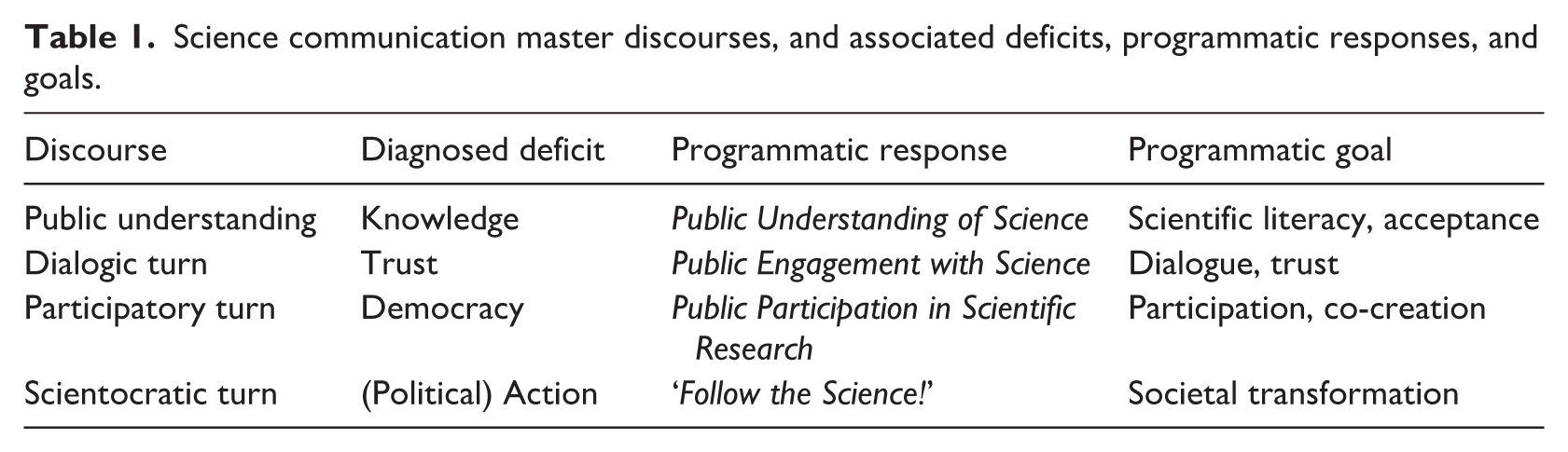
A first relevant feature of the master discourses is their shifting reference. The addressee of the identified deficits in the first two is the public, which represents society in the abstract. This presupposes, by implication, that the discourses in question are staged in societies in which a public has a political role to play, that is, in democratic societies. The deficits identified are ‘lack of knowledge’ and ‘lack of trust’, and each of them can and should be countered with respective measures: (increase of) science education, augmentation or restoration of trust in science, and intensification of dialogue between science and the public. In contrast, the programmatic goal of ‘participation’ entails a deficit of democratisation on the part of science as its reference. The reference of the ‘Follow the science!’ discourse are the political actors who are supposed to design and implement evidence-based policies. Indirectly, the last two discourses also address the public.
A second notable feature is that the master discourses do not supersede each other but rather continue in parallel from the time of their inception onwards (Bauer et al., 2007: 79f; Trench, 2008). As Figure 1 shows, new ways of narrating these crises have become prominent in public and policy discourse at different times.
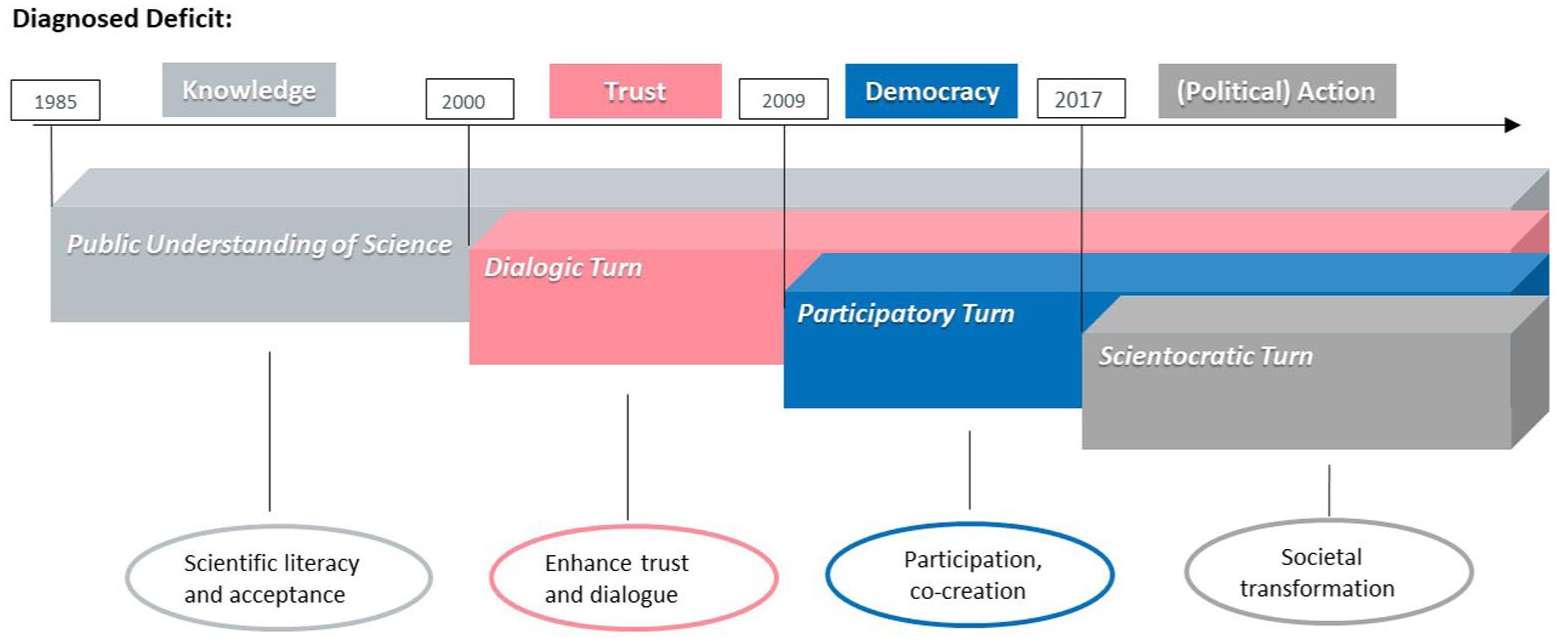
Historical evolution of the master discourses on science communication.
In the following, we will, for each discourse, (1) give examples of how the deficits are defined, (2) identify the assumptions that motivate them, and (3) ask what legitimation they provide for specific problem perceptions, solution orientations, and communication strategies.
Public Understanding of Science: The initial deficit of scientific literacy
A first paradigm of deficit was famously articulated in a UK science policy report, the so-called Bodmer Report of the Royal Society, which diagnosed a ‘knowledge deficit’ of the public in relation to science (The Royal Society, 1985). The response was the Public Understanding of Science (PUS) programme. The underlying conceptual framework came to be known as the ‘deficit model’ because it assumes that the public has cognitive deficits, manifest in a lack of understanding in the double sense of scientific literacy and acceptance of science and technology (Irwin and Wynne, 1996). The PUS communication process is understood as a linear transfer of knowledge from scientists to a passive general public.
The need to improve scientific literacy has been justified with the argument that important decisions in science policy which the public has to make, presuppose at least fundamental knowledge and understanding of science (Shen, 1975). The obvious analogy is the political process in which the public takes part, be it indirectly in elections or directly in referenda, which requires a fundamental knowledge of the institutions and their functioning (Bauer et al., 2007: 80). One persistent belief stipulates that the lack of scientific literacy may be ‘associated with decreased support for science and/or research’ (National Academies of Sciences, Engineering, and Medicine, 2016: 2). This was summarised in the famous phrase ‘to know science is to love it’, which, although incorrect, revealed the interest of governments in public support of science and technology. A related focus is the political concern about the public’s reactions to controversial new technologies. The widespread belief at the time was that civic scientific literacy would contribute to, if not ensure, a rational democratic process (Miller, 1998).
For the present context, it suffices to retain that the discourse on scientific literacy entertains two assumptions: the public’s knowledge about science – however it is measured – is an important condition for democracy, and it is an important condition for the public support of science. The two assumptions are merged when science policy (‘resolution of scientific and technological disputes’, ‘support of science and/or research’) is identified as part of general policy. The first can be condensed to: knowledge about science leads to ‘higher rationality’ in voting, the second equates knowledge about science and support for it (Allum et al., 2008: 37; Miller, 1998).
The PUS model’s normative implication of a hierarchy of knowledge and public ignorance has been widely criticised (Bauer et al., 2007) and neither assumption that is central to the discourse on scientific literacy is supported by research. Critics argue that a linear understanding of communication is oversimplified (Bucchi, 2008; Franzen et al., 2012), and ‘reception’ is not a passive process but subject to interpretation and re-contextualisation in professional fields such as journalism (Rödder, 2020), as well as in the context of everyday knowledge (Irwin and Wynne, 1996). Nevertheless, even digital and thus non-traditional science communication may – very successful in terms of reach – employ a one-way communication of knowledge, such as the COVID-19 science podcasts with lengthy statements by scientific experts (Winkler, 2021).
The dialogic turn: The crisis of public trust in science
A second paradigm of deficit, again most famously outlined in a UK science policy report (House of Lords, 2000), was a perceived crisis of public trust in science (Franzen et al., 2012). The discourse on the lack of trust in science started in full in 2000, triggered by the BSE crisis. Under the headline ‘a crisis of trust’ the report stated ‘Society’s relationship with science is in a critical phase’ and noted that science was actually limited to the ‘biological and physical sciences and their technological applications’ (House of Lords, 2000). The reason for the political sensitivity over the public’s trust in science was first and foremost the BSE affair that affected mostly the British government and its science advisory apparatus. Surveys of the late 1990s and around the turn of the century had revealed a dramatic lack of trust in scientists connected to the government (House of Lords 2000: 2.44 and Appendix 6, Table 2). Between the discovery of BSE in 1986 and the government’s final admission of a connection between BSE and the fatal Creutzfeldt-Jakob disease in 1995 lay 9 years of denial, secretiveness, and manoeuvring of the government and the scientists in its service. This episode explains, more than anything else, why the concern about trust started in the United Kingdom. Even beyond BSE, a series of new technological developments, particularly in the biosciences such as genetically modified food, genetically modified animals, and cloning, had triggered public debates and confronted governments and science policymakers with criticism (House of Lords, 2000: 2.2; 2.36; 2.37; 2.44). One can identify a series of counter-measures suggested by the Select Committee which are already influenced by suggestions from scholars of the UK Science and Technology Studies (STS) community.
The political programme in which the countermeasures were consolidated was called Public Engagement with Science and Technology (PEST). The ‘trust deficit’ was to be addressed by actively engaging the public with science, that is, by establishing various mechanisms of dialogue between science and the public in the form of ‘consultation exercises, designed to engage directly with as many as possible of the public at large’ (House of Lords, 2000). The expectation was that such measures would serve to develop the capacity to reflect on scientific knowledge as well as on the scientific method (Wynne, 2006). The dialogic turn shifts away from the PUS model’s view of science as the sole authority, presenting it as a voice among many, albeit privileged. It assumes that public concerns or needs can support scientific progress or political decisions on research policy (Bucchi, 2008) and challenge traditional notions of expert authority by valuing the input of non-scientific actors, considering all participants as experts with regard to their own concerns.
However, this strategy inevitably remained being executed ‘from above’, that is, by the science policy agencies designing and implementing it in the first place. As such it also does not provide any guidance as to which contents should be communicated to the public. The committee itself acknowledged that ‘the workshops were open to the charge of being directed by the organisers rather than the lay participants’ and that ‘the number of lay participants was small’ (House of Lords 2000: 5.6, 5.7). The topics that are being discussed, notably in consensus conferences, citizen juries, focus groups, and similar formats, were usually chosen by political and science policy agents concerned about public disputes over the risks of new technological developments.
While the UK-centred initiation of the discourse used the term ‘Public Engagement with Science and Technology’, it is difficult to keep this label as denominator of the respective master discourse. In both the science and the science communication literature, public engagement has evolved as an ‘umbrella term that encompasses many kinds of activity including science festivals, centers, museums, cafés, media, consultations, feedback techniques, and public dialogue’ (DIUS Department for Innovation, Universities & Skills, 2008: 19; our italics; cf. Weingart et al., 2021). As the key distinction from the first master discourse is the shift to a dialogue-oriented two-way communication, we refer to this discourse not as engagement, but as the dialogic turn.
The participatory turn: The democracy deficit
A mere 10 years later, another deficit was identified, this time on the side of science: a democracy or participation deficit. To counter this deficit, the participatory turn acknowledged a political and epistemic role of non-professional actors in knowledge production. Transdisciplinarity (Maasen et al., 2006) or co-production (Jasanoff, 2004) became integral to the research process, leading to what has been called a ‘participation explosion’ (Einsiedel, 2008). Approaches and programmes responding to this paradigm of deficit include citizen science, art/science, transdisciplinary dialogues, and real-world-laboratories, all of which have in common that they aim to enable citizen participation and the co-creation of usually applied knowledge.
Note that the deficit by now had shifted from the public to science. Rather than being driven by science policy, this paradigm of deficit was informed by academic work in STS, a field which since the 1970s has critically reflected on the authority of scientific knowledge and subsequent hierarchies in the relationship between science and society (Sismondo, 2008). Science was supposed to ‘open up’.
The theoretical model behind the participatory formats is Habermas’ theory of deliberative democracy in which direct deliberation among citizens is considered as a solution to the ‘inadequacies of representative democracy’ (Allum et al., 2008: 44; Habermas, 1962). This connection points to the discussion of deliberative versus representative democracy and the nature of the public, here with reference to the place of science in society. Critics of the participatory formats have focused on the far-reaching claims such as their preparing the road for a ‘democratisation of science’. The crucial question is if the reality of the present-day public(s) supports justified hopes for a Habermasian deliberative democracy, even if only in the realm of science and technology policy-making. As Scheufele points out, the normative ideals of Habermas’ theory are not met on several counts. The number of citizens involved in consensus conferences and similar formats is small. The overwhelming majority of citizens are not involved in deliberations, let alone science and technology policy issues. Nor are they competent about or even interested in these issues except perhaps if they are directly affected (Scheufele, 2011). 1 The way the selection of these groups is organised (as random samples or based on certain criteria) has an impact on the results of the discussions. Random selection of participants runs the risk of lack of knowledge and/or interest in the topics dealt with (Scheufele, 2011: 7).
Habermas himself, in a re-visit of his ‘Structural Transformation of the Public Sphere’, conceded that the new social media have led to the emergence of a fragmented, self-centred communication, so that for a growing part of the citizenry, a subjective precondition of a deliberative mode of opinion formation is endangered (Habermas, 2021: 477). The ‘public’ simply does not correspond to the ideal of rationally deliberating citizens that interact in a meaningful way with the constantly developing body of scientific knowledge as an input in the formation of their opinions.
This does not mean that the ideal of rational deliberation as the basis of democracy has to be given up as a ‘regulatory idea’ (Zürn, 2023). In fact, formats like ‘living labs’, which bring together small groups of citizens and scientists to deal with well defined, focused issues over a limited time span, can operate successfully. But even in these arrangements, the difference between the scientist who holds expertise in a particular knowledge domain and the citizen who lacks this knowledge but may want to acquire it or benefit from it does not disappear (cf. Collins and Evans, 2002). Nor does the difference disappear in arrangements in which the specific experiential knowledge of citizens is combined with scientific expertise to mutually benefit each other with respect to particular problems.
The scientocratic turn: Political inaction and the case for activist modes of science communication
The simultaneity of a certain cultural authority of scientific knowledge and the struggle for precisely this authority is the source of the most recent paradigm of deficit, which we term a scientocratic turn according to the slogan ‘Follow the science!’. This master discourse assumes that, although science is broadly acknowledged as the problem-defining as well as problem-addressing and problem-solving authority of our time, everyone (and especially policymakers) needs to be constantly reminded to ‘listen to the science’.
Since 2019, climate movements such as Fridays for Future have successfully mobilised millions for global climate marches around the world (Moor et al., 2021). In this early phase of their mobilisation, they have positioned themselves primarily as science communicators (Kern and Opitz, 2021; Rödder and Pavenstädt, 2023). In doing so, they have framed not only the state of the climate as being in crisis but also characterised the climate debate itself as a crisis of communication: although the IPCC has published comprehensive reports regularly since 1990, political leaders continue to disregard scientific guidance. Activists attribute this to a failure of communication formats such as assessment reports, and thus position their efforts as an alternative form of science communication.
The deficit postulated by this master discourse is thus driven by climate communication and related fields of science, notably climate research. The political movement behind this discourse identifies an ‘action deficit’, or failure to act upon well-known and consensual scientific assessments such as IPCC reports. The deficit is directed again to the side of the public, or more specifically to the electorate that is to hold politicians accountable for decisions based on scientific evidence. The advent of new climate movements under the slogan ‘Follow the science!’ can be seen as a programmatic response to this political action deficit.
The scientocratic turn has facilitated a rather apolitical role of climate movements as science communicators, at least in the initial phase of their mobilisation (Rödder and Pavenstädt, 2023). While they have brought in the younger generation as a promising actor in the climate debate, their evidence-first-model of the science-policy interface limits the potential to depoliticise this discourse by mobilising the youth (cf. Pavenstädt and Rödder, 2024). In a sense, this is a return to the archetypical paradigm of deficit: the general public and policy-makers are reminded that they should more readily accept scientific evidence. In order to ‘wake up’ the public, climate activists claim authority in scientific and moral terms, which arguably is in tension with their ideals of justice and participation. However, the scientocratic model of the science-policy interface in the tradition of the Public Understanding of Science master discourse is instrumental to manage this tension: if knowledge makes all the difference, then the enlightened may rightly claim a superior status.
4. Conclusion
This article explores the persistent troubles in the relation of science and its publics through a sociological lens. It conceptualises science communication as a wicked problem, a complex, systemic challenge involving boundary negotiations across differentiated social worlds. We then examine how actors themselves interpret this wicked situation. We have proposed to reflect on their understanding of the relation of science and its publics in the light of ideal-typical master discourses on science communication, which can be applied to the study of all novel science communicators. Since the mid-20th century, these master discourses focus on the centrality of science to society, in particular to democracy, and on the conditions of the support of science by the (respective) publics. The rhetoric of science policy not only becomes more ambitious with every new turn, but it also appears to be in search of a new arrangement between science and its publics, without having arrived at a stable and effective one. Notably, the top-down hierarchy and linear communication of the first, the Public Understanding of Science discourse, enjoys a revival as the underlying science-society model of the scientocratic turn in climate activism.
‘Confusion or deliberate obfuscation of broader political discussion in an attempt to make public engagement procedurally comfortable has meant that the deficit models we thought were dead are continually reinvented’, Stilgoe and colleagues stated already in the 2014 special issue of this journals on engagement (Stilgoe et al., 2014: 7). Allan Irwin, one of the most staunch and influential proponents of the idea, shied away from characterising ‘engagement’ as a failure but admitted that ‘despite all the “from deficit to democracy” talk, no such easy shift has been made’ (Irwin, 2014: 73).
From the viewpoint of sociological theory, that is not surprising and reason to take a step back and reconsider the implications of Luhmann’s differentiation thesis. The position outlined here – that the discourses in science, politics, and media are inherently system-specific and that these differences generate communicative risks – remains as plausible today as it was 25 years ago (Weingart et al., 2000). The notion of science communication as a wicked problem brings the relations and interfaces that science maintains with other social worlds into focus – along with the boundary work, boundary objects, boundary-defining language, and boundary-ordering devices that are employed in these relations. Any attempt to overcome the differences between the operative logics of different social systems has to fail and, instead, leads to ‘resonances’ that are typically reflected in the worlds themselves as crises of communication. The identification of a specific deficit or crisis often directs attention to corresponding remedial actions: for instance, if the perceived problem is one of non-transparency at the climate science–policy interface, then making confidential information public may be seen as an appropriate response, such as the leak of an Intergovernmental Panel on Climate Change (IPCC) draft assessment report by Scientist Rebellion activists in 2021 (Hartz, 2023). However, if concerns centre on trust and the risk of scientists being perceived as dissenting, then such a leak might not be the preferred approach. Under the trust paradigm, a more suitable strategy might involve scientists engaging directly with the public – perhaps by participating in informal discussions at local venues – to foster trust, disseminate knowledge, or both.
We find that multiple paradigms of deficit, that is, master discourses of narrating this wickedness as crises have become prominent since the mid-20th century. Over time, these crises have centred on issues of knowledge, trust, participation, and, most recently, political action. As we have shown, new reflections in the form of new crisis discourses appear at certain times, but do not substitute the previous ones. Rather, the discourses accumulate to form the space in which most of the literature on science communication operates.
In conclusion, we call for a reflexive, empirical approach that critically examines how actors’ categories and discourses shape problem perception, solution orientation, and communication strategies. Instead of conceptualising deficits, this analytical toolbox of sociological science communication research foregrounds ‘risks of communication’, ‘wicked problems’, and ‘resonance between multiple social worlds’ to inform the empirical analysis of novel science communicators as well as of science communication’s multiple programmatic approaches. Communicative risks are evident in how activists refer to scientific authority. Slogans such as “Listen to the Science!” appear to reflect an understanding of science critiqued long ago as a technocratic approach, which assumes that the lack of ecological resonance is merely due to inadequate knowledge or its poor dissemination.
What now is our role as science communication researchers?
Bauer et al.’s influential 2007 paper in this journal can be read as a call to separate research methods (like surveys) from specific knowledge interests, allowing for a more diverse and productive research agenda. However, current research in science communication, in our view, too often uncritically adopts the master discourses in a normative manner. This includes investing efforts into showing that the deficit model is now ultimately dead or, recently, advocating for academic activism (Dablander et al., 2024).
This analysis instead calls for a reflexive approach that critically examines how actors’ categories and narratives shape problem perception and communication strategies. We propose that to better manage science communication as a wicked problem, it is key to reflect on unintended consequences and the respective risks of communication. Our normative stance, thus, is that we should refrain from taking sides and promoting one master discourse over another. Rather, we suggest employing this conceptual toolbox to facilitate empirical investigations of, for example, novel science communication actors.
In this first step, we have derived our argument from looking closely at the Western science-policy contexts in which these discourses originated. Future studies should enlarge this to other contexts, and especially include perspectives from the Global South (Kankaria and Chakraborty, 2024).
Comparative research is the most promising to further interpret the workings of these master discourses. Additional research could focus on the following:
First, the nature of the master discourses’ (potential and factual) publics. Habermas’ educated bourgeois coffee-house public engaged in intellectual exchange on the reports about (inter alia) the latest advances in research has been replaced by the publics of the global digital platforms that are defined by their attention-attracting algorithms. These publics are characterised, among other things, by an almost infinite differentiation of interests which are shaped by an attention economy. Second, research would have to focus on the relation between the most widespread of these interests and particular disciplines. It is well known that the broader public is interested in medical issues that concern everyone’s health. That implies the medical sciences, biology, human genetics, and psychology as the likely popular disciplines. New technologies may ignite public debates so that disciplines underlying them are called upon to inform concerned publics about their implications. Particular attention should be paid to the role of the social sciences. Normally, they are not a subject of science communication (Lewis et al., 2023) but would be highly relevant when the role of the sciences for the democratic public discourse is considered. This pertains especially to the development and support of a critical competence vis-à-vis digital media. Third, there is a need for more in-depth analysis of the temporal dynamics of the master discourses. This would imply taking a closer look at the construction of communication crises and examining their contexts of emergence, and eventually addressing the question as to why certain master discourses arise at specific times.
Footnotes
Acknowledgements
We thank the participants of the 30th Anniversary Celebratory Conference of the Centre for Research on Evaluation, Science and Technology (CREST) in Stellenbosch, South Africa, for their helpful comments on a draft version of this manuscript.

Declaration of conflicting interests
The authors declared no potential conflicts of interest with respect to the research, authorship, and/or publication of this article.
Funding
The authors disclosed receipt of the following financial support for the research, authorship, and/or publication of this article: S.R.’s work is funded by the Deutsche Forschungsgemeinschaft (DFG, German Research Foundation) under Germany’s Excellence Strategy – EXC 2037 ‘CLICCS–Climate, Climatic Change, and Society’ – Project Number: 390683824, contribution to the Center for Earth System Research and Sustainability (CEN) of Universität Hamburg.