




Abstract
Executive functions (EFs; e.g., reasoning, working memory, and self-control) can be improved. Good news indeed, since EFs are critical for school and job success and for mental and physical health. Various activities appear to improve children’s EFs. The best evidence exists for computer-based training, traditional martial arts, and two school curricula. Weaker evidence, though strong enough to pass peer review, exists for aerobics, yoga, mindfulness, and other school curricula. Here I address what can be learned from the research thus far, including that EFs need to be progressively challenged as children improve and that repeated practice is key. Children devote time and effort to activities they love; therefore, EF interventions might use children’s motivation to advantage. Focusing narrowly on EFs or aerobic activity alone appears not to be as efficacious in improving EFs as also addressing children’s emotional, social, and character development (as do martial arts, yoga, and curricula shown to improve EFs). Children with poorer EFs benefit more from training; hence, training might provide them an opportunity to “catch up” with their peers and not be left behind. Remaining questions include how long benefits of EF training last and who benefits most from which activities.
Keywords
Diverse activities have been reported in research papers published in peer-reviewed journals to improve children’s executive functions (EFs). These activities include computer-based training, certain school curricula, and training in aerobics, traditional martial arts, yoga, or mindfulness (for a review, see Diamond & Lee, 2011). In this paper, I address what can be learned from these many studies.
First, What Are EFs?
EFs are a family of control functions needed when you have to concentrate and think, when acting on your initial impulse might be ill-advised. These functions depend on a neural circuit in which the prefrontal cortex plays a prominent role (Anderson, Jacobs, & Anderson, 2008; Bialystok & Craik, 2005). There is general agreement that there are three core EFs: inhibition (also called “inhibitory control”), working memory, and cognitive flexibility (e.g., Miyake et al., 2000). These form the foundation for higher-order EFs, such as reasoning, problem solving, and planning (Christoff, Ream, Geddes, & Gabrieli, 2003; Collins & Koechlin, 2012; Lunt et al., 2012).
Inhibition is important for (a) controlling one’s behavior—for example, by overriding habitual responses, exerting self-control (i.e., resisting temptations, such as the temptation to overeat or to respond impulsively rather than giving a more considered response), and exercising discipline (e.g., resisting the temptation to not complete a task); (b) controlling one’s attention (selective or focused); and (c) controlling one’s emotions so as not to act inappropriately (an aspect of self-regulation). In a longitudinal study in which 1,000 children born in the same city in the same year were followed for 32 years, Moffitt et al. (2011; Moffitt, 2012) found that children whose inhibition was worse (i.e., they had less persistence, more impulsivity, and poorer attention regulation) between the ages of 3 and 11 grew up to have worse health, earn less money, be less happy, and commit more crimes 30 years later than did those who had better inhibitory control as children, controlling for IQ, gender, social class, and home and family circumstances during childhood. Moffitt et al. (2011) concluded that because the effects of inhibitory control follow a linear gradient, “interventions that achieve even small improvements in [inhibitory control] 1 for individuals could shift the entire distribution of outcomes in a salutary direction and yield large improvements in health, wealth, and crime rate for a nation” (p. 2694).
Working memory refers to holding information in mind and mentally working with it. It is crucial for making sense of anything that unfolds over time, for that requires holding in mind what happened earlier and relating it to what is happening now. Therefore, working memory is necessary for making sense of any linguistic information, whether read or heard. It is also needed for mentally reordering items (e.g., reorganizing a to-do list), understanding cause and effect, and mentally relating pieces of information to derive a general principle or see novel relations among old ideas.
Cognitive flexibility refers to the ability to change perspectives (e.g., to see something from another person’s point of view), change the way you think about a problem (e.g., think outside the box to attack a problem from a different angle), and be flexible enough to adjust to changed demands or priorities, admit you were wrong, and take advantage of sudden, unexpected opportunities.
EFs are critical for success in school (Alloway & Alloway, 2010; Borella, Carretti, & Pelgrina, 2010; Duckworth & Seligman, 2005; Gathercole, Pickering, Knight, & Stegmann, 2004), on the job (Bailey, 2007), in friendships (Rotenberg, Michalik, Eisenberg, & Betts, 2008), and in marriage (Eakin et al., 2004); for mental and physical health (Baler & Volkow, 2006; Miller, Barnes, & Beaver, 2011); and for quality of life (J. C. Davis, Marra, Najafzadeh, & Lui-Ambrose, 2010). Improving EFs early in life is important because EF problems in early childhood predict EF problems years later (Friedman et al., 2007; Moffitt et al., 2011), and early EF deficits often do not disappear but can grow larger over time (O’Shaughnessy, Lane, Gresham, & Beebe-Frankenberger, 2003; Riggs, Blair, & Greenberg, 2003).
What Do We Know About Programs and Strategies for Improving EFs in Young Children?
Although all the studies that I discuss here passed peer review, not all provide equally compelling evidence. The strongest evidence for an activity improving children’s EFs exists for Cogmed computer-based training for working memory and reasoning (Bergman Nutley, 2011; Holmes, Gathercole, & Dunning, 2009; Klingberg et al., 2005; Thorell, Lindqvist, Bergman, Bohlin, & Klingberg, 2009), a combination of computerized and interactive games (Mackey, Hill, Stone, & Bunge, 2011), task-switching computer-based training (Karbach & Kray, 2009), traditional tae kwon do (Lakes & Hoyt, 2004), and two add-ons to school curricula: Promoting Alternative Thinking Strategies (PATHS; Riggs, Greenberg, Kusché, & Pentz, 2006) and the Chicago School Readiness Project (CSRP; Raver et al., 2008, Raver et al., 2011).
All the studies above used random assignment, included an active control group and pre- and post-intervention measures, and found convincing evidence that training effects transferred to more than one objective measure of EFs on which the children had not been trained. Studies that have thus far looked at the benefits to children’s EFs from aerobics (C. L. Davis et al., 2011; Kamijo et al., 2011; Tuckman & Hinkle, 1986), mindfulness (Flook et al., 2010), yoga (Manjunath & Telles, 2001), the Tools of the Mind early childhood curriculum (Diamond, Barnett, Thomas, & Munro, 2007), and the Montessori curriculum (Lillard & Else-Quest, 2006) have lacked one or more of the above features.
In the next two sections, I discuss a few principles that hold regardless of the program or intervention used.
General principles that apply to EF training
Those who most need improvement benefit the most
Children with the weakest EFs benefit the most from any EF intervention or program (Flook et al., 2010; Karbach & Kray, 2009; Lakes & Hoyt, 2004). Hence, early EF training should be an excellent candidate for leveling the playing field and reducing social disparities in EFs, thus heading off social disparities in academic achievement and health (O’Shaughnessy et al., 2003). Because EFs predict school readiness (Blair & Razza, 2007), later academic performance (Raver et al., 2011; Li-Grining, Raver, & Pess, 2011), and mental and physical health (Moffitt et al., 2011), if the early disparity in EFs is narrowed, the disparity in school readiness and academic and health outcomes should be narrowed as well.
Transfer effects from EF training are narrow
EF training appears to transfer (i.e., produce benefits to performance of tasks other than the task used in training), but transfer from computer-based working memory and reasoning training observed in studies thus far has been narrow. In children, training on working memory improves performance on untrained working memory tasks, but it does not improve inhibition (Thorell et al., 2009) and probably does not improve reasoning or problem solving (Bergman Nutley et al., 2011; Thorell et al., 2009; but see Klingberg et al., 2005). Training on reasoning improves performance on untrained reasoning tasks but does not improve working memory (Bergman Nutley et al., 2011) or processing speed (Mackey et al., 2011). The effects of nonverbal-reasoning training transfer to the same type of nonverbal reasoning but not to a different type of nonverbal reasoning (Bergman Nutley et al., 2011). Bergman Nutley et al. (2011) found that the effects of training on nonverbal working memory transferred to other measures of nonverbal working memory but not to a measure of verbal working memory.
EF gains resulting from training on task switching (Karbach & Kray, 2009), traditional martial arts (Lakes & Hoyt, 2004), and school curricula (Raver et al., 2011; Riggs et al., 2006) are wider, perhaps because these programs address EFs more globally. Thus, the transfer to particular EFs may be just as narrow, but the programs address more EF components. For example, the effects of training on task switching (which arguably requires all three core EFs) were found to transfer not only to an untrained task-switching task, but also to tests of inhibition, verbal and nonverbal working memory, and reasoning (Karbach & Kray, 2009).
Children’s EFs should be challenged throughout training
EF demands need to keep increasing as children’s EFs improve, or few gains will be seen (Bergman Nutley et al., 2011; Holmes et al., 2009; Klingberg et al., 2005). There may be two reasons for this. First, if people don’t keep pushing themselves to do better, they stop improving. Second, if the difficulty of an activity doesn’t increase, it becomes boring, and children lose interest. This has been a criticism of the control conditions in Cogmed studies.
Repeated practice is key
Whether EF gains are seen depends on the amount of time children spend doggedly working on these skills, pushing themselves to improve (Klingberg et al., 2005). This is consistent with what Ericsson (e.g., Ericsson, Nandagopal, & Roring, 2009) has found to be key for being truly excellent at anything: hours and hours of practice trying to master what is just beyond your current level of competence and comfort (working in what Vygotsky, 1978, would call the “zone of proximal development”). Similarly, school curricula shown to improve EFs train and challenge children’s EFs throughout the day, embedding practice in all activities (which may also have the benefit of varying the content and kind of EF practice) rather than in a single, isolated module (Diamond et al., 2007; Lillard & Else-Quest, 2006; Riggs et al., 2006).
Whether EF gains are produced depends on how an activity is done
For example, in a study with adolescent juvenile delinquents (Trulson, 1986), some adolescents were assigned to traditional tae kwon do, which emphasizes not only physical conditioning but also character development and self-control (e.g., waiting until your opponent attacks or is off balance and then taking advantage of that). Others were assigned to “modern martial arts” (i.e., martial arts as a competitive sport, emphasizing only the physical aspect, with no emphasis on exercising self-control). Compared with the adolescents who were trained in modern martial arts, those who were trained in traditional tae kwon do showed less aggression and anxiety and improved social ability and self-esteem. Those trained in modern martial arts showed more juvenile delinquency and aggressiveness and decreased self-esteem and social ability.
Outcome measures must test the limits of the children’s EF abilities to see a benefit from training
In studies of EF-enhancing activities, the largest differences between intervention groups and controls are consistently found on the most demanding EF tasks and task conditions. It is often only when the limits of children’s EF skills are pushed that these differences emerge (C. L. Davis et al., 2011; Diamond et al., 2007; Manjunath & Telles, 2001).
Activities reported by at least one published research study to improve EFs
Computerized training
It is clear that working memory and reasoning can be improved in children via computer-based training and specially designed games. The most researched approach for improving children’s EFs, and one repeatedly found to be successful, is Cogmed computerized training. When Cogmed training is on working memory, working memory improves even on untrained tasks (e.g., Klingberg et al., 2005; Thorell et al., 2009). Two studies (Holmes et al., 2009, Holmes et al., 2010) have found that gains in working memory remained 6 months after training. Moreover, although no immediate gains in math or reading were found after training, gains in math were evident 6 months later (Holmes et al., 2009). When Cogmed training is on reasoning, reasoning improves. Mackey et al. (2011) found that reasoning training using a combination of computerized and noncomputerized games also improved reasoning, even on untrained tasks.
Although there is evidence that computer-based training can improve children’s working memory and reasoning, attempts thus far to improve 4- to 6-year-olds’ inhibitory control using computerized inhibitory-control games or training have not been successful (Rueda, Rothbart, McCandliss, Saccomanno, & Posner, 2005; Thorell et al., 2009). For example, Rueda et al. (2005) found no EF improvements. Older children (9-year-olds), however, who received computer-based task-switching training improved in both task switching and inhibition (Karbach & Kray, 2009). Other approaches (e.g., school curricula) have improved inhibition in 4- to 6-year-olds. Thus, either computer-based training is not optimal for training inhibitory control in children so young, or the optimal computer-based approaches have not yet been studied. No approach demonstrated to improve EFs in young children has yet been shown to improve their ability to delay gratification; however, that ability has only been measured in assessments, not targeted during training (Lillard & Else-Quest, 2006; Raver et al., 2011).
Physical activity
Many studies have found that aerobic exercise improves EFs, but all but three of them have involved adults and/or examined the effects of only a single bout of exercise. The three studies in which young children exercised over an extended period did not find strong effects. (The earliest study, by Tuckman & Hinkle, 1986, found the strongest effects; the most recent study, by Kamijo et al., 2011, found the weakest).
Exercise alone may be less effective in improving children’s EFs than activities that involve both exercise and character development (e.g., traditional martial arts) or activities that involve both exercise and mindfulness (e.g., yoga). Lakes and Hoyt (2004) randomly assigned children in kindergarten through fifth grade (5- to 11-year-olds) by homeroom class to take part in either traditional tae kwon do or standard physical education. Students in the tae kwon do group improved more than students in the standard-physical-education group in working memory and on all dimensions of inhibitory control studied (e.g., cognitive inhibitory control, measured on a distractible–focused continuum; discipline, measured on a quitting–persevering continuum; and emotion regulation). These effects generalized to multiple contexts and were found on multiple measures.
In a pilot study of the effects of yoga (which involved physical training, relaxation, and sensory awareness) on children’s EFs, 10- and 13-year-old girls were randomly assigned to either yoga or physical training for 75 minutes a day, 7 days a week for 1 month (Manjunath & Telles, 2001). Those who did yoga improved more in planning and execution on the Tower of London (a task that requires all three core EFs), especially when task conditions were more difficult and complex, than did controls.
School curricula
The two curricula empirically shown to improve children’s EFs—Montessori (Lillard & Else-Quest, 2006) and Tools of the Mind (inspired by Vygotsky, 1978; Diamond et al., 2007)—share a number of features in common (Diamond & Lee, 2011). They both (a) help children exercise their EFs and constantly challenge them to do so at higher levels; (b) reduce stress in the classroom; (c) rarely embarrass a child; (d) cultivate children’s joy, pride, and self-confidence; (e) take an active and hands-on approach to learning; (f) easily accommodate children progressing at different rates; (g) emphasize character development as well as academic development; (h) emphasize oral language; (i) engage children in teaching one another; and (j) foster social skills and bonding. Many of these characteristics are also true of the two programs designed to complement school curricula that have been shown to improve EFs: PATHS (Riggs et al., 2006) and CSRP (Raver et al., 2011). Disadvantaged preschool children randomly assigned to a CSRP Head Start class showed better EFs than did controls at the end of that preschool year; moreover, they continued to perform better than controls in math and reading for the next 3 years, and those academic gains were mediated almost entirely through improved EFs (Li-Grining et al., 2011).
Both Tools of the Mind and CSRP are meant to be used only with children aged 3 to 6. None of the four programs shown to improve EFs have reported EF benefits in children older than 9 years of age. Thus, the effects of school curricula have been studied so far only in very young children. The school programs and their assessment have concentrated heavily on inhibitory control. A randomized control trial of Tools of the Mind is currently underway (Farran & Wilson, 2011). This study is particularly noteworthy because of its impeccable research design and the meticulous way in which it is being conducted. The first year of data collection failed to show a benefit from Tools of the Mind, but that may have been because of floor and ceiling effects of the EF measures.
Conclusions and Future Directions
Clearly, EFs can be improved in children, even in those as young as 4 or 5 years of age, without specialists and even without computers. To improve EFs, focusing narrowly on them may be less effective than also addressing emotional and social development (as do curricula shown to improve EFs) and/or physical fitness (as do aerobics, martial arts, and yoga). I hypothesize that the programs that will most successfully improve EFs are those that challenge EFs continually and also bring children joy and pride, give them a feeling of social inclusion and belonging, and help their bodies to be strong, fit, and healthy (Diamond, in press). Figure 1 illustrates this hypothesized model.
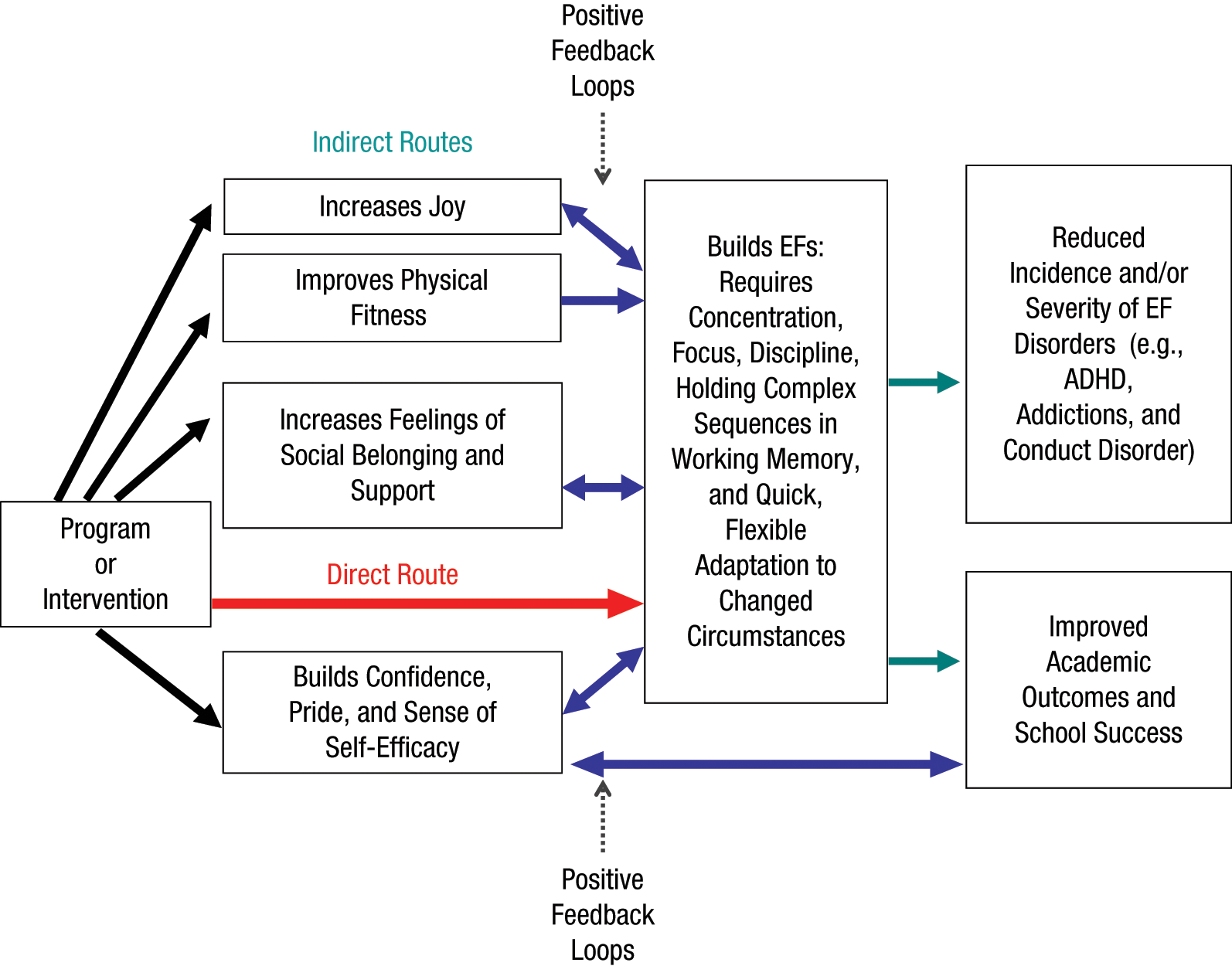
Prefrontal cortex and executive functions (EFs) are the first area of the brain and mental functions to suffer, and suffer disproportionately, if you are sad (von Hecker & Meiser, 2005), stressed (Arnsten, 1998), lonely (Cacioppo & Patrick, 2008), or not physically fit (Hillman, Erickson, & Kramer, 2008). Unmet emotional, social, or physical needs work against displaying good EFs. Conversely, when people are less stressed, happier, more physically fit, and socially supported, they can think more clearly and creatively and exercise better self-control and discipline (i.e., display better EFs). Therefore, I hypothesize that programs that will most successfully improve children’s EFs are those that require and directly challenge EFs and support EFs indirectly by reducing children’s stress or improving their ability to handle stress, increasing their joy, helping them feel that they belong and that others are there for them, and improving their physical fitness.
No one has yet looked at the available data to see what, other than amount of practice and baseline EFs, distinguishes children who benefit from EF interventions from children who do not. We know little about whether the benefits of EF interventions last and, if so, how long they last, in which domains, and what factors affect how long they last. Only one study (C. L. Davis et al., 2011) has systematically varied dosage (i.e., how much time was devoted to the activity at each individual session) or frequency. We know little about how the optimal dose, frequency, or duration of an intervention might vary as a function of a child’s age or the type of activity. Which kind of program helps children most at which age? Research to date has suggested that Cogmed and martial arts might work best for children 8 years of age and older, whereas the efficacy of school curricula in improving EFs has been demonstrated (and studied) only in very young children and primarily for inhibitory control.
It is likely that many activities not yet studied might improve children’s EFs (e.g., theater, orchestra, choir, caring for an animal, filmmaking, basketball, street soccer, rowing crew, rock climbing, and more). Who might benefit most from which activity? Which activities produce the most long-lasting benefits, and why? Given the drawbacks of randomized control trials and that they are not always feasible, what other research approaches might work well for investigating the efficacy of various activities for improving children’s EFs?
Whether EF gains are seen depends on the way in which an activity is done and the amount of time one spends doing it, pushing oneself to do better. It’s the discipline, the practice, that produces the benefits. The most important element of a program might be that it involves an activity children love, so they will devote intensive time and effort to it. An enthusiastic, charismatic adult can often engender that passionate interest in children. Improving EFs and thus school and job success is serious business, yet there is no reason one needs to be grim though working hard on important matters; one can be joyful even while working hard. Indeed, research has shown that people are more creative and have more energy for their work if they are passionate about it (e.g., Hirt, Devers, & McCrea, 2008). Why not harness children’s passionate interests in the service of the children’s positive development and academic success?
Recommended Reading
Best, J. R. (2010). Effects of physical activity on children’s executive function: Contributions of experimental research on aerobic exercise. Developmental Review, 30, 331–551. Provides a review of the effects of physical exercise on EFs.
Chaddock, L., Pontifex, M. B., Hillman, C. H., & Kramer, A. F. (2011). A review of the relation of aerobic fitness and physical activity to brain structure and function in children. Journal of the International Neuropsychological Society, 17, 1–11. Provides a review of the effects of physical exercise on EFs and on prefrontal cortex.
Diamond, A., & Lee, K. (2011). (See References). Provides a review of a variety of approaches for improving EFs, with extensive details on studies in supplementary tables.
Klingberg, T. (2010). Training and plasticity of working memory. Trends in Cognitive Science, 14, 317–324. Provides a review of the effects on EFs and on the brain of different attempts to improve EFs.
Melby-Lervåg, M., & Hulme, C. (2012). Is working memory training effective? A meta-analytic review. Developmental Psychology. Advance online publication. doi: 10.1037/a0028228. Provides a review of computerized working memory training.
Morrison, A. B., & Chein, J. M. (2011). Does working memory training work? The promise and challenges of enhancing cognition by training working memory. Psychonomic Bulletin & Review, 18, 46–60. Provides a review of computerized working memory training.
Footnotes
Declaration of Conflicting Interests
The author declared that she had no conflicts of interest with respect to her authorship or the publication of this article.
Funding
The author gratefully acknowledges support from the National Institute on Drug Abuse (Grant R01 DA019685) during the writing of this paper.