




Abstract
In this article, we summarize psychological research on residential mobility. Psychological research has shed new light on the short-term consequences of residential moves, such as excitement, anxiety, and loneliness, as well as on long-term consequences, such as subjective well-being and mortality risk in adulthood. Psychological research has also clarified the causal relationships between residential mobility and important societal outcomes, such as pro-community action. Finally, recent research integrating psychological and sociological perspectives has led to several new discoveries. For instance, residential mobility evokes anxiety, which in turn leads to familiarity seeking, which in turn leads to favorable market conditions for national chain stores. This article highlights the fact that residential moves have important implications not only for individuals but also for society.
With globalization, moving has become an essential part of life in many parts of the world today. Sociologists and other social scientists have investigated residential mobility for decades (Oishi, 2010; see Sampson, 2012, for review). Although sociologists have discovered a number of important phenomena linked to residential mobility (e.g., higher crime rates in residentially mobile neighborhoods), there have been two major limitations to their work. First, the vast majority of sociological research on residential mobility has been correlational. Thus, the causal direction of and mechanisms underlying the link between residential mobility and societal outcomes (e.g., crime rates, civic engagement) have not been clearly demonstrated. Second, the immediate experience of moving, which includes feelings such as excitement, anxiety, and anticipated loneliness, has not been explored. In this article, we summarize psychological research on residential mobility that has (a) captured the psychological states evoked by residential moves, (b) uncovered the causal processes underlying these associations, and, finally, (c) demonstrated the consequences of residential moves not only for individuals but also for society (see Greenwood, 1985; see Jokela, 2009, for the antecedents of residential moves).
The Consequences of Residential Mobility for Individuals
The first main contribution of psychology to the research on residential mobility is that it captures the short-term and long-term consequences of moving for individuals. First, residential moves evoke immediate psychological reactions, such as excitement, anxiety, and anticipated loneliness that the thought of moving brings (see Fig. 1). For example, when we asked people to write about a mobile lifestyle, they spontaneously used anxiety-related words more often than they did when writing about a stable lifestyle or a typical day (Oishi, Miao, Koo, Kisling, & Ratliff, 2012). Measuring neighborhood-level characteristics cannot get at this sort of individual experience of moving.

A psychological model of residential mobility and its outcomes. Solid lines indicate links that have received empirical support; dotted lines indicate links that have not yet been investigated.
More importantly, we discovered that these psychological states have various implications for individuals’ behaviors. First, we found that the thought of moving enhanced one of the most classic psychological phenomena: the familiarity-liking effect (also known as the “mere-exposure effect”). The familiarity-liking effect is the well-documented phenomenon that humans and animals like familiar objects more than unfamiliar objects (Zajonc, 2001). We discovered that the familiarity-liking effect is strengthened when people think about moving. Participants who were asked to think about a mobile lifestyle liked familiar objects more than did those who were asked to think about a stable lifestyle or a typical day (Fig. 2).

The familiarity-liking effect as a function of condition (stable vs. mobile) in Study 4 from Oishi, Miao, Koo, Kisling, and Ratliff (2012). In a study phase, participants were presented with some Chinese ideographs once, other Chinese ideographs three times, and yet other Chinese ideographs nine times. After this study phase, participants rated how much they liked the Chinese ideographs they had seen during the study phase, as well as Chinese ideographs they had not seen during the study phase, on a scale from -3 to 3, with higher values indicating greater liking. Error bars represent standard errors of the mean.
Second, the anxiety created by thinking about a mobile lifestyle explained this strengthened familiarity-liking effect (Oishi, Miao, et al., 2012, Study 5). That is, participants who thought about a mobile lifestyle used more anxiety words in their writing, and the number of anxiety words they used predicted the strength of the familiarity-liking effect. Residential mobility evokes a sense of anxiety, which in turn causes people to be attracted to familiar objects.
Anxiety evoked by moving has other consequences as well. For instance, we discovered that participants who were asked to think about a mobile lifestyle were more concerned about their future relationships than were those who were asked to think about a stable lifestyle or a typical day (Oishi, Kesebir, et al., in press). Furthermore, participants who were asked to think about a mobile lifestyle estimated that they would have fewer close friends in the future and were more motivated to expand their social network. Finally, we found that the thought of living a mobile lifestyle evoked more anticipated loneliness, which explained why people who thought about a mobile lifestyle wanted to expand their social networks.
Residential mobility also has consequences for interpersonal perceptions. For instance, participants who were asked to think about leading a mobile lifestyle liked an egalitarian helper (a person who helped a stranger as much as they did a close friend) far more than a “loyal” helper (a person who helped a close friend a lot but did not help a stranger; Lun, Oishi, & Tenney, 2012). In contrast, people who were asked to think about leading a stable lifestyle liked the two types of helpers equally. We believe that this pattern was caused in part by the fact that mobile people are more likely than stable people to need help from strangers (see also Wang & Leung, 2010).
In addition to the immediate psychological states evoked by residential moves, psychologists have investigated the long-term consequences of residential moves. The frequency of residential moves during childhood is associated with self-concept in adulthood. For instance, one study showed that the personal self (e.g., unique skills, abilities) was more central to the self-definition of frequent movers than to that of nonmovers, whereas the collective self (e.g., group membership) was more central to the self-definition of nonmovers than to that of frequent movers (Oishi, Lun, & Sherman, 2007, Study 1). The frequency with which people move during childhood is also associated with their sources of happiness in adulthood. Specifically, results from a laboratory-based study and a 2-week event-sampling study (Oishi, Lun, & Sherman, 2007, Studies 2 and 3) showed that frequent movers felt happier when an interaction partner accurately perceived their personal selves, whereas nonmovers felt happier when a partner accurately perceived their collective selves.
A number of studies have also found an association between mobility in childhood and depression in adulthood, controlling for childhood socioeconomic status, parental divorce, and other variables (see Jelleyman & Spencer, 2008, for review). Whyte (1956) recognized the difficulty of a mobile lifestyle, and argued in his chapter on the “outgoing life” that frequent movers must have a “professional” attitude toward relationships. This professional attitude toward relationships is also characteristic of the “other-directed type” described in Riesman, Glazer, and Denney’s (1950/2001) The Lonely Crowd. Whyte observed that movers adjust to their new environments better if they are friendly to others and get involved with their new community quickly.
One recent study has provided empirical support for Whyte’s (1956) observations. First, residential moves during childhood were negatively associated with subjective well-being (i.e., life satisfaction, positive affect, and lack of negative affect) in adulthood (Oishi & Schimmack, 2010). Moreover, the negative association between residential moves in childhood and well-being in adulthood was mediated by the quality of social relationships in adulthood. As predicted by Whyte, individuals who moved frequently as children had less satisfying relationships as adults, which explained their relatively lower levels of well-being.
Furthermore, consistent with Whyte’s observation, residential moves during childhood were particularly negatively associated with well-being in adulthood among neurotics and introverts, whereas they were not associated with well-being in adulthood among extraverts (Oishi & Schimmack, 2010). To the extent that extraverts can build new relationships in a new town quickly, extraverts who had moved frequently were as happy as others who had not in adulthood. Even more striking, data from a 10-year follow-up study showed that moves during childhood were associated with earlier death in adulthood among introverts, but not among extraverts (Oishi & Schimmack, 2010). As seen in Figure 3, introverts who had moved frequently as children had a much higher risk of mortality during the 10-year follow-up period than did introverts who had not moved much. In contrast, extraverts who had moved a lot as children had roughly the same risk of mortality during this period as did extraverts who had not moved as children. Another study in a sample of European American college students found that the frequency of residential moves during childhood was also positively associated with daily cortisol output (particularly in the afternoon and evening); however, this was true only for introverts, not extraverts (Oishi, Krochik, Roth, & Sherman, 2012).
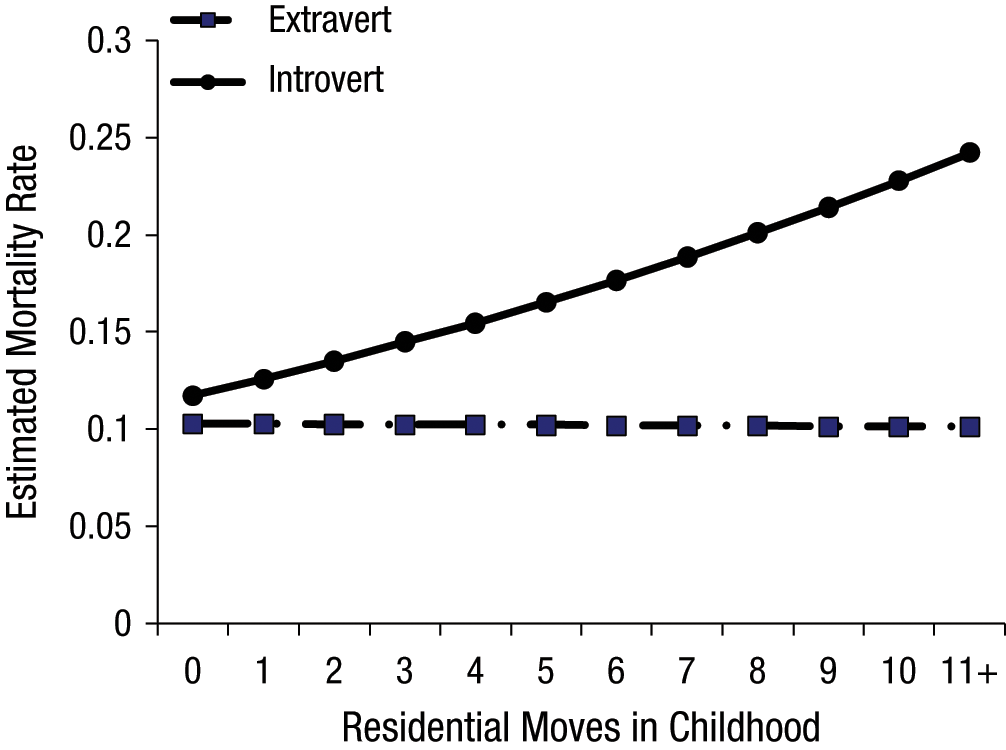
The moderating role of extraversion in the link between residential moves in childhood and mortality risk in adulthood. Adapted from “Residential Mobility, Well-Being, and Mortality,” by S. Oishi and U. Schimmack, 2010, Journal of Personality and Social Psychology, 98, p. 986. Copyright 2010 by the American Psychological Association. Adapted with permission.
In short, the first main contribution of psychology to the research on residential mobility is that it both captures the immediate psychological states evoked by residential moves and delineates the long-term consequences of moving for individuals’ well-being.
The Consequences of Residential Mobility for Society and Culture
The second main contribution of the psychological perspective on residential mobility is that it sheds light on the causal mechanism underlying community-level associations between residential mobility and outcomes. For instance, residential mobility has been repeatedly shown to be associated with higher levels of crime rates (see Sampson, 2012, for review). Similarly, residents of stable neighborhoods are more engaged in community affairs (Kang & Kwak, 2003) and more likely to engage in pro-community action (e.g., to buy specialty license plates whose proceeds fund the preservation of natural habitats; Oishi, Rothman, et al., 2007), than are those living in mobile neighborhoods. However, the causal direction of the observed association between residential mobility and these outcomes was unclear. Instead of residential mobility causing higher crime rates, for example, high crime rates might increase residential mobility. Likewise, pro-community action and civic engagement might be the cause, rather than the result, of residential stability.
In order to clarify the causal direction of this link, Oishi, Rothman, et al. (2007, Study 3) created a laboratory experiment in which participants were randomly assigned to a mobile or a stable “community.” Participants in the mobile condition completed three group tasks in three different groups, whereas participants in the stable condition completed the three group tasks in the same group. In a fourth, final task, participants played Trivial Pursuit for 10 minutes after being told that the best-performing individual in the group would receive a reward (a $10 coupon for Amazon, Papa John’s, or Blockbuster). In each group, there was a confederate who continually sighed, looked clueless, and wondered aloud about the questions. However, the confederate was instructed not to directly seek help from other group members. We video-taped each session and coded participants’ helping behaviors toward the confederate and toward other group members.
As predicted, participants in the stable condition helped the confederate significantly more often than those in the mobile condition did. Participants in the stable condition also helped the other participants in the group more often than those in the mobile condition did. Thus, we were able to show that residential mobility-stability could have a causal effect on pro-community action. Finally, we demonstrated that this effect was mediated by identification with the “community.” Residential stability strengthened identification with the “community,” which in turn resulted in greater pro-community action. Our results thus revealed a psychological mechanism underlying the link between residential stability and pro-community action.
Another example of psychological research that has explored the mechanisms of residential mobility is our research on the predominance of national chain stores in mobile regions of the United States (Oishi, Miao, et al., 2012). First, we observed that there are more national chain stores, such as Target, Best Buy, and Home Depot, in mobile states (e.g., Nevada and Florida) than in stable states (e.g., Pennsylvania and New York; Oishi, Miao, et al., 2012, Study 1). There are many obvious reasons for this phenomenon—for instance, newcomers need new furniture, electronic goods, and home-improvement materials, all of which are available at big-box chain stores. However, we found the same pattern of association between national chain stores and residential mobility even in the case of restaurants, grocery stores, and shoe stores, such as California Pizza Kitchen, Whole Foods, and Payless Shoes, which are not specifically catered toward newcomers. From our psychological perspective, we postulated that residential moves cause stress, which in turn evokes the psychological tendency of familiarity seeking. As stated earlier, we conducted a series of lab experiments and found support for this hypothesis, demonstrating the causal effect of residential mobility on familiarity seeking (Fig. 2).
In short, the second main contribution of the psychological approach to residential mobility is that it allows researchers to test the causal direction of the link between residential mobility and societal outcomes and to delineate the psychological mechanisms underlying it.
Future Directions
The psychological research on residential mobility has just begun. It is important to uncover how psychological states evoked by residential mobility give rise to various societal outcomes. For instance, our recent research has demonstrated that thinking about a mobile lifestyle induced loneliness, which in turn motivated people to expand their social network (Oishi, Kesebir, et al., in press). These psychological mechanisms might explain the characteristic American friendliness toward strangers that has surprised many foreign visitors, most famously de Tocqueville (1840/2003). Speculating further, the relationship anxiety and desire to expand one’s social networks evoked by residential mobility may have contributed to the creation of casual, friendly interpersonal norms in the United States. Just as familiarity liking was linked to the predominance of national chain stores, the motivation to expand personal social networks and the preference for egalitarian helpers could also give rise to the proliferation of low-threshold, low-commitment institutions (i.e., institutions that are easy to join), such as megachurches in residentially mobile communities. Finally, norms regarding friendly behavior and the presence of many low-threshold, low-commitment institutions might further make residential moves easier for Americans.
Besides excitement, anxiety, and loneliness, residential mobility probably induces other powerful psychological reactions that have not been empirically tested yet. For instance, a residential move often creates a sense of uncertainty, given that newcomers are often unsure about where to go, what to do, and whom to depend upon in a new city. Psychologists have already discovered many phenomena associated with a sense of uncertainty, such as increased patriotism and support for the status quo (Heine, Proulx, & Vohs, 2006). Residential moves might temporarily push people to adopt patriotic, conservative political attitudes, which might in turn give rise to the establishment of conservative institutions in residentially mobile communities. Moreover, moving is exhausting. Psychologists have already discovered many phenomena associated with depletion, such as failures of self-control (Baumeister, Vohs, & Tice, 2007). To the extent that a lack of self-control is associated with alcohol consumption and poor health behaviors, residential mobility might be linked to obesity and longevity at both the individual and the societal level. Although these are speculations at this point, it is plausible that the psychological states evoked by residential mobility could give rise to nontrivial societal outcomes.
Although the foregoing discussion has emphasized negative aspects of residential mobility, it has positive aspects as well. Moving is stressful, but it is also exciting. American adults who were transferred to a new city reported leading a more interesting life than their stable counterparts (although mobile men also reported experiencing upset stomach and shortness of breath more frequently than stable men did; Brett, 1982). Likewise, older women who voluntarily moved to a new community reported being less depressed, having more environmental mastery, and experiencing more personal growth (Kling, Seltzer, & Ryff, 1997) than older women who did not. Multicultural experience (including having lived abroad) is associated with increased levels of creativity (Leung, Maddux, Galinsky, & Chiu, 2008). Thus, residential moves might nurture flexible thinking styles, creativity, and the ability to take multiple perspectives (although in the short run, the stress of moving could make movers adopt more simplistic modes of thinking geared toward uncertainty reduction).
Cohen (1998) discovered that rates of murders stemming from arguments, viewership of violent TV programs, readership of violent magazines, people with hunting licenses, and votes cast against gun-control laws were higher in more residentially mobile areas in the U.S. North and Midwest, but lower in more residentially mobile areas in the U.S. South and West. The more stable communities in the South and West seemed to be holding on to a culture of honor tradition, which sometimes justifies violence in retaliation for honor violations.
Cohen’s (1998) findings confirmed Thomas and Znaniecki’s (1920) observation that residential stability encourages the continuity of existing norms, whereas residential mobility is likely to facilitate the introduction of new norms. It is important for future research to examine the roles that residential stability and mobility play in the maintenance and change of local cultures. Finally, it is critical to explore whether the causes and consequences of residential mobility vary across cultures. For instance, although residential mobility might evoke stress, anxiety, and excitement to most people in most places, the degree to which it does so might vary substantially. Moves might evoke more stress and anxiety in a residentially stable society, such as Japan. To the extent that different cultures deal with uncertainty differently, moves might elicit stronger uncertainty-reduction reactions in nations where uncertainty avoidance is high, such as Greece and Belgium, than in nations where uncertainty avoidance is low, such as Singapore and Jamaica (Hofstede, 2001). As residential mobility becomes an increasingly widespread worldwide phenomenon, it is critical that research examine how it relates to culture as well as to individual movers’ personality, values, and family, marital, and financial situations.
Summary and Conclusion
Residential mobility is both a personal and a societal issue. Psychological research has shed new light on the short-term consequences of residential moves, such as excitement, anxiety, and loneliness, as well as on long-term consequences, such as subjective well-being and mortality risk in adulthood. Psychological research has also clarified the causal role of residential mobility in such associations. Finally, the integration of psychological and sociological perspectives has led to the discovery that individual-level psychological variables such as anxiety, familiarity liking, and a sense of belonging might underlie sociological links between residential mobility and community-level phenomena (e.g., predominance of national chain stores, pro-community action).
Equally importantly, the integration of the psychological and sociological perspectives sheds light on the dynamic, reciprocal relationship between residential mobility and social structure (Fig. 4). Residential mobility evokes anxiety, which in turn leads to familiarity seeking, which in turn leads to favorable market conditions for national chain stores. This phenomenon then feeds back into mobility: The spread of national chain stores in suburbs of large U.S. cities has made it easier for Americans to move from one city to another, further contributing to the chronically high level of residential mobility across the country. Without the integration of psychological and sociological perspectives, it would have been impossible to fully delineate the process that links structural social factors and psychological factors (see Fig. 4).
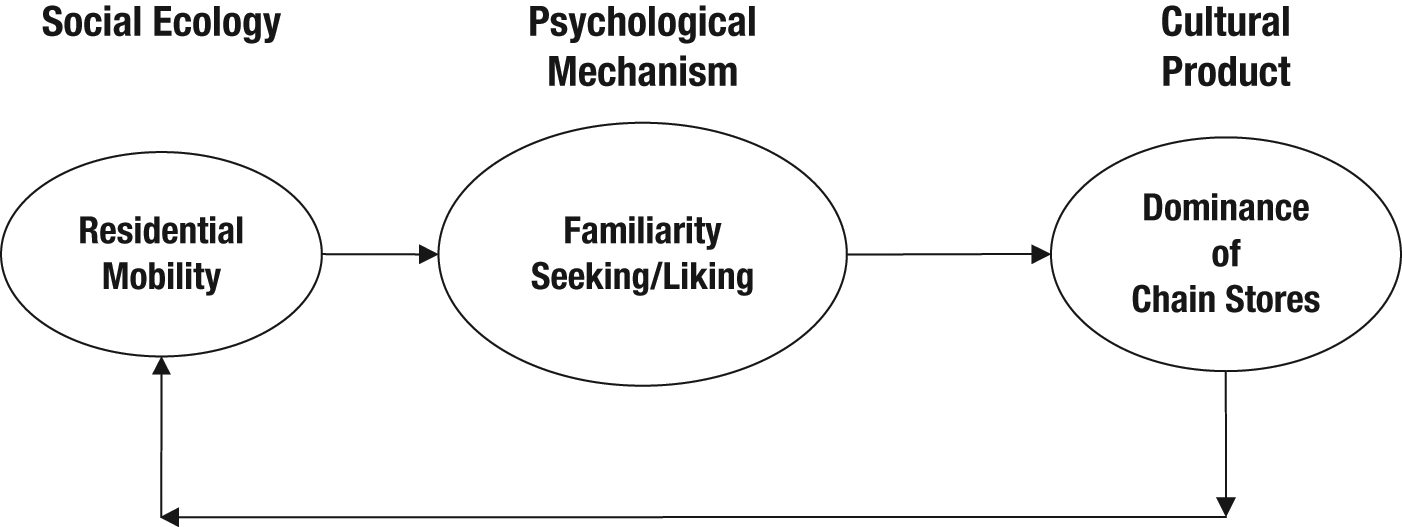
A theoretical model of the links between social ecology, psychology, and culture. Residential mobility tends to evoke the psychological tendency to seek familiar objects and prefer them to unfamiliar objects, which in turn gives rise to the predominance of national chain stores and the uniformity of American landscapes, which in turn make it easier for Americans to move from one place to another. Adapted from “Residential Mobility Breeds Familiarity-Seeking,” by S. Oishi, F. Miao, M. Koo, J. Kisling, and K. A. Ratliff, 2012, Journal of Personality and Social Psychology, 102, p. 160. Copyright 2012 by the American Psychological Association. Adapted with permission.
There are many rich psychological phenomena associated with residential mobility that are still waiting to be discovered. As psychological research on residential mobility has demonstrated, psychological states evoked by residential moves have important implications not only for individuals but also for society, and the marriage of sociological and psychological perspectives can provide a powerful approach for discovering how individuals and society influence each other.
Recommended Reading
Jokela, M. (2009). (See References). Demonstrates that personality predicts the chance of future residential mobility.
Oishi, S. (2010). (See References). A review of vast research on residential mobility, focusing on the self, social relationships, and well-being.
Sampson, R. J., Raudenbush, S. W., & Earls, F. (1997). Neighborhoods and violent crime: A multilevel study of collective efficacy. Science, 277, 918–924. One of the most influential papers on the link between residential mobility and crime.
Footnotes
Acknowledgements
We thank Jordan Axt, Casey Eggleston, Marguerite Beattie, and Brandon Ng for providing invaluable comments on earlier versions of this paper.
Declaration of Conflicting Interests
The authors declared that they had no conflicts of interest with respect to their authorship or the publication of this article.