



Abstract
People’s thoughts often go beyond what is right in front of them. In so doing, they mentally traverse psychological distance: They think about the past or the future, other places, other people, and wonder about the impossible. These four dimensions all tap into the same common construct of distancing from immediate experience. As a result, people associate each type of distance with the others and infer that anything far in one way will be far in all the other ways. Furthermore, distance causes further distance to shrink in the mind’s eye, even if in a different form than the first. We consider potential differences whereby certain distances might be understood in terms of other distances, and then we evaluate additional contenders that might qualify as distinct dimensions of distance in their own right. Throughout, we highlight implications of these principles for everyday judgment and decision making.
When the mind wanders, where does it go? The simple answer, by definition, seems to be “away from whatever is in front of me.” This process of wandering takes people in any number of directions. They reflect on the past or anticipate the future. They wonder about an old roommate who took a job overseas. They entertain the possibility of a zombie apocalypse. One way or another, they simulate something—anything—outside of the here and now.
Although wandering may be aimless, people also deliberately conjure specific targets even if they cannot see, touch, hear, smell, or taste them. The human cognitive system comes equipped to transcend its given context, a prerequisite in, for example, planning for retirement, taking the perspective of another person or another location, or speculating about alternate universes. Although these thoughts land in a variety of far-flung places, they all require the mind to extrapolate in going from right here to over there. The very nature of such mental travel—of going beyond the immediate environment—entails traversing psychological distance.
Psychological closeness anchors on the present state of the self, and as anything departs from this egocentric reference point, it becomes psychologically distant. Distancing, therefore, first transitions from near to not near before moving along the continuous path of increasing distance. To illustrate in reverse order, an anticipated birthday moves closer and closer in time over the course of 364 days before the clock strikes midnight on the 365th day and it enters the here and now of psychological proximity. What matters most is not the objective distance of a target but rather how far away it feels subjectively. Trope and Liberman (2010) parsed the realm outside of direct experience into four dimensions on which distance can vary: time, physical space, social distance, and likelihood or probability. These separable factors intersect at the underlying construct of psychological distance insofar as they capture avenues along which people can transcend their current context. Tapping into this common meaning of removal from immediacy gives rise to a number of important consequences that are similar across the four distances.
Distance Begets Distance
If each individual dimension ties into a broader framework of distance, then the location of an object on any one dimension should be relevant to its more general location. Learning that something is far away in time should invoke a sweeping sense of its remoteness. As a result, this expansive notion should bleed into specific inferences of distance for all of the other dimensions as well. Explicit information that a target is near or far in one aspect causes people to infer that the target is similarly proximal or distal, respectively, for each of the other distances. For example, politeness marks a sense of formal social distance, whereas people speak less formally with close others. When research participants read polite or informal descriptions of the same events, they expected the politely worded events to happen further in the future and at a greater spatial distance. The reverse also held true: People used more polite language in constructing messages to be received in the distant future or in distant locations (Stephan, Liberman, & Trope, 2010). Probability also changes extrapolation to other distances. When judging which things will happen to whom, people anticipate likely, common (i.e., probabilistically close) events for their socially near selves but less likely, rare circumstances (i.e., probabilistically distant) to befall other people (Chambers, Windschitl, & Suls, 2003). Rare events are also expected to happen in remote locations and in remote times (Wakslak, 2012). The general conclusion—that people expect targets near or far in one regard to be similarly near or far in all regards—aligns with the theory of magnitude from Walsh (2003), which suggests that the brain processes dimensions of psychological distance (as well as other numerical amounts) similarly.
The tendency for all four distances to move together may originate in everyday experience. People remember personal events as having a unified sense of distance and expect their future life events to behave in much the same way (Fiedler, Jung, Wänke, & Alexopoulos, 2012). In one study, research participants recalled an autobiographical episode and then rated, on separate scales, how distant it seemed in time, space, social distance, and probability. Positive correlations manifested among the four subjective distance ratings, suggesting that events feel near or far not along only certain dimensions but rather along a common path in which all specific dimensions go hand in hand. However, people do not need an initial distance cue to judge how distant an event feels. Describing an event in vivid, emotional terms pulls it psychologically closer across ratings of time, space, and social distance (Van Boven, Kane, McGraw, & Dale, 2010). Not only does distance on one dimension expand mental horizons on all dimensions, but also subjective feelings of distance respond similarly to certain external forces.
Near goes with near and far goes with far, and all of this happens in the blink of an eye (Bar-Anan, Liberman, Trope, & Algom, 2007). In a modified version of the Stroop task, research participants were asked to indicate the apparent location of a word against a visual background that made the words look spatially near or far. They responded faster if the distance implied by the meaning of the word (us signifying proximity, them signifying distance) matched its apparent location in space (e.g., us presented proximally) relative to when there was a mismatch (e.g., us presented distally). Thus, the common meaning shared by the four distances can be traced to an automatic, nonconscious association. At the level of downstream judgment and decision making, the mind prefers matched distances as well. People have greater confidence in and indicate greater willingness to bet on underdogs (i.e., unlikely winners) when the outcome is determined in a spatially distant location (Wakslak, 2012), and consumers are more strongly persuaded by recommendations from distant others when considering distant future purchases because those opinions seem more relevant (Zhao & Xie, 2011). Thus, there seems to be a basic and natural fit between the different dimensions of distance that is powerful enough to shape real-world decisions.
Distance Shrinks Distance
When something feels remote on one dimension of distance, it snaps into alignment on all dimensions if those precise locations remain unknown. Such assimilation is common for ambiguous stimuli. Conversely, patterns of contrast tend to emerge for unambiguous, clearly defined stimuli (e.g., Herr, Sherman, & Fazio, 1983). Therefore, might an initial introduction of one distance change how people assess a given, known span of distance from another dimension? That is to say, what is the effect of distance on distance itself?
Within a single dimension, an initial stretch of distance causes further distance to loom less large. A whole day right now is expected to drag on, because it will happen so soon, but a single day a year down the road will go by in a flash. This difference in duration estimates—judgments of how long a span of time will feel—as a function of timing can explain why people might prefer $5 now over $10 the next day but would simultaneously prefer $10 in 366 days over $5 in 365 days (Zauberman, Kim, Malkoc, & Bettman, 2009). Similar patterns of decreasing sensitivity with increasing distance have been documented for other distances as well (Green & Myerson, 2004; Jones & Rachlin, 2006).
Time shrinks time, space shrinks space, and so forth, but would, for example, space also subjectively shrink time? The leap from within-dimension distancing to cross-dimension distancing hinges upon the idea that the different dimensions of distance are fungible or interchangeable. Insofar as they share a common meaning of psychological distancing, this leap should be justified (Maglio, Trope, & Liberman, in press). In one study, research participants opted to wait 3 months for a larger financial payoff when that money would ostensibly be deposited into a bank on the other side of the country, indicating that spatial distance made a time delay more palatable. A separate study found that participants chose riskier lotteries for more distant people, suggesting that social distance tempered their sensitivity to the difference between a sure thing and a long shot. Whereas this shrinking held true regardless of specific distance combinations (see Table 1), it did not apply to magnitudes unrelated to distance.
A Summary of Evidence Whereby an Initial Introduction of Psychological Distance Reduces Sensitivity to Further Distance From a Different Dimension
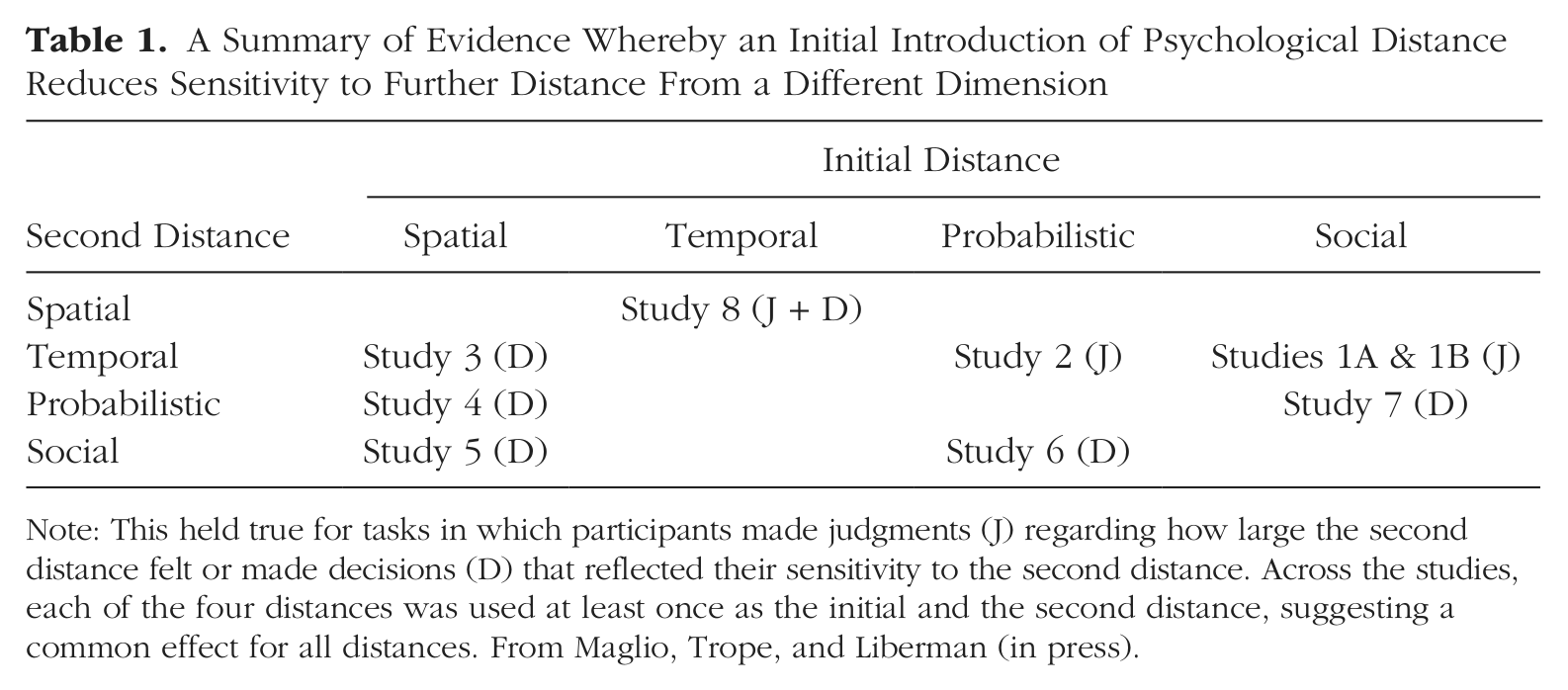
Note: This held true for tasks in which participants made judgments (J) regarding how large the second distance felt or made decisions (D) that reflected their sensitivity to the second distance. Across the studies, each of the four distances was used at least once as the initial and the second distance, suggesting a common effect for all distances. From Maglio, Trope, and Liberman (in press).
One could ask, of course, what causes this subjective shrinking in the first place. Frank Herbert (1981), in God Emperor of Dune, contended that “in the view of Infinity, any defined long-term is short-term.” This conjecture hints at a possible sequence of mental events that integrates our Distance Begets Distance and Distance Shrinks Distance sections. First, when a judgment task is framed as far on one dimension, people may derive an expectation of remoteness on all dimensions. Thereafter, they confront not an expansive but rather a limited span of distance from another dimension. Having contracted their scope from the cosmos to a mere few minutes or miles, they evaluate the defined distance in cosmic (and not mere mortal) terms and watch it shrink accordingly (Maglio & Trope, 2011).
Distant Origins
The necessary counterpoint to any discussion of similarities shared by the four dimensions of psychological distance inquires after differences between them. Such points of differentiation abound. Most germane to the question of distance commonalities, however, is the lingering issue of which came first in the human mind. Physical space has the unique distinction of being the only dimension of distance that can be seen directly. As a developmental consequence, people may structure their metaphorical understanding of other, indirect distances in spatial terms (Boroditsky, 2000; Casasanto & Boroditsky, 2008). Whereas priming spatial distance leads people to assume that a target is equally distant on each of the other dimensions, spatial distance inferences did not budge in response to the priming of time, social distance, or likelihood (Zhang & Wang, 2009). Perhaps the primacy of space accounts for this asymmetry. Nevertheless, our diminishing sensitivity research found symmetrical effects: Space shrinks time in the same way that time shrinks space (Maglio et al., in press). This raises the possibility that assessing fundamental dimensions of distance (spatial or otherwise) varies as a function of whether its amount is known or unknown.
Alternatively, likelihood may be the lynchpin from which all other distances derive. Consider, for example, the fact that an outcome to be obtained in the future remains probabilistically uncertain until it becomes realized in the present moment. Or the reverse: Probabilistically unlikely events require more individual attempts—spanning more time—before they ultimately come to pass (Green & Myerson, 2004). These observations may point to the most parsimonious definition of distance: If closeness originates from a person’s direct experience, then perhaps something becomes increasingly distant as there are more and more possible states in which that something will not materialize. Winning the lottery is a hypothetical consideration as well as an event that will fail to occur in more versions of reality as probability decreases: There are 99 ways to lose a 1% gamble but 999 ways to lose when the chance of winning falls to 0.1%.
Identification of a fundamental distance would shed light on the mechanics of distancing. Might the ability to traverse psychological distance develop earlier for essential distance(s)? Moreover, deficiencies in simulating a fundamental distance could handicap simulation of the others, but training to remedy this specific deficiency may improve the capability more generally. Answers to these questions await future empirical attention.
Diversifying Distance
What makes a distance distant? This question lies at the heart of the quest to identify additional dimensions of distance. Two approaches capture recent advances in the psychology of psychological distance. First, there is the issue of how data become part of direct experience in the first place; the source may matter a great deal when it comes to how people appraise these data (Fiedler, 2007). Information that people themselves know to be true—rather than that gleaned from other sources— signals greater proximity, perhaps reflecting the social distance of the source from which it originated.
Second, targets can vary not only in their static location but also in their orientation relative to the individual. As a result, people may feel a greater sense of distance from an object that is, at a given moment, moving away from themselves rather than moving closer (Fiedler, 2007). Whether this captures a separate dimension of distance or instead a property of an object along a continuum of an existing distance (e.g., advancing or retreating in space) remains open for future investigation. In addition, if an object tends to enter direct experience more often, this familiarity engenders a sense of psychological closeness (Förster, 2009). Novelty, then, might be conceptualized as a summary judgment of how distant a target feels in time, space, social distance, and likelihood. From a theoretical perspective, the number of distinct dimensions matters a great deal less than the underlying process by which psychological distancing occurs. Nevertheless, in broadening the scope with which distance is defined, we enrich our understanding of how it operates in practical, real-world phenomena.
Looking Backward, Looking Forward
By virtue of being human beings, people look beyond what is in front of them and therefore travel through psychological distance every day. They consider the past or the future, they think globally, they go outside themselves, and they entertain offbeat notions. Ever-expanding mental horizons are a hallmark of human evolution, history, and development. One way or another, people want to—and, in many ways, need to—transcend the phenomenology of the here and now. The different flavors of distance cohere around a single construct of psychological distance, and the similar meaning shared by time, space, social distance, and likelihood gives rise to a host of consequences, ranging from basic cognitions to reversals in prediction, evaluation, and action. Without the capacity to distance, people would remain trapped in the here and now. Given the capacity to distance, they experience that which is not immediate and situate themselves and their lives within a broader, more universal context.
Recommended Reading
Bar-Anan, Y., Liberman, N., Trope, Y., & Algom, D. (2007). (See References). Evidence for an association at the implicit level among time, space, social distance, and probability.
Fiedler, K., Jung, J., Wänke, M., & Alexopoulos, T. (2012). (See References). An illustration that people experience one generalized sense of distance across all four dimensions in everyday events.
Liberman, N., & Trope, Y. (2008). The psychology of transcending the here and now. Science, 322, 1201–1205. A broad, accessible description and summary of the psychological distance construct.
Maglio, S. J., Trope, Y., & Liberman, N. (in press). (See References). An empirical investigation into how distance similarities result in diminishing sensitivity to cross-dimension distancing.
Trope, Y., & Liberman, N. (2010). (See References). A theoretical perspective on the definition of psychological distance and its impact on judgment and decision making.
Footnotes
Declaration of Conflicting Interests
The authors declared that they had no conflicts of interest with respect to their authorship or the publication of this article.
Funding
Much of the research described here received support from the U.S.-Israel Binational Science Foundation Grant 2007-247 (to N. Liberman and Y. Trope).