



Abstract
Many employees perform emotional labor, regulating their emotions to meet organizationally mandated display rules (e.g., “service with a smile”), which has both professional and personal implications. Emotion regulation in a work context is important to enhance customers’ mood and service satisfaction, but putting on that smile to perform one’s work role can have surprising costs depending on how the emotions are regulated. When employees try to change their feelings to appear sincere (i.e., deep acting), performance is enhanced, yet employees must often “fake it” (i.e., surface act), which has consequences to their well-being. We discuss how these concepts are similar and distinct from emotion-regulation strategies while also reviewing work factors that help optimize emotional labor’s impact on performance and well-being. Finally, we note recent studies that have expanded the concept of emotional labor and the methods used to capture this workplace experience.
Most of us appreciate getting a smile and friendly greeting with our coffee, groceries, or hotel room key, but do we recognize that as labor? Showing positive emotions (e.g., “service with a smile”) is an explicit job requirement for an increasing number of employees as service-sector jobs continue to replace industry and manufacturing work. This emotional labor, a term coined by sociologist Arlie Hochschild (1983), was initially thought to enhance company profits but with personal cost. More recently, industrial-organizational psychologists have connected emotional-labor concepts to the dominant emotion-regulation framework (Grandey, 2000; Gross, 1998) to consider (a) how business and employee outcomes can be optimized and (b) the role of context for emotion-regulation effectiveness (Aldao, 2013).
Here, we review emotional labor; its overlap and distinctions from emotion regulation; its impact on the affective, health, and behavioral outcomes of both the actor (i.e., employee) and audience (e.g., customer, organization); and the role of the work context. We conclude by detailing emerging research that is expanding the concept of emotional labor and the methods used to investigate it in ways that can inform both the science and the practice of performing emotion regulation for a wage.
Defining Emotional Labor
Emotional labor encompasses a process that includes (a) explicit emotional requirements (i.e., display rules) and (b) the effortful strategies needed to meet those requirements (i.e., emotion regulation; Diefendorff & Gosserand, 2003).
Emotional labor as a job requirement: display rules
In contrast to physical-labor occupations that require physical exertion, emotional-labor occupations require the employee to exert control over emotions, to “create a publicly observable facial and bodily display” that is “sold for a wage and therefore has exchange value” (Hochschild, 1983, p. 7). Hochschild differentiated this concept from emotion work or emotion management, which is done for one’s personal goals in other social exchanges. In her view, emotional-labor occupations involve (a) frequently interacting with the public (e.g., cashiers, call center employees, receptionists, bus drivers, nurses, teachers), in which the audience is comprised of strangers, and (b) conforming to positive display rules 1 to interact with other people effectively.
In jobs with high emotional labor, display rules are explicitly communicated to motivate effective interpersonal performance (Diefendorff, Richard, & Croyle, 2006). For example, management communicates and enforces display rules during selection (e.g., the fast food marquee says “Now hiring smiling faces!”), training (e.g., the handbook says “Act like you are on stage at all times”), and performance evaluation (e.g., customer comment cards include the dimension “friendliness”). These display rules act as goals that direct employees’ attention and motivation toward regulating emotions, particularly when events occur that evoke incongruent emotions (Diefendorff & Gosserand, 2003). Given the likelihood of stressors such as rude treatment from the public (Grandey, Kern, & Frone, 2007), employees in emotional-labor jobs require high levels of emotion regulation to conform to the display rules and perform the job well.
Emotional labor as effort: emotion regulation
Like actors in a (very long) play, employees in emotional-labor occupations respond to display rules by using deep acting to deceive themselves by changing their own thoughts and feelings to create a sincere performance and surface acting to feign required displays without changing their internal state (Hochschild, 1983). Both are effortful strategies for striving to meet the display-rule goal, and in Hochschild’s original work, both are viewed as costly to the actor.
These two acting strategies have parallels with the dominant emotion-regulation model in psychology (Gross, 2015) but also some distinctions (see Grandey, 2015). Deep acting refers to modifying feelings, which can be done using cognitive strategies (e.g., refocusing attention, reappraisal) to proactively change how one feels (e.g., taking a difficult client’s perspective to genuinely show concern). Surface acting is a type of behavioral modulation (e.g., suppression, amplifying), often done reactively to negative events (e.g., hiding irritation with the difficult client).
Both literatures talk about the former strategies (i.e., cognitive, deep acting) as the more effective ones. Yet there are interesting distinctions that speak to the value of looking at emotion regulation in context. Emotion-regulation research finds that reappraisal robustly improves affect and well-being and that suppression is effective for emotional performance, whereas emotional-labor research finds that deep acting has weak affective benefits and surface acting harms emotional performance (Hülsheger & Schewe, 2011; Webb, Miles, & Sheeran, 2012). There are a variety of potential reasons for differences (Grandey, 2015), but one is the unique context: Emotional-labor strategies are specifically used to conform to explicit display rules for required and repeated social interactions (e.g., customers, patients) with an economic motive (e.g., job retention, tips). Thus, emotional labor offers scholars a real-world contextualized understanding of when emotion-regulation strategies are effective, with unique implications for the actor and audience, as reviewed below.
Emotional-Labor Outcomes for Actor and Audience
As shown in Figure 1, deep acting tends to be effective for audience reactions (i.e., emotional performance and customer satisfaction) with mild costs to the actor, whereas surface acting tends to be detrimental to the actor (i.e., symptoms, burnout, job dissatisfaction) with weak effects on performance. These effects, however, depend on the work context.
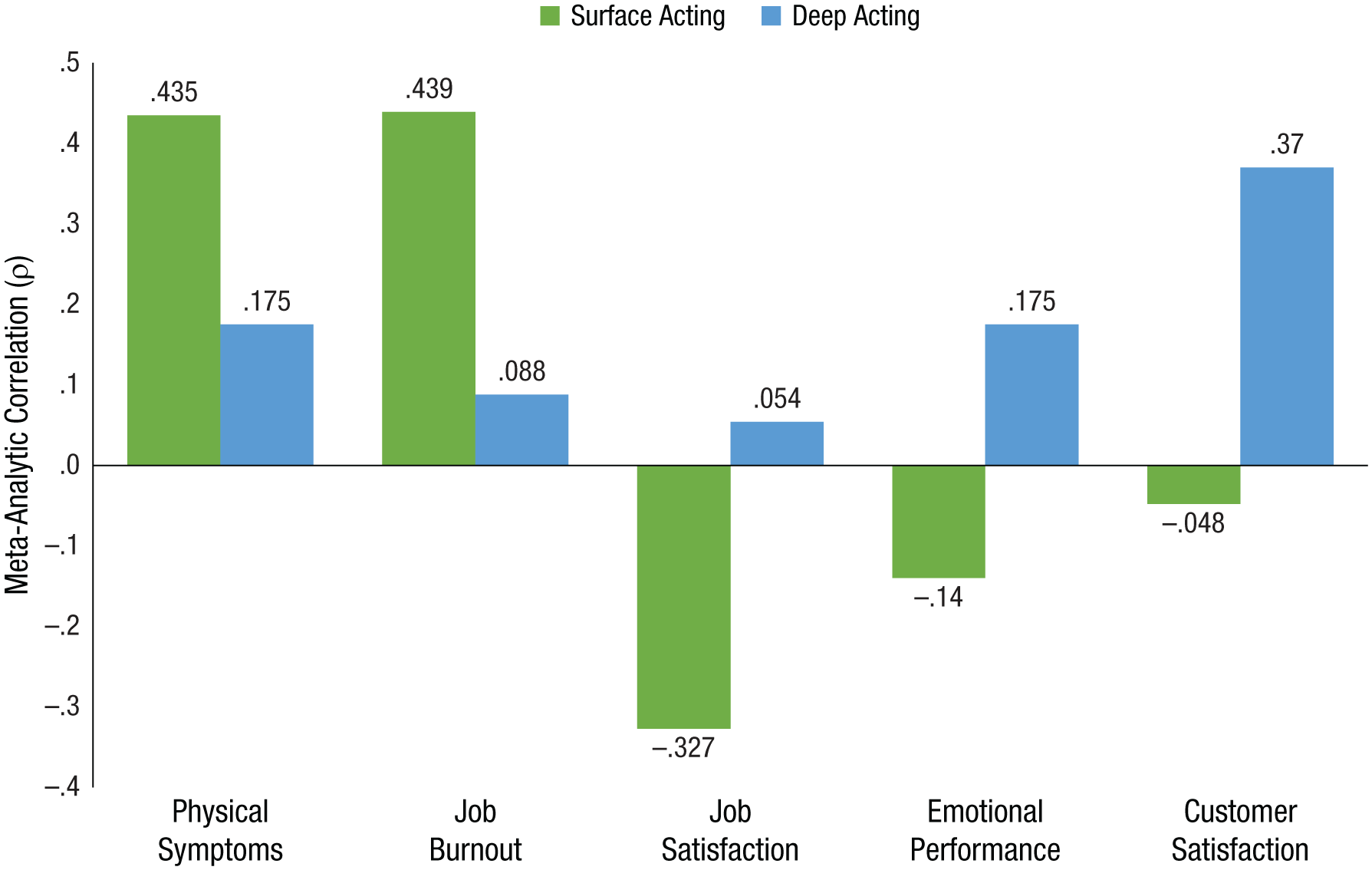
Meta-analytic correlation across 95 studies (N = 23,574) between acting style (surface acting, deep acting) and each of five emotional-labor outcomes. Confidence intervals (not shown) do not include zero, except for the correlation between deep acting and job satisfaction, meaning that all other correlations were significant. (This original figure uses values from the meta-analysis by Hülsheger & Schewe, 2011.)
Actor’s outcomes from emotional labor: affective, health, and performance
Although both deep and surface acting strive to bring expressions in line with the required display rules, deep acting does this by modifying feelings. In some studies, deep acting is linked to a sense of accomplishment (Brotheridge & Grandey, 2002) and greater job satisfaction (Grandey, Chi, & Diamond, 2013), but the overall effect is weak. Unlike for cognitive strategies (i.e., reappraisal), support for deep acting improving felt mood or well-being is mixed (Judge, Woolf, & Hurst, 2009). In fact, deep acting is positively related to exhaustion and psychosomatic symptoms, suggesting that chronic attempts at deceiving oneself (without changing the situation) take a toll over time.
Some might encourage “fake it ’til you make it,” but surface acting frequently is linked to health problems. The felt inauthenticity and resulting dissonance between one’s internal states and behavior predict tension and anxiety, impairing home outcomes such as sleep (Wagner, Barnes, & Scott, 2014).
Some researchers have argued that surface acting’s costs are simply due to feeling negative emotions (Semmer, Messerli, & Tschan, 2016). Yet surface acting is not always harmful, especially if authentic self-expression is not a core value or when the actor is socially skilled at appearing authentic (Judge et al., 2009; Pugh, Groth, & Hennig-Thurau, 2011), consistent with suppression findings (Butler, Lee, & Gross, 2009).
Beyond affect and attitudes, surface acting has other unintended costs to actors and their job performance. As with suppression (Richards & Gross, 2000), surface acting uses attentional and energy resources—impairing cognitive task performance (Goldberg & Grandey, 2007) and increasing the likelihood of counterproductive behavior unless employees have high self-control (Chi & Grandey, 2016). Critically, the more employees are surface acting, the more likely they will quit their job, a costly outcome for individuals and organizations alike (Chau, Dahling, Levy, & Diefendorff, 2009).
Audience reactions to emotional labor: affective, relational, and financial
Emotional labor is required because it is assumed to enhance audience reactions, specifically customer satisfaction. In the short term, smiling evokes mimicry and positive mood in customers or clients (i.e., emotional contagion), which enhances customers’ satisfaction ratings (Barger & Grandey, 2006). As in theater, deep acting changes one’s internal state, giving the audience a more believable emotional performance. In one dyadic study, when employees used deep acting, they were evaluated by customers as genuinely wanting to help, resulting in favorable reactions and higher intentions to return (Groth, Hennig-Thurau, & Walsh, 2009). Emotional labor that appears genuine by deep acting improves short-term financial gains (i.e., tips; Chi, Grandey, Diamond, & Krimmel, 2011; Hülsheger, Lang, Schewe, & Zijlstra, 2015), though there is little evidence for long-term benefits such as unit sales or return business (e.g., Christoforou & Ashforth, 2015).
Suppressing emotions with other people may impair relational connections (Butler et al., 2003), and similarly, surface acting can be seen as deceptive or inauthentic (Grandey, 2003). However, surface acting meets basic expectations for “service with a smile” and is only problematic when the phoniness is detectable by the audience (Groth et al., 2009). In fact, surface acting improves financial rewards (i.e., tips) for highly skilled actors (i.e., extraverts), though not for the less skilled (Chi et al., 2011). Overall, surface acting can help or harm audience reactions depending on audience expectations, which vary by actor race (Grandey, Houston, & Avery, 2017), the busyness of the store (Grandey, Fisk, Mattila, Jansen, & Sideman, 2005), and the nature of the employee–customer relationship (Wang & Groth, 2014).
Work Practices Determine Emotional-Labor Outcomes
On the basis of theoretical perspectives about autonomy and rewards, research has explored when workplace practices can buffer costs and improve gains from engaging in emotional labor.
When emotional labor is intrinsically motivated and autonomous
Consistent with self-determination theory (Gagné & Deci, 2005), affective and performance outcomes are better when emotional labor is intrinsically motivated or done autonomously. When employees are selected for traits that are aligned with a job’s display rules (e.g., positive affectivity, high self-control, job identity), emotional labor is more likely done with deep acting, and even surface acting is done with less effort, improving performance (Chi & Grandey, 2016). Designing work interactions to feel challenging, meaningful, and relationally motivated also helps buffer the costs of surface acting (Wang & Groth, 2014). When management offers job autonomy—freedom to choose how to perform job behaviors—compared with when behavior is scripted and controlled by management, the costs of emotional labor are buffered (Christoforou & Ashforth, 2015; Grandey, Fisk, & Steiner, 2005).
When emotional labor is externally rewarded and supported
Organizational practices that support and reward effective work behaviors generally increase commitment and performance, and this is also the case for emotional performance. Just as actors continually develop their craft, employees can improve their performance and tips by getting trained on how to better display emotions at work (Hülsheger et al., 2015), showing the value of a supportive environment. These work practices should also permit taking breaks when needed—such as after dealing with a difficult customer—to recover resources lost by surface acting (Trougakos, Beal, Green, & Weiss, 2008). Fostering a climate of authenticity among hospital staff (e.g., feeling safe sharing negative emotions and distress) buffered the relationship of patient-directed surface acting on job burnout (Grandey, Foo, Groth, & Goodwin, 2012).
Finally, offering financial rewards for emotional labor seems to feel supportive, rather than controlling, to employees. Performance-contingent rewards (e.g., tips, raises) reverse the typically negative relationship of surface acting with job satisfaction (see Fig. 2) and negative mood by giving an external justification for inauthentic behavior (Grandey et al., 2013). Yet as noted in a New York Times essay (Einhorn & Abrams, 2018), tipping contexts may force employees to put on a smile even when facing harassment or other unjustified conditions, suggesting there may be longer term costs.
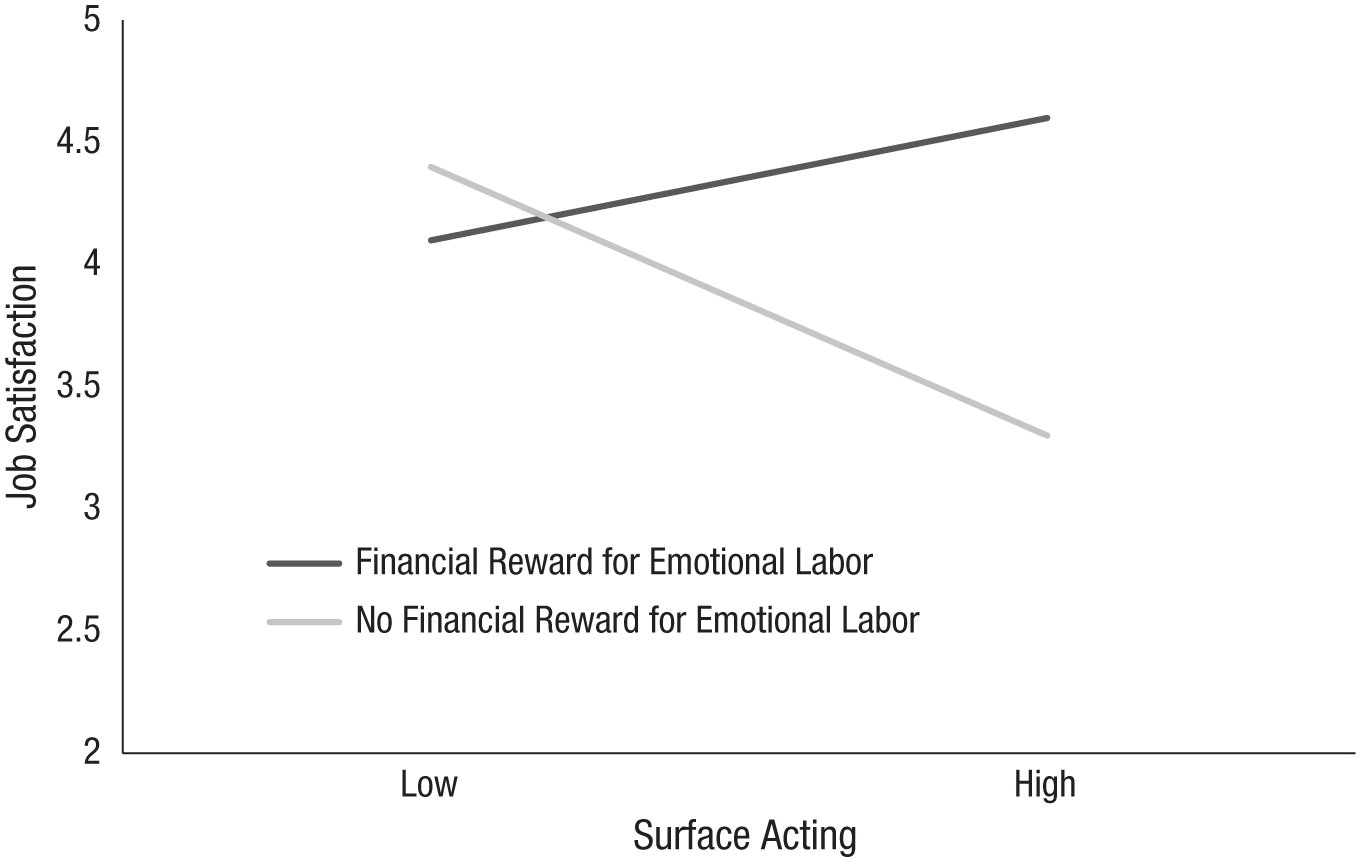
Mean job-satisfaction rating as a function of the employees’ level of surface acting (low, high) and whether financial reward (e.g., tips, raises) was available for emotional labor. (Figure adapted from Grandey, Chi, & Diamond, 2013.)
Current Directions of Emotional-Labor Research
Several emerging trends are expanding our understanding of emotional labor, both conceptually and methodologically, with implications for the broader study of emotion-regulation strategies and self-regulation.
Expanding emotional labor conceptually
Scholars are expanding beyond the dichotomy between surface and deep acting and broadening the audience to more than just customers. Employees, in fact, use the full range of emotion-regulation strategies (e.g., situation selection, attentional deployment) to cope with interpersonal events and meet display rules (Diefendorff, Richard, & Yang, 2008). Examining how display rules depend on the audience (e.g., customer vs. coworker) and actor (e.g., subordinate vs. leader) is necessary to understand how context changes expectations and effectiveness. For example, higher status employees (e.g., managers and leaders) may display negative emotions to motivate and negotiate, but it is unclear if faking negative emotions has similar effects to faking positive emotions (Côté, Hideg, & van Kleef, 2013). The concept of emotion-regulation flexibility—the ability to enact regulatory strategies in response to contextual demands (Bonanno & Burton, 2013)—may play an especially important role for higher status employees, who often face a wider variety of display requirements in a given day (e.g., anger with an underperforming team, then compassion for a sick employee).
Expanding emotional labor methodologically
Emotional-labor strategies were originally studied as person-level differences (Brotheridge & Grandey, 2002), but emerging research recognizes the momentary and dynamic nature of emotions. Experience-sampling methods with multiple daily assessments are increasingly the method of choice, providing insights on how emotional labor at work predicts after-work well-being and next-day performance (Wagner et al., 2014). Even more fine-grained are laboratory work simulations that have shown the value of obtaining continuous ratings (every 200 ms) of surface and deep acting, finding they are used simultaneously to deal with negative interactions (Gabriel & Diefendorff, 2015). New research must use dynamic and dyadic methods to test the newest models of both emotion regulation and emotional labor (Grandey & Melloy, 2017; Gross, 2015), which assess cycles of actor’s emotion regulation and audience reactions, with spillover from one interaction to the next.
Conclusion
Researchers began to study the concept of emotional labor in sociology and business over two decades ago, but more recently, industrial-organizational psychology has linked the concept to emotion-regulation models and psychological theories and principles (e.g., contagion, dissonance, depletion). We hope to point future research toward looking at how emotion regulation is experienced differently when performed for a wage and how employees and managers can help enhance performance while protecting the actor’s health.
Recommended Reading
Grandey, A. A., Diefendorff, J. M., & Rupp, D. E. (Eds.). (2013). Emotional labor in the 21st century: Diverse perspectives on emotion regulation at work. New York, NY: Routledge. Edited volume presenting a multidisciplinary view of emotional labor.
Grandey, A. A., & Gabriel, A. S. (2015). Emotional labor at a crossroads: Where do we go from here? Annual Review of Organizational Psychology and Organizational Behavior, 2, 323–349. Detailed review of conceptual development, theoretical paradigms, and evidence, with future directions proposed.
Grandey, A. A., Rupp, D., & Brice, W. N. (2015). Emotional labor threatens decent work: A proposal to eradicate emotional display rules. Journal of Organizational Behavior, 36, 770–785. Summary and cases focusing on the dark side of emotional labor for employees.
Hochschild, A. R. (1983). (See References). The original and classic book on the concept of emotional labor.
Humphrey, R. H., Ashforth, B. E., & Diefendorff, J. M. (2015). The bright side of emotional labor. Journal of Organizational Behavior, 36, 749–769. A distinctly more positive perspective of emotional labor as a counterpoint to the dark side.
Footnotes
Acknowledgements
We are grateful to Jim Diefendorff and to students Katelyn England and Louis Boemerman for their read of an earlier draft of this manuscript.
Action Editor
Randall W. Engle served as action editor for this article.
Declaration of Conflicting Interests
The author(s) declared that there were no conflicts of interest with respect to the authorship or the publication of this article.