



Abstract
This paper describes the multi-methodological approach employed in a partial, situated, contingent and interpretive feminist political analysis of Catholic mothers and daughters. The study draws on a number of sources including transcripts of mother-daughter interviews, autobiographical anecdotes, photographs, music, icons of Catholicism and poetry. It is argued in this paper that a feminist multi-methodological approach is valuable to feminist research as it disrupts the linear and logocentric construct of traditional social science research. Moreover, a multi-methodological and multi-sourced approach opens up sites so that the mothers and daughters in this study could be positioned within specific histories and contexts, and provided with a space so that as women they could reconstruct themselves as self-referential subjects.
Introduction
...(a)cknowledging the complexities inherent in any speech act does not necessarily mean taking away or compromising the qualities of a fine story (Minh-ha, 1990: 327).
This paper describes the feminist multi-methodological approach used in a study that traces female/maternal genealogies through an analysis of the Catholic mother-daughter relationship. I, the researcher and daughter in the study, used a multi-methodological approach to data collection with the intent that the study could be open-ended and take risks with, and subvert, traditional patriarchal discourse. This approach permitted changes to occur during the feminist research process. It opened up a space for the inclusion and linking of data across a vast time span. By combining interviews with photographs and memorabilia, the study was able to be responsive to a range of feminist deconstructive tools and theoretical gazes. The photographs, memorabilia, phone-calls and visits to the research site also prompted other memories of Catholic womanhood, and acted as a mnemonic triggering device and impetus for discussions between my mother and myself. Also, women’s lives are lived in different spaces and women’s connections exchanged and maintained in diverse material and symbolic dimensions (e.g. the garden, the dance, the music, the artefacts and so on), which requires both a multiple methodological approach and multiple-data sources. In other words, I argue, that one cannot get to women’s lives and experiences without a multiple layered feminist methodology and without the risk taking of chartering new analytic and methodological territory. The second part of this paper is an extract from the study that illustrates this feminist multi-methodological approach to research.
Female/Maternal Genealogies
In this study of the Catholic mother-daughter relationship the data collection and analysis was based on feminist methodology (Gibson-Graham, 1996; McCarl Nielsen, 1990; Stacey, 1988; Wheatley, 1994). A feminist methodology was employed as it fostered a rich, interpersonal examination of women’s experiences as they are constructed on the boundaries of Western patriarchy’s semantic field. Also, feminist methodological processes reject the rigid positivist distinction made between subject and object, knower and known (Stacey, 1988). In the study, the experiences of Catholic 1 women were analysed from my subjective perspective as both researcher and participant which contrasts with a masculinist, objective and ostensibly impartial social scientific inquiry. The study does not purport to tell the whole, complete, ‘real’ story but rather the aim was to offer an understanding of the ‘partial truths’ and perspectived local and contextual knowledges of women (Wheatley, 1994). The study is explicitly concerned with diversity and multiplicity of women’s experiences and identity.
Luce Irigaray (1994: 113) talks about the need for women to uncover female/maternal genealogies which have been hidden in the archives of patriarchy: ‘This patriarchal culture has erased – unwittingly or through ignorance perhaps – the traces of a culture which was anterior to it, or contemporaneous with it.’ Irigaray advocates for an ethical order to be created among, and between women, which takes a vertical (mother-daughter) as well as a horizontal dimension (sisterhood). She argues that this genealogical connection represents the site of the mother-daughter nexus and permits women to challenge patriarchy’s hom(m)osexual economy. The extract from the study that is to follow begins to bring into view female/maternal genealogies within my own matrilineal heritage. Irigaray offers no definite or conventional definition of female genealogies. Louise Muraro explains the need for a contextual rather than classic definition of female genealogies:
Why haven’t I given a classic definition? Because it is impossible. This theme lies on the border between the speakable and the unspeakable, like much – we do not know how much – of women’s experience. When, as in this case, we must make an uncodified reality speakable, the semantic field must open, like the Red Sea, to let things (experience) pass through, and the only valid definitions are those based on indexical signs (1994: 319).
Following Irigaray, this feminist genealogical study created sites for the ‘unspeakable’ to be read as ‘speakable’, and therefore allowed women’s memories and anecdotes of their lived realities, as Catholic women, as Catholic mothers and daughters, to seep through the text as ephemeral contextualized testimonies of female subjectivity.
The central theoretical focus, in this study, was on the mother-daughter nexus, with a secondary analytic theme being genealogies of women. The study is feminist because it is for and about women, and it recognizes that women’s experiences are important to social analysis. The study is a collaborative effort by women to construct feminist knowledges and a type of research community. I reference only feminist theory and scholars, and women’s writings throughout the study. I ‘self-consciously challenge the methods, objects, goals, or principle of mainstream patriarchal canons’ (Grosz, 1995: 11). Therefore, this study is a form of feminist politics. The politics of feminism is about changing women’s lives for the better and it needs women’s testimonies such as those explicated in this research. My intent is that this analysis and documentation of women’s life narratives can be of use to women (Harding, 1987).
Research Considerations
What counts as experience is neither self-evident nor straightforward; it is always contested, it is always therefore political. The study of experience, therefore, must call into question its originary status in historical explanation (Scott, 1992: 37).
I acknowledge that editorial dilemmas and ethical issues exist in feminist research. In this feminist inquiry I attempted, with utmost sensitivity, to draw on a diverse range of feminist insights when encountering dilemmas and ethical difficulties in the research process and final account. However, as Wheatley (1994: 407) states: ‘Demanding of feminist work full resolution of all such dilemmas seems self-defeating because such demands create insurmountable requisites for anyone.’ Any interpretation is a re-presentation of persons, events and narratives. Any re-presentation positions persons and their narratives in ways that are different from an original telling and intersubjective encounter. Moreover, the discourse demands of social science research inevitably reframe the qualitative texture of all ‘fieldwork.’ In this feminist study I both research and come under the researcher’s analytic lens. Therefore, I regard my story as an integral part of the stories of the women I interview. Asking who Catholic mothers and daughters are also involves asking who am I? As the author of this text, I acknowledge that I hold a privileged position as participant and text producer. I acknowledge that this study is framed through my interpretation and registered in my voice; that is, the study is ‘author’ized and narrated’ (Wheatley, 1994: 408). For example, I make decisions about how much of the women’s story and how much of my story to tell. As a researcher, I express my respect for the research subjects whom I consider are collaborators in the research process. As collaborators, I observe their decision to tell me certain partial stories so as to maintain their sense of privacy.
My role as researcher involved negotiating with women ways in which they wanted to be represented and some of the women became involved in selecting and shaping research techniques. This allowed these women to make choices about structural methods which shaped the way in which they were materialized in the text. That is, in collaboration, the women were involved in the co-construction of themselves as part of the research process (Cain, 1986). At times, my role shifted from researcher to researched subject or coordinator of the text. In other words, the analytic gaze was not always mine. For example, excerpts of the study were read and commented upon by a few women who therefore, helped to re-frame the narratives. At times this led the research into a ‘ “catharsis”...the place where the diverse fictions of representation and self-representation come together’ (Minh-ha, 1992: 194).
The narrative and interpretive practices of the writer and reader of the text are important and strategic elements of the research process and product. The writing of this feminist genealogy is not a product in itself as the completed study is open to the process of multiple interpretations by readers. Readers invest their own experiences, insights and positioning in systems of social relations and discourses. This feminist study is not fixed or owned by me, the researcher, but rather is open to an active process of historically situated textual realization (Smith, 1990). A profitable reading, says Whitford (1991: 13-14), engages with the text; that is, the text is read with dynamic ‘exchange’ and ‘mobility’. Irigaray argues in terms of her own writing, that writing summons an ‘interlocutor’ rather than a narrative or commentary:
No narrative, no commentary on a narrative, is enough to bring about change in discourse....Two approaches are important for the establishment of different norms of life: the analysis of the formal structures of discourse, and the creation of a new style. Thus, in Ethique de la diffrence sexuelle...there is no basic narrative and no possible commentaries by others, in the sense of an exhaustive deciphering of the text. What is said in this book is conveyed by a double style: a style of amorous relations, a style of thought, exposition, writing (Irigaray, 1987: 14).
I call for a critical engagement of this feminist genealogy with the reader as interlocutor so that further insights can be gained into the feminist political process of research, and of explaining women’s subjectivity.
It is acknowledged that this research is context-specific; that is, it investigates a certain group of Anglo-Saxon Australian Catholic mothers and daughters. The research group started with women I have remained friends with since school-days and developed further through ‘snowballing.’ My initial contacts subsequently branched out through these women’s networks. However, the specific focus of this study does not preclude the possibility of other women from different locations of race, ethnicity, class or religion identifying with the reading of ‘our’ story. Nancy Miller explains this practice of identifying with others’ texts:
I should say first that the ways in which, according to the checkpoints of locational identity, I am like her are also ways in which I am not like her at all … And yet despite these important differences, I felt written by this book (Miller, 1991: 136).
This text is limited as a feminist piece of writing because it is textually structured within the feminist research genre which immerses it in specialized and elitist language. However, I have tried to disrupt the traditional research format by including photos, poems and music. Margery Wolf (1992) asserts that feminist writing needs to be accessible to a wide readership in order for it to demonstrate that unequal power relations exist between men and women, and among women, and so that it can uncover ways to dismantle the master’s hierarchical house. The extract from the study that is attached to this paper is in a textual form that could be accessible to a wide readership.
A Multi-Methodological Approach
A multiple method or flexible research approach was adopted to the collection of data in this study (Jayaratne, 1983; Klein, 1983; Stanley, 1990; Steuernagel, 1987). This involved the flexibility to change the methodological approach after the data collection phase had started. It facilitated a more open-ended and less restricted research approach, and permitted the circularity of research process and product (Wheatley, 1994). This approach anticipated the discovery and exploration of the unexpected. This multi-methodological approach involved conversations and informal interviews with the research subjects, the inclusion of and women’s discussions about photographs as semiotic life-writing markers, and analysis of school magazines and a range of artefacts.
Thirty-six women were interviewed which consisted of 13 groups of mothers and daughters whose ages ranged between 20 and 80 years. The interviews were informal and took a conversational mode. Mothers and daughters were invited to be interviewed together but when the women did not prefer this mode, they were interviewed separately. Permission was asked of the women to be audio-taped and all participants agreed to this. Two participants (daughters) and I drew up a set of questions as a guide for the initial interviews. These questions took an open-ended format as much as possible. The questions were revised and reformulated as the interview process evolved. I was unable to conduct two interviews as the participants lived in rural areas. In these instances the guideline questions were sent to the participants who responded to them on tape which was forwarded to me.
Transcripts of the interviews were returned to all participants for perusal and editorial consideration. I was available personally or by phone to discuss interviews with the women. Some women chose to edit out sections of their interviews. From discussion a year later with a school-friend who was not involved in the interview process, I heard that the interviews had served as a catalyst for further dialogue between some of the women. The mother and daughter who chose to be interviewed separately shared their transcripts with each other.
Family photographs of the past and of the present are included in the text. The photographs acted as a triggering mnemonic device that generated dialogue between my mother and I, as well as an alternative dialogue process with which to interview my mother. The photographs in this text are not an object of fact but in contrast the reader and the photographer socially construct their meaning and understanding. Readers will bring to these photographs certain ideas about Catholic mothers and daughters. That is, ‘Photographs are always read at specific times in specific places and moments. Our reading of the “same” photograph, of what the photograph is about, often changes over time’ (Stanley, 1990: 264). Hence, these photographs will have, and have had, many meanings across time and generations. One of the aims of including photographs, and thereby providing a multi-dimensional image of the women represented in this study, is to generate resonance in the representation of the material (Minh-ha, 1992: 210). Moreover, it is an attempt to contextualize the abstract and linear narrative of print. Another aim is to enact feminist practice: intervene/subvert the (masculinist) thesis genre which values the linear logic of argumentation in print over other forms of knowledge and representation.
Conclusion
A feminist genealogy was undertaken to specifically gaze at the socio-historical inscription of a group of Anglo-Saxon Australian middle class Catholic mothers and daughters. The research subjects were involved in the planning and development of the study. Feminist research methods of researcher-as-researched and a multi-methodological approach were used to collect the data. The situated, subjugated standpoints of these mothers and daughters, I contend, offer a partial and context-specific perspective on growing up female and Catholic.
By working a Catholic feminine image back into dialogue, photographs and various forms of text, the aim was to create a visceral scene, which is both invisible and pervasive. As Minh-ha (1992: 264) notes: ‘There is a schism between what we see and hear, an impossibility, and in this dislocation the horror becomes unmotivated, random, and hence more threatening.’ The transcripts, the photographs, the poetry, the music, the incense and the feminist analytic text which bounds the study together, aim to unsettle the performance so that it is not the women’s story being told but, rather, that they are part of the construction of the story. Throughout the study, I, in tune with Kristeva would like to come to terms with, and represent parts of the abject and sublime which have been marginalized or repressed within traditional masculinist social science research.
The first section of this paper is meant to acquaint the reader with the feminist multi-methodological approach employed in the study. The ensuing prelude sets the scene for the personal circumstances enveloping the production. As the curtain rises the voices of a mother and daughter can be heard as they endeavour to mediate ‘the scars of the beginning and the end of a story’ (Irigaray, 1992: 97).
An Excerpt from the Study - The Prelude
If we are not to be accomplices in the murder of the mother we also need to assert that there is a genealogy of women. Each of us has a female family tree: we have a mother, a maternal grandmother and great grandmothers, we have daughters. Because we have been exiled into the house of our husbands, it is easy to forget the special quality of the female; we might even come to deny it. Let us try to situate ourselves within that female genealogy so that we can win and hold onto our identity. Let us not forget, moreover, that we already have a history, that certain women, despite all the cultural obstacles, have made their mark upon history and all too often have been forgotten by us (Irigaray, 1993: 19).

Baby Bernadette with her mother Marie and Gran Shiels.
Telephone Conversation
Mum, I’m thinking about doing a PhD on ‘Mothers-daughters - growing up Catholic’ What do you think?
Oh, how dreadful!
But Mum it’s on growing up Catholic.
But it didn’t work for you.
But Mum, I could be Dr. Anne Keary after this.
But wouldn’t you rather get married instead? (pause) We’ll keep praying for you. (pause) But what will Mrs. Eades 2 think? (a school-friend’s mother) I’ll think about it, I’ve never imagined myself in a book.
Mission Beach, North Queensland, Australia
I never realized how difficult it is to recover a mother-daughters’ lineage until I asked my own mother whilst she was holidaying with me to tell me about her mother and her mother’s mother. The telling of the story at Mission Beach went well and I was surprised at how relaxed my mother was chatting into the tape recorder. Was she relaxed because she had done it many times before for my father? My father has researched all sides of the family genealogy. Or maybe she enjoyed telling ‘her’ story? After her visit I transcribed the conversation and sent it to my mother for perusal. It arrived back with a typed sheet of ‘suggested clarifications’ numbered one to 12 with a comment on the bottom: ‘I have had a bit of help from Dad but as he says the article still remains me.’ My father had helped my mother to clarify the historical facts, which were not precise. From a patriarchal rational viewpoint that is how we mark a woman, by her kin and progeny in an exact historical factual manner (Modjeska, 1990). However, as I read the clarifications, which on the surface only appeared minor, I saw so clearly that this transcript no longer symbolized the relationship of mother-daughter, but had become enmeshed in a patriarchal overtone. My father in his eagerness to help had erased the emerging traces of a female genealogy. This amended transcript no longer gave me a woman’s insight into my maternal heritage. I rang my mother and explained my concern with the amendments. She said it was up to me as to how I wanted to use the interview whether it is in its original form or with the amendments.
As a daughter I am taking my mother’s voice and using it in an attempt to create a ‘woman’ centred text. This text is in stark contrast to a patriarchal historical interpretation. This is not to say that a patriarchal genealogical text is wrong or that my voice is better but, rather, to say that what I offer is another, a different version of the story. This story of mothers and daughters embraces the forces of both history and fiction; it accepts the inventiveness of memory and forgetfulness. Hence I draw on the transcript of the original conversation without my father’s ‘clarifications.’
In my family for the past three generations there have been daughters first born – my grandmother, my mother and my sister. However, preceding this women’s genealogy, the first child was a boy and as my mother tells it:
Mum - Grandma O’Loughlin was a Catholic, a good Catholic. But the story is that her parents, her father was a Catholic but her mother was a Lutheran. And they arranged that if the first child was a boy the family would be brought up Catholics, and if the first child were a girl they’d follow their mother’s religion. And, in any case, the first one was a boy and this Lutheran mother trained these children, there were eight in all four boys and four girls, and disciplined them and brought them up to be really good Catholic people. Grandma had three sisters and four brothers. We didn’t see much of her brothers because they were in the north-east of Victoria and southern New South Wales on properties. But the girls came, three of them were married and one wasn’t. They um...what else do you want to know, that’s Grandma O’Loughlin?
What else do I want to know? Who was she, this woman first born who symbolizes in my maternal family the beginnings of a feminine culture of Catholicism? Yet I do not want to inspect this woman too closely as, I don’t know, I could get it all a bit wrong. I don’t know and will never know what made her like she was but my mother’s voice gives her some kind of life:
Mum - Well, she was born at Barnawartha House, a big mansion of a house, in the Rutherglen district where they still process grapes and make wines. And it’s still in the family this old homestead and property traced down through.... But she was born there, one of eight children of German parents and she went to school there. At a young age, she was only eighteen; she married Andrew O’Loughlin who was with the customs at Wodonga, stationed at Wodonga at the time. He was a man about ten, twelve years older than she was. They were very happy, lovely people.
Grandma and Grandpa O’Loughlin came to live with us when I was about fourteen years old. Grandma was a bad arthritic and couldn’t walk far and my grandfather was an elderly man and couldn’t do all the work for her so they came to live with us. We knew them very well, they were lovely people. Grandpa O’Loughlin died, he was 91 when he died and had been a great walker and very healthy. He’d only been in hospital for one week for the whole of his life and that was with a bad flu and virus. But they lived in various places. They had a tremendous number of moves with this Custom’s job and when my mother had grown up, my Grandma’s brother died and his wife died and there were six children to be looked after. And she and Grandpa who had just retired went to live at Barnawartha House and rear these six children. They’re all dead now but they were a wonderful family and she did what she could to bring them up. They never forgot her for it and they came to visit and kept in touch the whole time. And in October we’re going up to Barnawartha for a family reunion of all the descendants of this (family).

Great Grandma and Great Grandpa O’Loughlin with Gran Shiels.
Then there’s my grandmother, Mary Shiels (nee O’Loughlin), a beautiful petite silver haired woman, as I remember her, about 60 years of age. Gran Shiels’ house always, despite its oldness, had freshness, brightness about it. From the moment one walked in the side door where the kumquat tree stood in a pot there was a feeling of lightness and spaciousness. As small children, my younger sister and I used to go and stay with Gran and Grandpa. I recall sleeping in the sleep-out, where my mother once slept, the room at the back with the small basin and cold water-tap in the corner and the beds with the pink chenille bedspreads. I remember the walks up the alleyway to the shopping centre of East Kew with Gran pushing the shopping trolley. We would always visit Coles variety store to buy a small packet of pencils and a colouring-in book. I recall the trips on the tram into the city to visit the fairyland at Fitzroy gardens. I recollect when I was 12 Grandpa telling me a story about the war and Gran saying to him ‘I’ve never heard that story.’ I was astonished as I thought they would know absolutely everything about each other, after all they were married and quite old. I remember Gran’s home-made ice-cream and pink flummery and freshly baked apple tea-cake. I loved the shells and coloured sand bottles, which she brought back from her trips to Queensland over the winter. I remember the countless Sunday afternoons we spent at my grandparents playing with my cousins, my mother’s sister’s children, whilst the adults talked in the living room. The adult conversation often focused on church happenings; the sermon at Mass, a feast day, a new priest in the parish. Gran Shiels’ house was alive with a serene vivaciousness, which extended from her garden to her living room to her bodily form. My mother recollects other glimpses of her mother, my grandmother:
Mum - ...(Grandma O’Loughlin) had one child. Well, she had two children, one was a little boy who died when he was about seven from diphtheria, I think it was. And then Grandma was an only child from then on.... She grew up in, she was born in Wodonga but she grew up in the Melbourne districts, Camberwell and Kew.... She went to Vaucluse Convent (where I was educated) to school and they lived at Camberwell and they used to go in there. She attended Our Ladies of Victory primary school where there was Josephite nuns. Then she went onto Vaucluse Convent and she graduated from there, and she went to Loreto Convent at Albert Park. They had a teaching course there and I think she was a boarder whilst she was there, and she learnt how to teach at that place. Then she went back and taught with the FCJ nuns who had educated her. She and Dad were married in 1925 on St. Valentine’s Day.
Between my mother and my grandmother there existed a very special relationship. This mother and daughter shared common interests and traits such as a gentle temperament, a lovely home, flowers in the garden and children. Irigaray suggests that:
The situation is different for the daughter (than the son) who is potentially a mother and can live with her mother without destroying either one of them even prior to the mediation of specific objects. To them nature is a preferred environment; the ever-fertile earth is their place, and mother and daughter co-exist happily there (1994: 110-11).
Maybe my mother and grandmother found a little piece of this ‘preferred environment’ lying in the feminine crevices of the Catholic world that they lived in. As Mum says:
Mum - My mother was a lovely person, a home lover. And she always had lots of lovely things in the home and it was a lovely old home they lived in although it got into disrepair when she died in 1976 …
… She he was a wonderful person. When I was first married and having a family she used to come all the way down and give me a hand once a week. She always had some lollies and jelly-beans or jubes for each of the children when she arrived. They’d wait for her at the gate. She was a lovely grandmother.
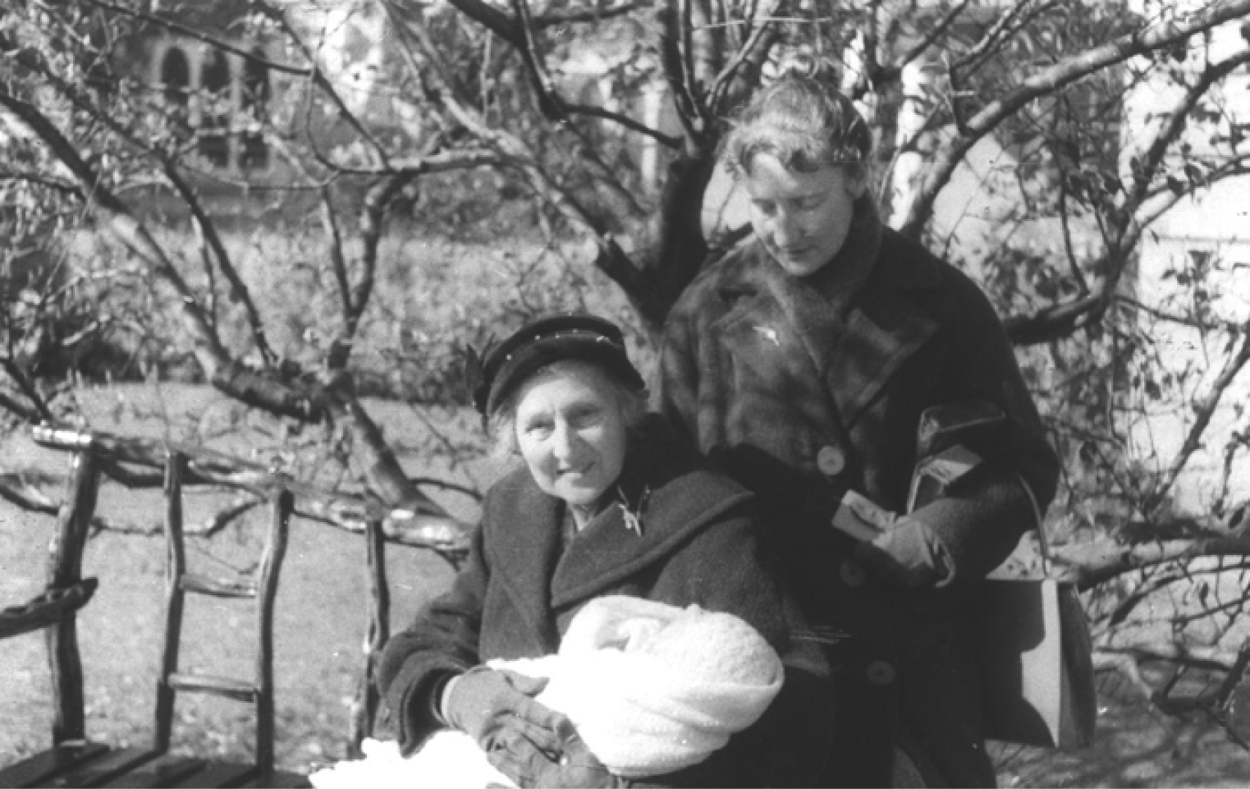
Gran Shiels with Aunty Inez and baby Anne.
There’s Aunty Inez with one of the children.
On the back of the photo, it’s got with me. Is that right? And Gran Shiels is holding me.
Baby Anne that would be right.
Where was that taken?
I’ve got no idea. Looks like St. Finbars church.
It does.
Probably was. Probably a christening.
I know only a small part of my mother – Marie Keary (nee Shiels, O’Loughlin). There are life-stages in this woman’s life I was not around for; a woman who had a childhood, a career, an early-married life and four children before I was born:
… I was the eldest and I had two sisters (Inez and Patricia) and we were a happy family … Well, when I was at school I did a business course, typing and shorthand and book-keeping and I got a job in the Price’s Commission which was subsidising various manufacturing things, all sorts of things. I was a typist there for two years and I wasn’t happy in that job. And all of a sudden it came to me that I’d like to do nursing. So I left the government, it was one way of being able to leave your job in the government because they were very very strict in those days with the war on, couldn’t change jobs. And then I went nursing at St. Vincent’s hospital in Melbourne and I loved it. There were some lovely girlfriends that I lived with, and we had a great time, one of the happiest times of my life. And I graduated from there and I went with two others, my sister-in-law as she is today and another girl and we went to Sydney and did our midwifery at St. Margarets hospital in Darlinghurst and that’s how I met Dad. He was your aunt’s brother. He had a lot of work to do in Sydney with his job and he’d be there for about a week. When he came to Sydney he’d always look up the nurses. Anyway we went on to get married. In 1950 I was married, a lovely wedding at St. Anne’s, East Kew and then at Butleigh Wootton in Kew. We were very happy and we had our honeymoon in Tasmania. That was quite a thing in those days because we were going overseas for our honeymoon (laughs) to Tasmania. Yes, that was good and after I was through my nursing I went to nurse at St. Vincent’s private maternity hospital and I was there up until the time I was married and I loved that too.
… but I loved it, I loved the work there and the babies, my heart melted for those little babies.
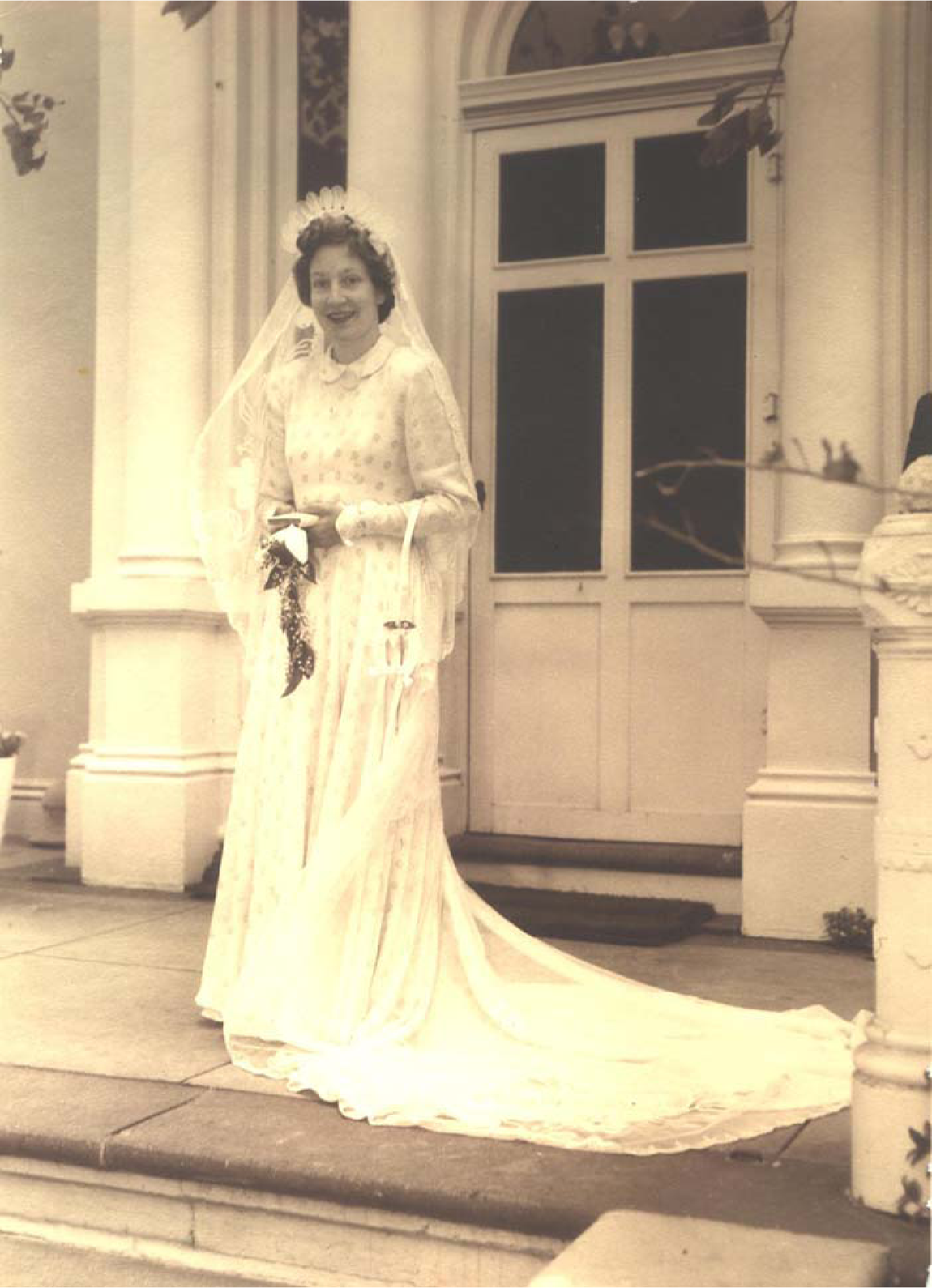
Marie Keary (nee Shiels) on her wedding day.
The beginning of the patriarchal power that we are familiar with – i.e. of the male’s power as legal head of the family, of the tribe, the race, the State – is associated with the dispersal of women into isolated homes, and most particularly the separation of the daughter from her mother. This relationship, which is the most fertile in regard to safeguarding life and peace, was destroyed for an order to be established that is linked to private property, to the transmission of goods from father to son, to the institution of monogamous marriage – which ensures that all property, including children, can be passed down the male line (Irigaray, 1993: 192).
Mum wanted a big Catholic family and that is what she had, a perfect, victorious Catholic family. I know that because I was in the middle of it all. Mum loved babies and she always said she would have had more children if circumstances had not prevented her. Irigaray contends that:
Motherhood – promoted by spiritual leaders as the only worthwhile destiny for women - most often means perpetuating a patriarchal line of descent by bearing children for one’s husband, the state, male cultural powers, thereby helping men escape from an immediate incestuous desire. To women, motherhood represents the only remedy for the abandonment or for the fall inflicted in love by male instincts, as well as a way for them to renew their ties to their mothers and other women (Irigaray, 1994: 99).
To my mother bearing children and for her children to bear children is extremely important:
Mum - I had seven children, a girl, then three boys and three girls and they’ve all lovely families now. We have thirteen grandchildren at this stage and four of the children are married and three of them aren’t. But they’re all doing well. The boys became engineers, one a civil engineer, then another was an agricultural engineer and the other an electronic engineer. So they’ve done well in their jobs. Two of the boys went on to do their Master of Business Administration degrees at Monash. They’re both married now with happy families. One didn’t marry, well hasn’t married yet, we’re still hoping. Then Bernadette was a nurse and still is and she lives in the Northern Territory and they manage a big cattle station. And she has three little children, a little girl and two little boys. Then Anne, the next girl she’s not married, she’s doing her doctorate. And then Marie has five children and lives in Sydney and she’s happily married. And Loreto’s a teacher and she’s not married, she’s on her own. None of them live at home with us now but we’ve kept the old home and it’s very comfortable for Dad and myself.
Then there is me, Anne Thérèse Keary, daughter of Marie, granddaughter of Mary and great grand daughter of Margaret-Mary. I come fifth in Marie’s succession of children and am the second eldest daughter. I was born in St. Vincent’s hospital on the 11th July, 1959 and was baptized at Immaculate Heart church in Hampton. I went to St. Finbars primary school at East Brighton where I made my confession, First Holy Communion and Confirmation. For my secondary education I attended Star of the Sea College at Gardenvale. My mother was disappointed with my education. She thinks that Star of the Sea provided a good academic education but was lacking on the convent and ‘ladyship’ side of things. For her this explains why my younger sister and I have fallen away from the Catholic Church. I went to Frankston Teacher’s College and became an early childhood teacher, which I practice today.

Anne Keary – First Holy Communion
So here lies my maternal chronology. The names are bound by straight lines drawn in ink. That way their relationships are forthright and unambiguous. However, this chronology leaves me unsettled. Despite the apparent perfectness of this lineage, the straightforwardness of it all, I know there must be cracks, fault-lines, breaks and restorations which I cannot see (Modjeska, 1990). Irigaray (1994: 99) suggests that ‘One of the last crossroads of our becoming women lies in the blurring and erasure of our relationships to our mothers and in our obligation to submit to the laws of the world of men-amongst- themselves.’ I will never be able to pin down a crystal clear view of my maternal lineage, my relationship to my mothers, but I can explore the unseen hairline cracks, the blurring and erasure of the mother-daughter relationship that lies at the boundaries of phallogocentric Catholic discourse.
Another Conversation – October
Last night as the tropical storm brewed I curled up on the couch to begin my reading of Je, Tu Nous - Toward a Culture of Difference by Luce Irigaray. I read:
In May 1984, after a conference at the Venice-Mestre Women’s Centre entitled “Divine Women”, I went to visit Torcello island. In the museum there is a statue of a woman who resembles Mary, Jesus’s mother, sitting with the child before her on her knee, facing the observer. I was admiring this beautiful wooden sculpture when I noticed that this Jesus was a girl! That had a very significant effect on me, one of jubilation – mental and physical. I felt freed from the tensions of that cultural truth-imperative which is also practiced in art: a virgin-mother woman and her son depicted as the models of redemption we should believe in. Standing before this statue representing Mary and her mother, Anne, I felt once again at ease and joyous, in touch with my body, my emotions, and my history as a woman. I had before me an aesthetic and ethical figure that I need to be able to live without contempt for my incarnation, for that of my mother and other women (Irigaray, 1993: 25).
Irigaray’s passage spoke to me. My name is Anne and my mother tells the story of my namesake. When my older brother was a baby my mother had a bad back. My mother’s mother told her to pray to St. Anne. My mother said the prayers daily from a book of devotions to St. Anne, her back improved and she said she would call her next daughter ‘Anne’. As the storm outside heightened I thought to myself next time I speak to my mother I must ask her if she has a picture of St. Anne with Mary. I read on and came to a section of the book in which Irigaray describes practical suggestions for the development of mother-daughter relationships:
In all homes and all public places, attractive images (not involving advertising) of the mother-daughter couple should be displayed … I’d suggest to all Christian women, for example, that they place an image depicting Mary and her mother Anne in their living room, in their daughter’s rooms, and in their own room … I’d also advise them to display photographs of themselves with their daughter(s), or maybe with their mother. They could also have photographs of the triangle mother, father, daughter. The point of these representations is to give girls a valid representation of their genealogy, an essential condition for the constitution of their identity (Irigaray, 1993: 47).
I remembered the only icon of Catholicism that I have. It is a wooden statue of Mary that is carved from one piece of wood. My mother’s sister, who died when I was young, gave it to my grandmother after a trip overseas. On the death of my grandmother my mother inherited it and then passed it on to me. I read on and Irigaray says: ‘Between mother and daughter, interpose small handmade objects to make up for the losses of spatial identity, for intrusion into personal space’ (1993: 49). I turned around to look at this statue, which I have never taken much notice of, sitting on my bookshelf. Here it was ‘a statue of a woman who resembles Mary, Jesus’ mother’ (Irigaray, 1993: 25) standing with a child in front of her. I stood up, went to the bookshelf to look more closely ‘when I noticed that this Jesus was a girl!’ (Irigaray, 1993: 25). I felt slightly ill at ease. It all seemed too coincidental, too remarkable. I rang my mother to ask her about the wooden carving. She confirmed that it was St. Anne and Mary. She told me that St. Anne had very special significance for my grandmother and next time I was home in Melbourne she would take me to St. Anne’s church that is a shrine to St. Anne. My mother went on to say that after a period of time she had only decided earlier in the week to begin a devotion to St. Anne because she felt I needed some prayers. Her original book had become so old but when going through Gran’s things after her death she found Gran’s tattered book of devotions to St. Anne and was using it now. I relayed the story of the reading of Irigaray’s book and the coincidence of the statue. My mother thanked me for the story and said she had another book of devotions to Mary’s father that she would lend me. She ended the conversation by saying that she and Dad would say a rosary for me tonight. I thought of Irigaray’s ‘triangle: mother, father, daughter’ and associated it to Anne, Mary’s father and Mary, and then to my mother, my father, myself. What a remarkable story I thought to myself!
This incident began to highlight to me that an elusive feminine space exists within my own maternal family. My grandmother and my mother have created a plane on which to affirm themselves as women within the boundaries of the phallogocentric structures of Catholic discourse. They have created a ‘female cultural order, transmitted from mothers to daughters’ (Irigaray, 1993: 17). It is just that it had eluded me. The wooden carving of St. Anne and Mary has passed from daughter to mother to daughter to daughter. It is a symbol, a sign of my female forebears creating their own universe; an outer space which facilitates their passage from the inside to the outside of themselves. This universe enables them to experience themselves as autonomous feminine corporeal yet spiritual subjects.
Last night I went to bed and thought of my sisters. I thought of their namesakes. My older sister Bernadette was named after the 12 year-old French girl Bernadette. Mary, the mother of Jesus Christ, appeared to St. Bernadette at the grotto at Lourdes in the south of France. Marie, my younger sister is named after my mother; Marie being French for Mary. Loreto my youngest sister is named after the village in the Alps of Italy. As the story goes the angels carried the house of Nazareth, which was the family home of Joseph, Mary and Jesus, to this small village. 3 Not only has my mother passed on concrete objects to her daughters but also our namesakes are a symbol of this Catholic feminine universe. Our namesakes as sisters centre on the Virgin Mary and her mother, Anne. That Mary and Anne are associated within my maternal family is of particular intrigue as Irigaray states that ‘Although Mary’s mother, Anne, is known, the New Testament never mentions them together, not even at the moment of conception of Jesus’ (1994: 100).
This morning I found the ‘Infant Jesus of Prague’ book of devotions hidden amongst my recipe books on top of the fridge. My mother gave it to me when I bought my house and said ‘pray to the infant and you will never have financial problems. It has always worked for me.’ I opened the book and read the section ‘Origin of the devotion’:
The statue of the Infant Jesus of Prague was brought to Bohemia by a Spanish princess, whose mother had given it to her as a wedding gift. This noble lady, in turn, presented the image to her daughter. When the latter’s husband died in 1623, she resolved to spend the remainder of her days in works of piety and charity. She was particularly generous to the Carmelites of Prague (order of nuns) who were in such utter destitution that at times they had scarcely enough to eat. Accordingly, she presented her beloved statue to the religious with these words that were to be so prophetic: “I hereby give you what I prize most highly in this world. As long as you venerate this image you will not be in want.”
Here lies yet another story, another image, another holy object passed down from mother to daughter, to daughter to the ‘brides of Christ’, and also from my mother to myself.
The history of Catholic discourse, the story of Moses was taught to me as truths that were not to be questioned. Yet, the story of Moses also features strong women, in his mother and sister Miriam, who remain veiled behind the male protagonist. Moses’ mother, Jochebed, made a scheme to save Moses from the Pharaoh who wanted to kill all Hebrew boys. She placed him in a basket beside the River Nile. Moses’ sister Miriam looked over him awaiting the Pharaoh’s daughter who approached the river to bathe. She discovered Moses in the basket. Miriam spoke to the Pharaoh’s daughter about a woman who could tend to the baby. It was Moses’ mother, Jochebed. The Pharaoh’s daughter took the baby and cared for him like he was her son. The green catechism held all the questions and answers about Catholicism. The Bible holds the text that tells the true story of the Old and New Testament. Invariably, however, I have always focused on the phallogocentric voice of Catholicism that has resulted in the erasure, the forgetting, of my female ancestry. Irigaray contends that ‘If the rationale of History is ultimately to remind us of everything that has happened and to take it into account, we must make the interpretation of the forgetting of female ancestries part of History and re-establish its economy’ (1994: 110). So here I am discovering another history of Catholic discourse, a different history, a feminine history passed on from mother to daughter.
Drusilla Modjeska states that:
History does not move in straight lines, it is fractured and uneven and runs off at tangents. The temptation is to talk as if the chronology went somewhere, and changes have clear derivations and destinations (1990: 90).
For Catholic women the history of the oppressive structures of Catholic discourse has ‘run off at tangents’, the chronology is fragmented. As I look in different places, different spaces, I find other tangents of Catholic history. This history involves the stories and objects passed from mothers to daughters. These resistant feminine Catholic tangents in a history of oppression have provided, and still provide, Catholic women with spaces to articulate their own feminine standpoint. My mother’s mother, my mother were, are, seeing to it ‘that her daughter, her daughters, form(s) a girl’s identity’ (Irigaray, 1993: 50).
Footnotes
Funding
This research received no specific grant from any funding agency in the public, commercial, or not-for-profit sectors.