



Abstract
Alfred Gilman was best known for his co-authorship with Louis Goodman of the seminal textbook on pharmacology The Pharmacological Basis of Therapeutics in 1941. The book made the discipline of pharmacology relevant to clinical medicine by providing a link between the basic medical sciences and the practice of medicine. Gilman was also instrumental in establishing the use of chemotherapy in the treatment of cancer and made important contributions in areas related to renal function, acid-base balance, and diuretics. During the 1960s, he created a first rate department at the newly formed Albert Einstein College of Medicine. A superb lecturer, he commented incisively on issues related to pharmacology, therapeutics, and pathophysiology. Dr Gilman also provided a key link between academia and the pharmaceutical industry by serving as a consultant to several drug firms. The legacy of Alfred Gilman senior was continued by his son, Alfred Goodman Gilman, who became a Nobel Laureate.
Introduction
Alfred Gilman was an international leader in the biomedical discipline of pharmacology, who co-authored the seminal textbook on pharmacology. Although over the years a number of textbooks of pharmacology have been produced, none has displaced The Pharmacological Basis of Therapeutics from its lofty position as the ‘Bible of Pharmacology’. However, this contribution does not begin to describe his meaningful life. As an academic and teacher, Gilman not only conducted quality research, but he played a major role in forging a link between the basic medical sciences and the practice of medicine (Figure 1).
Alfred Gilman Senior (from Wikipedia 7 December 2016).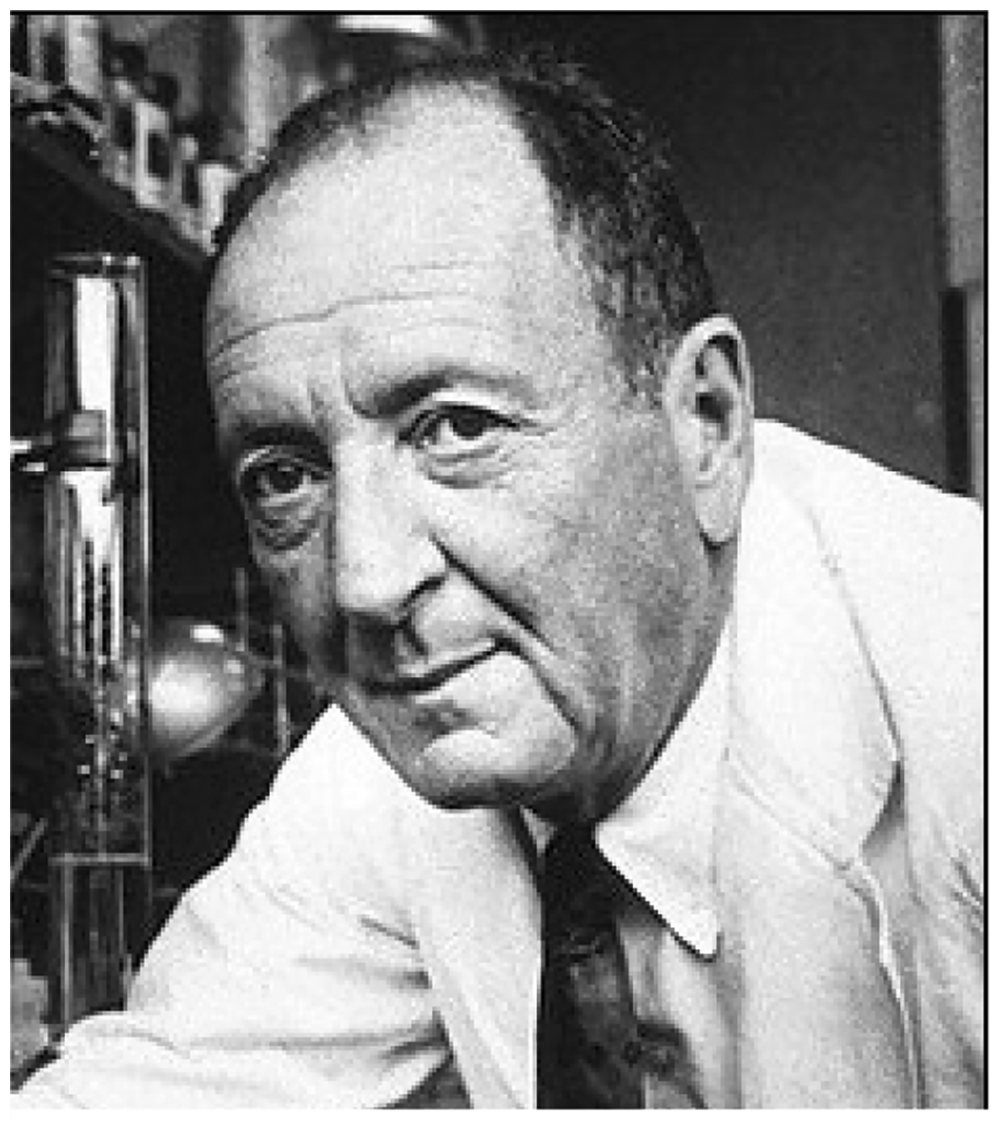
The researcher
Although born into a family where music predominated, Alfred Gilman chose to pursue a career in science. 1 When the Second World War began, he was a young Assistant Professor of Pharmacology at Yale. However, the advent of World War II interrupted his academic activities when he served in the army as Chief of the Pharmacology section at Edgewood Arsenal in Maryland. In 1942, Gilman and a colleague, Louis Goodman, were asked to work on a top-secret project to develop antidotes against chemical warfare agents which had been used against Allied soldiers during the First World War. Employing a rabbit model, they found that nitrogen mustards caused a decrease in the number of circulating lymphocytes and granulocytes. Realizing that this agent might be useful for treating patients with lymphoid malignancies, they initiated studies on an experimental lymphoma in mice. By replacing the sulfur atom with a nitrogen atom, the nitrogen mustards became less toxic and more importantly inhibited the growth of rapidly dividing cells. 2 Despite the fact that only mice with implanted tumors had received treatment, Gilman and Goodman understood the possible clinical significance of this experimental finding. Together with a colleague from the Department of Surgery, Gustav Lindskog, Gilman and Goodman participated in a clinical trial on a patient in 1942 at New Haven Hospital in Connecticut. After a month of treatment, the patient improved and his cancer became undetectable.
This seminal study revealed that nitrogen mustards were able to shrink tumors and depress white blood cell counts. However, after becoming resistant to the drug, the cancer returned and the patient subsequently passed away. Nevertheless, the temporary improvements in the patient’s clinical symptoms represented a marked advance in cancer therapy because up to that time treatment had been limited to radiation and radical surgery. Drs Gilman and Goodman are credited with the first use of intravenous chemotherapy for the treatment of cancer, which now represents a mainstay in combating this disease. Although this single study ushered in the era of chemotherapy, it was the renowned pharmacologist Paul Ehrlich who first coined the term “chemotherapy” to identify chemicals used in therapy; however, he was unaware that chemicals could be used to treat cancer. In addition to this groundbreaking study carried out by Gilman and his colleagues, over the years he also made important contributions in areas related to renal function, acid-base balance, and diuretics by providing deeper insight into how the ionic milieu of the body is maintained. 3
Murdoch Ritchie also notes that Dr Gilman offered valuable contributions to the field of therapeutics by serving as a consultant to several drug firms, including Smith Kline French and Burroughs Wellcome. 4 He perceived academia and the pharmaceutical industry as working in tandem, with academia as the source of training young pharmacologists and the pharmaceutical industry as the site where pharmacological agents are developed. Key members of the pharmaceutical industry, such as John J Burns and Paul Greengard, held adjunct faculty positions at Albert Einstein College of Medicine (AECOM) and participated in the training of graduate students.
The administrator
After the Second World War, Gilman joined the faculty at Columbia University College of Physicians and Surgeons. He left Columbia in 1956 to become Chairman of Pharmacology at the newly formed AECOM in New York City. Dr Gilman oversaw a vibrant department which established itself as a formidable research unit in which scientific achievement and productivity could flourish. Although relatively small in number of faculty, diverse areas of research were represented by individuals devoted to research and teaching. In addition, Gilman’s appointment at AECOM coincided with the school being one of the first recipients of an NIH grant for a combined MD/PhD program.
While at Columbia, Gilman met William Douglas, who was on sabbatical leave from Mill Hill in the United Kingdom 5 and recruited him as second in command when he assumed the Chair at AECOM. J Murdoch Ritchie was later invited by Dr Gilman to join his department at AECOM and became a leading neurobiologist. 6 The original faculty also included Robert Byck (1936–1999), an expert on the effects of cocaine and marijuana 7 and Murray Jarvik (1923–2008) who first reported that nicotine was the prime factor in addiction to smoking. 8 The Nobel Laureate Paul Greengard also served as a Visiting Professor in 1967.
After retiring from AECOM in 1973, Alfred Gilman returned to Yale as Lecturer, where he had earned his Bachelor of Science and PhD degrees. He was now able to focus his complete attention on that aspect of his career that he enjoyed the most, viz. teaching. Three of his former colleagues (Drs Douglas, Ritchie, Byck) now resided at Yale as Full Professors. Because of his many achievements, Dr Gilman was a national and international figure. He was elected to the National Academy of Sciences in 1964, and in 1967 he became Chairman of the National Academy’s Drug Efficacy Review Committee, which monitored claims of drug efficacy from the drug industry.
The educator
Information about the mode of action of drugs was slow to develop during the early part of the 20th century. In 1899, Arthur Cushny (1866–1926), Chair of Pharmacology at the University of Michigan, authored a textbook of Pharmacology to replace the Materia Medica, which was merely a compendium of miscellaneous drugs and medicinals, lacking any classification of drugs. 9 Cushny’s Textbook of Pharmacology and Therapeutics was the first general text of pharmacology in the English-speaking world and became the most valuable resource on the subject. After Cushny returned to his homeland in 1905 as Chair of Pharmacology at Edinburgh, Scotland, he authored eight editions of the text; subsequent editions were written by CW Edmunds and JA Gunn beginning in 1928. While this textbook was recognized as a very valuable guide to the subject of pharmacology, by 1940, it was woefully out-of-date.
At the time other textbooks were available, including a less comprehensive volume entitled Applied Pharmacology authored by Cushny’s colleague Alfred J Clark (1885–1941). This text, initially published in 1923, emphasized the pathophysiological and quantitative aspects of drug action. New editions were prepared at regular intervals initially by Clark and subsequently by colleagues until 1975. Another less detailed publication written primarily for medical students was authored by the eminent John Henry Gaddum in 1940, preceding the volume of Goodman and Gilman by one year. It was simply called Pharmacology. Multiple editions of this text were published, the last three of which were edited by ASV Burgen and JF Mitchell.
As previously mentioned, while a postdoctoral fellow at Yale, Dr Gilman met Louis Goodman who had just completed an internship in Medicine at Johns Hopkins. Both became engaged in the teaching of pharmacology to medical students. Because Pharmacology was a rapidly changing discipline, the subject now required significant updating. Goodman and Gilman decided to write a text for the Yale medical students with emphasis on the clinical aspects of drug action. The application of pharmacodynamics to therapeutics in the treatment of disease was highlighted. The practicing physician would also use the text to acquire the basic principles necessary for the rational use of drugs and to keep abreast of recent advances in drug treatment. 10
Despite being inordinately long for existing texts (containing nearly one million words), the Pharmacological Basis of Therapeutics was published in 1941 by Macmillan Company as submitted. The first edition proved to be an immediate success and sold more than 86,000 copies. However, the intervention of the Second World War delayed publication of the second edition until 1955. It was the last edition in which Goodman and Gilman were the sole authors. The enormity of this undertaking is underscored by the realization that the creation of the second edition and the subsequent editing of manuscripts were carried out by Alfred Gilman living on the East Coast, with Louis Goodman now residing in faraway Utah, and without the aid of computers and word processors.
Because of the marked advances in drug development during this period, each time the final chapters to the Pharmacological Basis of Therapeutics were completed, the earlier chapters were already out-of-date and had to be revised. As a result, the third edition, completed in 1965, contained chapters written by highly qualified experts in their respective fields, although both Goodman and Gilman were still deeply involved in the editing. New editions appeared regularly every five years. Gilman died before the seventh edition appeared (1985), while Dr Goodman relinquished his role prior to the eighth edition. Alfred Goodman Gilman, the son of the elder Dr Gilman, became senior editor of the sixth edition. It is now in its 12th edition and a 13th edition, with Laurence Brunton as senior Editor, is expected in due course. 11
The creation of the text was a remarkable accomplishment, and the fact that it was translated into at least nine different languages is testimony to its value to biomedical science. The book was a key factor in elevating the discipline of pharmacology to a realm comparable to that of the other basic science disciplines. In addition, by providing a link between the basic medical sciences and the practice of medicine, it made the discipline of pharmacology relevant to clinical medicine.
Another collaborative text entitled Pharmacology in Medicine edited by Victor Drill appeared in 1954. This textbook, which was also designed for both students and physicians, was offered as an alternative to Goodman and Gilman’s textbook, but was never able to challenge the pre-eminence of the Bible of Pharmacology.
Dr Gilman extended his prowess as an educator to the classroom. His lectures had tremendous impact on medical students, as well as graduate students. He was a topnotch teacher and communicator, and conciseness and clarity were hallmarks of his lectures. 12 His gift in communication was marked by emphasizing key issues and being dismissive of unimportant ones. He chose major points to deliver in his lectures, which were not merely a compilation of facts. Students were taught how to utilize an equation rather than just derive it. In addition, as a leading participant of clinical conferences, he was able to comment on all issues related to pharmacology, therapeutics, and pathophysiology. Wherever and whenever he taught, Alfred Gilman Senior had great impact.
Alfred Goodman Gilman (1941–2015)
Alfred Gilman also had a strong influence on the biomedical sciences, as well as the discipline of pharmacology, in yet another way. Growing up, Gilman’s son, Alfred Goodman Gilman, would visit his father’s laboratory where he viewed experiments carried out on canine renal function and on demonstrations with the heart–lung preparation. These experiences fueled his interest in biology. Noting that young Al was not utilizing his obvious talents, his father wisely sent his son to a New England prep school to further his education. Although Al did not particularly like the rigid atmosphere of the school, he performed well enough to be accepted at Yale where he majored in Biochemistry. He then went to Case Western University as an MD/PhD student in the Department of Pharmacology headed by the Nobel Laureate Earl Sutherland. Al’s thesis mentor was Ted Rall, and he investigated the role of cyclic AMP in the thyroid gland.
After graduation, Al moved to the NIH to work with another Nobel Laureate Marshall Nirenberg during the years 1969–1971. There he developed a simple assay for cyclic AMP, which helped to make the measurement of this second messenger available to researchers. He then joined the faculty at the University of Virginia headed by Joe Larner. In 1981, he moved to Dallas to Chair the Department of Pharmacology at Southwestern Medical Center, where he continued to investigate GTP-binding (G) proteins, an intermediary between the activation of receptors on the cell membrane and cell function. This work earned for him the Nobel Prize in 1994, 10 years after his father’s passing. Thus, Alfred Gilman senior not only left a legacy of his own, but it continued in the name of his son, who reached even greater heights. 13
Epilogue
Alfred Gilman’s stellar career as a pharmacologist can be defined in many different ways. He served as an excellent role model for junior faculty, postdoctoral fellows, and students alike, while the senior faculty respected his wisdom. As a graduate student working in the laboratory of Bill Douglas, I was involved in co-authoring several research papers. Dr Douglas, as a courtesy and out of respect, would unfailingly take the completed manuscript to Dr Gilman for his perusal prior to submission.
Because Dr Gilman wanted his students to know and understand how drugs acted in vivo rather than just in vitro, the department at AECOM was one of the few in the United States that was able to provide demonstrations of the canine heart–lung preparation to students. Developed by Otto Krayer at Harvard and implemented at AECOM by Paul Brazeau, this technique was difficult to master. But it represented yet another example of Alfred Gilman’s unwavering commitment to making pharmacology relevant to clinical medicine. I had the opportunity to witness Dr Gilman in his daily activities as Chairman, and I saw how he was able to connect with colleagues, students, and staff alike by placing himself in their respective situations. The contributions of Alfred Gilman to the discipline of pharmacology were extensive and wide-ranging, and his legacy will live on for those of us who profited from the experiences we shared as a member of his department, as well as more broadly students of pharmacology.
Footnotes
Declaration of Conflicting Interests
The author(s) declared no potential conflicts of interest with respect to the research, authorship, and/or publication of this article.
Funding
The author(s) received no financial support for the research, authorship, and/or publication of this article.