




Abstract
Jacob Winslow (1669–1760), a celebrated anatomist in his day, made his name publishing numerous medical treatises and writing the four-volume Anatomical exposition of the structure of the human body. He gives his name to the foramen of Winslow, and is credited with numerous significant findings in neuroanatomy and biomechanics. His life is characterised by meticulous devotion to his discipline and divided by a torturous religious conversion. In addition to his contributions to anatomy, he is famously remembered for his treatise on the uncertainty of the signs of death, which has influenced practices surrounding death down to the present day.
Keywords
Early life and education
Jakob Winsløv was born on 27 April 1669 in the Danish town of Odense, the first of 13 children, into a devout Lutheran family (Figure 1). 1 His father was rector of the parish and assistant to the Bishop’s court; a man of marked discipline, charity and strictness. Winslow relates in his autobiography that family tradition told that he was born with his hands folded as though at prayer, which was taken as a sign of his calling to the pastoral ministry, an ambition which Winslow’s father desired for his firstborn son. 2
Winslow was educated at home by his father until 1683 when he was sent to the local high school, of which his father was vice-principal. In 1689, he started at the distinguished gymnasium where he was schooled in a classical curriculum. This prepared him for admission to the University of Copenhagen where he studied under Ole Borch, a polymath and former physician to the king of Denmark. After passing the initial examinations at the university, he returned to Odense to devote himself to the study of theology for three years. In 1691, Winslow moved back to Copenhagen to study theology in a college newly founded by Ole Borch. Less than a year into these further studies, Winslow was called to the pastoral ministry by a parish whose curate had become terminally ill, though, on the advice of Jean Bicherot, a professor at the university of Copenhagen, he declined to take up the call. Instead, in 1692, he swapped places with a medical student in Borch’s college who wished to study theology. Winslow’s father consented to this development on the condition that his son not abandon the study of theology completely.
While studying medicine, Winslow was made prosector to Caspar Bartholin the Younger (1655–1738). 3 He was encouraged in his study of anatomy by another professor, Oliger Jacobaeus, who told him that the position of royal anatomist would one day be his as it had been Winslow’s great uncle’s, Nicolas Steno (1638–1686). 4 Winslow defended a public thesis to obtain his bachelor’s degree in medicine, and took part in the college’s academic activities and disputations. To learn the craft of surgery, he lodged for a year with the distinguished Johannes de Buchwald (1658–1738). Not long after, in 1697, he moved to the Netherlands to take classes at the University of Leiden, before moving to Amsterdam to attend the demonstrations of the celebrated botanist and anatomist Frederik Ruysch (1638–1731) 5 and the eminent surgeon Johannes Jacobus Rau (1668–1719). 6 The year 1698 saw Winslow travel between Leiden and Amsterdam to attend various lectures and demonstrations in the course of which he interacted with the luminaries of the medical and scientific world, including Hendrik van Deventer (1651–1724). 7
Winslow travelled to Paris in June 1698 on the order of his patron Matthias Moth in order to continue his studies. He attended classes in botany, chemistry and surgery given at the Royal Garden for Medicinal Plants and attached himself to Joseph Guichard Duverney (1648–1730), a talented anatomist with whom Winslow would later collaborate in a study of the organ of hearing.
8
Engraved portrait of Jacob Winslow made by Ambroise Tardieu (1788-1841).
Personal life
In Paris, Winslow encountered Roman Catholicism. He and a fellow countryman, Ole Worm (1672–1743), a student of theology, made a pact to engage with Roman Catholic polemics in order to sharpen their defence of Lutheranism. Winslow, was to take the part of the Roman Catholics, which forced him to study the tracts and treatises of the day, notably those of Jacques-Bénigne Bossuet (1627–1704), the Bishop of Meaux. Winslow, at first highly prejudiced against Roman Catholicism, judged that the religion of the ‘papists’ was not as corrupted as the Lutheran polemics he was familiar with made out. Further reading led him to conclude that the Protestant religion suffers from uncertainty regarding the way of salvation. In October 1699, after a private meeting with Bossuet, Winslow abjured Lutheranism and formally converted to Roman Catholicism. Upon receiving his first communion as a Roman Catholic, the priest celebrating the mass dubbed Winslow with Bossuet’s name, because of the bishop’s affection for the young doctor. Thenceforth, he would be known as Jacques-Bénigne Winslow.
Winslow devotes most of his autobiography to chronicling in detail his intellectual journey from Lutheranism to Roman Catholicism and its aftermath. In today’s predominantly secular atmosphere, it reads like something of a curiosity. Nevertheless, it reveals something to even the most religiously illiterate, something of Winslow’s character. That he agonised over and studied with great zeal the polemical Roman Catholic materials indicates his conscientious and meticulous personality, two traits which served his pursuit of anatomy well, as would later become apparent. Roman Catholicism’s allure was in part due to Winslow’s perception that it provided certainty and clarity in matters of dogma and praxis compared to Lutheranism, and, by extension, the way of salvation. Perhaps this yearning for certainty in matters religious came through in Winslow’s meticulous study of anatomy and in his famous treatise on the uncertainty of the signs of death. 9
Winslow’s conversion had profound personal ramifications. It led to a great rupture between Winslow and his father; it is painful to read Winslow’s account of how he gradually broke the news of his conversion, letter by letter, to his concerned father. 10 Additionally, the possibility of returning to Denmark to take up a position of prominence was now closed to him. 11 His conversion also spelt the end of financial support he received from Denmark, forcing Winslow, at one point, to entertain the idea of moving back to the Netherlands or to Florence in order to make a living. Fortunately for Winslow, and thanks to his connection with Bossuet, he attracted new benefactors and remained in Paris. 12
Little else is known about Winslow’s personal life. His autobiography deals mainly with his religious interests. At points, it details, paragraph by paragraph, the back-and-forth of the debates he and his father had by letter, analysing in sometimes tedious depth the alleged errors of his father and his responses to them. Manifestly, this aspect of Winslow’s life was of great importance to him; it dwarfs every other subject in his autobiography. Indeed, there is barely a mention of his marriage in 1711 to Anne Françoise Gilles and subsequent family life. Winslow died on 3 April 1760, days before his 91st birthday.
Career
In 1703–1704, Winslow found himself in financial difficulty. So much so, he made a special request to the faculty of medicine in order to receive a dispensation for the fees associated with his licencing and doctoral defence, which was successful. He was received into the faculty of medicine in October 1704 and began to practise medicine at the Hôtel-Dieu de Paris.
Since Winslow’s autobiography keeps almost no record after this time, relatively little is known about his life. It is known that in 1708 he was received as a member of l’Académie Royale des Sciences, a position he held until his death. In 1710, he took up an appointment at the Bicêtre Hospital. After becoming a professor of surgery in 1722, and for a time working as royal librarian on translation of Danish and Swedish works into French, in 1728 he gained the title of Docteur-Régent.
Winslow’s natural next career move, however, was delayed. Many expected him to take the chair of anatomy upon Duverney’s death, yet Winslow, despite already being an anatomist of renown, was overlooked in favour of François-Joseph Hunauld (1701–1742), 13 probably for religious reasons. 14 Hunauld died not long after taking the chair of anatomy, so it eventually came to Winslow in 1743. Winslow was 74 years old at the time. He occupied the chair until 1758, when he was forced to resign it due to chronic hardness of hearing. He was succeeded by Antoine Ferrein (1693–1769). 15
Contributions to medicine
List of Winslow’s publications in Histoire de l’Académie Royale des Sciences between 1711 and 1744.
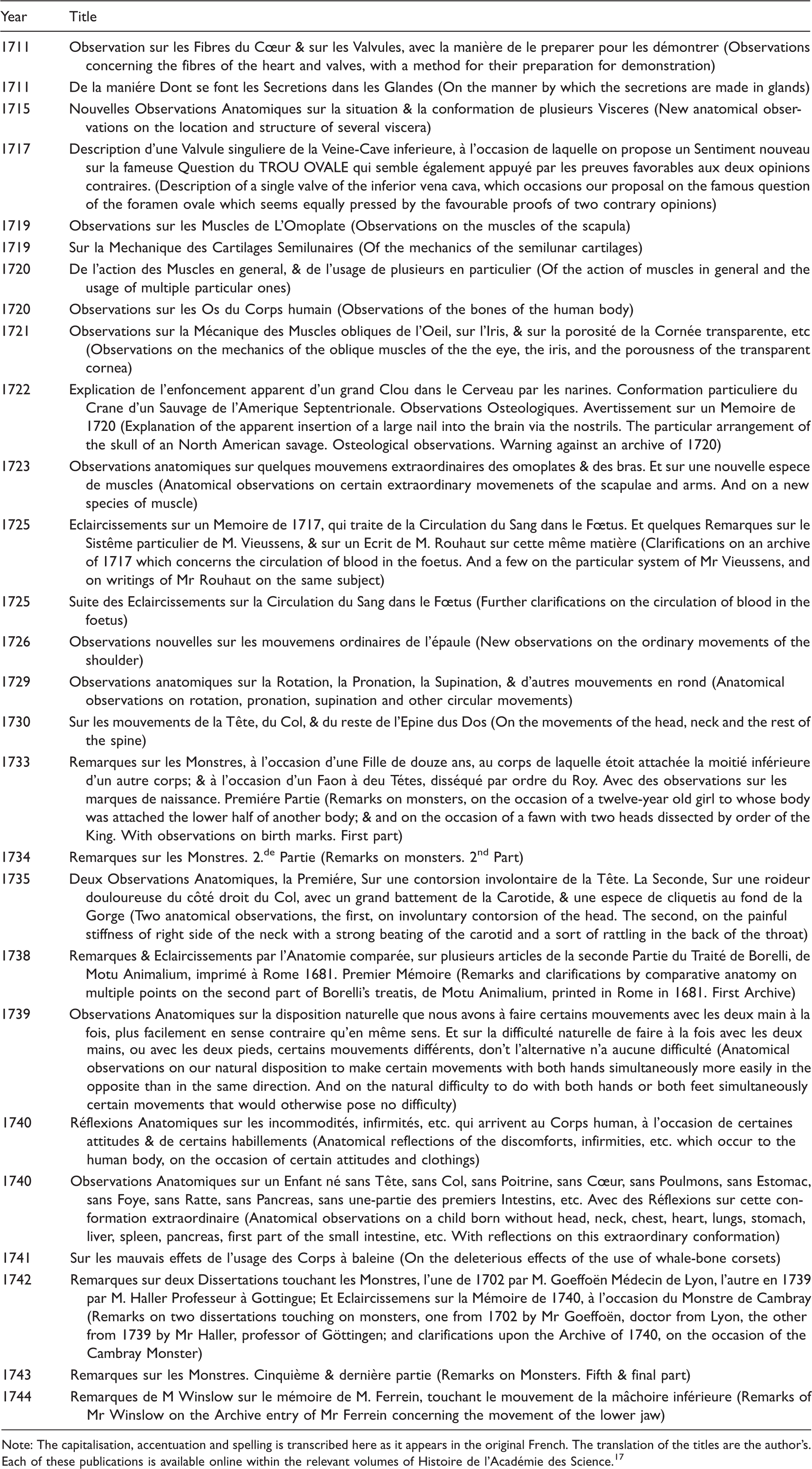
Note: The capitalisation, accentuation and spelling is transcribed here as it appears in the original French. The translation of the titles are the author’s. Each of these publications is available online within the relevant volumes of Histoire de l’Académie des Science. 17
Winslow’s major contribution to anatomy is thought to be his four-volume Exposition anatomique de la structure du corps humain, published in French in 1732 (Figure 2). 18 Winslow self-consciously followed Andreas Vesalius’s (1514–1564) order of contents, starting by treating bones and muscles, followed by blood vessels and nerves, the abdomen, chest and head. He asserts that his work is based purely on years of methodical dissection, and claims to have authored a work of almost pure anatomy which steers clear of all but the most certain physiological principles. He is also conscious of his dependence on the work of previous anatomists, stating that these are to be credited with much of his material. 19 Although the book has almost no illustrations (because Winslow found so few to his satisfaction), he made innovative use of tables to display information on muscles and bones in order to faciliate its memorisation. It is thought that his Exposition is especially insightful regarding myology and surface anatomy. 20 Concerning the former, Winslow noted the importance of understanding the function of muscles to rationally treat fractures. He was also perhaps the first to describe the antagonistic action of muscles, and observed that different muscles can serve different functions under different conditions: he demonstrated the synergistic action of muscle groups and described how muscles sometimes act far away from the joint which they move. One treatise also addresses the harms of wearing whale-bone corsets. Overall, it is fair to say that Winslow’s Exposition is a moderately important anatomical textbook in the history of the subject.
Some of Winslow’s other notable contributions are in neuroanatomy and neurophysiology. The term we translate ‘trigeminal nerve’ to refer to the fifth cranial nerve is one that he coined. His description of several of the other cranial nerves can also be considered original.
21
He also advanced the understanding of the parasellar compartment (commonly called the cavernous sinus)
22
by giving one of the first detailed descriptions of this structure. His understanding of the structure and theorising about the function of the sympathetic nervous system also constituted an important advance: he described in detail the sympathetic trunk and even coined the term ‘sympathetic nerve’.
23
The anatomical eponym most associated with Jacob Winslow is the foramen of Winslow, or, the epiploic foramen (Figure 3). This opening between the greater and lesser sacs of the peritoneal cavity, which Winslow was the first to describe, continues to be of clinical relevance: it is the landmark for the Pringle manoeuvre, an important element of hepatic surgery.
24
Front page of Winslow’s textbook of anatomy. Illustration by Henry Vandyke Carter taken from the 1918 edition Gray’s Anatomy of the Human Body showing the epiploic foramen in relation to the peritoneal sacs. Anterior to it (above it in this image) are the hepatic artery, bile duct and portal vein: the site that is clamped by the Pringle manoevre.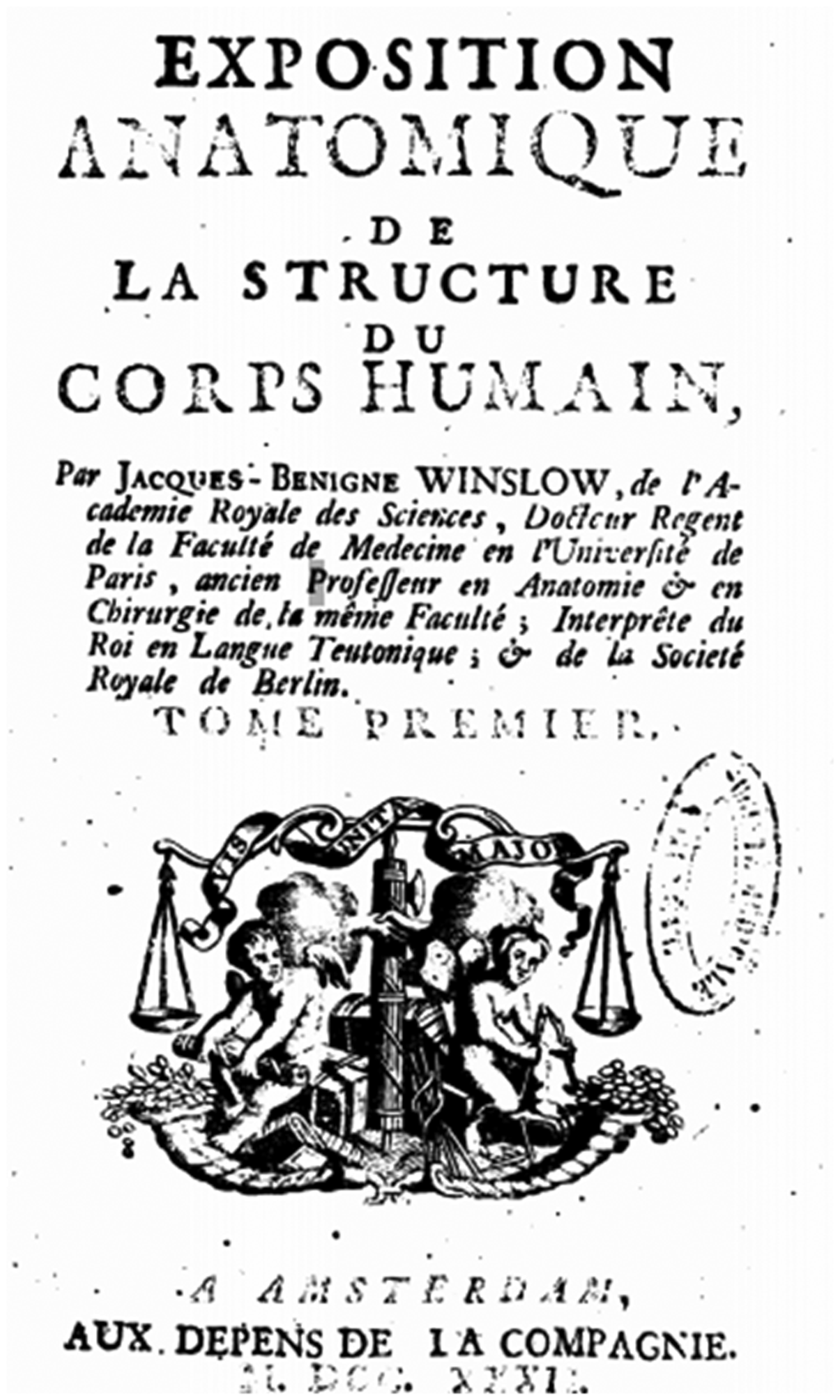

Winslow’s surprising legacy
Curiously, Winslow is not remembered in history only for his anatomical magnum opus and discoveries, but, probably most famously, for a treatise he first published in 1740 entitled Morte Incertae Signa (later translated into the French as Dissertation sur l’Incertitude des Signes de la Mort), the only one of his works to be translated into his native Danish. 25 In it he argued that while the techniques employed by some to verify that the presence of death (from the palpation of pulses to the placing of cups of water on the sternum, to stabbing various extremities with sharp objects) had some value, the only completely certain sign of death was putrefaction. Sure enough, plenty of times these techniques would give strong evidence of death but never definitive proof that death had well and truly occurred, since they do not give complete knowledge of the state of organs relying on circulation. Hence, Winslow was concerned that people might be prematurely buried and suffer agonising deaths as a result. He recounts several stories of apparently dead persons being buried alive. Indeed, he claims: ‘… The fate of others strikes terror into myself: Twice the physician condemn’d me to the Grave; first in my infancy, and then my Youth.’ 26 Historically conscious as he was, Winslow draws on the work of Paul Zacchias (1584–1659) and Giovanni Lancisi (1654–1720) to support his case. 27 Even though it caused a stir in Winslow’s medical circle, the treatise most probably would have fallen into obscurity had it not been for a physician and fellow member of the Académie des Sciences by the name of Jean-Jacques Bruhier d’Ablaincourt (1685–1756), who offered to make a French translation of Winslow’s essay. Winslow accepted, not knowing that this would result in his major legacy.
As well as translating Winslow’s dissertation, Bruhier added further tales of premature burial and a lengthy appendix on the funerary customs of various cultures. In recounting some well-known accounts of miraculous resuscitations, he unapologetically denied any supernatural influence in a way which the devout Roman Catholic Winslow might have considered objectionable. 28 While Winslow was an unassuming and discreet scholar, Bruhier became a zealous campaigner for burial reform as a result of his whole-hearted embrace of Winslow’s thesis, going as far as to have an audience with King Louis XV to propose a state-funded system of morgues.
The book’s immediate success and hostile reviews can in part be explained by some of its lurid stories. Bruhier responded to his critics in 1746 when he published a companion volume to Winslow’s dissertation in which he defended even the most tenuous of the many anecdotes he had compiled. In 1749, Bruhier published a rewritten and expanded version of Winslow’s work along with his own additions and the second volume, this time omitting Winslow’s name from the cover page. These two volumes stood for many as a convincing argument that the signs of death elicited by doctors are uncertain and their application posed a risk of premature burial. Translations into multiple European languages were disseminated and began to influence the culture of entire nations regarding death. Mortuaries multiplied as people feared premature burial, and the way was paved for the humane societies of the 18th century who pioneered cardio-pulmonary resuscitation. Moreover, the concern about premature burial remained important in people’s minds over the next century and would instigate the work of Eugène Bouchut (1818–1891), who first proposed the auscultation of the heart with a stethoscope to determine death, which remains standard practice to this day. In other words, what was perhaps Winslow’s most unconventional work, 29 due to Bruhier’s campaigning and the reaction this generated, has greatly influenced European practices surrounding death as well as the physician’s role in the determination of death. 30
Conclusion
Jacob Winslow stands out as a figure in the history of medicine in part because of his contributions to anatomy and physiology, some of which bear his name to this day. To be immortalised in the annals of medicine by lending one’s name to an anatomical structure is surely the sign of eminence—and, indeed, Winslow was eminent in his day, being held in high esteem by his teachers, colleagues and students. And, yet, it is perhaps his most obscure work for which history remembers him best, though this fame was not of his own contriving. His Dissertation on the Uncertainty of the Signs of Death, in the hands of Jean-Jacques Bruhier, and as a result of the polemics of subsequent decades, has had a significant effect on current European attitudes to death, practices surrounding the declaration of death by doctors and the care of corpses. Therefore, though Winslow’s contributions to anatomy and physiology together are of moderate importance, his influence on history and culture more generally—his surprising legacy—is particularly deserving of acknowledgement.
Footnotes
Declaration of conflicting interests
The author declared no potential conflicts of interest with respect to the research, authorship, and/or publication of this article.
Funding
The author received no financial support for the research, authorship, and/or publication of this article.