



Abstract
The Bristol School of Artists developed between 1800 and 1840 and was a collaboration between professional and amateur artists, one of whom was Dr John King. King started his professional life in Bristol as assistant to Thomas Beddoes where one of his colleagues was Humphry Davy and the three of them worked in the Pneumatic Institute, attempting to cure tuberculosis with gases. King subsequently became a popular general practitioner in Clifton and his correspondence with patrons of art, romantic poets and his friends gives much information about the social life in Bristol in the early part of the 19th century.
Dr John King worked in the Pneumatic Institute of Clifton, Bristol, that was created by Dr Thomas Beddoes in 1793. Beddoes was trying to find cures for illnesses such as tuberculosis, with gases and had been a reader in Chemistry at Oxford before moving to Bristol. After Beddoes’ death in 1809, King continued as a popular doctor and became particularly well known from his association with a group of Bristol artists.
King was born in Switzerland in 1766 as Johan Koenig 1 and rebelled against his family’s expectation that he should enter the Church. He came to London hoping to make his living by writing and engraving but decided to train in surgery under Mr Abernethy at St Bartholomew’s Hospital. After qualifying, he was commissioned in 1799 as an Ensign in the Second Shropshire Regiment of Militia. Abernethy put him in touch with Beddoes in Bristol who was looking for someone to accompany his friend and financial sponsor, Thomas Wedgwood, to the West Indies for health reasons. After a few months, the two returned to Bristol and King joined Beddoes in his Pneumatic Medical Institute to help look after the patients and to assist in the experiments.
Beddoes was the centre of an interesting social circle that included poets such as Samuel T. Coleridge and Robert Southey and his scientific assistant Humphry Davy who ultimately moved to London to become Professor of Chemistry at the Royal Institution. King and Davy shared accommodation at the top of the Institute in Dowry Square. King’s role was to look after the patients in the Institute and to help with the experiments. His engraving expertise was useful in the publications. Beddoes mentioned King several times in his book Rules of the Medical Institute for the benefit of the Sick and Drooping Poor. The longest comment relates to the records of the diseases patients suffered that attended the Institute and which were kept by King between 1802 and 1803. Beddoes also commented that ‘Mr King will get made patterns for proper dress’, 2 which related to types of clothing that he thought the poor should adopt as one of a long list of preventive health measures.
Dr John Edmonds Stock, who also worked with Beddoes and was his first biographer, described King
3
thus: (He) united an accurate acquaintance with anatomy, an insatiable ardour for physiological researches, a hand habituated to the arts of design and promptness of mechanical ingenuity, which enabled him to devise a mode of executing the experiments which the Doctor suggested. Nor was this a trifling task … the prompt resources of Mr King seldom failed to supply them. An immense variety of physiological experiments, therefore, was performed. Poor King, who is our bleeder and purger in ordinary keeps house with his wife, who is, I fear, past all hope in a childbed fever, so that instead of having him to keep us, I am obliged to go and look after him, and find a far worse house than I left at home.
He then described how his maid had suffered at the hand of nurses poor Mary Holland! You recollect with what zeal she managed my house in the most tempestuous days of my life… she was suspected of the foulest dishonesty – I had proofs, battled every insinuation. I could not suspect her though almost every impartial friend I had made to believe her dishonest. I converted every sly hint into an open accusation In 1811, when there was no prospect of peace and Clifton in its most flourishing state, it became advisable for me to fix my residence in a more eligible part of the parish, the home which I now inhabit was to be sold. Two friends joined in purchasing it for me – the purchase money was £2000, the estimate for repairs £500.
King's medical records
King’s medical records give a good indication of his various interests. It seems that he wrote memoranda most days to remind himself of things to do (usually visits to make to patients), diary entries of events that had occurred and a running total of income and expenses. Six sheets of about 5 in. × 2 in. size remain in the Bristol Archives and are dated from Thursday 14 April–16 April and Friday 17 December–18 December and Tuesday 31 December. The first three are from 1818, the next two 1819 and the last one 1822 – see Figure 1.
King’s memorandum for 31 December 1822 (source: Bristol Archives).
On 14 April 1818, King mentioned that he had received a long letter from William Goodeve (his partner) and one from Bird (a Bristol artist) who wanted a cast of Alderman Bengough’s head as he was preparing a bust of Bengough. King wrote that he had walked with the 38-year-old Francis Gold, a colleague and fellow amateur artist, to Brandon Hill. In the financial statement on the page, he received five shillings for drawing a tooth and paid five shillings for a warm bath. The next few days he reported details of an illness of Lady Storin. It looks as if she had an obstructed birth, where the baby was broken up in the uterus. The record dated Monday, 13 April included the following.
10
I returned to Lady Storin where I had a parley with Mr H Sitwell. I removed some bones from the vagina…. I went to Lady Storin again, removed more bone and home to dinner. After tea Gold came – went with me to Lady Storin we found her in a very active paroxysm … Gold was called away… I went home at eleven and took some tea etc…. Gold returned… I was engaged to sleep at Lady Storin’s which I did having to rise 4 times in the night
All of these memoranda are set out in the same way with people to be visited in the top left corner and the accounts for the day on the top right corner. There are a series of vertical strokes at the top of the page that presumably indicate the number of patients he saw during the day. The remainder of the page is taken up with a diary of the day’s events. The total income for 1822 is £1520 and apparently the profit was a mere £13 5s 10d. His wife was given £6 ‘for the house’ and the Bristol Infirmary received £2 2s as his annual subscription. Paying this subscription 11 enabled King (and all subscribers – whether medical or not) to be Trustees of the Infirmary who would be responsible for managing the hospital. Each Trustee was entitled to have one in-patient and three out-patients at any one time and was responsible for ensuring that no patient was capable of subscribing to the Charity.
Much later records are contained in a small booklet about 3 in. long and 2 in. wide and are over the month of December 1837. The writing is minute. Each page is dated, but there is no year and determining the year in question is not easy and must be done using a simple software tool 12 together with names of people mentioned in the contents. There are two possible years from when the weekday and date agree – 1826 and 1837. As King asked Dr John Addington Symonds to see Margaret Eagles for him on 16 and 19 December, the former year is impossible as Symonds only arrived in Bristol in 1831. 1837 is also the only likely year for Zoe (his daughter) to ask the newly qualified Dr William Coates to bleed Margaret (12 December).
King mentions two families frequently during the month of December 1837 – the Eagles and the Coates. Revd John Eagles was one of the important lay members of the Bristol School of Artists and was born in 1783. His youngest child Margaret born 1827 was causing King and his friend Eagles considerable concern because of a feverish illness. King and Eagles appear to have spent a lot of time together. Joseph Coates born 1797 was the eldest son of a Bristol solicitor who had died in 1829 and was a magistrate and his younger brother William born 1806 was another local doctor.
King’s friends and colleagues
The Bristol painters that King had most to do with were Edward Bird, Francis Danby, Edward Villiers Rippingille and William West, and he maintained friendships with the poets Robert Southey and Samuel T Coleridge and with the scientist, Humphry Davy.
Southey recommended many patients to King, and Humphry Davy wrote to King in 1801:
13
I think of you often – my heart often yearns toward the old ideas of Clifton, the hot wells and the novel and natural beings that beautify them, for I am in London connected with new scenes and new beings by which the old beings can never be modified. I do not remember you in my About 40 years ago the late Edw. Bird was the only artist of talent in this city. It was here that his genius developed itself with rapid strides; his society soon became the centre of attraction to all those who had enough of good taste to appreciate his works, and of liberal feeling to value his amiable character. Thus was spontaneously framed a small society of art-loving friends, from all that Bristol now can boast of artist and amateurs has descended. One of his earliest friends and pupils was the Rev. John Eagles, who then, already excelling in literary attainments, associated with his other pursuits the study of landscape painting, and followed it with a zeal that ensured him a success equal to that of a professed artist. Several other accomplished amateurs united with these in their social intercourse, and instituted periodical meetings in each member’s houses, in rotation, for the purpose of sketching and conversation; these were occasionally diversified by excursions for sketching from nature in the country….
William West was described as having King as a ‘mentor and friend’
17
and King wrote to John Gibbons on 8 April 1829:
18
The expectations concerning West are of late prodigiously revived and rising – for obstinacy and contempt of advice he beats Rip It appears that I was too much in the right in penning it to be an analogous case to Thomas Wedgwood’s – it is a stricture or thickening of the colon – but it will not put a period to his Life. I trust, indeed, he is very much better – & out of pain.
In the latter part of his life, King maintained a good friendship with John Gibbons, an ironmaster, who was in 1822 living in Stoke Bishop, in north Bristol, but who became wealthy and moved to his family home in Staffordshire. King acted as an intermediary between the Bristol artists and their patron, Gibbons. King had Gibbons’s great nephew, William as a pupil for a premium of £525
23
and William subsequently married King’s younger daughter Phoebe. On one occasion King wrote to Gibbons about Gibbons's wife:
24
Every new change for the worse, however slight, will depress her spirits – and aggravate all her sufferings – particularly when she has not your conversation, or some of my argument to charm away or to frighten away her ingenious fears. In this she does not at all differ from other hypochondriac patients; but she has the advantage over the majority of individuals of that unhappy class … Dr Beddoes was next represented to have been a devoted admirer of the fair sex, and in his solicitude for the health of the ladies, to have discovered that their liability to nervous diseases, and frequent deaths from pulmonary consumption, originated in their intemperate use of tea, and in order to convince them of that error, he devised a scheme of stocking two ponds, one containing an infusion of green tea, the other pure water, each with an equal number of live frogs; that he bespoke a cargo of these animals from a friend in Shropshire, who sent him ten thousand frogs in a huge hogshead, perforated with ten thousand holes, similar to those afterwards bored by Davy in the floor of the House of Lords; the cask duly directed to Dr Beddoes, at Clifton, being landed on the quay at Bristol, fell from the crane and broke, so that ten thousand frogs over-ran the quay, and many hopped into the Frome, an event which threatened the most dire consequences to Dr Beddoes – the burning of his house, and perhaps that of the city, because the common people being at that time very loyal, and Dr B suspected of sinister political designs, imagined that the frogs were intended as provision for some French jacobins concealed in the doctor’s cellar, would have proceeded to patriotic acts of revenge, had they not been timely restrained, and brought to their senses by the harangue of a benevolent physician
26
a Now for the sober truth of this matter….Though he also had his facetious moments Dr Beddoes’s conversation was always terse, and epigrammatic, like his respiration, not long-winded, and I do not believe that even in answer to some silly enquiries about the destination of the frogs, he would have said he meant to poison them with green tea. The fact was, that for some of Davy’s galvanic, as well as other physiological experiments, carried on at that time, at Dr Beddoes’ desire, by the writer of this letter, a supply of live cold-blooded animals was required. The toads of Clifton Down had been nearly extirpated by the experimenter, zealously aided by two fine boys, the pupils of Dr Beddoes. The doctor wrote for a supply, and a cask containing about 300 frogs, was sent. Through the carelessness or curiosity of the men engaged in landing it, the cask was opened, and many of the frogs were liberated, to die in the deadly waters of the Frome. The rest were saved, to be sacrificed in galvanic and physiological experiments. This, Mr Editor, is the bare groundwork of the story, which required so much embellishment for the entertainment of a Bristol audience…. Should Professor Buckland ever see Stock’s memoir of Dr Beddoes, he will find a mass of facts, proving that Dr Beddoes’s memory should have been treated with more forbearance at Bristol, by a man who enjoys so large and well-deserved a fame in the sphere of science.
The catalogue 27 of the sale is interesting for various reasons. Maby comments on the books in the sale, 28 some three thousand, and the general impression given is that they were the collection of a gentleman scholar. They show a good general selection with the exception of theology and natural history. It is especially good on Literature, Drama, History and Languages, showing a taste for both poetry and prose. The collection does not reveal any evidence of particular enthusiasms and his interest in the structure of language would seem as great as the literature of the language. There is rather surprisingly no evidence of an interest in geology as this had been a matter of great interest to Dr Beddoes and his circle in the early days of John King’s stay in Bristol. The section on medicine shows that besides the classic works, many of which were in Latin, he made a great effort to keep up to date with anything new that was published. It is hardly surprising that King’s library should contain many of Southey’s works and Humphry Davy’s ‘Nitrous Oxide’. It includes Gibbons’ ‘Decline and Fall of the Roman Empire’ and a 1760 edition of Locke’s Essays. His radical interests were obvious from the French section with 22 volumes of Diderot, 37 volumes of Rousseau and 22 volumes of Voltaire.
In the section of the catalogue dealing with paintings and drawings, the highest price paid was £26 for a landscape by Washington Allston. There was a portrait of Southey by Rippingille and a drawing by Danby of Dolbadden Lake and Castle which fetched the second highest price of £23.
He sold numerous surgical instruments including amputating instruments, a Parisian lithotrite, a case of trepanning instruments and a complete case of instruments for autopsy. There were also stethoscopes, several microscopes, cupping and scarifier, midwifery instruments and instruments for operating on the eye. Rather surprisingly, there were specimens in pots: a preparation of the heart where death was occasioned by a rupture of the left ventricle that was sold for 9 shillings; a strangulated right inguinal hernia not reduced. The patient died of a wounded femoral artery through a mistake of the operator, who thought the hernia was femoral, sold for two shillings and sixpence. Why, one must wonder, did he have these remaining in his house. Perhaps he had acquired these from his friend Francis Gold, the anatomist, when he left for India.
King was a multi-talented man, clearly demonstrated by the following that were included in the sale:
A forge – sold for £3 9s 0d; iron moulds for casting ingots; 3and half inch anvil; bench for wire-drawing 13 feet long; an excellent lathe sold for £13 10s 0d; extensive set of turning tools; a 2 foot Plate Electrical Machine by Cuthbertson with small Leyden Jars £5 5s 0d. A double cylinder air pump and over 300 human teeth. There was also a grand piano.
After leaving 26 The Mall, the Kings went to Bath for two years where they lived at 13 Orange Grove and then they returned to Clifton where they stayed at 3 Boyce’s Buildings, Clifton. King died 18 August 1848 aged 82 and is buried in Arno’s Vale cemetery with his wife and daughter, Zoe.
Maby
29
described King’s marriage and his relationships with members of his family: His marriage seems to have been a tempestuous one at least at the beginning – this has always been the family tradition and there are references in the various correspondences which support this theory but other references lead one to suppose that it suffered only the normal ups and downs of most marriages. Certainly he was devoted to his children and they to him, and in the social life of the literary and artistic world which struggled for survival in Bristol, he found relaxation and great interest. It was said at the time that the Swiss when they lived abroad always suffered from homesickness and King was no exception to this rule. The trip he made to Switzerland in 1834 was a cause of real pleasure and his delight in seeing his relations again after so long a lapse of time was very deep indeed, so deep in fact that he was unable to speak to one of his sisters who had been kind to him in his boyhood because of the intensity of the emotion he felt at seeing her again, although he was able to speak fluently in the German of the locality to everyone else. However, the fact that he abandoned his scheme for retiring to Switzerland at the end of his life on his own, shows that the family ties in Clifton were stronger than might have been thought at times. Portrait of John King by Allston 1814. Height: 113.03 cm (44.5 in.), Width: 86.36 cm (34 in.) (source: Fine Arts Museums of San Francisco).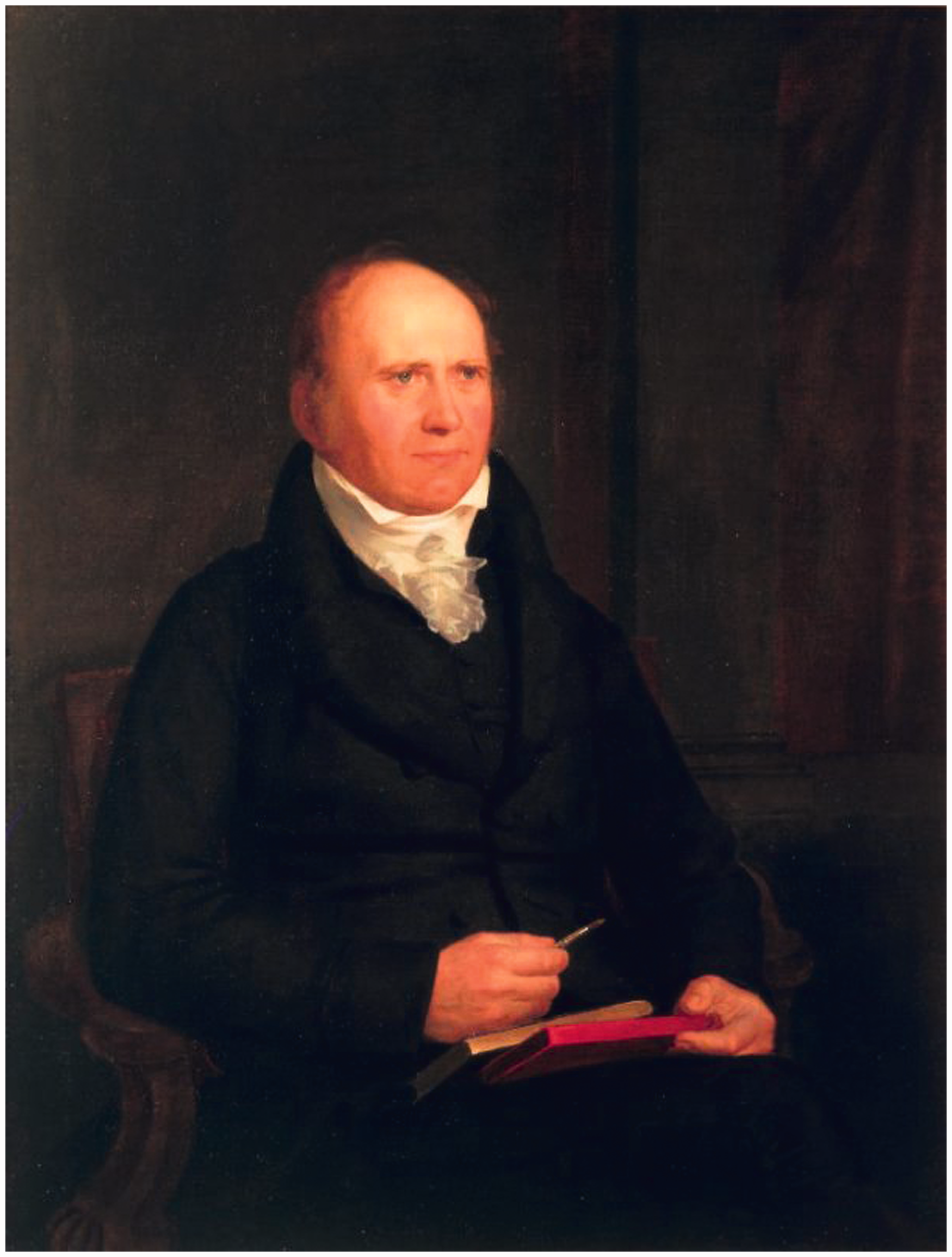
Footnotes
Acknowledgements
I am grateful to Jenny Gashke, the Fine Arts Curator at the Bristol Museum and Art Gallery and the staff of the Bristol Archives and the Bristol Reference Library for their help.
Declaration of conflicting interests
The author(s) declared no potential conflicts of interest with respect to the research, authorship, and/or publication of this article.
Funding
The author(s) received no financial support for the research, authorship, and/or publication of this article.