




Abstract
António Egas Moniz was a Portuguese neurologist and founder of modern psychosurgery widely revered for his discovery of cerebral angiography and prefrontal leucotomy (‘lobotomy’). He received the Nobel Prize in Physiology or Medicine in 1949 alongside Walter Rudolf Hess, becoming the first Portuguese citizen to receive the prize. Prior to his distinguished medical career, Moniz founded the ‘Centrist Republican Party’ from 1903–1917. He was appointed Ambassador to Spain and Minister for Foreign Affairs in 1917 and following the collapse of WWI, Moniz represented Portugal at the Versailles Peace Conference. Upon political retirement in 1926 aged 51, Moniz endeavoured into research and resumed as Professor of Neurology at the University of Lisbon. 1 Despite multiple failed attempts, he became the first to successfully visualise blood vessels of the brain through injecting radiopaque dyes; subsequently, receiving three Nobel Prize nominations (1928, 1932 and 1937). His research led to the radical development of prefrontal leucotomy to treat mental illness and in 1935, Moniz instructed the first psychosurgery of a 63-year-old woman's removal of white matter fibres from her frontal lobe. 2 Due to its reported success, Moniz was awarded the Nobel Prize in 1949. He continued operating his private medical practice despite becoming paraplegic upon near-fatal gunshot wounds inflicted by a schizophrenic patient of his. Moniz died from internal haemorrhage in 1955 aged 82. 3
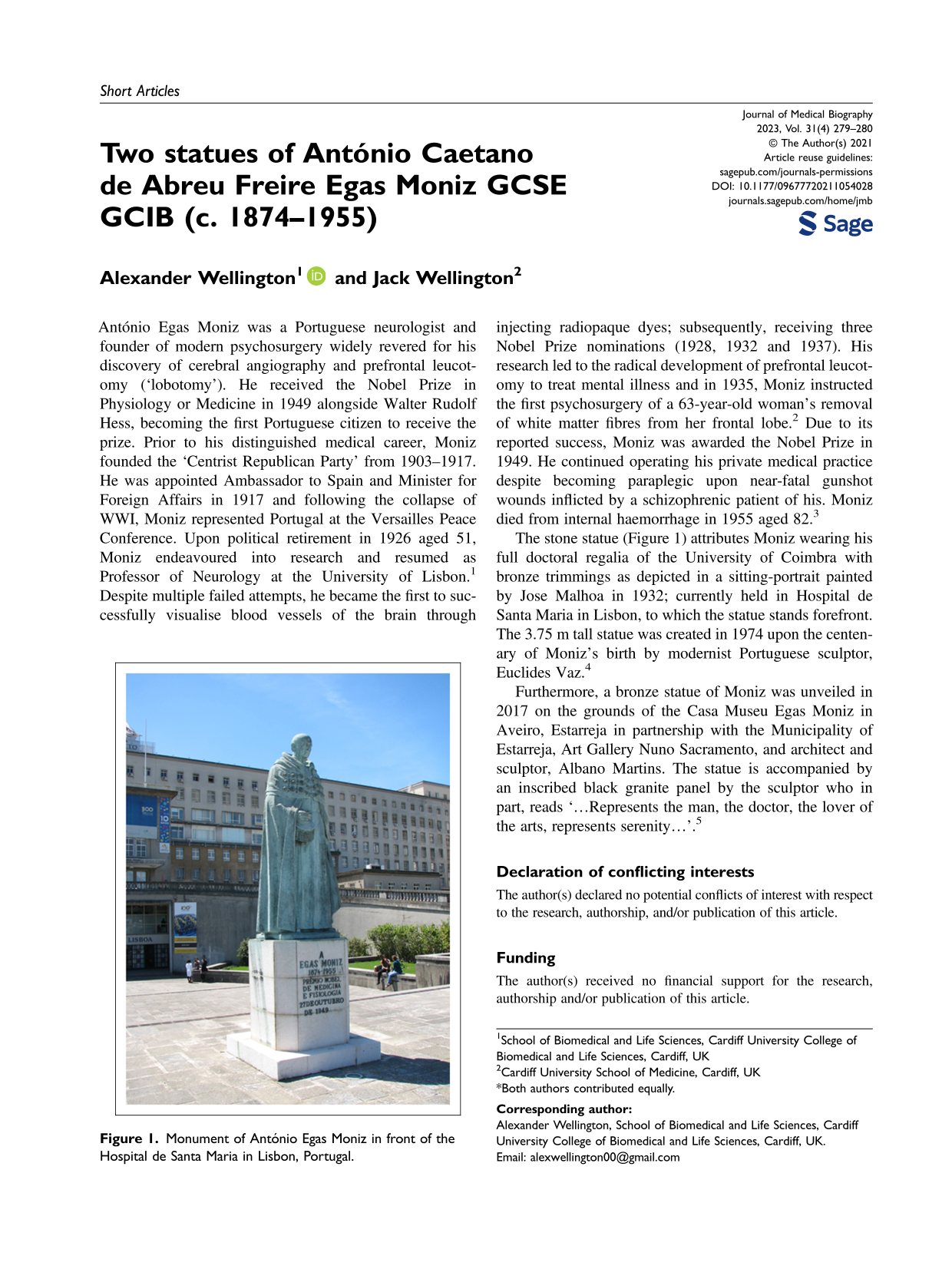
The stone statue (Figure 1) attributes Moniz wearing his full doctoral regalia of the University of Coimbra with bronze trimmings as depicted in a sitting-portrait painted by Jose Malhoa in 1932; currently held in Hospital de Santa Maria in Lisbon, to which the statue stands forefront. The 3.75 m tall statue was created in 1974 upon the centenary of Moniz's birth by modernist Portuguese sculptor, Euclides Vaz. 4

Monument of António Egas Moniz in front of the Hospital de Santa Maria in Lisbon, Portugal.
Furthermore, a bronze statue of Moniz was unveiled in 2017 on the grounds of the Casa Museu Egas Moniz in Aveiro, Estarreja in partnership with the Municipality of Estarreja, Art Gallery Nuno Sacramento, and architect and sculptor, Albano Martins. The statue is accompanied by an inscribed black granite panel by the sculptor who in part, reads ‘…Represents the man, the doctor, the lover of the arts, represents serenity…’. 5
Footnotes
Declaration of conflicting interests
The author(s) declared no potential conflicts of interest with respect to the research, authorship, and/or publication of this article.
Funding
The author(s) received no financial support for the research, authorship and/or publication of this article.
