




Abstract
Karl Jarmer was the first professor of dentistry at the Medical Academy in Dresden (Germany). This article chronicles his life, his professional challenges, and the impact of his work, illustrated by theses, articles, books, and original sources from the archives of the Dresden University of Technology's Medical Faculty. His career encompassed a range of experiences, from running a private practice in Stettin to specializing in oral surgery. After serving in the First World War, his academic journey began with the completion of his dental license and doctorate in 1921. Later, he worked at the universities of Greifswald and Kiel before being appointed to the Chair of Dentistry in Dresden in 1954. His appointment triggered a professional rivalry with Johann Alexander Vogelsang, a key figure in Dresden's maxillofacial care, due to conflicting views on academic leadership. Jarmer made significant contributions to the development of dental education in Dresden and played an important role in shaping Dentistry at the young Medical Academy Dresden. Jarmer remained active in academic circles until his retirement in 1963. He died in 1983.
Introduction
Karl Jarmer was the first professor of dentistry at the Medical Academy Carl Gustav Carus in Dresden, Germany. His career was marked by experiences in his private dental practice in northern Germany, his later academic career development, his provisional directorship of the Clinic for Dental, Oral, and Maxillofacial Surgery in Greifswald, and his role as head of the department in Dresden. His career was influenced by a difficult professional relationship with Johann Alexander Vogelsang (1890–1963).
This article aims to chronicle Karl Jarmer's life, from his academic education and practical work to his time as the first head of the Department of the Clinic of Dentistry at the Medical Academy in Dresden. Jarmer's biography was examined using available books, articles, theses, and original archival sources from the University Archives of the Dresden University of Technology, Branch of the Medical Faculty Carl Gustav Carus (UA TUD-MF).
Early years and academic education
Karl Jarmer was born on 10 March 1898 in Wollin in Pomerania, which was formerly part of Germany and is now in Poland. 1 He was the son of the teachers August (1871–1962) and Auguste Jarmer (1869–1933). 2 He spent his childhood in Stettin and completed his secondary education at the Schiller Gymnasium in January 1917. 2
Following his graduation, Karl Jarmer served in the German Army during the closing phase of the First World War as part of the 34th Infantry Regiment in France. 2 Karl Jarmer developed the wish to become a dentist during an internship with a dentist who was a family friend. 2 In 1919, he began studying dentistry at the University of Greifswald (Figure 1) and was granted his dental license in the winter of 1921. At the end of the same year, he was awarded his Doctorate of Dental Medicine (Dr med. dent.) with his dissertation entitled: “Über die mehrfache Anlage des Zwischenkiefers beim Menschen” “On the multiple development of the intermaxillary bone in humans” 3 a topic he received from Karl Peter (1870–1955), an anatomist at Greifswald who also served as Jarmer's mentor.1,2,4,5 In an international context, his published dissertation from 1922 3 was critically discussed by the Swedish dentist Gotthard Thourén (1881–1967), who argued that it merely summarized already known facts and, in his opinion, did not contribute any new insights. 6
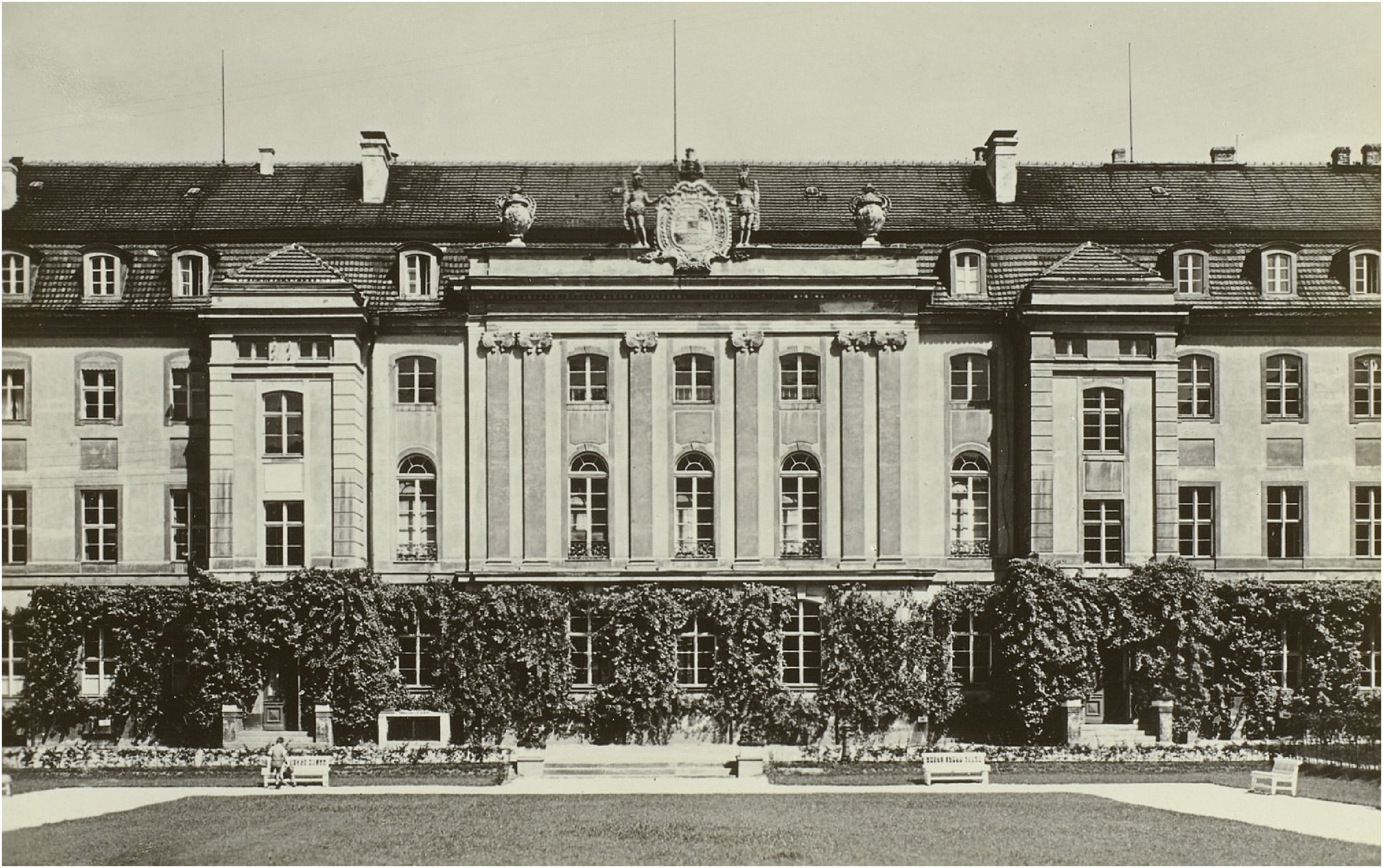
Ernst Moritz Arndt University in Greifswald.
Specialization in northern Germany
After postgraduate training, Jarmer established his own dental private practice in his former hometown Stettin, where he practised from April 1922 until the year 1937. 1 Karl Jarmer married the teacher Charlotte Krüger (1899–1987) on 21 June 1924, in Stettin, with whom he had five children: four daughters and a son. 2 His children later pursued careers in stage design, architecture, and German studies, with only his youngest daughter following a medical education, training as a medical-technical assistant. 2
In addition to his general dental practice, he was committed to continuous scientific advancement. 2 Furthermore, Jarmer had a strong interest in surgery, which he could not perform to this extent in his private practice. Additionally, the war facilitated the training of maxillofacial surgeons, which also played a significant role. These factors explain why he pursued further education alongside his practice. 2 In 1937, he began his specialization in oral surgery. He acquired his initial knowledge in the field of oral and maxillofacial surgery at the specialized clinics of the Rudolf Virchow Hospital in Berlin, as well as at hospitals in Hamburg and Bremen, as part of his specialist dental training. 1 During this time, his work was focused on a formal training post rather than solely providing clinical support.
During the final years of the Second World War, he served as an assistant physician and oral surgeon for the German Army. 2 The family lost their home three times in their hometown, Stettin, due to bombing raids. In 1944, his wife and children were evacuated to Schleswig-Holstein, but by the end of the war, the family was reunited. 2 During the closing phase of the Second World War, Karl Jarmer worked as a volunteer assistant at the otolaryngology clinic of Kiel University, 2 where he gained knowledge that later contributed to his professional work, particularly in areas such as salivary gland diseases, and war-related jaw and facial injuries. Through this role, he gained significant experience in treating war injuries to the oral and maxillofacial region. It should be noted that Karl Jarmer's biography contains no indications of a connection to National Socialism. He was never a member of the National Socialist German Workers’ Party during the Third Reich (1933–1945). Due to his distance from National Socialism, Jarmer did not have to undergo a denazification process after the war. 2 Instead, Jarmer was able to align himself with the new political order in East Germany.
In 1946, Karl Jarmer became a member of the trade union, which further integrated him into the emerging socialist system and provided him with a certain political standing. 2 That same year, in August, he was officially recognized as a specialist dentist for jaw diseases. 2 In 1949, Karl Jarmer joined the National Democratic Party of Germany (NDPD), a political party established in 1948 as part of the socialist state's structure. The NDPD functioned as a “block party” within the National Front of the German Democratic Republic (GDR), a coalition of parties designed to project a façade of political pluralism while firmly supporting the socialist system. 2 The National Front, including the NDPD, was effectively controlled by the Socialist Unity Party of Germany (SED), the dominant ruling party of the GDR.7,8 Although the NDPD lacked independent political power, its role was to help stabilize the GDR regime by integrating various social groups into the socialist framework.
Karl Jarmer gained his first experiences in academic leadership at his alma mater, the Ernst Moritz Arndt University in Greifswald, where he held the provisional directorship of the Clinic for Dental, Oral and Maxillofacial Surgery from 30 October 1946, until 1947. 9 At the same institution, he served as a senior physician and head of the Oral and Maxillofacial Surgery Department starting in the summer 1947. 2
Interestingly, he had not yet completed his habilitation. The habilitation is the highest academic degree that can be achieved in Germany and is typically a prerequisite for a professorship and department head position. It was also notable that he was 50 years old when he completed his habilitation. This can be explained by the fact that Karl Jarmer had worked as a practicing dentist for many years before that. The habilitation took place two years after he provisionally assumed leadership of the department. His habilitation occurred at the University of Greifswald in 1948 with the pathological-dental publications: Der akute parodontische Anfall, Überprüfung der für kardiale Mundsymptome gehaltenen Erscheinungen bei der exsudativen Diathese, nebst einigen Bemerkungen über Herdinfektionen und Zahnungskrankheiten bei exsudativen Kindern and Die Epithelisierung der Pulpapolypen vom histogenetischen und vergleichend pathologischen Gesichtspunkt aus. The acute periodontal attack, Review of symptoms misinterpreted as cardiac oral symptoms in exudative diathesis, along with some remarks on focal infections and teething diseases in exudative children, and the epithelialization of pulp polyps from a histogenetic and comparatively pathological perspective.
Since his specialist medical training in Kiel, Karl Jarmer had been involved in cleft lips and palate surgery. He further deepened this knowledge during a study visit in 1952 to the Centre for Plastic Surgery specializing in the repair of cleft lips and palates in Berlin. 2
First professor of dentistry in Dresden
Since its establishment in 1949, the GDR grappled with the significant challenge of sustaining its healthcare system. This issue had its roots in the immediate postwar period, when a severe shortage of medical professionals emerged due to the war's direct consequences and the migration of doctors from the Soviet-administered zone to areas controlled by the Western Allies. Even after the formation of both German states, this trend persisted, particularly during times of increased medical demand within the GDR. To address the strain on the healthcare system, the government made healthcare development a priority as early as July 1950. 10 One of the initial steps involved expanding the intake of medical students at existing faculties in Leipzig, Berlin, Jena, Greifswald, Halle, and Rostock. 2 By 1953, universities had exceeded these planned enrollment increases. However, the available resources and infrastructure remained inadequate to meet the growing and future needs. 11 As a result, it became clear that further expansion of the healthcare system required the establishment of new medical academies. After the Ministry of Health of the GDR decided to establish a Medical Academy in Dresden, Karl Jarmer (Figure 2) was appointed as the Chair of Dentistry at the newly founded Medical Academy (Figure 3) on 1 May 1954.11–13 This decision sparked significant conflict with Johann Alexander Vogelsang whose established career in Dresden and prior contributions to dental and maxillofacial care positioned him as a natural candidate for the role as Chair of Dentistry. 14

Karl Jarmer (1898–1983).
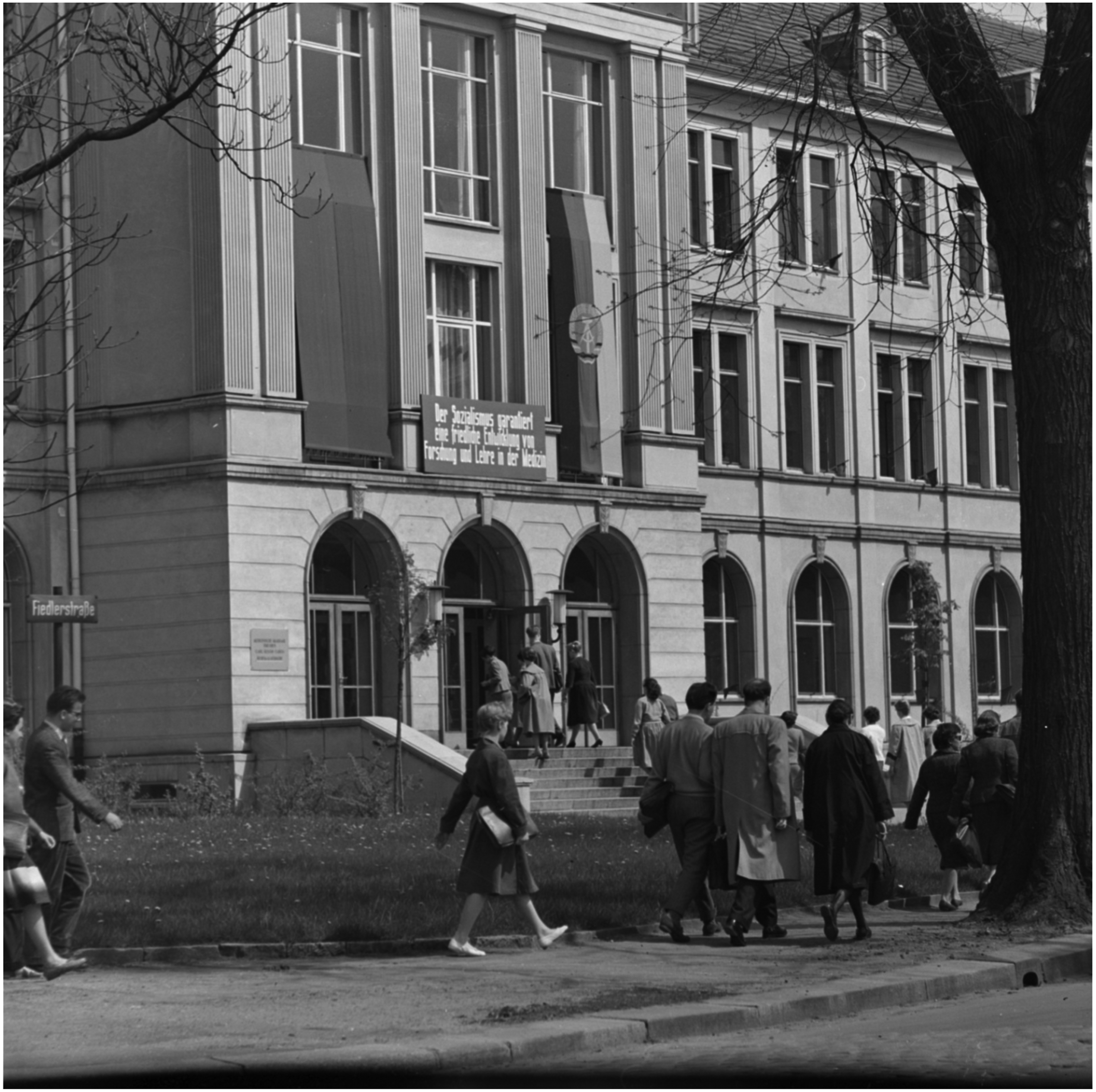
The main building of the medical academy Dresden, in front with a propagandistic slogan: “Der Sozialismus garantiert eine friedliche Entwicklung von Forschung und Lehre in der Medizin” “socialism guarantees the peaceful development of research and teaching in medicine”.
Vogelsang led the Dental and Maxillofacial Clinic at the City Hospital Dresden-Johannstadt and played a key role in expanding and rebuilding it after the Second World War. Karl Jarmer's appointment, however, disrupted Vogelsang's vision and sparked a professional rivalry between the two. 15 Their conflict, continued throughout Jarmer's early years at the academy. 14 Regarding the personnel development of Jarmer's clinic, he started in 1954 as the only professor, with one senior physician and four assistants. By 1959, he had further developed the clinic, and it had grown to include two professors, one lecturer, four senior physicians, and 20 assistants. 4
A difficult professional relationship
After the decision was made to establish a Medical Academy in Dresden, Johann Alexander Vogelsang was initially considered a suitable candidate for the position of head of department. As part of the plans for Vogelsang's appointment, in April 1954, all directors of the dental and maxillofacial clinics at the universities of the German Democratic Republic were consulted regarding these appointment plans. 16
Most of the professors expressed support, except for Wolfgang Rosenthal (1882–1971)17–19 from Humboldt University in Berlin, who had serious doubts about Johann Alexander Vogelsang's suitability. This assessment was based, on Vogelsang's lack of habilitation and limited scientific publication activity.14,16 In March 1954, the Ministry of Health proposed Karl Jarmer for the position of Chair, based on recommendations from the State Secretariat for Higher Education and the Scientific Advisory Board of Dentists. 20
In June 1954, the Dental and Maxillofacial Clinic at the Dresden-Johannstadt City Hospital, led by Vogelsang, was granted its own budget and staffing plan, becoming independent from the Department of Dentistry at the Medical Academy Dresden.21,22 This was seen as a form of compensation for Vogelsang, as he had not been appointed to the chair of the Department of Dentistry at the Medical Academy. Additionally, Vogelsang was also given a limited teaching assignment at the Medical Academy.1,23 Johann Alexander Vogelsang continued to oversee inpatient care independently of the newly established Medical Academy, while, due to this circumstance, no inpatient department was established at the Department of Dentistry of the Medical Academy Dresden.
For Karl Jarmer, the lack of inpatient care at his institution was a difficult circumstance to accept, which served as a starting point for understanding the recurring rivalries between the two men. From Vogelsang's perspective, the surprising appointment of Karl Jarmer and his efforts to integrate his clinic into the Stomatology Clinic for the harmonization of outpatient and inpatient care can also be cited as a triggering factor. 2 Both perspectives led to a series of conflicts between the two men, 24 which characterized the cooperation between the clinics during the early years and only came to an end with Vogelsang's passing. 14
An example of these tensions was that the Academy's senate had been pushing for a resolution as early as June 1954, since both institutions depended on each other. It was argued that the clinical and inpatient training of students in its current form was considered inadequate. Karl Jarmer proposed a solution by transferring responsibility for one department to Vogelsang. Vogelsang was to take over either the prosthetic, orthodontic, or conservative department and integrate his institution. 2 However, this compromise, sought by Jarmer, failed due to disagreements over the degree of independence and autonomy these departments would have, 20 as Jarmer was unwilling to grant extensive autonomy. The search for an adequate solution was further complicated by Jarmer's attempt to influence the Ministry of Health in his favor. In October 1954, Jarmer tried to prevent Vogelsang from receiving a professorship with teaching duties, which had been initiated by the Medical Academy. 25
A compromise was finally reached in 1955, when a written agreement clearly defined the responsibilities and rights of both parties. Vogelsang was allowed to continue his inpatient care but had to hand over the maxillofacial surgery outpatient clinic to Jarmer's department. Notably, Jarmer was granted the right to establish his own inpatient care which would only come into effect after Vogelsang's retirement. Despite this agreement, tensions persisted, especially when Jarmer attempted to push for Vogelsang's retirement in 1956. This led to further conflicts, prompting the rector of the Medical Academy, Horst-Günther Güttner (1912–1983), to report the matter to the Ministry of Higher Education. As a result of the 1956 incident, the senate of the Medical Academy advised Karl Jarmer to support the application for a professorship for Johann Alexander Vogelsang. 10 Jarmer complied with this recommendation in May 1957, 26 and Vogelsang was awarded the professorship in January 1958. 14
Publications
The main foci of Karl Jarmer's research activities were also reflected in his contributions and publications. His research interests, in addition to maxillofacial surgery, 27 included psychology and psychosomatics in dentistry, physical therapy in dentistry, 28 and jaw actinomycosis (Figure 4), 29 as well as inflammatory jaw diseases. As part of these research areas, he published 123 papers and books,28–32 which had a significant influence on dentistry in the German Democratic Republic. 27 One notable example of his research is his 1960 publication, “Klinik und Pathogenese einiger digito-fazialer Syndrome” “Clinical Features and Pathogenesis of Certain Digito-Facial Syndromes,” which appeared in Fortschritte der Kieferorthopädie. 27 In this article, he presented four clinical cases of cranio-digito-facial syndromes and analyzed their pathogenesis, exemplifying his approach to combining clinical observation with scientific investigation.
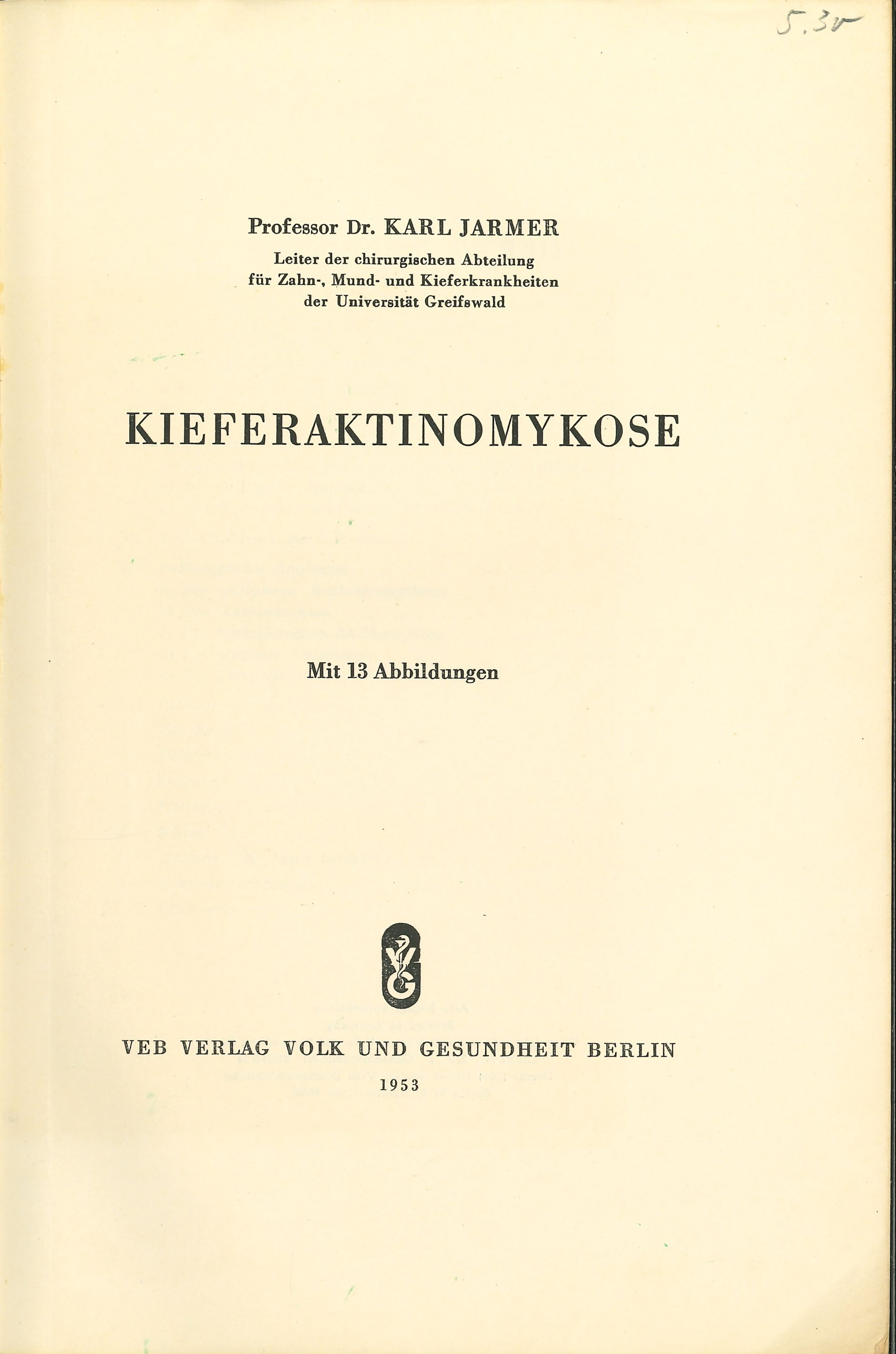
Cover page of Jarmer's publication “Kieferaktinomykose” “jaw actinomycosis”.
Privately, Karl Jarmer was interested in the history of dentistry and maxillofacial surgery, 33 anthroposophy, 34 and Goethean philosophy. 35 One of his earliest works, published in 1928, was the book “Das Seelenleben der Fische” “The Inner Life of Fish,” 30 which represented a synthesis of anthroposophy, Goethean philosophy, and zoology. According to Jarmer, his book was well received by Frederik Jacobus Johannes Buytendijk (1887–1974), the Dutch biologist, anthropologist, and psychologist, who was the head of psychology at the University of Utrecht. Buytendijk then offered him a position, which Jarmer, however, declined. 2 Especially in his later years, he increasingly turned his attention back to the history of his profession and anthroposophy.
Regarding his interest in the history of medicine, his main focus areas included the life of the American dentist and oral microbiologist Willoughby Dayton Miller (1853–1907) 36 and his time at the Dental Institute in Berlin. 33 Miller played a central role in the development of dentistry as an academic discipline in Germany, particularly through his work on the causes of dental caries and his promotion of the scientific foundations of dentistry. 37 Other key aspects of Jarmer's work included the role of doctors and dentists in the 1848 bourgeois revolution, a period of political and social upheaval in Germany.38,39 The revolution was an attempt to implement liberal and democratic reforms, including demands for more political rights and national unity. 40 During this time, many doctors and dentists became active figures, not only in healthcare but also in political discourse. 41 The developments of this period contributed to the professionalization and societal recognition of medicine and dentistry. 41 Furthermore, Jarmer also examined the emergence of the first dental associations in Germany, which played a key role in establishing dentistry as an independent discipline. 42
Later years
Karl Jarmer held numerous offices and positions. He was the first chairman of the Society for Dental, Oral, and Maxillofacial Diseases in Dresden, a member of the Central Working Group “Stomatology” at the Ministry of Health, and a member of the Scientific Advisory Board at the State Secretariat for Higher and Technical Education of the German Democratic Republic. 1 Political representation of his profession was important to him until his retirement from academia. In this position, Karl Jarmer advocated with the state authorities for the alignment of dental education with medical education and for the full medical training of dentists. 2 Unfortunately, this was neither considered nor implemented.
He stepped down from this position upon his emeritus status on 1 September 1963. 2 He shaped the profile of the still-young Medical Academy Dresden. Karl Jarmer died on 6 February 1983, in Koserow on the island of Usedom. 1
Footnotes
Acknowledgment
I would like to thank Prof Dr Dr Matthias Schneider (associate professor of Oral and Maxillofacial Surgery at the Dresden University of Technology) for initiating the idea of engaging with the history of Maxillofacial Surgery and Dentistry in Dresden, particularly focusing on the biographies of relevant dentists and maxillofacial surgeons. I also extend my gratitude to Stephanie Müller, MA (University Archives, Dresden University of Technology), for her guidance during the extensive archival research. In conclusion, I would like to thank the Institute for the History of Medicine, Faculty of Medicine, Dresden University of Technology, for the rights of use of the portrait of Professor Karl Jarmer in this publication.
Author contributions
The author conducted the data collection, data management, and writing.
Consent of publication
Consent for the publication of the images has been obtained.
Data availability
The datasets generated and/or analyzed during the current study are available from the corresponding author on reasonable request.
Declaration of conflicting interests
The author declared no potential conflicts of interest with respect to the research, authorship, and/or publication of this article.
Funding
The author received no financial support for the research, authorship, and/or publication of this article.
