



Abstract
Background:
In order to prove their commitment to the nursing profession, nurses need to base their professional activities on certain acknowledged values. Although a large number of studies have addressed professional values in nursing, only a few studies are available on the identification and comparison of nurses’, nursing students’, and nursing instructors’ understanding of such values.
Objective:
The study aims to compare nurses’, nursing students’, and nursing instructors’ perception of nursing professional values.
Research design:
In this descriptive-comparative study, data were collected using Weis and Schank’s Nurses’ Professional Values Scale–Revised. The data were analyzed using the SPSS statistical software (v 22).
Participants and research context:
A total of 299 nurses, 341 nursing students, and 100 nursing instructors from multisite, 20 different wards from 3 university hospitals and associated nursing schools located in the cities of Shiraz, Fasa, and Jahrom in Fars province, participated in 2016.
Ethical considerations:
The Institutional Review Board of the researchers’ primary university has verified that the study complies with research ethics.
Findings:
The total mean scores of the nurses’, nursing students’, and nursing instructors’ perception were found to be 4.23 (0.44), 3.92 (0.50), and 4.34 (0.35), respectively, in the domain of justice—this domain was the subjects’ top priority—and 3.40 (0.56), 3.29 (0.49), and 3.55 (0.36), respectively, in the domain of activism—this domain was attached the least importance by the subjects. There were significant differences across the three groups’ perception in all of the dimensions of professional values (p < 0.001).
Discussion:
The three study groups’ overall mean scores fall within the range of relatively important or important. Several studies show the same results, but there are still controversies in this regard.
Conclusion:
There is need for plans to increase nurses’ awareness of certain professional duties and improve their professional performance in all areas alongside their care duties.
Introduction
In terms of nursing ethics, values are basic convictions about what is right, proper, or satisfactory. Values influence individuals’ social behaviors and outlook. 1,2 Values also influence nurses’ professional behaviors, such as prioritizing care and providing quality care, 2 development of personality traits, mentality, and behavior. 3
Writing from a nursing ethics perspective, values represent basic convictions of what is right, good, or desirable and motivate social and professional behavior. 1 Values influence professional behaviors including prioritization of care and quality of care provided. 2 The things people esteem to be good influence how personal character develops and how people think and subsequently behave. 3 Values set the framework for ideal behaviors and reflect what an individual approves of and attempts to follow. Like beliefs, values are relatively stable and do not change over time. Values define ideal modes of conduct and reflect what the individual or group endorses and tries to emulate. Values, like beliefs, are relatively stable and resistant to change. 4 Values determine an individual’s priorities in life and shape the world in which he or she lives. Values are an integral part of human existence. Ethical values are indispensable to the society and, likewise, the nursing profession values conduct human life priorities and form the world we live in. They act as one of the most basic parts of human life. Ethical values are inseparable components of the society and, as a result, nursing profession. 5
Ethical principlism, that is, practicing ethics based on certain principles, does not mean the application of a theory or consensual decision-making; rather, it is a guideline that can help justify ethical decisions and evaluate the ethicality of practices. 3
Organizational values guide the behaviors of the personnel. 2 As an organization consists of individuals and professions in which the individuals work, organizational values can be divided into the two categories of personal values and professional values. Personal values are ideal, cross-situational goals that vary in importance and act as guidelines in an individual’s life, influencing his or her choices, behaviors, and actions. 6 While personal values guide individuals’ behaviors and choices in their lives as people, professional values guide individuals’ behaviors as members of a professional team. 7
An individual develops personal values in response to his or her family, society, culture, environment, religion, and ethnicity. 8 The acquisition of values is a gradual and evolutionary process that lasts throughout one’s life. 9 Over the years, social values have seen fundamental changes and moved from the wide domain of public benefits to the more specific domain of personal benefits. 10
In nursing, professional values provide a framework for commitment to the convenience of the patient and ethical behavior toward providing safety and humanitarian care. 11 Although nursing professional values are influenced by personal values, they have become embedded in the values of clinical care system, the body of the nursing profession and organizational values. 2
Personal and professional values affect the decisions of healthcare experts in the area of caring for patients. Sometimes, in clinical situations, there is a conflict between one’s professional and personal values; however, professionalism dictates that practitioners should be able to deal with their value conflicts and make decisions that are in the interest of patients. 7
Advances in technology and the expansion in nurses’ responsibilities have led to complex ethical and moral dilemmas for professional nurses. 12 A “moral dilemma” can happen in situations where conformity to accepted standards of good behavior conflicts with an individual’s deeply rooted personal values. 13 Morals are behavioral standards which guide the acts of the individual and the society. Ethics, on the other hand, constitute the approaches, beliefs, and behavioral standards of a specific group, like nurses. 4
According to Argyris and Schon (1974), every individual has a mental plan for how to make decisions, how to implement them, and how to assess the implementation. Yet, few people know that their action plans are not influenced by theories they consciously support. Furthermore, few people are aware of the plans or theories they employ. Therefore, there is a distinction between what people say and what they do. Argyris and Schon suggest that there should be a theory for what people say and another theory for what they do. There is no difference between theory and action, but between two theories of action, namely “Espoused theory” and “Theory-in-use.” Individuals are often unaware of the fact that their theories in-use are not consistent with their espoused theories. Also, individuals are often unaware of their theories in-use. 6
Differences in nursing roles raise the need for consistency and homogeneity in nurses’ values, knowledge, and personal skills. 14 In other words, nurses, regardless of the field of their practice, should base their actions on a set of common values that indicate their commitment to the nursing profession and the society. 15
The development of professional values is a long-term process that begins with professional education and lasts through the years of a nurse’s practice. 12 Nursing students enter college with certain personal beliefs, values and beliefs which are constantly changing and developing: as nursing students advance in their social lives, their values are affected by the society. 16 Nursing students’ professional values develop through education and contact with their instructors. 17 Nursing instructors play a key role in the socialization of their students, 18 the transference of nursing values, 19 and the formation of ethical values in nursing students. 18 Although nursing instructors stress such ethical principles as justice, compassion, not causing harm, and independence during their students’ education, the real problems arise when students face organizational realities. 20
After their academic education, nurses develop nursing professional values under the influence of the views of professional experts, colleagues, clinical situations, and organizational conditions. 21 A review of the related literature shows that the quality of the care provided by nurses is affected by their adherence to professional values. 22 As one of the pillars of the health system, nurses should be properly aware of the concepts of professional values so that they can effectively perform their delicate and challenging duties and meet their patients’ needs. 10 On the other hand, there is a need for more research and planning in the area of nurses’ ability to deal with ethical issues, provide care, and make ethical decisions. 18 The results of several studies on nursing education show that the professional values and ethical principles of nursing students and nurses are often seen as a challenging issue in the clinical environment. 23 According to a study, the majority of nursing students who are about to graduate are not sufficiently aware of certain value factors related to their non-clinical duties. 15 The results of a comparative study show that nursing students, newly graduated nurses, and experienced nurses are different in their knowledge of the ethical codes of nursing professional values and how they affect a nurse’s performance. 24
In the healthcare systems of European and Scandinavian countries, such as the Netherlands and Sweden, moral case deliberation (MCD) is used on a frequent basis to support clinical ethics. The goal of MCD is to have professional healthcare staff become actively involved in reflecting upon issues using their experiences and theoretical grounds. At MCD sessions, healthcare providers consciously focus on the ethical cases of their profession. MCD is meant to enable participants to share and think about their personal and moral considerations. At MCD meetings, healthcare providers systematically think about the ethical questions raised about a real clinical case. 25,26
Purposeful and uniform education on nursing professional values is essential to a bright future for nursing. Value-based professional behaviors are essential to quality care, 27 thus the need for paying attention to professional values in the curriculum to make for qualified nurse students. Students who are familiar with professional values can provide quality care. 28 For a long time, the gap between theory and practice, that is, what is learned in classes and what is experienced in the clinical environment, has been a major problem in the clinical education of nurse students. 29
Garity 30 states that the education of nurse students in ethical matters revolves around theoretical aspects, which is not effective for clinical practice. To reduce the gap between theory and practice in this area, it is essential that learners have the opportunity to put the skills they have learned into practice. 30 Chao et al. 31 used Integrated Web-based Teaching to teach ethical lessons to nurse students and found that the students who had been taught using that method had better ethical decision-making and critical thinking skills compared to the students who had been taught according to the traditional approach. Torabizadeh et al. 32 have found that teaching ethics to nursing students enhance their moral reasoning.
Moreover, studies of professional values in different countries show that differences in professional values are connected with their prioritization, not inherent qualities. Researchers have also found that differences in the prioritization of values are connected with cultural, social, economic, and religious factors. 33,34 For example, the study of Alkaya et al. 1 shows that the professional values mean score of American nurse students is higher than that of Turkish students—American students often choose nursing because of their personal goals while the motive of Turkish students is to improve the conditions of their lives. According to the study of Rassin, 10 nurse students of various ethnicities prioritize professional values differently. Another study reports that Iranian nurses stress the importance of respecting the dignity of patients more than others because of their stronger religious beliefs. 22
Collecting information about the values of nursing students, instructors, administrators, clerks, and policy-makers can contribute to a better understanding of values. An identification of various views about professional values can be used to educate care-providers with values whose aim is enhancing the quality of patient care. 21 Receiving feedback is a way to bridge the gap between theory and practice, which will lead to better personal, professional, and communicative skills. 35
An awareness of individuals’ values helps determine what activities are important to them. Today’s workforce consists of different generational cohorts. The current problems in the workplace are due to differences in values, views, mentalities, demographic characteristics, and generations. These differences have the potential to cause problems in nurses’ education and practice. Translating the differences between the generations in the workplace to benefits requires research into which values are dominant in each group. 24 An identification of the views of nurses, nursing students, and nursing instructors on the professional values of nursing is essential to determining their commitment to the nursing profession and the society. Studying the perception of these three groups and how they prioritize professional values can provide valuable information toward planning effective strategies for harmonizing their perception of the values and encouraging them to apply the values in professional practice and clinical learning. 36 Accordingly, this study aims to compare nurses’, nursing students’, and nursing instructors’ perception of professional values.
Objective
To compare nurses’, nursing students’, and nursing instructors’ perception of professional values in Shiraz, Fasa, and Jahrom.
Research questions
How do the nurses in different units of the university hospitals of Shiraz, Fasa, and Jahrom perceive professional values in the domains of caring, activism, professionalism, justice, and trust?
How do the nursing students at the nursing schools of Shiraz, Fasa, and Jahrom perceive professional values in the domains of caring, activism, professionalism, justice, and trust?
How do the nursing instructors at the nursing schools of Shiraz, Fasa, and Jahrom perceive professional values in the domains of caring, activism, professionalism, justice, and trust?
Are nurses’, nursing students’, and nursing instructors’ perceptions of professional values in the domains of caring, activism, professionalism, justice, and trust significantly different?
Is there a relationship between nurses’, nursing students’, and nursing instructors’ perception of professional values on one hand and their age, gender, experience, and academic degree on the other?
Method
Setting
This study is a descriptive-comparative work conducted in 20 internal, surgical, and intensive wards of the university hospitals of Shiraz, Fasa, and Jahrom and the nursing schools affiliated with them between September and December 2016. Of the 20 hospital units, 7 (Emergency, Internal-surgical emergencies, Dialysis, Liver transplant, Adults’ intensive care unit [ICU], neonatal ICU, and coronary care unit) were special care units and 13 (Infections, Neurology, Oncology, Urology, Orthopedics, Women’s surgery, Men’s surgery, Pediatric surgery, Cardiac surgery, Thoracic surgery, Neurosurgery, Gastroenterology, and Internal medicine and pediatrics) were internal-surgical units. Shiraz is the capital of Fars Province and the fifth largest city of Iran. As the cities of Shiraz, Fasa, and Jahrom are home to nursing schools with large numbers of nursing students as well as well-known university hospitals with a variety of wards, they were selected for study. The study population consisted of all the nurses, nursing students, and nursing instructors in the above-mentioned units.
The participants
The nurses
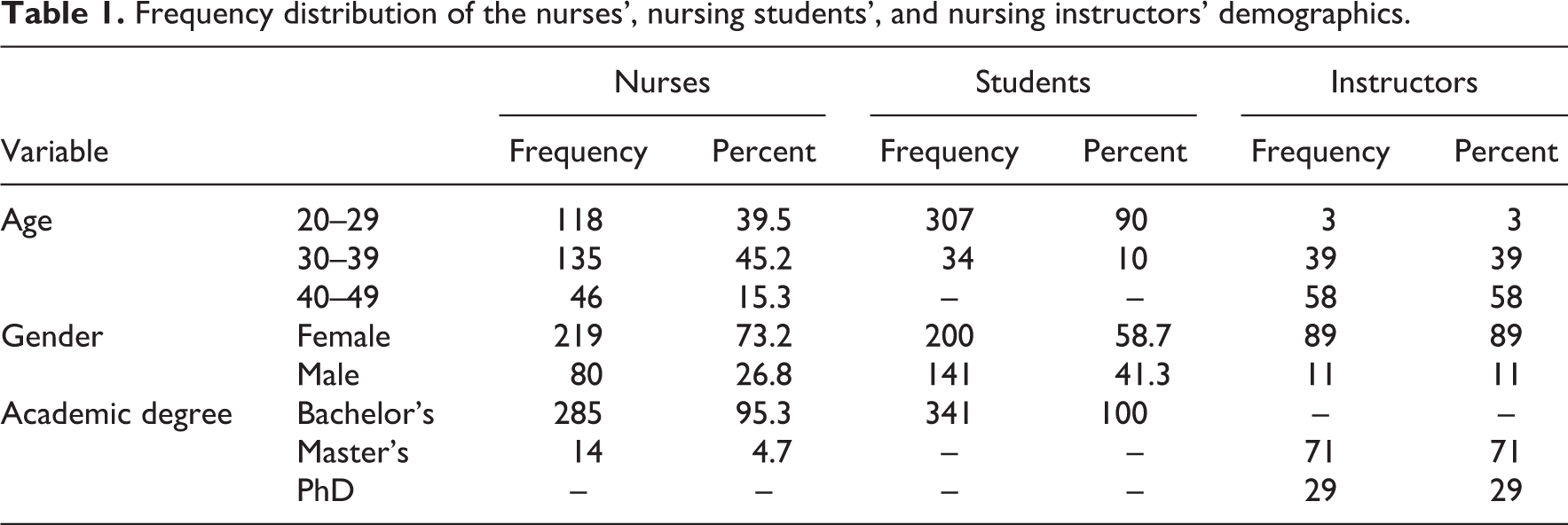
The inclusion criteria for the nurses were to have at least a bachelor’s degree and at least 1 month’s experience of professional practice. A total of 299 nurses were included, most of whom were female (73.2%). They had to have at least a bachelor’s degree: 95.3% were found to have a bachelor’s degree and the rest had a master’s degree. The nurses’ ages ranged between 22 and 49 years, with the mean being 32.70 ± 6.74. Moreover, their work experience ranged between 1 and 27 years, with the mean being 10.32 ± 6.62, and 91% of the nurses had never attended a workshop on professional values and ethics.
The nursing students
To be included, the students had to meet the following criteria: studying for their bachelor’s degree, not being a guest or transfer student, and not having been employed at a clinical education center. Overall, 341 students participated in the study, the majority of whom were female (58.7%). The students’ ages ranged between 20 and 39 years, with the mean being 24.83 ± 3.09, and 90.6% of the students had never attended a workshop on professional values and ethics.
The nursing instructors
The inclusion criteria for the nursing instructors were to have at least a master’s degree and at least 3 months’ experience of educational work at college. The majority of the 100 instructors who participated in the study were female (89%). The instructors’ ages ranged between 27 and 49 years, with the mean being 42.18 ± 7.27 years. The participating nursing instructors were required to have at least a master’s degree: 71% were found to have a master’s degree and the rest had a PhD. They had 1–22 years’ experience of work as an instructor, with the mean being 11.35 ± 5.75 years. The majority (94%) of the nursing instructors who participated in the study had attended a workshop on professional values and ethics.
Ethical considerations
This work has been approved by the Institutional Review Board of the researchers’ primary university. All the participants were informed of the objectives of the study and subsequently filled out and signed the informed consent form. The participants were assured that their information would remain anonymous and confidential (Table 1).
Frequency distribution of the nurses’, nursing students’, and nursing instructors’ demographics.
Data collection
Sampling was based on the census method. To evaluate the nurses’, nursing students’, and nursing instructors’ perception of professional values, the researchers used a two-part questionnaire: the first part addressed demographics and the second part was Nurses’ Professional Values Scale–Revised (NPVS-R). NPVS-R is a standard tool developed and normalized by Weis and Schank to measure professional values—their studies show the scale to be valid and reliable. The validity of the scale has been validated by a board consisting of five experts on professional values in nursing, and with regard to the reliability of the scale, its Cronbach’s alpha has been found to be 0.92. 37 NPVS-R consists of 26 items that address the following dimensions: caring (9 items: 16, 17, 18, 20, 21, 22, 23, 24, 25); activism (5 items: 4, 10, 11, 19, 26); trust (5 items: 1, 2, 9, 14, 15); professionalism (4 items: 5, 6, 7, 8); and justice (3 items: 3, 12, 13). The choices are scored based on the 5-point Likert scale, with the score of each item ranging from 1 (“not very important”) to 5 (“very important”). The score range is between 26 and 130 and higher scores indicate the respondent’s greater familiarity with professional values. A psychometric analysis of the Farsi version of the scale was conducted by Parvan et al. in 2012: first, the reliability of the translation of the scale from English into Farsi was confirmed by several university board members and English teachers; second, a panel of experts including post-graduate and PhD nurses were asked to assess the face and content validity of the scale and the necessary revisions were made according to their suggestions and comments; finally, the reliability of the scale was confirmed with a Cronbach’s alpha of 0.91. 15
The collected data were analyzed using SPSS v. 22. The participants’ demographics and perceptions of professional values were described using descriptive statistics: frequency, percentage, mean, and standard deviation. Also, the analytical methods of t-test and analysis of variance (ANOVA) were employed to describe the relationships between the variables and the differences between the groups. The researchers used Pearson’s correlation coefficient to study the relationships between the participants’ total scores and demographic characteristics. In this study, the significance level was set at p < 0.05.
Findings
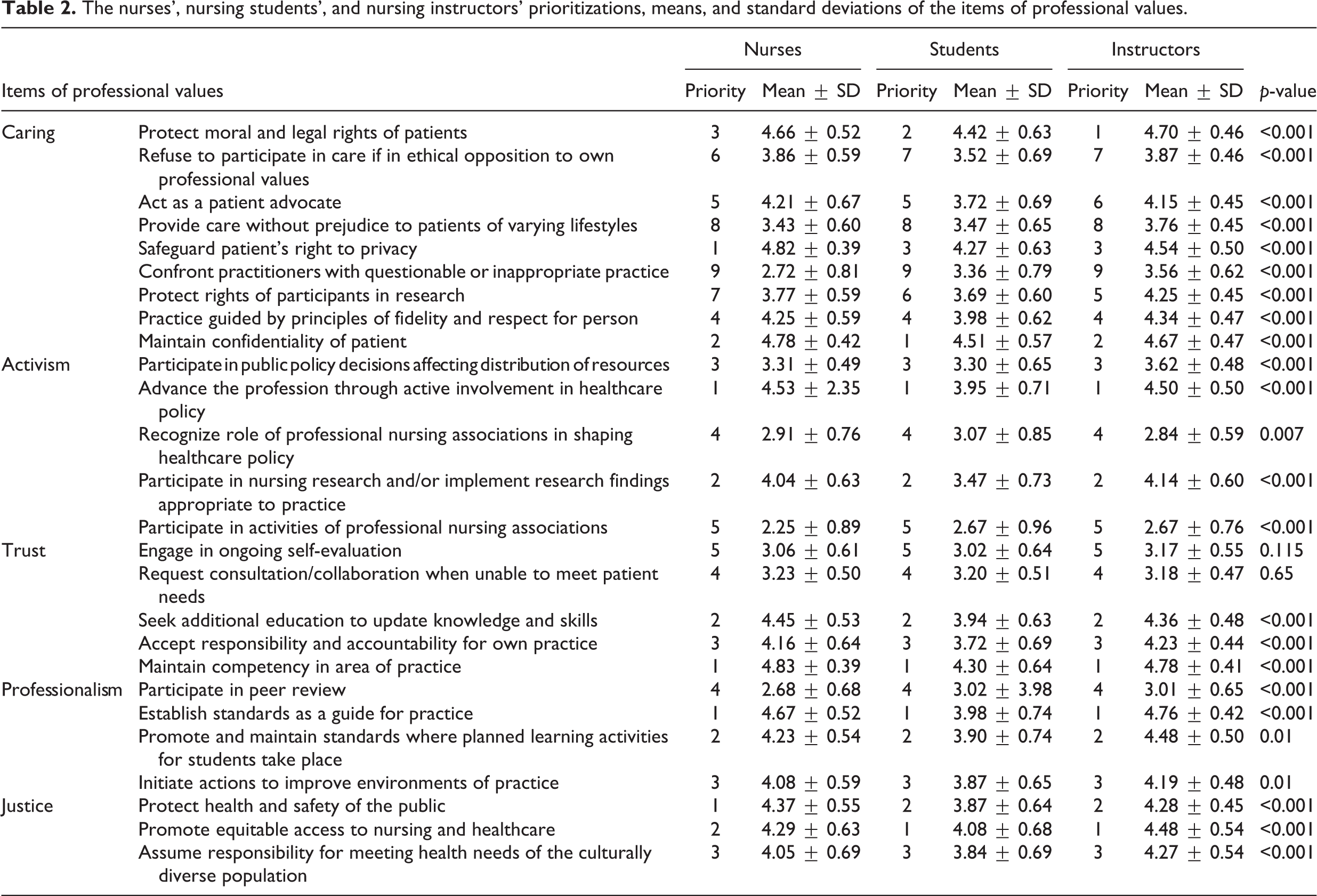
The findings of the study showed that of the nine items related to caring, from the nurses’ perspective, the items “Safeguard patient’s right to privacy” and “Maintain confidentiality of patient” were the most important and the items “Provide care without prejudice to patients of varying lifestyles” and “Confront practitioners with questionable or inappropriate practice” were the least important. According to the nursing students and nursing instructors, the items “Maintain confidentiality of patient” and “Protect moral and legal rights of patients” had the highest priority and the items” Provide care without prejudice to patients of varying lifestyles” and “Confront practitioners with questionable or inappropriate practice” had the lowest priority, respectively.
Of the five items related to activism, the nurses, nursing students, and nursing instructors believed the item “Advance the profession through active involvement in health care policy” to be the most important and “Participate in activities of professional nursing association” to be the least important.
Of the five items related to trust, the nurses, nursing students, and nursing instructors believed the item “Maintain competency in area of practice” to be the top priority and “Engage in on-going self-evaluation” to be the lowest priority.
Of the four items related to professionalism, the nurses, nursing students, and nursing instructors believed the item “Establish standards as a guide for practice” to be the most important and “Participate in peer review” to be the least important.
Of the three items related to justice, the nurses found the item “Protect health and safety of the public” to be the top priority, while the nursing students and nursing instructors regarded the item “Promote equitable access to nursing and health care” to be the top priority; on the other hand, all three groups believed the item “Assume responsibility for meeting health needs of the culturally diverse population” to be of the lowest priority (Table 2).
The nurses’, nursing students’, and nursing instructors’ prioritizations, means, and standard deviations of the items of professional values.
The mean total perception scores of the nurses, nursing students, and nursing instructors were 4.23 ± 0.44, 3.92 ± 0.50, and 4.34 ± 0.35, respectively, in the domain of justice which was found to be their top priority; the mean total perception scores of the nurses, nursing students, and nursing instructors were 3.40 ± 0.56, 3.29 ± 0.49, and 3.55 ± 0.3, respectively, in the domain of activism which was found to be their lowest priority. The nurses, nursing students, and nursing instructors were found to have significantly different perceptions of professional values in all the domains (p < 0.001; Table 3).
Comparison between the nurses’, nursing students’, and nursing instructors’ mean total scores for the different domains of professional values.
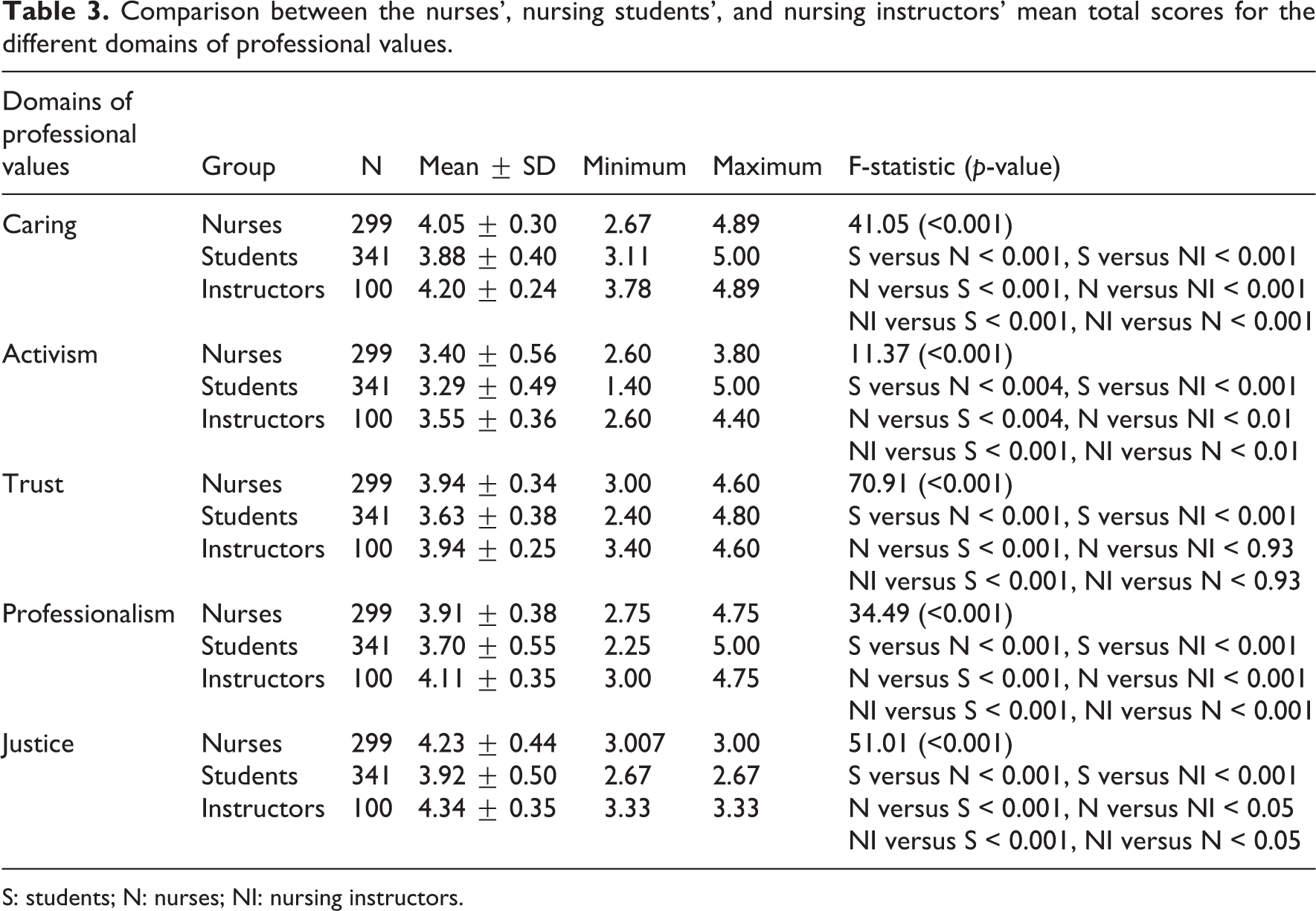
S: students; N: nurses; NI: nursing instructors.
The relationships between the total professional values scores of the nurses, nursing students, and nursing instructors and the variables of gender (p = 0.08, p = 0.31, p = 0.67, respectively), age (r = 0.09, p = 0.33; r = 0.1, p = 0.54; r = 0.09, p = 0.12; respectively), work experience, the nurses’ and instructors’ academic degrees (r = 0.08, p = 0.4 and r = 0.05, p = 0.32, respectively) (p = 0.17, p = 0.75), and participation in workshops (p = 0.12, p = 0.1, and p = 0.5, respectively) were found to be insignificant.
Discussion
This study determined and compared nurses’, nursing students’, and nursing instructors’ perception of professional values in five domains. Also, the relationships between the three groups’ perception of professional values and certain of their demographic characteristics were determined. As there were not many studies specifically addressing the domains of professional values as identified in Weis and Schank’s standard professional values scale (NPVS-R), the references made to related studies in this section are mostly statements broadly related to the aforementioned domains.
In their prioritization of the domains of professional values, the participants of this study were found to consider the items related to the domain of justice to be the most important and the items related to the domain of activism to be the least important.
Regarding justice, the study of Chisholm-Ford et al. 38 shows that nursing students attach more importance to the justice-related items of “Provide care without prejudice,” “Protect health and safety of the public,” and “Promote equitable access to nursing and health care.” The study of Hayes 39 concludes that all nurses should avoid unethical or incompetent practice. In other similar studies, “Protect health and safety of the public” is selected by the majority of nursing students as the most important item in the domain of justice, which is consistent with the results of this study. 16,34 On the other hand, in his respective study, Rassin 10 reports that justice is their subjects’ last priority. The reason why “Protect health and safety of the public” was selected as the most important item in this study can be the fact that since this item makes a direct mention of health and safety, the participants regarded it as more important than the other two items which stress nurses’ equitability and responsibility for meeting patients’ needs.
Similar to this study, the results of many studies show that the domain of activism and the items related to that domain are rated by nursing students and nurses as the lowest priority in professional values. 10,12,15,40 In the study of Chisholm-Ford et al., the item of “Participate in activities of professional nursing associations” from the domain of activism is reported to have the lowest mean score or priority in values. 38 In the study of Lin et al., 41 Taiwanese and Chinese nursing students are found to rate the activism-related items of “Participate in public policy decisions affecting distribution of resources” and “Act as a patient advocate” as the least important. In the studies of Lin et al. 41 and Iacobucci et al., 42 the item “Participate in public policy decisions affecting distribution of resources” is rated by the participants as the least important value.
According to the results of an international survey where nursing instructors from 19 different countries were interviewed, the majority of the respondents believed that professional values based on honesty, intellectualism, and altruism are the most important in clinical environments. 19 A comparison between the nursing students’ and nursing instructors’ perceptions of professional values showed that, like the students, the instructors regarded the values of justice, humanity, and freedom as important; also, a comparison between the nursing faculty members’ and the nursing students’ perceptions of professionalism revealed that humanity is one of the main concepts of professionalism and professional values to both groups: both groups regarded humanity as the backbone of professional values, such as respect for humans, personal integrity, respecting patients’ privacy, protecting patients against harm, responsibility, consideration of own personal beliefs and values, as well as standards and rules. 8
Studies show that the majority of nurses attach greater importance to those nursing values that are directly related to their profession 16 —other values that may necessitate their participation in activities outside working hours are less important to them. A number of factors can account for nurses’ unwillingness to rate all professional values as equally important: personal beliefs and views, conditions at work, work pressure, organizational culture, and organizational support. 21 On the other hand, development of professional values depends on active participation in professional organizations. Membership in professional organizations enhances nurses’ familiarity with current nursing issues: the results of the study of Chisholm-Ford show that nursing students who are members of nursing associations score higher in professional values than nursing students who are not. 38 Studies also show that proper educational programs can improve nurses’, nursing students’, and nursing instructors’ perception of this domain. Establishment of professional values and encouragement from instructors and colleagues can motivate nurses to participate in such activities. 43
In this study, the mean total scores of the nurses, nursing students, and nursing instructors showed the domain of caring to be their second priority. In a study conducted by Lin et al. 43 in Taiwan (2010), the highest mean total scores of both freshmen and new graduates were found to belong to the domain of caring. The results of other studies show that nursing students regard the values related to the domain of caring for patients as important. 16,43,44 Values and attitudes toward nursing profession has been focused on caring. 45,46 Caring for patients on a professional basis is a major part of nurse education mastering which is a prerequisite to graduation for nursing students. 43 Therefore, the personal attitudes of nursing students, personnel, and instructors to the nursing profession should be taken into account in nursing education and the procedure for nurses’ employment.
Of the items related to the domain of caring, the nurses regarded the items “Safeguard patient’s right to privacy” and “Maintain confidentiality of patient” as having the highest priority. The nursing students and nursing instructors, on the other hand, believed the items “Maintain confidentiality of patient” and “Protect moral and legal rights of patients” to be the most important. In their comparative study of the professional values of Taiwanese and American nursing students, Alfred et al. 34 report that Taiwanese students see the items “Maintain confidentiality of patient,” “Safeguard patient’s right to privacy,” and “Practice guided by principles of fidelity and respect for person” as the most important in the domain of caring, while American nursing students’ priorities are “Act as a patient advocate,” “Maintain confidentiality of patient,” and “Protect moral and legal rights of patients.” Nurses are expected to provide care with respect, competency, and without prejudice against patients. 15 Studies show that nurses and nursing students attach great importance to concepts such as respect, privacy, confidentiality, support, and high-quality care. 12,36,47 Yet, according to the study of Torabizadeh et al., 48 , the privacy and dignity of patients are not properly considered in medical centers. Moreover, patients and nurses have different conceptions of privacy and dignity, and the nursing staff has inadequate knowledge of patients’ rights to privacy and dignity. Therefore, the researchers suggest that the entire medical and clinical personnel should be educated about patients’ privacy and dignity. 48
In this study, the nurses’ mean total scores showed the domain of trust to be their third priority, and it was found to be the nursing students’ and instructors’ fourth priority. In the study of Parvan et al., 15 the domain of trust is reported to be the most important domain of professional values. Also, the studies of Alfred et al., 34 Clark 16 , and Parvan et al. 15 show that to nursing students, the most important item among the 26 items of Nurses’ Professional Values Scale is “Maintain competency in area of practice,” which finding is consistent with the results of this study. In this study, “Engage in on-going self-evaluation” was found to be regarded as the least important among the items of trust. It is possible that the limited familiarity of nursing students and nurses with the benefits of consistent self-evaluation, as well as fear of losing points on the part of students and fear of getting a salary cut on the part of nurses cause respondents to regard the above-mentioned item as unimportant. Considering the fast pace of progress in healthcare professions, it appears essential that more resources be dedicated to professional practice, consistent self-evaluation, updating knowledge and skills, and requesting help from other professionals as necessary to meet patients’ needs.
In this study, the nurses’ mean total scores showed the domain of professionalism to be their fourth priority, and it was found to be the nursing students’ and instructors’ third priority. All three groups regarded “Establish standards as a guide for practice” and “Participate in peer review” as the most and the least important items of professionalism, respectively. According to the study of Chisholm-Ford et al., 38 the professionalism-related items of “Practice guided by principles of fidelity and respect” and “Refuse to participate in care if in ethical opposition to own professional values” are the most and least important values, respectively, from the point of view of nursing students. The reason for the participants’ low opinion of peer review can be their misconceptions about assessing their peers’ professional performance and fear of creating a tense atmosphere at work or in the educational environment—it is also possible that they regard participation in peer review as spying and may result in their being ostracized. As patients should be the main concern of healthcare teams and proper monitoring of peers’ practice can significantly contribute to improving the individual and group performance of the team and the conditions for patients, there is need for effective awareness programs about peer review. 15 Like this study, several other earlier studies show that there is not a significant relationship between professional values scores and gender. 47,49 However, there are studies that report a significant relationship between professional values scores and gender.
So that, the scores’ average in female students is higher than in males 12,15,39,50 and in some others, it is vice versa; scores of male students are higher than females. 43,51 Gender plays an important role in developing professional values, especially in female students. In this regard, it can be said that nowadays, many male students consider nursing as a job and not a profession; actually they look at as higher chance for entering university, with easy acceptance conditions, diverse career options, and probably as a job. Yet female students look at it as a care profession and altruism. As with the findings of the study, Rognstad et al. 52 stated that, even in the last 30 years, despite the effect of education factors such as some progresses in nursing technology, it seems that young women select nursing as a profession because of its attention to the value of altruism.
Contrary to the results of this study, certain earlier studies report a significant relationship between professional values scores and age: 15 higher ages correlate with lower professional value scores. It appears that increased age is accompanied by the influence of factors such as work experience, clinical and even non-clinical activities related to nursing, environmental factors, the workload in one’s ward, and the amount of leisure time on one’s perception of professional values. While the results of this study show that there is not a relationship between professional value scores on one hand and academic degree or work experience on the other, some studies report that education and achieving professional experiences have an important role in the growth and development of professional values. Education makes a difference in the professional values formation and educators are influential in instillation of the professional values essential to professional development. 8 In most of the cases, values and ethics issues were not formally a part of the curriculums but were educated “incidentally” through unplanned classroom and clinical discussions. 53
Limitations
It is possible that in this study there may be a difference between the identified values and the values which actually form the subjects’ decisions. This matter was beyond the researchers’ control, and it is suggested that future studies take account of the possible discrepancy. Also, there was a chance that due to their tendency to select the highest scores on the Likert scale or fear that their responses might affect their respective colleges’ evaluation of them, the instructors and nurses might give unreal answers to the questions. The researchers tried to control this limitation by explaining the objectives of the study to the participants, assuring the participants the confidentiality and anonymity of their information, and increasing the sample size. It is suggested that future studies address the influence of modern teaching methods on nurses’, nursing students’, and nursing instructors’ professional values.
Conclusion
The results of this study show that the mean total of the nurses’, nursing students’, and nursing instructors’ professional value scores is in the relatively important or important area of the range. Values connected with important non-clinical activities in nursing, such as “Participate in activities of professional nursing associations” and “Recognize role of professional nursing associations in shaping health care policy” were rated as unimportant by all three groups. Therefore, it is suggested that regular education programs be developed based on the existing ethical challenges. Also, new educational methods, such as MCD and blended learning, are recommended for discussing value conflicts and ethical issues and giving feedback to participants. Overall, there is a need for more research for a better understanding of certain of the items of professional values that are related to the professional duties of a nurse. Therefore, there is a need for effective programs to enhance nurses’, nursing students’, and nursing instructors’ awareness and practice of their professional non-clinical duties alongside their clinical responsibilities.
Footnotes
Acknowledgements
This article is the result of a research project registered at Fasa University of Medical Sciences under the number 95202. The authors would like to thank the authorities at the universities of medical sciences and schools of nursing and midwifery of Shiraz, Fasa, and Jahrom, and all the nurses, nursing students, and nursing instructors who participated in the study.
Conflict of interest
The author(s) declared no potential conflicts of interest with respect to the research, authorship, and/or publication of this article.
Funding
The author(s) received no financial support for the research, authorship, and/or publication of this article.