



Abstract
Background:
Development of professional nursing values is critical within registered nurse–to–bachelor of science in nursing programs to prepare nurses for increasingly complex and diverse work environments. The results of previous studies have been inconsistent, with few studies focusing on online registered nurse–to–bachelor of science in nursing programs. In addition, little is known regarding the effectiveness of the educational methods used to support advancement of professional values and ethical practice.
Objective:
The object of this study was to gain an understanding of nursing students’ attitudes and beliefs about professional values at entry and exit of an online registered nurse–to–bachelor of science in nursing program that includes a standalone ethics course and integrates American Nurses Association Code of Ethics provisions throughout the curriculum.
Research design:
For this one-group pretest–posttest, quasi-experimental design, longitudinal matched-pair data were gathered at program entry and exit using the Nurses Professional Values Scale–Revised.
Participants and research context:
In all, 119 students of an online registered nurse–to–bachelor of science in nursing program at a Midwest public university who completed entry and exit surveys between spring 2015 and spring 2018 were included in this study.
Ethical considerations:
This study was reviewed and determined to be exempt by the university’s institutional review board.
Findings:
The results showed a significant increase in total posttest scores when considering all participants. However, students who took the ethics course after the pretest demonstrated a significant increase in posttest scores, while students who took the ethics course prior to the pretest demonstrated a small increase that was not statistically significant. Significant increases were also found in the professionalism, activism, and trust factors.
Discussion:
This study supports previous study findings where students scored higher on caring and lower on activism and professionalism factors. The largest gains were made after completing the ethics course.
Conclusion:
The results suggest that requiring a standalone ethics course in the registered nurse–to–bachelor of science in nursing curriculum had a positive impact on self-reported professional values.
Keywords
Introduction
With the well-documented value of the bachelor of science in nursing (BSN) degree being promoted in USA, increasing numbers of registered nurses (RNs) with associate degrees in nursing (ADN) are returning to school to obtain a BSN degree. RN-to-BSN programs are designed to build on and advance the knowledge, skills, and values that nurses have gained from their previous education and practice experiences. 1
RN-to-BSN educators strive to provide students with the knowledge and skills needed for professional practice in increasingly complex and diverse work environments. The development of professional nursing values should be a critical focus of these efforts as evidenced by their integration into the American Association of Colleges of Nursing’s (AACN) Essentials of Baccalaureate Education for Professional Nursing Practice document (hereafter referred to as the AACN Essentials). 1 In addition, this focus has its own separate standard in the document—Essential VIII: Professionalism and Professional Values. 1 Professional values support quality, ethical, compassionate, safe, and culturally congruent nursing care. Consistent with the current priority of promoting effective interprofessional care, Brown, Lindell, Dolansky, and Garber reported a significant positive relationship between practicing nurses’ professional values and better attitudes toward collaborative practice with physicians. 2
While the importance of developing professional values and ethical practice is acknowledged as an essential aspect of nursing education, less is known about the effectiveness of the educational methods used to support such development. Curricula focused on professional value development should be purposeful and outcome based. To advance the development of professional values among its graduates, faculty from a School of Nursing at a midsize Midwestern public university mapped, integrated, and assigned provisions of the American Nurses Association’s (ANA) Code of Ethics for Nurses with Interpretive Statements document 3 (hereafter referred to as the Code) into their core baccalaureate nursing courses. Students also are required to take a standalone course titled Legal and Moral Decisions in Nursing and Health Care for RNs (hereafter referred to as the ethics course).
The ethics course is a three-credit course in which RN-to-BSN students study Code 3 provisions; examine key frameworks of legal, ethical, and moral decision-making in nursing and healthcare; and address self-awareness and values clarification through a focus on real-life clinical case studies and the unique insights provided by practicing RNs. It is pre- or co-requisite to the first core curriculum nursing course.
Our research examined indicators of RN-to-BSN students’ professional values to examine how such values are developed in an integrated curriculum. In addition to using the results as indicators of student-learning outcomes, the data provided a useful basis for making curricular revisions.
Literature review
Two of the nationally recognized documents that provide a foundation for nursing practice emphasize ethics and professional values: the Code 3 and AACN’s Essentials. 1 To understand the role that educational processes and related factors have in professional value development, nurse educators have studied these values in the United States and abroad. 4 –13
Researchers have compared professional value development between different types of undergraduate nursing programs as well as at various stages within a program without consistent results. Fisher 7 found no significant differences in professional values between ADN and BSN students or between entry and graduating ADN and BSN students. Leners et al. 11 reported a significant increase in students’ total professional values score after completing a BSN program, while Posluszny and Hawley 13 found no significant differences between students’ entry and exit total professional values scores.
Researchers in other countries, such as Taiwan 12 and Turkey, 9 reported that students exiting a nursing program scored significantly higher than they had at program entry. However, these researchers did not describe the educational strategies used by the faculty in the programs they studied.
Researchers also have compared professional value development in nursing programs in the United States and other countries. While Alfred et al. 5 noted no significant difference between total professional value scores between Taiwanese and US nursing students, differences were found in certain subscales. Similarly, while Lin et al. 12 found no difference in Taiwanese and Chinese nursing students’ total scores, they noted variations in specific subscales.
Educational processes that effectively promote professional value development in nursing students have not been identified consistently in the literature. In one study, senior nursing students who had courses in ethics, philosophy, and/or theology did not demonstrate higher professional values scores than did students without such coursework. 14 Leners et al. 11 reported that students in a five-semester BSN program that had professional values content threaded throughout the curricula had higher professional value scores at program exit. Fowler 15 found no evidence of stronger professional values in nursing students participating in a service-learning experience within a three-credit didactic BSN course compared to students who had not participated in the experience. In a study of BSN students at three universities, Donnelly et al. 16 examined the effectiveness of a program that included an ethics consultation simulation as well as a didactic approach to teaching the ethical principles found in the first three Code provisions. While overall posttest scores increased significantly from pretest, students participating in the simulation did not have statistically significant higher scores than did those in the control group. Anecdotally, students reported feeling more prepared for real-world ethical dilemmas after participating in the simulation. 16 Posluszny and Hawley 13 compared the professional value scores of BSN nursing students: sophomores (who either had completed or were taking a course introducing professional values) and seniors (who had completed two professional value development courses). The authors reported no difference in total professional values scores between the new and graduating students, which indicated that the additional coursework did not appear to influence professional value development. 13
Leners et al. 11 studied evidence of students’ professional value development across a five-semester BSN curriculum in which professional values was one of five curricular threads. They reported a significant increase in scores between program entry and exit. 11 In a study of online RN-to-BSN students, Koomey et al. reported evidence of strong professional values. 10 However, the researchers did not examine whether there were score differences at program entry and exit, nor did they describe the curricula. They did note demographic and practice differences were not found to be associated with variations in professional value scores. 10 In a study of graduate students from 73 Clinical Nurse Specialist programs, Ares noted that higher professional values scores were associated with increased frequency of student–faculty interaction and higher ratings of preceptor role modeling. 6
In summary, results of studies related to professional value development within nursing students remain mixed. Very few longitudinal, matched-pairs studies focus on the development of professional values in online RN-to-BSN students and describe the curricula designed to address professional values.
Research aim and hypotheses
The aim of this study was to gain an understanding of evidence of nursing students’ attitudes and beliefs toward professional values at the beginning and end of an RN-to-BSN nursing program that included the ethics course and integrated Code provisions throughout the curriculum. The hypotheses were as follows:
Hypothesis 1. RN-to-BSN students will report an increase in self-reported professional values from program entry to program exit as measured by the Nurse Professional Values Scale–Revised (NPVS-R).
17
Hypothesis 2. RN-to-BSN students will report increases in self-reported levels of caring, activism, trust, professionalism, and justice as factors of professional baccalaureate nursing values from program entry to program exit as measured by the NPVS-R.
17
Participants and research context
This study employed a one-group pretest–posttest, quasi-experimental design to examine evidence of professional value development in RN-to-BSN students. 18 The participants were RN to BSN students who completed both the NPVS-R pretest and posttest (N = 119). Of those, 82 took the ethics course prior to completing the pretest and 35 took an ethics course after completing the pretest. For two students, we could not determine with full confidence the timing of when they completed the ethics course from available records. Quantitative data were obtained through a survey methodology. The NPVS-R was distributed at the beginning and end of the RN-to-BSN program’s core curriculum, which consists of required nursing (NUR) courses, but excludes foundational prerequisite courses. Course NUR 300 (Theoretical Concepts for Professional Nursing) was considered the entry core curriculum course, thus the pretest survey was administered in that course. NUR 421 (Synthesis of Knowledge for Professional Nursing Practice) was considered the final course and the posttest was administered at the end of that course. All students who completed both the pre and post NPVS-R surveys between spring 2015 and spring 2018 were included in the sample. Data were retrospectively collected from the program evaluation survey database.
Instrument
The NPVS-R served as this study’s survey instrument. 17 Weis and Schank 19 created the original NPVS survey tool to assess nursing values consistent with professional nursing practice based on Code provisions. The original version comprised 44 items, each reflecting a code statement from one of the Code’s 11 provisions. The 2001 Code update prompted an instrument revision. 17 The NPVS-R mirrors the Code-delineated ethical expectations and duties required for the expansion of nurses’ roles within the profession. 17
The 26-item NPVS-R is divided into five factors: caring (nine items), activism (five items), trust (five items), professionalism (four items), and justice (three items). The instrument uses a 5-point, Likert-type-scale format—ranging from 1 (not important) to 5 (most important)—with no reversed-scored items. The instrument designers stated, “each item is a short descriptive phrase reflecting a specific code provision” 17 (p. 22). Total scores range from 26 to 130, with a low score indicating a weak professional value orientation and a high score indicating a strong professional value orientation.
To assess the NPVS-R’s psychometrics, 782 participants completed the survey. 17 The sample included 404 baccalaureate nursing students, 80 graduate nursing students, and 298 practicing nurses. Nurses with established Code expertise reviewed the findings to support the instrument’s content validity. Its reliability was rated as high based on the tau-equivalent reliability value of .92. Additional studies reported similar reliability findings of .93 and .94. 2,5,6,8
Analysis
Data were collected and entered into Microsoft Excel® 2016 (Redmond, WA) in accordance with Broman and Woo’s 20 guidelines. Means and standard deviations are reported for pretest and posttest scores including factors. The posttest/pretest difference was tested for normality using the Anderson–Darling, Shapiro–Francia, and Shapiro–Wilk normality tests. 21 –23 Stephens 24 prefers the Anderson–Darling test for empirical distribution function to other tests of normality, as it gives more weight to the tails of the distribution than the Cramer–von Mises test. The Shapiro–Francia test was chosen because of its known performance, and the Shapiro–Wilk test because it is one of the best-known tests for normality. 22,23 Based on the normality testing results, a paired t test or Wilcoxon signed rank test was used to assess pretest/posttest using a one-tailed hypothesis test and an a priori alpha level of .05. In addition, tau-equivalent reliability was calculated to ensure internal consistency. All analyses were done using R v3.4.3 (Vienna, AT).
Following the realization that some of the students had taken the ethics course prior to the pretest, data were divided into two cohorts: one cohort of participants who had taken the ethics course prior to taking the pretest, and one cohort who had taken the course after the pretest. The participants were divided because the ethics course material could have affected their pretest results.
Ethical considerations
This study, as a component of the BSN student outcome assessment, was reviewed by the university’s institutional review board and determined to be exempt. The researchers received permission to use the NPVS-R survey. All identifying information was removed from the files prior to analysis. Electronic copies of the data and analysis were secured through password-protected university computers. Status within the RN to BSN program is unaffected for students who choose not to complete the survey.
Findings
All matched pairs
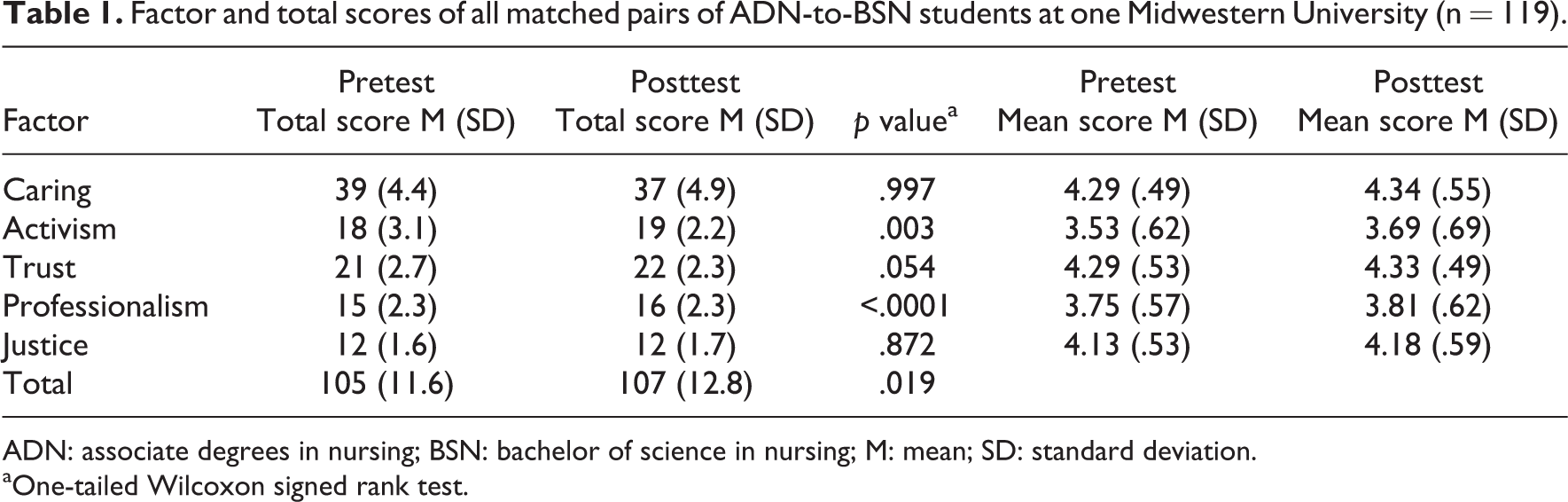
Eighty-two percent of the participants identified as female (n = 98) and 18% (n = 21) as male. The majority of the participants were White (71%, n = 91), with 12% (n = 10) self-identifying as Black, and 22% (n = 18) as a race other than White or Black. The average participant age was 36 (SD = 9.1), with an average of 6 years (SD = 6.4) of nursing experience after earning their ADN. The mean pretest total score was 105 (SD = 11.6) and the mean posttest total score was 107 (SD = 12.8). The null hypothesis of normality was rejected using the Anderson–Darling, Shapiro–Francia, and Shapiro–Wilk tests 21 –23 (p values = .0163, .0291, and .0428, respectively), leading to the conclusion that data were not normally distributed. Therefore, the Wilcoxon signed rank test was used to test for a significant difference in pretest and posttest values (Table 1).
Factor and total scores of all matched pairs of ADN-to-BSN students at one Midwestern University (n = 119).
ADN: associate degrees in nursing; BSN: bachelor of science in nursing; M: mean; SD: standard deviation.
aOne-tailed Wilcoxon signed rank test.
Ethics course before pretest cohort
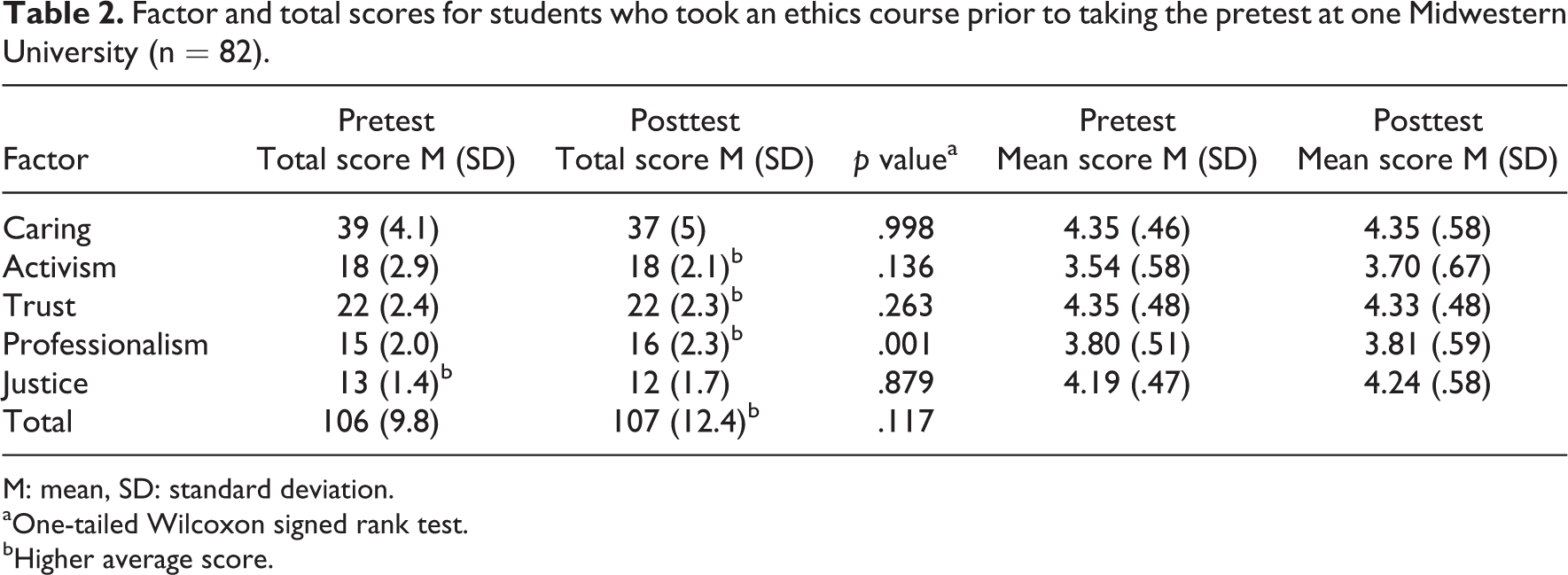
Eighty-two participants were enrolled in the ethics course prior to taking pretest. Of these, 80% identified as female (n = 66) and 20% (n = 16) as male. The majority of the participants were White (68%, n = 56), with 12% (n = 10) self-identifying as Black, and 20% (n = 16) as a race other than White or Black. The average participant age was 35 (SD = 9.0), with an average of 6 years (SD = 7.0) of nursing experience after receiving their ADN. The mean pretest total score was 106 (SD = 9.8) and the mean posttest total score was 107 (SD = 12.4) (factor summary scores are shown in Table 2). The null hypothesis of normality was rejected using the Anderson–Darling, Shapiro–Francia, and Shapiro–Wilk tests 21 –23 (p values = .0069, .0165, and .0142, respectively), leading to the conclusion that data were not normally distributed. Therefore, the Wilcoxon signed rank test was used to test for a significant difference in pretest and posttest values.
Factor and total scores for students who took an ethics course prior to taking the pretest at one Midwestern University (n = 82).
M: mean, SD: standard deviation.
aOne-tailed Wilcoxon signed rank test. bHigher average score.
A one-tailed Wilcoxon signed rank test yielded a significant increase in posttest over pretest scores (p value = .019). The standardized tau-equivalent reliability coefficient for the pretest was .93 and it increased slightly in the posttest to .95. 25 These values are commensurate with those reported in the literature. 2,5,6,8
A one-tailed Wilcoxon signed rank test did not yield a significant increase in posttest over pretest scores (p value = .117). The only factor demonstrating a statistically significant difference was the professionalism factor (p value = .001). The standardized tau-equivalent reliability coefficient for the pretest was .90 (confidence interval (CI): .86–.93) and it increased slightly for the posttest to .94 (CI: .91–.96). 25 These values are commensurate with those reported in the literature. 2,5,6,8,19
Ethics course after pretest cohort
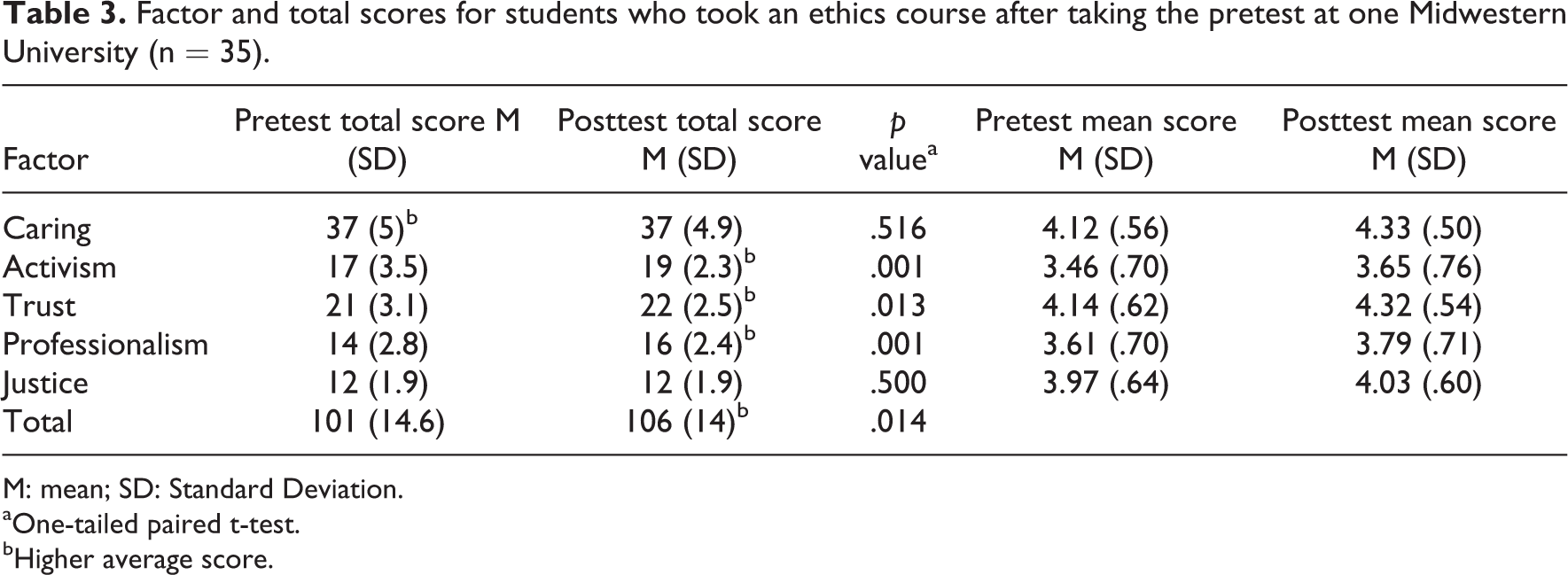
Thirty-five participants enrolled in the ethics course after taking the pretest. Of these, 86% identified as female (n = 30) and 14% (n = 5) as male. The majority of the participants were White (77%, n = 27), with 6% (n = 2) self-identifying as Black, and 17% (n = 6) as a race other than White or Black. The average participant age was 38 (SD = 9.2) and they had an average of 5 years (SD = 4.9) of nursing experience after receiving their ADN. The mean pretest score was 101 (SD = 14.6) and the mean posttest score was 106 (SD = 14.0) (summary factor scores shown in Table 3). The null hypothesis of normality was accepted using the Anderson–Darling, Shapiro–Francia, and Shapiro–Wilk tests 21 –23 (p values = .685, .527, and .688, respectively). This finding led to the conclusion that data were normally distributed and therefore a paired t test was used to test for a significant difference in pretest and posttest values.
Factor and total scores for students who took an ethics course after taking the pretest at one Midwestern University (n = 35).
M: mean; SD: Standard Deviation.
aOne-tailed paired t-test.
bHigher average score.
A one-tailed paired t test yielded a significant increase in posttest over pretest scores (p value = .014). Three factors demonstrated statistical significance: activism (p value = .001), trust (p value = .013), and professionalism (p value = .001) (Table 3). The standardized tau-equivalent reliability coefficient for the pretest was .96 (CI: .93–.98) and remained the same for the posttest at .96 (CI: .94–.98). 25
Discussion
The online RN-to-BSN program offers flexible course offerings for RNs returning to school seeking full-time, part-time, and/or intermittent study options. To assess students’ professional value outcomes, the program entry (pretest) NPVS-R is administered in the first core curriculum course (Theoretical Concepts for Professional Nursing Practice) and the program exit (posttest) NPVS-R is administered in a course required during their last semester. RN students can take select degree courses before or after beginning the core curriculum, which includes the ethics course. In this class, students primarily use case studies to examine the Code, 3 professional practice standards, key legal and moral decision-making components, self-awareness, and values clarification. While analyzing the data, the researchers recognized the study as an opportunity to evaluate the ethics course’s influence on RN students’ professional value development. The findings indicate that RNs who took the ethics course after beginning the core curriculum classes (after the pretest) had greater improvements in their posttest scores than did students who took the course early (before the pretest). For the student cohort who took the ethics course prior to the pretest, the findings indicate that the pretest (entry) scores were already influenced by the learning that occurred in the course. This cohort’s pretest scores looked more like the posttest (exit) scores of the cohort that took the ethics course after the pretest (Tables 2 and 3). While the RN-to-BSN faculty mapped and integrated the Code 3 and Standard VIII of the AACN’s Essentials 1 into the core curriculum courses, the findings suggest that the ethics course resulted in the greatest increase in professional development as measured by the NPVS-R.
In this study, RNs who took the NPVS-R at program entry and subsequently completed the core curriculum and ethics course had mean scores for each item, factor, and total that had moved in a positive direction at program exit. Significantly, higher scores were noted at program exit for the total NPVS-R score as well as the activism, trust, and professionalism factors. This finding was in contrast with Fisher 7 who reported no significant increase in BSN students’ total or factor scores from program entry to exit. Posluszny and Hawley 13 reported a positive difference in sophomore and senior BSN students only in the activism factor, whereas Lin et al. 12 reported increases in BSN students’ activism and professionalism factors, as well as the total scores. In Taiwan, Lin et al. used longitudinal data similar to what was used in this study. Fisher 7 and Posluszny and Hawley 13 used cross-sectional data in their studies. Longitudinal studies of RN-to-BSN students in an online program using the NPVS-R as a measure of professional values were not found in the literature for comparisons.
Examining the means of the NPVS-R’s items and factors showed that this study’s findings were remarkably similar to those of other studies within education and practice. The caring factor had the highest mean score at program exit. This finding was the same as those reported by Brown et al., 2 Fisher, 7 and Lin et al. 12 Posluszny and Hawley 13 reported that the caring factor mean score came in second to the trust factor, with both having similar high mean scores. Mean caring factor scores in each of these studies as well as the current study are higher than 4 on the 1–5 scale, indicating that caring is a core nursing value. In this study, as well as others, the caring factor item “acting as a patient advocate” had the highest or second highest mean score of all survey items. 5,7,8,11,13,26 Multiple studies conducted in both educational and practice settings reported that the item “providing nursing care that supports all patients’ rights and human dignity” consistently had a significantly high value. 2,5,7,8,10 –13,26,27
Nurse-reported areas of professional practice that had lower values were similar in this study compared to other studies. In this study, the activism factor had the lowest mean, a finding also reported in studies by Brown et al., 2 Fisher, 7 Lin et al., 12 and Posluszny and Hawley. 13 Consistent with the current study, the mean activism factor scores in these studies were all below 4.0 (3.55–3.82) on the 1–5 scale.
In examining survey items, lower mean scores were noted on items that did not involve direct care roles within nursing. These items were related to involvement with research, professional organizations, and policy. Items with lower-ranking means were consistent among all studies including the current one. 5,7,8,10 –13,26,27 Mean scores for the reported lower-ranking items were lower than 4 on the 1–5 scale.
The findings from this study along with the faculty’s curricular mapping process, nursing literature review, and professional standards evaluation provided support for maintaining the ethics course as a key component of the RN-to-BSN curriculum. In addition, Health Policy for Nursing was added as a required core course for RN-to-BSN students. To advance the nursing profession and prepare nurses to meet society’s increasingly diverse and complex healthcare needs, it is imperative that nurse educators emphasize professional roles and responsibilities that focus on societal health and well-being as well as direct patient care.
Limitations
One limitation of this investigation was its use of a one-group, pretest–posttest, quasi-experimental design. This design has noted limitations such as the main effects of history, maturation, testing, and statistical regression. 18 All these effects could have contributed to a potentially artificial increase in knowledge observed at posttest. In other words, we cannot rule out an increase in scores due to participants’ exposure to the pretest. In addition, the study took place at one university as a measure to assess the impact of a particular RN-to-BSN curriculum on the development of professional values. Results are not broadly transferable. However, the study does add to the body of literature related to the use of the NPVS-R scale and provides an indication that a dedicated ethics course—focusing on professional values, the Code, 3 and the legal dimensions of nursing—had a positive influence on professional values development.
Conclusion
Nurses completing an RN-to-BSN program demonstrated increases in NPVS-R scores from program entry to exit. However, significant increases were found only in the total score and the activism, trust, and professionalism factors. The ethics course was found to affect student scores.
Previous research with NPVS-R tool has demonstrated findings similar to the current study. Unique to this study is the exploration of the impact of having an ethics course in the curriculum. The entry scores of students who completed the course prior to the pretest were markedly higher than the entry scores and very similar to the exit scores of those who had not done so.
This study’s results could be helpful to educators engaged in program evaluation and curriculum development. The efficacy of including an ethics course in the curriculum should be evaluated further. This study also further corroborates the scores of BSN student’s professional values found in previous studies using the NPVS-R. For the low-scoring areas of activism and professionalism, additional content may be required within the curriculum. Further study is recommended on the impact of certain courses or course content on students’ professional value scores. Since professional nursing values are a cornerstone of nursing practice, evaluating and addressing the professional development of RN-to-BSN students regularly is a necessity.
Footnotes
Authors’ note
Gregory Gilbert is now affiliated to SigmaStats Consulting, LLC, Charleston, USA.
Conflict of interest
The author(s) declared no potential conflicts of interest with respect to the research, authorship, and/or publication of this article.
Funding
The author(s) received no financial support for the research, authorship, and/or publication of this article.
