



Abstract
Background:
Social inequities in health systems are threats to global health. Considering the important role of nurses in establishing social justice, identification of factors affecting nurses’ participation in this area can contribute to the development of social justice.
Objective:
This study aimed to identify factors affecting nurses’ participation in establishing social justice in the health system.
Research design and methods:
The study was conducted using conventional qualitative content analysis approach. Purposive sampling was used to select 14 participants in 2019. The data were collected through semi-structured interviews and analyzed concurrently with data gathering.
Participants and research context:
In total, six faculty members, five nursing managers, and three clinical nurses from three different universities were interviewed.
Ethical considerations:
The research was approved by the Ethics Committee of Urmia University of Medical Sciences in Iran.
Findings:
Four main themes were found, including inadequate professional authority, insufficient attention to social justice in the area of education, clinical concerns as barriers to professional presence in society, and reflection of personality traits in the profession. These are the main factors affecting nurses’ participation in establishing social justice in the health system.
Discussion:
Authorities need to take effective steps to establish social justice through reforming the health system’s policy-making and power-acquisition domains, promoting nurses’ involvement in social factors in health issues, and adding professional values as a part of nursing curriculum. The clinical practice environment can also be helpful through providing quality, safe, and cost-effective services. In addition, fair and efficient recruitment process for new nurses can contribute to the establishment of social justice in the health system.
Conclusion:
Macro-level managerial factors such as policy, education, and clinical environment, along with personal factors, play a significant role in the participation of nursing profession in establishing social justice.
Introduction
Health inequities are unjust differences in health systems that are rooted in sorts of discrimination or lack of access to certain resources. They arise from social issues, and the outcomes are often experienced by disadvantaged subgroups. 1 Although the terms “health disparities,” “health inequalities,” and “health inequities” are often used interchangeably, they reflect different perspectives on the “causes” of health outcomes. The terms “health inequalities” and “health disparities” refer to differences in health status among groups with specific characteristics, while the term “health inequities” clearly points to the root of health differences in social structures. 2 The determinants of unfair and unjust health conditions were listed by Whitehead, 3 including health-damaging behaviors due to a restricted choice of lifestyle, exposure to unhealthy and stressful life and work conditions, inadequate access to public and health services, and declining trend of sick people on social scales.
Researchers have paid more attention, especially in recent years, to the effect of social determinants of health. The World Health Organization (WHO) has thoroughly documented the detrimental effects of social inequalities on the health of vulnerable groups. It has also prioritized social justice as a mechanism for correcting and eliminating social inequalities. 2,4
The term “social justice” was first coined by Jesuit Luigi Taparelli in 1840, who defined it as a virtue that included actions toward common good and rectifying unfair treatment. 5 Social justice in the health system refers to the provision of equal health services to all people, regardless of their personal characteristics (e.g. gender, ethnicity, geographical location, and socioeconomic status). 6 In nursing, it is defined as “full participation in society and the balancing of benefits and burdens by all citizens, which in most cases involves social reconstruction.” 5 In Iran, which is an Islamic country, justice is highly emphasized. 7
Some outcomes of social justice in the health system include providing health equity and safety and appropriate social determinants of health both inside and among countries and societies. 8 However, social inequities lead to social resistance and conflicts, undermine public trust in the health system, and, ultimately, result in conflicts among individuals; therefore, justice is as important as the provision of health services for human survival in all cultures. 9
Given the importance of the issue of social and health inequalities as one of the most important global challenges, the increasing inequality was recognized as one of the most important issues by the United Nations (UN) in the Millennium Development Goals (MDG) for the years 2000–2015. Decreasing global inequalities became one of the 17 MDG goals for 2015–2030. The WHO Commission on Social Determinants of Health was also established in 2005. 4 Despite the considerable efforts made by the developing countries in recent years to promote social justice in their health systems, the health status of most of these countries has been unsatisfactory compared to that of the developed countries. 10 Although some health aspects have been successfully improved in Iran’s health system, 11 the system seems to suffer from some health inequities. 10
The establishment of social justice in the area of health requires the participation of all health professions, especially the nursing profession. 4 Nurses are responsible for providing healthcare to patients. They support the development of justice through fighting against inequalities (both individually and collectively) and trying to ensure equal resource allocation and equal access for all people to healthcare and other socioeconomic services. 12 Therefore, realization of social justice in the health system requires the participation of nurses. 13 Florence Nightingale and Lillian Wald were among the first advocates of social justice. Nightingale’s political efforts in social and economic issues “kindled the light of justice.” 5 Crowe was also among the pioneers of social justice in nursing profession who highlighted the role of nurses in promoting social justice in the health system. 14
However, according to the existing nursing literature, despite all efforts and extensive studies in the area of social justice, a little progress has been made. 15 Perry et al. 16 investigated barriers to nurses’ participation in social activities and identified internal (limited policy knowledge, perceived powerlessness, risks associated with advocacy, and insular disciplinary perspective) and external (disempowerment, insufficient time due to high workload, limitations of the institutionalized role, and adaptation with the interests of the research industry) barriers. Walter 17 presented a theory on social justice for nursing profession and stated the lack of educational and organizational support as an obstacle to the development of nurses’ involvement in social justice issues. Studies have also been conducted in the area of nursing education, and some researchers have provided practical solutions for better involvement of nurses in social justice affairs. 2,18 –22
Considering the importance of social justice in the health system, the key role of nurses in this area, and the existing evidence of shortcomings, accurate identification of factors contributing to the participation of nurses in the establishment of social justice in the health system is crucially important. To this end, a qualitative approach was adopted. This method helps researchers acquire a better understanding of various phenomena; it is also based on the participants’ real experiences and yields more realistic results. 23 Therefore, this study is an attempt to review the experiences of the participating nurses in order to identify factors affecting their participation in the establishment of social justice in the health system.
Method
Study design and research environment
As a conventional qualitative content analysis work, this study was carried out in 2019 in all hospitals, faculties, and nursing organizations and associations located in the cities of Urmia, Tabriz, and Tehran in Iran.
Participant
At first, nursing managers with an experience in expanding social justice were selected. In the purposeful sampling stage, the participants were selected based on their insight into the considered phenomenon. Then, based on the results of the interviews and to confirm the findings, a theoretical sampling method was followed. In total, 14 participants—eight men and six women—were selected and interviewed. The participants were five nursing managers, three clinical nurses (two in public hospitals and one in private hospitals), and six nursing educators. Seven participants had a doctorate degree, five had a master’s degree, and two had a bachelor’s degree in nursing. Sampling continued until data saturation; sampling stopped when the data obtained in the interviews were repetitive and revealed no new code. Efforts were made to diversify and enrich the sampling and have a more comprehensive look at the phenomenon under study. Participants with different genders, education levels, job positions, and various cultural backgrounds were selected.
Data collection
The study was conducted for 9 months. In-depth semi-structured interviews were used individually and face-to-face. The average interview time was 60 min (30–90 min). At the request of the participants, the interviews were conducted at their workplaces. After the warm-up phase, interviews would be continued on the subject of study. Questions were about the experience of participants in establishing social justice in the health system, such as “What do you do to promote social justice in the health system? Given the abstract nature of the issue, more efforts were made to address this issue with more objective and detailed questions. For example, given the participants’ reference to the disproportionate distribution of nursing staff across the country, professional policymakers were asked the following questions: “Describe your experiences of measures aimed at proportional distribution of nursing staff across Iran?” Factors affecting nursing profession’s participation in establishing social justice in the health system were also identified using questions such as “Considering your experiences, what factors affect your participation in the establishment of social justice in Iran’s health system?”
Data analysis
The collected data were analyzed through a conventional content analysis approach following Graneheim and Lundman’s method. 24 In this method, an entire interview is considered as a unit of analysis. A unit of analysis refers to the notes that must be analyzed and coded. The recorded interviews were transcribed verbatim after listening to the interviews for several times. The paragraphs, sentences, and words were considered as units of meaning. A unit of meaning refers to a set of words and sentences that are related to each other in terms of content and categorized based on their content and context. The written texts were reviewed several times to highlight the words containing key concepts or units of meaning and extract the initial codes. The codes were then reviewed several times in a continuous process from code extraction to labeling. Similar codes were merged, categorized, and labeled to obtain the subcategories. Finally, the extracted subcategories were compared and merged (if possible) to form the main categories or themes.
Assessment of data accuracy and stability
Guba and Lincoln’s criteria were used to ensure data rigor. The credibility of the data was assessed using member-checking and prolonged engagement techniques. The data were also assessed by an external researcher (external checking process). Triangulation method was used to control dependability. In addition, the audit trail method was used to obtain confirmability. In this respect, all research steps, especially the data analysis steps, were recorded in detail to help other researchers pursue this work in future. The transferability of the findings was also established by providing a rich description of the research report. 23
Ethical considerations
The eligible participants were invited to participate after obtaining approval from the Ethics Committee of Urmia University of Medical Sciences and necessary permissions. Before conducting the interviews, explanations were provided to participants about their anonymity, confidentiality of their information, research objectives, research method, and their right to leave the study at any time. Informed consent forms were then signed by the participants.
Results
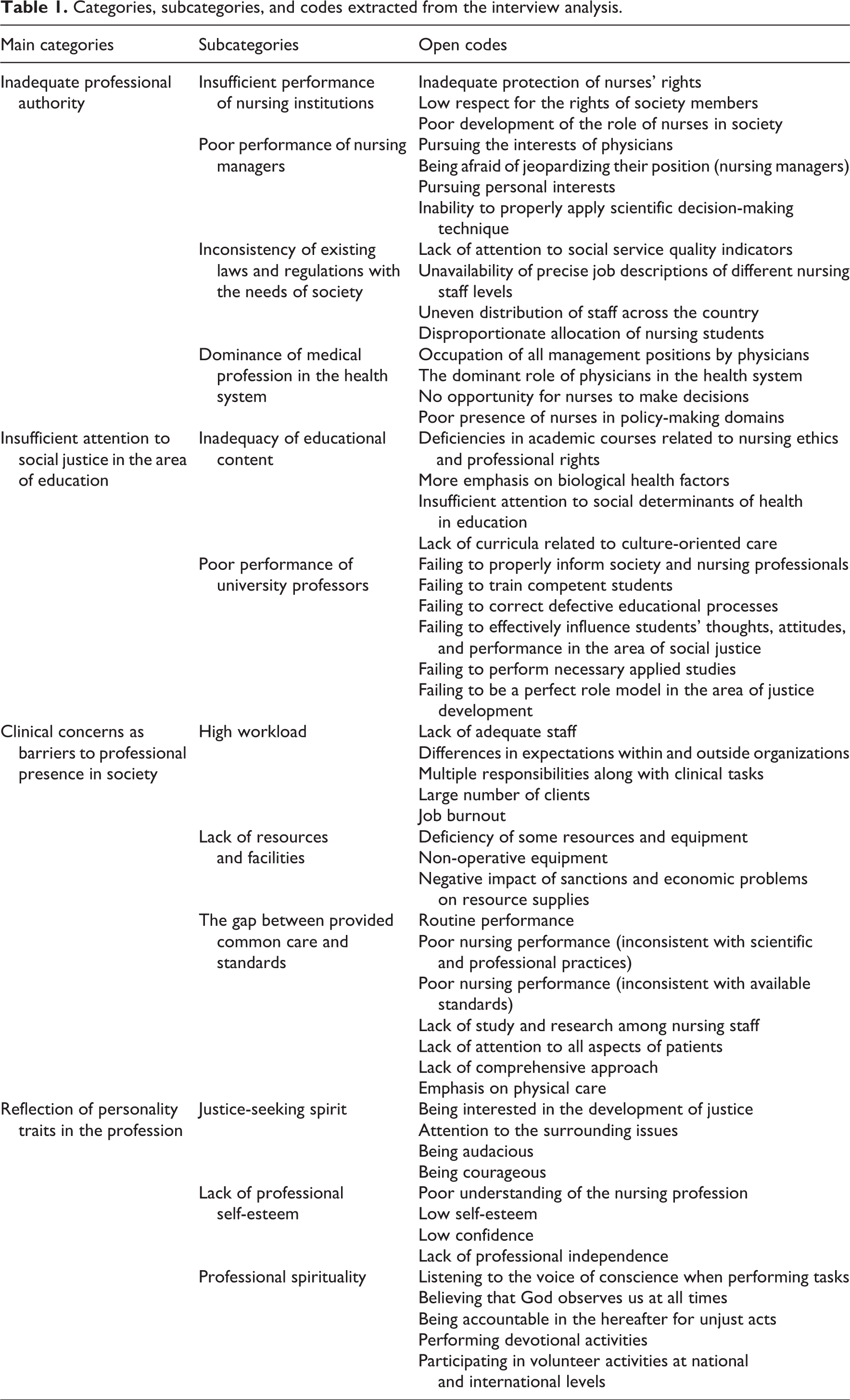
Based on the interview results, the themes “inadequate professional authority,” “insufficient attention to social justice in the area of education,” “clinical concerns as barriers to professional presence in society,” and “reflection of personality traits in the profession” were identified as the main factors affecting nursing profession’s participation in establishing social justice in the health system (Table 1).
Categories, subcategories, and codes extracted from the interview analysis.
Inadequate professional authority
The authority of the nursing profession serves as a driving force for the promotion of social justice in health system. Based on the data, due to poor performance of nursing institutions, poor performance of nursing managers, inconsistency of existing laws and regulations with the needs of society, and dominance of medical profession in the health system, nurses do not have the necessary professional authority to promote social justice in the health system. These factors were considered as subcategories of this theme.
Poor performance of nursing institutions
The activities of professional nursing institutions have improved the professional authority of nurses in the establishment of social justice. However, according to the participants, these activities are inadequate. Participants strongly emphasized that nurses have failed to gain their professional rights and cited this factor as a major obstacle to realize professional justice. According to the participants, there is a bilateral relationship between the provision of professional rights of nurses and efforts made by nurses to meet the needs of community members. Nursing institutions can play a crucial role in protecting the rights of actors in the health sector. According to the data, performance of these institutions was insignificant.
One participant stated, Protecting the clients’ rights is among the objectives and job descriptions of the Iranian Nursing Organization. However, the measures taken by this entity have not been effective. (Participant No. 3)
Poor performance of nursing managers
Nursing managers play an important role in establishing social justice in a health system by providing effective solutions. However, based on the data, the performance of managers in this field was not satisfactory. The participants cited issues such as trying to maintain their positions (jobs) and pursuing personal interests, and argued that these issues are in contrast to social justice.
One participant stated, During inspections, our hospital’s nursing service manager tries to conceal the shortages of the ward and hide the problems, instead of reporting the shortage and problems to the inspectors. This prevents the fair distribution of facilities. (Participant No. 7)
Inconsistency of existing laws and regulations with the needs of society
The establishment of social justice in the health system requires enactment of efficient laws which are based on the needs of society. However, the results revealed that the existing laws are inconsistent with the needs of society. Deficiencies related to existing indicators, job descriptions, and staff distribution procedures were identified by the participants as the items requiring further attention and modification. One participant stated, Unfortunately, in Iran, nurses are not appropriately distributed across different provinces. For example, there is a nursing faculty in a city with lots of students (mostly residents of the same city), and there is only a 60 to70-bed hospital in that city. Hence, the number of nursing staff in the city is clearly beyond the need of the city. (Participant No. 6)
Dominance of medical profession in the health system
This item refers to the fact that in the health system, physicians occupy most of the managerial positions. This issue restricts nurses’ power and hinders their activities undertaken to promote justice in the area of health. In this respect, one participant stated, The monopolistic view of health care authorities (who are mainly physicians) is the primary obstacle to promote justice. Unfortunately, physicians are the rulers; they have occupied most of the decision-making jobs. We cannot develop justice, when we cannot make decisions. (Participant No. 14)
Insufficient attention to social justice in the area of education
Proper education plays a valuable role in training justice-oriented nurses. Social justice and its importance in healthcare are not part of the nursing syllabus. More attention should be paid to this issue in all areas of education. For example, professors should use practical and objective methods to stimulate students’ emotions to pursue justice in the health system. However, the present results indicated that Iran’s education system has been unsuccessful due to inadequacy of educational content and poor performance of university professors.
Inadequacy of educational content
Development of comprehensive curricula on ethical issues such as social justice enables students to participate in the establishment of social justice in the health system. The following comment was made by a participant on the importance of education: I was not aware of the importance of social issues in health until I participated in a workshop called “social justice in health.” This workshop really changed my beliefs and broadened my perspective. (Participant No. 11) During our undergraduate studies, there was no course containing professional ethics codes such as social justice. Now, I cannot even provide a clear definition of social justice in the health system.
Poor performance of university professors
Professors play an undeniable role in training individuals and internalizing their beliefs and behaviors. Instructors can act as role models for students by discussing social issues about health in classroom and demonstrating justice in their relationship with students. Through this, they can promote the sense of social responsibility in students.
Despite the important role of nursing professors, the participants believed that the performance of their professors was inadequate in terms of training justice-seeking individuals. In this regard, one participant said, When I was a student working in the surgery ward, I informed my professor about the anxiety of patients and lack of pre-operative patient training. However, my professor recommended me to cooperate with head nurses. I did not see any patient support at that time. (Participant No. 10)
Clinical concerns as barriers to professional presence in society
Promotion of public health primarily requires the provision of desirable services in the clinical setting. This will prepare the ground for development of community-based health. However, according to the data, various clinical concerns such as high workload, lack of resources and facilities, and the gap between provided common care and standards prevent the active participation of nurses in health equity development.
High workload
The participants argued that low ratio of nurses to bed puts more pressure on nurses. This leads to minimal care provision, especially in the face of high admission rates. According to the participants, this issue leads to infringement of patient rights, and on the other hand, high workload prevents nurses from participation in social and justice development activities.
Regarding the shortage of nursing staff, one participant stated, We have two nurses covering patients in 30 beds; while we need a minimum of four or five nurses for these beds. Naturally, we cannot provide quality care, and in these conditions, we cannot even think about social justice in the health system. (Participant No. 1)
Lack of resources and facilities
Lack of resources, due to either unavailability or inefficiency of resources, is an obstacle to the provision of quality health services by health systems. It also leads to the provision of poor nursing care and infringement of patient rights. The participants stated that the lack of resources is an obstacle to promotion of social justice: Most of the resources and facilities are often concentrated in big cities. It is a norm to gather many expertise and different medical equipment in a big center. Small cities must also have minimum resources to provide patients with desirable care services. (Participant No. 2)
The gap between provided common care and standards
Care standards represent an acceptable level of quality of care developed for a particular group by some experts based on available evidence. Receiving standard cares is part of the rights of all members of society and a manifestation of social justice in the health system. The participants believed that current care provided by nurses in Iran does not meet minimal international standards. In this regard, the participants reported the lack of evidence-based practice and holistic care provision. Participant No. 8 stated, Based on my observations of students, nurses do not often give patients their medicines on time. They also forget to wash their hands before and after medical procedures, and fail to observe sterilization guidelines.
Reflection of personality traits in the profession
In addition to the above-mentioned managerial factors, personal factors also play a significant role in the development of social justice in a health system so that according to the data, personality traits such as justice-seeking spirit, professional self-esteem, and spirituality influenced nurses’ participation in development and promotion of social justice in the health system.
Justice-seeking spirit
Justice-seeking spirit is a personal value that is rooted in one’s cultural background. Given the cultural and religious context of the study population, this characteristic was very important, and in many cases, individuals had attempted to develop social justice in the health system despite all problems. Attention to the surrounding issues and being audacious and courageous were cited by the participants as examples of justice-seeking spirit. Participant No. 3 stated, Developing justice in any community requires devoting considerable time and paying the price. It is not easy; some people in our profession do not have the courage, but I accept all these problems and will never give up on my goal.
Lack of self-esteem
Self-esteem is a psychological notion that is accompanied with a focus on positive aspects and improvements in confidence and self-worthiness
25
and contributes to social justice. The data suggested that many nurses had poor professional self-esteem, which reduced their courage to participate in the establishment of social justice. One participant argued, You cannot expect nurses, who are sometimes considered as secretaries and treated as second-class staff, to take steps and promote social justice in the health system. They don’t feel confident enough. (Participant No. 9)
Professional spirituality
Spirituality is an intrinsic value influenced by religious beliefs and social culture. According to the data, spirituality affects different aspects of Iranian nurses’ professional performance and promotes social justice in the health system. In this respect, one participant stated, As a nurse, I always listen to the voice of my conscience when treating a patient, and don’t favor some patients over others. I believe that God is watching us at all times, so I do my best for all patients and try to protect their rights. (Participant No. 5)
Discussion
Based on the findings, professional authority, academic education system, clinical practice environment, and personality traits of nurses were identified as the main factors affecting nursing profession’s participation in establishing social justice in a health system.
Professional authority was among the factors contributing to the participation of nurses in the establishment of social justice in the health system. Unfortunately, in this study, this factor acted as a deterrent due to several factors, including poor performance of nursing institutions, poor management performance, inconsistency of existing laws and regulations with the needs of society, and dominance of medical profession in the health system. Other studies have also emphasized the critical role of nursing organizations in improving individual and collective performance of nurses to promote social justice. 26 For instance, Dos Santos et al. 27 emphasized this issue, and Reutter and Kushner 2 highlighted the role of various institutions, including nursing organizations in supporting nurses in the path of social justice development. Dos Santos et al. 27 reported that the performance of these institutions was in favor of the working class, which is inconsistent with the present results. Poor presence of nurses in policy-making domains and professional dominance of physicians over nurses (dominance of medical profession in the health system) seem to be a barrier to the participation of the nursing profession in the establishment of social justice. The deterrent role of professional dominance of physicians in health systems has also been highlighted in other societies as reported by Ameen’s study. 28 A true example of this case is that nurses cannot easily raise their voices in other parts of the world as well. 29 The inconsistency of existing laws with the needs of society has also been discussed in Perry’s study, where he quotes from Churchill: the expansion of social justice in the health system depends on policies derived from the needs of society. 16
Academic education was identified as another factor contributing to the participation of nursing profession in the establishment of social justice in the health system. As shown, this factor has also failed to help develop social justice due to the inadequacy of educational content and poor performance of university professors. Other scholars have also pointed out the importance of the issue of social justice in the health system during education, in terms of both education content and teaching techniques. Rozendo et al. 4 conducted a review study and found that in some countries, such as the United States, educational topics related to this issue are available in undergraduate curricula, while there is little material on social justice in postgraduate curricula. Ellis 30 stressed the need for providing nursing professionals with proper education on social justice. Performance of professors was another important factor in this study, which was considered unsatisfactory by the participants. One of the most influential leaders of social justice education emphasized the important role of professors in this area. 21 Ellis also stated that university professors should shift nursing student learning and the predominant way of thinking from individual client to collective society and from tertiary (reactive) care approaches to primary (preventive) care approaches. He considered this as a manifestation of social justice in the health system. 30
The results showed that various clinical concerns such as high workload, lack of resources and facilities, and the gap between provided common care and standards have restricted the presence and influence of nursing professionals in society. The effect of workload on proper and ethical performance of nurses has been confirmed in various studies. 31 –34 Lack of medical resources and equipment reduced the quality of nursing services and led to unequal allocation of these services to people. Moyimane et al. have also confirmed the effect of lack of medical resources and equipment on the quality of nursing services and health equity. In their study, some nurses noted that shortage of medical equipment deprives some people from these facilities and promotes inequality in the health system. 35
In this study, justice-seeking attitude, professional self-esteem, and spirituality were introduced as nurses’ personality traits influencing the development of justice. Other studies have also confirmed the effect of personality traits on individuals’ willingness to participate in social and justice-seeking activities. 36 Moore 37 found that the personality traits of authoritarianism, self-esteem, powerlessness, national identity, patriotism, religiosity, ethnicity, education, and income affected one’s willingness to participate in social actions. Spirituality has an impressive and undeniable effect on justice-seeking attitude. According to Todd and Rufa, 38 social justice in a health system is essentially a religious and spiritual value. These religious and spiritual beliefs are also significantly important in the nursing profession, and the provision of ethical care is considered impossible without strong spiritual beliefs and professional commitment. 39 The voluntary and devotional activities of Iranian nurses in various situations are spiritual acts and great examples of participation of nurses in developing social justice in the health system. In Western European countries, 30% to 60% of adults are involved in organized and voluntary activities aimed at justice development. 40 Jiranek et al. 41 also highlighted voluntary activities performed to promote social justice in the health system.
In general, the concept of social justice differs from the perspective of professional members in different situations (policy-making, education, clinical). Some consider the social justice equivalent to providing quality care without discrimination in clinical setting, and some have a broader view of the issue and consider it as provision of minimum health benefits by all members of society in proportion with their needs. They believe that this is feasible with the presence of nurses in the community and the provision of nursing services at various levels of prevention. Ellis stated that with the development of social justice perspectives in nursing, there has been a growing attention to social justice. In addition, nursing seeks solutions beyond the individual client and thinks about the collective health of society. 30 Of course, due to the concerns in our country’s clinical setting, unfortunately, the development of professional thinking from the individual level has not made significant progress, and the limitation of the profession to the treatment field and shortages of education have also provoked this issue.
The findings of this study are limited to the factors affecting nursing profession’s participation in establishing social justice in the health system in Iranian culture. Further studies with qualitative and quantitative approaches are required in different cultures.
Conclusion
More attention must be paid to social issues of health and professional values in educational curriculum in order to train justice-seeking nurses with a sense of responsibility. Trying to demonstrate the capacities of the nursing profession and preparing the ground for active presence of nurses in policy-making domains are essential for acquiring and promoting professional authority. Managers should also strive to resolve clinical problems such as lack of staff and equipment. Considering the effect of personal characteristics on the demonstration of justice-seeking behaviors, careful recruitment of nursing candidates is also very important.
Footnotes
Acknowledgements
This study is part of a PhD dissertation approved and funded by the Office of Vice Chancellor for Research of Urmia University of Medical Sciences (Code: IR.UMSU.REC.1397.223). The researchers would like to thank all the participants for their sincere cooperation.
Conflict of interest
The author(s) declared no potential conflicts of interest with respect to the research, authorship, and/or publication of this article.
Funding
The author(s) disclosed receipt of the following financial support for the research, authorship, and/or publication of this article: This study was funded by the Research Department of Urmia University of Medical Sciences.
