



Abstract
Background:
Professional commitment, which constitutes one of the criteria of the professionalisation process, is directly affected by attitude towards the work, constituting the content of nursing profession.
Aim:
This study was conducted to determine the effect of nurses’ attitudes towards work on their professional commitment.
Methods:
This study is a cross-sectional and analytical study. The data were collected from 293 nurses working at different units in a public hospital between April 2019 and May 2019. The data collection tool includes a 10-question participant information form, the Nurses’ Professional Commitment Scale and the Attitude Towards Work Scale. Variables were analysed using multiple linear regression.
Results:
The nurses obtained high scores from overall professional commitment and attitude towards work scales and their subscales. Significant differences were found in the scale total and its subscales caused especially by the variables of professional experience, position, income level and the status of willingly choosing the profession (p < 0.05). Nursing professional commitment was predicted by ‘content of the work’, (β = 0.32, p < 0.01), ‘working conditions’ (β = 0.38, p < 0.01), ‘co-workers’ (β = 0.30, p < 0.01) and ‘compensation’ (β = 0.21, p < 0.01), which accounted for 25.6% of the variance in nursing professional commitment.
Ethical considerations:
Ethics committee approval and institutional permissions were obtained. The participants were informed about the study and written consent was obtained.
Conclusions:
The nurses who had an increasing duration of professional experience, were working in managerial position, found their income level sufficient and chose the profession willingly had higher professional commitment and attitudes towards work. In addition, a significant correlation was found between nurses’ professional commitment and their attitudes towards work, and nurses’ professional commitments were explained with their attitudes towards work. It is important to increase and strengthen the attitude towards work that affects nurses’ professional commitments.
Introduction
Nursing has managed to renew itself with social, cultural and scientific changes from past to present during the professionalisation process. and it is one of the health-related professions that play an effective role in protecting, improving and maintaining the health of the society. 1 Professional commitment, one of the criteria of nursing in the professionalisation process, 2 signifies that nurses believe and accept the ethical values of their profession, and they are willing to improve themselves in professional field and determined to continue this profession by striving to realise these values.3,4
The professional commitment, defined as the emotional attachment that individuals develop with their profession, is expressed as a strong identification of individuals with their profession.4,5 Professional commitment starts in the education process of the individuals and continues to grow stronger throughout their professional lives. 3 Nurses’ professional commitments start to develop during their education period and continue as a professional socialisation process with the internalisation of professional values.4,5 Along with the nurses’ professional commitment, their attitudes towards the profession and work they do have an important place in bringing their occupation to a professional status, delivering a qualified healthcare service, law of caring professions and strengthening their professional identities.6,7
Nurses’ attitudes, ethical and moral values towards work, which play an important role along with the professional commitment in the provision of qualified and desired healthcare services guide nurses’ interaction with individuals, communities and colleagues they care for by providing a basis for nursing practices. 7 In the literature, factors that are related to nurses’ professional attitudes have been reported as education level, working duration, status of being satisfied with the profession, the department they work in, membership to associations related to the profession, participation in scientific activities and number of shifts.4,8–11 Besides, it has been reported that the nurses’ professional attitudes increased as their education level and working duration increase, and the nurses’ professional and work-related attitudes are also reported to be related to patients’ perceptions on nursing care. 4
In the studies evaluating nurses’ professional commitments, positive correlations between professional commitment and job satisfaction, and organisational commitment and job performance and negative correlations between professional commitment and organisational-professional turnover rate were reported.12–15 It was expressed that there was a strong correlation particularly between the intention to leave the profession and professional commitment.4,16 In their study, Numminen et al. 14 revealed that professional competence, age, work experience and satisfaction with the nursing profession increased professional commitment. In another study, it was reported that as professional commitment increased, the individual would adopt his or her job more and see and feel it as his or her own business. 17 In another study, Kong et al. 18 indicated that professional commitment in nurses increased patient safety and perceived patient care quality. Evaluating the professional commitments and attitudes towards work of nurses who are involved at the centre of healthcare practices and revealing the correlations between them are important in order to provide and maintain adequate and qualified healthcare services, with ethical and moral values.
Aim
The first aim of this study is to describe the level of nurses’ attitudes towards work and professional commitment. The second aim is to determine the effect of nurses’ attitudes towards work on their professional commitment. Finally, the third aim is to test the effect of nurses’ sociodemographic and professional characteristics on their attitudes towards work and professional commitment.
Methods
Study design
This study was conducted as a cross-sectional and analytical study.
Sample and procedure
The population of the study consisted of 558 nurses working in a public hospital. In calculating the sample size, the formula (n = N × t2 × p × q / d2 × (N − 1) + t2 × p × q) recommended for cases with known population was used.19,20 According to this formula, the ideal sample size was calculated as 289 in a population consisting of 558 nurses with a significance level of 95% and a sampling error of 4%. The data were collected between April 2019 and May 2019. The questionnaires were distributed and collected by researchers of this study. Participants were informed about the aim of this study and they were assured about the confidence of their responses. Their approval for participating in this study were obtained via informed consent form. In the first phase, 202 questionnaires out of 320 were returned. After a follow-up procedure was carried out, 95 questionnaires were returned. The response rate was 92.81%. After eliminating the incomplete questionnaires, the sample of the study consisted of 293 questionnaires filled completely.
Measures
The data were collected by the survey method. The first part of the questionnaire included questions about the sociodemographic and professional characteristics of nurses.
In the second part, Nursing Professional Commitment Scale (NPCS) was included. This scale was developed by Lu et al. 21 and adapted into Turkish by Çetinkaya et al. 22 It was a 4-point Likert-type scale (1 = strongly certain to 4 = strongly uncertain). The scale’s content, language and construct were validated by Çetinkaya et al. 22 The scale consists of 26 items and 3 subscales after the scale was validated using exploratory factor analysis. 22 These are ‘desire to effort’, ‘maintaining professional membership’ and ‘devotion to goals and values’. The scale and its subscales had acceptable reliability according to the study of Çetinkaya et al. 22
Finally, in the last part, there were questions related to the Attitude Towards Work Scale (ATWS). This scale was a 5-point Likert-type scale (1 = strongly disagree to 5 = strongly agree). It was developed by Baysal 23 and adapted by Altuntaş and Baykal 24 for nurses. Content validity, language validity and construct validity of the scale were analysed and validated by Altuntaş and Baykal. 24 ATWS consists of totally 55 items and has 6 subscales (institution, manager, content of the work, working conditions, co-workers and compensation). Altuntaş and Baykal reported that the Cronbach’s alpha values of the overall scale and its subscales were above 0.70. 24
In order to use both scales (NPCS and ATWS) in the current study, permissions were first obtained from the authors adapting these scales into Turkish via e-mail.
Data analysis
SPSS 23 software program was used to analyse the data. First, it was determined whether or not the data were normally distributed. To do this, the skewness and kurtosis scores of the variables were examined. Tabachnick and Fidell 25 state that the skewness and kurtosis indexes calculated by dividing the skewness and kurtosis coefficients into their standard errors are close to 0 within ±2 boundaries, which indicates the normal distribution of the data. Accordingly, it was determined that the data of this study were not normally distributed (skewness: 0.26 to −4.63; kurtosis: 0.66 to 7.92). Therefore, non-parametric tests were used to analyse the data. Kruskal–Wallis test was used to compare the sociodemographic and occupational variables according to three categories such as age, having children, education, organisational tenure, work shifts and willingly choosing the profession. Then, Dunn’s post hoc test was performed to find out which groups differ from each other significantly. 26 For two categories of sociodemographic and occupational variables, Mann–Whitney U-test was used. Finally, multiple linear regression analyses were performed to determine the effect of nurses’ attitudes towards work on their professional commitment. The assumption of regression analyses was tested by checking multicollinearity. 27 The multicollinearity is a statistical phenomenon that arises due to strong relationships between independent variables. If there are high correlation values between the independent variables, the multicollinearity problem occurs. 28 In the literature, variance inflation factor has been one of the indicators of multicollinearity.27,28 Variance inflation factor is the value that represents how much of the variance of the dependent variable explained by the independent variables is inflated. Variance inflation factor is used to determine how far the variances diverge from the true values due to the multicollinearity problem. 27 Variance inflation factor should be less than 10. 27 In this study, values of variance inflation factor were found within the range of 1.64–2.39. Therefore, it could be concluded that multicollinearity did not exist. Then, sociodemographic and professional variables were controlled in regression analyses to eliminate the effect of sociodemographic and professional variables of nurses on dependent variables. For this reason, nurses’ sociodemographic and professional variables were converted into dummy codes (e.g. for gender 1 = female, 0 = male). Table 5 shows all dummy variables.
Ethical considerations
Ethics committee approval (Decision No: 2018/05/06, Date: 12 March 2018) and institutional permissions were obtained. The participants were informed about the study and written consent was obtained.
Results
Characteristic features of the sample
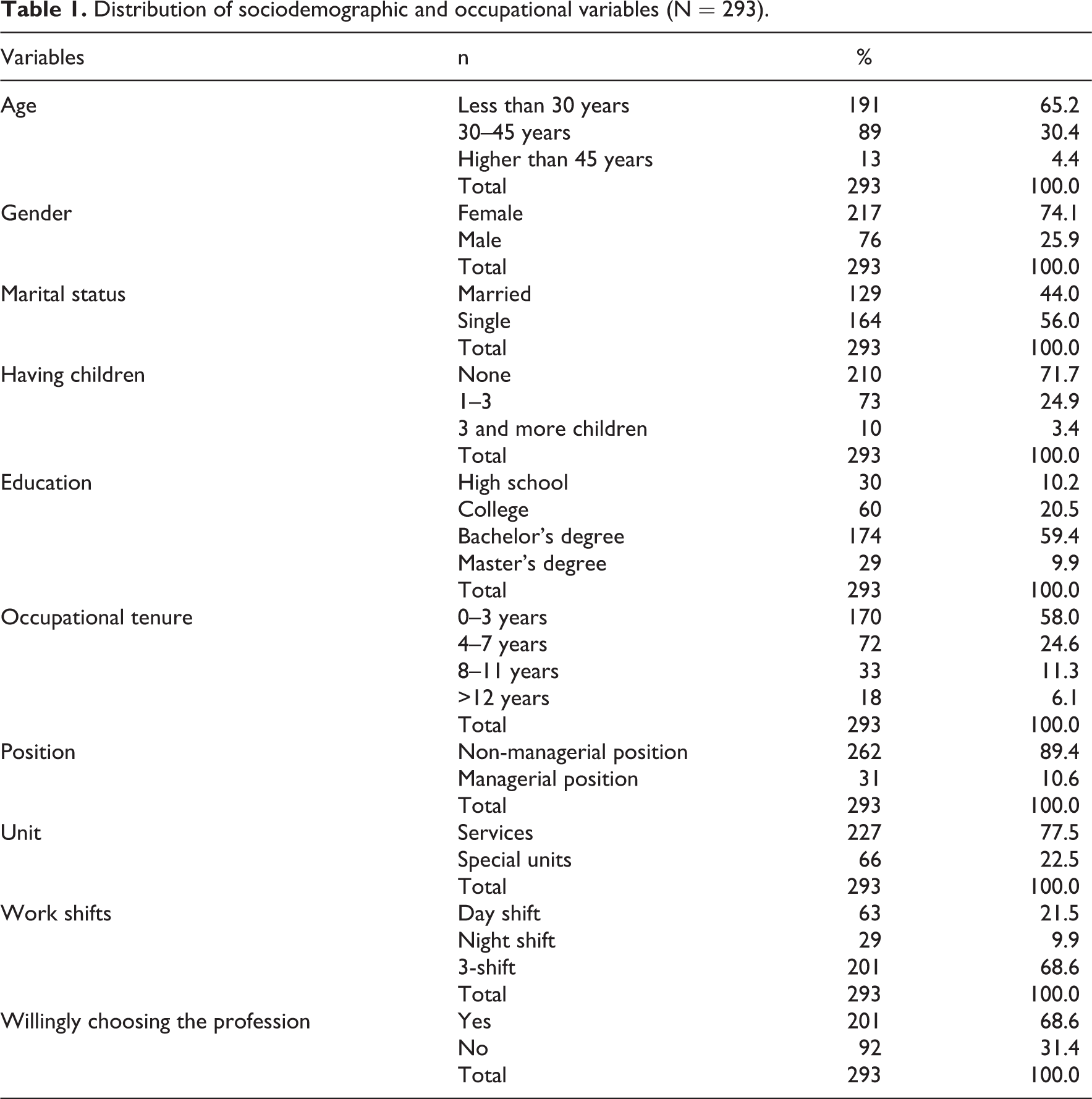
Table 1 shows sociodemographic and professional variables of the sample. Based on Table 1, the majority of the participants were aged under 30 years, female, single, and had no children. In addition, the majority of them worked at service unit and declared that they chose their profession willingly.
Distribution of sociodemographic and occupational variables (N = 293).
Descriptive data, correlation and Cronbach’s alpha coefficients of the variables
Table 2 shows the descriptive data, correlation and Cronbach’s alpha coefficients of the scales and their subscales. When Table 2 was examined, it was seen that Cronbach’s alpha coefficients of all variables were higher than 0.70, showing that the scales were reliable. 29
Descriptive data, correlation and Cronbach’s alpha coefficients of variables (N = 293).

SD: standard deviation. Cronbach’s alpha coefficients are given in parentheses.
According to Table 2, the total mean score of the ATWS on the 5-point Likert-type scale was found to be 3.03 ± 0.33, indicating that nurses’ attitudes towards work were moderate. When the subscales of the ATWS were examined, it was determined that the highest mean score belonged to the subscale of co-workers (3.71 ± 0.85), while the lowest mean score belonged to the subscale of working conditions (2.45 ± 0.96). The total mean score of the NPCS on the 4-point Likert-type scale was found to be 2.72 ± 0.38. Based on this score, it could be concluded that professional commitment of the nurses was above average. When the subscales of the professional commitment scale were examined, it was determined that while the highest mean score (2.94 ± 0.44) belonged to devotion to goals and values, the lowest mean score (2.40 ± 0.81) belonged to maintaining professional membership.
When the correlations between the variables were examined, the correlation between ATWS and NPCS was moderately strong, positive and significant (r = 0.553, p < 0.01). While the correlation coefficient between the job content subscale and the nursing professional commitment was the highest (r = 0.451, p < 0.01), the correlation between the manager subscale and the nursing professional commitment variable was insignificant (r = 0.90, p > 0.05).
Sociodemographic and occupational variables affecting NPCS
Desire to effort
Scores of the ‘desire to effort’ subscale differed significantly according to gender, having children, education, organisational tenure, position, income and choosing the profession willingly (p < 0.05). Female nurses reported higher scores than male nurses (p < 0.05). In addition, nurses who were managers, had sufficient income and willingly chose the profession had higher scores than the scores of others (p < 0.05) (Table 3).
Nursing professional commitment scale according to sociodemographic and occupational variables (N = 293).
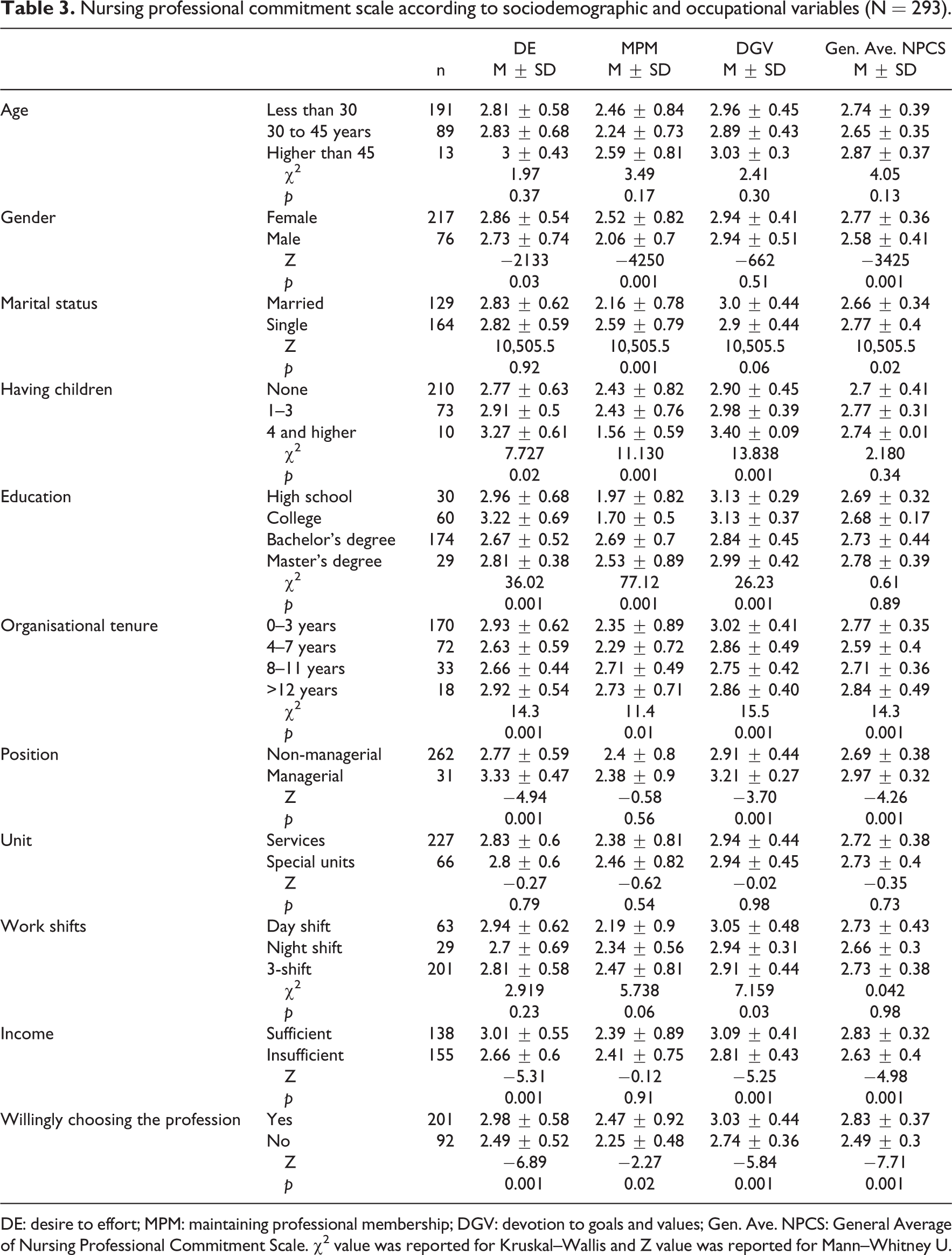
DE: desire to effort; MPM: maintaining professional membership; DGV: devotion to goals and values; Gen. Ave. NPCS: General Average of Nursing Professional Commitment Scale. χ2 value was reported for Kruskal–Wallis and Z value was reported for Mann–Whitney U.
Maintaining professional membership
As seen in Table 3, scores of the nurses in this subscale differed significantly according to the variables of gender, marital status, having children, education, organisational tenure and willingly choosing the profession. First, the nurses who were female and willingly chose the profession reported higher scores than others (p < 0.05). Nurses holding bachelor’s degree or master’s degree had higher scores than those graduating from high school or college (p < 0.01).
Devotion to goals and values
Table 3 shows that the scores of the nurses in this subscale differed significantly in terms of having children, education, organisational tenure, position, work shifts, income and willingly choosing the profession (p < 0.05). Initially, nurses who were managers, had a sufficient income and willingly chose the profession had higher scores than others. Finally, nurses working at day shifts reported higher scores than nurses working at three shifts (p < 0.05).
Total mean score of NPCS
Table 3 presents that the total mean score of NPCS on the 4-point Likert-type scale differed significantly in terms of gender, marital status, organisational tenure, position, income and willingly choosing the profession (p < 0.01). The nurses who were female, were single, were managers, had sufficient income and chose the profession willingly had higher scores than the others (P < 0.01). When post hoc test was examined for organisational tenure, only nurses having an organisational tenure of 0–3 years had higher scores than those having an organisational tenure of 4–7 years (p < 0.01).
Sociodemographic and occupational variables affecting nurses’ ATWS scores
Institution
As seen in Table 4, institution scores differed significantly in terms of age, having children, education, organisational tenure, position, income and willingly choosing the profession (p < 0.01). Managerial nurses had higher scores than non-managerial nurses (p < 0.01). In addition, the nurses who stated that they had a sufficient income and chose the profession willingly had higher scores (p < 0.01) than others.
Nurses’ attitude towards work scale according to sociodemographic and occupational variables (N = 293).
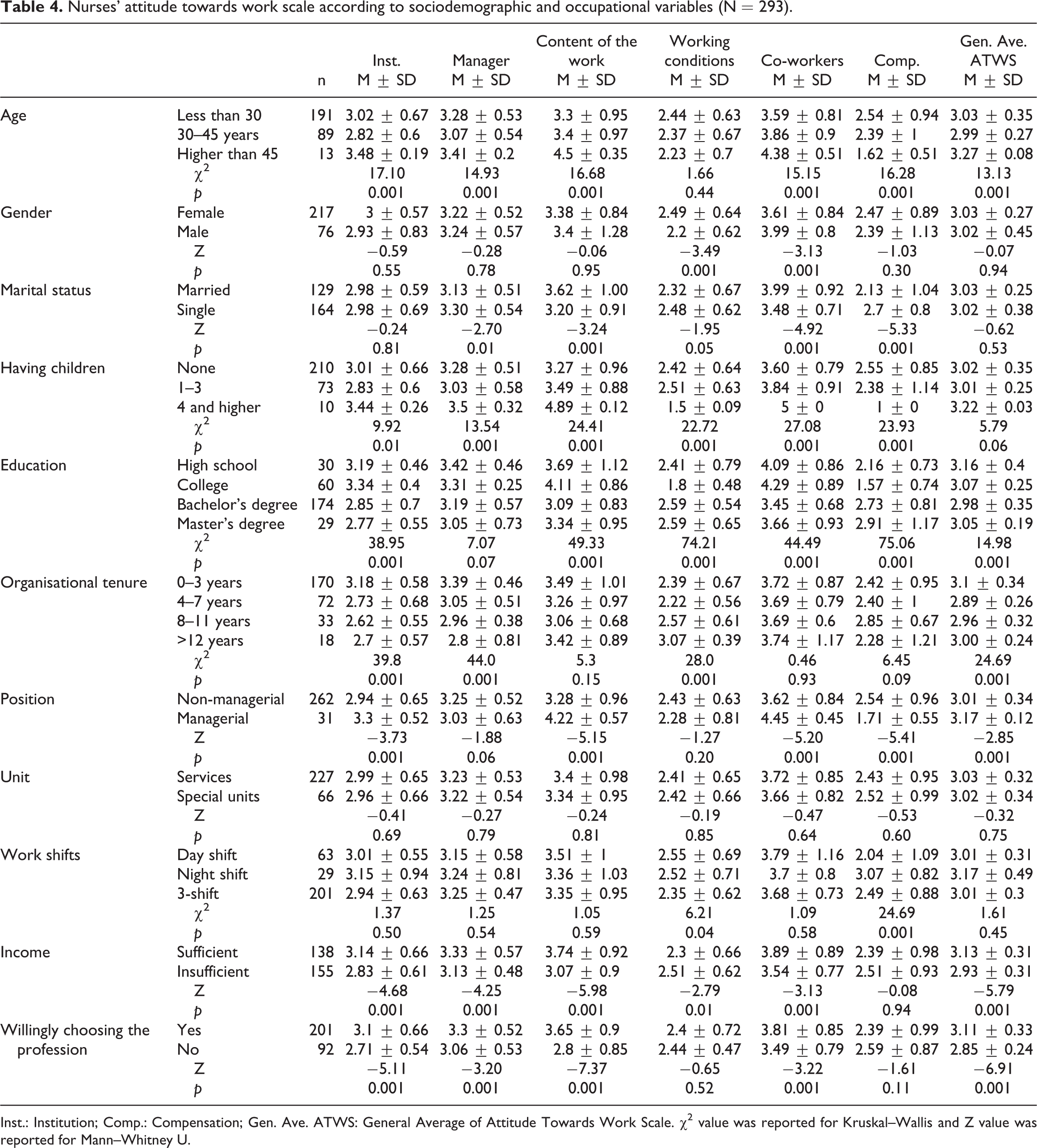
Inst.: Institution; Comp.: Compensation; Gen. Ave. ATWS: General Average of Attitude Towards Work Scale. χ2 value was reported for Kruskal–Wallis and Z value was reported for Mann–Whitney U.
Manager
Scores of ‘manager’ subscale differed in terms of age, marital status, having children, organisational tenure, income and willingly choosing the profession (p < 0.01). Then, the nurses who had sufficient income and chose the profession willingly obtained higher scores than others (p < 0.01). When the post hoc analyses were examined, the scores of the nurses aged 45 and above were the highest (p < 0.01).
Content of the work
The participants’ age, marital status, having children, education, position, income and willingly choosing the profession differed in scores of content of the work (p < 0.01). Moreover, the nurses holding managerial positions, sufficient income and choosing the profession willingly reported higher scores than other nurses (p < 0.01).
Working conditions
Scores of working conditions differed in terms of gender, marital status, having children, education, organisational tenure, work shifts and income. The nurses who were female, were single and reported sufficient income had higher scores than the others (p < 0.05). The post hoc analyses revealed that scores of the nurses having one to three children differed significantly from the other groups (p < 0.01). Finally, the nurses having an organisational tenure of 12 years and above and those working in three shifts had higher scores compared to other groups in organisational tenure and work shifts (p < 0.05).
Co-workers
In Table 4, scores of the nurses obtained in the subscale of co-workers differed significantly according to age, gender, marital status, having children, education, position, income and willingly choosing the profession. The nurses who were male and married had higher scores than others (p < 0.01). In addition, the nurses who were managers, had a sufficient income and chose the profession willingly had higher scores than the other ones (p < 0.01).
Compensation
Table 4 shows that scores of compensation differed significantly in terms of age, marital status, having children, education, position, income and willingly choosing the profession. Single and managerial nurses had higher scores than others (p < 0.01). According to post hoc test, the compensation scores of nurses aged 45 and above were the lowest (p < 0.01). Then, scores of nurses having one to three children differed from the other groups significantly (p < 0.01).
Total mean score of ATWS
Table 4 indicates that the total mean score of ATWS on the 5-point Likert-type scale differed significantly in terms of age, education, organisational tenure, position, income and willingly choosing the profession (p < 0.01). The nurses who were managers, had a sufficient income and chose the profession willingly had higher scores than others (p < 0.01). Post hoc tests revealed that the attitudes towards work of the nurses aged 45 and over differed significantly from the nurses in the age groups of under 30 and 30–45 years (p < 0.01). There was a significant difference only between the scores of those having a bachelor’s degree and those graduating from high school (p < 0.01). The nurses having a bachelor’s degree had lower scores than those graduating from high school. Similarly, only nurses having an organisational tenure of 0–3 years differed significantly from the nurses having an organisational tenure of 4–7 years (p < 0.01).
The effect of nurses’ attitude towards work on their professional commitment
Table 5 shows the results of multiple regression analyses about the effect of the ATWS and its subscales on the NPCS and its subscales.
Results of multiple linear regression analysis (N = 293).
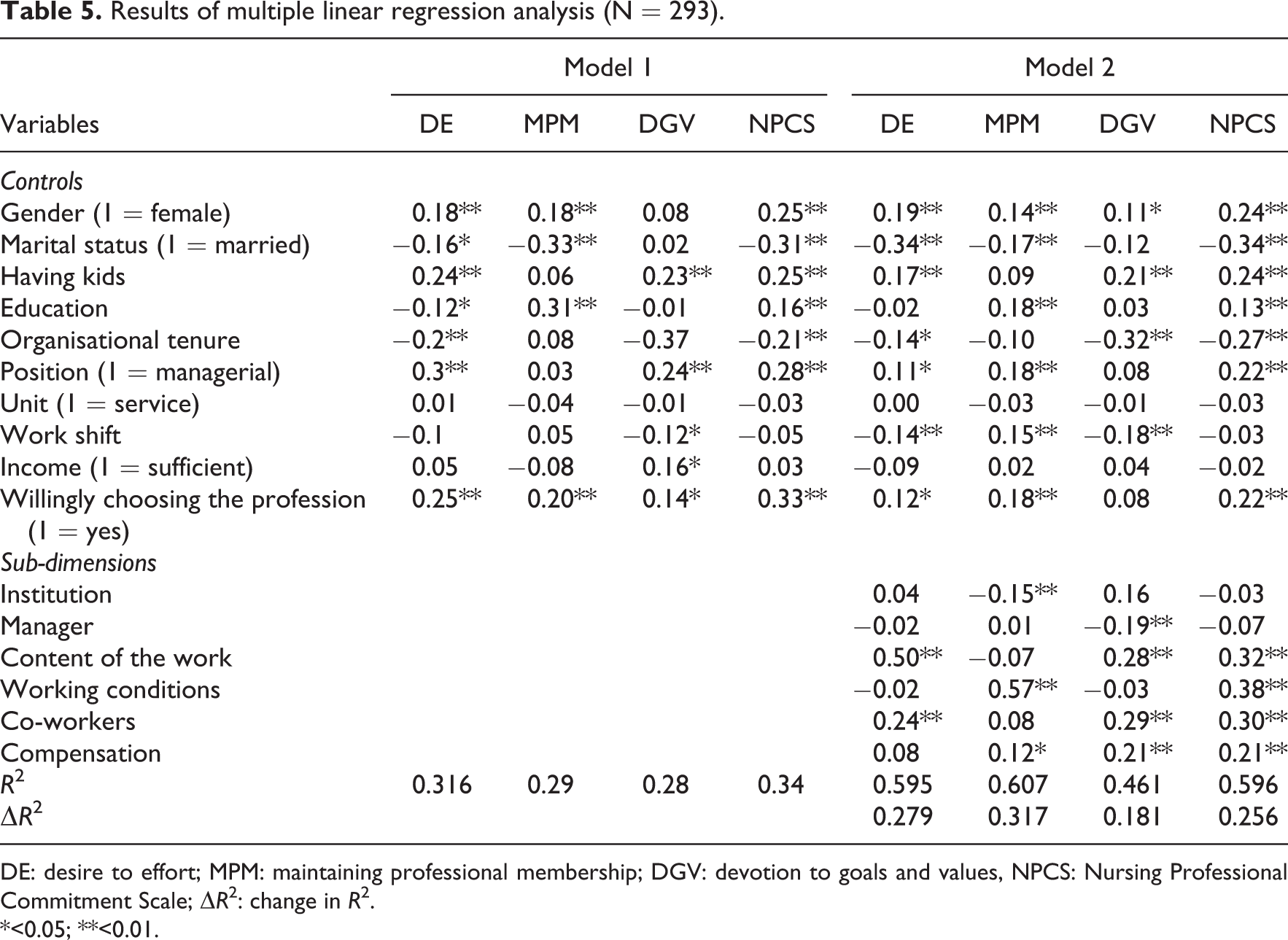
DE: desire to effort; MPM: maintaining professional membership; DGV: devotion to goals and values, NPCS: Nursing Professional Commitment Scale; ΔR2: change in R2.
*<0.05; **<0.01.
The effect of control variables on dependent variables was tested in Model 1. Control variables accounted for 31.6% of the variance in ‘desire to effort’, 29% of the variance in ‘maintaining professional membership’, 28% of the variance in ‘devotion to goals and values’ and 34% of the variance in NPCS.
The effect of nurses’ scores in ATWS and its subscales on dependent variables was tested in Model 2. According to Model 2, desire to effort was predicted by ‘content of the work’ (β = 0.50, p < 0.01) and ‘co-workers’ (β = 0.24, p < 0.01), which accounted for 27.9% of the variance in desire to effort without control variables.
Maintaining professional membership was predicted by ‘institution’, (β =−0.15, p < 0.01), ‘working conditions’ (β = 0.57, p < 0.01) and ‘compensation’ (β = 0.12, p < 0.05), which accounted for 31.7% of the variance in maintaining professional membership without control variables.
Devotion to goals and values was predicted by ‘manager’, (β =−0.19, p < 0.01), ‘content of the work’ (β = 0.28, p < 0.01), ‘co-workers’ (β = 0.29, p < 0.01) and ‘compensation’ (β = 0.21, p < 0.01), which accounted for 18.1% of the variance in devotion to goals and values without control variables.
Finally, NPCS was predicted by ‘content of the work’, (β = 0.32, p < 0.01), ‘working conditions’ (β = 0.38, p < 0.01), ‘co-workers’ (β = 0.30, p < 0.01) and ‘compensation’ (β = 0.21, p < 0.01), which accounted for 25.6% of the variance in NPCS without control variables. It was determined that the subscale of working conditions had the strongest effect on NPCS (β = 0.38, p < 0.01).
Discussion
Sociodemographic and occupational variables affecting nursing professional commitment
Professional commitment is an important criterion for nurses adopting this profession as a job they will pursue throughout their lives and having their attitudes towards the work they do. As a result of the study, it can be asserted that nurses had high professional commitment, and this commitment was related to professional values and beliefs (Table 2). It was stated in the studies that the nurses had moderate or higher professional commitments, and professional commitment increased the desire to continue the profession and job satisfaction.1,2,9,14 In addition, in another study conducted with Jordanian nurses, the professional commitment level was determined at moderate level (3.47 ± 1.58) and the highest professional commitment was determined in the ‘loyalty to their nursing profession’ subscale and above the average value. 12
In the study, it was determined that the professional commitments of the nurses who willingly chose the profession were higher level (Table 3). In their study, Dönmez and Karakuş 1 stated that the professional commitments of the nurses who willingly chose the profession were higher and supported the results of this study, whereas young nurses had lower mean scores in professional commitment. This was due to the fact that newly graduated and young nurses experienced problems such as their joining the working life recently, stress, their communication problems with team members, fear of failure, insecurity and incompatibility to the working environment. 1
As a result of the study, it can be asserted that a significant correlation was determined between the nurses’ professional commitment and gender, organisational tenure, position and income level (Table 3). In another study conducted by Al-Hamdan et al. 12 with Jordanian nurses, it was determined that female nurses had higher professional commitment since nursing is perceived as a female profession. Besides, monthly income level was determined as one of the strongest variables affecting professional commitment, and this supports the study result. 12 In addition, a significant correlation was determined between the nurses’ professional commitment and age and duration of professional experience. 12 In other studies conducted with nurses, it has been determined that there was no significant correlation between the unit they work in and professional commitment.30,31 In their study, Derin et al. 4 found no significant difference between the variables of gender, age and education level and the nurses’ professional commitment. However, a significant difference was found between the duration of professional experience and position and professional commitment (p < 0.05), which also supports the results of this study. It was determined that those with higher duration of professional experience and managerial nurses had higher professional commitments. 4 The results of this study and other studies showed that as the duration of professional experience and the working position increased, nurses became integrated with their profession and their professional commitment increased.
Sociodemographic and occupational variables affecting nurses’ ATWS scores
As a result of the study, it can be asserted that nurses had high attitudes towards work including particularly their relations with their colleagues and the content of the job (Table 2). In addition, it can be asserted that the nurses who had an increasing professional experience, were managers, found their income sufficient and chose their profession willingly, in other words devoted themselves to their profession, had higher attitudes towards work (Table 4). In their study, Tarhan et al. 7 found that professional attitude and subscale mean scores of the nurses were high. In addition, it was determined in the study that while nurses who had master’s degree, loved their profession, were married, and were aged 27 and above had higher attitude score towards the profession, those who intended to change his or her profession had lower scores, which supports the result of the study. 7
The effect of nurses’ attitude towards work on their professional commitment
As determined in Model 1, job satisfaction and satisfaction levels of nurses who chose their profession willingly and had an increasing working duration and position in the institution increased and their professional commitment was positively affected (Table 5). In a study, a positive correlation was determined between the nurses’ work satisfaction levels and their professional commitments.8,30 This showed that there was a strong correlation between job satisfaction and professional commitment. Besides, it was reported that there was a positive and strong correlation between organisational commitment and professional commitment, which also supports the results of the study.8,32
In the study, professional commitments of the nurses were explained with their attitudes towards work (Model 2). It can be asserted that nurses’ professional commitments can increase by increasing the content of their jobs, working conditions, their relations with their colleagues and their salaries (Table 5). In another study conducted by Tarhan et al. 7 with nurses, it was determined that there was a positive and statistically significant correlation between nurses’ attitudes towards the work with their professional values affecting their attitudes towards work (r = 0.367, p < 0.01). This result showed that the professional values of the nurses were directly correlated with and positively affected their attitudes towards work, which also supported the study results. 7
In another study, a moderate and positive correlation was found between professional commitment and ensuring and maintaining patient safety (r = 0.30; p < 0.001). This was explained by the fact that nurses who were committed to their profession behaved more consciously about patient safety. 12 This can also be associated with nurses’ attitudes towards work and thus their professional commitment. In conclusion, nurses’ attitudes towards work increased their professional commitment and positively affected patient safety, the quality of care, job satisfaction and organisational commitment.
Limitations
As this study was conducted in only one institution in Turkey, the results cannot be generalised to all nurses and these results are valid for the sample. Another limitation is that our sample consisted only of voluntary participants, and the data collection process was based on self-report. For this reason, the participants were asked to respond sincerely in order to reduce self-bias error. In addition, the data were collected in a cross-sectional design. For this reason, it is recommended for other researchers to repeat this study in different countries and hospitals with longitudinal study design.
Conclusion
As a result of the study, it was determined that total scores of the nurses in the professional commitment and attitude towards work scales were above average and high. In the professional commitment subscales, the lowest mean score was determined in maintaining professional membership subscale and the highest mean score was determined in devotion to goals and values subscale. In the attitude towards work subscales, the lowest mean score was obtained in the working conditions and the highest mean score was determined in the subscale of co-workers. Besides, there were significant differences especially in the professional commitment and attitudes towards work especially due to the variables of professional experience duration, position, income level and status of willingly choosing the profession from the sociodemographic characteristics of the nurses. In addition, a significant correlation was found between nurses’ professional commitments and their attitudes towards work, and nurses’ professional commitments were explained with their attitudes towards work. In line with the results obtained as a result of the study, it can be recommended to
Evaluate the professional commitment of nurses at certain intervals;
Evaluate the attitude towards work indicators at certain intervals;
Evaluate the independent variables affecting nurses’ professional commitments and attitudes towards work;
Reveal the relationship between attitude towards job indicators affecting nurses’ professional commitments that enable them to integrate with their profession.
Footnotes
Acknowledgements
We are thankful to the nurses who participated in this study.
Author contributions
The authors conceptualised and designed the study, undertook the data collection and analysis, and drafted and wrote the manuscript.
Conflict of interest
The author(s) declared no potential conflicts of interest with respect to the research, authorship and/or publication of this article.
Funding
The author(s) received no financial support for the research, authorship and/or publication of this article.
