




Abstract
Background
Moral courage is a recognized virtue. In the context of the COVID-19 pandemic, the master’s students of nursing (MSNs) in China have shown tenacious moral courage.
Objective
This study elaborates on the moral courage of Chinese MSNs through their experiences of volunteering during the pandemic.
Research Design
Descriptive qualitative, interview-based.
Participants and Research Context
Participants were nursing postgraduate students who participated in the prevention and control of the COVID-19 pandemic selected by purposeful sampling. The sample size was determined by data saturation, which was reached with 10 participants. Data were analyzed using a deductive method of content analysis. Because of the isolation policy, telephone interviews were adopted.
Ethical considerations
After obtaining the approval of the ethical institution of the author’s school (No. 138, 30 August 2021), verbal consent was obtained before the interview with the participants. All data were processed anonymously and confidentially. In addition, we recruited participants through MSNs’ counselors, and obtained their phone numbers with their permission.
Results
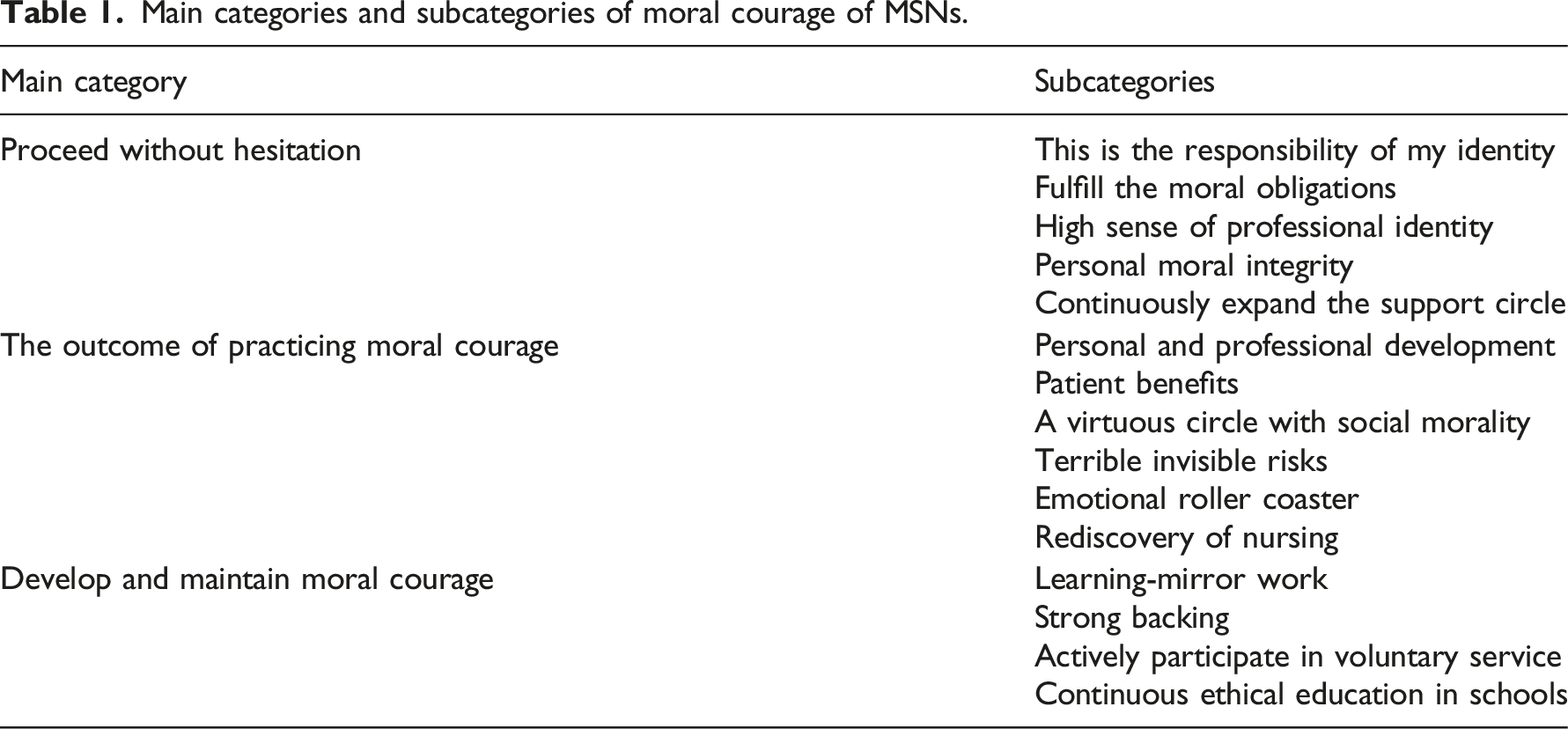
Data analysis resulted in 15 subcategories that were subsequently grouped into 3 major categories including proceed without hesitation, the outcome of practicing moral courage, and develop and maintain moral courage.
Conclusion
This qualitative study is based on the special background of the COVID-19 pandemic, and the MSNs in China have shown tenacious moral courage in the work of epidemic prevention and control. Five factors led them to take action without hesitation, and six possible outcomes followed. Lastly, this study provides some suggestions for nurses and nursing students to enhance their moral courage. To better develop and support moral courage in the future, it is necessary to use different methods and multidisciplinary approaches to study moral courage.
Introduction
In 2022, COVID-19 remains a global pandemic. In this special environment, healthcare systems worldwide have been overwhelmed, leading to moments of staff shortages and overwhelming numbers of patients. 1 Therefore, some regions are urgently recruiting master’s students of nursing (MSNs) with qualification certificates from schools to participate in relevant work, including nucleic acid collection, body temperature measurement, and data entry. Although there is a high risk of infection, many students have not withdrawn but rather actively signed up to participate. One of the reasons for this phenomenon could be “moral courage.” 2 They not only need to overcome physical pressure but also moral courage to overcome psychological pressure, such as fear and anxiety. After these MSNs are urgently recruited to the community, it will still most likely have insufficient medical resources or personal protective equipment, as well as insufficient health system preparation. Because of their inexperience and inadequate skills, in the face of ethical dilemmas, MSNs need strong moral courage to work on the front lines of the pandemic, balancing their professional duties and their competence with urgent ethical choices and decisions to be made in practice. This fact also emphasizes the important role of moral courage in nursing practices. However, most of the current studies focus on the moral courage of nurses and nursing undergraduates. This work presents an in-depth qualitative study investigating how MSNs were urgently recruited for epidemic prevention and control work during the COVID-19 pandemic and expressed their moral courage, as well as their views on the role of moral courage and how to improve it.
Background
Moral courage is defined as the ability to rationally defend ethical principles and act accordingly despite possible adverse consequences. 3 Moral courage is one of the key characteristics of the nursing profession and is a significant tool for dealing with ethical issues; 4 for example, conflicts of moral values frequently occurred during the COVID-19 pandemic. 5 Further, moral courage bridges the gap between personal values and professional obligations 6 to enable nurses to perform their duties while also staying committed to observe the ethical values and principles of their profession in such situations as caring for patients with infectious diseases. 7 The moral courage of nurses is not only beneficial to themselves in breaking the puzzle of a moral dilemma but also helps them to take better care of patients, including improving patient safety and enhancing the quality of care and quality of life for their patients. 8 Therefore, it is an acknowledged virtue in nursing care. 9
Compared to professional nurses, nursing students, being inexperienced, possess inadequate aptitude and courage to confront and manage ethical dilemmas in clinical settings. 10 Research suggests that nursing students often remain silent, lacking the moral courage to intervene when confronted with clinical situations that may negatively impact the quality of patient care. 11 Other research results also show that most nursing students lack moral courage despite feeling they have a moral obligation to take action. 12 As future nurses, when these nursing students encounter moral dilemmas in the clinical environment and cannot solve them, their emotional health will be affected, thus affecting their professional learning and career development 13 and possibly even causing them to leave the profession for good. 5 Evidence suggests that nursing postgraduates have a relatively high level of critical thinking and decision-making skills, they demonstrate leadership qualities to empower them to challenge poor practices, and they have the skills needed for advanced clinical practice roles. 14 However, they are still nursing students and do not think that they have sufficient ability to solve moral problems, even though they have learned more ethical theories and principles than undergraduate students. However, there is no literature on the moral courage of MSNs.
In the current COVID-19 pandemic, the moral problems experienced by nurses and nursing students are more complex and frequent.1 Around the globe, feelings of hopelessness and helplessness have been reported among experienced medical workers. 15 COVID-19, with high morbidity and mortality, has led nurses to feel indescribable fear and anxiety about death, and the situation of nursing students is more serious. 16 However, some scholars have argued that the challenges created by COVID-19 can shape the students’ professional identity, making nursing students think about how to become excellent nurses. 17 Another study also indirectly verified this view, wherein 82% of nursing students were still willing to take care of COVID-19 patients. 18 Nevertheless, it is undeniable that factors brought about by the COVID-19 pandemic, including death anxiety, will seriously affect their moral courage. 16 Therefore, to help these MSNs become future nursing elites, it is necessary to fully understand their moral courage during the COVID-19 prevention and control period, and to better cope with moral challenges and moral dilemmas in the future.
Aim
Through the experience of volunteer work during the pandemic, this study expounds on the views of Chinese MSNs on moral courage.
Materials and methods
Design
This study used descriptive qualitative methods by referring to the Consolidated Criteria for Reporting Qualitative Studies, 19 to examine MSNs’ moral courage in COVID-19 epidemic prevention and control. As a research method for making replicable and valid inferences from data, content analysis method was considered.
Participants
The study participants were selected using a purposive sampling method. Inclusion criteria were (1) voluntary participation, (2) possession of a nursing qualification certificate, (3) having been recruited for COVID-19 prevention and control work, and (4) being currently a full-time master’s student of nursing. The sample size was determined by data saturation, which was reached at 10 participants.
Data collection
Data collection was completed by experienced master students majoring in humanistic medicine. Data were collected via semi-structured telephone interviews that included closed questions about demographic information (gender, professional grade, professional type, number of working years, and nursing department) and the following open-ended questions: 1. What aspects did your participation in COVID-19 epidemic prevention and control reflect moral courage? 2. Why did you choose to do it? 3. How do you feel about the process from registration to completion of work? 4. Where do you think you can get moral courage?
Afterward, the interview continued based on the participant’s answers with more detailed questions such as “What do you mean?”, and “Please explain more about this.” The interview outline was determined after consulting with nursing educators and ethicists. First, the researcher obtained the verbal consent of the participants again. Then, the participants explained the definition of nurses’ moral courage and the method of a qualitative interview. In this study, 14 interviews were conducted, including 10 formal interviews and 4 secondary interviews. The purpose of the second interview is to collect the missing data, including details such as confirming what the term “risk” refers to. Each interview was of 15–40 min duration. The average interview time of each person is 34 min. Both sides were interviewed in a quiet place at a convenient time for participants.
Data analysis
Data analysis occurred concurrently with data collection. Within 24 h after each interview, the recorded materials were transcribed word-by-word into written materials. We have used Braun and Clarke’s step-by-step process for thematic analysis. 20 When carrying out this study, MSNs knew little about the views and experiences of moral courage since the outbreak of the COVID-19 pandemic and reported little, which challenged the choice of the theoretical framework to guide this study. Therefore, it is possible to obtain topics and subtopics from research data instead of existing theories or conceptual frameworks when using traditional inductive content analysis methods. 21
First, the two authors independently reviewed the data to create code, subcategories, and main categories, all based on repeated listening to the recordings and reading the interview records. The second step is to review respective codes, discuss coding data together, and establish consensus on data organization. Corresponding authors shall independently review inconsistent codes to reveal substantial consistency between the two code sets. Next, all the authors conferred and developed a consolidated set of codes that best reflected the data, the first author translated them into English, and English experts checked whether the translation was correct. The reliability of the research was guaranteed by the triangulation of the results among the authors working independently.
Ethical considerations
This study received ethical approval from the ethical review board of Fujian Medical University (No. 138, 30 August 2021). Participation was voluntary, all participants were informed of the purpose and content of the study, and their oral consent was recorded. All data were processed anonymously and confidentially. In addition, we recruited participants through MSNs’ counselors, and their phone numbers were obtained with their permission.
Results
Main categories and subcategories of moral courage of MSNs.
Proceed without hesitation
One of the abstract themes is “proceed without hesitation,” which is the power behind MSNs’ moral courage. This main category includes five subcategories.
(a) This is the responsibility of my identity: Different identities bring different responsibilities. Nightingale’s oath describes the responsibility of a nurse, while the responsibility of nursing students is still to learn how to become an excellent nurse. Most of them remind themselves of their responsibilities as nurses, not as students. In addition, the responsibilities of student cadres and Communist Party members are also mentioned. It is the superposition of different responsibilities that motivates them to participate in the fight against the COVID-19 epidemic without hesitation.
"I just think it's time for me to take action and I take this matter very seriously. Because you are doing this job as a nurse now, you should take it as a job commitment, which is the responsibility of the nurse." (Participant 3)
“As a student cadre, I must take the lead. If I don't go, I don't think I can set an example.” (Participant 7)
“When the teacher asked me if I would like to go, my answer was yes, because I have worked in the hospital for 2 years. I think this is what I should do. Who should go if I don't go? Besides, I am still a Communist, and I should lead by example.” (Participant 10)
In the context of the COVID-19 epidemic, the ability is a prerequisite for fulfilling responsibilities, so some participants suggested that: “Because nursing operations such as nucleic acid collection are new under COVID-19. If you don't have the skill and take the initiative to participate in the work, it's an irresponsible performance.” (Participant 4)
Another participant had a different view on the idea that this identity enhances moral courage:
“Maybe you have done a good job in all aspects. It is because of the moral courage that you have obtained the status of student cadre, so this status is only an additional one.” (Participant 8)
(b) Fulfill the moral obligations: Responsibility differs from obligation in that the latter is unconditional and non-binding. Fulfilling obligations is high-level moral behavior, which these MSNs bravely demonstrated.
“As a reserve force for clinical medical workers, I think this is an obligation.” (Participant 7)
“Because COVID-19 is related to everyone. If no one does these things, we will be affected, so I sign up.” (Participant 2)
(c) High sense of professional identity: Values represent basic convictions about what is right, good, or desirable and motivate social and professional behavior.
25
Professional identity is a key issue in the transition from student to practicing nurse and potentially influences retention rates.
26
The MSN participants in this study had chosen to further their study in nursing after internship or work. A strong professional identity encourages MSNs to treat nursing as a career, take more initiative in nursing patients, and stand up bravely to safeguard the dignity and interests of patients.
“First of all, if he doesn't love nursing, even if he thinks it's the right thing, he has courage, but he won't take action.” (Participant 5)
“Why do you take risks? Of course, this is the recognition of your career. I think.” (Participant 8)
(d) Personal moral integrity: Acting as a courageous nurse about moral integrity means behavior coherent with the nurse’s beliefs and principles 4. Based on moral integrity, they will be prompted to do what they think is right.
“Although doing this may have some adverse effects on us, out of this moral spirit, I felt that this was what we should do, so I chose to go.” (Participant 7)
“I think it's a sense of morality. In fact, you can choose to refuse, but your inner moral expectation for you can also be called moral restraint.” (Participant 8)
(e) Continuously expand the support circle: MSNs have identified a variety of support systems, including their families, mentors, schools, colleagues, and society. With the ever-expanding support and encouragement, they have a sense of security and feel that they will not shrink back, and lack of support can have the opposite effect.
“If my tutor wouldn't let me take risks, I might not go.” (Participant 4)
“I told my mother that I would go. Even though she would be worried, she still supported my decision.” (Participant 6)
“First of all, this is organized by the school, and we are encouraged to go. Then there are a large number of students together, and I will not feel lonely.” (Participant 7)
“After finishing the work, the school also provided logistical support, such as free isolation rooms and food.” (Participant 8)
The outcome of practicing moral courage
Moral courage is a kind of personal internal quality which may require certain personal sacrifice after acting according to their own beliefs. So this main category was named “The outcome of practicing moral courage,” it includes six subcategories.
(a) Personal and professional development: Although the COVID-19 epidemic is threatening, it is also a unique and unrepeatable professional learning opportunity, which can accelerate students learning process and make students better transition to professionals. After that, they can deal with many moral problems.
"The school has organized skill training, so I can acquire more professional skills. And I can also exercise my critical thinking in the process of work." (Participant 8)
“I think if you have moral courage, you will find your career meaningful and helpful for the whole career.” (Participant 10)
(b) Patient benefits: Humans are vulnerable, especially in the face of a pandemic of this disease, they will be afraid, afraid, anxious. And the brave actions of nurses can appease them.
“Because patients had lined up for a long time, it was already more than 11 p.m. at that time. It was not easy to see the nurse appear, so they felt that they suddenly saw the same hope.” (Participant 1)
“Patients' ignorance of the disease will certainly lead to more fear. If nurses have this courage, they will first give patients a kind of dependence, then a kind of psychological support, and give patients a positive psychological atmosphere.” (Participant 10)
(c) A virtuous circle with social morality: Globally, 59% of healthcare professionals are nurses.
27
Therefore, nurses play an important role in society.
“My understanding is that moral courage is on the moral level, that is, you can choose not to do it, but if everyone does it, it will make the whole society better, although nurses' moral courage is currently diminishing.” (Participant 2)
“The impact it brings is a positive circular relationship, that is, the more people do good deeds, the more people dare to stand up, so the more such things happen in the future, and everyone can stand up bravely.” (Participant 9)
(d) Terrible invisible risks: When these MSNs acted bravely, they knew the risk of infection. But compared with these, they are more afraid of some invisible risks.
“If you don't do it, people may not say anything, but if you do it, some people will think you're meddling.” (Participant 5)
Another participant expressed the unique view that nurses may be forced to be brave in the face of wider public opinion:
At that time, everyone took action and I didn't. Whom did I become? (Participant 6)
(e) Emotional roller coaster: These MSNs have experienced complex emotional changes, such as excitement at the beginning, fear at work, and pride in helping others.
“I was very excited at the beginning, because I had never experienced this before, and I felt very strange.” (Participant 2)
“After all, it is possible to contact [COVID] positive patients, so I am still afraid of being infected.” (Participant 3)
“This thing is just like a story learned when I was a child. Giving roses has a lingering fragrance, and I will be happy in the process of doing it. I don't have to get anything, but I feel a clear conscience.” (Participant 1)
“Some people also recorded this event with photos, which they felt was a very proud thing, and they also sent the photos to their families and friends.” (Participant 6)
(f) Rediscovery of Nursing: Nurses’ ongoing work in the pandemic is making nursing history.
1
The heroism of nurses dominates social media. They are called heroes as if they were discovered for the first time.
“I think COVID-19 is an opportunity for nurses, a chance to change the public's view of nurses' occupation. Just like 2002 with SARS, we should seize this opportunity.” (Participant 6)
“Compared with doctors, other people had a lower opinion of nurses before than after the pandemic. Then, during the 2019 coronavirus disease, people gradually improved their understanding of the nursing profession and gave us more motivation to do these things.” (Participant 10)
Develop and maintain moral courage
Most participants affirmed the role of moral courage, which can be maintained and improved. So from their perspective, what aspects do they hope to benefit from?
(a) Learning-mirror work: In theoretical courses, they seldom accepted the knowledge of moral courage. Most of them think that they will learn through imitation in this respect.
“I think that learning from the examples around you and listening to more heroic stories around you should be helpful to enhance moral courage.” (Participant 4)
“Teachers can share some examples of successful use of moral courage, and the next time we encounter similar situations, we will imitate their practices.” (Participant 10)
(b) Strong backing: Moral courage may not be applied if there is a fear of risks in the following action. Reduction or removal of these risks will help to improve moral courage.
“Moral courage is not objective. You must quantify it, then have an evaluation index, and then incorporate it into the performance appraisal of nurses so that nurses will pay attention to it.” (Participant 6)
“If you have the strong ability, you will have a good idea of what to do.” (Participant 7)
“If you have this mechanism to allow moral courage to play, and there will be no harm, then more people will dare to take action.” (Participant 9)
“The correct guidance of public opinion will make us more motivated to do these things.” (Participant 10)
(c) Actively participate in voluntary service: School education
28
and hospital work experience
29
enhance moral courage, and some participants proposed that non-work or study activities may also cultivate moral courage.
“We can take part in more meaningful volunteer activities in our spare time, because the nature of our work may be more dedicated. Now teenagers have better living conditions and are only children, so it is helpful for them to take part in more.” (Participant 10)
(d) Continuous ethical education in schools: Learning ethics knowledge can help students acquire the ability to judge right and wrong, which is a prerequisite for exerting courage.
“Strengthening the education of some ethics can help establish a correct view of right and wrong, good and evil, and then help students to establish correct values.” (Participant 5)
Discussion
This study recorded MSNs’ thoughts on moral courage after participating in voluntary service for epidemic prevention and control during the COVID-19 pandemic. Most of the MSNs who volunteered to participate in this event had experienced a pandemic for the first time, and had no experience in coping with it. Thus, some previous studies indicated that nursing students lacked sufficient moral courage.10,31 However, in actuality, these students stood at the front line, regardless of the danger, and devoted themselves to disease control, which shows their tenacious moral courage. In the context of the COVID-19 epidemic, this study learned investigated the driving force and outcome behind the brave actions of MSNs and what key insights they can provide for gaining moral courage.
Proceed without hesitation
Moral courage is an important part of nurses’ ethical competence, 32 but acting morally courageously can be strenuous. 8 In this study, MSNs described five reasons for their courageous actions performed without hesitation.
The first reason was the sense of responsibility felt by the nurses, which is consistent with most studies.4,10,33,34 The responsibilities mentioned by the participants included those of nurses, student cadres, and Communist Party members. These responsibilities or the superposition of multiple responsibilities made them realize that it was their turn to stand up for the society. This responsibility is often accompanied by professional ability. 28 If one’s ability is insufficient, she will often become reckless, which does not reflect moral courage. 35 However, one study asserted that nurses’ ability brings with it a sense of responsibility. 36
When only these nurses possess such ability, they have no choice but to perform the task at hand. However, most of our participants still believed that responsibility and ability need to be paired together, which can be attributed to their status as nursing students without developed professional skills.
The second reason for the nurses’ moral courage was due to their sense of obligation. Most MSNs expressed their obligation to help others, which alluded to their expectation of becoming kind and selfless nurses and is consistent with Kari Martinsen’s description of the nursing profession as altruistic behavior. 37 In an ideal altruistic caring relationship, encounters with fellow human beings are based on a genuine desire to alleviate suffering. 38 The MSNs of our study have lived in China since childhood. Influenced by the traditional Chinese Confucian culture, they strongly consider the idea of “benevolence,” which means maintaining a kind of friendly relationship between people. Therefore, altruism, the obligation of selfless dedication to helping others, has become a major motivation for nurses. This result is consistent with other studies. 39 Unfortunately, the idea of altruism has weakened over time and is not as highly valued today as it was in the past. 40 As one survey points out, only 37.8% of the people agree that medical students must provide help during the current pandemic. 41
Thirdly, professional identity and personal moral integrity are sources of moral courage. Some MSNs described nursing as being loving and meaningful, and they asserted that they chose nursing as a career rather than just a job. A strong sense of professional identity allows them to work harder in the nursing industry. This result was also verified in another study. 33 Humanity is vulnerable but also responsible and caring, 36 and this kind of compassion and sympathy is spontaneously generated when we see that our compatriots around us are in urgent need of medical help. If such moral integrity is not expressed through actions, it will cause these MSNs to suffer from the shame of moral shortcoming. Thus, it is their conscience or moral integrity that enables them to stand up for patients during the pandemic. 36
Finally, moral courage is derived from the desire to continuously expand the support circle for patients. Previous studies have indicated some personal and organizational factors related to moral courage, including work experience,4,35 education, 3 teamwork, 35 mentor-student relationships, 42 and organizational support. 10 During the COVID-19 epidemic, we found that these support circles were expanding. For example, organizational support mostly refers to that of hospitals and schools, and now that of the government and social groups should also be included.
The outcome of practicing moral courage
After reflecting on their brave behavior, the participants found that their professional experience, values, moral responsibilities, and other aspects of themselves had developed since the start of the pandemic. The most common improvement was an increase in professional experience, which is also reported in most studies.33,43–45 However, some values are difficult to develop through formal teaching plans, 46 and this rare volunteer action provides an opportunity for training.
Moral courage is a recognized virtue that benefits not only the MSNs themselves but also their patients. In this study, the greatest benefit for patients was reflected at the psychological level. These MSNs, through their actions, had alleviated people’s psychological conditions of anxiety, impatience, and fear with their actions. At the social level, as Kidder believes, “without moral courage, the brightest virtues rust from lack of use and with it, a more ethical world is built piece by piece.” 46
In addition to the above benefits, the participants also mentioned an interesting point that nursing was rediscovered. It is undeniable that before the COVID-19 pandemic, the public and the wider healthcare sector paid little attention to the arrival of the Year of Nurses and Midwives. However, nurses’ ongoing work during the pandemic is currently making nursing history. 1 The heroism, courage, selfless dedication, and professionalism of these nurses and nursing students have become the mainstream of media reports. All sectors of the society suddenly cheer for nurses, as if they were discovered for the first time. Thus, the social status of nurses has improved. 47 Therefore, our participants believed that now is the best time to rediscover nursing care, and their actions will increase this opportunity of rediscover nursing.
In terms of risk, the participants expressed the presence of risk of infection. Compared with this risk of infection, intangible risks (such as gossip) were considered worse. The participants seemed to be more concerned about what people around them thought of them than about infection. For example, if one takes courageous action, others will consider that person to have a desire to be in the limelight, but if that person does not take such action, they will be considered cowardly.
Finally, these MSNs described to us the process of how their emotions changed in light of their brave actions, which was a dynamic process. In the beginning, they were excited because they could do what they thought was right. Then, the participants experienced a fear of the relevant risks before taking action. In the process of action, they gained pride and confidence because they were recognized by patients. Finally, there were uncertainties and distress when recalling brave actions because these MSNs were not confident in their professional skills. Because this dynamic process of change is rarely reported in other studies, it needs further verification in the future.
Develop and maintain moral courage
Moral courage can be learned and developed 30 ; thus, it can become a natural part of an individual’s behavior and moral deliberation. 48 Our participants also agreed with this view and put forward several strategies from their perspective. The first is to imitate through “mirroring.” Nursing teachers share their own positive work experience in theory classes or by simulating a moral event that would require moral courage to create a realistic situation for the learner to become engaged on a physical, conceptual, emotional, and experiential level. 49 In this way, the students are able to show tough moral courage in similar situations in the future. The second strategy is to participate in volunteer activities. One study showed that medical students participating in volunteer services during the pandemic may receive educational benefits that are not easy to quantify, including moral aspects. 46 This cannot be cultivated in theoretical courses. The third strategy is the study of ethical knowledge, which has been proved by many researchers to be beneficial to the promotion of moral courage.3,6,28 This is because nurses have rich ethical knowledge and can better cope with complex clinical ethical situations, and they often realize that they have a responsibility and obligation to hold to certain “correct” values to develop moral courage and provide a basis for respecting patients’ rights, safety, and just treatment. The last strategy is to have strong administrative backing, such as providing opportunities to discuss ethics and rewarding ethically sound behavior. 50 The above measures are only based on the personal views of the MSNs of this study, and their effectiveness needs to be further verified. However, it is also possible that moral courage is metaphysical and not easy to capture, so its promotion is also difficult to understand, which needs to be done in future research.
Limitations
One of the limitations of this study was that due to the use of telephone interviews, the expression and body language of the interviewees could not be observed. In addition, the interviewees were mainly from Fujian Province, so the research might have certain geographical limitations. The last limitation was that the sample size was only 10, which may have lacked some broader views.
Conclusion
This research is based on the special background of the COVID-19 pandemic, and the MSNs in China have shown tenacious moral courage in the work of epidemic prevention and control. This study has drawn some views on moral courage from MSNs in China through interviews. They expressed five driving forces behind their ability to take action without hesitation and added six possible outcomes after taking courageous actions. Among them, it is a special point of view that nursing is rediscovered, and it is also rare to display the dynamic emotional changes of moral courage. Finally, this study also provides some suggestions to enhance the moral courage of nurses or nursing students. With the development of the pandemic and the progress of the nursing discipline, moral courage has been found to play an important role in providing high-quality nursing, ensuring nursing safety, and eliminating moral dilemmas in nursing practice. Therefore, it is necessary to use various methods and multi-disciplinary to study the virtue of moral courage, so that it can be supported and developed.22–24
Footnotes
Acknowledgements
The authors thank all the participants of this study. The authors thank all the participants of this study. The authors are particularly grateful to Professor Chen Min, Dr. Chen Yin, the PhD student Wei Yitao from Fujian Medical University, and Weng Yucen, the PhD student from Research Center of S&T Ethics and Management of Dalian University of Technology for their guidance on this study.
Declaration of conflicting interests
The author(s) declared no potential conflicts of interest with respect to the research, authorship, and/or publication of this article.
Funding
The author(s) disclosed receipt of the following financial support for the research, authorship, and/or publication of this article: This work was supported by the Medical Humanities Research Center of Fujian Medical University, Project No. 2021RWJH002; The 14th five-year plan of Educational Science in Fujian Province, Project No. FJJKBK21-107.
