



Abstract
Background
To practice nursing ethics, students must first understand the ethical concepts and principles of their profession, but despite this knowledge, students face challenges in implementing ethical principles in clinical settings. The educational performance of nurse educators is critical in resolving these challenges. This study focused on the lived experiences of nurse educators.
Objective
To address the main concern of educators when teaching ethics to undergraduate nursing students and how they deal with it.
Research Design
We conducted this qualitative content analysis in Iran in 2020. We used individual semi-structured interviews to collect, record, and transcribe data, as well as Graneheim and Lundman method to analyze them.
Participants
and research context: We used purposive sampling to select 11 nurse educators who either were currently in the position of ethics educators or had taught ethics from Iranian universities of medical sciences.
Ethical considerations
The present study received the code of ethics No. IR.MODARES.REC.1399.036. Participants were aware of the study’s purpose and signed a consent form to participate in the study. We considered data confidentiality and the voluntary principle in data collection.
Findings
Nurse educators’ main concern was how to sensitize students to ethical principles in clinical settings, so they tried to involve students in the teaching process, to repeat and practice ethical principles and concepts, simplify and simulate ethical principles and concepts, and provide opportunities for students to gain clinical experiences.
Discussion
To sensitize students to ethical nursing care, nurse educators try to institutionalize ethical principles using different teaching methods, including students' involvement in teaching, experiential learning through simulated situations, practice, repetition, and provision of opportunities for practice and experience.
Conclusion
Improving students’ cognitive ability and objectifying moral concepts and principles for students will institutionalize moral values in them that are fundamental for their moral sensitization.
Introduction
Nursing care is based on the idea that nurses should be competent in professional ethics.1–3 Therefore, we expect them to work according to professional rules and regulations and observe ethics in all aspects. 4 When a newly graduated nurse enters a clinical setting, she/he must be ready to provide quality care to the patient while establishing complex relationships with patients, families, and healthcare members. 5 For this reason, nurses trained by the education system must have moral abilities to address moral challenges and they need to develop moral competencies in their profession.6,7
Ethical competence is part of the nursing profession, but it is unclear how ethics education contributes to developing nurses’ ethical competence, and there are concerns about the ethical preparedness of nurses in practice. 8 In daily care, nurses are continuously challenged to make decisions with the view to provide ‘‘good care.’’ Making and performing these decisions requires not only clinical competence but also ethical competence, which involves much more than understanding ethical theories. Gallagher defines ethical competence as the possession of ethical knowledge next to the ability to ‘‘see’’ what a situation presents (ethical perception), to reflect critically about what nurses know, and do (ethical reflection), to bring out the ethical practice (ethical behavior), and to ‘‘be’’ ethical. 9 Although most nurses and nursing students are aware of the ethical aspects of their daily work and understand their importance, the main concern is their ability to put those ethical aspects into practice. 10
Background
Studies have shown an increasing number of nurses who are involved with moral problems, and these individuals have common characteristics, such as lack of experience, insufficient training in ethics, and dissatisfaction with the profession.11–14 Ethics education is an important factor affecting the ethical performance of nursing students and nurses of any educational level. 5 Ethics education aims to develop ethical decision-making and reasoning among students. 15
Studentship is one of the important factors that shape the moral and professional character of students,6,16,17 but recently we have witnessed that despite the ethical training that nurses receive, they are unaware of how to practice and deal with different ethical situations. 18 Many nurses recognize ethical issues they encounter during work, but they do not solve them. 10 Studies conducted on new graduate students show their inability to face moral problems, which makes them feel insecure and stressed. Therefore, some planning for ethics education is essential to enable students to provide ethical quality care. 18 Lack of moral competence may be due to ineffective teaching; the current state of ethics education in nursing is unable to develop nurses with complete moral competence. 19 Nursing schools must be sure that nursing students can both recognize and solve ethical problems.5,20
The unpreparedness of nursing students to deal with moral conflicts can cause moral distress and professional stress, and arise problems for them that reduce their motivation, ability, and desire to stay in the nursing profession. 5 Borhani et al. (2011) conducted qualitative research on nursing students’ perceptions of the obstacles to acquiring professional ethics and reported eight themes, one of which was the use of inappropriate teaching methods for ethical issues. Studies also highlighted the lack of a suitable approach to ethics education that could be an obstacle to the development of ethics in the nursing profession and ethical practice. 19
In Iran, ethics education has become a separate subject since 2013–2014, but some challenges were available when teaching and including the subject in the nursing curriculum. However, Iran’s board of nursing has approved the course of ethics and professional communication in nursing for undergraduate students since 2014 (one theoretical credit and 0.5 practical credit). Theoretical topics include nursing ethics and its importance, ethics in health, spirituality and philosophy, human dignity and moral values, principles of bioethics, moral sensitivity, patient communication, ethical and legal concepts and problems in nursing, patient rights, ethical issues in providing care for vulnerable groups, professional ethics in the health system and professional responsibilities of nurses based on ethical standards. The practical credit includes presenting a written and oral report (conference/seminar) on the challenges of nursing ethics and professional nursing relationships in one of the clinical nursing care departments and providing solutions based on ethical standards and codes.
Of course, among the challenges raised in ethics education are the absence of consistent moral content, a specific systematic approach in moral education, and the abstract nature of many moral theories, which are not applicable in the context of nursing.21,22,23
Nurse educators face the challenge of choosing between ethics-specific courses through ethics lectures integrated throughout the curriculum, between teaching abstract theories by using more skills-based approaches, as well as lectures, clinical experience, and reflection. 24 In qualitative studies, explore live experiences that would be helpful for nurse teachers’ problem diagnosis in teaching strategies and learning ethics to students. Borhani et al. (2009) found that the use of appropriate ethics training programs and familiarity with moral concepts was one the important strategies in reducing nurses’ moral and professional distress, 18 So, in this qualitative study, we explore the main concerns of nurse educators in ethics education to nursing students and how they encounter them.
Study design and question
This study aimed to explain main concern of educators when teaching ethics to undergraduate nursing students and how they deal with it. Due to few studies on nurse educators’ experiences and the lack of a solution in Iran’s healthcare systems, conventional content analysis was chosen to conduct the study and better understand the nurse educators’ experiences of promoting the use of moral principles among nursing students.
Sampling
Characteristics of the interviewees.

Data collection
We conducted face-to-face and virtual semi-structured in-depth interviews to collect data. The interviews lasted from 38 to 60 min, with the average interview lasting 46.50 min. The participants determined the location and time of face-to-face interviews, and we took into account their comfort during the interview. After receiving their demographic information, we explained the purpose of the study to the participants and then asked them open-ended questions. Exploratory questions were asked based on the responses of the participants in order to gain more experience from them. A digital recorder was used to record all of the interviews.
The main interview questions were as follows: • What are the most important problems in teaching ethics to students? • How do you teach ethics? • What are your theoretical and practical teaching methods?
We conducted additional interviews until we reached data saturation, which meant that no new themes or categories were available.
Data analysis
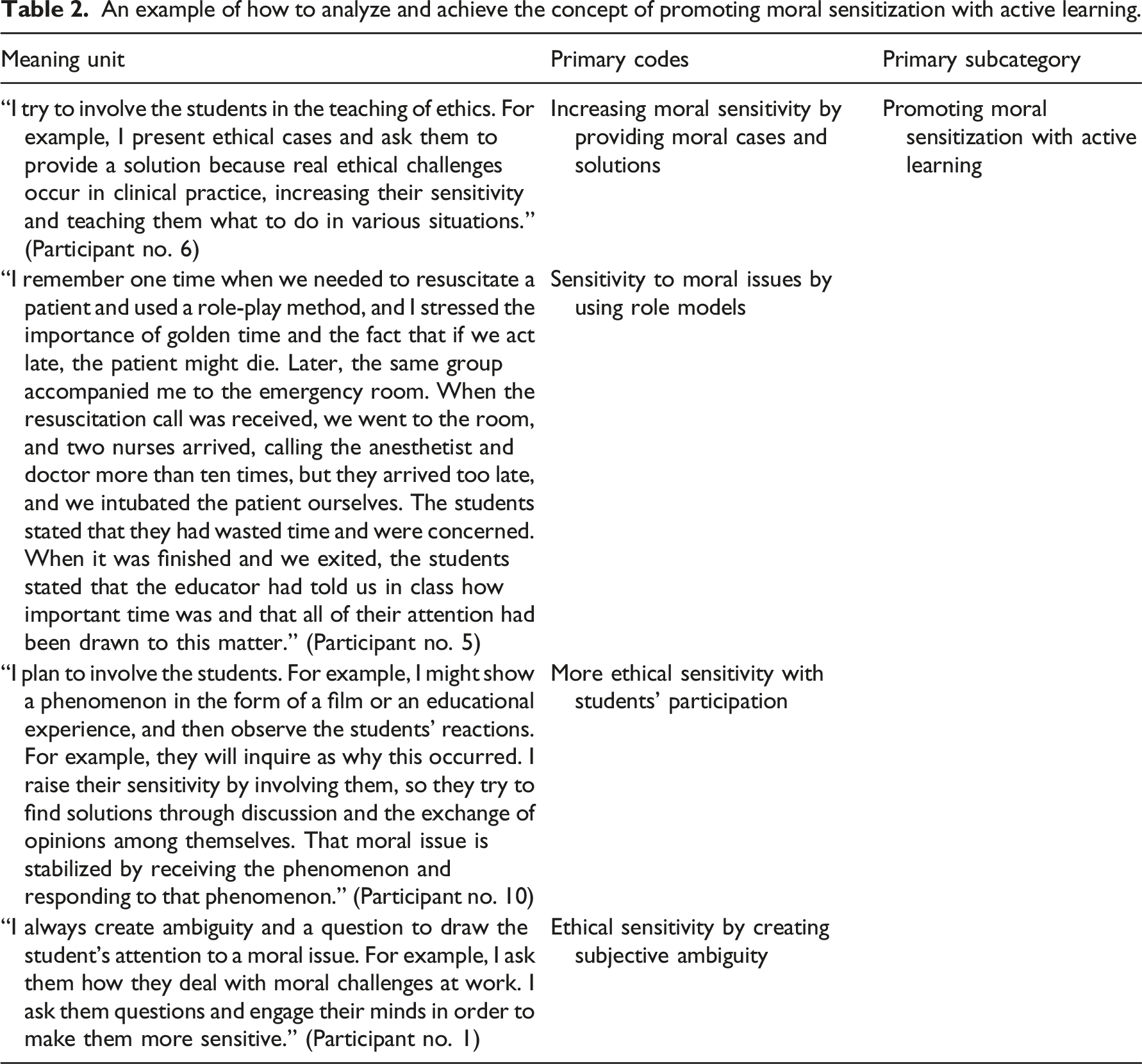
Graneheim and Lundman method was used to analyze the data, with the following steps: 1. Transcribe the interviews verbatim and read them thoroughly several times to obtain a comprehensive sense of transcripts. 2. Divide the text into meaning units that are condensed. 3. Abstract the condensed meaning units and label them as codes. 4. Sort the codes into subcategories and categories based on comparisons regarding their similarities and differences. 5. Formulate themes as the expression of the latent contents of the text.
25
An example of how to analyze and achieve the concept of promoting moral sensitization with active learning.
Ethical considerations
We received the code of ethics (IR.MODARES.REC.1399.036) from Tarbiat Modares University before conducting the study. The study process took into account the ethical principles of voluntariness, independence, and confidentiality. All participants signed informed consent forms and agreed to participate in the study voluntarily. We assured them that we would keep their information confidential. We informed the participants about the study’s purpose and method before conducting the interview, and they signed written consent for audio recording and note-taking during the interview.
Study rigor
Lincoln and Guba’s criteria were used to increase the study’s rigor. 26 Member check was used for the study’s credibility. Therefore, we returned the interview transcripts to the participants to ensure that the researcher and the participant shared the same perception. We had prolonged engagement with the collected data and immersed them in the process of analysis. In addition, experts in qualitative research, teaching, and ethics controlled data coding and analysis. The maximum variation sampling was considered in the sampling of nurse educators. To increase the fittingness, we tried to document all the stages of the research, including collection, analysis, and the formation of subcategories and categories so that others can examine them, and used the opinions of other individuals and educators in presenting written and oral reports.
Findings
After reviewing the interviews, codes, and concepts, we found that the main concern of educators was students’ moral sensitization when teaching theoretical and practical credits of professional ethics in nursing. “We first teach the theories, then express a series of principles and good and bad norms, and then provide more details in practice. At the following stage, behavior is crucial. I could walk into the room and instruct the students to drape a bed sheet over the patient to protect his or her privacy. Yes, I used to do this, but I realized it was pointless because they do what they want; they know what is right and wrong, but they do not follow it at all. They are insensitive. They do not seem to care.” (Participant No. 4, a nurse educator).
“For example, during training, I noticed that even though the students were on their third day with me, when they entered the ward, they liked to sit and stand by the window, paying no attention to the patient at all.” (Participant No. 5, a nurse educator).
“For example, one of the students approached me and stated that she had done everything possible for her patient. The patient had gone to have an endoscopy. I went to see if he had returned from the endoscopy. I called the student and inquired as to why she had failed to visit her patient. She needed to take care of her patient now that the patient had returned from the endoscopy. She claimed she was unaware of his arrival. I told her that she should have gone to the patient's room every 5 or 10 minutes. This means she is insensitive to her patient, and she is not a responsible and committed individual.” (Participant No. 9, a nurse educator).
Ethics educators want students to learn and apply ethical content, but students ignore ethical principles when providing care. Ethically sensitive students must first learn about the ethical dimensions and issues of their profession. The study findings revealed that nursing students, despite learning in the classroom, were insensitive to ethical principles. Many participants believe that if students consider the phenomenon from an ethical standpoint, they will act ethically. Educators must instill moral sensitivity into students from the start.
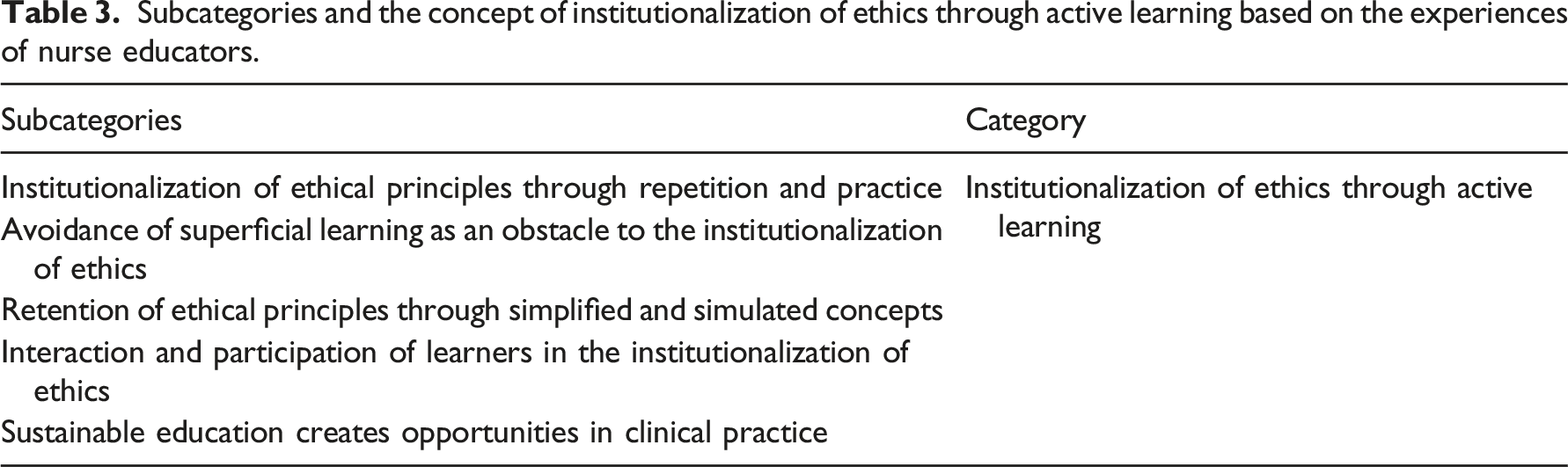
The findings showed that educators decided to solve their concerns by institutionalizing ethics through active learning.
Subcategories and the concept of institutionalization of ethics through active learning based on the experiences of nurse educators.
Category: institutionalization of ethics through active learning
Subcategory 1: Institutionalization of ethical principles through repetition and practice
Institutionalization of ethical principles through repetition and practice was one of the strategies emphasized by Nurse educators. They believed that repeating ethical principles was effective on the continuous practice and institutionalization of the ethical principles. Some of the participants’ statements are as follows: “When the students entered the ward and visited patients, for example, they did not communicate at all. I told them about the importance of first impressions, and I followed the communication principle and many other principles. I used to repeat and practice this principle, so they began to notice it unconsciously.” (Participant No. 2)
Subcategory 2: Avoidance of superficial learning as an obstacle to the institutionalization of ethics
Nurse educators reported that students applied ethical principles superficially, while students pointed out inappropriate teaching methods, resulting in their low moral sensitivity and inappropriate practice. Educators focused on thorough learning based on ethical principles in clinical practice. “The desired outcome from professional ethics is unavailable. Students only have a superficial understanding of ethical issues. When I ask a question about ethics, for example, everyone responds quickly, but this is not the case in practice. For example, why do they allow patient companions to enter the room while the patients are being dressed? They should learn thoroughly so that they are not indifferent in practice and can respond appropriately.” (Participant No. 5)
Subcategory 3: Retention of moral principles through simplified and simulated concepts
Many educators emphasized the importance of having a better understanding and retention of ethical principles. They used a variety of strategies, such as simplifying and stimulating the teaching of ethical concepts. Educators believed that a clear understanding of ethical principles resulted in consistent and correct practice.
“To make students more sensitive to moral issues, we use moral stories and narratives, as well as moral challenges that my colleagues and I faced at the workplace. As a result, when students encounter that situation, they will remember the principles.” (Participant No. 6)
Subcategory 4: Interaction and participation of learners in the institutionalization of the ethics
The collaboration and interaction of students in teaching moral concepts cause more understanding and retention and as a result, create more moral commitment in them. They learn better when they participate in the presentation of moral concepts.
“When I enter the classroom, I ask the students what moral challenges they see in their workplace, and this program may change slightly based on their experiences. My group discussions are sometimes about topics brought up by the students. For example, our homework follows a specific plan, but the content quality is determined by their moral experiences in our class.” (Participant No. 5)
Subcategory 5: Sustainable education through creating opportunities in clinical practice
Many participants stated that students’ clinical experiences improved their ethical sensitivity, reasoning, and decision. As a result of being in similar conditions, they will stabilize moral values and principles over time. “Students will gain a better understanding of ethical principles if they face ethical challenges in the clinical setting. That is why I try to familiarize them with the ward’s ethical challenges and discuss them. As a result, when they are exposed to these moral problems, moral principles will be better stabilized in them.” (Participant No.9).
Discussion
This study aimed to analyze the most important challenge of nurse educators in teaching ethics to nursing students and find out how they face this challenge. The study results indicated that the most important concern of nurse educators was students’ moral sensitization. Educators believed that nursing students had not enough moral sensitivity in practice despite receiving training.
As moral sensitivity developed over time, 27 personal and environmental factors influencing moral sensitivity must be identified first-year and second-year nursing students must benefit from ethics education to enhance their moral sensitivity, 28 but undergraduate nursing curricula usually provide nursing ethics education to junior and senior students. 29 Therefore, curricular re-development is necessary to provide first-year and second-year nursing students with ethics education. Moreover, we require continued research on pedagogical methodologies 30 and the optimal timing and duration of education to enhance moral sensitivity. Most of the nurse educators in this study believed in the institutionalization of ethics to increase students’ moral sensitivity included five themes: the institutionalization of moral principles through repetition and practice, avoidance of superficial learning as an obstacle to the institutionalization of ethics, retention of moral principles through simplified and simulated concepts, interaction and participation of learners in the institutionalization of ethics, sustainable education by creating opportunities in clinical experiences.
Various ways are available to solve this concern of ethics educators and studies suggested recommendations to increase moral sensitivity and decision-making among students.31–33 Nurse educators found themselves responsible in this regard, so all of their solutions were effective in teaching ethics. They also experienced that modeling the behaviors of clinical educators and nurses were important in students’ moral sensitization, but they understood it when teaching ethics.
The institutionalization of ethical concepts and principles was the most important solution for applying them in practice, but what teaching methods should educators use for students who must provide ethical nursing care? The lived experiences of educators in this study indicated that students’ involvement, simulation of clinical situations, use of simple methods, and optimally different situations could be very helpful. As mentioned before, educators sometimes used results of the incorrect ethical decisions to teach ethics. The teaching and learning textbooks have mentioned the term active learning33,34; educators in this study experienced that they had to provide students with active learning.
This study focused on a better understanding of the ethical principles for their better retention and educators used simplified and stimulated ethical concepts, which led to a clear understanding and correct and permanent implementation of the ethical principles. Studies indicated that the use of simulated situations, 35 exposure to challenging situations, 36 movie shows, creation of situations similar to what a nurse faces in practice, or role-playing could be more effective on students’ moral development than pure theory. 30 The results of other studies show that ethics education through new educational methods, including clinical simulation, is effective in improving moral sensitivity and clinical decision-making. 37 Holland studied nursing students’ experiences of the first exposure to moral decisions in clinical settings and concluded that movie showing, creation of situations similar to what a nurse faces in practice, or role-playing were much more effective on the moral decision-making of students than theoretical education. 38 Cannaerts et al. believed that ethics educators should sufficiently apply ethical theories in clinical practice; educators could model these theories in the classroom and simulation laboratories because they could have a deep and long-lasting effect on the mindset and moral performance of nursing students. 39
The interaction and participation of learners in the institutionalization and teaching of ethics are very important. The study results suggest that interaction and participation in the teaching of moral concepts cause greater understanding and retention and create more moral commitment in students who try to implement ethical principles correctly. The findings indicated that students, who had more interaction and participation and a better understanding of teaching performed better. Educators must establish effective communication with their students during teaching, which can change students' views on teaching and in turn increase their performances and motivations. The educator’s performance causes students to be more involved in learning, so students have more motivation for progress; the class atmosphere provides students with the opportunity for active discovery, exploration, and experimentation, and educators should prepare the ground for them and direct the teaching process. Interactive learning is revelatory based on effort and hard work: the educator provides no direct answers to the questions of the students, but a mutual effort increases the amount of their learning and improves their performance.40,41 In collaborative learning, learners collaborate with others to maximize their learning; the educator tries to make students’ learning deeper by raising questions and encouraging them to think and answer. Learners try to achieve the results sought by all peers and feel responsible for the learning of peers and themselves. 42
Therefore, students’ involvement in learning leads to deep and lasting learning and makes them feel more responsible for the implementation of what they have learned. Cognitive ability is fundamental in moral sensitivity, meaning that individuals with moral sensitivity can identify patients' problems in time and have the best practice, so educators in this study used teaching approaches, including collaborative and interactive methods to institutionalize ethical principles and concepts in students and increase their moral sensitivity. The strategies related to the institutionalization of ethics will ultimately increase the moral sensitivity of learners and improve their practice. Studies suggest that students’ moral sensitivity and practice improve when they exchange their ideas about the best ethical decision-making solutions with their peers and educators. 39 Homann studied nurse educators’ perceptions of teaching ethics to nursing students and extracted themes after interviewing five nurse educators: group discussion, students’ interaction and participation in teaching, and ethical decision-making models, which led to the moral performance of students. 43
Educators must be creative and sensitive when providing learning environments and opportunities for students. 44 The educators in this study experienced that creating opportunities for students in clinical settings increased their moral sensitivity, reasoning power, and decision-making, so the educators could institutionalize moral values and principles in students by providing them with diverse and similar conditions. In this learning method, learners play the main role and must think about what they are doing, while educators act as facilitators.45,46 Using experiential learning, students can practice and learn from failures; many experts believe that this method causes learners to learn general and basic principles by gaining different experiences so that they can use their experiences when a change or a big problem occurs. Experiential learning includes several purposes, but the main goal is that a person learns in the best way through active involvement. Carland believes that experiential learning is more lasting than learning through information obtained from a traditional classroom. 47 The educators in the present study also used the experiential learning method to institutionalize ethics, increase moral sensitivity, and improve the moral practice of students. This method allows students to learn from the strengths and weaknesses of others and themselves and to apply the learned experiences in a real environment. Freeze and Steward also considers nursing a social profession that deals with many people such as patients, companions, and people in the community, so they believe that experiential learning is very useful for nursing education and teaches nursing students how to communicate with others. 48 In experiential learning, a person experiences a concrete situation with no previous knowledge of it, so he or she reacts to this new experience, evaluates and generalizes the result, and makes an abstract concept to use it in similar conditions.
We had some limitations in this study: it was difficult to examine the moral concepts and experiences of the individuals because they usually interpreted moral principles according to their attitudes and knowledge. The participants only pointed to positive moral experiences and did not express experiences without moral results or those that were not in accordance with moral principles, so the researcher tried hard to ask indirectly the interview questions related to moral teaching. We had no access to educators due to their busyness in universities of medical sciences and the COVID-19 pandemic, so we tried to increase the number of interviews with each of the educators but in shorter durations. This attempt helped us obtain the necessary and diverse characteristics of the interviewees, which are important in a qualitative study.
Conclusion
We wanted to answer the following question in this study: what is the most important concern of nurse educators when teaching ethics to nursing students? Live experiences of the nurse educators indicated that the most important concern about teaching nursing ethics was students’ moral sensitization, which solution was the institutionalization of ethical concepts and principles through active learning strategies. The concept of moral sensitivity is important and should be considered first in moral education.
The findings indicated the importance of ethical sensitization in teaching ethics to students. The studies could rarely clarify the teaching process of professional ethics in educational environments to increase moral sensitivity. The present study described the applicable teaching methods of ethics educators, all of which focused on the creation and promotion of ethical sensitivity and their application was easy for experienced educators. To institutionalize moral sensitivity in students, educators must improve students’ cognitive ability in moral principles and concepts and objectify moral situations for them. This goal can be achievable by using active and experimental teaching methods; improving the cognitive level and objectifying moral concepts and principles lead to the institutionalization of moral values in students that is fundamental for their moral sensitization. We suggest using teaching methods to sensitize nursing students ethically. We found no specific educational model for teaching ethics in the literature, so we recommend a study be conducted to investigate and identify the teaching process of professional ethics to present a suitable educational model for professional ethics in nursing education.
Footnotes
Acknowledgments
The authors would like to thank all the nurse educators who participated in this study.
Declaration of conflicting interests
The author(s) declared no potential conflicts of interest with respect to the research, authorship, and/or publication of this article.
Funding
The author(s) received no financial support for the research, authorship, and/or publication of this article.