



Abstract
The pattern of interurban industrial localization is stable. A current explanatory approach argues that decentralization from large urban areas to mid-sized and small-sized towns is the only process now active and that the basic variables of this interurban decentralization are city size and proximity to or distance from a large urban area. This article provides a theoretical discussion, methodological recommendations and evidence for the argument that industrial decentralization processes are more complex than this and require less restrictive suppositions. Our analysis of new industries located in Zaragoza, one of the main Spanish urban areas, from 1992 to 2005 shows how two aspects, which are seldom found in the literature, influence these processes. The first is the structure of the urban system, because the distance-sensitive decentralization process is contingent on the spatial structure of the system. The second aspect is the industrial and urban development policies, because they can alter the competitive advantages of the different types of cities. Thus, large urban areas can maintain their industrial attractiveness because they meet different and more numerous requirements than the predictions suggested they would and because they halt the spatial advance of the industrial decentralization processes. The article concludes with a reflection on the theoretical and methodological implications of the results as well as their contributions to a better understanding, formulation and analysis of the interurban industrial dynamic.
Keywords
Introduction
An examination of the maps of contemporary industrial localization shows that ‘virtually all manufacturing and business service activity is located in urban places’ (Dicken, 2007: 62). We also notice that the pattern of interurban industrial localization is stable and that decreasing transport and telecommunications costs have not been accompanied by a significant spatial decentralization of industrial activities (Storper and Venables, 2004). This finding is particularly striking and has inspired several works of research that directly focus on explaining the current industrial decentralization processes. For example, a current prominent approach claims that two urban attributes, size and distance from a metropolis, are good predictors of the development of such processes and that industrial interurban localization generally exhibits similar spatial distributions. Although the simplicity of this approach renders the conclusions of this research attractive, we understand that the complexity of the subject requires a more nuanced, contextualized and cautious approach (Peck and Sheppard, 2010). This article focuses on providing a theoretical discussion and evidence regarding the structure and policy features of a specific regional urban system to better explain industrial relocation processes. We will begin with a critical review of the existing literature on interurban industrial decentralization processes. It is worth noting that companies are still extremely attracted to large urban areas and that the structure of urban systems still influences decentralization processes. Next, we utilize this approach to analyse and explain the processes driving industrial activities in the urban area of Zaragoza, which is located in the industrial axis of the Ebro Valley (in north-east Spain). This area is especially suitable for our study because it is one of the largest urban areas in the country and the centre of a regional urban system.
The results of our study will enable us to argue that large cities can still be attractive to companies and thus halt the spatial advance of any industrial decentralization processes. The influence of the institutional environment on the nature of these processes will also be evident. Another important finding is that the spatial model of these processes can present different nuances, depending on the structure of the urban system itself. This discovery leads us to propose using less restrictive approaches to account for the possible impact of at least two aspects, which are not usually found in the literature on the subject, on these processes. These two aspects are the structure of the urban system and the industrial and urban development policies, focusing on how they can alter the competitive advantages of the different types of cities and thus their attractiveness to companies. The article concludes with a reflection on the theoretical and methodological implications of the results as well as their contributions to a better understanding, formulation and analysis of the interurban industrial dynamic.
Interurban industrial localization: theoretical and methodological considerations
Approaches for the study of the interurban industrial dynamic
Over the years, the study of the interurban industrial dynamic has produced a large number of studies utilizing several different approaches. A significant amount of this analysis centres on the factors that attract companies and lead them to establish themselves in a given urban area. 1 For example, the studies on innovation clusters by Gordon and McCann (2000) and Moulaert and Djellal (1995) have underlined the importance of the externalities generated by knowledge networks and infrastructure (Méndez and Sánchez Moral, 2011). Another research stream addresses the advantages that companies find in urban areas (for example, lower transport costs, access to markets, availability of intermediate products and greater diversification in the workforce) and how these advantages increase with city size (Glaeser, 1998; Quigley, 1998). The sources of the ‘economies of urbanization’ and the ‘economies of localization’, the latter of which are generated by grouping companies in similar sectors, are the object of a third approach: the study of the economies of agglomeration (that is, location-specific externalities or scale economies of some sort) (Hanson, 2001). Undoubtedly, this approach is the most popular in this field. Whether the origins of agglomeration economies are external (that is, stemming from the existence of positive spillovers among firms sharing the same location) (Henderson, 1997) or internal (that is, generated by demand links among firms with related transport costs and fixed costs) (Krugman, 1991), agglomeration economies appear to be clearly related to the typical concentration of industries in urban areas.
A complementary line of research addresses the relationship between agglomeration economies and the processes of industrial decentralization from large cities towards mid-sized and smaller cities. Some works present industrial decentralization as an almost automatic effect of urban areas that pass the threshold at which economies become diseconomies. For example, Desmet and Fafchamps write that ‘negative externalities – rising commuting costs and increasing land rents – cause congestion and put a cap on the size of clusters’ (2005: 261). One study on the crowding-out of industry owing to the effects of urban agglomeration in London refines the aforementioned conclusions and reveals the complexity of the subject by providing evidence that ‘certain manufacturing firms still want to be located in London, and a fuller understanding of these trends is likely to produce a more accurate account of manufacturing change than analysts simply viewing it as a process of decline’ (Graham and Spence, 1997: 482–3). Polèse and his team (Polèse and Champagne, 1999; Polèse and Shearmur, 2004; Polèse et al., 2007; Shearmur et al., 2007) present interurban industrial decentralization as resulting from the balance between the agglomeration economies (or diseconomies) that can arise in large cities and the spatial interaction costs that firms will incur by using the services offered in the metropolis. The authors conclude that ‘manufacturing activities prefer to locate outside, though close to, metropolitan areas’ (Polèse et al., 2007: 169) and that industrial specialization systematically varies with urban size and distance from a large metropolis or urban area.
Factors of the interurban industrial dynamic: the attributes of urban areas and urban systems
It should be noted that the results obtained from any study depend on the original postulates or suppositions. Some current approaches are influenced by the new economic geography. On this point, Deichmann writes, ‘economists . . . tend to be more comfortable with boiling down complex issues to their essence . . . to reveal the general contours of economic geography’ (Deichmann et al., 2010: 375–6). Nevertheless, the abundant research on the interurban industrial dynamic clearly shows that this dynamic is a complex, multifaceted phenomenon that appears to be closely related to the spatial logic of productive activities and the localization options offered to companies (Storper and Scott, 2009). Size is a variable that can illustrate the advantages that urban areas offer to firms. In fact, this idea led to Evans’ model (1972), which is based on the association between the cost of certain localization factors (for example, land, salaries and services) and city size. More recently, Storper (2008) confirmed its validity by affirming that, at the intra-metropolitan scale, there is a correlation between labour, land costs and the localization of economic activities as well as a correlation between the costs of both factors and the types of activities that we find in the different types of urban area (Storper, 2008: 3). Nevertheless, as Storper notes, the extensive literature on the subject does not explain the sectoral differences observed between urban areas belonging to the same type or size category. This observation is interesting because it clearly shows that the different advantages of localization are not, in principle, exclusive to a given category of city size. Additionally, the type of business (that is, high, medium or low added value) is not exclusive to certain urban areas. Therefore, the interpretation of the conditions offered in different urban areas should be done with caution. In the empirical section of this work, we will present and examine three aspects of urban areas: labour costs, land prices and public policies.
Thus, although the prevailing assumption states that the costs of salaries in large urban areas are higher, these salaries can be reduced by two factors: the greater availability of labour in urban areas and the existence of regional variations in salaries. These alternative salaries may be lower than those observed in similar urban areas in other regions. In fact, regional variations in salaries are characteristic of many economies and are closely related to industrial localization. Research in the UK indicates that ‘regions with low relative white-collar wages specialize in a different set of industries from regions with high relative white-collar wages’ (Bernard et al., 2008: 432; see also Bernard et al., 2004). Other studies clearly demonstrate the influence of interregional variations on the level of unionization (that is, the strength of unions) and the importance of collective bargaining. The US is a good example because unionization is higher in the states of the manufacturing belt and lower in the so-called “right-to-work” states in the south and the rural west (Hayter, 1997). In a similar vein, Spain exhibits some of the greatest contrasts in salaries from region to region among all European countries because collective bargaining in Spain is performed through sectoral agreements on an intra-national scale, which are then applied exclusively to provinces and regions (Ahamdanech Zarco et al., 2008). As a result, it is quite possible that different salaries will be found in urban areas of the same rank, depending on the region.
Land prices are also a clearly important condition that influences interurban industrial localization, especially if we account for companies’ needs for space to conduct their activities and the problems caused by the scarcity of space in large urban areas (Hayter, 1997). The classic models of localization state that the highest land costs are found in the largest urban areas. However, as in the case of salaries, the higher land costs assumed for those areas can be reduced by at least two factors: the availability of land and the existence of land policies, which we will return to below. Land costs in large urban areas may be lower than expected or observed in similar areas in other regions.
In any case, the attractiveness of large urban areas for the location of industries can be accentuated by local policies designed to support industrial development and to shape the microeconomic environment or the various facets of the business climate (Acemoglu et al., 2004; Rodrik, et al., 2004). Many analysts have shown interest in sector-specific institutions that enable certain industries to develop in a territory. Additionally, there is considerable empirical evidence of wide-ranging, active intervention by regional and local governments in diverse fields, such as the provision of land and infrastructure for the purpose of establishing and developing industries, financial aid, the improvement of products or processes, and training. A more recent line of research that is highly relevant to this subject is related to the structures of the institutions that introduce urban and industrial policies (Storper and Manville, 2006). A promising hypothesis suggests that, in highly centralized urban areas where the main jurisdiction belongs to a large city (for example, the city and metropolitan area of New York), economic and industrial policies can appear to be skewed towards certain types of large projects and initiatives that favour the interests of powerfully organized elites. Such initiatives often consist of ‘land use and public investment decisions [which] can, in any case, be powerfully directed toward strong effects on the conditions for labour market/business network formation and sustenance, and hence on specialisation’ (Storper, 2008: 32). Consequently, in these large urban areas, the classic production factors (for example, land and labour) can be offered with costs and availability conditions different from the costs and conditions that their size would lead us to expect.
Our hypothesis is that large urban areas can attract activities that generate high, medium and low added value. Thus, excessively simplifying the locational qualities of larger cities and their attraction for different types of industries is risky for two reasons. First, the real mix of businesses present in these cities can be different from that forecast in some of the theoretical models. Second, the processes causing industrial decentralization from large cities toward small-sized and mid-sized cities can show less range than expected. In the theoretical reviews of industrial localization, we seldom find references to the influence of urban systems on these processes. These references do appear in Polèse’s work, although he assumes that these processes take place in a system that is balanced according to the rank-size rule (that is, Zipf’s law) because the system has lognormally distributed city sizes. Additionally, Polèse assumes that the system is dense because there must be intermediate and lower-ranking cities that are not far enough from the main city to dissuade companies from relocating from the main city (Polèse et al., 2007). However, as was demonstrated at the time, more than 70 percent of urban systems at any scale have urban populations distributed more unevenly than Zipf’s law would predict (Berry, 1967; Rosen and Resnick, 1980). According to Berry, primate type distributions, ‘whereby a stratum of small towns and cities is dominated by one or more very large cities and there are deficiencies [or absences] in numbers of cities of intermediate sizes’ (Berry, 1961: 573), are especially frequent. It should also be noted that the aforementioned qualities of urban systems persist over time because the relative growth rates of cities from different ranks are always, on average, constant fractions of the relative growth rate of the entire system’s population (Berry, 1967).
The reference to the urban systems seems appropriate because we understand that these processes cannot operate in the same manner in balanced urban systems as they do in systems exhibiting a primate pattern, where the absence or scarcity of mid-ranking cities can determine the nature of the industrial decentralization process. Therefore, because local hierarchies vary in both content and form (Berry, 2002), the specific characteristics and shape of the regional urban system also require significant attention to understand the degree to which the decentralization processes affect the system.
Methodological aspects and implications for the analysis of industrial decentralization processes
The theoretical considerations presented here suggest how the different opportunities or limitations that influence interurban industrial decentralization processes and thus enable companies to decide their location are created. Providing evidence for these aspects is a primary requirement for verifying the suppositions on which the different theories are based. The methodology is also important because it ensures that firms’ real preferences regarding industrial location coincide with those revealed by the analysis. Similar to previous studies, Polèse et al.’s (2007) work on Spain presents some peculiarities with respect to the territorial scale, the level of disaggregation in the data and the selected indicators, all of which prevent scholars from satisfactorily verifying the suppositions of the analysis. First, Polèse et al. (2007) focus on the national scale and require all of the cities to be grouped by population into a certain number of categories. The resulting rankings contain different categories that descend in rank according to size and can be used to present the decentralization processes at this scale, even though, given the distance threshold adopted, these processes take place de facto at the regional scale. In other words, by definition, a certain type of city is given a role in the process that can have been observed for the cities in that category only in one of the regional subsystems.
Additionally, the urban areas included in some of the categories are different in many relevant aspects, which may be masked if aggregated data are used. 2 The aggregation of data requires scholars to treat these areas as if they are spatially homogeneous and to ignore any industrial processes other than decentralization, which cannot be detected. Finally, we understand that the indicators of decentralization must be sufficient to describe the type of urban area in which the industry is actually located and the various processes (for example, the launch of new companies and the relocation of firms into the area) that support its presence. Location quotients can be used if we consider that, in its pure state, this quotient shows only the relative importance of an activity in an economy compared with a reference space. In smaller spatial entities, this quotient has a high value if a given industry is the only or the most notable aspect of their economy, although the size of this industry (in terms of companies, jobs or other variables) may be much smaller than in larger spatial entities with lower quotients. Therefore, a study of interurban industrial decentralization cannot use only these quotients to establish the direction of the flow of interurban business or to determine where companies want to be located, because they are likely to want to be located in the same area as most other companies. 3
We can deduce various analytical implications for the nature and reach of industrial decentralization processes in Zaragoza based on the aforementioned conceptual refinements and methodologies. We propose incorporating elements that are excluded if a highly stylized version of reality is adopted. First, we analyse and explain the various competitive advantages of Zaragoza, which include not only the benefits commonly associated with its rank as a large urban area but also those attributed to medium- and small-sized towns (for example, lower labour and land costs). We find that these advantages are necessary to justify the diversity of the city’s mix of businesses. Second, we account for the specific characteristics of the regional urban system to show how they influence the extensiveness of the decentralization processes. Third, the selected scale, sources and indicators enable us to cover the business, sectoral and spatial variations of the industrial dynamic within the urban area as well as the intensity and character of the interurban decentralization processes. We apply these methodological determinations in the analysis below.
The competitive advantages of Zaragoza and the spatial organization of the Ebro Valley urban network
In 2009, 85 urban areas in Spain had more than 50,000 inhabitants. The Zaragoza metropolitan area had 741,132 inhabitants, which was the eighth-highest total after the metropolitan areas of Madrid, Barcelona, Valencia, Seville, Malaga, Bilbao and Asturias. All national and international studies of the Spanish urban system since the 1980s have acknowledged Zaragoza’s status as a second-tier metropolis (Nel.lo, 1997). With the top level of the urban hierarchy reserved for the two national metropolises, Madrid and Barcelona, the next level comprises the ‘regional’ metropolises, whose current populations range from 1.5 million (Valencia) to 0.7 million (Zaragoza) inhabitants.
Agglomeration economies for industries in the Zaragoza urban area
As with all urban areas of its rank and size, Zaragoza offers companies high location-specific externalities or agglomeration economies, such as lower transport costs, good access to markets, a more diverse population of skilled labourers and a wide range of services. These circumstances have contributed to the development of a metropolitan industry in the past and are now being strengthened. For example, 81 percent of the jobs and 70.6 percent of the advanced service companies in the entire region of Aragon are concentrated in Zaragoza. The construction and opening of ring roads around the city, the creation of a high-speed Madrid–Zaragoza–Barcelona train line and the revitalization of the airport have helped to further reduce transport costs and to maximize the traditional advantages of spatial interactions. Additionally, the development of spaces with sophisticated logistical equipment (for example, Zaragoza’s logistics platform PLAZA, which is one of the largest platforms in Europe at nearly 13 km2) has rendered the city a national and international hub and distribution centre for important business groups.
Access to a large market has been a decisive factor in the location of medium-sized businesses, which have recently moved to Zaragoza and its immediate surroundings (Escalona-Orcao et al., 2006). Proximity to suppliers of intermediate goods is particularly appreciated by companies in Zaragoza’s metalworking and machinery sectors and in the municipalities surrounding the city.
Other competitive advantages for industries in the Zaragoza urban area
Zaragoza also offers some of the location advantages typical of cities of its lower rank and size. For example, Zaragoza offers lower salary costs. Because of the infra-national nature of collective bargaining, labour costs in the industrial sector are noticeably higher in Madrid, Bilbao and Barcelona than in Zaragoza. Specifically, labour costs in Madrid, Bilbao and Barcelona are, respectively, 30 percent, 16 percent and 9 percent higher than costs in Zaragoza. Thus, labour costs in Zaragoza are lower than the labour costs associated not only with urban areas of higher rank but also with other urban areas, such as Bilbao, in the same hierarchical rank (National Statistics Institute, ‘Annual Labour Cost Survey’).
Although land prices in Madrid, Barcelona and Valencia are similar, prices in Zaragoza are three times lower (King Sturge, 2007). 4 This difference can be explained by several interrelated factors, such as the large size of Zaragoza’s municipal area (that is, 1052 km2, which is one of the biggest in Spain), the city’s low occupation density 5 and government bodies’ clear desire to encourage the growth of industries. As discussed in the theoretical section, previous economic and industrial policies have focused on large projects that favour the interests of powerfully organized elites. Approved in 2002, Zaragoza’s General Zoning Plan scheduled a 77 percent increase in the amount of land occupied by industries in the municipal area and made plans for various improvements in equipment, infrastructure and access (Alonso Logroño et al., 2006).
Zaragoza has also benefited from regional government policies that helped to promote its economic activities externally and to capture companies with a high drag-along factor on other activities. Additionally, the government has implemented various policies that attract companies on the basis of land prices by subsidizing 20 percent of the companies’ investments in fixed assets. These policies have helped Zaragoza to maintain its industrial importance, because new industrial estates are located within the municipal boundaries, and to continue to attract a high proportion of total investments in the immediate surroundings.
Structure of the regional urban network: city rank and distance in the Ebro industrial region’s urban system
Another determinant of the interurban industrial decentralization processes is the structure of the regional urban system itself. Some of the aforementioned theoretical models assume that urban systems are balanced (that is, the system contains urban areas of all ranks) and relatively dense (that is, medium- and small-sized towns are within reach of the metropolis or main urban area). As already indicated, the literature on urban systems states that these assumptions are not valid in most urban systems or in the Ebro Valley. Figure 1 shows the basic characteristics of the Ebro Valley’s urban system in accordance with the descriptive criteria adopted by Polèse et al.’s research on Spain (2007). We classify urban areas, which they call synthetic regions (SRs), into five categories: metropolitan areas with populations ranging from 0.5 to 2.5 million (SR2) and urban areas with populations ranging from 100,000 to 500,000 (SR3), 50,000 to 100,000 (SR4), 20,000 to 50,000 (SR5) and 10,000 to 20,000 (SR6). In the categories SR3 and under, we differentiate two additional groups of urban areas or cities: central and peripheral. We classify the urban areas into one of the two groups, depending on whether they are inside or outside the distance threshold of 1 hour’s travel from Zaragoza.
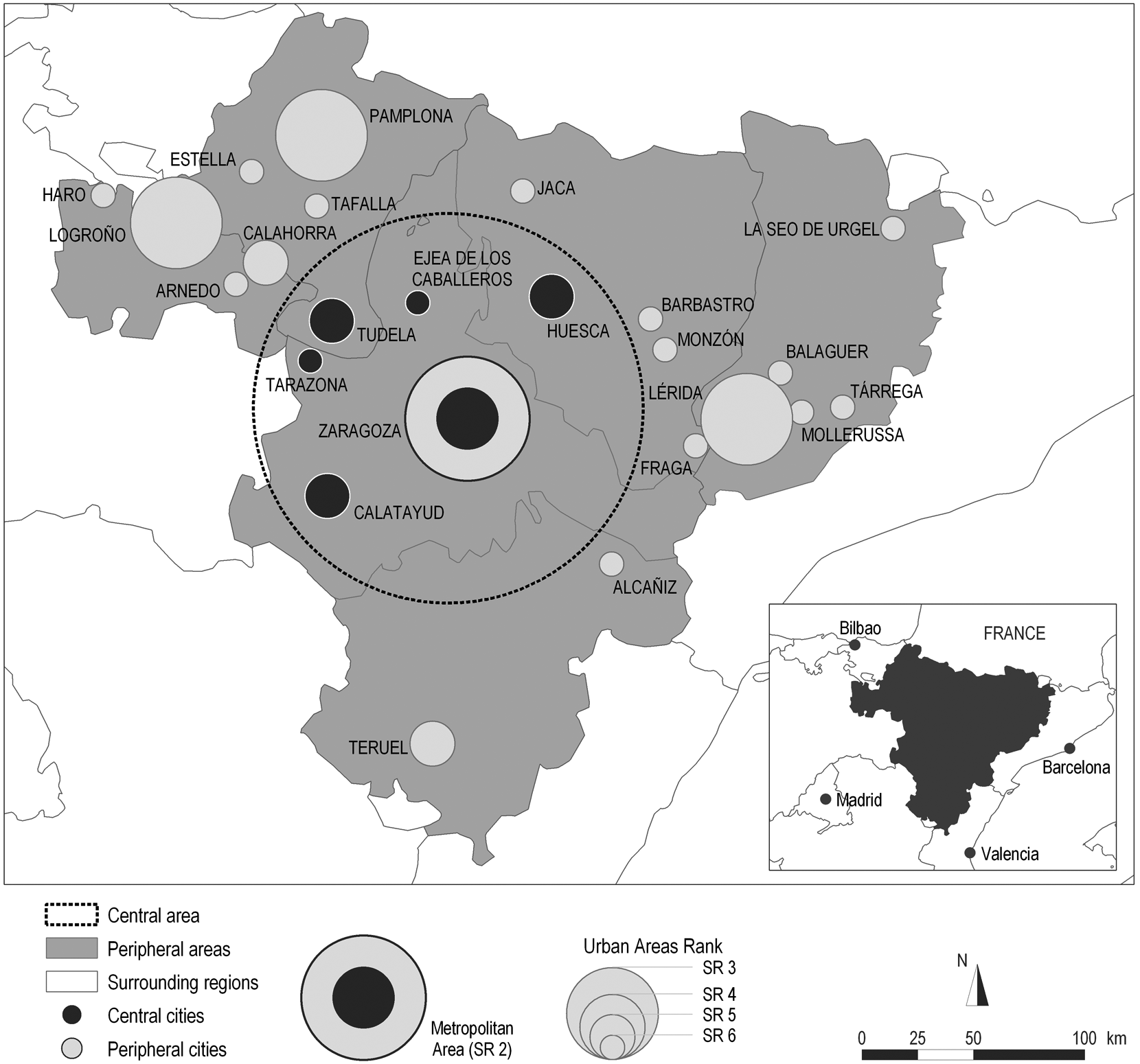
The urban network in the Ebro Valley region
We find a marked macrocephaly in the urban network of the Ebro Valley regions. The difference in population between Zaragoza and the three cities below it in the SR3 rank is greater than the fall-off predicted by the simple rank-size rule. The primacy index is 1.7, which is approximately 40 percent more than the value that we find in systems in which the rank-size rule fits perfectly. 6 This urban network is a clear case of the primate pattern in which the role of the first urban area, Zaragoza, is dominant. At the same time, there are no cities in the SR4 rank in the urban hierarchy. If we incorporate the criterion of distance, then we see that, in the group of the central cities, macrocephaly is even more marked because no towns in the SR3 or SR4 ranks are within the threshold of 1 hour’s travel from Zaragoza. As a result, the primacy index in this case is 8.6, which is seven times higher than the value associated with balanced systems. The set of peripheral towns is slightly more complete. There are three peripheral cities in the SR3 rank (Pamplona, Logroño and Lerida), but there are none in the SR4 rank. To find the central and peripheral towns, we must examine the lower levels of the urban network (that is, SR5 and SR6).
In short, the structure of the urban system in the Ebro Valley has the following features. On the one hand, the cities in the hierarchy ranked immediately below Zaragoza are too far away (that is, nearly 2 hours away from the city). On the other hand, the nearby towns that are less than 1 hour away are too small (that is, three or four hierarchical levels below Zaragoza).
Analysis of the spatial industrial dynamic
We split the analysis in this section into four differentiated but interrelated parts. The first and second focus on showing the effects of the aforementioned competitive advantages on the industrial dynamic of the Zaragoza urban area between 1992 and 2005. The third and fourth show how the structure of the urban network influences the processes of industrial decentralization to the lower-ranking cities in the Ebro Valley. We examined the municipality of Zaragoza and a peripheral ring formed by 18 municipalities on 6 axes of the intra-metropolitan expansion. We selected the municipalities on the basis of two criteria. The first criterion was that, over the period being considered, new and relocated industrial companies had created at least 100 jobs. The second criterion was that the municipalities’ boundaries must form a continuous space around Zaragoza. To analyse the industrial decentralization processes, we included all of the urban areas of the Ebro Valley regions.
Our main source of information was the Register of Industrial Establishments, which is the only available source that includes the level of temporal, spatial and sectoral disaggregation necessary to test the hypotheses in this work. Our analysis also included a survey of local business owners’ opinions regarding industrial localization (Escalona-Orcao et al., 2006, 2007).
Industrial dynamic within the Zaragoza urban area: the localization of new and relocated companies
Following Graham and Spence (1997), we hypothesized that the industrial dynamic within large urban areas does not consist only of centrifugal movements. Rather, we argued that this dynamic is a more complex phenomenon. To facilitate verification of the hypothesis, we divided the study area into two sub-spaces: the municipality (that is, city) of Zaragoza and the 18 municipalities of its periphery. At the same time, we classified the companies registered during the period of study into two categories: newly created and relocated. Finally, we established the relative importance of each municipality based on the number of companies and jobs.
Zaragoza, the central city, is home to 51.4 percent of the industrial companies that have established themselves in the study area, and these companies provided 49.1 percent of new jobs. These figures are clearly higher than would be expected from cities of similar size in advanced economies. Furthermore, 76.0 percent of the companies registered in the city were new, which suggests the existence of a fairly intense centripetal movement. In absolute terms, the attractiveness of the urban area centre for newly created companies is greater than that of its periphery.
A quarter of the industries registered in the central city had relocated to the city and were responsible for 49.0 percent of the total jobs created there. Although the relocation of industries is one of the components of the metropolitan decentralization process, 44.6 percent of the relocated companies in the general area moved from the central city to the new industrial estates to the south. In the short term, companies will continue to move from the city’s older industrial areas to these southern estates. Most of these companies had received incentives from the city council and had signed agreements related to future land use.
In the municipalities surrounding the central city, relocated companies comprised 31.5 percent of the companies moving to this area during the considered period and accounted for 41.6 percent of the created jobs. The results of a recent survey found that most relocating companies also come from the central city. This finding confirms the existence of centrifugal forces. However, the reach of the process is limited because 75 percent of the relocations were recorded in only six municipalities that are adjacent to Zaragoza (Escalona-Orcao et al., 2006).
The analysis clearly shows that the city of Zaragoza is still an attractive centre, as a location both for new companies and for the relocation of others. This finding confirms the initial hypothesis regarding the complexity of industrial movements in large urban areas.
Sectoral specialization and localization preferences
Our second hypothesis states that large urban areas can attract not only high-added-value activities but also medium- and low-added-value activities because the labour costs in these areas can be lower than those recorded in neighbouring regions. Moreover, land prices in large urban areas can be cheaper because abundant, well-equipped spaces have recently entered the market. We classified the branches of industrial production into three groups according to whether they generate high, medium or low added value and thereby account for the added value being positively correlated with the degree of technological complexity. 7
Of the companies that had established themselves in the study area, 59.8 percent manufacture goods with low added value, and only a small proportion (3.8 percent) produce goods with high added value. However, this last group was the only category fulfilling the general localization trend predicted by the theory – 75.2 percent of these companies were located in the centre of the study area. Conversely, the companies manufacturing low-added-value goods were located in both the centre and the periphery. In fact, based on percentages, the companies manufacturing low-added-value goods were more important in the central city than in the periphery of the area. This finding indicates that, despite its rank and size, Zaragoza is still an attractive location for companies that are sensitive to labour costs and land prices and that manufacture more standardized products.
In addition, a large number of company branches producing medium-added-value goods were present as well. However, we found that 55.4 percent of the companies producing medium-added-value goods were in the periphery of the area under study, especially the auxiliary industries and suppliers related to General Motors, a multinational company located 28 km from Zaragoza. The municipalities adjacent to Zaragoza that offer low-cost land make competitive bids to attract companies looking to relocate to other areas. Examples of such companies include technologically advanced companies that once benefited from regional industrial policies. Aside from a few branches with high added value, the other companies were located in the periphery of the city, as predicted by the theory. Thus, we can view these companies as an example of the crowding-out effect because they belong to sectors with low added value. Some surveys indicate that the new companies are attracted to the abundant local supply of well-prepared and competitively priced land (Escalona-Orcao et al., 2007) and by the subsidies offered by the local government of Aragon. Thus, the crowding-out effect is not only the result of a spontaneous or automatic process but also a response to the active intervention of the local and regional authorities.
In conclusion, the urban area of Zaragoza is an attractive location for a wide range of companies. Only the manufacturers producing medium-added-value goods may be relevant to an incipient decentralization process, given their relatively major presence in the periphery of the urban area. However, some of the leading companies of this type have benefited from various types of incentives. This finding shows that we need to consider the possible factors limiting agglomeration diseconomies in large urban areas in order to provide a satisfactory explanation of the highly selective nature (from a spatial point of view) of the decentralization processes within the urban area and of the industrial decentralization processes across urban systems. We explore these aspects in the following sections.
The nature and reach of the industrial decentralization process
The hypothesis underlying this and the next section is that the intensity and character of the interurban deconcentration process depend on the attractiveness of the different urban areas and the structure of the urban network. To determine the attractiveness of Zaragoza for the location of industries, we performed our analysis at a more detailed level and subdivided the study area into four concentric rings. The first was the centre of the area and contained only the municipality of Zaragoza. The other rings corresponded to the periphery of the area. Table 1 shows the proportion of companies established in the municipalities in each ring during the studied period. This percentage in effect describes the distribution of industry and the impact of decentralization. Based on the table, we can deduce that 51.4 percent of the companies were established in the centre of the area and that increased distance has a clearly dissuasive effect because the proportions of companies decreased from the centre (that is, 51.4 percent of the total) to the periphery (that is, 2.44 percent from 30 km and beyond).
The location of new and relocated industrial companies in the urban area according to their distance from the city centre, 1992–2005

Source: Camerdata, “Fichero de empresas” [Spanish Companies Directory], http://www.camerdata.es/php/Productos/fichero_empresas.php; and “Registro de Establecimientos Industriales” [Register of Industrial Establishments].
Because there were relatively more relocated than new companies during the studied period, relocated companies comprised almost half the total number of companies in the second and third rings. However, the spatial reach of the relocation process is limited. For example, in the outermost ring, the proportion of relocations was low and was not counterbalanced by the presence of new companies.
However, the relocated companies coming from the centre or from municipalities in the first ring indicate the existence of centrifugal processes that might serve as the base of an incipient industrial decentralization process. This process would explain the notable importance of industry in some of the municipalities surrounding the central city. This aspect is covered by their location quotients, showing that their traditional economic structures have been notably modified by industries opening in and relocating to these municipalities. For this reason, although the total number of companies and jobs was much lower in these municipalities than in the city of Zaragoza, the values of their location quotients were higher. This finding is reinforced by the attraction that Zaragoza exercises on the industries locating in this area has not impeded its consolidation as a clearly tertiary capital. The location quotients indicate that the greatest impact of industrial decentralization on local economies was in the municipalities closest to Zaragoza. We found a significant gradient from the second ring to the furthest ring: the second ring had the highest location quotient (2.8), and it decreased gradually until it reached its minimum value in the fourth ring (1.6).
In conclusion, the data (that is, proportion of companies, relocations and location quotients) confirm that the city of Zaragoza retains a strong attraction for relocating companies. In turn, this attraction slows the industrial decentralization processes within the urban area.
The interurban decentralization processes
In this section, we focus on how the unbalanced structure of the regional urban network influences the hierarchical and spatial diffusion of industries toward the smaller cities in the Ebro Valley. We classified the urban areas that comprise the urban system being studied in accordance with the criteria adopted by Polèse et al. (2007). Figure 2 shows the indicators that shed some light on the process and enable us to compare the results of the analysis with those obtained in other works on Spanish cities in general. 8 Our first indicator is the proportion of industrial companies that exist in each urban category. The results show clear parallels with those obtained in the previous section. This finding indicates that the distribution of industrial companies among the areas comprising the urban system is directly proportional to the areas sizes. The system’s main urban area has the greatest proportion of industrial companies (41.3 percent), followed by the areas ranking immediately below, whose values are 27.4 (SR3), 10.6 (SR5) and 20.6 (SR6). These values confirm that the primate city in the system has considerable industrial weight over those cities that are closest to it in rank or distance. We can explain the proportion of industries in the smaller cities by showing that many of these cities maintain a dense fabric of traditional food processing and consumer goods industries.

The spatial distribution of industry and location quotients in the urban network of the Ebro Valley
Figure 2 is based on the location quotients of the urban areas. Among the central urban areas, the difference between the values of the main city, Zaragoza, and the next three (Huesca, Tudela and Calatayud) is slight. The quotient of this group of three cities is clearly lower than the average of the other Spanish cities in its rank (SR5), whereas the next rank (that is, cities with populations ranging from 10,000 to 20,000 inhabitants (SR6)) registers a location quotient distinctly higher than that for Spanish cities of that size. In addition, the quotient of the peripheral cities presents strong upward values. The starting value is similar to that obtained for Spanish cities of the same size (SR3), but the values of the quotients for the SR5 and SR6 categories are clearly higher (1.49 and 1.51). In turn, a comparison of the quotients of the central and peripheral cities with the same size indicates that, in the Ebro Valley’s urban system, the quotients are greater for the peripheral cities. This result contradicts the findings regarding Spanish cities in general (Polèse et al., 2007). The lines showing the variation in the industrial location quotients (Figure 2) exhibit specialization patterns that diverge noticeably from those obtained for all of Spain. The line joining the quotients of the central cities displays a less pronounced slope, whereas the line connecting the values of the peripheral cities displays a strong upward slope.
The results of the analysis show that the Ebro Valley region’s central cities, which contain 20,000 to 50,000 inhabitants, obtain lower location quotients than those of Spanish cities in general and of the peripheral cities with the same rank in the system. This finding confirms the limited scope of the industrial decentralization process in the system. Additionally, this result shows that the attractiveness of the capital city and the shape of the regional urban system interfere with the decentralization process. The high degree of industrial specialization in the small cities further away from Zaragoza also departs from the findings regarding Spanish cities in general. In these small towns in Aragon, Navarre, La Rioja and inner Catalonia, manufacturing industries are visibly important, especially because of the scarcity of services and the decline of agriculture in these towns. However, this industrial weight cannot be interpreted as indicating industrial deconcentration from Zaragoza for the following reasons: the powerful attractiveness of Zaragoza; the barely perceptible centrifugal processes in the metropolitan industrial dynamic, which can also be seen in the low location quotient of the rank-5 central cities closest to the central city; and the resulting enormous difference between the industrial size of Zaragoza and the cities belonging to these categories. In conclusion, with respect to the Ebro Valley region, we can still affirm that industrial companies prefer to be located in Zaragoza.
Conclusion
In contemporary industrial maps, most companies prefer to locate their industrial activities in urban areas and their surroundings. Industry is no longer the main driver of metropolitan growth, but metropolises are not becoming less industrialized (Holz and Houssel, 2003: 238). The model of interurban industrial localization is also quite stable, though the factors and processes explaining it are still controversial. In this study, we have discussed a recent approach that claims that decentralization towards mid-sized and small cities is the only active process within urban systems, and that the basic variables of interurban decentralization are city size and ‘proximity to or distance from a large urban area’. A review of the literature has provided material for our hypothesis, which states that more variables exist and that the scope of the interurban industrial decentralization processes varies according to the real characteristics of the respective urban areas and urban systems.
Our analysis of the new industries establishing themselves in Zaragoza between 1992 and 2005 showed that this large urban area was attractive not only to high-added-value industries looking for economies of agglomeration but also to medium- and low-added-value industries (that is, industries that prefer lower labour and land costs). We found theoretical elements in the literature that account for this finding and identified the factors explaining why Zaragoza has this dual attractiveness. On the one hand, the demographic and functional size of the city and its excellent transport and communications infrastructure appealed to companies. On the other hand, the city had low salaries compared with those of the main Spanish urban industrial agglomerations, such as Madrid, Barcelona and Bilbao, which are located approximately 300 km from Zaragoza. Furthermore, Zaragoza had a large supply of land recently equipped for industrial purposes and put on the market at competitive prices, as well as the political will and commitment from the local authorities needed to keep industries in the central city.
We also showed that Zaragoza’s attractiveness is accompanied by a process of industrial decentralization marked by limited spatial reach such that new industries (that is, either new or relocated companies) within the urban area continued to establish themselves mainly in the central city and the nearest peripheral ring. Rarely did these companies establish themselves beyond a 30 km radius. Regarding interurban localization, we showed that within the Ebro Valley’s urban system, which is clearly primate and has no mid-sized cities in Zaragoza’s sphere of influence, the expected interurban deconcentration process occurred to only a small degree. Several reasons may explain this result. First, Zaragoza maintained the highest proportion of industrial companies of all of the areas (that is, nearby or distant, large or small) in its urban system. Second, industrial specialization in the three central cities, which had populations ranging from 20,000 to 50,000 inhabitants and were located less than 1 hour away, was not significantly higher than that of the main city. Finally, the highest location quotients were found in the smallest and most distant cities. We can interpret this finding not as an indication of industrial decentralization but rather as a result of the relative importance of industry within the local economy.
We understand that the Zaragoza case is not an empirical anomaly and that our conclusions are noteworthy because they refer to aspects of the theory on interurban industrial decentralization that need to be adjusted so that the theory more closely resembles reality and can be applied in a more flexible manner. On the one hand, our findings suggest that large urban areas can maintain their industrial attractiveness because they can meet different and more numerous requirements than the existing theory predicts. On the other hand, the process of distance-sensitive decentralization is contingent on the spatial structure of the hierarchy undergoing the decentralization process. Therefore, a theoretical understanding of the industrial interurban dynamic requires scholars to account for the various characteristics of the regional urban system. These characteristics may include the categories of the urban areas that form this system and the number and locations of these urban areas. Certainly, clarifying all of the specific causes of these processes will require complementary research. However, we are confident that we have demonstrated that a notable richness and complexity underlie the interurban decentralization processes and that properly formulating the principles governing them will continue to pose an interesting challenge for future researchers.