



Abstract
European Union policy at the local scale is split into numerous sectoral programmes in the spheres of cross-border cooperation, energy, the environment, culture and transport. In this context, the CIVITAS (City-Vitality-Sustainability) initiative on sustainable urban mobility was launched in 2000. The aim of this article is to analyse relations between cities and Europe, focusing on the practical ways in which local policies have been ‘Europeanized’ in four French cities. The article highlights three main results. First, CIVITAS does not represent a sufficient financial incentive to sustain ‘download Europeanization’ of local transport policies, which remain under the control of local authorities. Second, despite a lack of European funding, local authorities mobilize strongly on a European level in order to distinguish themselves. In a context where French transport authorities are becoming increasingly dependent on local financial resources, entering the CIVITAS programme and acquiring this seal of approval has played a determining role in legitimizing and boosting budget allocations to public transport. Third, the mobilization of local authorities and the selective strategy of the European Commission jointly strengthen political competition between cities at a European level and reinforce a network of innovative cities.
Introduction
After the first European initiatives in the field of urban planning policy, such as URBAN, European Union policy at the local scale subsequently split into numerous sectoral programmes in the spheres of cross-border cooperation, energy, the environment, culture and transport. In this context, the CIVITAS (City-Vitality-Sustainability) initiative on sustainable urban mobility was launched in 2000 by the Directorate-General Energy and Transport (DG TREN), within the 5th, 6th and 7th Framework Research Programmes. After calls for applications in 2000 (CIVITAS I/2002–2006) and 2004 (CIVITAS II/2005–2009), 36 cities were selected. The measures undertaken by these 36 cities represented a budget of about €300 million, of which more than €100 million was funded by the European Union. The 19 large cities chosen in 2000 were organized into four specific programme groups (consortia) made up of four or five cities each. The 17 medium-sized cities chosen in 2004 were formed into four new consortia. Not unlike the earliest urban policies undertaken by Europe during the 1990s, this new intervention emerged in a context of gradual withdrawal by national state governments from funding urban transport; once again, cities could see Europe as a potential new backer.
The aim of this article is to analyse relations between cities and Europe, focusing on the practical ways in which local policies have been ‘Europeanized’; my approach will be to study the CIVITAS programme and its application in four participating French cities. In choosing this approach, my objective is to understand the extent to which the French transport policy context and rescaling trends influence how European programmes are implemented. I shall deal with two research questions:
- What is the impact of European programmes on local urban transport policies in the French local transport policy context, which is now characterized by growing dependence on local government resources?
- How have French local authorities made use of CIVITAS programmes to acquire new capacities for action at local and European scales? How far can these strategies be explained by processes that are rescaling transport policy in France?
I shall highlight three main results. First, CIVITAS does not represent a sufficient financial incentive to sustain ‘download Europeanization’ of local urban transport policies, which remain under the control of local authorities. Convergent with analyses of the URBAN programme and its implementation in various European cities (Marshall, 2005; Mboumoua, 2010), I found that the effects of the CIVITAS programme have been relatively limited at a local level and mainly driven by local authorities’ preferences and past practices. Second, despite a lack of European funding, local authorities mobilize strongly at a European level in order to distinguish themselves and to promote their innovations in transport policy. A new seal of approval offers politicians a strategy, at both local and European scales, for reorientating public transport policies and gaining funds for public transport projects. In a context in which French transport authorities are becoming increasingly dependent on local financial resources, entering the CIVITAS programme – and so acquiring this seal of approval – seems to play a determining role in legitimizing and strengthening budget allocations to public transport. Third, the mobilization of local authorities and the selective strategy of the European Commission jointly strengthen political competition between cities at a European level and reinforce a network of innovative cities.
After a brief review of the literature on Europeanization of local politics, I shall analyse the impact of European programmes on local transport policies, using the example of four French cities, before turning to an examination of the competing ways of structuring local government that have resulted from European thematic networks focusing on urban transport.
The Europeanization of local politics: a research area under construction
Analysis of Europeanization involves distinguishing the dialectic process of Europeanization – whether top-down or bottom-up – from other, unilateral trends towards convergence and harmonization (Radaelli, 2003). Policies can be ‘Europeanized’ – that is, profoundly transformed in procedure, rules and instruments under the influence of Europe – without this necessarily leading to a common, converging policy. This approach to Europeanization allows us a wider view of relations between levels of government, both national and subnational. In practice, ‘download’ and ‘upload’ Europeanization can take different pathways: implementing European programmes at a local level; adapting to the pressure of new European rules; lobbying European authorities in the aim of influencing the measures they take and their funding allocations; and forming networks of cities or local authorities in order to acquire capacity for action at a European scale (Benington and Harvey, 1999; Kübler and Piliutyte, 2007; Marshall, 2005).
The earliest research into the European political scene related to the involvement of subnational stakeholders and assessed the impact of the regions on the emergence of multilevel governance in European policies (Benz and Eberlein, 1999; Scharpf, 1994). The concept of multilevel governance underlined the polycentric nature of power in Europe, no longer concentrated solely in the hands of individual states, but shared to differing degrees among multiple levels – European, national and regional – and becoming more and more differentiated from one region to another (Hooghe, 1995; Hooghe and Keating, 1994; John, 2000). In parallel, city-regions continued to put pressure on national authorities (Bache, 1999; Balme and Jouve, 1996; Benz and Eberlein, 1999; Duran and Thoenig, 1996; Muller, 1992). From the urban governance standpoint, the work of Patrick Le Galès (2002) and of Neil Brenner (2004) examined the function of Europeanization of local policies in the context of the ‘rescaling’ process that was at work in European cities. ‘Rescaling’ is understood here in an instrumental sense, as a process that focuses on agents and on the use they are able to make of different scales (Brenner, 1999). Different state, municipal and regional actors can choose to either localize or Europeanize their policy, or even to regionalize it. According to Le Galès (2002), in a context of increasing competition between urban areas, local authorities find new modes of governance and of policy, with strategies to Europeanize local policies representing one of the main levers (Le Galès and Harding, 1998). The Europeanization of urban policies began in the 1990s with the development of the URBAN I and URBAN II programmes, aimed at issues relating to social cohesion and development of urban areas (directly inspired by contract-based urban policies adopted in France and in the UK) (Hamedinger and Wolffhardt, 2010). More recent European urban and regional policy has focused on developing the attractiveness and competitiveness of urban regions in Europe and on the nature of factors attracting local development (Brenner, 2004).
To complement the top-down URBAN programmes, cities created horizontal networks in order to promote their image as innovative cities in certain policy fields (‘EnergieCités’ in the field of renewable energy, 1 ‘Polis’ on sustainable urban transport, 2 and wide-ranging policy innovation networks such as ‘Eurocities’). Apart from the initial consideration of reputation, the principal purpose of these networks was to press for more funds to be allocated for urban development by the European Union. For Brenner (2004), these large interurban networks are above all orientated towards marketing their own city-regions. In doing this, they do not soften competition between cities but accentuate it by offering local authorities new means to differentiate themselves. European programmes are selective; and participation in local authority networks differs vastly from one city to another.
Thus, multiple strategies for Europeanizing local policies, deployed both by local authorities themselves and by the European Commission, are based simultaneously on a desire to strengthen cities’ collective capacities for action and on a growing differentiation of local policies through programmes, branding and European city networks. However, the issue of the practical ways in which these Europeanization strategies are used must be examined in depth in order to evaluate how and precisely why local authorities have adopted these programmes and strengthened their policy strategies. As a matter of fact, the diffusion of European programmes is strongly dependent on time and scale contexts related to national instruments and institutional traditions as well on the temporality of the rescaling process, contrasting with the aim of a cross-national convergence of good practices (Oliveira and Breda-Vázquez, 2010).
Methodology
My methodology was to study the ways that cities involved in CIVITAS implemented the programme, in order to evaluate and compare the degree to which cities modified their practices over the course of their participation in the programme.
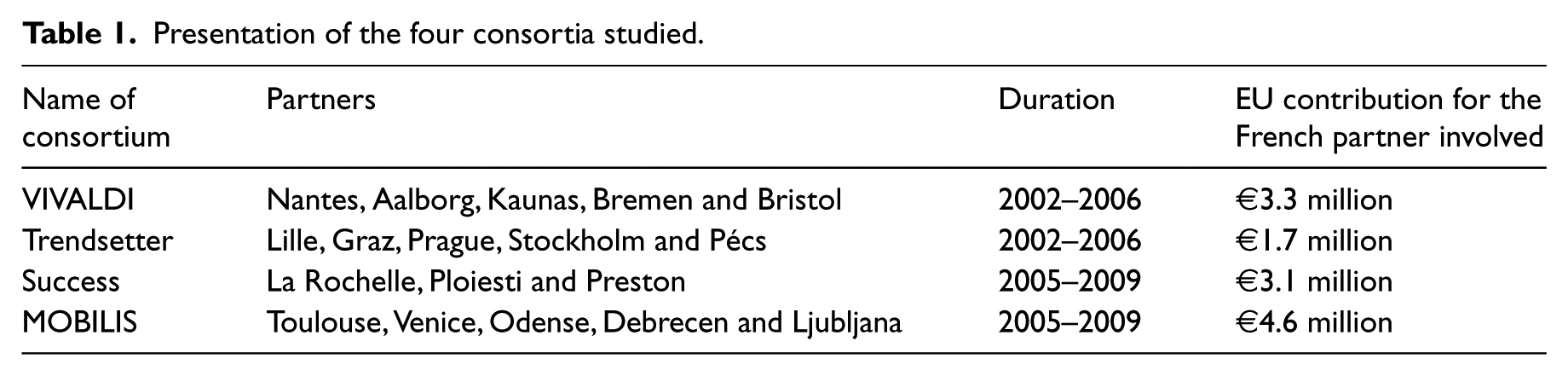
I first chose to compare the impacts of the CIVITAS initiative on the cities and the ways in which Europeanization was ‘downloaded’ to their urban transport policies. To do this, I compared the impact of the programme on different cities in the same country. The case of France is interesting because it shares with the UK the specific feature that it had two cities participating in the two phases of CIVITAS (two in each), which allowed intranational comparison at each stage of the programme. Moreover, Lille, Nantes, Toulouse and La Rochelle all participated in different city consortia (Table 1) and this allowed me to compare the possible influence of a consortium on the implementation of the CIVITAS programme.
Presentation of the four consortia studied.
In order to compare the impacts of CIVITAS, I chose to evaluate the respective significance of two variables:
The roles of the European Commission and the various consortia in the particular CIVITAS programme in which the cities were involved; this analysis depends on the first definition of Europeanization, which concentrates on the top-down process (Radaelli, 2003; Saurugger and Surel, 2006).
The weight of specific local institutional arrangements. This will allow us to grasp the relative importance of traditional ways of acting, of past political choices in the field of urban transport and of previous transport policies (Kübler and Koch, 2008; Pflieger et al., 2009; Pierson, 2000).
Each of these variables can play a determining role in the local implementation of a European programme. They allow us to evaluate the actual impact of Europeanization processes through the direct influence of the Commission as compared with local politics. This evaluation also allows us to understand how the CIVITAS programme offered French cities an opportunity to become part of a selective thematic network of cities focusing on mobility and to equip themselves with new policy intervention and lobbying capacities.
This section of the fieldwork was based on case studies in the four French cities involved in CIVITAS. For this, I decided to take a systematic approach, and in each city I interviewed the politician in charge of the transport authority and, where this was not the same person, the politician in charge of the CIVITAS project. In addition, I interviewed the technical officers responsible for administering and steering the CIVITAS project within the local authorities, who were most often transport planners (see list of interviewees at the end of article) The interviews were then transcribed and coded according to the main variables used in the analysis, as outlined above: how the CIVITAS programme was designed at the local scale; the role and impact of the European Commission and of the consortium’s other cities in programming the projects; the place of CIVITAS in local transport policy, both in terms of the local political and institutional context and in relation to broader rescaling trends in the transport sphere; and the strategies and methods adopted by local politicians and technical officers in their use of CIVITAS. The interviews were supplemented by a detailed documentary analysis of the four local transport policies. I studied and compared the urban transport plans drawn up by the transport authorities, both before and after the CIVITAS programme was implemented. This content analysis and this tracking process enabled me to trace the integration of the CIVITAS programme into local transport policies and their specific features.
Four different reorientations of urban public transport policies: the respective influences of the EU and local policy trajectories
The French model of urban transport: growing dependence on local funding and local government resources
The French urban transport policy context explains how the four French cities studied were able to adopt the CIVITAS programme as a set of new instruments to help them implement their local transport policies. Since the late 1990s, the central government in France has gradually withdrawn from funding investment in new public transport infrastructure. Therefore local authorities have found themselves faced with three concomitant and partly contradictory trends: (1) the need to adapt to a new national legal context encouraging local authorities to initiate policies to promote a shift from the private car to collective passenger transport; (2) the growing dependence on local financial resources to fund public transport; and (3) the increasing extent of cooperation between local authorities in managing public transport.
First, in 1996, the central government made it obligatory for all transport authorities serving over 100,000 residents to establish an urban transport plan – but without granting any additional financial resources to the urban regions. The law explicitly required that the new plans must provide measures supporting the development of new modes of transport as alternatives to the private car and promoting a reduction in road traffic. Therefore, local transport authorities were forced by law to implement transport policies that would restrict car users – policies that were very costly in terms of financial resources and less acceptable politically, as they targeted a large part of the electorate. Implementing new urban transport plans merely intensified local authorities’ needs in terms of the policy resources explained above.
Second, since the late 1990s, on the financial level – after supporting investment more strongly throughout the 1990s and promoting the construction of new light rail lines in most medium-sized French cities (Pflieger et al., 2009) – the central government has gradually reduced its support to urban public transport. Above all, city councils have found themselves obliged to cover public transport operating deficits, as transport use has increased but the extra income from fares has failed to cover most of the steadily rising running costs. In parallel, local authorities have had to engage in a continuous process of trying to find ways of diversifying their methods for financing investment, as they can no longer count on state aid. In France, urban transport systems outside the Paris region are funded, on average, 15% by income from fares, 35% by a special public transport tax levied on businesses and the remainder – roughly half the costs – directly from local authorities’ general budgets (including borrowing), with central government contributing no more than 2% (Faivre d’Arcier, 2009). Faced with new financial challenges, there was nothing local authorities could do other than diversify sources of funding – with the European Union representing a new opportunity – or increase their direct financial contribution to the collective passenger transport budget. However, in a context of financial austerity, any growth in the budget allocated to public transport inevitably works to the detriment of competing budgets for education, urban development or social policy. Councils increasingly depend on local budgetary resources, which are becoming tougher to raise in a context of crisis in local public-sector budgets.
In terms of the governance of transport, historically France has relied on ‘special districts’ and on cooperation measures between city centres and their adjoining suburban municipalities to fund and coordinate the planning of its transport network (Offner, 2006). The third shift has been that, from the late 1990s onwards, with the increasingly rapid growth of periurban areas and of travel between urban centres and peripheries, cities have been faced with worsening congestion. Transport problems have underlined the ‘scale mismatch’ of the authority in charge of transport, which remained focused on the central urban areas but in effect had to take on the financial burden of travel needs generated by residents of peripheral municipalities. Central government encouraged extension of transport authorities’ boundaries, but this enlargement has had two direct effects on the governance of public transport. The first is that the tax income derived from the enlarged transport tax area has not covered the relatively high costs of providing a service to periurban areas. Extending the boundaries has therefore made the transport authorities’ financial situation, relatively speaking, worse (Faivre d’Arcier, 2009). The second is that the political paradigms supporting collective passenger transport policies have broadly changed. Politicians from periurban municipalities have increased their power within transport authority assemblies by supporting public policies that are often less favourable towards collective passenger transport and to any increases in public transport budgets, which are above all dedicated to denser areas, where congestion problems are the most glaring. These two changes have pushed the decision makers who head the transport authorities to look for symbolic resources in order to assert the legitimacy of their decisions, strengthen their power of social production 3 and build alliances or compromises within majorities that are more fragmented and essentially less favourable to public transport than they used to be.
French cities instrumentalize the CIVITAS programme
In the context of growing dependence on local government resources – both financial and symbolic – how have French local authorities made use of CIVITAS programmes to acquire new capacities for action at that scale?
The basic approach of the CIVITAS initiative is to establish a policy framework offering measures across eight fields: clean fuels and vehicles, integrated pricing strategies, access restrictions, collective passenger transport, less car-intensive lifestyles, urban goods transport, transport management and ‘soft’ measures (measures to encourage change in travel behaviour ranging from schemes that encourage walking and cycling to more complex programmes in workplaces and across whole towns and cities), as well as operational innovations. From this starting point, it was intended to create a means for the Commission to influence cities to set up and act on new transport-related policies and, more generally, to adapt their local transport policies in the direction of these measures.
As far as the French CIVITAS cities were concerned, we shall see that there were a number of contrasting situations. For Nantes and Lille (presented in the next subsection), the cities involved in the first phase of the programme, CIVITAS supported existing projects. In contrast, for La Rochelle and Toulouse (studied in the following subsection), the CIVITAS programme enabled acceleration or reorientation of their transport policies. The European measures were used strategically by politicians and transport planners to support the transformation of local policies in Toulouse and to legitimize the implementation of new instruments (such as the new Urban Transport Plan) in La Rochelle. CIVITAS was taken up by the cities as a means of strengthening their own political trajectories and – though less often – as a form of as a form of complete revision of their local transport policies for local transport policies.
Nantes and Lille: CIVITAS as a support for existing projects
Nantes entered CIVITAS without being approached by a research consultancy or by another city. The politician responsible for transport at the metropolitan authority 4 referred to ‘channels at European Commission level’ (Interview 2). According to him, Nantes had generated good results from all the European projects in which it had previously taken part. It was the European Commission that contacted Nantes Métropole to invite it to participate in CIVITAS, because its urban transport policies matched the CIVITAS approach. The proposed policies formed part of a programme of activities initiated by the metropolitan area, some of which had already been budgeted for or were even under way (remodelling the Vannes road).
Nantes’s first response involved only Aalborg (Denmark). Aalborg was defined from the start as a ‘follower city’, since it wanted to join only in order to tackle certain very specific issues. Therefore Nantes took the lead in this first consortium. However, when it came to the negotiations, the European Commission imposed a merger with another consortium. This decision was taken on the basis of the complementary nature of their proposed activities. Following the merger, the European Commission decided that the VIVALDI (Visionary and Vibrant Actions through Local Transport Demonstration Initiatives) leadership should go to Bristol. To compensate Nantes, which had been leader of the first consortium, the city was awarded the status of scientific coordinator. This made VIVALDI the only CIVITAS I consortium with two ‘lead cities’.
On the political level, according to Nantes Métropole, the financial contribution was not the reason why the city took part in CIVITAS. Its participation was motivated by the Europe-wide visibility it would gain from the initiative. However, on the technical level at least, representatives of the metropolitan area’s Urban Planning Agency and the metropolitan transport authority estimated that European subsidies played an incentive role for local government. In Nantes, 75% of the CIVITAS budget was concentrated on three projects: buying 150 buses running on compressed natural gas and supporting plans to introduce the Bus Rapid Transit Busway route 4, developing the Nantes–Vertou railway link and upgrading the Vannes road.
A top-level executive of the Public Transport Department at Nantes Métropole (Interview 4) pointed out that Nantes won recognition not for its participation in CIVITAS as such, but for the fact that the actions it took within the CIVITAS framework were actually on a continuum with the city’s activities over some 30 years, making Nantes an important ‘living laboratory’ for tramways and Bus Rapid Transit lines. The fact that only two French cities were chosen for CIVITAS I also served to place Nantes in pole position for other European projects. For the European Commission, the promotion of ‘lead cities’ was an essential part of the CIVITAS initiative: showing off flagship cities to best advantage at the European scale and subsidizing their projects in order to provide examples to other cities of how to carry forward an integrated transport policy.
Before CIVITAS I (2002–2006), Lille had taken part in very few European projects in the field of transport. Lille Métropole became aware of CIVITAS through the monitoring work of its European Relations Department. Lille had been a member of the Polis network (which brought together European cities that were pioneering transport innovations) for several years, and so it used this network to choose its first partner, Stockholm, on the basis that both cities used biogas for their buses. Stockholm then got in touch with Prague, and these three cities together made an initial bid to CIVITAS. Stockholm was the consortium leader; Lille did not want this role, preferring to learn from Stockholm, which was widely recognized in the field of European programmes. After receiving the candidates’ responses, DG TREN insisted on a consortium merger. The consortium grew from three to five cities, obliging it to accommodate Graz and Pécs despite issues of coherence: ‘This is a competitive programme. We’ve already put a lot of effort into working with Stockholm on complementary issues and we’ve reached a position where the project is coherent… But after we bring in the other two […]. It’s bound to be a bit forced’ (Interview 3).
The projects put forward by Trendsetter fell into two broad areas: improving transport management and setting up clean vehicle fleets. The Trendsetter project in Lille was essentially organized around one main aim: to significantly increase public transport use by encouraging alternatives to the private car. The objective set was to double passenger levels between 1998 and 2015 – which was also one of the key objectives of Lille’s Urban Transport Plan. It bought 128 biogas buses; the eligible costs represented only the amount of depreciation on these over the three years that CIVITAS ran. In fact, even though the funding argument played a role, it did not represent the city’s primary motivation for entering CIVITAS. Lille would have put through all its proposed measures, even without the CIVITAS contribution: ‘for the Urban Community, the interest in getting involved in this kind of approach is not a pecuniary one, since these subsidies are very modest in proportion to the investments required’ (Interview 12). On the other hand, participating in CIVITAS led to very visible recognition by the various transport stakeholders. Lille had already received visits from representatives of several cities interested in its initiatives, and following CIVITAS it saw demand for these presentations increase: ‘We really sensed strong interest in this European seal of approval, and it helped us to build links with other cities and with the Commission’ (Interview 4). Thus DG TREN chose Lille to present its achievements to the annual conference of the Clean Cities programme, which is the US equivalent of CIVITAS.
La Rochelle and Toulouse: CIVITAS as an acceleration or reorientation of transport policies
La Rochelle got involved in CIVITAS following an approach in 2003 by the ‘Eco-Mayors’ Association. This proposal arrived just at the beginning of the implementation of an ambitious Urban Transport Plan. The coincidence of a new Urban Transport Plan – involving a large number of promising projects – with a reduction in national state subsidies for public transport created a favourable context for drawing La Rochelle into CIVITAS. Contact was first made with the two partner cities, Preston and Ploiesti, and the European Commission during the October 2003 CIVITAS Forum.
In a similar way to the other CIVITAS projects studied, the proposed measures did not arise from the consortium working together, but were prepared by each city individually and then assembled to form a shared project. The consortium’s main aims related to the use of alternative fuels, traffic management techniques and sharing experience between cities in newly acceded Member States and Western European cities. The La Rochelle stakeholders stressed the programme’s role as an accelerator. La Rochelle’s transport policy was characterized by a succession of innovations relating to clean transport; participation in CIVITAS was in itself a form of continuity. Among La Rochelle’s 26 CIVITAS measures, many pursued a direction that had been initiated earlier. These included extension of the Bike–Bus Scheme, implementation of a second Park and Ride and development of an integrated pricing system. So, although CIVITAS did not alter the directions of La Rochelle’s transport policy, the programme provided an incentive for taking the demands of existing transport policy even further. CIVITAS helped to structure thinking on transport: ‘Thanks to CIVITAS, we conceptualized and theorized quite a number of things’ (Interview 13). It helped to strengthen local politicians’ strategic vision of mobility and transport issues, supporting their desire to maintain the city’s lead in the field of transport: CIVITAS enabled La Rochelle to keep up its image as an experimenter, an innovator and a pace-setter. La Rochelle is rated a benchmark city at European level. (Interview 6)
In September 2008, La Rochelle hosted a two-day meeting for European transport ministers; the city’s participation in CIVITAS had contributed to its selection as the venue. This event represented an opportunity for La Rochelle to promote its transport innovations in order to emphasize its commitment to Europe: ‘For La Rochelle, a medium-sized city recognized at the national level for its transport policy, it is highly validating to have a constructive dialogue with other major European cities and, especially, to gain EU recognition. It was indispensable’ (Interview 5).
Since Toulouse had a tradition of involvement in European projects, it knew about CIVITAS through the Polis network, of which it is a member. Toulouse applied as a CIVITAS I candidate, but was not selected by the European Commission. It put more resources into its application for CIVITAS II. Preliminary contact was established with Ljubljana (Slovenia) through the Polis network. Toulouse then used Rupprecht Consult, a German research consultancy specializing in European projects, to find its second partner: Debrecen (Hungary). These three cities formed an initial consortium, which was selected by the European Commission. The latter then imposed a merger with another consortium. Each city put forward projects corresponding to the CIVITAS requirements and then these projects were bundled together. The goal of the five cities was to establish radical strategies in favour of clean forms of urban transport.
In Toulouse, the overall aim of MOBILIS was to grow the use of public transport and to increase its modal share of journeys, which was just 12% at the start of the project. Operations in support of Metro Line B were at the heart of the MOBILIS project in Toulouse. Line B was not financed by CIVITAS, which did not subsidize – or very rarely – heavy infrastructure. Most of the MOBILIS measures in Toulouse corresponded to existing local projects, for which the decisions had already been taken or were in the course of being taken when CIVITAS II started. According to a Top Level Executive of the City’s Traffic and Transport Department (Interview 10), Toulouse traditionally used this method in its European projects in order to guarantee that the programme would be completed.
The politicians were convinced by the strategic dimension and by the opportunity to market Toulouse in Europe. The elected representative of the SMTC (Interview 9) saw a dual advantage to the Authority’s participating in this kind of project: sharing experience at the European level and receiving financial aid from Europe. However, according to the MOBILIS-Toulouse Project Manager (Interview 11), the city did not commit to this type of initiative on simple financial grounds. The sums involved were low compared with the total expenditure committed in order to implement the project as a whole, which, where MOBILIS was concerned, was a sum in excess of €100 million. All the projects would have been completed anyway in the long term, but it was noted that CIVITAS had clearly acted as an accelerator (Interview 8).
In Toulouse, the CIVITAS programme was used as an instrument to reorientate transport policies and as an additional way of legitimizing the change that the new council was attempting to inspire. The election campaign programmes of the main candidates for Mayor of Toulouse in 2008 were strongly coloured by transport and took up MOBILIS issues. At the local level, the MOBILIS project enabled the question of urban mobility to be tackled much more broadly and through a shared vision, notably with politicians: ’From now on, we won’t be able to argue only in terms of private car versus public transport’ (Interview 7). The MOBILIS-Toulouse project stood in contrast to the city’s tradition of a certain political reserve towards restricting domination by the car. From this point of view, CIVITAS represented a catalyst for changes underway in local transport policy, breaking with past policies: “European projects have played a part because they have introduced another way of looking at things” (Interview 7).
Moreover, as with the three other French cities that took part, one of the advantages of CIVITAS was the validating effect of having ‘CIVITAS City’ status. To be a CIVITAS city and to have coordinated a project means being rapidly identified by DG TREN and represents the cities’ key argument in favour of winning other projects and acquiring other funding, as well as being approached by other cities.
Institutionalizing a network of leading cities
The four French local authorities that participated in CIVITAS wanted to sustain their European involvement over the long term, and this desire was translated into the creation of appropriate structures. In Toulouse in particular, a European unit emerged within the metropolitan transport authority, designed to pursue such activities. La Rochelle, which had begun its project fairly ‘timidly’, quickly found itself obliged to recruit a competent larger team, which is now established and continues to manage European projects. Similarly, Nantes Métropole has set up structures that allow it to manage CIVITAS directly. Its elected official in charge of transport was the only politician who remained on the Political Advisory Committee (PAC) throughout the whole programme; normally, membership of the CIVITAS PAC rotates. ‘I think the European Commission recognizes that CIVITAS cities are cities that play a part in major political decisions, for example the Kyoto agreements’ .
In this context, belonging to CIVITAS offers the advantage of making the city a pioneer. Nantes has been called upon numerous times by the Commission. However, the same was not true of all the cities: the elected representative of the Toulouse SMTC pointed out that Toulouse was not invited by the Commission to help draw up the legislation. However, the success of CIVITAS in Toulouse can be seen in its presidency of the Polis network from 2005 to late 2007. Enhanced reputation and capacity for influence are probably the main motives for cities to get involved in the CIVITAS network, rather than the interurban exchange that the Commission would like.
In terms of lobbying, Toulouse and La Rochelle were the originators of the ‘French Task Force’ created in late 2005 when the views of the four French CIVITAS cities converged. The declared aim of the Task Force was to encourage participation in European projects by strengthening exchange and visibility. The goal of satisfying the Commission was achieved, since the French Task Force is now funded by the Commission. This initiative spread to some other countries, where similar structures have been created: for example, the city of Ploiesti founded the Romania Task Force.
As far as European lobbying is concerned, the originality of the CIVITAS Cities Network lies in the fact that it was actually set up by Europe through the eponymous programme and is funded by Europe. This ‘model pupils’ network made several contributions to discussions of the European Regulation on public passenger transport services and, in particular, to the 2007 consultations on the Green Paper on Urban Mobility. 5 Attracting criticism from more generalist local government associations, the CIVITAS network is perceived by the French Group of Transport Authorities (GART) as ‘a network under obligation’ (Interview 1): a stakeholder created at a stroke by the Commission. However, my study of the way CIVITAS functions has revealed the opposite: that, having initially used a CIVITAS project as a communication and city marketing tool, local authorities have often gone on to create their own instruments of participation, such as the Task Forces or the CIVITAS PAC, which actually have a responsibility to take a position on European transport policy. In the context of preparing the Green Paper on Urban Mobility in 2007, the positions of Polis and of CIVITAS were situated at the intersection between the most fervent defenders of public transport, promoters of cycling and the local government associations. To the representatives of CIVITAS cities, there was an obvious thematic similarity between the CIVITAS programme and the contents of the Green Paper published in 2007 by the European Commission.
However, the primary demand of the great majority of stakeholders (local government associations, city networks, public transport operators’ representatives) was that the European Union should make a much stronger commitment to urban transport by increasing funding. Following the trend for central governments to withdraw from financing public transport, the stakeholders have seen Europe as a potential ally in furthering their public transport plans. Nonetheless, requests for European funding found little echo in the contents of the Green Paper, which envisaged new money only after 2013. Publication of the action plan, scheduled for early 2009, has been postponed twice; and it is unlikely to provide for any increase in European funding for this area.
Results and discussion
Studying the practical ways in which urban transport policies have been Europeanized through the European CIVITAS programme allows me to highlight three main results.
First, and converging with the work of Marshall (2005) and of Mboumoua (2010) on the URBAN I and II programmes, I found that local authorities exercise strong control over implementation of the CIVITAS programme, thus limiting the scope of download Europeanization. Nantes, Lille, La Rochelle and Toulouse developed similar strategies for participating in European programmes: they ensured that the projects they put forward had always been initiated earlier at the local level. In addition, local authority control of the initiative is expressed in the CIVITAS city consortia programmes, which are created essentially by juxtaposing the participating cities’ action plans rather than by designing a shared framework that would be disseminated from the consortium to the cities. Furthermore, the local actors do not take the view that it is the European Commission’s role to direct local policies. ‘It’s not the Commission that defines the cities’ projects; that is clearly the remit of local politicians. If political priorities change, the Commission cannot tell the cities what to do’ (Interview 4). If the Commission wanted to interfere in the management of local policies, its sole means of exerting pressure would be to threaten withdrawal of its financial participation. However, the subsidy contribution is not big enough, relative to the whole of the financing committed by local authorities, to make this a strong argument. At the local scale, the French cities have adopted European programmes so that CIVITAS financing will strengthen policies already under way locally, rather than just help to disseminate European Union precepts on the subject. For three out of the four cities studied here – with the notable exception of Toulouse, where CIVITAS has been used to reorientate local policies in a more transit-friendly direction – past policies were directly reproduced within the CIVITAS framework. Nantes was typical of this.
The second result was that participation in European programmes such as CIVITAS represents a strategic instrument for local politicians, despite reduced European funding.
Locally, in the four cities studied, entering the CIVITAS programme – and gaining the ‘CIVITAS City’ label that went with it – enabled the politicians in charge of transport and the project’s technical officers to strengthen the local legitimacy of public policies initiated in the sector and to sustain measures adopted during the implementation phase into the longer term. As I have shown in presenting the context of transport policies in France, local authorities have been faced with rising needs for investment, higher operating costs and increased dependence on local public-sector budgets, both because of the national state government’s withdrawal from funding investment in infrastructure and because transport boundaries have been extended to include periurban areas that are more costly to serve. In this context, CIVITAS programmes and their seal of approval have been used to legitimize the increased allocation of local authority budgets to public transport. This greater legitimacy is indispensable in the context of budgetary austerity, in order to maintain or even strengthen budgets allocated to transport, notably in relation to other sectors of public policy such as major urban development projects, culture or higher education. The European project becomes a key symbolic and political local resource for actors, confirming their leadership in this sphere.
The strategic effectiveness of CIVITAS is even more visible in a city such as Toulouse, where the politicians in charge of transport have found themselves at a turning-point in reorientating transport policies. The CIVITAS programme has legitimized a policy shift, reorientating the opinions of even the most stubborn politicians towards public transport. Although the CIVITAS project in Toulouse was mainly based on operations in support of Metro Line B, which had represented the city’s main public transport strategy since 1985, it also included a policy of reducing parking places in the city centre, accompanied by a reallocation of public space to pedestrians and to public transport. So CIVITAS acted as both a tool for implementing this policy and a project accelerator.
CIVITAS was undoubtedly a project accelerator in the three cities studied in addition to Toulouse. The deadlines that had to be observed, the presence of a higher authority (the European Commission) and the commitment to a contract all acted as frameworks contributing to a dynamic around the projects involved. So, in all four cities under study, CIVITAS helped to generate emulation around the issue of urban transport in general and to equip the cities with a European-scale dimension, both politically and symbolically. Even though its funding is certainly limited, CIVITAS is not just a discourse or a public relations initiative; it has become a strategic instrument for stabilizing public policy at the local scale in the transport sector over a relatively long period (4 years, compared with the 6-year term of office of a local councillor in France), in relation not only to funding, political support and the legitimacy of directions taken but also to methods and measures. Compared with external finance, CIVITAS has been able to offer local authorities more symbolic, less quantifiable, resources – but resources that have played an equally determining role in the context of French transport policy.
For politicians and local transport project officials, the strategic application of CIVITAS has been not only through policies at the local scale. The European level seems to have become vital because of the enhanced reputation of CIVITAS cities in the sphere of sustainable mobility. Holding conferences and city forums dealing with transport (Nantes), hosting the meeting of the European Union Council of Transport Ministers (La Rochelle), representing European cities to the US Clean Cities Forum (Lille) and receiving a clean transport award (Nantes) all reflect international involvement strategies and help to foster recognition of innovations not only at European level, but also locally. Local authorities have well understood this and make use of the ‘club effect’. The four cities that participated in CIVITAS have subsequently chosen to ‘beef up their European CVs’ by creating a European unit, strengthening their international relations department or stressing their involvement in city networks on sustainable transport, such as POLIS. The aim is to perpetuate the image that they are pioneer cities and to stay on the European circuit, against the background of a constant stream of new technological innovations in the urban transport sector over the last 15 years – from Bus Rapid Transit lines to the most sophisticated urban toll and traffic management systems, through the most recent measures promoting cycling or car sharing.
Third, the European Commission represents a key actor in fostering these proactive local strategies. Since research has looked at multilevel governance, we know that the European Union supported the emergence of subnational governments as European political actors. However, the CIVITAS programme is not simply reproducing a network of leading cities; it is strategically promoting a strong ‘model pupils’ network – a concept introduced by Europe before it was appropriated by the cities concerned. This promotion takes place through the nomination of a network of cities that can then serve as showcases, thus accentuating the ‘club effect’. In doing this, the Commission offers cities the infrastructure that is vital to mobilize their distinguishing strategies. The Commission funds the CIVITAS cities’ new lobbying and representation initiatives (task forces) and it nominates cities to membership of the PAC. Consequently, on the one hand, the CIVITAS programme has helped to insitutionalize a network of leading cities by confirming the pioneer city status of Nantes and La Rochelle, whose reputation in the sphere of public transport largely preceded their entry into CIVITAS. On the other hand, the Commission agreed to support more ‘backward’ cities such as Toulouse, which has one of the highest modal shares for car use in France and could hardly be described as a pioneer of sustainable mobility. Toulouse has enjoyed one of the most substantial European budgets, helping to transform its local transport policy. The CIVITAS programme has also systematically supported Eastern European cities, viewing them as learners that can benefit from the models provided by Western European cities.
Footnotes
Acknowledgements
My warm thanks go to those who participated in the ‘Local et politique’ Group at the Association française de sciences politiques Colloquium (Grenoble, September 2009) and in the ‘Programme ville’ research seminar at Sciences Po Paris (Paris, June 2010) for their constructive comments on an earlier version of this text.
The article was translated from French by Karen George; our cooperation has proved very effective and a pleasure
Funding
The author would like to thank the 11th Group (Transport Policy) for funding the EUROTPU research project (which served as a basis for writing this article) under the French Ministry of Ecology and Sustainable Development’s PREDIT 3 Programme of Research, Experimentation and Innovation in Land Transport.