




Abstract
The purpose of this article is to assess the influences exerted by European Union Cohesion Policy to the patterns of governance of the sub-national actors in Greece and the role played by the latest wave of territorial reforms and the austerity measures that were introduced following the fiscal crisis of 2010 in these processes. It does that through the deployment of the theoretical frameworks of Multi-level Governance and the application of the principle of partnership. The principle of partnership has been an integral aspect of the regulatory framework governing the Cohesion Policy and has remained so after all the reforms of the Structural Funds. The aims of the partnership principle are mediated through domestic policy practices which, in the case of Greece, have been highly centralised. An assessment regarding the changes of governance towards greater sub-national involvement about the current programming period (2008–2013) indicates that there has hardly been any turn towards Multi-level Governance whilst the principle of partnership was only applied in a superficial way. These issues are pertinent in light of the ‘Kalikratis’ plan, which was introduced in 2010 in order to modernise the sub-national authorities, as well as the austerity measures that followed the fiscal crisis which has engulfed Greece since 2010. The interplay between the domestic territorial reforms introduced by ‘Kalikratis’, the austerity measures and the superficial patterns of internalisation of the principle of partnership has led to the rescaling of governance and to less spending, further undermining the already diminished capacities for participation by the sub-national authorities.
Introduction
The purpose of this article is to assess the influences exerted by European Union (EU) Cohesion Policy (CP) on the patterns of governance of the sub-national actors (regional and local) in Greece and the role played by the latest wave of territorial reforms and austerity measures that were introduced following the fiscal crisis of 2010 in these processes. The research approach adopted in the paper is broadly based on the new institutionalist literature and its application regarding the theoretical framework of Multi-level Governance (MLG) (Bache, 2010; Hooghe and Marks, 2001, 2010; Piattoni, 2010) and the implementation of the principle of partnership (Bachtler and McMaster, 2008). Although there has been some scholarship examining patterns of governance in relation to CP in Greece (Andreou, 2010), little attention has been paid to these issues in connection with the current programming period of the National Strategic Reference Framework (NSRF) that started in 2008 and is supposed to finish in late 2013. Furthermore, as of 2010 and the introduction of the austerity measures, the policy context in which CP is implemented has changed dramatically for Greece. However, the spatial effects of the austerity measures in the patterns of political and administrative decentralisation for Greece have not been examined by the scholarly literature. At the same time, the ‘Kalikratis’ plan for the reorganisation of the territorial structures of the country was introduced in 2010 with its main aim being the strengthening of the sub-national authorities’ (both regional and local) capacities. Although some scholarship has been devoted to the examination of the impact that the ‘Kalikratis’ plan has on territorial structures in Greece, in general (Chorianopoulos, 2012; Hlepas, 2010), there has been no literature concerning the impact of the ‘Kalikratis’ territorial reforms in connection with the capabilities of the sub-national actors to participate more actively in the programmes funded by the CP. Therefore, the current article aims to fill this gap in the academic literature and provide an empirical assessment of the interplay between the NSRF programming period, the ‘Kalikratis’ plan and the austerity measures at the regional and local levels. True, each level of sub-national authorities participates at different stages of the CP cycle. The regional authorities are more central interlocutors both according to the CP regulations and the Commission’s policy preferences, with the local authorities acting mainly as final beneficiaries and on a monitoring capacity. Given this important policy context, the article attempts to identify patterns of sub-national participation at both regional and local levels and will differentiate between the two when the analysis justifies it.
Although the analytical focus of the paper is the CP in connection with MLG and partnership in Greece, its indirect aim is to produce results that can be applicable to other countries benefiting from the CP. This is particularly important in relation to the countries of Central and Eastern Europe (CEE) that could learn from the policy experiences of Greece and try to emulate or avoid the country’s patterns of adaptation to CP rules and practices. The results of the article also apply to Spain and Portugal, which are involved in fiscal consolidation plans similar to the one implemented in Greece. The historical configurations that have influenced political and social developments in Greece have resulted in the embedding of certain domestic institutional characteristics that did not assist in the creation of decentralised structures. However, it would be wrong to assume that the countries that have entered the EU in subsequent waves of enlargement do not face similar issues.
Previous research concerning the patterns of internalisation of CP requirements to the domestic institutional structures has unearthed significant problems in most Cohesion countries (Syrett, 1997, for Portugal; European Policies Research Centre (EPRC), 2009, for an overall comparative evaluation of these issues), as well as the CEE countries (Bache, 2010; Dabrowski, 2014). In a recent publication, Dabrowski (2012) analysed for Poland similar issues to the ones identified in the current paper for Greece, in terms of insufficient regionalisation processes as a result of CP involvement. Also, Cartwright and Batory (2012) have provided empirical findings as regards the insufficient operation of the partnership principle through the Monitoring Committees (MCs) in Hungary and Slovakia. The sole exception to the patterns identified in this research has been for the case of Ireland where non-state actors have formed partnership agreements that have led to the substantial reorientation of Irish political actors towards decentralised governance arrangements (Adshead, 2014).
In any case, the role played by institutional configurations and legacies in determining the outcome of CP in all the recipient countries has become central in the latest discussions concerning the regulations and theoretical underpinnings of the next programming period of CP (Barca, 2009). The empirical findings of this research update previous results concerning the limited impact of the CP in terms of regionalisation in the then candidate countries (Bachtler and McMaster, 2008; Hughes et al., 2004).
Therefore, although from an analytical viewpoint it would have been an attractive proposition to isolate the Greek case as unique in terms of discrepancies between domestic institutional realities and EU requirements (in this case CP regulations concerning decentralisation), the empirical reality is different. The Greek institutional ‘peculiarities’ have gained increased policy attention over the last three years because of the country’s participation in the single currency. In other words, the idiosyncratic Greek institutional structures have become detrimentl in influencing ‘realpolitik’ considerations and particularly the fate of the single currency. To the extent that according to the Lisbon Treaty, EU integration has become inexorably entangled with the single currency, hence the CEE countries will at some point become members of the Eurozone, the results produced in the current paper will become of even more relevance. Furthermore, the introduction of austerity measures in the former Cohesion countries have already provided sources of conflict between centralisation and decentralisation dynamics. For example, Spain has had to deal with both calls for regional autonomy and decentralisation from certain regions – primarily Catalonia – and the requirement to cut spending at the sub-national level. Thus, far from being a unique case, Greece provides a good case study both for the CEE countries and the original Cohesion countries, and the results produced in the paper can have wider usefulness.
The paper is structured as follows. The next section provides an overview of the main issues involved in the theoretical framework of MLG and the application of the partnership principle. This is then followed by an analysis of the changes that emerged in the institutional structures supporting the programmes funded through the CP as a result of the ‘Kalikratis’ plan and the NSRF. In conjunction with the ‘Kalikratis’ plan, the patterns of MLG have also been influenced by the austerity measures introduced in 2010 and their interplay in connection with the theoretical framework, which are discussed in the fourth section. The third and fourth sections also present the results of fieldwork and desk research undertaken in order to identify the parameters influencing patterns of MLG in the country. 1 The final part concludes by summarising the main issues discussed in the previous sections.
Theorising Multi-level Governance and the partnership principle
Hooghe and Marks (2001, 2010) have developed a conceptual framework regarding MLG in relation to the governance arrangements promoted by the regulations governing the CP. 2 They identify MLG with the dispersion of authoritative decision making across multiple territorial levels as a result of a member state implementing the CP. This is also identified by other authors as a process of regionalisation through which sub-national actors are empowered to challenge the central government’s decision-making authorities (Piattoni, 2010). The interaction between these actors is both vertical and horizontal, with the former dimension describing interactions between actors from the same layer of government and the latter with actors across layers (Kokx and Kempen, 2010).
Regarding the quest for the empirical assessment of the term, there is a consensus in the literature that the concept of MLG is closely related to the implications involved in the partnership principle and that the application of this principle offers the opportunity for the promotion of ‘real’ subsidiarity at the domestic level (Barca, 2009). Similarly, the consensus is that the influence exerted by the principle of partnership is varied, which produces differentiated patterns of MLG in the member states. This is the case in the comparative studies conducted by Bache (2010) and Bachtler and McMaster (2008). The latter focus on the impact of the CP in the regionalisation processes in the countries of CEE and conclude that the most optimistic accounts of MLG are not substantiated by empirical reality. Although they accept the significant steps undertaken towards regionalisation in the CEE and the increase in the institutional capacities and visibility of the regions in these countries, they point towards the importance of previously established constitutional and political arrangements in providing obstacles to more sub-national involvement. Thus, they challenge the view that there is a direct link between the CP and the increase in sub-national involvement at the domestic level, arguing instead that a comparative assessment of such trends is needed.
Similarly, in the final evaluation of the programmes funded during the period 2000–2006 (EPRC, 2009), the authors find limited evidence to support the view that the CP has led to significant sub-national participation in the recipient countries, hence governance arrangements as those envisioned by the MLG literature. In a similar approach, Bache (2010) links MLG with the principle of partnership, and identifies partnership with opportunities for learning by the domestic actors and treats MLG as an external stimulus towards the adoption of structures closer to those of a compound polity. In this context, interaction between policy actors does not produce zero sum political results as it would have in a majoritarian political system. Instead, it offers a perspective in which: … actors change their preferences through socialisation in a changing environment and ascribe shifts towards MLG to a learning process. (Bache 2010)
Furthermore, as briefly mentioned above, the principle of partnership is intended to exert horizontal influences in every component of the CP cycle (EPRC, 2009). Programming, project selection, evaluation and monitoring are all supposed to be influenced by the parameters of the principle of partnership. Nonetheless, not all actors are intended to have the same type of responsibility; each of the participating organisations – the Commission, the member states, the regional authorities and the final beneficiaries (the respective project managers) – is assigned specific tasks in the process. They are asked, however, to cooperate with each other in all stages of the policy by each adopting the role that they are meant to play in accordance with the regulations in order to produce the most effective outcome. In practice, the institutional channels through which this takes place are the MCs, which were established as part of the regional and sectoral Operational Programmes (OPs). These meet twice a year and representatives from socioeconomic interests express their views about the programme. Thus, MLG and the introduction of the principle of partnership offer significant opportunities for change in the domestic actor’s actions and reorientation of their practices towards more consensual patterns of decision making.
However, despite the intended consequences of the partnership principle towards MLG, it is made clear in the literature that when applied to empirical reality, the outcomes are varied. In this context, Hooghe and Marks (2010) propose a useful analytical framework in order to organise the constituent characteristics of the different forms that MLG can take by distinguishing between two types of MLG. Type I MLG affects domestic polities in ways closer to those existing in a federal polity, whilst Type II does so in ways more consistent with those offered by the neo-classical concepts of political economy. The main elements of each type are described in Table 1.
Types of multi-level governance.
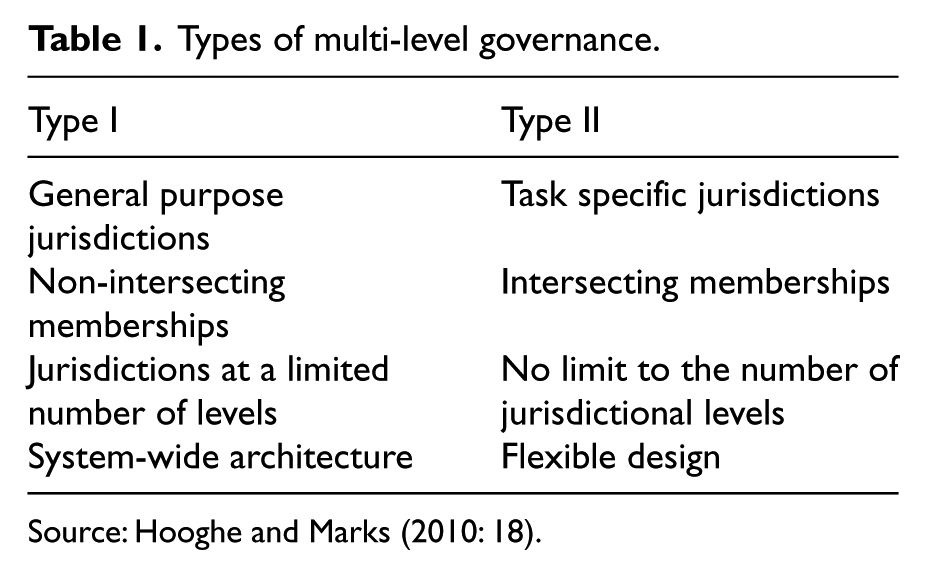
Source: Hooghe and Marks (2010: 18).
In Type II MLG, the services offered by the government are limited and sub-national layers of administrations only provide very specific services. In Type I, these services are broader and sub-national authorities play a more active role in delivering them. Also, the basic organising principle that determines that the types of memberships developed in Type I are territorial affinities and memberships are non-intersecting. In Type II MLG, group memberships can be intersecting and territorial affiliations play a limited role. Finally, the design of Type I MLG resembles that of the central state with clear divisions of power being established at all territorial levels. This is in contrast to Type II MLG, which theorises a more flexible design as a result of the overlapping memberships achieved by social groups during their lifetime.
Therefore, the characteristic patterns of application of the principle of partnership are linked with the constellations of the types of MLG that emerge in a country. Certainly, these two types are little more than ideal types describing the configurations of sub-national involvement, whilst their constituent characteristics are not mutually exclusive but may co-exist in a country. Nonetheless, it is safe to conclude that Type I MLG is consistent with more democratic participation by the sub-national authorities and, therefore, with the enforcement of the principle of partnership in ways closer to the ones intended by the relevant regulations governing CP.
Patterns of Multi-level Governance and of the application of the partnership principle in the National Strategic Reference Framework
Starting from January 2011, the territorial divisions of power were altered in Greece. The previous system that comprised 13 NUTS II regions, 54 prefectures and 1033 Local Government Associations (LGAs) as was decided with the ‘Kapodistrias’ plan, is now replaced by 13 regions, 325 municipalities and seven decentralised administrative units. Under new legislation implemented under the ‘Kalikratis’ plan, the prefecture level is scrapped as an administrative and political unit and all its responsibilities are transferred to either the newly created regional authorities or to the LGAs. The 13 regional authorities are democratically elected, as are the 325 municipalities. However, the seven decentralised units are run by the central government via a General Secretary appointed centrally. As part of the ‘Kalikratis’ plan, at the NUTS II level, there are seven decentralised administrative units governed directly through the central government and 13 democratically elected regional authorities, the boundaries of which correspond to those of the Intermediate Managing Authorities (MAs).
At the local level there are 325 municipalities that are also democratically elected. Each municipality is run by a mayor and a municipal council that are appointed after local elections which are held every 5 years. The regional authorities are run by an elected regional governor and a regional council, which is similarly elected every 5 years. Finally, the seven decentralised administrative units comprise two or three regions each (except for Attica and Crete) and are run by a centrally appointed General Secretary. She is assisted by an advisory council comprising the regional governors and representatives of the municipalities.
The logic that motivated the Greek government to introduce the ‘Kalikratis’ plan was similar to the logic behind the introduction of the ‘Kapodistrias’ plan in the 1990s (Hlepas, 2010). Firstly, the democratisation of the regional and local authorities and the promotion of structures closer to ones practised in countries with federal and territorially corporatist structures played an important role. Secondly, the modernisation of the sub-national administration through the concurrent cuts in the costs that they would incur and the promotion of better opportunities for cooperation in local economic development programmes between sub-national authorities was an important motivating factor. 3 Moreover, the promotion of better governance was central in the short-lived PASOK government’s agenda that ran the country between 2009 and 2011. In this context, the introduction of transparent practices through the ‘Clarity’ programme that made it compulsory for all government departments to publish their decisions on the internet would be assisted through the ‘Kalikratis’ plan. 4 Finally, the influence of the Structural Funds in the ‘Kalikratis’ reform was important as an additional motivating factor. It offered additional stimulus for regionalisation and the democratic consolidation of the operation of the regional authorities that had only been operating as MAs of the regional OPs in previous programming periods.
In parallel with the ‘Kalikratis’ plan, the fourth round of coordinated assistance funded by the structural funds started in Greece in 2008. This is the NSRF, which replaced the previous programming documents of the Community Support Frameworks (CSFs). As part of the NSRF the number of OPs has been reduced to 13, which cover eight sectoral OPs and five regional ones. Five out of the 13 new regions receive less funding under the NSRF compared to the other eight because they have entered the phasing-in status, that is, they will stop being treated as Objective 1 regions under the CP after 2013.
The changes in the allocation of the OPs were not followed by any institutional alterations in the management and monitoring system of the NSRF (Andreou, 2010). Specifically, the previous MAs of the 13 regional OPs remained as Intermediate MAs, which are now coordinated by a central MA placed under the Ministry of Economy with a specific remit for the coordination of the actions of the regional OPs. This authority also has responsibility for the coordination of the actions taken by the sectoral OPs that fund European Regional Development Fund (ERDF) projects. Thus, the newly created five Regional Operational Programmes do not have their own MA but are to be implemented through collaboration between the Intermediate MA of the 13 regions. The logic behind keeping the 13 regional OPs was that they would continue the management of the programmes that were left over by the third CSF. 5 Similarly, for the same reason, the MCs remain at the level of the 13 regions. At the sectoral level, those areas that continued receiving structural assistance have their own MA placed in the relevant ministry. Therefore, regarding the institutional and administrative units responsible for the management and implementation of the NSRF in Greece, there are 13 regional Intermediate MAs and MCs and five sectoral MAs that are created as a direct result of the changes in CP.
Together with these institutional developments as they emanate from the ‘Kalikratis’ plan and the NSRF, Greece has been facing an unprecedented fiscal crisis since 2010. The parameters of this crisis develop daily and a multitude of factors, both domestic and international, determine their outcomes. What is of relevance to the empirical aims of this paper is that after the country’s public finances reached high levels, the troika provided a bailout plan 6 in exchange for significant reforms that the Greek government is conditioned to implement. Some of these reforms affect the regional and local administrations either directly or indirectly.
These reforms are of substantive nature, in other words, they aim to improve the structural factors that determine the competitiveness of the Greek economy. However, their main objective is to cut the costs of the government and subsequently the civil service and the sub-national authorities. It has not been possible to verify the exact amount of public funding that will be cut by the regional and local authorities. An Organization for Economic Cooperation and Development (OECD) study (Allain-Dupré, 2011) points out that before the crisis, Greece was one of the two countries with the lowest share of sub-national capital spending of gross domestic product (GDP); hence, the starting point of the cuts was already low. The measure that has already been implemented is a pay freeze for all public sector workers at all levels of government, sometimes reaching 40% of the civil servants’ salaries as well as freezing promotions in order to reduce costs. Similarly, as part of the ‘Kalikratis’ reform, the number of employees in the local government is planned to be reduced by 50% (Allain-Dupré, 2011). An assessment of the interplay between the austerity measures and the political geography that was created in Greece through the ‘Kalikratis’ plan and the NSRF is attempted in the next section.
The interplay between ‘Kalikratis’, the National Strategic Reference Framework and the austerity measures in the promotion of Multi-level Governance and the enforcement of the principle of partnership
Parts of the aims of the ‘Kalikratis’ plan regarding the modernisation of the sub-national administration of Greece are consistent with the aims of decreasing government costs, which are the main aims of the austerity measures. Reducing the number of regional and local administrations will decrease the overall government agencies and hence provide more opportunities for cost-cutting. Indeed, contrary to the broader patterns of enforcement of the domestic reforms, which is generally speaking patchy, the cost-cutting elements of the ‘Kalikratis’ plan that could achieve a reduction in administrative costs have been implemented very quickly. This has been in contrast to the measures of the territorial reform that required increased expenditure on behalf of the regional and local authorities (Leontitsis, 2012).
Certainly, the ‘Kalikratis’ plan and the NSRF involve different policy actors to the ones that are involved in the implementation of the conditionality imposed as part of the austerity measures. In the case of ‘Kalikratis’, the Ministry of Interior and the sub-national authorities are primarily affected, whilst the NSRF by definition involves the Ministry of Economy and the Commission’s DG Regio. On the other hand, the austerity measures were the object of negotiation between the Ministry of Economy and the troika. However, the paper does not aim to address the direct policy implications of the ‘Kalikratis’ plan or the NSRF. Both these policy initiatives have resulted in the creation of institutional structures that manage and monitor the programmes funded by the Structural Funds. Therefore, the focus of the paper remains at the institutional interrelationships that develop after the establishment of the decentralised authorities by the ‘Kalikratis’ plan and the MAs and the MCs by the NSRF. In any case, the austerity measures were negotiated by the same ministry that manages the NSRF (the Ministry of Economy), since there is no separate Ministry of Finance in Greece.
The fact that the introduction of the NSRF was not accompanied by any institutional changes points towards the strengthening of the centralisation processes in Greece. The management system for the implementation of the NSRF is essentially the same as the one that managed the third CSF. The creation of the 13 regions did not alter the role of the relevant MAs, which as mentioned previously, operate as Intermediate MAs in the NSRF. However, these 13 Intermediate MAs do not implement regional OPs relevant to their areas, since there are now five regional OPs that consist of the separate 13 regions that were all of Objective 1 status in previous programming periods. Thus, the Intermediate MAs manage, implement and monitor, through the regional MCs, programmes that are not from their area.
Moreover, no further competences were allocated to the Intermediate MAs, the operation of which is monitored by an organisation that works as part of the Ministry of Economy. This will be a separate MA with the remit to coordinate the actions of the regional MAs. In addition to that, most large ministries located in Athens have introduced new coordination authorities to oversee the operation of the regional MAs in their area of interest. 7 The regional units now have to acquire the consent of the ministerial authorities in order to amend any project. 8 Given the already complex nature of the system that was created with the NSRF, it is difficult to identify the logic behind the creation both in the unit in the Ministry of Economy and the coordination authorities in the ministries. Although it is early for proper assessments, it is hard not to conclude that the central government’s aim is to control the actions of the regional MAs and hence to cancel any effects expected by the principle of partnership.
Further on from this, the MCs are the institutionalisation of the principle of partnership. Therefore, apart from any effects from the improvement of the quality of participation by the sub-national authorities as achieved through the MAs, actors representing regional civil societies have the opportunity to influence the OPs through the MCs. However, as with the previous programming periods, there is little evidence to suggest that the MCs are anything other than consultative bodies with very limited resources at their disposal, which only play a ‘decorative role’. 9 The MCs meet infrequently (usually not more than once a year) and can hardly influence the patterns of governance for the regional OPs which, in any case, are not from their area. Indeed, for most policy actors involved, the MCs are little more than completely irrelevant when it comes to the management and monitoring of the regional OPs. 10
Certainly, the operation of the MCs has left a legacy regarding the quality of participation by actors representing civil society and the industry. This is an area in which Greece has had practically no experience before the CP so it can build on what has been achieved through the MCs and can create more inclusive structures in the future. However, the point remains that overall the MCs did not operate in accordance with the expectations of the Commission in Greece. 11 This view was shared by the respondents of a questionnaire regarding the institutional capacities of the Intermediate Managing Authority for Ipeiros. Most of the respondents (7 out of 10) pointed out that the sub-national authorities did not have the capacities to influence the OP of their area through the MC. Also, half of them were either ‘little’ or ‘not’ hopeful that the ‘Kalikratis’ reform would do anything to alleviate this situation. Although most of the respondents (9 out of 10) agreed that the regional and local civil societies and representatives or business interests were aware of the existence of the funds available from the OP, they also admitted that these representatives were mostly interested in the stage of the implementation of the programme and had limited or no input at the stage of the monitoring. Certainly, it is worth pointing out, in this context, that these results are consistent with recent research regarding the MCs’ operation in the countries that started receiving Structural Funds after 2004 and 2007, showing that Greece is hardly an exception in that respect (Cartwright and Batory, 2012). The overall finding of this research is that the MCs are not operating in accordance to the regulations relating with the principle of partnership and do not contribute to more MLG.
On the other hand, the introduction of the seven decentralised regional units is clearly an effort by the Greek government to reassert the control of the operation of the regional authorities and follows the example of the ‘Kapodistrias’ plan that was introduced in the 1990s. On that occasion, the prefecture and the local levels were given democratic representation, but the 13 regional structures were unelected and centrally governed. In the case of the ‘Kalikratis’ plan, the government offered autonomy to the 13 regional units and reinforced the democratic legitimacy of the local governments, but created seven unelected decentralised units. Thus, there is a continuation of the trend of providing decentralisation and allowing more autonomy to the sub-national actors on the one hand, whilst reasserting central government control on the other.
In any case, the institutionalisation of the regional authorities through the CP is supposed to encourage the creation of bottom-up regional institutions. The constant experimentation of the Greek governments in re-drawing the regional map of the country indicates that the different regional authorities do not correspond to any regional affinities of their respective populations. Instead, as happened with the 13 regional authorities that were drawn in the 1980s in order to satisfy the Commission’s requirements, the newly created regional authorities do not respond to any bottom-up demands for regional representation. Even more so, the regional authorities will co-exist with the seven decentralised units, which are by definition created in a top-down manner.
The multiplicity of institutional actors is made worse by the recurrent problems of capacity that the regional authorities are facing. 12 The regional MAs were created with the third CSF as independent organisations that would help overcome the main obstacle in the management of the Structural Funds in Greece, which is the ineffective public administration. 13 After a period of relatively successful functioning in the first decade of the new millennium, the fact that they are being integrated in the elected regional authorities will jeopardise their prospects for operational autonomy. 14 Therefore, although the ‘Kalikratis’ reform is aimed at strengthening the democratic legitimacy of the regional authorities, it may end up contributing to the MAs being influenced through clientelistic practices from the regional authority. On top of that, there has been an apparent ‘relaxation’ 15 of the operation of the regional MAs during the last few years. Several negative characteristics of the core public administration have been spilling over the regional MA rather than the other way around, which was the initial aim.
Related to the issue of regional capacities, the difficulties in the capacities of the LGAs to participate on equal terms in the implementation and monitoring of the projects implemented in their area has not been affected by the ‘Kalikratis’ plan (Hlepas, 2010). Certainly, the number of LGAs was reduced, their constitutional role was enhanced and they acquired competences in policy areas such as social and environmental policies. However, the main institutional reforms that could be undertaken in order to improve their operations did not materialise. As with the regional authorities, they remain financially dependent on the central government (Chorianopoulos, 2012), a fact that diminishes any chance for them to formulate autonomous decisions. The financial support programme ELLADA that was supposed to be implemented in conjunction with the the ‘Kalikratis’ and would have provided fiscal autonomy to the sub-national authorities did not materialise after all because of the onset of the crisis (Leontitsis, 2012). Moreover, the local authorities’ operation continues to be characterised by clientelism, corruption and factionalism, which further diminish genuine citizen participation (Hlepas, 2010). The deployment of non-transparent practices in the selection of projects (the LGAs can participate in the implementation of the regional OPs as final beneficiaries) (Andreou, 2010) only serves to justify the central government’s distrust towards more participation by the local authorities.
The issue of clientelism in Greece and its impact on socioeconomic development and the country’s competitiveness has attracted wider interest after the crisis since 2010. Some commentators have advocated the view that there is little opportunity for the reform of domestic institutional structures because any such effort will be captured by clientelistic and patronage networks. In the context of the current paper, the argument suggests that there is little point in providing more decentralisation in Greece since the sub-national actors will deploy the funds that will become available in order to promote patronage exchanges. Indeed, this has been the primary argument advocated by the Ministry of Economy, which is reluctant to allow more autonomy to the sub-national actors (Andreou, 2010).
However, this view ignores the reality concerning clientelism in Greece, and other countries with similar structures either in Europe or elsewhere (for Poland see Dabrowski, 2012). Clientelism and corruption are not abnormal behavioural characteristics that the Greek people share but intermediate variables binding politics and society. In particular, they have formed idiosyncratic patterns of democratic representation and welfare provision in countries where Western-type democracy and welfare states have not developed. To the extent that greater decentralisation and adoption of structures closer to Type I MLG would promote proper democratic accountability at the sub-national level, they would have actually assisted in the creation of structures that would countenance the possibilities for clientelism, patronage and corruption. Therefore, far from decentralisation promoting clientelism and corruption, it would have been the other way around in that more participation and a sense of ownership on behalf of the regional and local actors would have diminished the influence of such practices.
To conclude, corruption, clientelism and the limited administrative capacities of the regional and local authorities represent opportunities for the central government to reclaim control of the management of the regional OPs in the NSRF. The ‘Kalikratis’ plan did not promote any meaningful changes that would ameliorate these issues. The problems of institutional capacity that have engulfed the regional authorities were not addressed, neither were the sub-national authorities given any fiscal autonomy. The multitude of regional authorities, some of them elected and some directly run by the central government, only serves to exacerbate these problems and create confusion regarding the responsibilities of each policy actor involved. 16 Moreover, the MCs remain irrelevant institutional authorities and the intentions of the principle of partnership remain almost entirely incomplete. What is even more surprising is that these patterns represent a fall back from the first two programming periods of CP during the 1990s when the MCs operated much more effectively.17
As the central government is responsible for the absorption of the available funds, it ends up overriding any sub-national involvement in order to avoid forfeitures. This is what is termed by Bachtler and McMaster (2008: 423) as a conflict between regionalisation and effective structural funds management. Apart from the principle of partnership, the remaining regulatory framework governing the CP favours effective centralised management as opposed to meaningful bottom-up participation. In Greece that means that the central state takes away the already limited powers enjoyed by the regional authorities so as to hasten the absorption rates and avoid losing the funds. Furthermore, the austerity measures and the increased monitoring of the troika regarding the patterns of implementation of the programmes funded through the NSRF provide additional excuses for the central government to focus on rates of absorption at the expense of promoting meaningful bottom-up participation.
As a result, there is very little in the period that started in 2008 to suggest that there has been any advance towards Type I MLG in Greece or that the principle of partnership has been enforced in the manner advocated by the relevant regulations. True, given the limited experience of Greece in the implementation of public policies that would involve actors not representing the central government in pluralistic and non-particularistic ways, there is little doubt that the requirements of the principle of partnership can lead to structures envisaged by Type I MLG in the future. However, in order for that to happen, the CP regulatory framework guiding the operation of the principle of partnership needs to be accompanied by meaningful territorial reforms at the domestic level.
Conclusion
This paper discussed the extent to which three sets of influences – the NSRF, the ‘Kalikratis’ plan and the austerity measures – have altered the patterns of participation by the sub-national authorities in Greece. It put forward the conceptual argument that the adoption of Type I MLG would lead to the enforcement of the principle of partnership in ways closer to those described by the relevant regulations of the structural funds. The overriding theme of the article has been that despite the opportunities offered by the CP, the mediating impact of the centralised Greek state proved detrimental in limiting the adoption of structures close to Type I MLG. The rescaling of governance introduced with the austerity measures, as well as the ‘Kalikratis’ plan, have also contributed to this situation. Through the identification of the interplay between these parameters, the article aimed to provide an original contribution regarding the enforcement of the principle of partnership and patterns of MLG in the Greece. It postulated that the institutional capacities of the sub-national actors are determined both from the CP and the domestic territorial reforms; hence, any empirical analysis of these issues needs to take that into account. Most importantly, the article offers a tentative assessment of the impact that the austerity measures have at the sub-national level for Greece. The dogmatic interpretation of the monetarist philosophy guiding the austerity measures by the troika has resulted in the reversal of even limited trends towards sub-national involvement and the improvement of the regional and local authorities’ capacities.
Certainly, there is little evidence to suggest that the troika is the slightest bit interested in those issues and during its operation in Greece it has become more than apparent that contrary to its reformist rhetoric, the squeezing of public spending is the only policy aim that it feels appropriate to pursue. This also becomes apparent when one examines the nature of the conditionalities that the troika has imposed with the Memorandums of Understanding (MoUs). All the conditions that the Greek government needs to comply with relate to cuts in government spending regardless of the policy actions that will be taken domestically in order to achieve that objective. This is why the issue of sub-national involvement is only addressed in this context. Thus, the second MoU (Commission of the European Communities (CEC), 2012) conditions the Greek government to decrease the number of deputy mayors and associated staff, as well as the remuneration of elected and related staff at local level.
The identification of the limited impact that the regulations governing the principle of partnership have had does not mean that the principle of partnership in particular has left no legacy in the governance arrangements of the sub-national authorities in Greece. The institutionalisation of the MCs, in particular, has been an important institutional innovation that can be used as a catalyst for further changes in the future. Before the introduction of this principle, the Greek state never allowed any input from societal and industrial interests that were not articulated in clientelistic and particularistic ways. The decisions that affected the regions were taken by the central government and were implemented by de-concentrated agencies appointed and controlled by the central state. Thus, creating these fora for communication between state and non-state actors can challenge these centralising tendencies. However, in order for that to happen, there is an urgent need for the continuation of the reforms that relate to the territorial distribution of powers in Greece. These need to complement the democratic legitimacy assigned to the regional authorities with the ‘Kalikratis’ plan, with the power to collect and spend their own revenues. Moreover, it needs to address the severe problems of administrative capacity facing both the regional and local authorities through deploying human resources programmes that will provide incentives for skilled personnel to move to sub-national authorities.
This is also important in light of the reinforcement of ‘place-based’ approaches in the management and implementation of the programmes funded through the CP in the regulations that will govern the programmes in the next programming period (Barca, 2009). As the countries of CEE will gradually become the main beneficiaries of CP funding, the EU needs to understand that the Structural Funds need to address issues of domestic capacity more explicitly and to move away from the ‘one-size-fits-all’ approaches of the past. However, it needs to be said that given the current balance of power at the EU Council (where the CP regulations are finally decided following consultation with the European Parliament), the primary responsibility for the domestic reforms remains with the national governments.
The strict stance of the EU Council on the issue of the Greek debt, as well as the continuous reluctance of certain member states to accept any EU competencies on budgetary issues, point towards the importance of each recipient country promoting the reforms that will mediate the impact of the EU. Also, the Greek experience with EU-imposed austerity indicates that the promotion of domestic territorial and institutional reforms at a time when regional development funding – or economic development funding for that matter – has dramatically diminished will have adverse effects at the domestic level. The mainstream EU approach, as advocated by the German government, is that the Greek government needs to implement the structural reforms that will improve the competitiveness of its economy whilst drastically reducing public spending. There is little evidence so far to suggest that this strategy works or will work in the future. In other words, the promotion of territorial reforms can only take place if there is enough funding available. To the extent that the German government continues to have a dogmatic position regarding public spending, the issues of the territorial reform, MLG and partnership are likely to become meaningless.
Therefore, despite the significant theoretical and discursive developments concerning place-based approaches in connection with the CP, as well as the initial recognition that some of the CEE countries faced weak administrative capacities at the regional and local levels (Hughes et al., 2004), there is little evidence to suggest that geographical considerations will seriously inform the regulations that will govern the CP for the next programming period (2014–2020). Thus, it would make sense if the Council that is primarily responsible for the allocation of the CP funding would distinguish between those groups of countries that have also become involved in bailout plans with the EU when deciding on these issues. It is hardly realistic to expect countries with limited experience in democratic participation to successfully implement the principle of partnership. Similarly, countries with proven levels of reduced administrative capacity would benefit from being allowed more time to adjust their systems to the admittedly demanding regulatory framework governing the operation of the CP.