



Abstract
This article is concerned with the role of national governments in the rescaling of cross-border metropolitan governance structures in Europe. In the context of emergent cross-border metropolitan regions, the objective is to highlight the structuring effects of support policies to metropolitan areas at national level, in the context of their politics of scales, on the scalar configurations developed by local and regional actors. Using a comparative approach, the cases of Basel, Geneva and Luxembourg are singled out. The confrontation between German, Swiss and French state policies, and the modalities of the rescaling of levels of governance within the three cross-border metropolitan regions, allows us to underline the considerable influence of national guidelines on scalar reconfigurations. The structuring role of governments in this ‘new cross-border regionalism’ needs to be relativized, however, in functions of the specific characteristics of each context as well as factors relating to the actors involved.
Introduction
The rapid growth in the globalization of economic and cultural exchanges, as well as the reinforcement of the mechanisms of regional integration, are at the root of a profound re-ordering of the geographical bases of the political and economic orders (Scott, 1998). The fact that the boundaries of urban border regions no longer necessarily coincide with those of the nation-state, but have acquired a cross-border dimension, is one manifestation of this spectacular spatial re-shaping of the economy and society (Herzog, 1990). In Europe, the relative openness of national borders, and the emergence of cross-border urban areas, has stimulated institutional actors to introduce local and regional initiatives (Perkmann, 2003). In a first phase, urban cooperation operated at the level of cross-border agglomerations and concerned the resolution of local problems derived from the proximity of a border (Reitel, 2007). From 2000 on, cities such as Basel, Geneva and Lille committed themselves to cross-border cooperation at metropolitan level (see Nelles and Durand, 2012; Sohn et al., 2009, respectively). These initiatives reflect a change in register as they are dealing with strategic functions such as the strengthening of the interconnectedness of large transport networks, economic competitiveness and international influence. They also involve a change of scale insofar as cooperation affects functional urban regions. If local and regional authorities are the principal actors in these cooperative endeavours in the process of institutionalization, the emergence of cross-border metropolitan regions (CBMRs) is also taken into consideration by certain central and federal states in their regional planning and development policies (Harrison and Growe, 2012).
The putting in place of support policies for peripheral metropolitan areas at national level thus questions the role of governments in the process of cross-border regionalization at the same time as this latter is very often taken as indicative of the relativization of their involvement (Jessop, 2002). To what extent do states influence the construction of CBMRs in Europe? What are the aims and strategies deployed by local and regional actors? What, finally, are the main determinants in the rescaling of governance levels at work at the heart of emerging CBMRs? Centred on this problem, this article examines the effects of the differences between the various national mechanisms for supporting CBMRs on the scalar configurations developed by local and regional actors in the context of their ‘politics of scales’. In this perspective, derived from the work of Smith (1992), the scales are not fixed frameworks that pre-exist social activity but are themselves socially constructed and politically contested (Brenner, 2001; MacKinnon, 2010; MacLeod, 1999; Swyngedouw, 1997). Following Gonzales (2006: 838), ‘politics of scales are, therefore, those strategies used by actors to explain, justify, defend and even try to impose the link between a particular scale or scalar configuration and a political project’. The hypothesis examined states with national policies that have a structuring effect on the scalar strategies of metropolitan actors by virtue of symbolic or territorial recognition and the support they bring. This effect is not structurally determined, however, insofar as metropolitan actors are capable of exploiting the opportunities that the presence of a national border can present and of modifying some of the constraints that accompany cross-border activity (Sohn, 2013). Empirically, this article uses a comparative approach focused on three case studies (Basel, Geneva, Luxembourg). The comparative case studies aim to identify the factors that lead to the use of certain scales of territorial governance by local and regional actors against the background of national policies for supporting CBMRs.
First of all we deemed it necessary to specify the analytical framework used to highlight the rescaling of cross-border metropolitan levels of governance. We will then describe the national policies for supporting peripheral metropolitan regions put in place in Germany, Switzerland and France. Following that, we will explain the comparative approach and the choice of examples, then examine the modalities of the rescaling of cross-border metropolitan governance at work in Basel, Geneva and Luxembourg. Lastly, the structuring role of national policies will be examined though three explicatory factors, and we will then conclude.
The scales of cross-border metropolitan governance: an analytic framework
The question of cross-border metropolitan governance links two fields of investigation that are traditionally viewed separately though they share the same theoretical foundations. On the one hand, work on metropolitan governance deals with large urban areas within a national context (Brenner, 2003; Heinelt and Kübler, 2005; Jouve and Lefèvre, 2002; Kantor, 2008; Le Galès, 2006). On the other, research on cross-border cooperation has focused on the growth of border regions irrespective of their urban or metropolitan dimensions (Blatter, 2004; Medeiros, 2011; Perkmann, 2007; Scott, 1999). A brief survey of the debates on metropolitan governance and the specificity brought by the presence of a border therefore appears in order.
The normative and scholarly debates around metropolitan governance find their origin in the classic opposition between ‘regionalists’, who subscribe to the metropolitan reform tradition and the ‘localists’, holding to a public choice perspective (Ostrom, 1972). This discussion on the forms of metropolitan governance evolved in tandem with the growth in influence of the concept of governance that accompanied the role of non-public actors in government processes as well as the existence of forms of horizontal cooperation derived from voluntary work (Savitch and Vogel, 2000). Henceforth, the question is what meaning to give to the rescaling of governance (Brenner, 2003). Following Blatter (2006), two perspectives confront each other. In one corner of the ring are the proponents of a move towards larger scales/higher levels in metropolitan governance with a view to adapting them to the geographical expansion of socio-economic activity (Barnes and Ledebur, 1993). This is the perspective of new regionalism (Savitch and Vogel, 2000). On the other side, authors such as Brenner (1999) plead for a ‘relativization of scales’ and the taking into account of the multiplication of both geographical scales and of the institutional levels implicated in the governance of metropolitan areas. This approach, which recognizes the persistence of older levels such as the city or the state alongside the newer ones, rejoins the analyses that use the notion of multi-level governance (Hooghe and Marks, 2003). This theoretical debate on the scales of metropolitan governance is linked to another question relative to the types of institution required and the scope of their competence (Blatter, 2006). Derived from the reflections of the ‘public choice’ school, the multiplication of jurisdictions and networks of governance that are specialized from a functional point of view, and have the multiple allegiances characteristic of a process of de-territorialization, is opposed to a vision of governance founded on the existence of multi-functional territorialized institutions which are stable over time.
Taking the existence of a border into account, in the question of cross-border metropolitan governance, does not fundamentally alter the terms of the discussion. As regards scalar changes, the question is first of all to know whether new CBMRs tend to assert themselves as an unavoidable dimension in the management and regulation of metropolitan issues and dynamics, or whether they are just another supplementary rung in a multi-level governance setting (Johnson, 2009). It is also a question of examining the nature of the institutions implicated in cross-border metropolitan governance by differentiating, on the one hand, the creation of new structures of cooperation bearing on territorial projects (of the Euroregions or Eurodistricts kind), and on the other, the taking off of specialized and mobile jurisdictions (Perkmann, 2007). To the extent that the great divides mapped by Blatter (2006) retain their validity, these questions will guide us in our empirical analysis of the rescaling of governance using our case studies.
The presence of a national border, which still remains a significant limit from a political point of view (O’Dowd, 2010; Paasi, 2009), nevertheless bestows certain singularities on cross-border metropolitan governance. On the one hand the creation of new cross-border scalar unities (of local, metropolitan or regional reach), and even more, their institutionalization, leads to a contestation of pre-existing unities, first and foremost that of the nation-state (Jessop, 2002). For the metropolitan governance system at work within national borders, this ‘relativization of scales’ does not necessarily signify a withdrawal of the state but rather the appearance of new modes of intervention based on partnership, support or mediation. In a cross-border context this state intervention is biased because it is limited to that portion of space that falls under national territorial jurisdiction. Taking into account this fact in the scalar politics of CBMRs leads us to examine the national support policies deployed in Europe.
Government support policies for their peripheral metropolitan areas
Generally speaking, government support for metropolitan areas can take three different forms (Lefèvre, 2004). First of all a state can trigger metropolitan cooperation by putting in place mechanisms that motivate local actors. Aligned with the neo-liberal view which sees the state as a ‘facilitator’, these policies usually operate according to the logic of projects (putting metropolitan actors in charge) and putting them out for tender (selectivity of state support). Second, a state can give legitimacy to metropolitan cooperation by conferring the label of ‘metropolitan’ on it or by recognizing the relevance of the new areas of cooperation for its own policies. This symbolic or territorial recognition has great importance for it contributes at the institutional level to the reinforcement of innovative metropolitan cooperation initiatives which are otherwise often fragile. Moreover, legitimacy can also be granted by financial support that aims to uphold the initiative or, more ambitiously, to finance the management of larger metropolitan infrastructures and facilities. Third, the state can intervene as mediator and minimize conflicts between local actors, and thus promote the emergence of consensus.
If the years 1990 and 2000 were marked by a renewal of institutional forms aiming to bring answers to the issues of how to govern metropolises (Le Galès, 2006), in Europe only three states developed specific measures for CBMRs. In chronological order, these were Germany, Switzerland and France. These countries are the most directly concerned with the phenomenon of the urbanization of border regions insofar as, of the 11 CBMRs identified in the context of the work of ESPON (2010), seven are on the French border (Basel, Geneva, Lille, Luxembourg, Nice, Saarbrücken, Strasbourg) four on the German border (Basel, Luxembourg, Saarbrücken, Strasbourg) and two on the Swiss border (Basel and Geneva).
Germany was the first of three countries to have initiated policies aimed at strengthening the competitiveness of German metropolises in order to turn them into centres of national economic development. It was an orientation decided on at ministerial level (Ministerkonferenz für Raumordnung, MKRO) at the beginning of the 1990s when reunification stimulated debate on developmental perspectives and how to bring the newly reconfigured territory into the European fold. Based on the concept of ‘European metropolitan regions’ (Europäische Metropolregionen) this policy has since become a ‘discursive framework’ leading to a paradigm shift in the domain of planning and development at national level (Blotevogel and Schmitt, 2006). In 1995, six European metropolitan regions were called thus by the MKRO; a seventh was added in 1997 and four more in 2005. Yet, none of the 11 German metropolitan regions 1 has the cross-border dimension. Taking note of the growing importance of metropolitan areas that straddle border regions, MKRO completed its set-up in 2009. In a pilot project of planning and development called MORO (Modellvorhabens der Raumordnung) four model cross-border regions were consequently identified: the Lake Constance region, the Euroregion Rhine-Moselle, the Greater Region and the Upper Rhine (Bundesamt für Bauwesen und Raumordnung (BBR), 2009). In all four cases they concern polycentric regional spaces that overlap with pre-existing areas of institutional cooperation, of the Euroregion type. Even if none of these regions contains a metropolitan centre of European dimensions on the German side, the links of functional interdependence that bind these peripheral spaces together with the neighbouring foreign regions nevertheless allow one to glimpse dynamics of territorial development that could bring strategic importance to cities embedded in the region (Harrison and Growe, 2012).
In the case of Switzerland, a federal ‘agglomeration policy’ was launched in 2001 by the Swiss Confederation. Though it does not target metropolitan areas as such, the policy touches them closely insofar as it aims to strengthen the coherence of urban agglomerations 2 within the planning and development framework and to promote cooperation between territorial entities (Federal Council [Conseil federal], 2001). Agglomeration projects, which are planning instruments that allow for the coordination of transport and housing policies within an agglomeration, thus require new structures of governance that go beyond existing juridical limits. In 2007, following a first tender, 30 projects bearing on the theme of ‘transport and urbanization’ were registered and 26 of them satisfied the evaluation criteria. More than 1.5 billion CHF was allocated by the Confederation to a dedicated infrastructure fund in order to co-finance these projects (Office fédéral du développement territorial (ARE) and Secrétariat d’Etat à l’économie (SECO), 2011). Among the chosen agglomerations, Basel, Geneva and Schaffhousen exhibit a cross-border dimension, the first two being part of Swiss metropolitan areas (Conférence Tripartite sur les Agglomérations (CTA), 2011). This recognition on the part of the Confederation of the transnational dimension of the Basel and Geneva agglomerations has been evidenced by the granting of federal subsidies for the financing of structural cross-border projects, especially in the field of transport.
Lastly, in France, the Interministerial Delegation for Territorial Planning and Regional Attractiveness (Délégation interministérielle à l’Aménagement du Territoire et à l’Attractivité Régionale, DATAR) launched, in June 2004, an appeal for metropolitan cooperation with a view to promoting the economic development of French metropolises and to strengthen their influence at European level. It concerns incentive and support policies which aim to legitimize certain initiatives of cooperation by recognizing a new area of cooperation. Following two calls for tender organized between 2004 and 2005, 15 candidates from outside the Parisian basin were short-listed, six of them including border region partners. These were the Franco-Valdo-Genevan agglomeration, the Lille Metropolitan area, the Eurodistrict Strasbourg-Ortenau, the Metropolitan Region Côte d’Opale-West-Flanders, the Rhine-Rhone and Saarbrücken-East Moselle metropolitan networks (see Figure 1). Yet, the composition of the partners does not always reflect the functional realities of cross-border regions. Thus, the metropolitan cooperation area of the Lorraine Corridor (Epinal, Metz, Nancy, Thionville) excludes the city of Luxembourg even though this latter dominates the northern end of this area with at least 75,000 cross-border workers from Lorraine active in the Grand Duchy. In 2010, after some years of vacillation, support policies for metropolitan cooperation have been reactivated through the creation of ‘metropolitan poles’ under the law of the reform of local authorities. In this way, new projects for metropolitan centres have recently been created which, in certain cases, show a significant change in scale (Figure 1). In Eastern France, the Eurodistrict, Strasbourg-Ortenau, and the Rhine-Rhone network have made way for new metropolitan configurations, whereas the Franco-Valdo-Genevan agglomeration, as well as the Lorraine Corridor, have been retained. 3
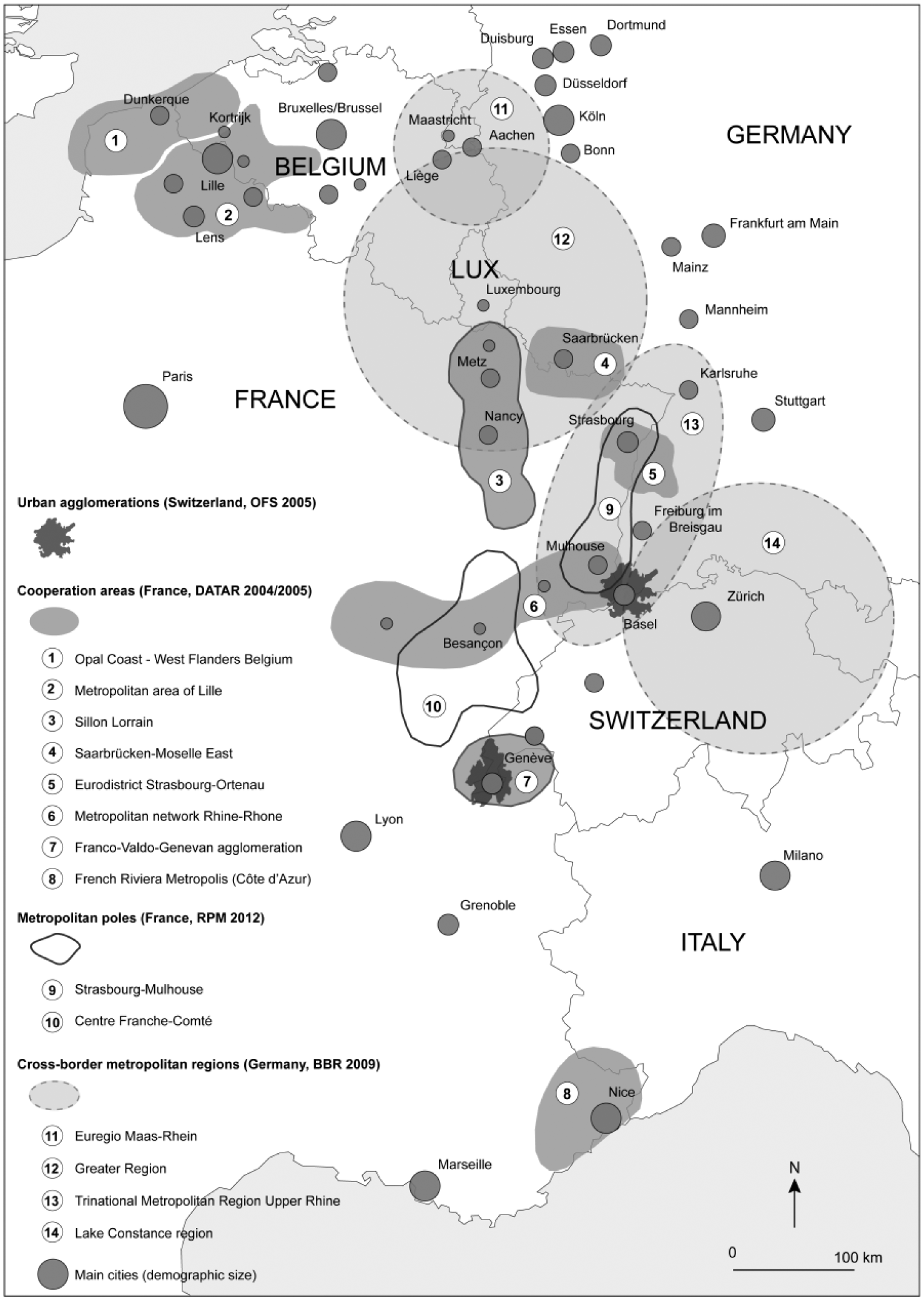
Areas of cross-border metropolitan cooperation in Germany, France and Switzerland.
One is forced to conclude that the three states have developed support policies that are different both in the means used and the ends aimed for. Whereas Germany recognizes cross-border metropolitan areas of cooperation by means of symbolic endorsement, France and the Swiss Confederation have staked out certain cross-border cooperation areas that have effectively entailed territorial recognition. These countries have also played a triggering role by motivating local actors to take part in initiatives that aim to create new metropolitan configurations. Switzerland is, however, the only state to lend financial support to structural projects in the context of its policy of agglomeration. Taking into account the nature of the investments involved, this ongoing policy is based on a long-term vision. Lastly, there is also a spatial element to the differences in support policies of the three states. With the exception of a few zones like Geneva, the areas of cooperation coming into being on either side of the borders between Germany, France and Switzerland are not congruent (Figure 1). Taking these divergences – which are political as well as spatial – in the manner of rescaling cross-border metropolitan levels of governance seriously, leads us to put forward an empirical analysis, one founded on a comparative approach.
Methodological approach and choice of case studies
In order to be able to interpret these differences in government policy with respect to support for scalar configurations of cross-border areas, the comparative strategy conducted here privileges the selection of case studies which present analogous cross-border and metropolitan dimensions, in line with ‘most similar systems design’ (Przeworski and Teune, 1970). Indeed, comparing similar geographical entities placed within different national contexts offers the possibility of evaluating the significance of national variations on the behaviour of metropolitan actors (Pierre, 2005). Two hypotheses stand out in this approach. If we observe a differentiation in the scalar configuration of the CBMRs in question, the hypothesis of an influence exercised by a national programme is confirmed. If, on the contrary, we note a convergence in scalar configurations, this would tend to show the absence of any structuring effect from national programmes and would necessitate looking for causal factors elsewhere.
In Europe, the three CBMRs that best correspond to this research approach are Basel, Geneva and Luxembourg (see Table 1). In the first instance, these three regions face the dynamics of large-scale functional integration which go beyond national limits and create new cross-border pools of labour (Sohn et al., 2009). Luxembourg, Geneva and Basel exercise a strong attraction on cross-border workers with, respectively, 150,900, 61,600 and 52,500 people actively residing in the neighbouring country in 2011. In the second instance, these three cities present a similar metropolitan profile (Bundesinstitut für Bau- Stadt-und Raumforschung (BBSR), 2011), which puts them in the same position as regards problems of competitiveness in an international context. Despite their average size by European standards, these cities host economic functions characterized by knowledge-intensive activities, mostly at global level. Specifically, we can point to the financial sector and the presence of international organizations in Geneva, finance and European institutions in Luxembourg, and pharmaceuticals and life-sciences in Basel. Lastly, all three CBMRs are affected by the national programmes implemented by France, Switzerland and Germany (Figure 1). Because of its location on the Upper Rhine and the tri-national configuration of its urban area, the case of Basel is on the agenda of the metropolitan policies of all three countries. In Geneva, the Franco-Swiss metropolitan area is a target for federal agglomeration policy as well as being included in the appeal for metropolitan cooperation by DATAR. Lastly, the metropolitan area of Luxembourg covers four countries, two of which (France and Germany) have initiated specific support programmes for their metropolitan areas. Regarding the significance of the state borders the three CBMRs cross, the fact that Basel and Geneva are located at an external EU border whereas Luxembourg is entirely within the EU does not prevent any meaningful comparison; the Swiss cities have a long standing history of cross-border cooperation with their neighbours and the bilateral agreements signed between Switzerland and the EU in 1999 and 2004 have tempered the specificity of this border.
Choice of case studies.
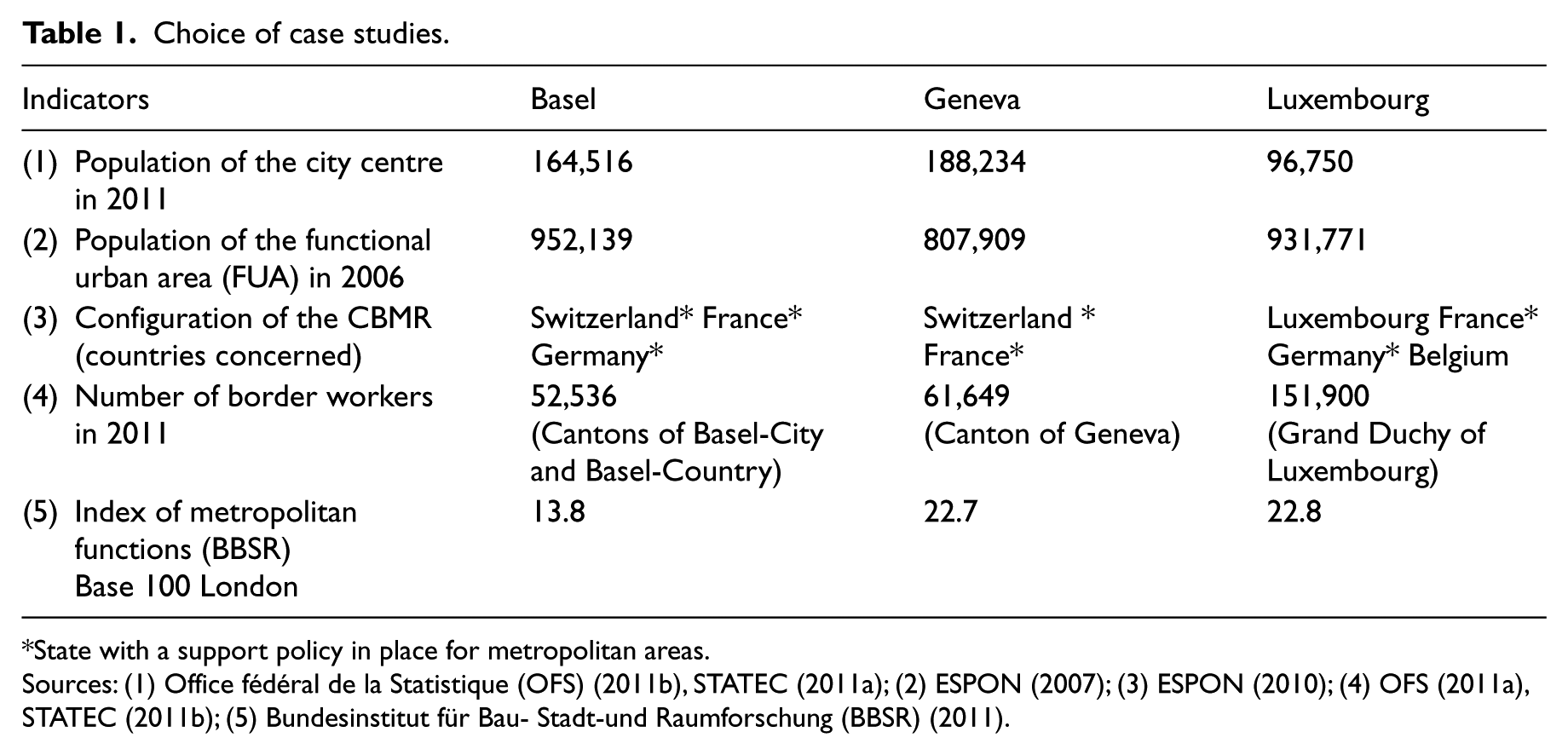
State with a support policy in place for metropolitan areas.
Modalities of rescaling of cross-border metropolitan levels of governance
The empirical analysis of the three case studies chosen in this approach is focused on the forms of rescaling of cross-border metropolitan levels of governance. The initiatives and institutions that result from the actions taken by metropolitan actors in answer to this question are looked at through the prism of two questions derived from the theoretical discussion on the notion of metropolitan governance as studied by Blatter (2006). In each case, it is a question of seeing: 1) whether we are looking at the emergence of a unique dimension of metropolitan governance or, on the contrary, at a multiplication of dimensions/levels; and 2) if a process of territorial integration or functional specialization can be observed at institutional level.
Basel
In Basel, Swiss metropolitan actors have been developing a strategy for many decades that integrates a cross-border dimension with the aim of establishing the international character of the city and its positioning within the networks of the globalized economy. Already, in the 1960s, its border position with Germany and France, together with the existence of an important nodal point of terrestrial circulation along the Rhine axis, led to the realization that Basel occupied a singular place in Switzerland. More recently, following the refusal of Swiss voters in 1992 to join the European Economic Area, the canton of Basel-City developed a strategy to prevent it becoming marginalized in relation to the European Union, all the more so since it became a centre of employment attracting numerous cross-border workers from France and Germany. Moreover, the strategic reorientation of the larger chemical and pharmaceutical industries towards the life-sciences during the 1990s weakened the position of the agglomeration in relation to Zurich, which imposed itself as the financial and economic metropolis of Switzerland.
Basel’s originality lies in the fact that it is part of several cross-border metropolitan configurations of various sizes but which all stem from different initiatives. The Swiss actors in the agglomeration seek to reinforce a metropolitan region, an autonomous space centred on Basel, but two initiatives seem to be in competition. The tri-national agglomeration project of Basel (TAB), set up in 1995 in the wake of Interreg projects, aimed to improve the coordination of public authorities in urban planning. The realizing of urban development projects allowed for the nurturing of very close relationships. The agglomeration policy of the Confederation put in place in 1999 supports this process through the financing of public works projects in the field of public transport. The cooperation took a more institutionalized form with the creation of a cross-border urbanism agency followed by the foundation of the Tri-national Eurodistrict Basel (TEB) in 2007. Another project, called ‘metrobasel’, was launched by private actors in 2005. This step sought to alert the Swiss public authorities, specifically the Confederation, to the fragility of the Basel border position. Institutional fragmentation was presented as a brake on the competitiveness of the agglomeration. The border dimension appeared as a zone over which Basel exercised its economic grip. In this context, even though the spatial frameworks are very close, TEB seeks to propose management solutions to a territorial project that has acquired institutional form, whereas the second furnishes a quality label to the agglomeration. In 2011, the canton Basel-City used the proliferation of structures, and the desire for clarity with respect to the Confederation, to lobby for the creation of a Basel Metropolitan Conference. The goal of this initiative, launched in 2011, is to become the sole interlocutor to be able to represent the interests of the ‘metropolis Basel’ by harmonizing existing steps with the dimension of the urban region of Basel. This initiative marks in some way the taking back of power by public authorities from private actors, but it also reinforces the weight of Basel-City in relation to other Swiss cantons and to the neighbouring French and German regions. The scope corresponds to the fusion of TEB and ‘metrobasel’, that is, an autonomous urban space with Basel-City as its heart.
The cross-border agglomeration of Basel is also integrated with the tri-national metropolitan region of the Upper Rhine. Following the contours of a cross-border cooperative territory of the ‘Euroregion’ variety, which had existed since 1975, it was established on the initiative of German authorities, the City of Karlsruhe and the Land of Baden-Wuertemberg who realized that, though they were part of one of the most attractive regions in Germany, the space in question did not figure in any of the 11 metropolitan regions. This project was not only recognized by the German state but was also championed by French public actors, notably the Alsace region who considers cross-border cooperation to be a strategic orientation. In order to distinguish themselves from other regions, and in the absence of a dominant urban centre, the metropolitan region is presented as polycentric. Though it is integrated into the project, the Swiss authorities do not consider it a priority, which raises the question of the links between the different configurations.
Geneva
In the case of Geneva, the strategy aiming to construct a CBMR has its origin in the realization by the Swiss canton that it ought to reconsider its regional position in relation to several new determining factors at the beginning of the 1990s. As with Basel, in 1992 the fear of being marginalized featured all the more strongly since Geneva’s economic growth, and the presence of significant differentials at the levels of employment and salaries, was translated into an equally significant growth in the number of border workers and in the functional interdependence between Geneva and its French hinterland. Added to this was the keener competitive pressure from the Canton of Vaud which also experienced rapid economic growth, and which thus had an argument in favour of the recognition of a Lake Geneva area (including Geneva and Lausanne) as a polycentric metropolitan space of cooperation in Switzerland.
The first reflections on the planning of a regional cross-border space were carried out by the Franco-Genevan regional committee (Comité Régional Franco-Genevois, CRFG), set up in 1974. The work of this inter-governmental commission allowed both government and regional actors to take a position in the discussions on cross-border metropolitan issues and to exercise the right to inspection. The concept of ‘Regio Genevensis’, based on the scope of the direct attraction exercised by Geneva, was thus developed with the aim on the Genevan side of asserting the centrality of the canton. In 1993, a white paper on planning and development was published, followed in 1997 by a Planning Charter for the cross-border agglomeration consisting of at least 10 projects. Most of these aimed to strengthen the functionality of international activities and to promote the image of the metropolis. A new stage was reached at the beginning of 2000 with the conception of a project for creating a Franco-Valdo-Genevan (FVG) agglomeration which was supported by the policies of the Swiss Confederation. To this has been added a contract for metropolitan cooperation steered by DATAR on behalf of the French state. Developed between 2004 and 2006, FVG agglomeration is supported by the Canton of Geneva, the district of Nyon and the Regional Association of Genevan municipalities, which includes the municipalities on the French side. This integration of the French outer-urban space into the project resulted from a negotiation which aimed at a re-balancing of roles between the metropolitan centre and its periphery. The financial support of the Confederation through its agglomeration policy provides for new tramlines and the construction of the CEVA railway (Cornavin-Eaux Vives-Annemasse) which would allow the Swiss and French networks to join up seamlessly. In 2012, a new version of the agglomeration project, now called ‘Greater Geneva’, was advanced. At the same time a new juridical tool, which allows for a more permanent governance mechanism for the cross-border agglomeration, was called into being as Local Grouping of Cross-border Cooperation. This institutionalization of cooperation at the level of FVG agglomeration shows the will of the local partners to provide themselves with a level of governance that is suited to their territorial project. Such an approach also outlines the setting up of a multi-scalar governance mechanism in which the CRFG, as inter-governmental committee, plays the role of umbrella organization.
Luxembourg
In the case of Luxembourg, the first discussions in the direction of establishing a CBMR were held from the middle of the 1990s within the framework of the Greater Region. This is a structure for cooperation uniting Luxembourg, the Länder of Saarand Rhine-Palatinate, the region of Lorraine and Wallonia. Guided by recommendations made by the European Spatial Development Perspective, the reflections of the regional stakeholders have focused on the strengthening of exchanges and synergies between the cities of the Greater Region in order to counter-balance the absence of a metropolitan centre of European stature and thereby to avoid marginalizing this vast institutional territory of 65,000 km 2 with more than 11 million inhabitants.
In tandem with these debates engaging the regional and national authorities of the Greater Region, initiatives were started by local authorities, in particular through the setting up of city networks. Established in 2000, the Quattropole network unites Luxembourg, Metz, Saarbrücken and Trier with the idea of working towards a virtual network. Since 2006 another network, called Tonicités, re-groups six border cities situated within the functional urban area of Luxembourg. Guided ‘under the radar of government institutions’, these initiatives, which have a weak degree of institutionalization, allow these towns to escape their status as border towns and to increase their visibility at European level. However, the objectives of these networks of cities are not on a par with metropolitan concerns and most of the activities consist of forms of territorial marketing and the lobbying of regional and national authorities.
Since 2008, under the aegis of the Luxembourg presidency of the 11th Summit of the Greater Region, a new strategy for the development of a polycentric CBMR was launched. The objectives includedconsolidating the influence and socio-economic attraction of the Greater Region and the strengthening of its internal cohesion. Though the voluntarist dimension of this step breaks with earlier declarations, there remains an ambiguity about the question of scale used in the discursive practices and, more generally, about the actual projects of the actors. On the one hand, the question is one of giving meaning to cooperation within a Greater Region in search of a federalist project whose objective is to be a player on the European stage. The Berlin declaration of July 2011 thus asserted the ambition of creating a ‘Metropolitan Greater Region’. On the other hand, it is clear that the construction of a CBMR concerns, above all, what is the epicentre of the Greater Region: Luxembourg as principal economic centre and the border territories with which it has close functional interdependence. This gap in scale between the two entities referred to is echoed at the level of terms used in the discourse, since the notion of ‘Metropolitan Greater Region’ puts forward the institutional framework, whereas that of CBMR, which is more technocratic, is based on a particular spatial configuration. Behind this ambiguity one can thus see the outline of divergent interests with respect to the construction of a cross-border metropolitan region at the centre of the Greater Region. For the Saarland, and Lorraine specifically, the scalar assertion of the CBMR puts into question the role of urban regional centres such as Saarbrücken, Metz or Nancy, in a process of economic integration predominantly centred on Luxembourg and its capital. The fear of excessive domination by Luxembourg and the promotion of other initiatives, such as the agglomeration project Saarbrücken-Moselle-East or the Lorraine Corridor (Epinal, Nancy, Metz, Thionville), sweeps away any declarations about an institutionalized governance mechanism for carrying through territorial projects and instead leads the actors to privilege specialized and more fluid forms of cooperation.
To sum up, if the three CBMRs face similar issues in terms of cross-border integration and metropolitan influence, the answers they bring, in matters of governance, diverge. In Geneva, the agglomeration project has succeeded in imposing itself as the scale of reference for cross-border metropolitan cooperation. This rescaling is accompanied by a territorialization of the initiatives around the area that sustains a territorial project. In Basel the multiple initiatives and levels of cooperation present a logic of nested scales. The desire for territorial integration displayed by the canton of Basel-City comes up against the divergent strategies emanating from various metropolitan border centres of the Upper Rhine which favour other scales of governance. In the case of Luxembourg, the emergence of a CBMR at the centre of the Greater Region has difficulty materializing. Faced with the multiplication of initiatives and levels of governance, the privileged solution seems to be the putting in place of a functional system of governance whose geometry varies with the issues and stakes in play.
The structuring effects of national metropolitan policies
According to the comparative approach followed here, the existence of differences in the scalar arrangements of the three CBMRs examined tends to confirm the structuring role of national planning and cooperation policies as developed by each state. Putting the case studies alongside each other will allow us to isolate some of the determining factors at work.
Border cities supported by their government
The case studies analyzed tend to show that national metropolitan policies have a structuring effect on the initiatives of metropolitan actors in cross-border regions. This is all the more true when the metropolitan centre is situated in the country implementing the support policy. Symbolic and a fortiori territorial recognition of an initiative or scale of governance by a state contributes to strengthening its legitimacy, in the first instance in the eyes of those actors that are part of that state. Geneva and Basel are exemplary in this respect insofar as the agglomerations policy of the Swiss Confederation has played a triggering role in the launching of the FVG agglomeration project and contributed to reinforcing the weight of Basel in cross-border cooperation. The fact that this policy was accompanied by financial measures in theform of putting projects out to tender has, of course, contributed to its capacity for structuring cross-border cooperation, since the convergence of actors around common projects is a sine qua non for obtaining subsidies. A counter example is given by Luxembourg as it shows that divorcing political initiatives for territorial cooperation on the part of the state, on the one hand, from the efforts of local authorities, on the other, tends to weaken the formation of a system of cross-border metropolitan governance.
The convergence of national policies
Beyond state support, the comparative analysis shows that the convergence of national policies of bordering states is a constitutive factor in the setting up of a governance system on one scale (see Table 2). In the case of Geneva, the fact that Switzerland and France recognized the FVG agglomeration project in their respective planning and development policies strongly contributed to entrenching its legitimacy. The moment a scale system for cross-border metropolitan governance is supported by central government it appears difficult for local and regional authorities to contest it for fear of being marginalized. If the FVG agglomeration succeeded in imposing itself faced with the ‘competing’ project for a polycentric ‘Lake Geneva area’ it is because CRFG combined two central governments whereas the Council of Leman, the principal promoter of the ‘Lake Geneva area’, does not include the French state. Over and above the convergence of spatial visions, the continuous and unerring political activity of state actors appears to be preponderant.
Level of adjustment of areas/scales of metropolitan cooperation.
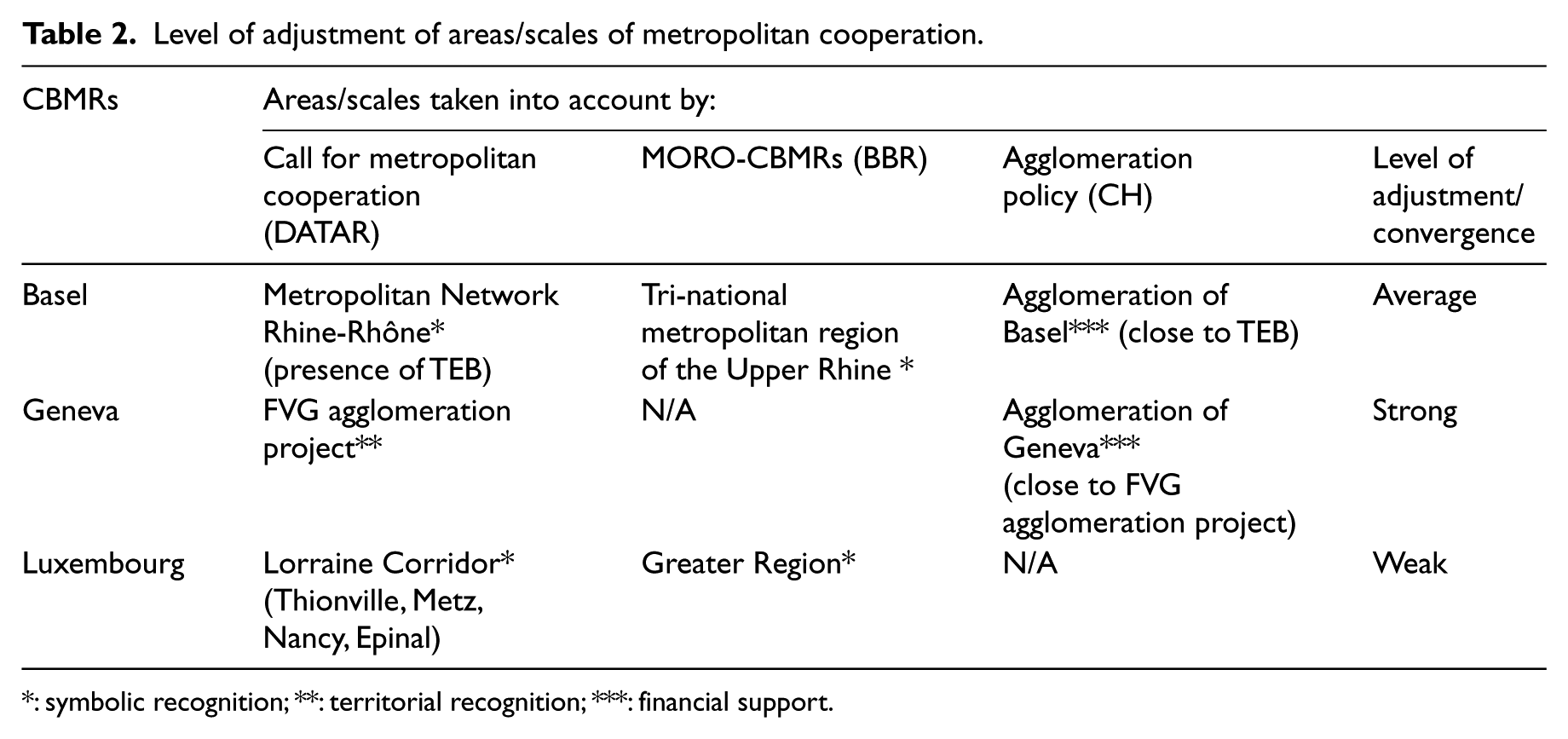
: symbolic recognition; **: territorial recognition; ***: financial support.
In the cases of Basel and Luxembourg, which lack the convergence of national metropolitan policies, the juxtaposition of different national visions makes territorial consensus on a cross-border scale more difficult. The tri-national metropolis of Basel is thus grasped from three different angles: centred on its urban area for the Swiss Confederation; integral part of the Tri-national Metropolitan Region of the Upper Rhine for the German MKRO; and associated to the network metropolis Rhine-Rhone in the French instance, even though this vision put forward by DATAR in 2003 seems to have petered out. The result is the appearance of certain scalar strategies which contest the leadership of Basel, such as, for example, the promotion of a polycentric CBMR on the scale of the Upper Rhine. This dimension, notably promoted by Karlsruhe, not only allows the German border city to relativize the dominant role of Basel as metropolitan centre but also to situate itself favourably with respect to the German federal planning and development policies as one of the structuring centres in a cross-border metropolitan space. Through a knock-on effect, this scalar strategy is also supported by the French public authorities who see in it a complementary dimension to that embodied by the Eurodistrict, Strasbourg-Ortenau, and which more or less encompasses a functional urban area. In the case of Luxembourg, the project of setting up a CBMR within a Greater Region framework has come up against pre-existing structures, especially those benefiting from the support of their national state, as is the case with the Lorraine Corridor which unites the cities of Nancy, Metz, Thionville and Epinal and which declared itself a ‘metropolitan pole’ in 2011.
Metropolitan actors with variable resources at their disposal
As national policies are neither set in stone nor forced on local actors and regions, but are the product of lobbying, political compromises and power struggles, the competencies of metropolitan actors is also a factor in the equation. This factor, which refers back to the question of metropolitan leadership, appears crucial insofar as the making operational of a system of metropolitan governance within a context of institutional fragmentation necessitates the involvement of actors capable of acting as intermediaries and of bringing about consensus (see especially Heinelt and Kübler, 2005; Heinelt and Zimmermann, 2011). As this question cannot be fully dealt with in this article, we will confine ourselves to examining two aspects of it: on the one hand it is a question of the ability of actors to convince the national authorities of the pertinence of their project (adaptation of the national ‘rules of the game’ to local and regional concerns) and, on the other hand, their ability to generate a consensus as a basis for collective action (the ability to adapt oneself to the ‘rules of the game’ in order to profit from it).
The first concern foregrounds the relations between city and state and the ability of the former to represent its interests with the latter. It seems that the urban cantons of Basel and Geneva, drawing on extensive institutional and managerial competences of Swiss federated states, have succeeded in having their interests recognized by the Confederation and its agglomeration policy (recognition of the cross-border dimension of the agglomeration, financing of cross-border infrastructures). In contrast, as the capital of a small country, Luxembourg-City has but little margin for manoeuvre in the final analysis faced with a state which monopolizes discussions on cross-border cooperation in the context of the construction of the Greater Region. The second aspect concerns the relations between local and regional actors and, in particular, the ability of the metropolitan centre to exercise a leadership that is capable of generating consensus as regards the form taken by cross-border metropolitan governance. Thus, in the case of Geneva, the endorsement of the French partners for the FVG agglomeration project rests on the adoption of a compromise which aims at a better distribution of employment and new residents within the cross-border area. By being able to go beyond the simple defence of its own interests, Geneva has succeeded in making the interests of its partners converge. In the case of Basel, the Swiss canton has also imposed its leadership in matters of cross-border metropolitan governance, sometimes directly in the case of cooperation projects linked to the agglomeration policy and sometimes indirectly through the mobilization of ad hoc organizations. The Regio Basiliensis thus plays a key role, alongside the canton of Basel-City, in steadily working for over half a century for the coming together of points of view and the construction of relations of confidence between actors on either side of the border. Originally conceived as an association set up to encourage cross-border cooperation, it has since become an agency for representing the Swiss cantons of the north-west in the matters of cross-border cooperation and allows for the management of many actors at different levels, both regionally and locally. Lastly, as regards Luxembourg, the authorities of the Grand Duchy have not yet succeeded at this point in time in creating consensus around the form the CBMR should take, but the recent character of the process calls for prudence in not interpreting this fact too hastily since time is very much a key factor in cross-border cooperation.
Conclusion
In looking at the cases of Basel, Geneva and Luxembourg, our analysis has shown that, despite considerable variation in the modes of cross-border cooperation put in place, the differences between national policies of metropolitan cooperation exert a significant influence on the scalar configurations of CBMRs. The more national policies diverge, as in Basel or Luxembourg, the more local and regional actors are inclined to contest the level of governance put forward by the metropolitan centre by committing themselves to other initiatives whether presented as complementary or as competing. One can detect in this the desire of certain peripheral actors to assert themselves in relation to the metropolitan centre whose leadership they contest. In contrast, when a border city enjoys the support of its national government and the views of neighbouring states converge, as in the case of Geneva, the creation of a single level of governance linked to a process of territorial integration seems easier. In that case, national policies contribute to rendering the initiatives of metropolitan actors legitimate, something that is a sizeable trump card in the politics around the rescaling of cross-border metropolitan levels of governance.
If the lack of coordination between states appears to stand in the way of structuring governance for emerging CBMRs, it does, nevertheless, offer the possibility for local authorities to exploit the different scales to their advantage. They could harness the border dimension in order to assert themselves within the national context through the political recognition of their territorial peculiarity, which is then no longer seen as a handicap but as an opportunity. This is notably the case of Karlsruhe, which aims to position itself favourably in relation to German metropolitan regions by promoting the tri-national metropolitan region of the Upper Rhine. Alternatively, the metropolitan dimension, held up at national level, can be used to contest cross-border governance levels and to reorder power relations. In the Greater Region, the promotion of the Lorraine Corridor as ‘metropolitan pole’ supported by the French state appears to be a strategy by its cities for contesting the leadership of Luxembourg on the question of setting up a polycentric CBMR.
This influence of national frameworks should also be relativized, however, because the politics of scales can take different forms depending on the way the actors behave and on the particularities of each context. As cantons, Basel and Geneva are in possession of great skills and the political, human and financial resources which allow them a priori to impose their leadership and to co-ordinate their activities in their border regions. The city of Luxembourg, which is one municipality among others in the Grand Duchy, does not possess the same powers. Thus, the political weight of the actors of the metropolitan centre plays a fundamental role in the structuring of levels of governance. Yet, the ability to link up different initiatives and to let the interests of local actors converge also depends on other factors. Thus, the game appears more complex in Luxembourg and Basel, which are, respectively, a crossroads for four and three states, than in Geneva, where only two states have to enter into dialogue. Moreover, the presence at regional level of a polycentric urban set-up, as at Luxembourg and Basel, tends to favour the emergence of competing projects (Lefèvre, 2004). Last, the historical depth of cooperative relations is of importance for local and regional actors to converge in their politics of scales, although the case of Basel shows that the accumulation of experience is not in itself a guarantee of success. What is certain is that, though the harmonization of national planning and development policies seems necessary in order to promote the institutionalization of cross-border metropolitan governance around stable and recognized scales, such an attempt will always remain a political construction that is historically contingent.
Footnotes
Acknowledgements
The article was written while Bernard Reitel was Visiting Professor in the department of Geography, CEPS/INSTEAD, Luxembourg.
Funding
This research is part of the MetroNet project ‘Cross-border metropolitan governance in Europe: A network analysis approach’ supported by the National Research Fund of Luxembourg (FNR Project C09/SR/03).
