



Abstract
In the last 20 years, the number of cross-border cooperation structures in Europe has exploded owing to political and financial support by the European Union aimed at encouraging cohesion and developing peripheral regions. These policies are part of processes of de-bordering and political rescaling that have profoundly affected cross-border areas by creating new institutional territories and political structures. The purpose of this paper is to study the institutional history of cross-border metropolitan governance in Europe through the comparison of two of the most advanced cross-border metropolitan regions: Lille and Luxembourg. This paper asks how these cross-border structures have developed and changed. What can their patterns of institutional evolution contribute to understanding governance in other cross-border regions? Are these new spaces evidence of political rescaling? This paper presents and redefines cross-border governance as a cyclical and a long-term process and also explores the challenges that these partnerships face in becoming functionally effective and autonomous policy actors. Ultimately, we find that there is no replicable ideal of cross-border governance and that even long-standing partnerships are in a period of exploration and reinvention. Establishing a competitive and coherent cross-border metropolitan region is ambitious and complex, and it necessitates the coordination of policies at multiple scales and across institutionally diverse territories. This project requires the modification and/or construction of new institutional and legal frameworks. This reorientation of political attention has resulted in a reconceptualization of political space but not the empowerment of new political actors, indicating that the process of rescaling may be a work in progress.
Keywords
Introduction
The process of de-bordering in the European Union (EU) has resulted in an intensification of functional interdependencies and the institutionalization of informally defined cross-border metropolitan spaces (Perkmann, 2003a). Various mechanisms of EU policy have encouraged the formalization and accelerated the proliferation of these cross-border regions (Medeiros, 2011), which has proceeded in parallel with ongoing internal processes of political and territorial rescaling. Although the emergence of these ‘new’, institutionalized, and multi-national regions is an incredibly significant phenomenon, the broader political implications of the emergence of these intermediary jurisdictions continue to be deliberated (see Brenner, 2000; Van Houtum and Strüver, 2002; Perkmann, 2003b). This paper contributes this debate and seeks first to understand how these processes of European territorial reimagining and cohesion have affected the production of political space in a cross-border framework and, secondly, to study the particular dynamic that develops in these cross-border territories. In other words, to what extent have the emergence and governance of cross-border regions resulted in political rescaling through the creation of new territorial spaces and actors?
This paper compares the evolution and forms of cross-border metropolitan governance in the European regions of Lille and Luxembourg. These are excellent test cases within which to explore these core questions. They were selected because both regions have adopted very different but highly institutionalized structures and strategies for region-building and governance over three decades to suit different geographic social and institutional challenges. Their comparison enables a broad exploration of the processes of regional governance development over the long term and of the challenges each approach has faced in implementing cross-border cooperation. This paper finds that, despite their differences, there are important similarities in the evolution of governance mechanisms and that they have both faced broadly similar impediments to cross-border consolidation. The cyclical nature of patterns of development and cross-border challenges in these cases may also be relevant to other European border regions. Furthermore, despite the lengthy functional and political evolution of these regions, and their adoption of recently created legal status, both have struggled to function effectively as political actors. The experiences of these two regions suggest that processes of de-bordering and territorial rescaling may have resulted in the creation of new spaces without leading to the emergence of new political actors that have the capacity to play an important role in cross-border policy.
The first section introduces the concept of cross-border regions and rescaling followed by a discussion of the processes of regionalization and the evolution of European cross-border governance. The next tracks the evolution of cross-border cooperation in the regions of Lille and Luxembourg. It provides an overview of their institutional development, the challenges the partnerships have faced, and the actors that are driving the process. It concludes with a comparative synthesis of the two cases. The third section presents some critical observations about the phases of cross-border regional governance and its cyclical nature, and the final section explores evidence of partial territorial rescaling. The conclusion reflects on the relevance of these findings for European cross-border regions more generally and the ongoing process of Europeanization. Ultimately, we find that there is no replicable ideal of cross-border governance and that even long-standing partnerships are in a period of exploration and reinvention. This process may similarly be a phase in a trajectory of rescaling that has not yet been fully achieved.
Cross-border regions, governance and rescaling
The simplest definition of a cross-border region is a territorial unit that is made up of contiguous subnational units from at least two nation-states (Perkmann and Sum, 2002). Typically, this involves a combination of local political authorities across national boundaries, but subnational units can also include planning regions, ecological areas, industrial districts, or tourist zones. They can also be defined more expansively in terms of functional integration across state boundaries measured by the spatial dynamics of factors such as economic flows (that is, trade, labour markets, and consumption patterns) (Van Houtum, 2000; Petrakos and Topaloglou, 2008; Nelles and Walther, 2011; Decoville et al., forthcoming) or sociocultural conditions such as the boundaries of ethnic, cultural, or linguistic communities (Scott, 2005; Topaloglouet al., 2005; Brunet-Jailly, 2006). In the most general sense, a cross-border region is a potential region based on any of these factors but ‘disrupted by the sovereignty of the governments ruling on each side of the frontier’ (Council of Europe, 1995).
This paper focuses specifically on the governance and institutionalization of cross-border metropolitan regions in Europe. Metropolitan regions are particularly interesting because functional integration presents governance challenges simultaneously across a wide variety of policy areas (that is, transit, infrastructure, labor, education, commercial, economic development and promotion, etc.) that necessitate at least some form of political coordination. Furthermore, the nature of these policy challenges – which rest largely, though not exclusively, in local spheres of competency – means that coordination is often driven by local actors from the bottom up. As a result, focusing on the metropolitan scale enables an investigation of how (and whether) local actors manage governance in the context of multi-level and multi-state policy and the extent to which the transnational regional scale has – through a combination of top-down and bottom-up actions – acquired autonomous governance capacity.
The discourse on political and territorial rescaling emerged in response to the perceived (and at least partially real) hollowing out of the state. The concept of glocalization encapsulates the forces that have weakened state capacity. Glocalization refers to the ‘contested restructuring of the institutional, regulatory level (the level of social reproduction) from the national level both upwards to supranational and downwards to the scale of the individual body, the local or regional configurations’ (Swyngedouw, 1997: 170). The concept also applies to strategic shifts within the private sector and the global localization of industries, services, and financial capital.
Europeanization is the quintessential case of state glocalization. The creation of the EU and the concomitant erosion, but definitely not elimination, of member state sovereignty and regulatory authority is a prime example of how the institutional level has been restructured upwards. European regional policy that responded to the economic logic of regional development but also sought to build up regions as a way to circumvent national politics (Deas and Lord, 2006; Johnson, 2009) created a shift of policy attention to the local and regional scales. Furthermore, European member states such as France embarked on a mission to decentralize their states (Harguindeguy and Bray, 2009), further ‘localizing’ political scales.
There is no question that the European project and globalization have caused a territorial rescaling and the shift of some political responsibility to alternate, often new, scales of government and away from the state. However, on the localization side of the rescaling equation, state rescaling implies more than decentralization, devolution, and relocation of responsibility to lower levels of government. Rather it involves the creation and contestation of new configurations of the state at different scales – the emergence of a new scalar order – and a transfer of power. Rescaling blurs traditional hierarchies by reconcentrating authority at different scales, which become both sites of regulation and arenas for social negotiation (Brenner, 2001, 2004; MacLeod, 1999). In this sense, ‘scale’ takes on a plural meaning implying a reconfiguration of hierarchies ‘among geographic scales and not within a geographic scale’ (Perkmann, 2007a: 255). Rescaling is consolidated through the creation of governance institutions and functions at this different scale (that is, in metropolitan regions and/or cross-border spaces) that have both legitimacy and the capacity to act. Ultimately, it involves the creation and empowerment of new territorial and political actors. Are cross-border spaces evidence of the emergence of a new set of actors in a multilevel and ‘post national’ political system (Popescu, 2008)? The paper first explores the evolution of cross-border metropolitan governance in Europe and in each of the two cases before considering the implications of this development in terms of political restructuring.
European regionalization and the evolution of cross-border metropolitan governance
A 2005 study identified 387 cross-border regions in Europe on the basis of economic and socioculturalintegration (Topaloglou et al., 2005). The Associationof European Border Regions (AEBR) currently lists 184 institutionalized cross-border metropolitan regions (AEBR, 2011). The Metroborder project has also defined 11 cross-border metropolitan regions (ESPON, 2010). Furthermore, this phenomenon has accelerated since the first formalized partnership established in 1958 with the Treaty of Rome (which established the European Economic Community), such that there is now no internal border in the European Union not penetrated by some form of cross-border partnership (Jonsson et al., 2000; Perkmann, 2003b).
The rise of cross-border regions in Europe is attributable to the interaction of two parallel and related processes: globalization and the project of European integration. The centripetal forces of globalization on the nation-state have solidified the metropolis and the region as the motors of the global economy (Scott, 2001) and as natural economic zones (Ohmae, 1995). The permeability of national borders to international networks and capital flows has reduced the importance of the national scale as the site of competitive advantage and has concentrated investment inglobally linked urban regions that benefit from agglomeration economies (Cox, 1997; Brenner, 2004; Swyngedouw, 2004; Deas and Lord, 2006). Consequently, policy discourse emphasizes the emergence of new regionalism and new entrepreneurial paradigms and the importance of exploiting the competitive edge of the local and metropolitan scales in economic development strategies (OECD, 2006, 2007). Meanwhile, governments continue to reshape political institutions in response to the challenges of shifting global capitalism. This has resulted in a shift of responsibility to local and metropolitan levels of government through policies of decentralization and retrenchment (Rodriguez-Pose, 2008). State policy restructuring resulting in a transfer of jurisdiction to lower governmental tiers frequently began as a response to global fiscal pressures on senior levels. However, governments increasingly are adopting explicit policies to promote metropolitan economies in recognition of their importance to national prosperity (Harrison, 2008; Otgaar et al., 2008).
European regional policy incorporates the logic of the catalytic power of regional development to transform underperforming economies. However, European regionalism is also strongly tied to the core projects of integration and territorial cohesion at the heart of the Lisbon process. This agenda aspires to promote internal cohesion, minimize socioeconomic disparities, and reduce the national borders of its member states to ‘mere administrative boundaries’ (AEBR, 2008: 15). Border areas merit specific attention because they are typically marginalized, both geographically and within national policies, in addition to their traditionally disadvantaged socioeconomic status. However, they are also important spaces where development could further integration goals by reducing inter-state competition, fostering economic interdependence, and encouraging cultural exchange (Johnson, 2009). As a result, European policies focused on regional development have included a specific track dedicated to stimulating the growth of previously peripheral cross-border regions. The INTERREG (1989–present) funding initiative, financed by the European Regional Development Fund, is the most visible manifestation of these political goals (Medeiros, 2010). The program aims to promote cooperation between regions within the EU. Strand A focuses specifically on supporting cross-border regional cooperation. The program is currently in its fourth funding period (2007–13) with a budget of €6.4 billion for the cross-border strand alone (Wolfe, 2007). The European Commission has also pursued several rounds of statutory reform of European regulations to facilitate the establishment of cross-border partnerships eligible for these funding streams.
Scholarship on European regional policy and program evaluations claim that political and financial support for cross-border initiatives has increased cooperation within these cross-border spaces and enhanced opportunities for border actors (Nijkamp, 1993; Spinaci and Vara-Arribas, 2009; Panteia, 2010). From this perspective, the regional policy of the EU is an important catalyst of cross-border governance. However, a growing proportion of recent literature on cross-border cooperation questions the effectiveness of European policy in stimulating meaningful and, more significantly, sustainable partnerships (Perkmann, 2007a; Harguindeguy and Bray, 2009). This paper pursues this line of inquiry more broadly by investigating the impact of cross-border governance arrangements on the empowerment of new types of actor. The following section introduces the cross-border regions of Lille and Luxembourg and highlights the core similarities and differences in the institutional evolution of governance.
The production of cross-border metropolitan governance
How can cross-border metropolitan governance be implemented? This paper investigates the evolution of cross-border governance in two metropolitan regions: Lille, bordering France and Belgium; and Luxembourg, whose area of influence crosses into parts of Germany, Belgium, and France (see Figure 1). This section explores and compares their institutional and legal development as two of the longest-running and most formalized examples of cross-border cooperation in the EU.
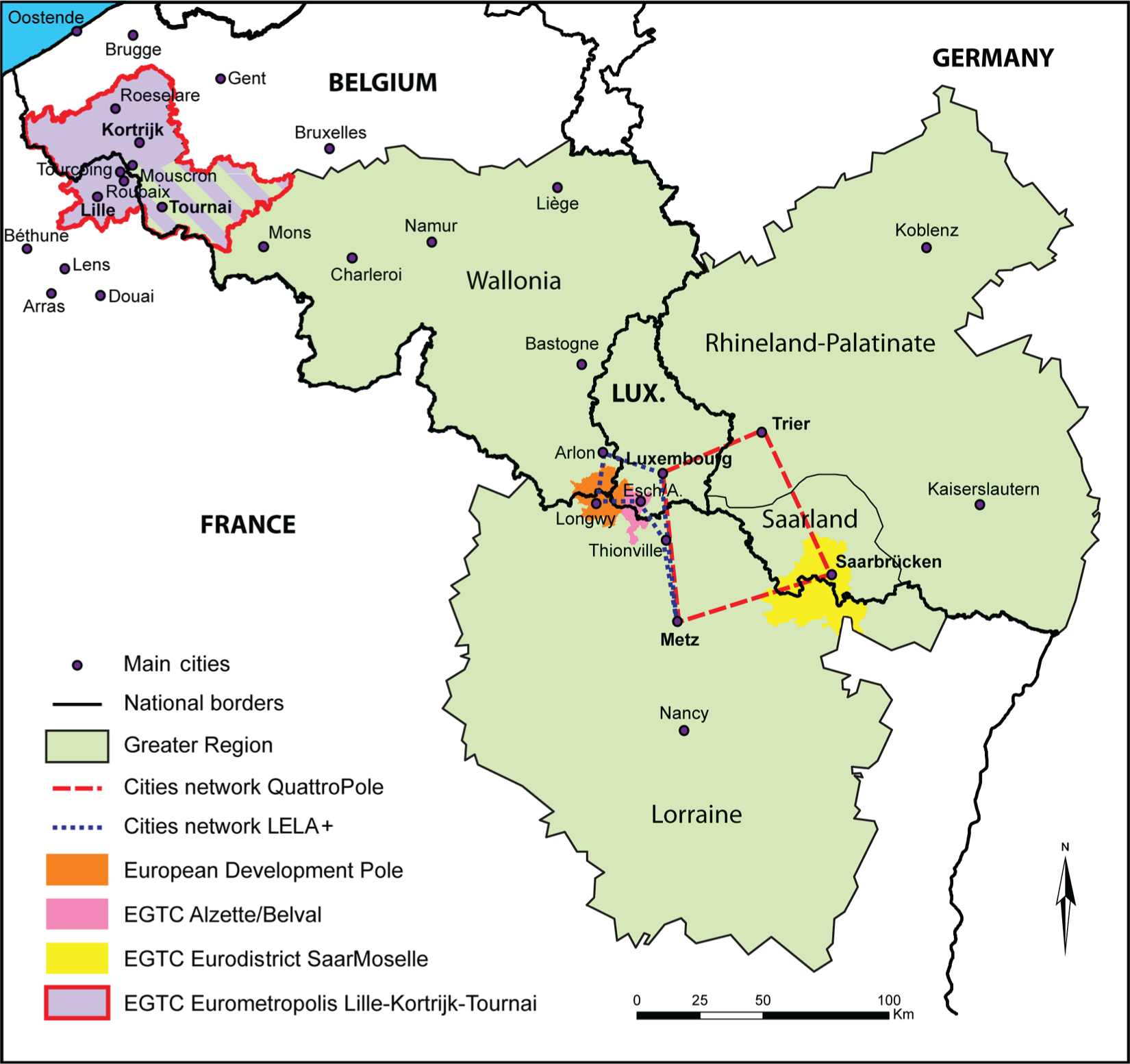
The cross-border regions of Lille and Luxembourg.
Cross-border governance in Lille: from local partnerships to the Lille–Kortrijk–Tournai Eurometropolis
The Metropolitan Area of Lille is a continuous cross-border conurbation comprising the three major cities (Lille in France and Kortrijk and Tournai in Belgium). This 3550 km2 territory contains 147 local authorities and 2 million inhabitants. This urban area is divided not only into two parts between France and Belgium, but into three with the internal divisions within Belgium between Flemish and Walloon territories. This cross-border conurbation is a multi-polar metropolis that is an important employment and economic centre (Sinn et al., 2001). But this metropolis is also marked by strong social inequalities. The unemployment rate is high: 13 percent in the Département du Nord (first trimester 2011, INSEE) and 20 percent in the Province du Hainaut (2010, ONEM), although the rate is relatively low in the Province of West Flanders: 4.3 percent (EUROSTAT, 2009).
In this region, cross-border governance has historically been initiated by local authorities. Until recently, the national level of government was not interested in the spatial coordination of the cross-border region, but local success and the rising importance of this border region has increasingly attracted its attention. The first generalized cross-border partnership – the permanent inter-communal conference on cross-border affairs (Conférence permanente intercommunale transfrontalière, COPIT) – was created in 1991 between the metropolitan government of Lille Metropolitan Community (LMCU) in France and the four inter-communal organisms of the Belgian side: IDETA (in the region of Tournai), IEG (Mouscron-Comines), Leiedal (Kortrijk) and WVI (Bruges/West Flanders). The aim of the partnership was the creation of a Eurometropolis in order to successfully access INTERREG I funding (Van Staeyen, 2008). From the outset, the political actors wanted to involve other local actors in the process of deliberation and invited the private sector and civil society to participate in the cross-border debate. The cross-border agenda in the region was driven and sustained by the strong personalities of local politician Pierre Mauroy, who was Prime Minister of France 1981–4 and president of the LMCU 1989–2008, and Bruno Bonduelle, one of the most dynamic entrepreneurs in the North, the founding father of the Comité Grand Lille 1 and president of the Lille Chamber of Commerce (CCI Grand Lille) between 2004 and 2010. Both individuals were committed to the revitalization of the Lille metropolitan region and recognized its cross-border character as a key asset. With their strong political and commercial connections, Mauroy and Bonduelle constructed the cross-border networks and generated local interest in the institutionalization of the partnership as COPIT and in the construction of a cross-border metropolis.
However, the partnership quickly encountered difficulties in implementing its cross-border agenda. The primary obstacle was a lack of both financial and political capacity to follow through on collective projects, particularly when implementation required the cooperation of senior levels of government. In 2002 the French and Belgian governments signed the Brussels agreement to reduce the roadblocks to cross-border cooperation. The agreement established conventions and a legal framework for cross-border cooperation between local authorities. In addition, a French-Belgian Parliamentary Working Group was created in November 2005. The group of 12 parliamentarians was asked to identify the main legal, legislative, and regulatory obstacles limiting effective cross-border cooperation and to define conditions for institutional experimentation in the Greater Lille Metropolitan Area and along the Franco-Belgian border more generally.
In 2006 the working group proposed aninstitutional formalization of the evolving COPIT partnership as a European Grouping of Territorial Cooperation (EGTC), 2 which unites national, regional, provincial, departmental, and inter-communal authorities on both sides of the border. The European Commission introduced this new legal and governance tool by Regulation 1082/2006, which took effect in the summer of 2007. This EGTC is the outcome of 20 years of cross-border cooperation and the culmination of the work of local authorities that wanted create a formal and effective cross-border structure to replace the COPIT. The activities of this primary cross-border structure were limited. Although the COPIT was efficient in the production of cross-border studies, it was only an association with a small budget with which it was impossible to apply the cross-border strategy defined by the partners. Besides, the COPIT also lacked political competences owing to the absence of state and regional stakeholders. The COPIT worked well as a cross-border cooperation laboratory and as a structure through which key relationships were built, but it was less effective at confronting the challenges of the fragmented political environment in implementing cross-border projects.
Establishing the EGTC involved the creation of a completely new institutional cross-border framework. The resulting structure of the EGTC is complex but logically constituted. It represents a new step in the cross-border governance of the region, being composed of political, technical, and civil society organs (see Figure 2). The political level consists of the Assembly, the Board and the Chairmanship, which are the primary decision-making bodies for the region and are composed of political actors from the 14 partners of the EGTC. They form six thematic working groups that explore the major themes to prepare collective agendas. The Conference of the Mayors informs local and inter-communal executives of the projects of the Eurometropolis and coordinates their implementation at the local level. Technical aspects of the partnership are coordinated by the cross-border agency, which is an administrative tool and provides technical support to the Assembly. Finally, the effective integration of civil society is an important element of the cross-border cooperation process. The Cross-Border Forum of the Eurometropolis was created using the model of the Development Council of Lille Métropole (LMCU). This forum guarantees that the interests of the residents of the Eurometropolis are formally incorporated into the political process. Ultimately, this structure was designed to ensure that the cross-border region is developed with the input of a wide variety of actors and, by including representatives from senior levels of government, it has the political capacity to execute its collectively constructed vision. The structure of the EGCT has existed since 2007; however, it has been operational only for a short time because of difficulties in finding a suitable director to manage these new processes.
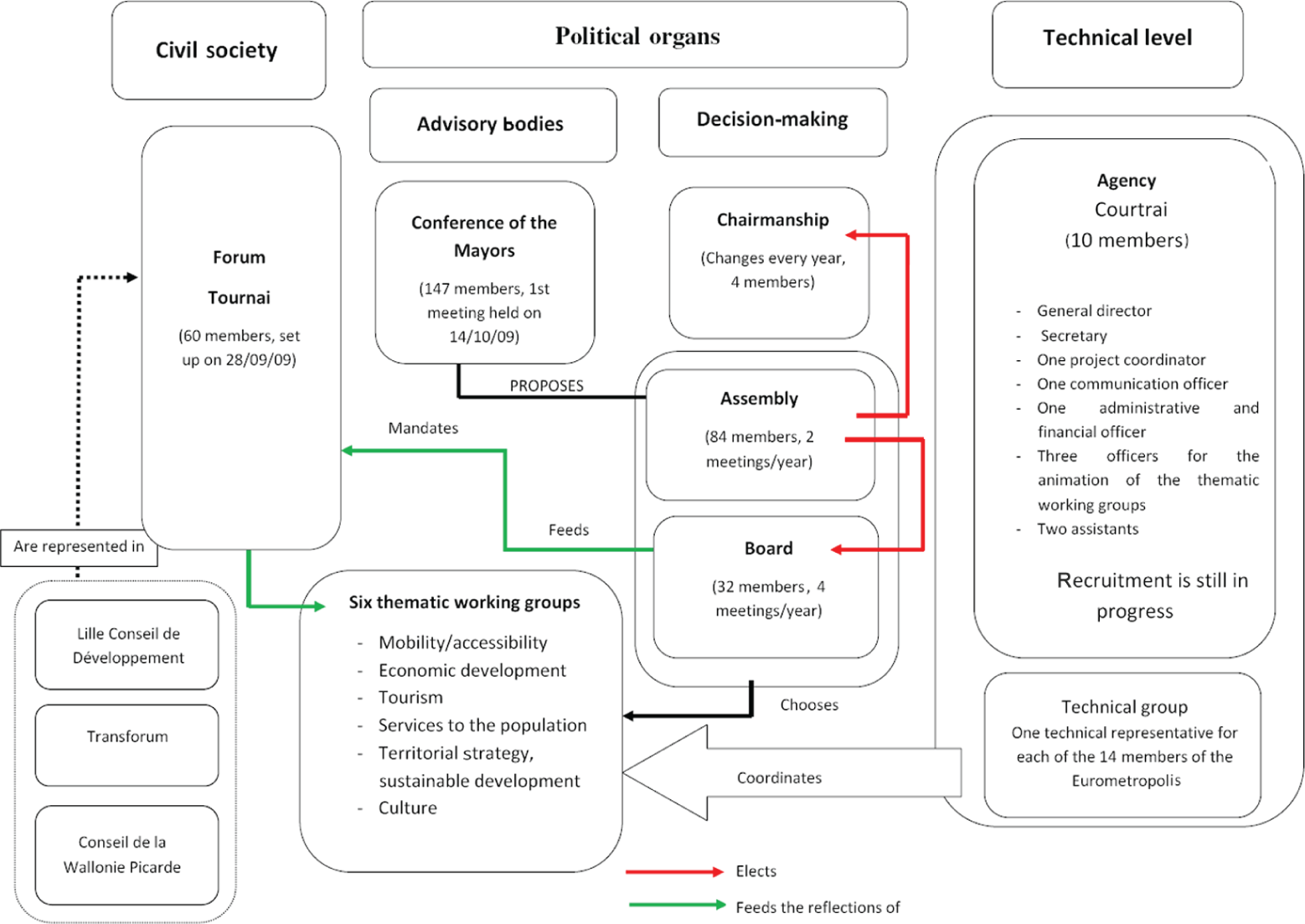
The organizational structure of the Lille–Kortrijk–Tournai Eurometropolis.
Although the new EGTC holds a lot of promise as a cross-border institution, it is not the only game in town. The Metropolitan Area of Lille (AML) is another structure involved in cross-border governance. Whereas the EGTC covers the territory of the Urban Community of Lille Métropole, the Walloon districts of Mouscron, Tournai, Ath and Enghien, and the Flemish districts of Kortrijk, Ieper, and Roeselare, the area of AML is larger and includes, in addition to the aforementioned territory, the agglomerations of the coalfields in the south of the French region (Lens, Douai, and Bethune). The most significant difference is that the Belgian actors are not partners of the AML but only observers. This territorial vision was launched in 2005 by DATAR (Délégation interministérielle à l’aménagement du territoire et à l’attractivité régionale) with the cross-border metropolitan project to promote the European influence of major French cities. The AML is still active in coordinating policy – most notably in visioning regional transportation networks – but the lack of state funding has hampered the participation of Belgian actors. The Belgian partners prefer the EGTC, in which French and Belgian populations (1 million inhabitants on both sides of the border) and political representation are more balanced. Although the cross-border area of the AML corresponds more to a functional conception of the future metropolitan area, currently the political actors prefer to focus on the cross-border perimeter of the EGTC.
Cross-border governance in Luxembourg
The cross-border territory around Luxembourg is much more complicated than that of Lille. The Metropolitan Area of the City of Luxembourg is the economic and social centre of the broader cross-border region, which stretches into southern Belgium, France and Germany despite the fact that its urbanized area fits largely within the boundaries of the country. Rather the region is built on strong, primarily economic, ties with communities on the other side of its borders. Approximately 150,000 people cross the border every day to work in the City of Luxembourg (STATEC, 2011), drawn by work related primarily to the financial sector 3 and its status as a European capital. The relatively small size of the country makes building strong ties with its neighbors indispensible to the vitality and development of its economy. As a result, Luxembourg has a long history of networking to nurture its economic growth that reaches back to the early 1950s. Luxembourg was one of the founding members of the European Coal and Steel Community established in 1952. The initiative to consolidate links between Luxembourgish, French, German and Belgian actors developed gradually around the common challenge of the decline of the steel industry in the heart of Europe and of the reconversion of the primarily mining and industrial regions of the partner countries and evolved into a territorial project that united them in a community of interest. It was not until 1980 that the partnership was formalized as the SaarLorLux, a cooperative structure that included Luxembourg, the Lorraine in France, and the Saarland in Germany. It eventually added the Rhineland-Palatinate region of Germany and Wallonia. Today it covers a vast cross-border area of more than 65,401 km2 with over 11 million inhabitants 4 and has rebranded itself as the Greater Region.
The Greater Region is currently a partnership between 11 national and regional governments in the region. 5 The institutional structure (see Figure 3) has two elements. Strategic leadership is provided by the Executive Summit of the Greater Region, which includes representatives of the principal political actors in the partnership. Several organizations are concerned with the operational mission. The House of the Greater Region coordinates the directives that issue from the leadership summits. The Managing Authority of the Greater Region, technically supported by joint secretariats located in each of the five territories, controls the implementation of joint programs. Finally, 19 working groups bring together numerous political actors and experts and coordinate policies across a wide variety of thematic areas (higher education, economic development, spatial planning, health, etc.).
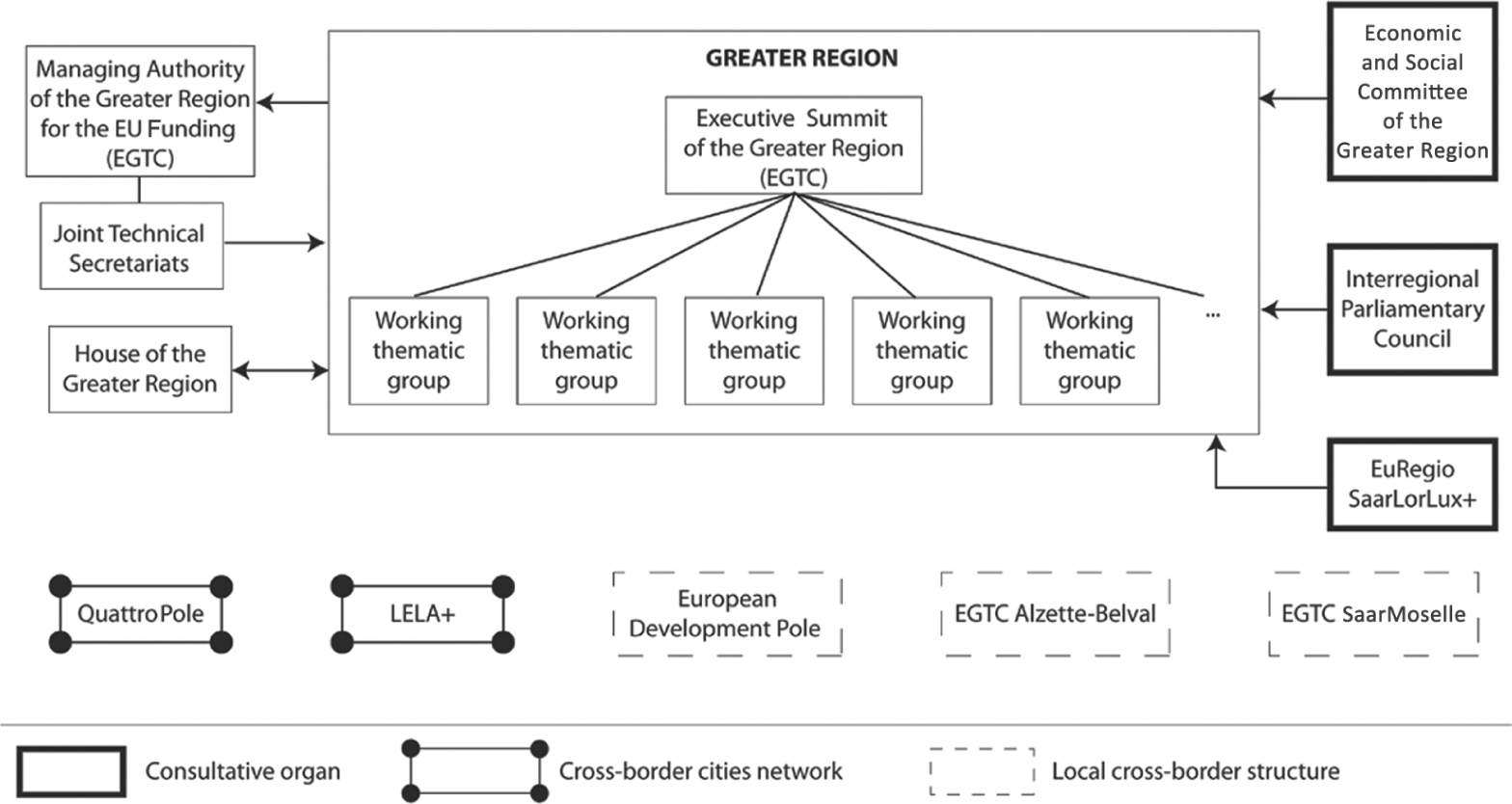
The organizational structure of the Greater Region and its governance partnerships.
The Greater Region is the primary cross-border structure in the region, but several other organizations are also engaged in cross-border governance. Three consultative bodies of the Greater Region are involved in cross-border governance. First, the Interregional Parliamentary Council, established in 1986, is a consultative assembly made up of the parliamentarians of the partner territories. Its role is to promote and improve cross-border cooperation and coordination in the region. Second, the Economic and Social Committee of the Greater Region (ESCGR), constituted in 1997, focuses on the socioeconomic development of the region and represents private, social, civil society, and non-profit interests. Its role is to identify, produce feedback and propose solutions to problems they encounter in working in a cross-border environment. Finally, the EuRegio SaarLorLux+ is the structure that represents and defends the interests of local authorities in the territories of the Greater Region. Its purpose is to reinforce cooperative links between the communities of the Greater Region and also to develop linkages between the EuRegio and other cross-border institutions primarily by participating in the ESCGR and Greater Region working groups.
Several more local cross-border partnerships have also developed within the Greater Region territory and largely without its initiative. The European Development Pole (EDP) and the future Alzette-Belval EGTC unite local actors on either side of Luxembourg’s border with France. The EDP was one of the first local cross-border structures in Europe. Lots of cross-border projects were implemented within this structure, especially studies to help the stakeholders to organize cooperation better. But the main objective was to plan the building of a cross-border agglomeration between the industrial towns close to the national borders (Longwy, Differdange, Pétange, Athus, Aubange) in order to coordinate the economic revitalization of the industrial wastelands. The SaarMoselle Eurodistrict on the border of France and Germany also recently became an EGTC. Although these three cross-border partnerships relate to small territories with local objectives, state bodies are represented alongside the local authorities.
Another class of cross-border cooperation between local actors is a network. Although local authorities are the primary actors in these cross-border organizations, they are united by common interests rather than territorial proximity. QuattroPole is a partnership between the cities of Luxembourg, Trier, Saarbrücken, and Metz. LELA+ is another network that brings together the French-speaking communities of Luxembourg, Longwy, Arlon, Metz, Esch-sur-Alzette, and Thionville. 6
Cross-border partnerships within the Greater Region have multiplied over the past two decades. The Greater Region structure is definitely the primary regional body; nevertheless, the dispersal of cross-border capacity across these multiple partnerships constitutes a weakness of cross-border governance resulting in a lack of coherence and transparency of cross-border policy vis-à-vis external actors.
Synthesis: comparing cross-border governance in Luxembourg and Lille
A comparison between these two cases reveals important differences in the evolution and institutionalization of cross-border governance (see Table 1). These differences are a result of the different shared histories of cross-border territories, their pastcooperative experiences, the number of actors involved in their partnerships, and the size of the cross-border region, among others. The local and regional context is also an important determinant of cross-border governance structures. In these two cases, the most striking difference is the level at which cooperation was structured. These regions have taken two radically different, almost diametrically opposite, approaches to establishing cross-border governance. In the Lille region, a single structure that federates all political jurisdictions, policy capabilities, and institutional scales has emerged, whereas in Luxembourg’s region there are several. Local authorities do not participate in the Executive Summit of the Greater Region and there is a clear separation between the state and regional representatives, who decide policies and define regional strategies, and the local actors, who are relegated to peripheral roles.
Comparing the Lille and Luxembourg cross-border regions.
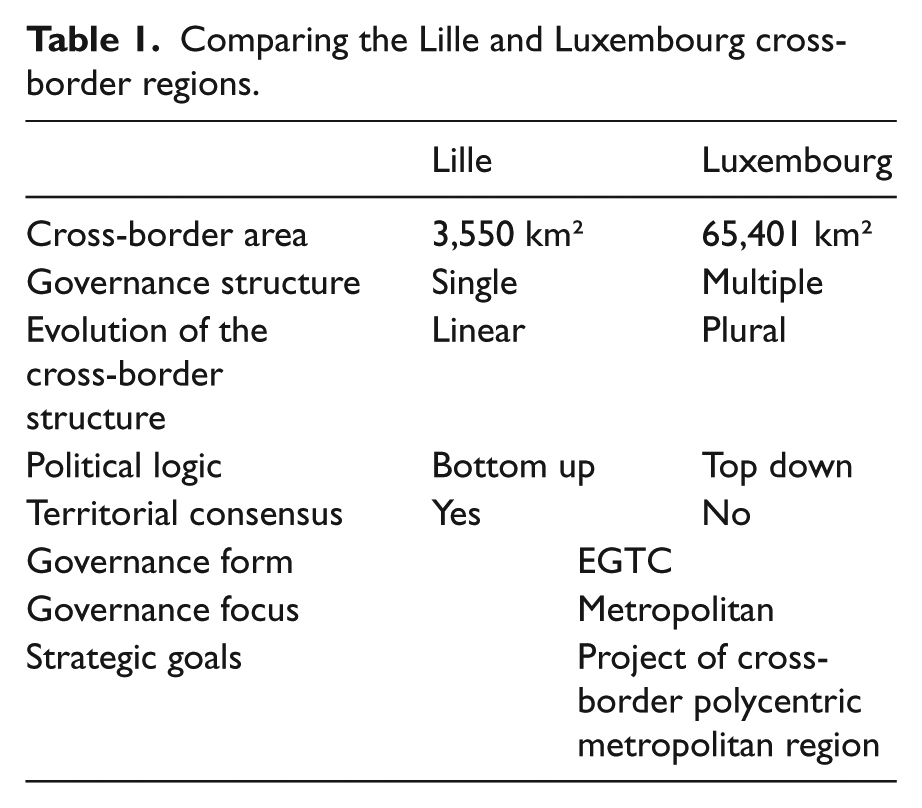
Two different political logics are emerging in these two regions. In the Greater Region the governance process in which state and regional interests dominate decision making is top down. By contrast, the process in the Lille–Kortrijk–Tournai Eurometropolis has been bottom up: in this case the initiative and the institutionalization of cooperation originated from local authorities. The distinction between these two examples is reinforced by the very different roles that central states play in each set of partnerships. In the Greater Region the states drive cooperation, whereas in the Eurometropolis the states play a more supervisory and facilitative role.
Cooperation in both regions also followed very different trajectories of institutional development. In Lille it was relatively linear, and more intense and institutionalized forms of cooperation emerged from and replaced a less formal partnership. In Luxembourg it was a much more plural process in which parallel collaborations became institutionalized in a wide variety of forms and legal frameworks. No fewer than four EGTCs have been created over the past two years in the Greater Region area: the EGTC SaarMoselle, the EGTC Alzette-Belval, the EGTCs of the Managing Authorities of INTERREG Programmes, and the EGCT Greater Region. The first two were created independently from and with few connections to other existing Greater Region structures. Another key difference is that the political actors in the Lille region managed to arrive at a consensus about the territorial boundaries of the cross-border region. Even if the perimeter of the AML is more reflective of the functional metropolitan region, a mutually acceptable agreement was reached between the French and Belgian partners in the form of the Eurometropolis. In Luxembourg, there has been no comparable compromise on the definition of the cross-border territory or alignment between the functional metropolitan region and the political institutions that have been created to manage the collective space.
These two governance systems seem completely divergent; however, they do have some important similarities. In both cases political actors sought to formalize cross-border cooperation within one or several institutional structures. These structures were enabled by transnational accords that required the appropriate legal framework and structure for cooperation between subnational authorities to be defined (the Karlsruhe and Brussels agreements of 1996 and 2002, respectively). Another similarity between the cases is the cross-border political scale envisioned by their creators. In Lille, as in Luxembourg, the shared ideal of the actors is to identify a collective development strategy, with a metropolitan focus, to orient the cross-borderterritories. The creation of the Lille–Kortrijk–Tournai Eurometropolis EGTC represents a political compromise between the French, Flemish and Walloon partners to define the boundaries of their region and to use this definition as the primary basis of their cross-border policy agenda. In Luxembourg, the metropolitan project has assumed the form of a cross-border network of cities where the principal players are the cities of Luxembourg, Metz, Trier, and Saarbrücken, while the functional perimeter of the region remains vaguely defined. Political actors in the region are currently deliberating on how to reorient and concretize this kind of governance model (Sohn et al., 2009).
These two cases demonstrate how much variation can exist in cross-border governance forms. There are no clear guidelines on how to establish an ideal cross-border partnership and what form it should take. It is up to each cross-border region to discover the most appropriate, the most feasible, and the most effective configuration that takes into account the vagaries of its local context (Ettlinger, 1999) and to experiment with and evolve novel structures out of its own unique political consensus.
A permanent redefinition of cross-border governance
Cross-border governance is a relatively recent political process that has resulted primarily from attempts to manage cross-border regions (Anderson et al., 2003). The vitality of cross-border cooperation is related to the degree of involvement of the different actors present in the policy space and the quality of relations between them. As the empirical cases demonstrate, because of the diversity of cross-border contexts there is no preordained methodology for establishing this type of cross-border governance arrangement. Rather, governance in cross-border regions is built through a process of experimentation, innovation, error, and re-evaluation within the unique set of institutional constraints imposed by the fragmented international context. Each region invents ‘its own’ method of coordinating political action in ‘its own’ cross-border space (geographical, political, and institutional) with the ultimate objective of structuring effective cross-border cooperation. That said, there are nevertheless some lessons that can be gleaned from observing the broader experience of cross-border partnerships. It is important to take into account historical patterns that play out over the long term and permit us to understand the challenges that currently face cross-border partnerships and to better anticipate those that will emerge as cooperation matures. This section elaborates these processes and compares the experiences of each case.
Cross-border cooperation: a long-term process
Despite the variety of types of cross-border governance in Europe, it is clear that outcomes are strongly linked to the geographical context and an enabling and open political climate towards developing regional partnerships. However, cross-border governance is a process that typically unfolds over the very long term. Engaging in cross-border cooperation involves entering into a realm of long time-frames andslow progress and encountering (and countering) complex situations formed by the blending ofheterogeneous territorial systems (Durand, forthcoming). Nevertheless, the evolution of each cross-border region passes through similar phases, which permits them to establish lasting cooperation over the long term. In the past two decades several general sequential phases of cross-border cooperation are observable in Europe (see Figure 4).

The phases of cross-border governance evolution.
Institutionalized cross-border cooperation starts with an exploratory phase. The opening of national borders that resulted from the establishment of the EU permitted political actors at all levels of government on either side of these boundaries to make contact and share information with their peers. During this period of exchange of practical information links were built between the actors, sowing the first seeds of the potential for political cooperation. This simple form of networking is the first phase, which enables the idea of defining common territorial projects to flourish.
The second period consists of a structuring phase of cooperation. This involves the negotiation and formalization of inter-state compacts that will structure the terms and legal frameworks that will govern cross-border cooperation between subnational actors. The EU has established regional policy and funding instruments to support cross-border cooperation. Over time the partners in cross-border governance have produced a proliferation of studies and territorial analyses in order to better understand their cross-border environment and where cooperation can make the most effective contribution. In this phase, cross-border governance structures emerge rapidly in order to consolidate and institutionalize these partnerships. The momentum behind the cross-border approach to development promises new growth potential for these previously peripheral border regions and fuels high hopes for the future.
This institutionalization of cross-border partnerships precipitates the programming phase, during which the first collaborative projects are launched and realized. As projects are proposed and move towards implementation, the partnerships encounter their first major challenges, which are often legal and technical but can also be political and financial. These can result in the disillusionment of actors with cross-border governance and a stagnation of cooperative efforts. Organizational difficulties are accentuated by a lack of a shared strategic vision within the partnership. Recurring legal and statutory problems in project implementation linked to the inability of senior levels of government to find mutually acceptable solutions for coordinating cooperation in cross-border policy areas slow progress. Even if steps have been taken to pre-empt such institutional and political barriers (for example in the institutional design of the partnerships and strategic documents), they generally prove inadequate at envisioning practical solutions to these ingrained challenges. As a result, even well-established cross-border partnerships still find themselves in a period of experimentation and re-imagination in which new modes of coordination are being tested and old organizations replaced with new forms. This phase raises the question of whether the first period of contact and networking had catalyzed a real knowledge of the Other – promoted a real understanding of the territory, population, and political, financial, and legal systems on the other side of the border – and of how their systems actually work. In many cases, doubts remain over the extent to which this has been the case and has produced a situation that must be redressed in order to build better cross-border synergies.
From an analysis of the two case studies, it appears that these regions have passed into a new phase. In light of the persistence of cross-border challenges, actors have attempted different types of adjustment (to the institutional and fiscal capacities of partnerships) in order to smooth cooperation. The adjustment phase aims to perpetuate cross-border cooperation by improving methods of organizing governance. These adjustments have strong parallels to similar shifts in European cohesion policy.
How should we evaluate cross-border cooperation in Europe 30 years after the signature of the European Outline Convention on Transfrontier Co-operation between Territorial Communities or Authorities (the Madrid Convention)? Transnational political actors are in the process of reflecting on this question in this adjustment phase. In fact, the governance struggles of cross-border regions have prompted leaders to reconsider cross-border cooperation and re-evaluate it in terms of effectiveness (as a form of governance but also on the practical question of whether INTERREG funds have been employed productively) and territorial development outcomes. The current impulse is to learn from the ensemble of cross-border regions and experiences, to understand the common and unique dynamics at play, and to construct a strategy to stimulate the development of these places. Understanding cross-border governance is one of the keys to achieving this European policy goal, and continued institutional, political, and technical support will encourage the experimentation and innovation necessary to hone regional policy.
Cross-border cooperation: a cyclical process?
Since its explosion in the 1980s, cross-border cooperation has been facilitated by the presence of strong political leaders who have managed to unite relevant actors, diffuse tensions, and structure compromise. However, faced with the inertia and plodding progress of establishing cooperation over the long term, even energetic leaders can fall victim to frustration and lassitude. The relentless back and forth of projects and the multitude and persistence of constraints can dampen the enthusiasm of political actors for the cross-border agenda. Barriers can be more influential than opportunities and means in the world of cross-border politics.
A gradual turnover in personnel and leadership has sustained cross-border institutions. New people and new teams have brought their own perspectives and new ideas to the table. Commonly, after 10–20 years the pioneers of cross-border cooperation have ceded their places to new elected or bureaucratic actors. 7 As time passes the leaders disappear, leave politics, or retire. It is essential for the perpetuation of the cross-border project that new leaders emerge. But does this continual renewal occur in practice? Are we observing the emergence of a new phase in cross-border cooperation? In the two cases here it appears as though a new cross-border cycle has started in which each of the successive phases (contact, study, programming, and adjustment) is being replayed.
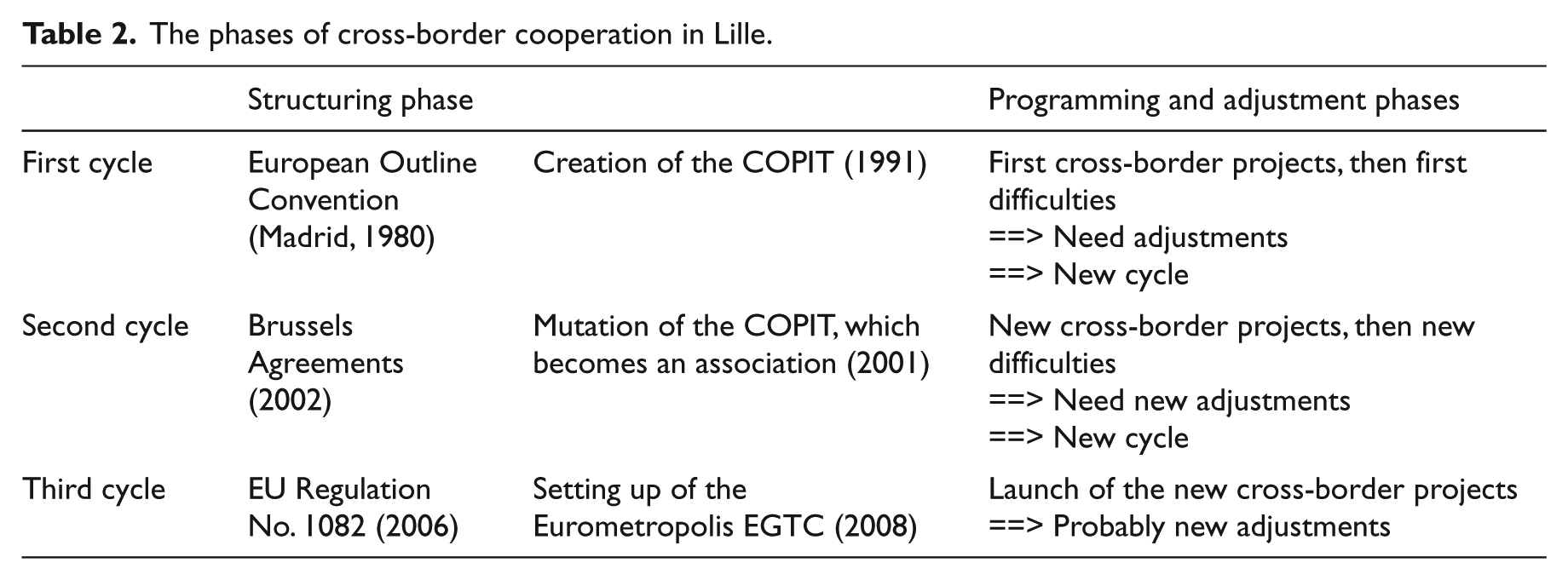
In Lille, the advent of the EGTC led to a complete reorganization of cross-border governance. The COPIT was dismantled, to be replaced by the new strategic leadership of the EGTC. There was no transfer of personnel or leadership from one administration to the next. The galvanizing political leader Pierre Mauroy retired, having accomplished the formalization of the COPIT partnership. At first glance, the creation of the Eurometropolis appears to be a new phase, with a completely new cast of characters charged with the cross-border agenda. This transition was accompanied by a two-year recruitment period for key leadership positions before the EGTC structure could actually get up and running. A similar adjustment period was necessary for the three major political leaders (Martine Aubry, Stefaan DeClerck, and Rudy Demotte) from the partner territories (Metropolitan Lille, Flanders, and Wallonia, respectively) to come to a consensus on their cross-border goals. However, when the agenda of the newly created governance structure was finally revealed it emphasized a reintroduction and intensification of connections between actors on either side of the border, a raft of new studies, and the elaboration of a medium-term metropolitan strategy. 8 In other words, what initially appeared to be a new phase in the cross-border cooperation in Lille may in fact be a new cycle. Certainly, this new cycle is informed and shaped by previous experiences but it appears to be unfolding, with new actors, through the exact same set of steps (with a lack of real innovation?). Thus, we observe several cycles in the evolution and construction of cross-border cooperation (Table 2). The first step was the creation of the cross-border structure (COPIT). The second step involved its mutation and improvement (which could be interpreted as the second wave of cross-border cooperation). Finally, the third step was the establishment of the EGTC.
The phases of cross-border cooperation in Lille.
The Luxembourg case appears more complex because it is composed of numerous cross-border structures at different geographical scales, but the process is the same. We could apply this cyclical view to each cross-border structure. The example of the EDP is relevant. The cross-border cooperation begun in 1985 with the willingness of the Belgian, French and Luxembourgish states to coordinate their strategy to redevelop these old industrial border territories (first cycle). Then the local authorities took over the management of the EDP (second cycle). Currently the prospects for a continuation of institutionalized cross-border cooperation are fairly slim. The mixed record of the partnership resulted ina completely new set of French, Belgian and Luxembourgish actors that ultimately did not know how to craft a new collective strategy (end of cross-border cooperation or the start of a new cycle?) and were not interested in trying. Today the strategic efforts of actors in the Greater Region (particularly the regional and national actors) are focused on the creation of a vibrant polycentric cross-border metropolitan region rather than concentrating on specific lagging post-industrial areas. This political project responds to the competitive imperatives of the globalized economy but, at the moment of its implementation, the core actors have again insisted on (re)doing studies and (re)defining a common strategy.
A paradox has emerged between the long process of cross-border governance and the relatively ‘short’ life of the actors involved. In these circumstances, how can cross-border structures persist and evolve effectively?
Are cross-border structures a form of territorial rescaling?
Although formal structures of cross-border cooperation have multiplied across Europe over the past 30 years, their legitimacy, their political capacity to autonomously implement cross-border policies, and their sustainability have been consistently challenged. The last two challenges are closely linked to the first. Therefore, understanding the challenges to the legitimacy of cross-border governance is of central importance.
The process of political rescaling precipitated the formation of cross-border structures, but have they really developed the capacity to play a central role in cross-border policy (Popescu, 2008)? Some have suggested that, rather than emerging as empowered scales of governance, elites have co-opted cross-border and regional structures in order to access EU funding streams (Van Houtum, 1998; Church and Reid, 1999) in ‘an unchanged polity managed by traditional tiers of governance’ (Harguindeguy and Bray, 2009: 749). Many cross-border structures are composed of elected officials from states, local authorities, regional governments, and metropolitan collectivities. These actors represent the other territorial scales in which they were elected or appointed and to whom they are ultimately accountable. They do not have political representatives who are uniquely charged with defending their interests or defining its policies. The enduring tendency to institutionalize these forms of cooperation reinforces the influence of the territorial actors that comprise and drive them. As a result,cross-border structures are less cross-border politicalactors than instruments for coordinating cross-borderpolicies in the interests of the represented partners. Traditional hierarchies may continue to dominate local and regionalized cross-border policy. This conclusion is sustained by recent empirical research. In his study of policy entrepreneurship in Euro-regions, Perkmann (2007b) finds considerable variation in the political capacities of these cross-border partnerships. Although these results do not discredit the phenomenon of state rescaling in Europe, they do suggest that the concept needs to be subjected to further critical analysis.
Perkmann (2007b) proposes a framework to analyze the degree to which novel cross-border governance structures constitute new actors endowed with political capacity (Pikner, 2008). He argues that this depends on organizational development, diversified resource bases, and the appropriation of cross-border activities. In order to establish a degree of strategic and operational autonomy, cross-border partnerships need to develop as independent organizations with clear specialization in cross-border policy areas. Governance structures that depend exclusively on INTERREG funding risk being mere implementation agencies rather than political agents. Therefore, a diversified revenue base ensures a measure of political maneuverability and the sustainability of the partnership. Finally, successful partnerships must assert themselves as the key players in the area of cross-border policy and be regarded as the central and legitimate authority in that territorial space. The deference of other political actors to their dominance of the policy space is crucial to maintaining autonomy.
Applying Perkmann’s (2007b) framework shows that, in both Lille and Luxembourg, regional cooperative structures lack the autonomy to function as meaningful actors in the political process. Both cases fail his first criterion of organizational development. Although both the Lille and Luxembourg regions have established and formalized cross-border structures, these are organizations that are beholden to and controlled by other political actors. Consequently, despite their specialization in cross-border issues, neither the Lille EGTC nor the Greater Region’s partnerships can be reasonably classified as independent vis-à-vis other authorities involved in cross-border policy.
Diversification of resource bases has also been a problem for both partnerships. In Lille much cross-border interaction is supported by INTERREG funding. At present, most of the projects that were initiated in order to access and with the help of INTERREG funds have been refunded or have evolved into new projects that have qualified for funding. It is anticipated that the EGTC structure will lead to even greater success at securing this crucial source of EU support. Most actors in the region credit INTERREG as one of the most important facilitators of cross-border projects. But what might happen if that funding were denied or disappeared? The experience in Luxembourg of the EDP shows what a devastating effect the withdrawal of European funds can have. When the partnership failed to get a renewal of INTERREG support, the interest of cash-strapped authorities at state, regional and local levels – particularly in France and Belgium – in mounting collective projects waned. Without a clear set of funded projects, the partnership limped along and eventually withered. Although the decline of the EDP partnership cannot be exclusively attributed to the lack of INTERREG support, it has been an important nail in the coffin of cross-border partnerships in that region. This experience provides a cautionary example to other regions that are over-reliant on European support to bring partners and their resources together in cross-border initiatives.
Finally, one area in which both cases have been relatively successful is the appropriation of cross-border cooperation. In Lille, the EGTC has been conceptualized as the hub of cross-border activities in the region. Because the EGTC is in its very early stages of development, it is not yet clear how dominant this forum will be in coordinating cross-border activities. There is some question as to whether it will be the central player in some policy areas, for instance in the governance of cross-border water resources where the LMCU has independently established partnerships in wastewater purification and in transnational partnerships to study the health and quantity of cross-border aquifers. Similarly, the relationship between the AML and the EGTC and their respective areas of interest has yet to be clarified. However, the governments implicated on both sides of the border have generally agreed that the central structure for cross-border communication in most policy areas will be the EGTC. In Luxembourg, the proliferation of cross-border structures and partnership has complicated the appropriation of cross-border activities by any one organization. Although governments interested in cross-border cooperation will typically act through the conduit of one of the partnerships, there is no one single forum that dominates the regional agenda and a good deal of cross-border communication still occurs directly.
This analysis leads us to conclude that, although the partnerships in both regions have become increasingly institutionalized and proven their sustainability, they have not developed the independent political capacity that is indicative of political rescaling. Political action in these cross-border spaces continues to be dominated by traditional governments. The emergence and increasing importance of cross-border regional territories on political agendas at various levels of government is a significant step in the redefinition of state spaces. However, this process has not (yet) empowered the creation of new political actors that would signify the consolidation of political rescaling.
Conclusion
As Martin Guillermo Ramirez, Secretary General of AEBR, said during the final URBACT conference on Expertising Governance for Transfrontier Conurbations: ‘The process of cross-border integration has been launched and cannot be turned back. Cross-border cooperation is an instrument to normalize relationships across borders and to add value to national measures for the development of very challenging areas. . . . Cross-border cooperation constitutes a new dimension of local and regional development processes. The main obstacles to its smooth operation are: the centralized governments, the differences of economic structures, the various levels of capacity of management, and the differences in the processes of decentralization.’
Without a consistent model – even with the advent of new tools and labels such as the EGTC – each border territory has invented a cooperative process with their partners. Despite the proliferation of partnerships, cross-border metropolitan governance and the organization of cross-border territories in Europe are still in a discovery phase.
Cross-border governance is an art rather than a science. Despite the challenges of cooperation, cross-border partnerships have emerged and survived. They have learned to adapt to improve coordination between actors and have established the sites (if not the actors) within which cross-border metropolitan politics will unfold. However, governments (state, regional, local) are in the spotlight and lead the dance. Cross-border partnerships are instruments at the service of regional governance. At the moment they function primarily as forums for discussion and consensus-building. They lack the fiscal and jurisdictional capacities and the institutional competencies to be agents that can defend their interests in the arena of multi-level policy. For the moment, cross-border governance has created the political space but lacks the sphere of action that is the consequence of state rescaling. That said, in addition to their technical and logistical expertise in cross-border affairs, the presence of cross-border structures is necessary to sustain cross-border policies and to consolidate the cross-border metropolis as a functional and strategic space. Although the new cross-border structures have not empowered the creation of new political actors, they have led to a deepening of cross-border policy coordination. In Luxembourg, these collaborative structures have resulted in concrete projects such as the installation of cross-border fiber optic infrastructure through LELA+ and interregional research funds through the Greater Region Summit. Similarly, cross-border governance has yielded successful results in the Eurometropolis, even early on in branding the region and constructing an Internet portal to provide information about the region and ongoing projects.
The cyclical character of the evolution of cross-border governance structures and the professional life cycle of the actors involved raise some questions about how these structures can endure and evolve in the face of these challenges. In both cases, cross-border institutions have persisted over the long term. However, the differences in the evolution of governance structures in the Luxembourg and Lille regions sheds some light on the conditions that underpin institutional durability. Cross-border governance institutions in the Eurometropolis have intensified over time. A central partnership was established (COPIT) and evolved into an organization with greater political capacity and a broader policy reach through the mechanism of the EGTC. In Luxembourg, the central partnership, the Summit of the Greater Region, was unsuitable for the cross-border needs of all of its constituents. As a result, the region evolved a proliferation of more targeted cross-border partnerships to fill these gaps. In both cases the central governance structures have proven persistent. However, in Lille the Eurometropolis has, so far, dominated the cross-border agenda whereas in Luxembourg the appropriation of cross-border cooperation is distributed across a wide variety of actors. These two cases suggest that territorial consensus and institutional effectiveness are key determinants of how, and whether, cross-border structures will weather the governance cycle. The Summit of the Greater Region has proven to be an effective institution at a large scale but not at a more localized scale, where necessary local actors have adapted new structures to fulfill their more specialized policy needs. In Lille, the scale of the Eurometropolis has fairly closely mirrored the cross-border policy territory. Therefore, rather than fragmenting, the partnership has intensified as the cross-border agenda has evolved. Another difference between the evolution of the two regions is that strong leadership on cross-border issues and in the cross-border institution has been consistent over time in Lille and less so in Luxembourg. The very strong personalities that shaped the original partnership in Lille consciously passed the cross-border project on to their successors as part of their political legacy. Whether this pattern will persist through future cycles remains to be seen, but the continued leadership of second-generation political actors in Lille is another genesis of its success. There is nothing inevitable about the continuation of cross-border governance through successive cycles. The different outcomes in these cases – a centralized cross-border organization or many different partnerships – both have advantages and have succeeded in maintaining interest in the cross-border project. Further research on governance failure will be necessary to make a final assessment about the determinants of the longevity of cross-border structures, but these two cases provide some clues as to what determines different forms.
Has cross-border metropolitan governance resulted in political rescaling? The process of building the EU enabled border territories to change their relationship to their own nations and the European economy by building partnerships that leveraged the periphery. At the same time, states undertook territorial reforms to define and strengthen metropolitan regions as the new motors of competitiveness in the globalized economy. At the territorial margins of nation-states there is a political and economic imperative to reap the advantages of border regions and to consolidate resources to create a metropolis significant enough to join the ranks of globalized cities. However, as this paper has demonstrated, establishing a competitive and coherent cross-border metropolitan region is ambitious and complex, and it necessitates the coordination of policies at multiple scales and across institutionally diverse territories. This project requires the modification and/or construction of new institutional and legal frameworks. This reorientation of political attention and reconceptualization of political space indicates that the process of rescaling may be work in progress. Of the two governance forms, the Lille variant, characterized by a centralized multi-level authority with broad policy capacity, may have a greater potential to emerge as a legitimate and empowered political actor because it comes closest to approximating Perkmann’s (2007a, 2007b) ideal of autonomy. However, only time will reveal whether these partnerships will persist and further develop their political capabilities.
Footnotes
Funding
This project was supported by the National Research Fund, Luxembourg, and co-funded under the Marie Curie Actions of the European Commission (FP7-COFUND).